Friday, August 24, 2018

Beedle : JavaScript Library to help Manage State

Beedle is a tiny library to help you manage state across your application. Inspired by great libraries like Vuex and Redux, Beedle creates a central store that enables you predictably control and cascade state across your application.

The post Beedle : JavaScript Library to help Manage State appeared first on Best jQuery.


by Admin via Best jQuery

Messenger Bot Funnels: How to Nurture Prospects Toward a Sale

Thinking about getting into Messenger bots? Wondering how to use bots to get people into marketing funnels? To explore what you need to know about setting up a successful funnel using Messenger bots, I interview Mary Kathryn Johnson More About This Show The Social Media Marketing podcast is designed to help busy marketers, business owners, [...]

The post Messenger Bot Funnels: How to Nurture Prospects Toward a Sale appeared first on Social Media Examiner.


by Michael Stelzner via Social Media Examiner

Yo! #025


This week in Yo! I cover a Free UX Sketch Pack, Picular Color Schemer, Framer X Drawing, CSS Scroll Snapping, freebies, laughs, beats and more!


What is Yo!? Yo! is a weekly show on my YouTube channel covering the latest design and development news. Each story is linked below but if you want them sent straight to your inbox, sign up to the Yo! newsletter.

Episode links:

Full Review | Direct Link


by Rob Hope @robhope via One Page Love

Thursday, August 23, 2018

Charles Simon

Charles Simon initiated from a desire to push the boundaries of the luxury luggage world through design, and a quest towards perfection.
by via Awwwards - Sites of the day

Smart Contract Safety: Best Practices & Design Patterns

Blockchain technology is still a highly experimental technology. Things move fast and you should expect constant changes in the security landscape, as new bugs and security risks are discovered and new best practices are developed. Following the security practices described in this article will help you better understand how to design flawless Ethereum smart contracts.

Developing with a security mindset is extremely important as the cost of failure can be high and change can be difficult. A basic defence mechanism against known vulnerabilities is therefore not enough. It’s recommended to use secure design patterns like rate limiters, exit strategies or circuit breakers to protect your contract against unexpected events.

Prepare For Failure

Any non-trivial contract will have errors in it. Your code must, therefore, be able to respond to bugs and vulnerabilities gracefully. When writing code, bear in mind the following security design patterns.

Checks-Effects-Interaction Pattern

This is the general guideline when coding any smart contract as it describes how to build up a function. You start with validating all the arguments and throwing appropriate errors when the args do not apply with the expected input. Next, you can make changes to the smart contract’s state and finally interact with other smart contracts.

Interacting with other contracts should always be the last step in your function as this mostly includes handing over the control to another contract. So, when we are handing over the control, it’s crucial that the current contract has finished its functionality and does not depend on the execution of the other contract. Here’s an example that comes from an Auction contract to set the end of the auction using a boolean.

Circuit Breaker

A circuit breaker, also referred to as an emergency stop, is capable of stopping the execution of functions inside the smart contract. A circuit breaker can be triggered manually by trusted parties included in the contract like the contract admin or by using programmatic rules that automatically trigger the circuit breaker when the defined conditions are met. The most common usage of a circuit breaker is when a bug is discovered.

The post Smart Contract Safety: Best Practices & Design Patterns appeared first on SitePoint.


by Michiel Mulders via SitePoint

Mobile Gaming: Build a Security Token Service with Object Storage Service

This article was originally published on Alibaba Cloud. Thank you for supporting the partners who make SitePoint possible.

Think you got a better tip for making the best use of Alibaba Cloud services? Tell us about it and go in for your chance to win a Macbook Pro (plus other cool stuff). Find out more here.

In mobile gaming, many applications require developers to segregate player resources. This includes a range of things, from saving files to processing user profile information. Using traditional methods, developers can manage this segregation, but must consider many other problems such as security, scalability, and APIs.

As cloud technologies evolve, the need for higher-level usability and features is increasing. With Object Storage Service (OSS), customers can store and manage their objects easily and efficiently. OSS provides real-time image processing service online. Some customers may want additional features such as allowing users to have limited access to a service like OSS, but with the convenience of secure, centralized management.

Security Token Service provides short-term access permission management for Alibaba Cloud accounts or RAM users. Through STS, you can issue federated users, who are managed in your local account system, with an access credential that customizes the expiration duration and access permission. Federated users can use the STS temporary access credential to directly call the Alibaba Cloud service API or to log on to the Alibaba Cloud Management Console to access authenticated resources.

In this scenario, we test the functionality of STS by using OSS.

Prerequisites

It requires the ability to adjust Resource Access Management (RAM) settings and Roles. For more information, see Roles.

The sample code is written in Python. While it is not required, a basic understanding of computer programming is an advantage. The sample code provided in this tutorial can serve as a template which can be modified to meet your specific needs. Many people are currently using the raw API so as to manage an environment, or an application. While an SDK is available in many languages, the raw API provides more flexibility.

Architecture
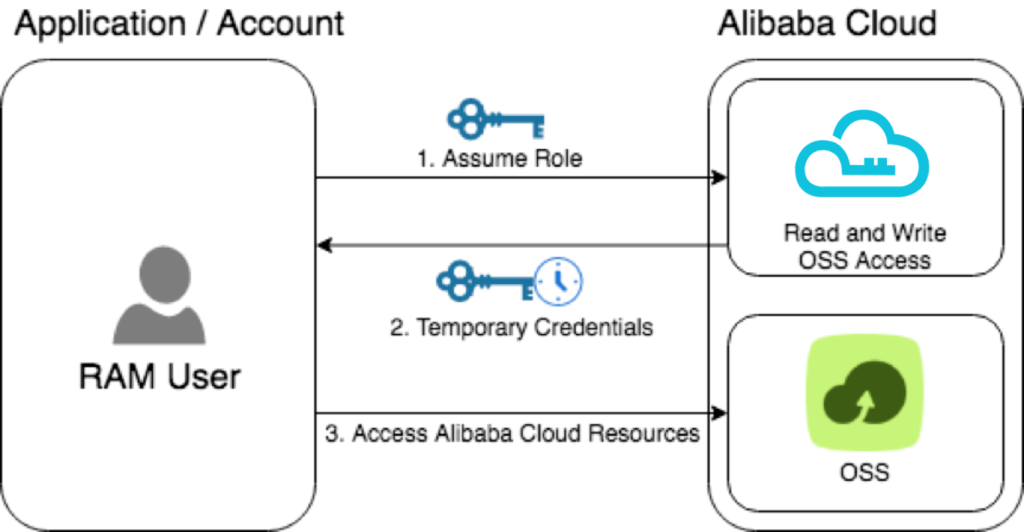
In this diagram, a RAM user wants to upload images to a separate folder in an OSS bucket.

The upload process is as follows:

  1. The user assumes a RAM role for Read and Write OSS Access for a specific folder in Alibaba Cloud by calling AssumeRole.
  2. STS returns a set of temporary security credentials.
  3. The user applies the temporary security credentials to access OSS. The user can then make a read or write call on the object.

We take OSS as an example here. However, STS can be used to grant temporary access to a wide range of Alibaba Cloud services. In this tutorial, we use fine-grained STS permission to limit access to a specific OSS bucket.

Implementation

Three files in the sample code are as follows:

  • sts.py
    • This is the code for assuming the role and to retrieve essential information such as accessKeyId, accessKeySecret, and securityToken.

The available functions are as follows:

  • Generate signatures to guarantee request authenticity
  • Get HTTPS requests

The example code for file “sts.py” is as follows:

The post Mobile Gaming: Build a Security Token Service with Object Storage Service appeared first on SitePoint.


by SitePoint Team via SitePoint

Google makes it Easier for Smaller Developers to Produce Instant Applications

Google's Play Store probably is the most distinguished of all other similar platforms based on the fact that it allows people to experience a game without having to download it. It is an amazing feature for both users and application developers, since it not only saves time and space for people,...

[ This is a content summary only. Visit our website https://ift.tt/1b4YgHQ for full links, other content, and more! ]

by Neha Zaidi via Digital Information World