When it comes to the world’s most valuable tech companies, you can’t help but wonder what it’s really like to score a job in them. In particular, a commonly asked question is linked to whether or not such firms are biased in their hiring.
A new study is investigating the role of prestigious universities in guaranteeing graduates' dream jobs. And it’s quite interesting to see the results, after taking into consideration all the data acquired through LinkedIn.
The study also provides readers with an insight into where some of today’s best tech firm employees studied, helping those individuals make career-related decisions today.
This analysis provided by Toner Giant took leading tech companies like Facebook, Microsoft, Google, and Amazon into consideration. Both universities hailing from the UK and the US were studied and here’s a quick glance at the findings observed by the researchers involved.
In terms of the United Kingdom, Cambridge University topped the list, when compared to any other institution in the country. And by that, we mean that graduates from this prestigious location were more likely than any other to get the best jobs in some of the biggest tech firms worldwide.
Current figures stood at a whopping 4220 graduates who could be found on LinkedIn with stellar work resumes and experiences.
On the other hand, in terms of prestigious US universities giving jobs at leading tech organizations, well, it was the University of Washington that topped the list. The study unveiled how nearly 16,400 employees from this university were able to find jobs at the biggest companies in the tech world.
As far as specific companies are concerned, well, LinkedIn showed how Amazon took the lead in terms of directing its hiring toward graduates having an educational background linked to a prestigious university called the Russell Group. This was true for both US and UK universities.
Other leading names to take on board Russel Group graduates in high numbers were IBM, Google, and Accenture. While Apple and Microsoft were also included in the list, their figures were considerably less.
Similar findings were seen in the same companies for alumni hailing from Ivy League Universities and that just goes to show how educational background makes a huge impact on your final hiring process.
When it came down to actual locations and respective universities in that area, the study found some interesting findings for both the US and the UK. They outlined the country-specific location where you’re likely to find the highest performing alumni who obviously get a shot to work at leading tech companies around the world.
In the US, graduates from states such as California went on to secure better tech firm jobs than any other in the country with a figure comprising 74,000. This was closely followed up by New York, Massachusetts, Illinois, and then Texas.
As far as the UK is concerned, a list was displayed in the research that proved where the best alumni hailed from in the country. And not to many people’s surprise, graduates from London managed to secure the best tech jobs globally with a figure comprising nearly 28,000.
This was followed up by South East London, Scotland, North West England, and then East England.
In the end, the research also provided some useful insights from job seeking platform Carrus.io to see what the actual hiring process at top tech firms is actually like.
Big Tech firms are very careful about their hiring process that’s well defined as they’re dealing with hundreds of thousands of applicants each week.
For instance, firms like Google follow their 4 attribute principle during the interview process. Meanwhile, companies like Amazon follow a specific 16-point principle while hiring, and then you have Netflix which bases its hiring on a fixed set of cultural values.
All in all, the study found that alma mater counts a lot but the priority today is much less than what it was a decade ago so that’s a plus point.
Read next: Climate Tech Funding At A Glance: What Role Does Big Tech Play In Sustaining A Greener Future?
by Dr. Hura Anwar via Digital Information World
"Mr Branding" is a blog based on RSS for everything related to website branding and website design, it collects its posts from many sites in order to facilitate the updating to the latest technology.
To suggest any source, please contact me: Taha.baba@consultant.com
Wednesday, July 27, 2022
Tuesday, July 26, 2022
AI-Based Art Is The New Trend, But The Internet Questions Whether Or Not It Is Harmful
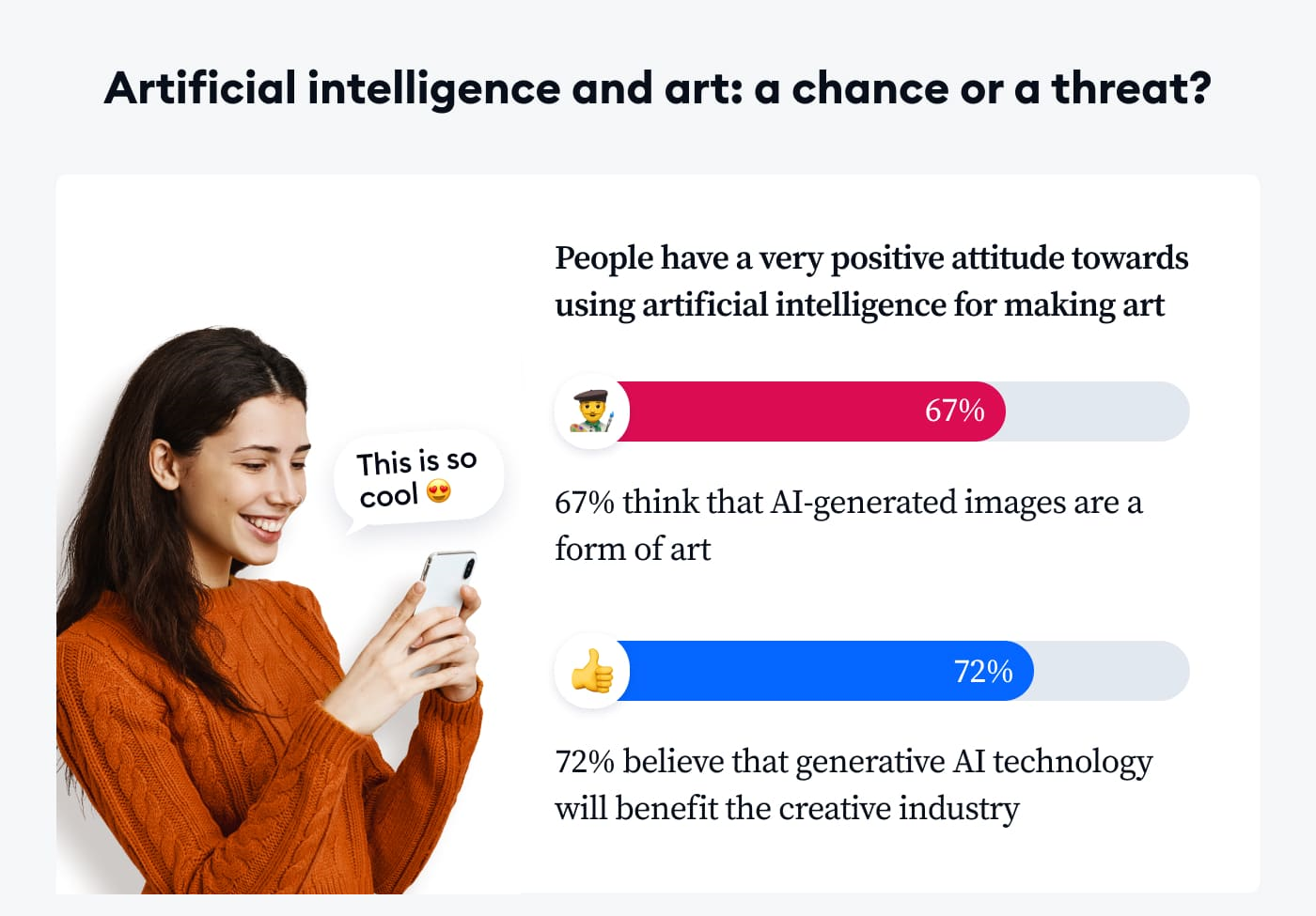
With AI-based art rising in popularity nowadays, the question is being raised: will AI overcome artists and endanger our artistic sensibilities?
To that, my response is: has anyone seen the AI-based art memes floating around on the internet? I genuinely don’t think putting artists out of jobs seems to be the internet’s main concern nowadays. Of course, then there’s the deep-fake argument: that AI-art can imitate people getting into incriminating scenarios. To that I respond by saying that such technology has been accessible for over half a decade now, how is AI art the reason people are scared now? Perhaps I come off as unnecessarily vehement in my defense of the new technology (which isn’t even new technology, it’s just more accessible and trendy nowadays).
The reason is that any new tech is immediately branded as being harmful and dangerous, much like how cavemen probably responded to discovering fire. The difference between us and cavemen, however, is that the former’s supposed to have enough intuition and know-how to separate mass online hysteria from the technology. Art-based AI might have issues, especially with NFT forgery becoming popular (who would have guessed?), but many of the problems people seem to be gunning for aren’t necessarily going to be them; at least not anytime soon.
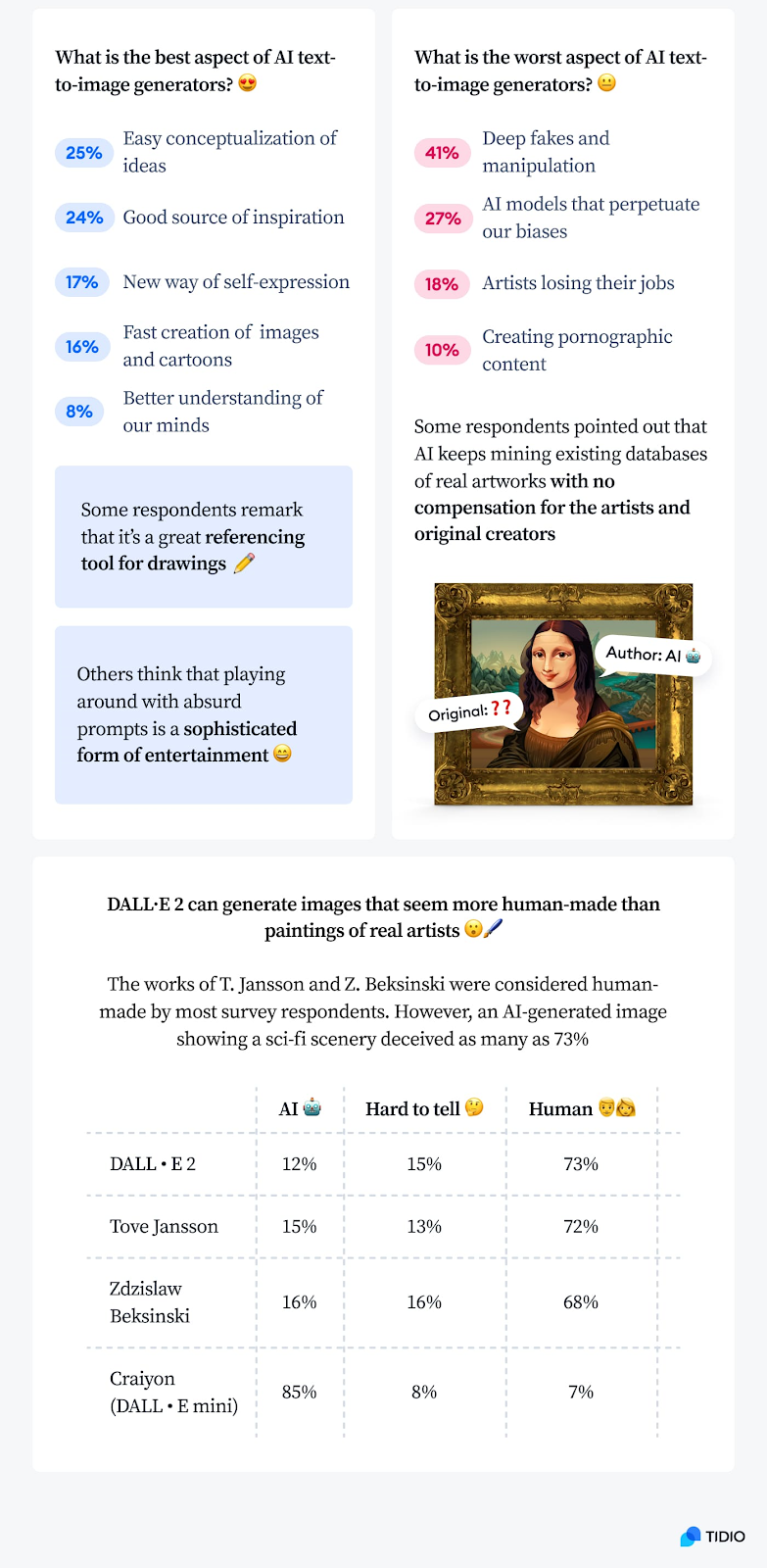
Let’s, in turn, take a look at what benefits AI art could provide to the general populace. First of all, it turns art-making into a more accessible hobby and allows individuals to express themselves more. A Tidio survey revealed that 25% of respondents saw easy conceptualization of ideas as a major plus point for the tech. 17% even labeled AI art as a good way of allowing self-expression within individuals. Naturally, people are rebutting the arguments by stating that by allowing AI art, actual artists are being undermined and the value of knowing how to draw or paint is being diminished. I have a few rebuttals of my own to such arguments: first off, similar arguments were presented when digital art was popularized, and I don’t see anyone complaining now; secondly, AI can only attempt to emulate, not perfectly encapsulate, a user’s input, which is something only a human mind can adapt to best; finally, AI art would still need to be printed out on canvas, giving real-life painters and artists a break since their work still has merit.
The DALL-E2 and Crayon AI models were used as a measuring stick for how well the Tidio respondents could distinguish between AI and human art. Results were relatively mixed, with the sample population more or less correctly identifying human artists, but having divisive results over AI art. Crayon was immediately found out as being non-human, with 85% of respondents identifying it as AI. DALL-E2, however, was identified by more participants as being human than the two actual human artists who were a part of the study. Of course, with such a limited pool of art, and a non-peer-reviewed study, more work needs to be conducted.
Read next: Climate Tech Funding At A Glance: What Role Does Big Tech Play In Sustaining A Greener Future?
by Arooj Ahmed via Digital Information World
To that, my response is: has anyone seen the AI-based art memes floating around on the internet? I genuinely don’t think putting artists out of jobs seems to be the internet’s main concern nowadays. Of course, then there’s the deep-fake argument: that AI-art can imitate people getting into incriminating scenarios. To that I respond by saying that such technology has been accessible for over half a decade now, how is AI art the reason people are scared now? Perhaps I come off as unnecessarily vehement in my defense of the new technology (which isn’t even new technology, it’s just more accessible and trendy nowadays).
The reason is that any new tech is immediately branded as being harmful and dangerous, much like how cavemen probably responded to discovering fire. The difference between us and cavemen, however, is that the former’s supposed to have enough intuition and know-how to separate mass online hysteria from the technology. Art-based AI might have issues, especially with NFT forgery becoming popular (who would have guessed?), but many of the problems people seem to be gunning for aren’t necessarily going to be them; at least not anytime soon.
Let’s, in turn, take a look at what benefits AI art could provide to the general populace. First of all, it turns art-making into a more accessible hobby and allows individuals to express themselves more. A Tidio survey revealed that 25% of respondents saw easy conceptualization of ideas as a major plus point for the tech. 17% even labeled AI art as a good way of allowing self-expression within individuals. Naturally, people are rebutting the arguments by stating that by allowing AI art, actual artists are being undermined and the value of knowing how to draw or paint is being diminished. I have a few rebuttals of my own to such arguments: first off, similar arguments were presented when digital art was popularized, and I don’t see anyone complaining now; secondly, AI can only attempt to emulate, not perfectly encapsulate, a user’s input, which is something only a human mind can adapt to best; finally, AI art would still need to be printed out on canvas, giving real-life painters and artists a break since their work still has merit.
The DALL-E2 and Crayon AI models were used as a measuring stick for how well the Tidio respondents could distinguish between AI and human art. Results were relatively mixed, with the sample population more or less correctly identifying human artists, but having divisive results over AI art. Crayon was immediately found out as being non-human, with 85% of respondents identifying it as AI. DALL-E2, however, was identified by more participants as being human than the two actual human artists who were a part of the study. Of course, with such a limited pool of art, and a non-peer-reviewed study, more work needs to be conducted.
Read next: Climate Tech Funding At A Glance: What Role Does Big Tech Play In Sustaining A Greener Future?
by Arooj Ahmed via Digital Information World
Big Tech Firms Unite To Reduce Harmful Online Content While Dodging Government Regulations
Some of the biggest names in the tech industry have opted to unite and put an end to harmful online content in New Zealand.
The move is being described as one where the firms joined hands on Monday and dodged an alternative to the usual government regulations in place as they feel not enough is being done.
The Big Tech companies include the likes of TikTok, Meta, Google, Amazon, and Twitter. They’ve all reportedly put their signatures on a single document, better known as a code of practice. This news was recently confirmed by a group that deals with internet safety called Netscafe.
Netscafe has further claimed that the code would be followed religiously as an initiative toward self-regulation for all these tech giants.
It’s interesting for many to see this step make its way because the country’s citizens have been facing numerous cyber-related crimes like bullying, harassment, and even abuse when they’re online. This is why the companies claim there’s no better time to tackle the matter than now, adding how user protection would be seen as a top priority.
It was also recently highlighted how NZTech, which is a leading organization that deals as a lobby group for the tech world in New Zealand, would now be handling the meetings of these firms whose main aim is to decrease harmful content spread on the web.
NZTech would now also be responsible for making reports on how such companies act to achieve such goals, with a clear-cut and transparent evaluation of the results involved.
The group’s chief was very keen on the challenges that lay ahead for the firm while talking about how the framework should evolve with time and simultaneously respect all forms of rights to expression for New Zealand citizens.
Meanwhile, we’re hearing some statements made by social media giants TikTok and Meta recently who both claim to be super enthusiastic regarding the whole endeavor. They also shared how honored they feel toward getting one step closer to better and safer online platforms.
But with the good news does come some bad as interest groups claim they need more details about what happens if such firms fail to stick to the policy outlined. There also needs to be some sort of mechanism available to address comments or complaints being made public, they add.
Another concern being highlighted is how such pacts are getting administered by some specific giants in the tech world and not the country’s government.
Therefore, they’ve not been shy to voice their thoughts on how such code practices are weak and designed to overthrow already set regulations in the country and those seen abroad.
This is why many are showing plenty of skepticism on how it’s more related to being a model that’s solely led by the industry and no one else.
We’re not quite sure which direction the move will end up going but one thing we’ve come to learn about is that New Zealand does care about its citizens and the threatening abuse they’re facing online.
Unfortunately, the steps taken by regulatory bodies aren’t successful at curbing the issue of online hate and that’s why we’re seeing such firms take matters into their own hand.
H/T: Reuters
Read next: Cybersecurity Firm Mutare Reveals That Nearly Half Of All Organizations Have Been Targeted By Voice-Acted Phishing Attacks
by Dr. Hura Anwar via Digital Information World
The move is being described as one where the firms joined hands on Monday and dodged an alternative to the usual government regulations in place as they feel not enough is being done.
The Big Tech companies include the likes of TikTok, Meta, Google, Amazon, and Twitter. They’ve all reportedly put their signatures on a single document, better known as a code of practice. This news was recently confirmed by a group that deals with internet safety called Netscafe.
Netscafe has further claimed that the code would be followed religiously as an initiative toward self-regulation for all these tech giants.
It’s interesting for many to see this step make its way because the country’s citizens have been facing numerous cyber-related crimes like bullying, harassment, and even abuse when they’re online. This is why the companies claim there’s no better time to tackle the matter than now, adding how user protection would be seen as a top priority.
It was also recently highlighted how NZTech, which is a leading organization that deals as a lobby group for the tech world in New Zealand, would now be handling the meetings of these firms whose main aim is to decrease harmful content spread on the web.
NZTech would now also be responsible for making reports on how such companies act to achieve such goals, with a clear-cut and transparent evaluation of the results involved.
The group’s chief was very keen on the challenges that lay ahead for the firm while talking about how the framework should evolve with time and simultaneously respect all forms of rights to expression for New Zealand citizens.
Meanwhile, we’re hearing some statements made by social media giants TikTok and Meta recently who both claim to be super enthusiastic regarding the whole endeavor. They also shared how honored they feel toward getting one step closer to better and safer online platforms.
But with the good news does come some bad as interest groups claim they need more details about what happens if such firms fail to stick to the policy outlined. There also needs to be some sort of mechanism available to address comments or complaints being made public, they add.
Another concern being highlighted is how such pacts are getting administered by some specific giants in the tech world and not the country’s government.
Therefore, they’ve not been shy to voice their thoughts on how such code practices are weak and designed to overthrow already set regulations in the country and those seen abroad.
This is why many are showing plenty of skepticism on how it’s more related to being a model that’s solely led by the industry and no one else.
We’re not quite sure which direction the move will end up going but one thing we’ve come to learn about is that New Zealand does care about its citizens and the threatening abuse they’re facing online.
Unfortunately, the steps taken by regulatory bodies aren’t successful at curbing the issue of online hate and that’s why we’re seeing such firms take matters into their own hand.
H/T: Reuters
Read next: Cybersecurity Firm Mutare Reveals That Nearly Half Of All Organizations Have Been Targeted By Voice-Acted Phishing Attacks
by Dr. Hura Anwar via Digital Information World
Google Chrome is testing a new feature that allows users to create notes on the websites they visit frequently on its browser
Ever wanted to write down key points about a website? For instance, you want to put a record of login information, tracking ID, security numbers, etc. Or it can be anything that you want to recall when you see that website again. Well, Google seems to be addressing this problem soon. A Reddit user noted that Google Chrome is trying hard on the ability to create notes while saving a webpage on Chrome.
The popular opinion is that when a website seems important to users, they use bookmarks. Bookmarks often help to remember why you wanted to visit a web page again after some time. But, when bookmarks aren’t enough, people prefer using third-party apps. For example, Beanote, Pocket, or Note Anywhere. All of these apps enable you to highlight important points and make notes about a webpage. In addition, these apps also allow multi-device sync, wherever you’re all of your devices will be automatically synchronized to your account.
Google developers find this interesting to incorporate notes in Chrome so that people won’t have to use other extensions. Four months before, Chromium Gerrit had incomplete information about how the update will work but Redditor Leopeva64-2 predicts that Google is still trying out the notes feature to soon be available on Chrome. However, it is yet unavailable on Chrome Canary so nobody knows exactly how it’s going to be. The expectations are similar to what Edge offers its user to add a note in the PDFs by selecting text in the PDF reader, right-clicking on it, and adding a comment to write a key point.
At this moment, Redditor shared an undeveloped preview of the developer version, Chrome Canary. You’ll be able to select the content visible on your screen, then right-click and choose the Create a note label. It would be pretty much similar to Microsoft Edge’s execution as mentioned earlier. So, once you’re done with creating a note, the specific text would be shown up in purple. Likewise, you can add notes to the images as well. Furthermore, the side panel on Chrome will display all your saved notes and the lateral panel would intuitively emerge when a person visits a web page where the notes were created.
The current preview shows that with every note there’s also a hamburger menu side by side which allows you to delete or rewrite a note. It is essential to mention here that, selecting a text to add a note is not a must. You can create a note without selecting text. You only need to right-click on the web page at any place and add a note according to your desire. By adding notes you don’t have to put pressure on your mind about why you saved a certain web address.
On the end note, this update would be really helpful for website developers to save observations on the pages they create and the browsers will automatically sync notes across all devices. By doing so, you can live in the cloud letting you be free from devices. It’s secure and saved in your Chrome browser and drive.
Currently, the feature is still in the testing phase and we don’t know whether it’ll be available to the public or not. We suggest that if the feature takes some editing tools from Google Docs, one can effortlessly share notes with a team as well.
Read next: What Country’s Citizens Use Neighbor’s WiFi the Most? The Answer Might Surprise You
by Arooj Ahmed via Digital Information World
The popular opinion is that when a website seems important to users, they use bookmarks. Bookmarks often help to remember why you wanted to visit a web page again after some time. But, when bookmarks aren’t enough, people prefer using third-party apps. For example, Beanote, Pocket, or Note Anywhere. All of these apps enable you to highlight important points and make notes about a webpage. In addition, these apps also allow multi-device sync, wherever you’re all of your devices will be automatically synchronized to your account.
Google developers find this interesting to incorporate notes in Chrome so that people won’t have to use other extensions. Four months before, Chromium Gerrit had incomplete information about how the update will work but Redditor Leopeva64-2 predicts that Google is still trying out the notes feature to soon be available on Chrome. However, it is yet unavailable on Chrome Canary so nobody knows exactly how it’s going to be. The expectations are similar to what Edge offers its user to add a note in the PDFs by selecting text in the PDF reader, right-clicking on it, and adding a comment to write a key point.
At this moment, Redditor shared an undeveloped preview of the developer version, Chrome Canary. You’ll be able to select the content visible on your screen, then right-click and choose the Create a note label. It would be pretty much similar to Microsoft Edge’s execution as mentioned earlier. So, once you’re done with creating a note, the specific text would be shown up in purple. Likewise, you can add notes to the images as well. Furthermore, the side panel on Chrome will display all your saved notes and the lateral panel would intuitively emerge when a person visits a web page where the notes were created.
The current preview shows that with every note there’s also a hamburger menu side by side which allows you to delete or rewrite a note. It is essential to mention here that, selecting a text to add a note is not a must. You can create a note without selecting text. You only need to right-click on the web page at any place and add a note according to your desire. By adding notes you don’t have to put pressure on your mind about why you saved a certain web address.
On the end note, this update would be really helpful for website developers to save observations on the pages they create and the browsers will automatically sync notes across all devices. By doing so, you can live in the cloud letting you be free from devices. It’s secure and saved in your Chrome browser and drive.
Currently, the feature is still in the testing phase and we don’t know whether it’ll be available to the public or not. We suggest that if the feature takes some editing tools from Google Docs, one can effortlessly share notes with a team as well.
Read next: What Country’s Citizens Use Neighbor’s WiFi the Most? The Answer Might Surprise You
by Arooj Ahmed via Digital Information World
Cybersecurity Firm Mutare Reveals That Nearly Half Of All Organizations Have Been Targeted By Voice-Acted Phishing Attacks
Research by Mutare revealed that approximately 47% of all organizations were at the receiving end of voice-oriented phishing attacks.
Phishing attacks are ridiculously commonplace nowadays, being one of the most encountered forms of cyber-crime. You as an internet user have more likely than not encountered an attempt if you haven’t simply fallen prey to an attack. Phishing attacks are some of the most commonly executed forms of online crime because of multiple reasons: they’re relatively easy to execute; require few resources, and the culprits are very difficult to identify and track down. Sure, with keen enough insight it’s rather difficult to get stuck in a phishing attack, but for every ten thousand or so individuals that are targeted, a few are bound to slip through the cracks.
Phishing is an ever-evolving form of crime as well, with newer technologies and methods of communication leading to more nuanced schemes. However, with this particular article, we’re going to go back instead of forward, to a form of phishing that’s been around for perhaps longer than the internet. That’s right, we’re talking about voice-oriented phishing (or what can more easily be referred to as scam calls).
The goal of a phishing attack is simple: trick an individual into revealing personal and sensitive information that can then be used to exploit them. Examples include setting up fake websites to trick users into revealing commonly used passwords, or information such as credit card details or social security numbers. Email phishing usually just involves someone pretending to be your bank attempting to attain private information. Phone calls usually take the form of the latter as opposed to the former; it’s so much easier to pretend to be a bank or similar service over the phone than it is online, with those pesky Verified tags and whatnot. Many cybercriminals have a penchant for the voice call scam as well since Mutare reports that 47% of all organizations are targeted by such individuals or groups.
Mutare is itself a cybersecurity firm of sorts; it specifically specializes in filtering voice spam using its own developed voice traffic filter (VTF). The VTF will filter out repetitive or spam voicemails and actively put distance between you as a user and the numbers that conduct such behavior. Naturally, Mutare would want to publish its findings on just how prevalent voice-acted cybercrime is. At any rate, not only are there a lot of attempts being carried out against organizations, it seems that employees aren’t well equipped enough to handle such coordinated behavior as well. 43% of the survey’s respondents quoted employees as being a major weak link for organizational cybersecurity.
36% of the sample population also ultimately agreed that further sessions on cybersecurity best practices would be the most effective decision moving forwards.
Read next: 90% of Americans Faced Scam and Phishing Attempts According to This Survey
by Arooj Ahmed via Digital Information World
Phishing attacks are ridiculously commonplace nowadays, being one of the most encountered forms of cyber-crime. You as an internet user have more likely than not encountered an attempt if you haven’t simply fallen prey to an attack. Phishing attacks are some of the most commonly executed forms of online crime because of multiple reasons: they’re relatively easy to execute; require few resources, and the culprits are very difficult to identify and track down. Sure, with keen enough insight it’s rather difficult to get stuck in a phishing attack, but for every ten thousand or so individuals that are targeted, a few are bound to slip through the cracks.
Phishing is an ever-evolving form of crime as well, with newer technologies and methods of communication leading to more nuanced schemes. However, with this particular article, we’re going to go back instead of forward, to a form of phishing that’s been around for perhaps longer than the internet. That’s right, we’re talking about voice-oriented phishing (or what can more easily be referred to as scam calls).
The goal of a phishing attack is simple: trick an individual into revealing personal and sensitive information that can then be used to exploit them. Examples include setting up fake websites to trick users into revealing commonly used passwords, or information such as credit card details or social security numbers. Email phishing usually just involves someone pretending to be your bank attempting to attain private information. Phone calls usually take the form of the latter as opposed to the former; it’s so much easier to pretend to be a bank or similar service over the phone than it is online, with those pesky Verified tags and whatnot. Many cybercriminals have a penchant for the voice call scam as well since Mutare reports that 47% of all organizations are targeted by such individuals or groups.
Mutare is itself a cybersecurity firm of sorts; it specifically specializes in filtering voice spam using its own developed voice traffic filter (VTF). The VTF will filter out repetitive or spam voicemails and actively put distance between you as a user and the numbers that conduct such behavior. Naturally, Mutare would want to publish its findings on just how prevalent voice-acted cybercrime is. At any rate, not only are there a lot of attempts being carried out against organizations, it seems that employees aren’t well equipped enough to handle such coordinated behavior as well. 43% of the survey’s respondents quoted employees as being a major weak link for organizational cybersecurity.
36% of the sample population also ultimately agreed that further sessions on cybersecurity best practices would be the most effective decision moving forwards.
Read next: 90% of Americans Faced Scam and Phishing Attempts According to This Survey
by Arooj Ahmed via Digital Information World
Monday, July 25, 2022
Women in Crypto: Why It’s Important To Get More Involved
Men have saturated the crypto consumer base with twice as many men as women investing in cryptocurrency. This is a great time for new investors, especially women, to enter the market because new regulations have slowed its growth and decreased the value of some cryptocurrencies.
Here are three reasons why women should consider getting involved in crypto.
Ziprecruiter recently announced that the United States' national average salary for cryptocurrency traders is $94,427 annually. Women should not expect to be making this amount right away, but it is an attainable goal to work towards.
Additionally, women can create financial autonomy. Women typically make less than men, so it can be more difficult to build up the funds needed for opening a brokerage account for the stock market. But purchasing crypto requires fewer funds, so it is more attainable. In fact, investments can start with as little as $10.
Opportunities include but are not limited to blockchain accounting, marketing, software engineering, web development, journalism, and more. Careers in this field are plentiful and in demand as the technology is still in its infancy. The field may currently be male-dominated, but women must act now to take advantage of the existing prospects and equalize the number of men and women involved.
Nina Nichols - President and Founder of Global Women In BlockChain
People are vulnerable when they are unfamiliar with key terms and general operations. This is what makes newcomers more susceptible to malicious attacks like scams or retrieving information from non-reputable sources. Becoming the victim of these attacks can be off-putting and drive women away from crypto trading. Luckily, there are many ways to check a person’s or business’ reputation online.
Another gap in knowledge has to do with getting started and how the technology is used. There are several resources for this information, and they should cover what blockchain is, how to invest or exchange currencies, and common terms. Coinmetro is one resource that covers current events and provides educational materials.
In addition, the industry is experiencing a rapid influx of regulations and rules. On the one hand, it may be easier for newcomers as they can learn as they go rather than having to adjust to new rules. On the other hand, these regulations are rapidly evolving and will need to be monitored with care to ensure compliance.
Also, since many women are new to the field, they may be more interested in learning how to grow their careers. However, the topics covered may cater to those who have been in the industry for a while.
by Web Desk via Digital Information World
Why should women be involved in cryptocurrency?
Although there are fewer women than men involved in cryptocurrency, there are many female success stories. Some have been able to start their own company, others have found a career, and others have built wealth, all thanks to blockchain technology.Here are three reasons why women should consider getting involved in crypto.
It’s a way to build wealth
Perhaps you have heard about the hundreds, thousands, and sometimes millions of dollars people and businesses have made buying and selling crypto or working in the industry.Ziprecruiter recently announced that the United States' national average salary for cryptocurrency traders is $94,427 annually. Women should not expect to be making this amount right away, but it is an attainable goal to work towards.
Additionally, women can create financial autonomy. Women typically make less than men, so it can be more difficult to build up the funds needed for opening a brokerage account for the stock market. But purchasing crypto requires fewer funds, so it is more attainable. In fact, investments can start with as little as $10.
Good for career growth
Women can use cryptocurrency to build a career as well as wealth since investing is not the only way you can be involved in the industry. There are many jobs and careers that have emerged in the field.Opportunities include but are not limited to blockchain accounting, marketing, software engineering, web development, journalism, and more. Careers in this field are plentiful and in demand as the technology is still in its infancy. The field may currently be male-dominated, but women must act now to take advantage of the existing prospects and equalize the number of men and women involved.
Allows you to have an influence
Getting into the industry will give women the chance to have their voices heard and their ideas implemented. This provides a way for women to influence the field and how it will evolve. Furthermore, their advancement into the space will show others that it is possible to enter the industry.Women currently in crypto & how they are involved
There are many influential women involved in cryptocurrency. Some prominent names include:Nina Nichols - President and Founder of Global Women In BlockChain
- Their leadership staff is a full female team
- The organization aims to empower women to lead in blockchain technologies worldwide
- The center provides mentorship, education, and training regarding blockchain technologies
- Develops sustainable infrastructure for Ethereum
- Focuses on building communities in Asia
- Software development for mobile blockchain technologies
Barriers to entry
There are various obstacles women must overcome to enter the crypto world, and these barriers often act as deterrents to entry. Understanding what these barriers are is the first step in overcoming them.The knowledge gap
There is an overwhelming amount of information to learn when it comes to blockchain technology. Those looking to gain access must be familiar with terms, concepts, current events, general operations, and laws/regulations. Women new to the concept must familiarize themselves with the field’s vocabulary.People are vulnerable when they are unfamiliar with key terms and general operations. This is what makes newcomers more susceptible to malicious attacks like scams or retrieving information from non-reputable sources. Becoming the victim of these attacks can be off-putting and drive women away from crypto trading. Luckily, there are many ways to check a person’s or business’ reputation online.
Another gap in knowledge has to do with getting started and how the technology is used. There are several resources for this information, and they should cover what blockchain is, how to invest or exchange currencies, and common terms. Coinmetro is one resource that covers current events and provides educational materials.
In addition, the industry is experiencing a rapid influx of regulations and rules. On the one hand, it may be easier for newcomers as they can learn as they go rather than having to adjust to new rules. On the other hand, these regulations are rapidly evolving and will need to be monitored with care to ensure compliance.
It’s a male-dominated world
Women may be sparse at networking, training, and blockchain events. This ratio may intimidate many women from attending events that could be pivotal to their careers.Also, since many women are new to the field, they may be more interested in learning how to grow their careers. However, the topics covered may cater to those who have been in the industry for a while.
Gatekeepers
Niches and communities tend to have gatekeepers. These community members attempt to keep outsiders who may disrupt or corrupt their community out. The intentions of gatekeepers may be to protect the integrity of the space, but their actions can alienate and drive away newcomers. To be accepted, anyone looking to enter a new space should show genuine interest, care, and patience.Conclusion
Despite the current male dominance within the field of cryptocurrency, there are several ways for women and minorities to enter the space and begin to reap the rewards of the growing sector. Individually, women will be able to gain financial stability, grow their wealth, and start or develop their careers. Moreover, it will diversify the field, reduce barriers to entry, and showcase the capabilities of women. Most of all, those who get involved now will pave the path to the future of cryptocurrency.by Web Desk via Digital Information World
Metaverse and MMO Are Similar To Each Other But How Is Metaverse Going To Update the Existing Landscape
Metaverse is becoming a center of many technology-related things. But we all know online gaming has been using the same landscape as Metaverse since the 2000s and especially with MMO gaming, the users can see how similar they seem to each other.
MMO Gaming is becoming an important part of the online gaming world. Massive Player Online (MMO) games enable the users to interact with players within the game through audio and text. MMOs are getting so popular that companies are getting the help of different successful and famous authors to write the storyline of games so more people can get attracted to the game. The most popular MMO game is Call of Duty and different other games are also in this run.
The difference between MMOs and Metaverse gaming is that the former has a storyline and the latter doesn't have one. MMOs are more interactive and progress through a certain story but this isn't the case with metaverse gaming. When a user starts playing the game, the metaverse starts progressing according to it without any direction of a story. The most important component in Metaverse gaming is VR headsets. VR headsets are the core way of communicating and interacting while playing the game. Meta has developed its own Quest VR Headset series so everyone using different devices can use it. In Q4, it was reported that these specific headsets had a sell-out of 90% globally. Now Sony and Microsoft are also going to release their VR Headsets.
Rumors are that Meta is going to release its new PlayStation headset VR2 by the end of 2022 but with the ongoing issues with the OEM, it is not looking possible. So the chances are that this headset will be released in 2023. Sony has also come forward to say that 20 new games are getting ready to be released with the new VR headsets. But as the Meta products are already on the market, Sony's are not going to be as successful as the company is hoping. Sony is still going to get potential customers as the ones who already have a PlayStation will want the games and the ones who are interested in the titles will also be buyers because they cannot get names with Metaverse gaming. It is predicted that Meta's VR will make up to 40M by the end of 2025.
H/T: CPR
Read next: Baby Boomers Increasingly Prefer Wearable Tech Over Smartphones and Tablets
by Arooj Ahmed via Digital Information World
MMO Gaming is becoming an important part of the online gaming world. Massive Player Online (MMO) games enable the users to interact with players within the game through audio and text. MMOs are getting so popular that companies are getting the help of different successful and famous authors to write the storyline of games so more people can get attracted to the game. The most popular MMO game is Call of Duty and different other games are also in this run.
The difference between MMOs and Metaverse gaming is that the former has a storyline and the latter doesn't have one. MMOs are more interactive and progress through a certain story but this isn't the case with metaverse gaming. When a user starts playing the game, the metaverse starts progressing according to it without any direction of a story. The most important component in Metaverse gaming is VR headsets. VR headsets are the core way of communicating and interacting while playing the game. Meta has developed its own Quest VR Headset series so everyone using different devices can use it. In Q4, it was reported that these specific headsets had a sell-out of 90% globally. Now Sony and Microsoft are also going to release their VR Headsets.
Rumors are that Meta is going to release its new PlayStation headset VR2 by the end of 2022 but with the ongoing issues with the OEM, it is not looking possible. So the chances are that this headset will be released in 2023. Sony has also come forward to say that 20 new games are getting ready to be released with the new VR headsets. But as the Meta products are already on the market, Sony's are not going to be as successful as the company is hoping. Sony is still going to get potential customers as the ones who already have a PlayStation will want the games and the ones who are interested in the titles will also be buyers because they cannot get names with Metaverse gaming. It is predicted that Meta's VR will make up to 40M by the end of 2025.
H/T: CPR
Read next: Baby Boomers Increasingly Prefer Wearable Tech Over Smartphones and Tablets
by Arooj Ahmed via Digital Information World
Subscribe to:
Comments (Atom)