Wednesday, January 25, 2023

WhatsApp is rolling out new features for iOS and macOS users

Meta’s instant messaging platform, WhatsApp, has been spotted working on some new features that will be introduced in future updates. The first update focuses on providing three ways through which any contact can be blocked instantly. Whereas the second feature is for macOS users.

Starting with the new shortcut features. WhatsApp is aiming to provide a safe environment for users. For this reason, the app is ensuring that users don’t receive unwanted messages from others or messages from unknown numbers. To help its community deal with such conditions, the developers from Whatsapp have added two additional ways through which anyone can be restrained.

While everyone is already familiar with the block option that can be accessed through chat preview, this feature is only available for a one-on-one chat and can’t be used within a group. The second way is through the options that are accessed through chat options. From here, the users don’t have to go all the way down in the chat preview. And the third way to do this is through the red option that becomes visible whenever someone who is not in contact messages that person.

Whenever these options are selected, the application will ask the user if they also want to report any messages they’ve received from that number that led to them being blocked. If the reported texts are found to be against the community guidelines, then that account will be banned.


As per WBI, the beta version has already been released for several iOS users and can be used by downloading it from the TestFlight application.

Moving on to macOS users, a few months back, WhatsApp announced that the company was working on a new application for Mac, an application created with catalyst.

The main idea behind this was to offer all the options iOS users have access to. Initially, the app could only be downloaded from the TestFlight app, but now the company has made it accessible from its site, reports WBI. As a result, the beta version can be used by a large audience. Once it has been downloaded, the app can be connected by scanning the code from the mobile phone application.


However, what needs to be kept in mind is that the app is still in its beta phase, which means that some features won’t be accessible and that it will take some time before access to those features is granted. The users will also receive a note asking for suggestions and their experience with the application.

Read next: Bad News For iPhone 14 Pro Max As It Loses Its Download Speed Crown To Two Android Devices
by Arooj Ahmed via Digital Information World

Instagram Might Not Be Making Teenagers Unhappy According to This Study

A lot of people tend to assume that social media platforms like Instagram are doing a real number on the mental health of teenagers. In spite of the fact that this is the case, a study that was conducted by the University of Amsterdam seems to suggest otherwise.

Researchers working at the School of Communications Research at the University of Amsterdam recently conducted a study that analyzed over 210,000 Instagram DMs that were sourced from approximately 100 teenagers. These teenagers were in the 8th or 9th grade, so they can serve as good representations of what adolescents are experiencing on the image sharing platform.

With all of that having been said and now out of the way, it is important to note that teenagers sent four times as many happy DMs as sad ones. What’s more, when the teenagers filled out biweekly surveys about their emotional state, this revealed that there was no strong connection between the emotions expressed in DMs and what they were experiencing in the real world.

This seems to suggest that Instagram can actually be a positive influence on teenage mental health. However, the timing of this study might make the results less reliable than might have been the case otherwise.
For one thing, this study was conducted mostly throughout the heyday of the pandemic. That could skew results, since teenagers were forced to stay home during lockdown and Instagram along with other social media platforms were the only outlets they had which allowed them to stay in touch with friends.

Using Instagram in that period must have had a good impact because of the fact that this is the sort of thing that could potentially end up helping them socialize. The study still reveals some important details, since many assumed that Instagram would be a bad influence even during lockdowns, and it should be taken into consideration moving forward.

Everything has some kind of nuance, and the same goes for social media. Chances are that it is neither entirely good nor bad, but can rather be helpful if used the right way.


Read next: Users Are Spending Less Time On Snapchat As App Faces Tough Competition From Reels And YouTube Shorts
by Zia Muhammad via Digital Information World

Tuesday, January 24, 2023

AI Might Be Even More Biased Than People

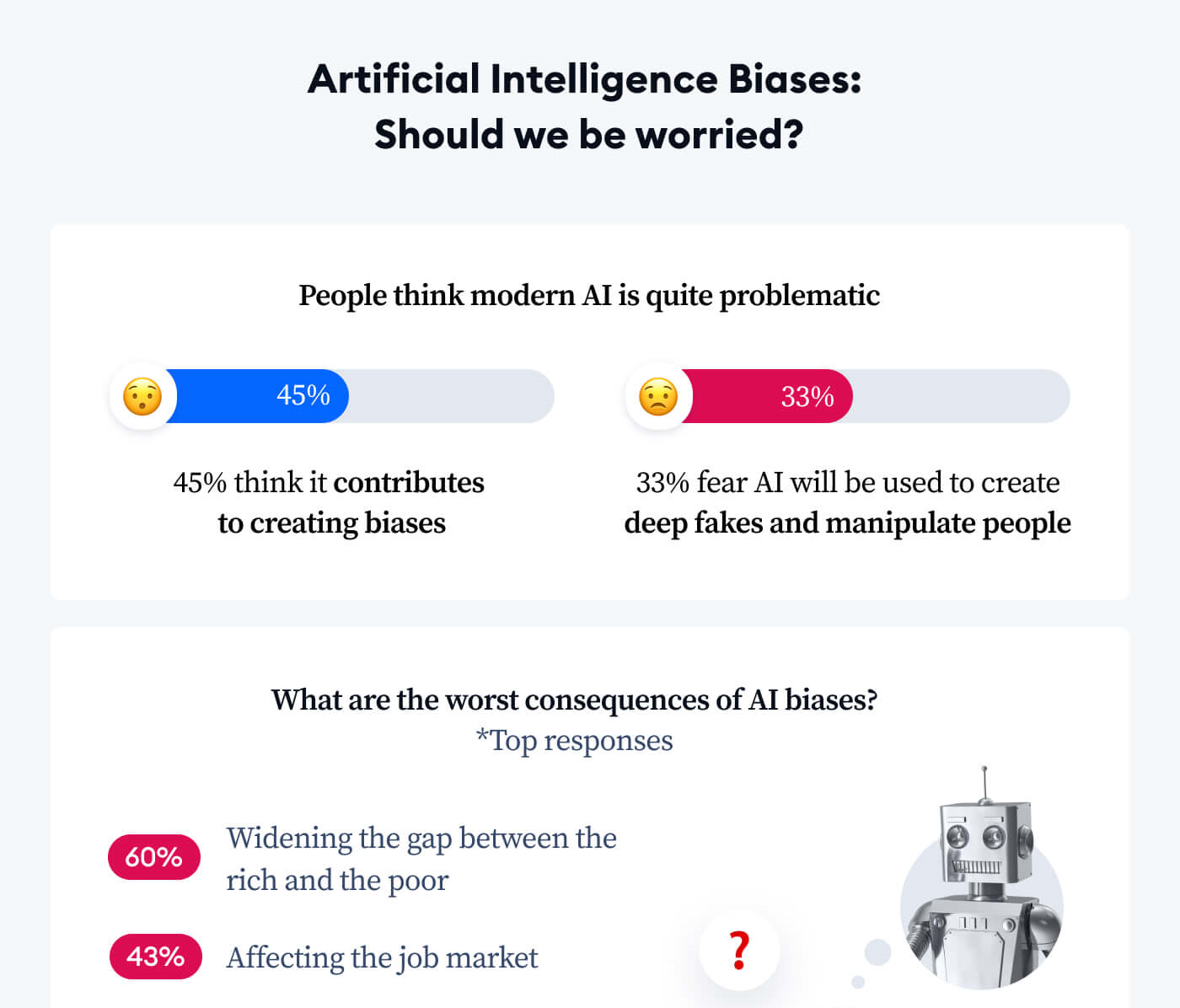
Many seem to be under the impression that AI can help us make better decisions. After all, what can be more objective than a machine? Well, studies have shown that AI can be prone to bias, just like human beings. Humans are the ones entering the data to feed its machine learning algorithm in the first place, so it stands to reason that it will start learning a lot of the biases that we are operating under.

A survey conducted by Tidio revealed that 98% of people think that AI is biased. 45% of the people who responded to this survey stated that this is actually the biggest issue with AI, and 40% went on to say that it is the developers who are responsible for these biases with all things having been considered and taken into account.

With all of that having been said and now out of the way, it is important to note that the data sets that are being used to train the AI deserve some of the blame. They contain all of our biases, and they were certainly going to show up when AI started using them.

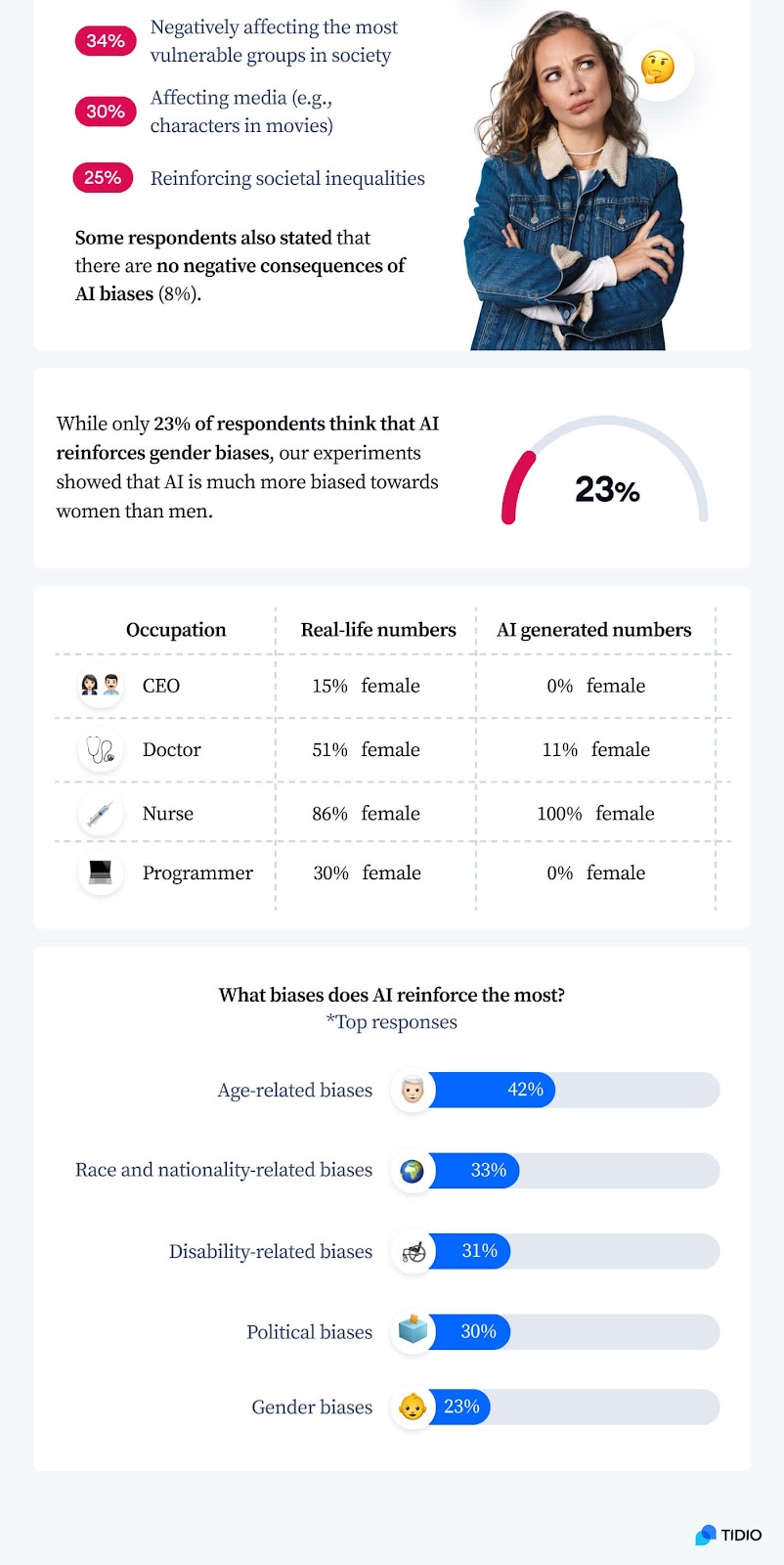
In spite of the fact that this is the case, the more recent iterations of AI that were developed by Open AI are showing some promise. When prompted to show an ambitious CEO, for example, the AI ended up depicting a black man as well as a woman wearing professional clothing. This is very likely due to a conscious effort from Open AI to reduce biases in DALL-E.

However, Stable Diffusion clearly needs to do a lot of work, since it only depicted middle aged white men when given this prompt. When asked to depict a nurse, it only showed women. This is a clear sign of bias, and it suggests that the people behind Stable Diffusion are not putting enough effort to address this.

Changes need to be made if AI is meant to go to the next level. Otherwise it will just be an advanced representation of the same old biases we’ve been living with for thousands of years.
Read next: Users Are Spending Less Time On Snapchat As App Faces Tough Competition From Reels And YouTube Shorts
by Zia Muhammad via Digital Information World

Google Will Soon Display An AI-Version Of Its Search Engine After Declaring ChatGPT As ‘Code Red’

The threat of AI-powered technology cannot be denied and after the mega hype and success linked to ChatGPT, Google is going public with its own plans to overcome the ordeal.

The leading tech giant says it will soon display an AI-powered version of its search engine after the company’s CEO labeled ChatGPT as code red. This particular report comes to us thanks to The New York Times, which detailed what the firm’s next plans would be.

It’s clear focus renewal on the subject of AI by Google and one that many felt was a long time coming. Therefore, the company is not planning on taking a step back and hopes to get active on this front after the threat of ChatGPT takes center stage.

While no major comments have been made by Google to queries set out by tech outlets, one thing is for sure. A spokesperson from the firm says there is a newfound focus on AI technology to make sure it’s functioning in a safe and helpful manner for all of Google’s users.

Therefore, they do hope to share some positive results soon. Experts have raised a lot of questions on ChatGPT and what the future for search engines holds in this manner.

We’re seeing software giant Microsoft announce today how it has strengthened its partnership with the makers of ChatGPT, Open AI, as a means to launch a new search feature via Bing that uses the same technology behind the ChatGPT tool. And we’re expecting that rollout to occur as soon as March of this year.

This way, it hopes to provide proper answers to users’ searches instead of the usual display of links pertaining to the queries asked. But if you think this tool has the capability of replacing search engines, well, that’s not quite what experts from Google and those linked to AI and search sectors feel.

There is plenty of inaccuracies related to the likes of ChatGPT and the type of responses it’s giving out. So there are no signs of it replacing Google Search completely yet.

But how exactly did ChatGPT attain the status of Code Red by Google?

As per the New York Times, the mega success behind ChatGPT is one that had a lot of people scratching their heads. People saw it as another means through which searches could be conducted online. This is bound to be a massive threat to the likes of Google and more and that’s why it was bound to pull out the fire alarm.

It’s a moment that members working at the Silicon Valley firm dreaded since day one- the arrival of a huge tech change that could really bring the business to a standstill. There were meetings after meetings held between the likes of top executives and the CEO on what to do next and what plan of action needed to be prepared to combat such changes in the industry.

The tech giant will soon be launching its own AI-powered search engine with a chatbot feature, alongside 20 more products. Remember, Google knows about the huge power of AI technology. It’s not something new for the company. After all, it has ownership of an AI-based lab of its own called Deep Mind which was bought nearly a decade ago.

At the same time, Google has a series of other plans involving the likes of using AI technology for launching image creator programs and those linked to app development. So as you can see, plenty of work is being done to even come near to a situation where it’s wiped out by the likes of ChatGPT and others.


Read next: Google Search Will Allow AI-Generated Articles On Its Platform Without Any Penalization
by Dr. Hura Anwar via Digital Information World

Two-Thirds Of Consumers Will Abandon Apps Or Sites Offering Poor Performance As Per This Study

There is no doubt about the fact that eCommerce is flourishing in today’s modern tech world. People can now shop online with ease and make transactions with the click of a button. It’s as simple as that, not to mention safe, reliable, and quick too.

But a new study has gone on to show that if and when an app or mobile site fails to perform, consumers will surely not return.

Around 55% of respondents mentioned how a good customer experience goes a long way in their books. And if they do end up with problems, you just might not be seeing them make a return to that certain app again.

This is clear proof that hassle-free digital experiences are the call of the day. The news comes to us thanks to intelligence data from Fullstory. It says clients are all set to go that extra mile to reward people who deliver a great experience by making sure they return and order more. As the old saying goes, a happy shopper is a permanent shopper.

In the same way, the study has gone on to prove how customers really do care about the entire in-app experience more than the actual brand name itself.

The survey entailed a staggering 7,000 shoppers whose findings were quite interesting. 44% mentioned they’re not a fan of the location of shopping, provided it works. Meanwhile, a good 42% of marketers spoke about keeping customer loyalty as the secret to success but that might be declining this year as per stats linked to user spending habits.

It has been declared to be super important that a brand’s experience through its app is perfect if it wants to build a great reputation and see success. It’s all about functionality.

In case you’re wondering which part really frustrates shoppers the most, well, the answer has to do with slow-paced times for loading applications as well as websites when they’re making online purchases.

Around 63% are likely to get frustrated with ease due to errors observed while loading. Other issues that cause users to abandon their carts include dead links, poorly designed forms that don’t function when inputs are added, and also glitches made across pages.

As a whole, the top frustrations seen among various app and mobile shoppers have to do with transactions that take a really long time. Nobody has time to waste on such behavior and 76% of respondents say that most online experiences have left them beyond disappointed and feeling awfully stressed.

Without a doubt, some apps faired much better than others. For instance, those linked to the world of retail had 50% of individuals calling their experience smooth and simple as compared to the likes of travel applications. In the same way, other app categories that didn’t perform too well with users included the likes of healthcare and grocery shopping and that’s why the owners really need to rethink their strategy if they wish to survive in today’s competitive market.

So, how can the overall experience of users be improved? Well, around 65% of users were likely to abandon their whole transactions as they felt frustrated. Then we had a good 55% of respondents mention that they’re not going to be coming back with the general digital experience was not good. This calls for a quick need for change.

To win back clients, glitch-free digital experiences are key. Remember, it does not take long for any customer to switch to another brand as tolerance in such circumstances seems to be at an all-time low.


Read next: New Study Says Email And SMS Witnessed Slow But Steady Growth In 2022
by Dr. Hura Anwar via Digital Information World

Bad News For iPhone 14 Pro Max As It Loses Its Download Speed Crown To Two Android Devices

The latest report on mobile performances is out thanks to Ookla and there is some bad news for the iPhone 14 Pro Max.

While the device from Apple may have been crowned as having the best download speed in the past, it’s now losing out to not only one but two devices.

The news comes to us thanks to Ookla who recently compared the leading mobile phone carriers in the US in terms of downloads and uploads as well as consistency and availability among other things.

The device earned the top ranking in Q3 with a staggering score of 147 Mbps while a 17 Mbps upload speed had just been recorded. Now, the tables are turning as those that were once beaten out are reigning supreme as per this study.

So who took the crown this year if it was not Apple? Well, no guesses here because it was indeed the new Galaxy Z Fold4 phone from Samsung to win the leading spot as it had 147 Mbps. In second place, it was the Pixel 7 Pro from Google ranked second with 137 Mbps.

This iPhone device ranked third and scored 133 while the iPhone 14 Pro stood at just 130 Mbps. Meanwhile, while the latency and upload speeds were all so similar, it was the Pixel 7 Pro that led the race at a staggering 15 Mbps for uploads and another 50 ms for latency.

Other interesting facts to note had to do with Samsung devices getting the fastest median download speed figures when compared to all Apple devices by a good 7 Mbps.

The study also shed light on how one of the most interesting things about the iPhone 14 Pro Max losing out is that the top download speeds seen on the Galaxy Z Fold4 won the race with the same performances that were witnessed with the 14 Pro Max observed during Q3.

What could the reason be as we’ve seen the iPhone series perform at a speed that was greater than both of these devices from Android? One link could be due to the iPhone 14 Pro Max devices getting into the hands of clients that lived in places having poor or slow mobile coverage.

Whatever the reason may be, the stats are out. And the top carriers having the best performance speeds are certainly Apple, Google, and even Samsung.


Read next: Survey of almost 500 founders highlights the biggest factors that cause startups to fail
by Dr. Hura Anwar via Digital Information World

Monday, January 23, 2023

New Study Says Email And SMS Witnessed Slow But Steady Growth In 2022

The Winterberry Group is shedding light on some interesting news including how email and SMS witness tepid growth in the previous year.

Stats recorded from last year proved that a 5.7% growth arose, which did end up falling short of CTV, digital videos, search, and the likes of digital out-of-home features. The respective figures noted for each of them in descending order include 46%, 17.5%, 16%, and 15%.

That’s a staggering total of $6 billion that was spent across emails when compared against the likes of a massive $98 million linked to search and around $60 million that had to do with paid social media.


The study also highlighted how growth fell across most channels between the years 2020 to 2023 where an average of nearly 6% was recorded. This was down the usual high linked to 21% while heading into the likes of 2021.

On the other hand, the total calculated for yearly advertising and associated marketing spending grew to a massive $480 billion which was almost a 10% rise but it did go down from the 21% growth recorded for the likes of 2021.

The study’s researchers have also mentioned how they’re forecasting a 6% growth arise in 2023 and that would take the grand total to $510 billion.

For this year, Winterberry predicts a 1.3% growth in the world of email and that would take it up to $6 billion. But with that said, it also highlighted how spending on the likes of data services, email platforms, and even data identity fell by almost 4% last year, reaching a total of $2.8 billion.

The spending in the world of digital media for such technology witnessed a 22% growth, racing $18 billion. But in the world of television, there was great growth where figures jumped by nearly 32% to reach the $5 billion target.

This study also set out forecasts regarding a 1.3% increase in the likes of data identity and platforms linked to email space. This reached the $3 billion figure for 2023.

The stakes are high in terms of emails as proven by this statistical report but how true such forecasts really turn out to be in the end, well, only time can tell. For now, we’ll just have to wait and watch the performances unfold in 2023.

Read next: Meta's Quest VR headset sets new record for holiday sales
by Dr. Hura Anwar via Digital Information World