Fake news is one of the most significant problems that the world is facing right now, but a new study in the journal “Personality and Individual Differences” revealed that people who have certain personality traits might be more susceptible to fake news than might have been the case otherwise. According to the findings, there are three types of personality traits that could make someone prone to believe fake news, namely schizotypal, paranoid and histrionic.
With all of that having been said and now out of the way, it is important to note that these personality traits can make critical thinking more of a challenge. That can lead to bearers of these personality traits forming connections that aren’t actually objective or factually correct.
One thing to not here is that such personality traits are not exactly a modern invention. In spite of the fact that this is the case, access to the internet is exacerbating the tendency of individuals with these traits to obtain access to conspiracy theories that they would then immediately use to fill in the gaps with faulty logic.
The study in question involved 1,483 people, who were tested with a wide range of personality tests. They were then given a test that was meant to gauge their ability to spot misinformation pertaining to Covid-19, with 18 pieces of news being given 6 of which were factual, 6 incorrect and 6 didn’t have enough context to prove anything either way.
Participants in this study were quite prone to the Barnum effect, wherein a generalized piece of information seems like it pertains to only them rather than being a vague statement that actually applies to a number of people. This effect can be used maliciously because of the fact that this is the sort of thing that could potentially end up making people believe things that just aren’t true.
The findings of this study are quite interesting, since they shed some light on misinformation and how it tends to spread. Access to this much information can be overwhelming, and more work needs to be done to find a solution.
Photo: Freepik
Read next: SimilarWeb Highlights 2022's Fastest-Growing Digital Platforms
by Zia Muhammad via Digital Information World
"Mr Branding" is a blog based on RSS for everything related to website branding and website design, it collects its posts from many sites in order to facilitate the updating to the latest technology.
To suggest any source, please contact me: Taha.baba@consultant.com
Monday, January 30, 2023
What’s the Most Toxic Platform on the Internet?
Gen Z is the first generation to have grown up with the internet, and that means that their lived experience could end up being markedly different from that of generations prior. ExpressVPN conducted a study that revealed what some of the most toxic platforms for children might end up being, and they surveyed 2,000 children from the US as well as the UK to better understand what was going on.
The first thing that this survey revealed was what the most common toxic online experiences for children might end up looking like. With all of that having been said and now out of the way, it is important to note that 34% of kids who responded to this survey said that they experienced someone being rude to them. 31% said that they had seen a video that scared them and 26% said the same about scary images.
Parents seem to have a very different idea about what type of negative experiences children are having online. 59% of parents felt that online bullying was a common toxic interaction, but in spite of the fact that this is the case it came in fourth for children with only 22% reporting having gone through it.
Now, as for as the most toxic platforms online, YouTube was selected by 43% of children. YouTube tied with Roblox for first place in the UK, with both being chosen by 34% of children who participated in this survey.
With children over the age of 13 regularly using the internet for at least 45 minutes a day, exposure to this type of behavior can become more frequent than might have been the case otherwise. That might not be a lot of time, but regardless it is clearly enough to expose children to a wide range of behavior that can end up having a rather negative impact on them with all things having been considered and taken into account.
Parents must reconcile their assumptions with what their children are actually experiencing. Bullying is not as big of an issue as parents think, and there are other things that might be far more commonplace.
Read next: 5G Internet of Things Connections Set to Reach New Heights: Major Targets Expected Further
by Zia Muhammad via Digital Information World
The first thing that this survey revealed was what the most common toxic online experiences for children might end up looking like. With all of that having been said and now out of the way, it is important to note that 34% of kids who responded to this survey said that they experienced someone being rude to them. 31% said that they had seen a video that scared them and 26% said the same about scary images.
Parents seem to have a very different idea about what type of negative experiences children are having online. 59% of parents felt that online bullying was a common toxic interaction, but in spite of the fact that this is the case it came in fourth for children with only 22% reporting having gone through it.
Now, as for as the most toxic platforms online, YouTube was selected by 43% of children. YouTube tied with Roblox for first place in the UK, with both being chosen by 34% of children who participated in this survey.
With children over the age of 13 regularly using the internet for at least 45 minutes a day, exposure to this type of behavior can become more frequent than might have been the case otherwise. That might not be a lot of time, but regardless it is clearly enough to expose children to a wide range of behavior that can end up having a rather negative impact on them with all things having been considered and taken into account.
Parents must reconcile their assumptions with what their children are actually experiencing. Bullying is not as big of an issue as parents think, and there are other things that might be far more commonplace.
Read next: 5G Internet of Things Connections Set to Reach New Heights: Major Targets Expected Further
by Zia Muhammad via Digital Information World
Sunday, January 29, 2023
What’s the Best Threat Protection Against Ransomware?
Suffering from a ransomware attack can be quite disastrous for a business because of the fact that this is the sort of thing that could potentially end up bringing its operations to a grinding halt. Using a threat detection and prevention system can be great for companies who are looking to fend off ransomware attacks, but which software ends up performing the best in that regard?
AV-TEST attempted to get to the bottom of that by pitting some of the most well known threat preventers against 10 separate scenarios in which ransomware could come into play. With all of that having been said and now out of the way, it is important to note that three software variants ended up scoring the maximum 30 points.
These were Kaspersky’s Internet Security, Microsoft Defender and PC Matic’s Application Whitelisting software. Internet Security by Bitdefender didn’t do too poorly either, as did Norton360 by NortonLifeLock both of which got 29 points apiece.
VIPRE Security was an especially poor performer with all things having been considered and taken into account. Not only was it close to the bottom of the rankings with just 27 points, it also failed to detect one of the ten attacks.
That is a real red flag, since it suggests that up to 10% of the attacks could slip through the cracks which would make this threat protection program less reliable than might have been the case otherwise. It still wasn’t at the bottom of the list though, with V3 Internet Security by AhnLab getting that dubious honor with just 24.5 points.
Each software was given a score out of 3 for how well it defended against each attack. This means that Kaspersky, Microsoft and PC Matic did perfectly in all ten scenarios, while the rest had a few gaps here of there.
VIPRE Security could have gotten a full 30 points too, but the missed attack ended up losing it 3 points. AhnLab did really poorly since even though it detected all of the attacks it failed to respond to them in an appropriate enough manner which makes it a risky choice for businesses.
Read next: Cyber attackers are not getting enough revenue because victims are refusing to pay
by Zia Muhammad via Digital Information World
AV-TEST attempted to get to the bottom of that by pitting some of the most well known threat preventers against 10 separate scenarios in which ransomware could come into play. With all of that having been said and now out of the way, it is important to note that three software variants ended up scoring the maximum 30 points.
These were Kaspersky’s Internet Security, Microsoft Defender and PC Matic’s Application Whitelisting software. Internet Security by Bitdefender didn’t do too poorly either, as did Norton360 by NortonLifeLock both of which got 29 points apiece.
VIPRE Security was an especially poor performer with all things having been considered and taken into account. Not only was it close to the bottom of the rankings with just 27 points, it also failed to detect one of the ten attacks.
That is a real red flag, since it suggests that up to 10% of the attacks could slip through the cracks which would make this threat protection program less reliable than might have been the case otherwise. It still wasn’t at the bottom of the list though, with V3 Internet Security by AhnLab getting that dubious honor with just 24.5 points.
Each software was given a score out of 3 for how well it defended against each attack. This means that Kaspersky, Microsoft and PC Matic did perfectly in all ten scenarios, while the rest had a few gaps here of there.
VIPRE Security could have gotten a full 30 points too, but the missed attack ended up losing it 3 points. AhnLab did really poorly since even though it detected all of the attacks it failed to respond to them in an appropriate enough manner which makes it a risky choice for businesses.
Read next: Cyber attackers are not getting enough revenue because victims are refusing to pay
by Zia Muhammad via Digital Information World
37% of Consumers Are Willing to Pay for Generative AI
Generative AI is one of the latest iterations of the cutting edge tech, and it has seen an enormous adoption rate among everyday users. A market research firm by the name of Suzy conducted a survey to see what consumers are thinking about generative AI, and this revealed that 35% of consumers are aware of most of the variants that are out there right now.
If we were to zero in on AI users, 37% of them said that they would be willing to pay for access to Chat GPT or whatever other generative AI they prefer. That’s not surprising given that 78% of people that use AI on a regular basis said that they would be upset if they lost access to their chosen tool since it’d make it harder for them to get work done than might have been the case otherwise.
With all of that having been said and now out of the way, it is important to note that generative AI is already being used in a wide array of professional contexts. That seems to suggest that people are going to start using AI to earn money because of the fact that this is the sort of thing that could potentially end up streamlining their various processes.
Hence, it makes a lot of sense that so many AI users are willing to pay for the service. In spite of the fact that this is the case, only about half of all AI users who responded to this survey said that they’d be willing to pay for it, so the companies behind these generative AI models might have to choose between increasing their revenues and alienating their user base or going for a wider approach whilst looking for other sources of profit.
Half is still pretty good though, and Chat GPT developer Open AI has recently said that they might put the AI chatbot behind a paywall. It will be interesting to see what would happen when that occurs, since it could determine the future trajectory that the tech would go down in the long run.
Read next: Chat GPT Achieved One Million Users in Record Time - Revolutionizing Time-Saving in Various Fields
by Zia Muhammad via Digital Information World
If we were to zero in on AI users, 37% of them said that they would be willing to pay for access to Chat GPT or whatever other generative AI they prefer. That’s not surprising given that 78% of people that use AI on a regular basis said that they would be upset if they lost access to their chosen tool since it’d make it harder for them to get work done than might have been the case otherwise.
With all of that having been said and now out of the way, it is important to note that generative AI is already being used in a wide array of professional contexts. That seems to suggest that people are going to start using AI to earn money because of the fact that this is the sort of thing that could potentially end up streamlining their various processes.
Hence, it makes a lot of sense that so many AI users are willing to pay for the service. In spite of the fact that this is the case, only about half of all AI users who responded to this survey said that they’d be willing to pay for it, so the companies behind these generative AI models might have to choose between increasing their revenues and alienating their user base or going for a wider approach whilst looking for other sources of profit.
Half is still pretty good though, and Chat GPT developer Open AI has recently said that they might put the AI chatbot behind a paywall. It will be interesting to see what would happen when that occurs, since it could determine the future trajectory that the tech would go down in the long run.
Read next: Chat GPT Achieved One Million Users in Record Time - Revolutionizing Time-Saving in Various Fields
by Zia Muhammad via Digital Information World
13% Quarterly Increase Reported for US Digital Ad Spend Driven by Social
The economic turmoil that has immersed the world has put a lot of industries in jeopardy, but in spite of the fact that this is the case digital marketing has managed to weather the storm for the most part. It turns out that digital ad spending in the US increased by as much as 13% in the fourth quarter of 2022, and a big chunk of that growth came from increased investment in social media.
This represents a $3 billion increase quarter over quarter, and it should be mentioned that ad impressions are also on the rise. They were sitting at around the 2.5 trillion mark in the third quarter of 2022, but by the fourth quarter of 2022 they had risen by 8.6% to reach 2.7 trillion with all things having been considered and taken into account.
With all of that having been said and now out of the way, it is important to note that 63% of this ad spending is going towards social media. 22% goes towards display and video, with the final 15% being taken up by OTT channels and platforms.
TikTok is having an especially good time of it based on the findings in this report. Ad spending on the platform grew by as much as 62%, which meant that it got the highest growth rate out of every single media channel that gets used by digital advertisers these days.
By comparison, ad spending on Facebook grew by 14% and TikTok’s main competitor Instagram only saw spending increase by approximately 15%. Snapchat did far better, although its 29% increase still fell way short of what TikTok saw, and it suggests that the growing short form video platform has a lot more to offer in the long run.
Twitter did not have a very good quarter, with ad spending on the platform only growing by 9%. Some might call Elon Musk’s leadership into question because of the fact that this is the sort of thing that could potentially end up making it harder for him to keep the momentum going as CEO than might have been the case otherwise.
We also received some data pertaining to the top advertisers in the US, and it turns out that Amazon was far and away the highest spender by a very large margin. The ecommerce juggernaut spent close to half a billion dollars on advertising in the US in the fourth quarter of 2022 alone. This is despite Amazon slashing its digital ad spending by 6.3%, which just goes to show how big of a player Amazon is in this arena.
Following Amazon we saw P&G with a healthy $280 million, followed by Walmart with an even $200 million. The fact that Amazon is nearly the combined total of the next two advertisers on the list reveals the enormous level of influence the ecommerce giant has, and it also suggests that Amazon is quite critical to the advertising industry as a whole.
Amazon was the biggest advertisers on all major social media platforms save for Snapchat. Meta ended up being the advertiser that was putting the largest amount of spending into digital marketing on the Gen Z centered app.
by Zia Muhammad via Digital Information World
This represents a $3 billion increase quarter over quarter, and it should be mentioned that ad impressions are also on the rise. They were sitting at around the 2.5 trillion mark in the third quarter of 2022, but by the fourth quarter of 2022 they had risen by 8.6% to reach 2.7 trillion with all things having been considered and taken into account.
With all of that having been said and now out of the way, it is important to note that 63% of this ad spending is going towards social media. 22% goes towards display and video, with the final 15% being taken up by OTT channels and platforms.
TikTok is having an especially good time of it based on the findings in this report. Ad spending on the platform grew by as much as 62%, which meant that it got the highest growth rate out of every single media channel that gets used by digital advertisers these days.
By comparison, ad spending on Facebook grew by 14% and TikTok’s main competitor Instagram only saw spending increase by approximately 15%. Snapchat did far better, although its 29% increase still fell way short of what TikTok saw, and it suggests that the growing short form video platform has a lot more to offer in the long run.
Twitter did not have a very good quarter, with ad spending on the platform only growing by 9%. Some might call Elon Musk’s leadership into question because of the fact that this is the sort of thing that could potentially end up making it harder for him to keep the momentum going as CEO than might have been the case otherwise.
We also received some data pertaining to the top advertisers in the US, and it turns out that Amazon was far and away the highest spender by a very large margin. The ecommerce juggernaut spent close to half a billion dollars on advertising in the US in the fourth quarter of 2022 alone. This is despite Amazon slashing its digital ad spending by 6.3%, which just goes to show how big of a player Amazon is in this arena.
Following Amazon we saw P&G with a healthy $280 million, followed by Walmart with an even $200 million. The fact that Amazon is nearly the combined total of the next two advertisers on the list reveals the enormous level of influence the ecommerce giant has, and it also suggests that Amazon is quite critical to the advertising industry as a whole.
Amazon was the biggest advertisers on all major social media platforms save for Snapchat. Meta ended up being the advertiser that was putting the largest amount of spending into digital marketing on the Gen Z centered app.
H/T: Sensor Tower Blog
Read next: The best (and worst) pieces of business support softwareby Zia Muhammad via Digital Information World
The List For Downloaded Apps December 2022 And the List of Apps With the Most Revenue in December 2022 is Here
Ranking the most downloaded apps in December 2022, TikTok has once again come to the first spot. TikTok was downloaded on almost 600 million new devices in 2022 alone which says a lot about how people love consuimg short-form content. However, as the app is banned in India, Instagram got the second spot overall. Instagram was the most downloaded app in Google Play in December 2022 with 36 million downloads. TikTok only ranked as the most downloaded app on Google Play Store in June 2022 and now it has gotten the third spot after Facebook. CapCut, a video editing app, was the third most downloaded app in December 2022, where it took the second spot on IOS App Store and fourth spot on Google Play Store's most downloaded apps list.
Overall, Facebook and WhatsApp took fourth and fifth spots as the most downloaded apps in December 2022. The top ten most downloaded apps in the world in December 2022 had 319 million downloads in total, which is much lower than in November 2022. Maybe it's because December was the holiday season and everyone was too busy with their families and stuff.
If we talk about the highest-earning apps on Play Store and App Store, TikTok still got the first spot with $55 million in revenue. It got $52 million just from IOS App Store while $3 million from the Play Store. Lite and regional versions of the app were also included in its revenue. Youtube came in the second spot with $50 million in revenue in December 2022, just from the App Store alone. Youtube didn't make the top 10 list on Google Play Store. Lensa took the seventh spot with $26 million in revenue on the list of the apps with the most revenue in December 2022 on IOS App Store. It wasn't seen on Google Play and hence, we can see that the trend of Lens is almost finished and that it couldn't make it to the list of top 10 apps with the most revenue in December 2022.
Life360, Fitbit, and Disney+ were the apps with the most revenue on Google Play with $4 million revenue.
LensaAI can be barely seen in this revenue list so it is almost impossible that it will make it to the top 10 list in January. So we can see that the craze for LensaAI was only till December and now people are almost bored with this app. Let's see what the list of apps with the most revenue in January 2023 will bring.
H/T: App Figures.
Read next: Almost Half of Brits Don’t Trust Meta Anymore
by Arooj Ahmed via Digital Information World
Overall, Facebook and WhatsApp took fourth and fifth spots as the most downloaded apps in December 2022. The top ten most downloaded apps in the world in December 2022 had 319 million downloads in total, which is much lower than in November 2022. Maybe it's because December was the holiday season and everyone was too busy with their families and stuff.
If we talk about the highest-earning apps on Play Store and App Store, TikTok still got the first spot with $55 million in revenue. It got $52 million just from IOS App Store while $3 million from the Play Store. Lite and regional versions of the app were also included in its revenue. Youtube came in the second spot with $50 million in revenue in December 2022, just from the App Store alone. Youtube didn't make the top 10 list on Google Play Store. Lensa took the seventh spot with $26 million in revenue on the list of the apps with the most revenue in December 2022 on IOS App Store. It wasn't seen on Google Play and hence, we can see that the trend of Lens is almost finished and that it couldn't make it to the list of top 10 apps with the most revenue in December 2022.
Life360, Fitbit, and Disney+ were the apps with the most revenue on Google Play with $4 million revenue.
LensaAI can be barely seen in this revenue list so it is almost impossible that it will make it to the top 10 list in January. So we can see that the craze for LensaAI was only till December and now people are almost bored with this app. Let's see what the list of apps with the most revenue in January 2023 will bring.
H/T: App Figures.
Read next: Almost Half of Brits Don’t Trust Meta Anymore
by Arooj Ahmed via Digital Information World
Saturday, January 28, 2023
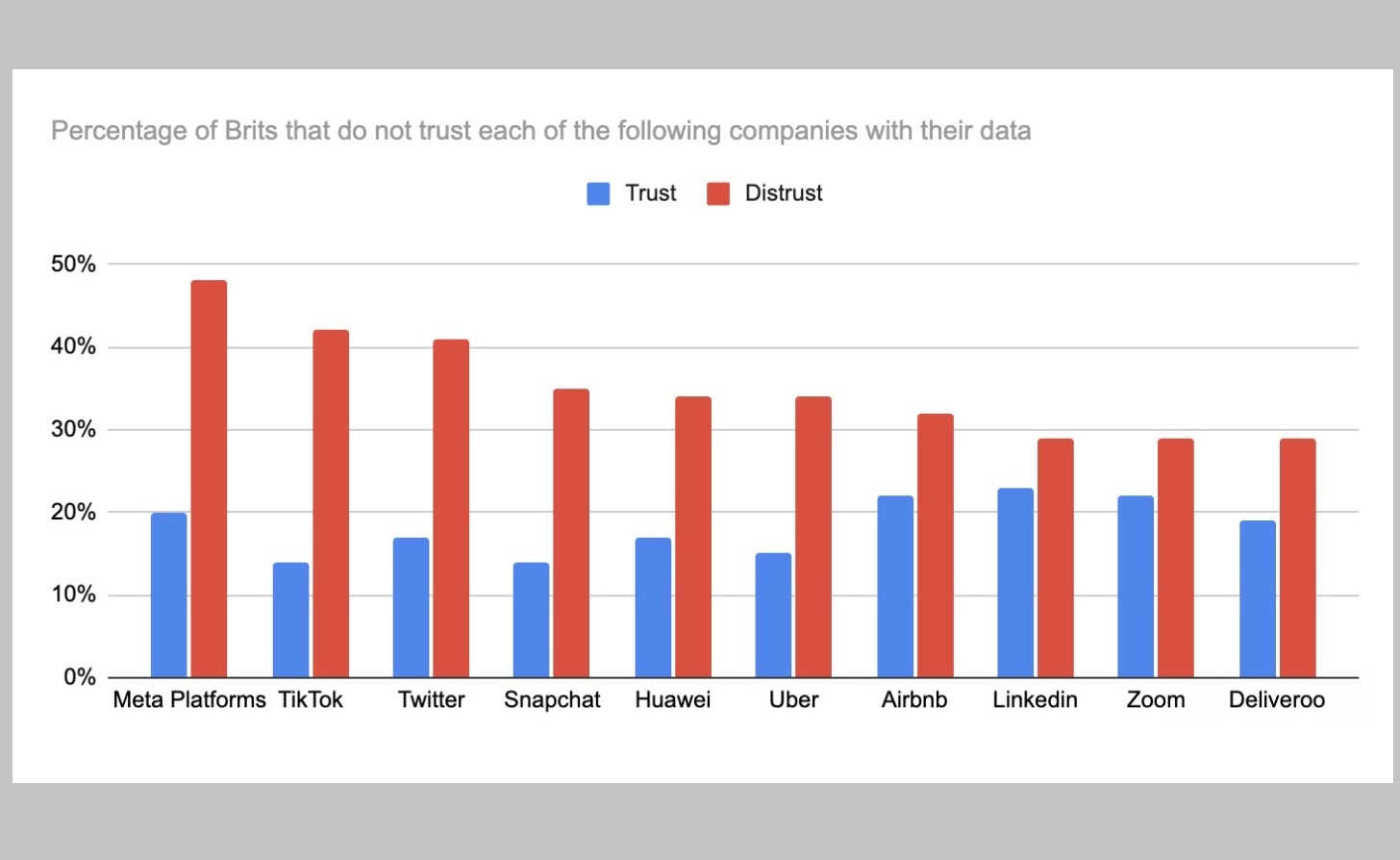
Almost Half of Brits Don’t Trust Meta Anymore
Privacy scandals have rocked the world of tech one after another these past few years, and it is resulting in the industry suffering from a crisis of trust among consumers. Forbes Advisor recently conducted a survey of 2,000 British people, and this revealed the extent to which public trust of social media platforms has ended up eroding so far.
Meta ended up being the least trusted app developer of all, with 48% of the people who responded to this survey saying that they really don’t trust anything that Meta might have to offer. That’s not surprising considering the shocking revelations that have come out about Meta’s algorithm and how it manages the data of its users, but in spite of the fact that this is the case other social media platforms aren’t all that widely trusted either.
With all of that having been said and now out of the way, it is important to note that Twitter and TikTok have miserably low trust scores as well, with 41% of people not trusting the former and 42% not trusting the latter. That seems to suggest that social media in general is not seen as trustworthy by a decent chunk of the British populace.
As for what app developers Brits trust the most, that honor belonged to PayPal. Amazon and Microsoft were also included in the list of most trusted. It bears mentioning that nine of the ten app developers that got the highest level of trust were established prior to the year 2000, so this crisis of confidence seems to be impacting recent brands more than older ones.
With 90% of British people scared of being hacked, it’s quite understandable that social media is where they are aiming their mistrust. Personal and private data has to be managed effectively, and most social media platforms have failed at that.
Youngsters seem to trust TikTok and Instagram more. That bodes well for the future, since it suggests that these apps will have fewer trust issues and will get their hands on more data once their target demographic becomes the majority in the world.
Read next: Two-Thirds Of Consumers Will Abandon Apps Or Sites Offering Poor Performance As Per This Study
by Zia Muhammad via Digital Information World
Meta ended up being the least trusted app developer of all, with 48% of the people who responded to this survey saying that they really don’t trust anything that Meta might have to offer. That’s not surprising considering the shocking revelations that have come out about Meta’s algorithm and how it manages the data of its users, but in spite of the fact that this is the case other social media platforms aren’t all that widely trusted either.
With all of that having been said and now out of the way, it is important to note that Twitter and TikTok have miserably low trust scores as well, with 41% of people not trusting the former and 42% not trusting the latter. That seems to suggest that social media in general is not seen as trustworthy by a decent chunk of the British populace.
As for what app developers Brits trust the most, that honor belonged to PayPal. Amazon and Microsoft were also included in the list of most trusted. It bears mentioning that nine of the ten app developers that got the highest level of trust were established prior to the year 2000, so this crisis of confidence seems to be impacting recent brands more than older ones.
With 90% of British people scared of being hacked, it’s quite understandable that social media is where they are aiming their mistrust. Personal and private data has to be managed effectively, and most social media platforms have failed at that.
Youngsters seem to trust TikTok and Instagram more. That bodes well for the future, since it suggests that these apps will have fewer trust issues and will get their hands on more data once their target demographic becomes the majority in the world.
Read next: Two-Thirds Of Consumers Will Abandon Apps Or Sites Offering Poor Performance As Per This Study
by Zia Muhammad via Digital Information World
Subscribe to:
Posts (Atom)


