Ever since we learned how to make sense of the world around us, we have been taught to think critically. To succeed in any field of life, you have to deploy your critical thinking skills. But is the world now telling us to critically ignore it? Go back to the ways we have been taught.
In the Digital Age, everything you see on the internet is a mix of fibs and truth. No one can differentiate the good and bad, the true and false, from a single glance. This is where critical thinking comes into play. Without it, we would go insane with the abundance of knowledge we have at our disposal.
On social media, one needs to critically filter through the comments to gain new information. Since social media is more like a canvas, ready for everyone’s stories to be a pain, one might display their opinions as facts.
The uneducated opinions, falsehood, and misinformation infiltrated into the platforms make it the worst place for a mind to grow or flourish. At a time like this, a new concept has been introduced. This concept goes by the term, ‘Critical ignorance.’
According to TheConversion, where this term first came into being, Critical Ignorance involves consciously deciding where to pay attention and what to ignore, given the limited capacity of our attention. Critical Ignorance goes beyond simply not paying attention, and requires cultivating mindful and healthy habits to effectively deal with the overwhelming amount of digital information that surrounds us.
It is now a core value that human beings, regardless of their jobs or area of expertise, require. Without it, we can flourish in this digital paradise but there is a higher chance that we will be a victim of what we call the ‘digital hellscape.’
We do agree with this new concept. Although everyone views social media through their tinted glasses, seeing only what they want, it is still not the right way to go. Without questioning the validity or accuracy of the content found online, people absorb and form opinions based on inaccurate and false info.
Critical ignorance asks one to ignore certain content completely for it is not worth spending their precious time or brain power on.
Another important aspect of this is the dominance of AI in our current age. With AI, humans have access to more information than they ever did. However since AI tools aren’t designed to critically evaluate any piece of information, you end up with ample misinformation.
The most dangerous issue at hand is all the misinformation through spreading deep fakes. For now, we have come across deep fake newscasts, followed by celebrities, and soon we shall even witness political deep fakes. With AI, these have been turned so realistic that it is impossible to spot them.
With technology advancing and the world becoming a global village, we surely are headed toward doom. Although with the help of critical ignorance, we might be able to slow down.
Photo: Freepik
Read next: New Study Reveals Key Misconceptions About Misinformation
by Arooj Ahmed via Digital Information World
"Mr Branding" is a blog based on RSS for everything related to website branding and website design, it collects its posts from many sites in order to facilitate the updating to the latest technology.
To suggest any source, please contact me: Taha.baba@consultant.com
Friday, February 17, 2023
Top News Outlets Criticize OpenAI For Using Their Articles For Free To Train Its ChatGPT Software
It appears like the controversies surrounding OpenAI never cease to end.
Now, some of the world’s leading news outlets have started to criticize the company for using their articles for training its ChatGPT software. And that too, without offering any sort of financial compensation in return.
The news comes to us thanks to a report by Bloomberg. This showed how Wall Street journalists of the firm seemed furious and began raising their voices on the matter that’s awfully controversial.
Moreover, they feel that anyone that wishes to use content related to WSJ media for AI-related training needs adequate licensing rights from the likes of Dow Jones as revealed by Bloomberg today. And just for the record, they were very clear about how Dow Jones doesn’t have any sort of a deal in place at this moment in time with ChatGPT makers OpenAI.
Another statement expressed due concern and anger on the incident, adding how they feel this is just a blatant example of misusing journalists’ work in the most awful manner. And for this reason, they’re now overviewing the situation seriously to see what the next step could be.
The sudden arousal of concerns comes into play when a top journalist named Francesco Marconi put up a tweet through his account claiming content that belonged to them was utilized for training the AI-powered chatbot by OpenAI. Moreover, he even asked ChatGPT to provide a list of all the news outlets used for its training and that’s when he was dumbfounded to see the response had at least 20 different sources mentioned.
The software has been trained using a lot of data that range from huge names in the media industry which powers AI. But it’s just not clear if OpenAI has any set agreements in place with all of these publishing firms or not. As you may know, taking data without first asking for permission is definitely against the law as it goes against any publisher’s policy and terms of service.
For now, OpenAI is yet to comment on the matter. But news outlets claim they are not the first ones to ask queries on the subject regarding if the content is used without authority by AI systems.
Let’s not forget how in November last year, OpenAI, GitHub, and Microsoft Corp were issued lawsuits because one of their tools went by the name GitHub Copilot was copying content belonging to human creators. This was a clear violation of the licenses issued to them.
Then last month, another group of artists issued a case against AI producer Stability AI and DeviantArt Inc for installing and using so many copyrighted pictures without offering any form of compensation or even getting the consent of the respective artists involved.
CNN is also a part of the list who says that it’s wrong to use its content for training purposes of the viral software as it goes against its terms of service. Therefore, they do hope to reach out to the makers of ChatGPT for payment to license their respective content, as revealed by a person familiar with the matter. But since the case is a legal one, his name was not disclosed.
As you can see, the uprising of AI technology and chatbots is turning out to be a controversial affair in the world of media and publishing. Many top journalists fear that these sorts of advancements in the tech world may end up taking over their respective bread and butter.
Read next: Battle of the Brains: Chat GPT Takes on Google Search in AI Showdown
by Dr. Hura Anwar via Digital Information World
Now, some of the world’s leading news outlets have started to criticize the company for using their articles for training its ChatGPT software. And that too, without offering any sort of financial compensation in return.
The news comes to us thanks to a report by Bloomberg. This showed how Wall Street journalists of the firm seemed furious and began raising their voices on the matter that’s awfully controversial.
Moreover, they feel that anyone that wishes to use content related to WSJ media for AI-related training needs adequate licensing rights from the likes of Dow Jones as revealed by Bloomberg today. And just for the record, they were very clear about how Dow Jones doesn’t have any sort of a deal in place at this moment in time with ChatGPT makers OpenAI.
Another statement expressed due concern and anger on the incident, adding how they feel this is just a blatant example of misusing journalists’ work in the most awful manner. And for this reason, they’re now overviewing the situation seriously to see what the next step could be.
The sudden arousal of concerns comes into play when a top journalist named Francesco Marconi put up a tweet through his account claiming content that belonged to them was utilized for training the AI-powered chatbot by OpenAI. Moreover, he even asked ChatGPT to provide a list of all the news outlets used for its training and that’s when he was dumbfounded to see the response had at least 20 different sources mentioned.
The software has been trained using a lot of data that range from huge names in the media industry which powers AI. But it’s just not clear if OpenAI has any set agreements in place with all of these publishing firms or not. As you may know, taking data without first asking for permission is definitely against the law as it goes against any publisher’s policy and terms of service.
For now, OpenAI is yet to comment on the matter. But news outlets claim they are not the first ones to ask queries on the subject regarding if the content is used without authority by AI systems.
Let’s not forget how in November last year, OpenAI, GitHub, and Microsoft Corp were issued lawsuits because one of their tools went by the name GitHub Copilot was copying content belonging to human creators. This was a clear violation of the licenses issued to them.
Then last month, another group of artists issued a case against AI producer Stability AI and DeviantArt Inc for installing and using so many copyrighted pictures without offering any form of compensation or even getting the consent of the respective artists involved.
CNN is also a part of the list who says that it’s wrong to use its content for training purposes of the viral software as it goes against its terms of service. Therefore, they do hope to reach out to the makers of ChatGPT for payment to license their respective content, as revealed by a person familiar with the matter. But since the case is a legal one, his name was not disclosed.
As you can see, the uprising of AI technology and chatbots is turning out to be a controversial affair in the world of media and publishing. Many top journalists fear that these sorts of advancements in the tech world may end up taking over their respective bread and butter.
- Related: Microsoft’s New AI Chatbot Could Face Legal Issues Due To Its Controversial Terms Of Service
Read next: Battle of the Brains: Chat GPT Takes on Google Search in AI Showdown
by Dr. Hura Anwar via Digital Information World
Battle of the Brains: Chat GPT Takes on Google Search in AI Showdown
In a head-to-head competition, which tool reigns supreme: Chat GPT or Google? As artificial intelligence continues to evolve and get more advanced, there is a growing interest in how chatbots and vocabulary models like Chat GPT stack up against traditional search engines like Google.
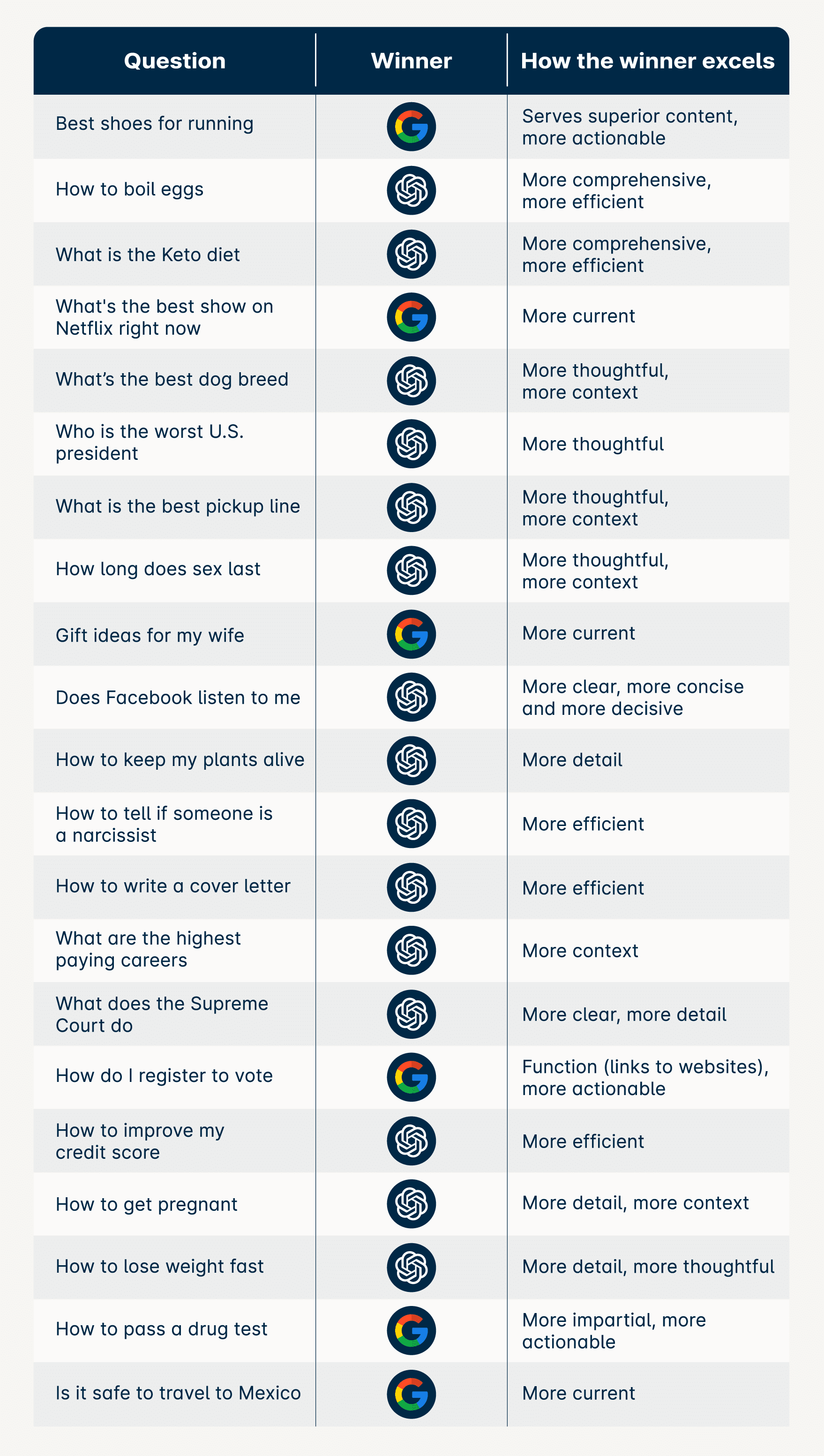
To put these two systems to the test, researchers at Preply conducted a study to compare the performance of Chat GPT and Google Search in answering various types of questions. The researchers found that while both systems had their strengths and weaknesses, Chat GPT was able to provide more accurate and relevant answers to a wider range of questions than Google Search when comparing the total 40 questions. Though the scale of this study was very small, yet, Google was declared winner on 16 answers while ChatGPT was leading the race on 23 queries while there was tie on just 1 question.
Chat GPT is an artificial intellect language model that uses machine learning to understand natural vocabulary and generate responses to a wide range of questions. It was trained on a massive dataset of text from the WWW and other sources and can be utilized to answer questions, provide recommendations, or engage in casual conversation.
In the study, the researchers sampled both AI and Google Search on a variety of inquiry types, including factual questions, opinion-based inquiries, and questions that required more nuanced or contextual understanding. They found that Chat GPT was able to provide more accurate answers to factual questions, and was better able to understand and respond to questions that required contextual understanding.
For example, when asked 'Is God real?', 'What is the meaning of life?', & 'How to boil eggs?', then Open AI's tool gave more clearer and concise answers as compared to Google.
While Google Search still outperformed Chat GPT in certain areas, such as providing quick and simple answers to straightforward questions, the researchers noted that Chat GPT's ability to provide more detailed and accurate answers to a wider range of questions made it a promising alternative to traditional search engines.
As the field of artificial intelligence continues to evolve, the potential applications for language models like Chat GPT are becoming increasingly clear. From virtual assistants and chatbots to recommendation systems and personalized tracking engines, there are a variety of ways that these advanced language models can be used to improve the way we interact with technology and access information.
It makes sense that Chat GPT would lose when answering time-exposed queries because the data set used to train it is only dated through 2021. However, as we already noted, that disadvantage didn't prevent it from outperforming the venerable Google search on the whole.
Naturally, Alphabet is currently exerting significant pressure on the Bard. Microsoft funded early in Open AI, so its capabilities are already seen in Bing search engine previews. Additionally, Open AI-assisted Bing is fully current and does not only use data that has been crawled up to 2022. Even sources will be cited, something Chat GPT does not do (but should). It won't even be hindered by Open AI's sluggish servers. Alphabet has been shaken by all of these causes.
While the debate over which search engine is smarter may never be fully resolved, the study suggests that Chat GPT is a powerful tool that has the potential to revolutionize the way we search for and access information in the years to come. However, it's important to note that ChatGPT and the search engine that it backs Bing is still churning out several misinformed and factually incorrect data points for the vast majority of users.
Read next: Here Are the 7 Biggest Roadblocks to AI Assisted Search Engines
by Arooj Ahmed via Digital Information World
To put these two systems to the test, researchers at Preply conducted a study to compare the performance of Chat GPT and Google Search in answering various types of questions. The researchers found that while both systems had their strengths and weaknesses, Chat GPT was able to provide more accurate and relevant answers to a wider range of questions than Google Search when comparing the total 40 questions. Though the scale of this study was very small, yet, Google was declared winner on 16 answers while ChatGPT was leading the race on 23 queries while there was tie on just 1 question.
Chat GPT is an artificial intellect language model that uses machine learning to understand natural vocabulary and generate responses to a wide range of questions. It was trained on a massive dataset of text from the WWW and other sources and can be utilized to answer questions, provide recommendations, or engage in casual conversation.
In the study, the researchers sampled both AI and Google Search on a variety of inquiry types, including factual questions, opinion-based inquiries, and questions that required more nuanced or contextual understanding. They found that Chat GPT was able to provide more accurate answers to factual questions, and was better able to understand and respond to questions that required contextual understanding.
For example, when asked 'Is God real?', 'What is the meaning of life?', & 'How to boil eggs?', then Open AI's tool gave more clearer and concise answers as compared to Google.
While Google Search still outperformed Chat GPT in certain areas, such as providing quick and simple answers to straightforward questions, the researchers noted that Chat GPT's ability to provide more detailed and accurate answers to a wider range of questions made it a promising alternative to traditional search engines.
As the field of artificial intelligence continues to evolve, the potential applications for language models like Chat GPT are becoming increasingly clear. From virtual assistants and chatbots to recommendation systems and personalized tracking engines, there are a variety of ways that these advanced language models can be used to improve the way we interact with technology and access information.
It makes sense that Chat GPT would lose when answering time-exposed queries because the data set used to train it is only dated through 2021. However, as we already noted, that disadvantage didn't prevent it from outperforming the venerable Google search on the whole.
Naturally, Alphabet is currently exerting significant pressure on the Bard. Microsoft funded early in Open AI, so its capabilities are already seen in Bing search engine previews. Additionally, Open AI-assisted Bing is fully current and does not only use data that has been crawled up to 2022. Even sources will be cited, something Chat GPT does not do (but should). It won't even be hindered by Open AI's sluggish servers. Alphabet has been shaken by all of these causes.
While the debate over which search engine is smarter may never be fully resolved, the study suggests that Chat GPT is a powerful tool that has the potential to revolutionize the way we search for and access information in the years to come. However, it's important to note that ChatGPT and the search engine that it backs Bing is still churning out several misinformed and factually incorrect data points for the vast majority of users.
Read next: Here Are the 7 Biggest Roadblocks to AI Assisted Search Engines
by Arooj Ahmed via Digital Information World
Thursday, February 16, 2023
Search engines have lost their reach because consumers have started visiting social media platforms for product research
Whenever it comes to purchasing something new, many people tend to first research the product they are willing to buy. Many U.S. citizens would take help from search engines such as Google to learn more about the item. However, a recent study has shown that people’s use of search engines for such purposes has now started to decline.
Statista’s Consumer Insight report revealed that three years ago, in 2019, almost 69 percent of U.S. citizens would go to a search engine to learn more about the product, and by 2022, the figures had come down to 54 percent. This means 15% of the people stopped using Google or any other such platforms to research the product.
However, on the other hand, social media platforms, including websites and applications, started to gain popularity as they began having more influence as a platform offering research on the desired items. Last year, people looking forward to social networks for product information went up by 4 percent. Upon further analysis, it was observed that people between the ages of eighteen and sixty-four started using such platforms for the same purposes that search engines were once used for.
Similarly, electronic and print media such as magazines and newspapers as well as online websites for such articles also observed an increase from 2019 to 2022 as more people started referring to them for product insight. Print media houses offering consumer sections such as Consumer Reports are also among the most relied-upon sources for consumers. In addition to this, the New York Times-owned Wirecutter, a review website, has also been actively working to provide insight on different products since it was bought by the New York Times company seven years ago, in 2016.
According to the chart, search engines weren’t the only platforms that suffered losses. Customer reviews also decreased from 46 percent in 2019 to 34 percent in 2022. Similarly, online stores also suffered a reach loss, as the figures dropped from 40 percent in 2019 to 33 percent last year.
Read next: What Tools Does A Small Business Need For A Successful Empire? This Study Has The Answer
by Arooj Ahmed via Digital Information World
Statista’s Consumer Insight report revealed that three years ago, in 2019, almost 69 percent of U.S. citizens would go to a search engine to learn more about the product, and by 2022, the figures had come down to 54 percent. This means 15% of the people stopped using Google or any other such platforms to research the product.
However, on the other hand, social media platforms, including websites and applications, started to gain popularity as they began having more influence as a platform offering research on the desired items. Last year, people looking forward to social networks for product information went up by 4 percent. Upon further analysis, it was observed that people between the ages of eighteen and sixty-four started using such platforms for the same purposes that search engines were once used for.
Similarly, electronic and print media such as magazines and newspapers as well as online websites for such articles also observed an increase from 2019 to 2022 as more people started referring to them for product insight. Print media houses offering consumer sections such as Consumer Reports are also among the most relied-upon sources for consumers. In addition to this, the New York Times-owned Wirecutter, a review website, has also been actively working to provide insight on different products since it was bought by the New York Times company seven years ago, in 2016.
According to the chart, search engines weren’t the only platforms that suffered losses. Customer reviews also decreased from 46 percent in 2019 to 34 percent in 2022. Similarly, online stores also suffered a reach loss, as the figures dropped from 40 percent in 2019 to 33 percent last year.
Read next: What Tools Does A Small Business Need For A Successful Empire? This Study Has The Answer
by Arooj Ahmed via Digital Information World
Pay Rates for Sponsored Posts on TikTok Have Declined by 5% YoY
Part of the process by which social media platforms are trying to achieve dominance is through enticing content creators. TikTok has tried to position itself as a leading platform for creators who are looking to put content out there and monetize it, but in spite of the fact that this is the case its pay rate has been declining gradually over the years with no sign of it going back up anytime soon.
With all of that having been said and now out of the way, it is important to note that this is not a trend that can be seen on a few other social media platforms. For example, it seems that the pay rate for sponsored posts happens to be going up on Instagram.
According to a survey conducted by Hashtag Pay Me, sponsored posts on TikTok can net a content creator around $2,947 on average. This has gone down from the $3,108 that creators could have received as sponsorship money for a post back in 2021.
Meanwhile, the average rate of pay for a sponsored post on Instagram appears to be telling a different story entirely. Back in 2021, a creator could receive $3,652 on average from a sponsored Instagram post, and this has increased by an incredible 39% to reach $5,077 last year in 2022.
However, despite the relative decline in payment amounts for sponsored posts, TikTok is projected to gain an even larger share of the content creator market in the US by 2024. Back in 2020, around 5.4% of ad spends on influencer marketing went to TikTok. Fast forward to 2024 and this proportion will be closer to 18.5%, which suggests that marketing agencies will be spending more ad dollars on TikTok than might have been the case otherwise.
One thing that creators can do here is to try to get paid for multiple posts. According to the survey, a single post could net an average of $1,427 for creators. However, if they were able to get a contract for five posts, the average payment per post would skyrocket to $3,667.
Also, we might be seeing an era where small creators can finally start to level the playing field. Smaller creators can get close to 20% more engagement due to them having a closer relationship with their followers.
All in all, the world of influencer marketing is going through a series of seismic shifts, and there is no way to tell which platform or influencer will come out on top once they make it to the other side. Whatever the case may be, it seems like TikTok is here to stay.
Read next: How many former employees from the world's biggest companies now run their own businesses?
by Zia Muhammad via Digital Information World
With all of that having been said and now out of the way, it is important to note that this is not a trend that can be seen on a few other social media platforms. For example, it seems that the pay rate for sponsored posts happens to be going up on Instagram.
According to a survey conducted by Hashtag Pay Me, sponsored posts on TikTok can net a content creator around $2,947 on average. This has gone down from the $3,108 that creators could have received as sponsorship money for a post back in 2021.
Meanwhile, the average rate of pay for a sponsored post on Instagram appears to be telling a different story entirely. Back in 2021, a creator could receive $3,652 on average from a sponsored Instagram post, and this has increased by an incredible 39% to reach $5,077 last year in 2022.
However, despite the relative decline in payment amounts for sponsored posts, TikTok is projected to gain an even larger share of the content creator market in the US by 2024. Back in 2020, around 5.4% of ad spends on influencer marketing went to TikTok. Fast forward to 2024 and this proportion will be closer to 18.5%, which suggests that marketing agencies will be spending more ad dollars on TikTok than might have been the case otherwise.
One thing that creators can do here is to try to get paid for multiple posts. According to the survey, a single post could net an average of $1,427 for creators. However, if they were able to get a contract for five posts, the average payment per post would skyrocket to $3,667.
Also, we might be seeing an era where small creators can finally start to level the playing field. Smaller creators can get close to 20% more engagement due to them having a closer relationship with their followers.
All in all, the world of influencer marketing is going through a series of seismic shifts, and there is no way to tell which platform or influencer will come out on top once they make it to the other side. Whatever the case may be, it seems like TikTok is here to stay.
Read next: How many former employees from the world's biggest companies now run their own businesses?
by Zia Muhammad via Digital Information World
TikTok To Launch More Shopping Features For Brands As Instagram Does The Opposite
In the world of social media, apps are always striving to reach the top of the list as the competition is tough.
Both TikTok and Instagram are arch rivals, looking to better the app and invest heavily in trends that make a lot of money. This includes the likes of short vertical video content, alongside many other features.
But a recent report is talking about TikTok doing the exact opposite of its rival Instagram.
The app is working on rolling out some more shopping features for brands on the platform while Instagram just recently shut doors on its livestream shopping endeavor.
The feature would entail users to purchase directly through the platform as reported by AdAge. It reveals the feature is being launched quietly right now and is similar to an in-app checkout offering in America.
This means brands are given the chance to sell products via the app directly. Moreover, the company is inviting big names like those linked to pop culture and favored greatly by the youth. Common examples include the likes of Pacsun and KimChi chic which would allow featuring their goods on the app.
Those brands offering a great shopping experience on the platform would comprise a tiny bag icon that features across their profile. This is where users may explore goods through a respective catalog that entails images, price tags, videos, and even descriptions. Similarly, users may include products from a number of stores in the same shopping cart.
This move arrives at a time when more and more individuals including teens are making use of the app as their leading search engine. Furthermore, this does not indicate that the app would be successful with the whole shopping endeavor.
Remember, Instagram failed to get the response that many at the company had envisioned. They followed in the footsteps of markets in China but the West was just not too included in in-app purchases at the frequency that it would have liked. Therefore, Meta announced that both Facebook and Instagram would have the feature of the Shop Tab removed.
Instead, Instagram hopes to divert its efforts and resources toward the likes of advertising instead of e-commerce. Moreover, on Wednesday, we saw a direct announcement of the platform shutting down the Live Shopping offering from early next month. This means creators can no longer tag the goods in their Live broadcast. But Meta says it will continue to allow other shopping endeavors on the app.
For now, TikTok is carrying out its shopping feature launch across the USA. But it’s yet to be determined whether or not we can expect to see another expansion to other regions in the near future. Also, the brands being included are limited so with time, it would be interesting to see how many more get on board.
Above all, critics are looking at whether or not Instagram’s leading competitor can succeed in a designated area where it failed to make a lasting impression. For that, we’ll just need to wait and watch.
Read next: 8 Growth Hacks for Social Media Marketers (Based On Data)
by Dr. Hura Anwar via Digital Information World
Both TikTok and Instagram are arch rivals, looking to better the app and invest heavily in trends that make a lot of money. This includes the likes of short vertical video content, alongside many other features.
But a recent report is talking about TikTok doing the exact opposite of its rival Instagram.
The app is working on rolling out some more shopping features for brands on the platform while Instagram just recently shut doors on its livestream shopping endeavor.
The feature would entail users to purchase directly through the platform as reported by AdAge. It reveals the feature is being launched quietly right now and is similar to an in-app checkout offering in America.
This means brands are given the chance to sell products via the app directly. Moreover, the company is inviting big names like those linked to pop culture and favored greatly by the youth. Common examples include the likes of Pacsun and KimChi chic which would allow featuring their goods on the app.
Those brands offering a great shopping experience on the platform would comprise a tiny bag icon that features across their profile. This is where users may explore goods through a respective catalog that entails images, price tags, videos, and even descriptions. Similarly, users may include products from a number of stores in the same shopping cart.
This move arrives at a time when more and more individuals including teens are making use of the app as their leading search engine. Furthermore, this does not indicate that the app would be successful with the whole shopping endeavor.
Remember, Instagram failed to get the response that many at the company had envisioned. They followed in the footsteps of markets in China but the West was just not too included in in-app purchases at the frequency that it would have liked. Therefore, Meta announced that both Facebook and Instagram would have the feature of the Shop Tab removed.
Instead, Instagram hopes to divert its efforts and resources toward the likes of advertising instead of e-commerce. Moreover, on Wednesday, we saw a direct announcement of the platform shutting down the Live Shopping offering from early next month. This means creators can no longer tag the goods in their Live broadcast. But Meta says it will continue to allow other shopping endeavors on the app.
For now, TikTok is carrying out its shopping feature launch across the USA. But it’s yet to be determined whether or not we can expect to see another expansion to other regions in the near future. Also, the brands being included are limited so with time, it would be interesting to see how many more get on board.
Above all, critics are looking at whether or not Instagram’s leading competitor can succeed in a designated area where it failed to make a lasting impression. For that, we’ll just need to wait and watch.
Read next: 8 Growth Hacks for Social Media Marketers (Based On Data)
by Dr. Hura Anwar via Digital Information World
Instagram Just Changed Its UI, Here’s What You Need to Know
Instagram is known for switching things up when it comes to its user interface. Changes like these are pretty common because of the fact that this is the sort of thing that could potentially end up getting Instagram ever closer to its goal of having a perfect interface that users might enjoy. It turns out that yet another change has come into play, as spotted by Matt Navarra, although its perception has been rather mixed with all things having been considered and taken into account.
The change in question concerns two separate parts of the user interface. Firstly, the create button that you can tap in order to create reel, story or any other kind of post on the platform has been shifted to the bottom nav bar. More specifically, it can now be seen in the very center of this nav bar which is located on the bottom of the screen when you have the Instagram app opened up on your phone.
With all of that having been said and now out of the way, it is important to note that the create button is not the only thing that has changed positions on the user interface for the Instagram smartphone app. The notifications center has been shifted to the top right corner as well, and that might make it more visible than might have been the case otherwise.
Visibility might be the primary concern here for Instagram, since the social media platform would obviously want the maximum number of users checking their notifications. Making the notifications section appear on the top right might prevent users from navigating a way from the app, since there is a chance that they might see a notification that will have one waiting for them there.
In spite of the fact that this is the case, a number of users have voiced their displeasure about this update. Meta certainly seems to be pulling the trigger on a number of changes fairly quickly, and this is creating a confusing environment for users since they never know what to expect from the next update that will be coming their way.
One piece of good news for Instagram users is that the shopping tab seems to be noticeably absent from the UI. That gives the impression that the social media platform is moving away from its ecommerce push. This might be related to Mark Zuckerberg saying that Meta will be cutting down on costs and prioritizing on fundamentals in the wake of a plummeting stock price as well as record low quarterly earnings. It will be interesting to see what comes next for Instagram as well as for Facebook.
Read next: Why Are Digital Ads Getting Worse?
by Zia Muhammad via Digital Information World
The change in question concerns two separate parts of the user interface. Firstly, the create button that you can tap in order to create reel, story or any other kind of post on the platform has been shifted to the bottom nav bar. More specifically, it can now be seen in the very center of this nav bar which is located on the bottom of the screen when you have the Instagram app opened up on your phone.
With all of that having been said and now out of the way, it is important to note that the create button is not the only thing that has changed positions on the user interface for the Instagram smartphone app. The notifications center has been shifted to the top right corner as well, and that might make it more visible than might have been the case otherwise.
Visibility might be the primary concern here for Instagram, since the social media platform would obviously want the maximum number of users checking their notifications. Making the notifications section appear on the top right might prevent users from navigating a way from the app, since there is a chance that they might see a notification that will have one waiting for them there.
In spite of the fact that this is the case, a number of users have voiced their displeasure about this update. Meta certainly seems to be pulling the trigger on a number of changes fairly quickly, and this is creating a confusing environment for users since they never know what to expect from the next update that will be coming their way.
One piece of good news for Instagram users is that the shopping tab seems to be noticeably absent from the UI. That gives the impression that the social media platform is moving away from its ecommerce push. This might be related to Mark Zuckerberg saying that Meta will be cutting down on costs and prioritizing on fundamentals in the wake of a plummeting stock price as well as record low quarterly earnings. It will be interesting to see what comes next for Instagram as well as for Facebook.
Read next: Why Are Digital Ads Getting Worse?
by Zia Muhammad via Digital Information World
Subscribe to:
Posts (Atom)


