According to Nima Owji, an app researcher, Twitter is working to let its users choose the quality of their uploaded video content. Nima, while sharing the news with his followers through his Twitter profile, uploaded a screenshot offering 720p as the recommended video quality and 1080p as the rarely needed quality (something like YouTube, but we wonder if the micro-blogging platform is ever going to offer 2K or 4K option).
The video quality issue is not new, and Twitter is not the only platform having video quality problems. It has been observed that whenever video content is uploaded, it gets compressed significantly. This step is taken to provide a better experience to the users. Video content of high quality will need more bandwidth. As a result, viewers with low-speed Internet won’t be able to enjoy the uploaded media on time and may get frustrated. Hence, a compressed video will be able to get itself loaded even on a low-speed Internet connection.
Twitter may compress the video due to several factors, including the techniques used for compression. Compression on the platform is not similar to the way users' devices deal with it. Hence, the content may end up getting compressed for reasons that are better known to the regulator.
The speed of the internet connection is also an important factor that determines the compression level. Users with the “Save Data” feature enabled will be viewing videos in low quality as the content will be displayed according to its optimized format.
If a user tried to upload an optimized video, the platform wouldn’t have any reason to compress it; however, if a user uploaded a non-optimized video that may go against video specifications, the content would be compressed.
If a video is being uploaded from a device carrying a virus, the file may end up corrupt. As a result, the content may get blurry and get uploaded with the same blurriness.
Hence, to ensure that the content doesn’t get compressed, users can make sure that they are uploading an optimized version of the video that follows the video specification available on the platform. It is better to keep the original version of the video as well. By following the video requirements, videos won’t be tampered with and will be uploaded in their original form.
Read next: Pay Rates for Sponsored Posts on TikTok Have Declined by 5% YoY
by Arooj Ahmed via Digital Information World
"Mr Branding" is a blog based on RSS for everything related to website branding and website design, it collects its posts from many sites in order to facilitate the updating to the latest technology.
To suggest any source, please contact me: Taha.baba@consultant.com
Friday, February 17, 2023
Report Reveals Alarming Data Breach Trends Among Data Brokers in the US: Over 200 Million Records Compromised
What’s worse than data brokers collecting and selling personal information? Data brokers that suffer data breaches resulting in the exposure of your info.
Research conducted by Incogni established that out of the 506 registered, US-based data brokers, 23 had experienced a data breach. How many records were compromised? And where did these breaches occur? Here's everything you need to know.
Data brokers scrape the web for this personal data, gathering it from various public sources, such as public records or social media sites, but also from your search history or purchase history. Further, data brokers may also obtain it from one another or when a data breach occurs. The latter has been a particular cause for concern, especially regarding data privacy.
Data breaches can occur for various reasons, ranging from human error (like succumbing to phishing attacks, incorrectly setting up firewalls, delaying updates, etc.) to a deliberate cyberattack which can be carried out by using malware, DNS tunneling, SQL injection, and more.
Incogni recently conducted an analysis of data broker breaches in the United States. According to their findings, the first data broker data breach occurred in 2002 and involved Acxiom, which actually suffered two breaches. The only other data broker breach during that decade took place in 2005 when LexisNexis was breached.
Once 2011 hit, things started to go downhill, with a data breach happening almost every year, 2014 and 2022 being the only two exceptions. The year 2017 experienced a massive spike, with six companies being breached.
With the COVID-19 pandemic spreading, 2020 was a challenging year that witnessed a significant surge in cybercrime. The number of cybercrime victims increased dramatically, by 69%, highlighting the severity of the situation. As a result, it is perhaps not surprising that a total of nine data breaches occurred during this time.
There was a decrease in the number of data breaches in 2021, with only three breaches reported. While no reports of data breaches were received in 2022, it’s important to note that data breaches are not always immediately discovered. That’s why the accuracy of this information is yet to be confirmed.
Exceptions like the 2021 decline notwithstanding, the trend throughout the first two decades of the 21st century has been one of increasing numbers of data broker data breaches.
Keeping this data in mind, it should come as no surprise that it is also California that saw the greatest number of data broker breaches, with five of its registered brokers experiencing data breaches. New York followed with three breached data brokers, and Washington and New Jersey tied for third place, each with two breached data brokers.
Note: Experian and Equifax were excluded from this data set, as these data brokers operate through multiple subsidiaries located in different states, thus making it difficult to attribute their breaches to a specific location.
California-based People Data Labs accounted for most breaches, making up 40% of the total, with 179 million records leaked. Following in second place was Apollo.io, with 17.8% of the breaches resulting in 79.2 million records leaked, and in third place was ShareThis, with 10.8% of the breaches and 41 million records leaked.

“Even though there is nothing we can do about data leaks, there are ways to minimize the amount of our data that ends up on data broker websites in the first place. Apart from optimizing your online privacy settings and removing unused accounts, you can also opt out of data broker records.”
You can manually send opt-out requests to data brokers asking them to remove your personal information or turn to a data removal services that will automatically send removal requests to data brokers and people search sites on your behalf without you having to lift a finger.
Read next: Study Shows Refund and Tech Assistance Frauds Are on the Rise
by Web Desk via Digital Information World
Research conducted by Incogni established that out of the 506 registered, US-based data brokers, 23 had experienced a data breach. How many records were compromised? And where did these breaches occur? Here's everything you need to know.
What are data brokers?
Data brokers are companies that collect, aggregate, and sell personal information. This information can include names, contact details, addresses, financial data, criminal records, and even Social Security numbers.Data brokers scrape the web for this personal data, gathering it from various public sources, such as public records or social media sites, but also from your search history or purchase history. Further, data brokers may also obtain it from one another or when a data breach occurs. The latter has been a particular cause for concern, especially regarding data privacy.
What are data breaches, and how do they happen?
A data breach is an incident during which sensitive (such as personally identifiable information) or confidential information is accessed by an unauthorized party. The affected entity may not even be aware that the breach has occurred and only learn about it after a significant amount of time has passed.Data breaches can occur for various reasons, ranging from human error (like succumbing to phishing attacks, incorrectly setting up firewalls, delaying updates, etc.) to a deliberate cyberattack which can be carried out by using malware, DNS tunneling, SQL injection, and more.
Is the number of data broker data breaches on the rise?
Incogni recently conducted an analysis of data broker breaches in the United States. According to their findings, the first data broker data breach occurred in 2002 and involved Acxiom, which actually suffered two breaches. The only other data broker breach during that decade took place in 2005 when LexisNexis was breached.
Once 2011 hit, things started to go downhill, with a data breach happening almost every year, 2014 and 2022 being the only two exceptions. The year 2017 experienced a massive spike, with six companies being breached.
With the COVID-19 pandemic spreading, 2020 was a challenging year that witnessed a significant surge in cybercrime. The number of cybercrime victims increased dramatically, by 69%, highlighting the severity of the situation. As a result, it is perhaps not surprising that a total of nine data breaches occurred during this time.
There was a decrease in the number of data breaches in 2021, with only three breaches reported. While no reports of data breaches were received in 2022, it’s important to note that data breaches are not always immediately discovered. That’s why the accuracy of this information is yet to be confirmed.
Exceptions like the 2021 decline notwithstanding, the trend throughout the first two decades of the 21st century has been one of increasing numbers of data broker data breaches.
Where do data breaches happen most often?
To understand why data breaches happen where they happen, we must first look at where data brokers are registered. With a total of 113, California takes first place in the most significant number of registered data brokers. Second is New York, with 82 data brokers, and the third is Florida, with a "mere" 41 brokers.Keeping this data in mind, it should come as no surprise that it is also California that saw the greatest number of data broker breaches, with five of its registered brokers experiencing data breaches. New York followed with three breached data brokers, and Washington and New Jersey tied for third place, each with two breached data brokers.
Note: Experian and Equifax were excluded from this data set, as these data brokers operate through multiple subsidiaries located in different states, thus making it difficult to attribute their breaches to a specific location.
Largest data broker breaches
The graph below illustrates the ten most substantial data broker breaches, which collectively impacted an astounding 444.5 million accounts. Interestingly, all occurred between 2012-2021.California-based People Data Labs accounted for most breaches, making up 40% of the total, with 179 million records leaked. Following in second place was Apollo.io, with 17.8% of the breaches resulting in 79.2 million records leaked, and in third place was ShareThis, with 10.8% of the breaches and 41 million records leaked.
The global impact of data broker breaches
Since 2004 the US has had a staggering 207.6 million accounts leaked. The other four countries affected the strongest by these breaches include India, the UK, Brazil, and Canada.Conclusion
“Data privacy is becoming increasingly alarming, yet many people are still unaware of the hidden market in which data brokers operate. Upon reviewing the findings, we have seen that data brokers can also experience a data breach, just like any other company. However, they are the ones dealing with massive amounts of sensitive data.” - says Darius Belejevas, Head of Incogni.“Even though there is nothing we can do about data leaks, there are ways to minimize the amount of our data that ends up on data broker websites in the first place. Apart from optimizing your online privacy settings and removing unused accounts, you can also opt out of data broker records.”
You can manually send opt-out requests to data brokers asking them to remove your personal information or turn to a data removal services that will automatically send removal requests to data brokers and people search sites on your behalf without you having to lift a finger.
Read next: Study Shows Refund and Tech Assistance Frauds Are on the Rise
by Web Desk via Digital Information World
Critical ignorance - the new way forward in the digital information world
Ever since we learned how to make sense of the world around us, we have been taught to think critically. To succeed in any field of life, you have to deploy your critical thinking skills. But is the world now telling us to critically ignore it? Go back to the ways we have been taught.
In the Digital Age, everything you see on the internet is a mix of fibs and truth. No one can differentiate the good and bad, the true and false, from a single glance. This is where critical thinking comes into play. Without it, we would go insane with the abundance of knowledge we have at our disposal.
On social media, one needs to critically filter through the comments to gain new information. Since social media is more like a canvas, ready for everyone’s stories to be a pain, one might display their opinions as facts.
The uneducated opinions, falsehood, and misinformation infiltrated into the platforms make it the worst place for a mind to grow or flourish. At a time like this, a new concept has been introduced. This concept goes by the term, ‘Critical ignorance.’
According to TheConversion, where this term first came into being, Critical Ignorance involves consciously deciding where to pay attention and what to ignore, given the limited capacity of our attention. Critical Ignorance goes beyond simply not paying attention, and requires cultivating mindful and healthy habits to effectively deal with the overwhelming amount of digital information that surrounds us.
It is now a core value that human beings, regardless of their jobs or area of expertise, require. Without it, we can flourish in this digital paradise but there is a higher chance that we will be a victim of what we call the ‘digital hellscape.’
We do agree with this new concept. Although everyone views social media through their tinted glasses, seeing only what they want, it is still not the right way to go. Without questioning the validity or accuracy of the content found online, people absorb and form opinions based on inaccurate and false info.
Critical ignorance asks one to ignore certain content completely for it is not worth spending their precious time or brain power on.
Another important aspect of this is the dominance of AI in our current age. With AI, humans have access to more information than they ever did. However since AI tools aren’t designed to critically evaluate any piece of information, you end up with ample misinformation.
The most dangerous issue at hand is all the misinformation through spreading deep fakes. For now, we have come across deep fake newscasts, followed by celebrities, and soon we shall even witness political deep fakes. With AI, these have been turned so realistic that it is impossible to spot them.
With technology advancing and the world becoming a global village, we surely are headed toward doom. Although with the help of critical ignorance, we might be able to slow down.
Photo: Freepik
Read next: New Study Reveals Key Misconceptions About Misinformation
by Arooj Ahmed via Digital Information World
In the Digital Age, everything you see on the internet is a mix of fibs and truth. No one can differentiate the good and bad, the true and false, from a single glance. This is where critical thinking comes into play. Without it, we would go insane with the abundance of knowledge we have at our disposal.
On social media, one needs to critically filter through the comments to gain new information. Since social media is more like a canvas, ready for everyone’s stories to be a pain, one might display their opinions as facts.
The uneducated opinions, falsehood, and misinformation infiltrated into the platforms make it the worst place for a mind to grow or flourish. At a time like this, a new concept has been introduced. This concept goes by the term, ‘Critical ignorance.’
According to TheConversion, where this term first came into being, Critical Ignorance involves consciously deciding where to pay attention and what to ignore, given the limited capacity of our attention. Critical Ignorance goes beyond simply not paying attention, and requires cultivating mindful and healthy habits to effectively deal with the overwhelming amount of digital information that surrounds us.
It is now a core value that human beings, regardless of their jobs or area of expertise, require. Without it, we can flourish in this digital paradise but there is a higher chance that we will be a victim of what we call the ‘digital hellscape.’
We do agree with this new concept. Although everyone views social media through their tinted glasses, seeing only what they want, it is still not the right way to go. Without questioning the validity or accuracy of the content found online, people absorb and form opinions based on inaccurate and false info.
Critical ignorance asks one to ignore certain content completely for it is not worth spending their precious time or brain power on.
Another important aspect of this is the dominance of AI in our current age. With AI, humans have access to more information than they ever did. However since AI tools aren’t designed to critically evaluate any piece of information, you end up with ample misinformation.
The most dangerous issue at hand is all the misinformation through spreading deep fakes. For now, we have come across deep fake newscasts, followed by celebrities, and soon we shall even witness political deep fakes. With AI, these have been turned so realistic that it is impossible to spot them.
With technology advancing and the world becoming a global village, we surely are headed toward doom. Although with the help of critical ignorance, we might be able to slow down.
Photo: Freepik
Read next: New Study Reveals Key Misconceptions About Misinformation
by Arooj Ahmed via Digital Information World
Top News Outlets Criticize OpenAI For Using Their Articles For Free To Train Its ChatGPT Software
It appears like the controversies surrounding OpenAI never cease to end.
Now, some of the world’s leading news outlets have started to criticize the company for using their articles for training its ChatGPT software. And that too, without offering any sort of financial compensation in return.
The news comes to us thanks to a report by Bloomberg. This showed how Wall Street journalists of the firm seemed furious and began raising their voices on the matter that’s awfully controversial.
Moreover, they feel that anyone that wishes to use content related to WSJ media for AI-related training needs adequate licensing rights from the likes of Dow Jones as revealed by Bloomberg today. And just for the record, they were very clear about how Dow Jones doesn’t have any sort of a deal in place at this moment in time with ChatGPT makers OpenAI.
Another statement expressed due concern and anger on the incident, adding how they feel this is just a blatant example of misusing journalists’ work in the most awful manner. And for this reason, they’re now overviewing the situation seriously to see what the next step could be.
The sudden arousal of concerns comes into play when a top journalist named Francesco Marconi put up a tweet through his account claiming content that belonged to them was utilized for training the AI-powered chatbot by OpenAI. Moreover, he even asked ChatGPT to provide a list of all the news outlets used for its training and that’s when he was dumbfounded to see the response had at least 20 different sources mentioned.
The software has been trained using a lot of data that range from huge names in the media industry which powers AI. But it’s just not clear if OpenAI has any set agreements in place with all of these publishing firms or not. As you may know, taking data without first asking for permission is definitely against the law as it goes against any publisher’s policy and terms of service.
For now, OpenAI is yet to comment on the matter. But news outlets claim they are not the first ones to ask queries on the subject regarding if the content is used without authority by AI systems.
Let’s not forget how in November last year, OpenAI, GitHub, and Microsoft Corp were issued lawsuits because one of their tools went by the name GitHub Copilot was copying content belonging to human creators. This was a clear violation of the licenses issued to them.
Then last month, another group of artists issued a case against AI producer Stability AI and DeviantArt Inc for installing and using so many copyrighted pictures without offering any form of compensation or even getting the consent of the respective artists involved.
CNN is also a part of the list who says that it’s wrong to use its content for training purposes of the viral software as it goes against its terms of service. Therefore, they do hope to reach out to the makers of ChatGPT for payment to license their respective content, as revealed by a person familiar with the matter. But since the case is a legal one, his name was not disclosed.
As you can see, the uprising of AI technology and chatbots is turning out to be a controversial affair in the world of media and publishing. Many top journalists fear that these sorts of advancements in the tech world may end up taking over their respective bread and butter.
Read next: Battle of the Brains: Chat GPT Takes on Google Search in AI Showdown
by Dr. Hura Anwar via Digital Information World
Now, some of the world’s leading news outlets have started to criticize the company for using their articles for training its ChatGPT software. And that too, without offering any sort of financial compensation in return.
The news comes to us thanks to a report by Bloomberg. This showed how Wall Street journalists of the firm seemed furious and began raising their voices on the matter that’s awfully controversial.
Moreover, they feel that anyone that wishes to use content related to WSJ media for AI-related training needs adequate licensing rights from the likes of Dow Jones as revealed by Bloomberg today. And just for the record, they were very clear about how Dow Jones doesn’t have any sort of a deal in place at this moment in time with ChatGPT makers OpenAI.
Another statement expressed due concern and anger on the incident, adding how they feel this is just a blatant example of misusing journalists’ work in the most awful manner. And for this reason, they’re now overviewing the situation seriously to see what the next step could be.
The sudden arousal of concerns comes into play when a top journalist named Francesco Marconi put up a tweet through his account claiming content that belonged to them was utilized for training the AI-powered chatbot by OpenAI. Moreover, he even asked ChatGPT to provide a list of all the news outlets used for its training and that’s when he was dumbfounded to see the response had at least 20 different sources mentioned.
The software has been trained using a lot of data that range from huge names in the media industry which powers AI. But it’s just not clear if OpenAI has any set agreements in place with all of these publishing firms or not. As you may know, taking data without first asking for permission is definitely against the law as it goes against any publisher’s policy and terms of service.
For now, OpenAI is yet to comment on the matter. But news outlets claim they are not the first ones to ask queries on the subject regarding if the content is used without authority by AI systems.
Let’s not forget how in November last year, OpenAI, GitHub, and Microsoft Corp were issued lawsuits because one of their tools went by the name GitHub Copilot was copying content belonging to human creators. This was a clear violation of the licenses issued to them.
Then last month, another group of artists issued a case against AI producer Stability AI and DeviantArt Inc for installing and using so many copyrighted pictures without offering any form of compensation or even getting the consent of the respective artists involved.
CNN is also a part of the list who says that it’s wrong to use its content for training purposes of the viral software as it goes against its terms of service. Therefore, they do hope to reach out to the makers of ChatGPT for payment to license their respective content, as revealed by a person familiar with the matter. But since the case is a legal one, his name was not disclosed.
As you can see, the uprising of AI technology and chatbots is turning out to be a controversial affair in the world of media and publishing. Many top journalists fear that these sorts of advancements in the tech world may end up taking over their respective bread and butter.
- Related: Microsoft’s New AI Chatbot Could Face Legal Issues Due To Its Controversial Terms Of Service
Read next: Battle of the Brains: Chat GPT Takes on Google Search in AI Showdown
by Dr. Hura Anwar via Digital Information World
Battle of the Brains: Chat GPT Takes on Google Search in AI Showdown
In a head-to-head competition, which tool reigns supreme: Chat GPT or Google? As artificial intelligence continues to evolve and get more advanced, there is a growing interest in how chatbots and vocabulary models like Chat GPT stack up against traditional search engines like Google.
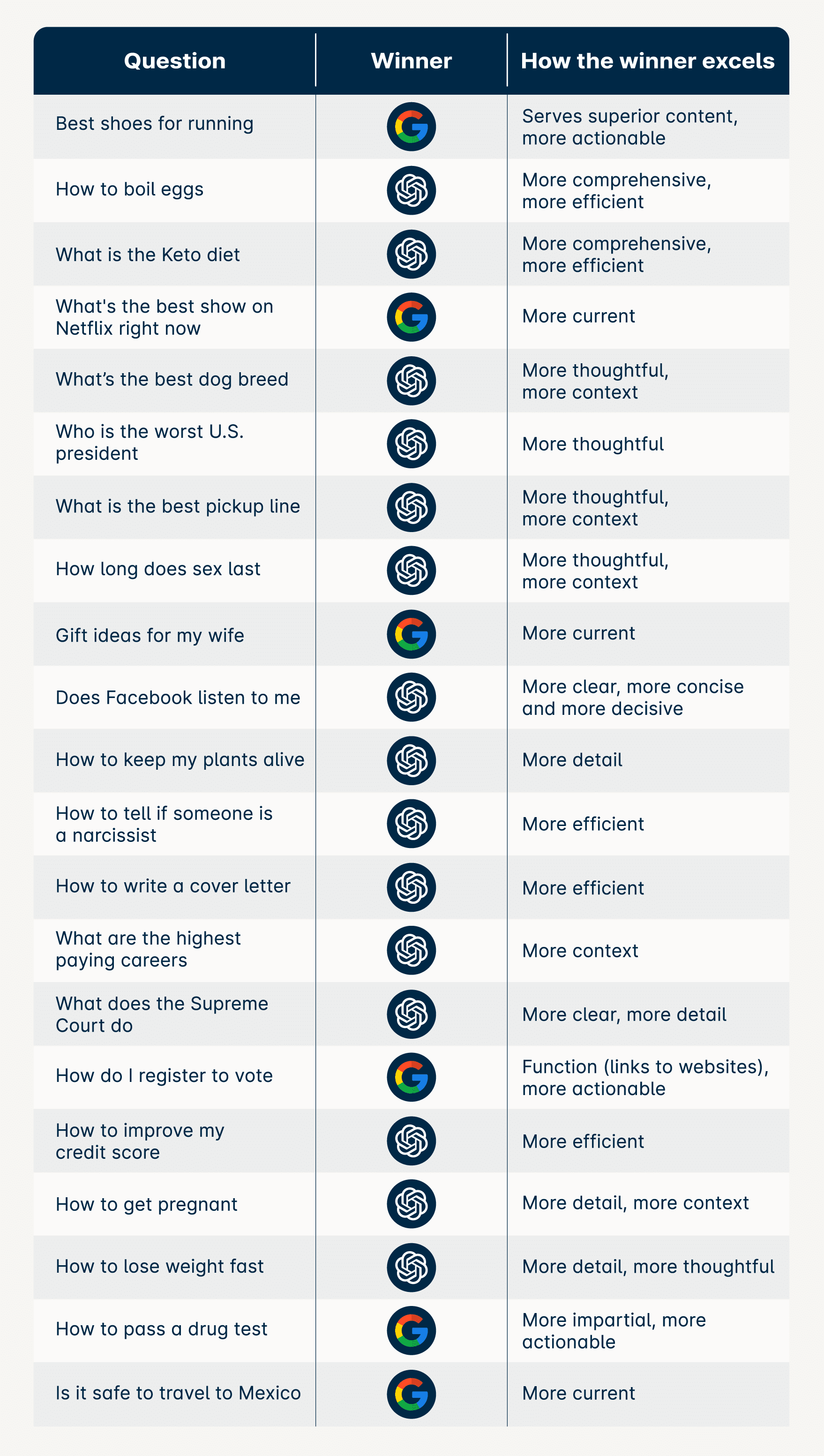
To put these two systems to the test, researchers at Preply conducted a study to compare the performance of Chat GPT and Google Search in answering various types of questions. The researchers found that while both systems had their strengths and weaknesses, Chat GPT was able to provide more accurate and relevant answers to a wider range of questions than Google Search when comparing the total 40 questions. Though the scale of this study was very small, yet, Google was declared winner on 16 answers while ChatGPT was leading the race on 23 queries while there was tie on just 1 question.
Chat GPT is an artificial intellect language model that uses machine learning to understand natural vocabulary and generate responses to a wide range of questions. It was trained on a massive dataset of text from the WWW and other sources and can be utilized to answer questions, provide recommendations, or engage in casual conversation.
In the study, the researchers sampled both AI and Google Search on a variety of inquiry types, including factual questions, opinion-based inquiries, and questions that required more nuanced or contextual understanding. They found that Chat GPT was able to provide more accurate answers to factual questions, and was better able to understand and respond to questions that required contextual understanding.
For example, when asked 'Is God real?', 'What is the meaning of life?', & 'How to boil eggs?', then Open AI's tool gave more clearer and concise answers as compared to Google.
While Google Search still outperformed Chat GPT in certain areas, such as providing quick and simple answers to straightforward questions, the researchers noted that Chat GPT's ability to provide more detailed and accurate answers to a wider range of questions made it a promising alternative to traditional search engines.
As the field of artificial intelligence continues to evolve, the potential applications for language models like Chat GPT are becoming increasingly clear. From virtual assistants and chatbots to recommendation systems and personalized tracking engines, there are a variety of ways that these advanced language models can be used to improve the way we interact with technology and access information.
It makes sense that Chat GPT would lose when answering time-exposed queries because the data set used to train it is only dated through 2021. However, as we already noted, that disadvantage didn't prevent it from outperforming the venerable Google search on the whole.
Naturally, Alphabet is currently exerting significant pressure on the Bard. Microsoft funded early in Open AI, so its capabilities are already seen in Bing search engine previews. Additionally, Open AI-assisted Bing is fully current and does not only use data that has been crawled up to 2022. Even sources will be cited, something Chat GPT does not do (but should). It won't even be hindered by Open AI's sluggish servers. Alphabet has been shaken by all of these causes.
While the debate over which search engine is smarter may never be fully resolved, the study suggests that Chat GPT is a powerful tool that has the potential to revolutionize the way we search for and access information in the years to come. However, it's important to note that ChatGPT and the search engine that it backs Bing is still churning out several misinformed and factually incorrect data points for the vast majority of users.
Read next: Here Are the 7 Biggest Roadblocks to AI Assisted Search Engines
by Arooj Ahmed via Digital Information World
To put these two systems to the test, researchers at Preply conducted a study to compare the performance of Chat GPT and Google Search in answering various types of questions. The researchers found that while both systems had their strengths and weaknesses, Chat GPT was able to provide more accurate and relevant answers to a wider range of questions than Google Search when comparing the total 40 questions. Though the scale of this study was very small, yet, Google was declared winner on 16 answers while ChatGPT was leading the race on 23 queries while there was tie on just 1 question.
Chat GPT is an artificial intellect language model that uses machine learning to understand natural vocabulary and generate responses to a wide range of questions. It was trained on a massive dataset of text from the WWW and other sources and can be utilized to answer questions, provide recommendations, or engage in casual conversation.
In the study, the researchers sampled both AI and Google Search on a variety of inquiry types, including factual questions, opinion-based inquiries, and questions that required more nuanced or contextual understanding. They found that Chat GPT was able to provide more accurate answers to factual questions, and was better able to understand and respond to questions that required contextual understanding.
For example, when asked 'Is God real?', 'What is the meaning of life?', & 'How to boil eggs?', then Open AI's tool gave more clearer and concise answers as compared to Google.
While Google Search still outperformed Chat GPT in certain areas, such as providing quick and simple answers to straightforward questions, the researchers noted that Chat GPT's ability to provide more detailed and accurate answers to a wider range of questions made it a promising alternative to traditional search engines.
As the field of artificial intelligence continues to evolve, the potential applications for language models like Chat GPT are becoming increasingly clear. From virtual assistants and chatbots to recommendation systems and personalized tracking engines, there are a variety of ways that these advanced language models can be used to improve the way we interact with technology and access information.
It makes sense that Chat GPT would lose when answering time-exposed queries because the data set used to train it is only dated through 2021. However, as we already noted, that disadvantage didn't prevent it from outperforming the venerable Google search on the whole.
Naturally, Alphabet is currently exerting significant pressure on the Bard. Microsoft funded early in Open AI, so its capabilities are already seen in Bing search engine previews. Additionally, Open AI-assisted Bing is fully current and does not only use data that has been crawled up to 2022. Even sources will be cited, something Chat GPT does not do (but should). It won't even be hindered by Open AI's sluggish servers. Alphabet has been shaken by all of these causes.
While the debate over which search engine is smarter may never be fully resolved, the study suggests that Chat GPT is a powerful tool that has the potential to revolutionize the way we search for and access information in the years to come. However, it's important to note that ChatGPT and the search engine that it backs Bing is still churning out several misinformed and factually incorrect data points for the vast majority of users.
Read next: Here Are the 7 Biggest Roadblocks to AI Assisted Search Engines
by Arooj Ahmed via Digital Information World
Thursday, February 16, 2023
Search engines have lost their reach because consumers have started visiting social media platforms for product research
Whenever it comes to purchasing something new, many people tend to first research the product they are willing to buy. Many U.S. citizens would take help from search engines such as Google to learn more about the item. However, a recent study has shown that people’s use of search engines for such purposes has now started to decline.
Statista’s Consumer Insight report revealed that three years ago, in 2019, almost 69 percent of U.S. citizens would go to a search engine to learn more about the product, and by 2022, the figures had come down to 54 percent. This means 15% of the people stopped using Google or any other such platforms to research the product.
However, on the other hand, social media platforms, including websites and applications, started to gain popularity as they began having more influence as a platform offering research on the desired items. Last year, people looking forward to social networks for product information went up by 4 percent. Upon further analysis, it was observed that people between the ages of eighteen and sixty-four started using such platforms for the same purposes that search engines were once used for.
Similarly, electronic and print media such as magazines and newspapers as well as online websites for such articles also observed an increase from 2019 to 2022 as more people started referring to them for product insight. Print media houses offering consumer sections such as Consumer Reports are also among the most relied-upon sources for consumers. In addition to this, the New York Times-owned Wirecutter, a review website, has also been actively working to provide insight on different products since it was bought by the New York Times company seven years ago, in 2016.
According to the chart, search engines weren’t the only platforms that suffered losses. Customer reviews also decreased from 46 percent in 2019 to 34 percent in 2022. Similarly, online stores also suffered a reach loss, as the figures dropped from 40 percent in 2019 to 33 percent last year.
Read next: What Tools Does A Small Business Need For A Successful Empire? This Study Has The Answer
by Arooj Ahmed via Digital Information World
Statista’s Consumer Insight report revealed that three years ago, in 2019, almost 69 percent of U.S. citizens would go to a search engine to learn more about the product, and by 2022, the figures had come down to 54 percent. This means 15% of the people stopped using Google or any other such platforms to research the product.
However, on the other hand, social media platforms, including websites and applications, started to gain popularity as they began having more influence as a platform offering research on the desired items. Last year, people looking forward to social networks for product information went up by 4 percent. Upon further analysis, it was observed that people between the ages of eighteen and sixty-four started using such platforms for the same purposes that search engines were once used for.
Similarly, electronic and print media such as magazines and newspapers as well as online websites for such articles also observed an increase from 2019 to 2022 as more people started referring to them for product insight. Print media houses offering consumer sections such as Consumer Reports are also among the most relied-upon sources for consumers. In addition to this, the New York Times-owned Wirecutter, a review website, has also been actively working to provide insight on different products since it was bought by the New York Times company seven years ago, in 2016.
According to the chart, search engines weren’t the only platforms that suffered losses. Customer reviews also decreased from 46 percent in 2019 to 34 percent in 2022. Similarly, online stores also suffered a reach loss, as the figures dropped from 40 percent in 2019 to 33 percent last year.
Read next: What Tools Does A Small Business Need For A Successful Empire? This Study Has The Answer
by Arooj Ahmed via Digital Information World
Pay Rates for Sponsored Posts on TikTok Have Declined by 5% YoY
Part of the process by which social media platforms are trying to achieve dominance is through enticing content creators. TikTok has tried to position itself as a leading platform for creators who are looking to put content out there and monetize it, but in spite of the fact that this is the case its pay rate has been declining gradually over the years with no sign of it going back up anytime soon.
With all of that having been said and now out of the way, it is important to note that this is not a trend that can be seen on a few other social media platforms. For example, it seems that the pay rate for sponsored posts happens to be going up on Instagram.
According to a survey conducted by Hashtag Pay Me, sponsored posts on TikTok can net a content creator around $2,947 on average. This has gone down from the $3,108 that creators could have received as sponsorship money for a post back in 2021.
Meanwhile, the average rate of pay for a sponsored post on Instagram appears to be telling a different story entirely. Back in 2021, a creator could receive $3,652 on average from a sponsored Instagram post, and this has increased by an incredible 39% to reach $5,077 last year in 2022.
However, despite the relative decline in payment amounts for sponsored posts, TikTok is projected to gain an even larger share of the content creator market in the US by 2024. Back in 2020, around 5.4% of ad spends on influencer marketing went to TikTok. Fast forward to 2024 and this proportion will be closer to 18.5%, which suggests that marketing agencies will be spending more ad dollars on TikTok than might have been the case otherwise.
One thing that creators can do here is to try to get paid for multiple posts. According to the survey, a single post could net an average of $1,427 for creators. However, if they were able to get a contract for five posts, the average payment per post would skyrocket to $3,667.
Also, we might be seeing an era where small creators can finally start to level the playing field. Smaller creators can get close to 20% more engagement due to them having a closer relationship with their followers.
All in all, the world of influencer marketing is going through a series of seismic shifts, and there is no way to tell which platform or influencer will come out on top once they make it to the other side. Whatever the case may be, it seems like TikTok is here to stay.
Read next: How many former employees from the world's biggest companies now run their own businesses?
by Zia Muhammad via Digital Information World
With all of that having been said and now out of the way, it is important to note that this is not a trend that can be seen on a few other social media platforms. For example, it seems that the pay rate for sponsored posts happens to be going up on Instagram.
According to a survey conducted by Hashtag Pay Me, sponsored posts on TikTok can net a content creator around $2,947 on average. This has gone down from the $3,108 that creators could have received as sponsorship money for a post back in 2021.
Meanwhile, the average rate of pay for a sponsored post on Instagram appears to be telling a different story entirely. Back in 2021, a creator could receive $3,652 on average from a sponsored Instagram post, and this has increased by an incredible 39% to reach $5,077 last year in 2022.
However, despite the relative decline in payment amounts for sponsored posts, TikTok is projected to gain an even larger share of the content creator market in the US by 2024. Back in 2020, around 5.4% of ad spends on influencer marketing went to TikTok. Fast forward to 2024 and this proportion will be closer to 18.5%, which suggests that marketing agencies will be spending more ad dollars on TikTok than might have been the case otherwise.
One thing that creators can do here is to try to get paid for multiple posts. According to the survey, a single post could net an average of $1,427 for creators. However, if they were able to get a contract for five posts, the average payment per post would skyrocket to $3,667.
Also, we might be seeing an era where small creators can finally start to level the playing field. Smaller creators can get close to 20% more engagement due to them having a closer relationship with their followers.
All in all, the world of influencer marketing is going through a series of seismic shifts, and there is no way to tell which platform or influencer will come out on top once they make it to the other side. Whatever the case may be, it seems like TikTok is here to stay.
Read next: How many former employees from the world's biggest companies now run their own businesses?
by Zia Muhammad via Digital Information World
Subscribe to:
Posts (Atom)