Saturday, February 18, 2023

When Do Kids Become More Tech Savvy Than Parents?

Children that were born into a world in which a certain type of tech is commonplace will obviously be more in touch with modern devices than their parents. Adults tend to see tech innovations over the course of their life, but their understanding of these innovations is often not that intuitive. Hence, children are becoming more tech savvy than their parents earlier than might have been the case otherwise.

With all of that having been said and now out of the way, it is important to note that a recent survey revealed what parents seem to think about all of this. It turns out that 47% of parents are aware that their kids are already more tech savvy than they are. 15% said that this allowed them to get tricked, such as in situations where their kids easily turned off safety settings that they had added to their phones or other devices.

57% of parents also said that they wished they were more tech savvy because of the fact that this is the sort of thing that could potentially end up allowing them to take better care of their children. 66% of parents have never heard of modern internet slang such as OOMF, Face Card and GRWM. That makes them feel alienated from the language of their children, almost as if their kids are speaking in some secret dialect.

In spite of the fact that this is the case, 90% of parents said that they can talk to their children about such things and find some common ground. That is very important, since a lot of parents tend to make the mistake of trying to be too controlling over how their children access the internet. That can make kids go online in secret, and the high degree of tech savvy that they have means that parents would never know.

All in all, it was inevitable that a knowledge gap would occur when it comes to tech savvy. Parents can always learn more about tech if it matters to them, although the speed at which such things change might make that difficult.


Read next: According To This Poll, Bing Chatbot Will Take Up Just 2% Of Google’s Market Share
by Zia Muhammad via Digital Information World

Google Called A Durable Monopoly In Search By US Supreme Court As Its $168 Billion Ad Revenue At Stake In Another Case

Google has been dubbed as behaving as a dual monopoly in the world of search by the US Justice Department.

It claims the leading Android maker functions as the gatekeeper of the internet due to these reasons. It was mentioned in a series of newly published court papers that remain unsealed.

The tech giant has been accused further of cementing all monopolies via exclusionary distribution documents that make way for billions of dollars through the likes of search on Google every single day.

And by having a great number of users on a daily basis, the entire mechanism works in a feedback loop that impacts the quality of search results of users as well as the degree of competition taking place.

These court papers were filed in the District of Columbia through Judge Amit Mehta as a reply to the tech giant’s request for a summary. This in turn means a judgment would arise before a trial could begin in terms of antitrust lawsuits being brought out by both federal as well as state officials.

These lawsuits were set out in the latter part of 2020 and included accusations that the search engine giant got great dominance on the web by forcing itself to be a default search engine seen across the Mozilla Firefox Browser as well as Safari, which is Apple’s offering. They managed to do it by arranging another pre-installed search engine on various Android smart devices.

But Google is not backing down without any fight. It argued that all documentations with tech giants Apple and Mozilla weren’t anti-competitive for a number of reasons. And that means these deals don’t stop consumers from resorting to different options in the world of search.

The US Justice Department mentioned that no matter what Google may believe, default settings do end up impacting traffic immensely.

So by being the default search engine, Google is smartly reaching out to so many of its user base as the browser is preinstalled as well as placed so appropriately on an app. Users that have a default browser in place tend to stick to it, even if they are given the chance to make amendments to such settings.

On another front, the country’s Supreme Court is all set to hear out a new case that spells danger for the web’s most attractive business. The case filed against Google talks about whether or not big tech giants have the right to attain content that their respective algorithms end up recommending to others on the platform.

But many big names in the industry feel they are protected by some huge legal shields that give them the right to do so.

However, a lot of the case’s discussion is related to online firms and if the court feels they are responsible legally to answer to the millions of comments, posts, and videos set out by users on a daily basis, then this is certainly news.

What it could also end up doing is affecting the major way through which tech giants like Google make money which is online advertising. Both Google as well as Meta rely on this to generate revenue for their firms and we can only imagine the outcome of this case that Google is looking through the eyes of a very threatening affair.

The lawsuit is brought forward by an American citizen’s family named Nohemi Gonzalez who was reportedly killed in an Attack in Paris in the year 2015. They feel both Google and its YouTube app need to be brought to justice for providing automated recommendations for explicit videos that promote such terrorist activities.


H/T: Bloomberg / MP

Read next: Research on Mobile Phone addiction Links Constant Checking to Mental Failures in Daily Life
by Dr. Hura Anwar via Digital Information World

Twitter Gives Users Another Setback After Announcing Charges For Two-Factor SMS Authentication

In today’s modern digital world, you can never have too much security and privacy. It’s no wonder why users scramble to pay extra and attain features that guarantee just that.

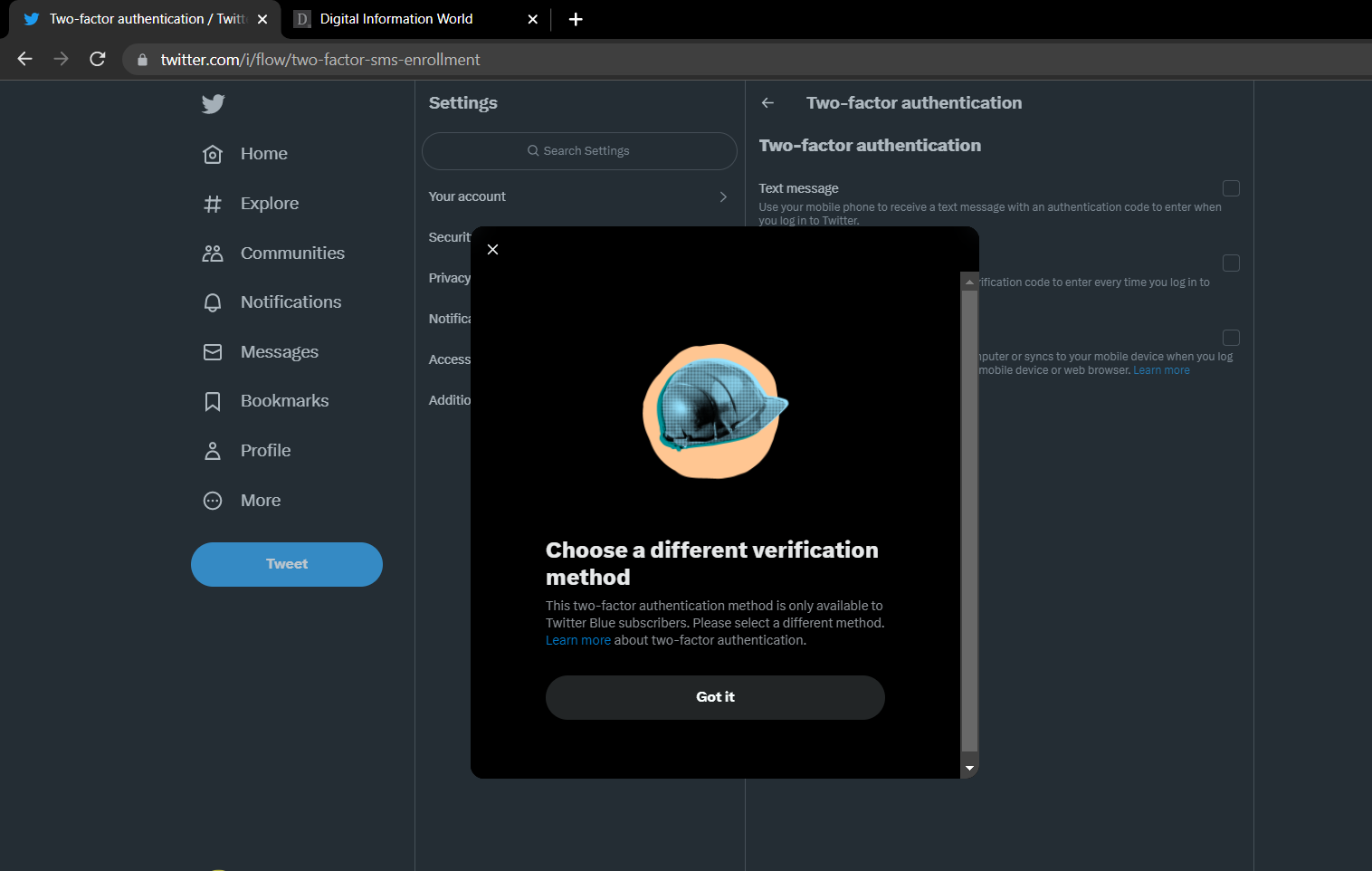
Twitter users have been securing accounts using a two-factor authentication feature via SMS. But as per new rules, the platform is opting to remove the free-of-cost endeavor, starting March of next month.

So if you wish to attain that extra layer of protection, you’re going to have to pay for it as it’s no longer free of cost and would be offered as a subscription fee. The other option is to eliminate the feature and perhaps opt for something else.


For those that might not be aware, the feature enables users to protect accounts in situations of password theft. Moreover, those that do have the feature enabled can simply access their account after plugging in passwords and codes that are attained via a simple SMS or any other app for authentication. Other features that can be utilized include the likes of the security key.

The firm recently mentioned in a blog post how it was not keen on enabling users to log into the SMS feature method for the 2FA until and unless they join the Blue Twitter Subscription offering.

For those still confused as to what significance it holds, the app is yet to make it necessary for log-ins however experts do feel it’s one of the best means when resorting to a safe and carefree in-app experience.

Twitter went public with the news on Friday where they tweeted that the feature only puts a restriction on the types of methods available for 2FA that aren’t already Twitter Blue members.

The app’s Blue subscription fee currently stands at $8 a month if taken through the web but you’ll have to pay $11 if subscribing via a mobile device like iOS.

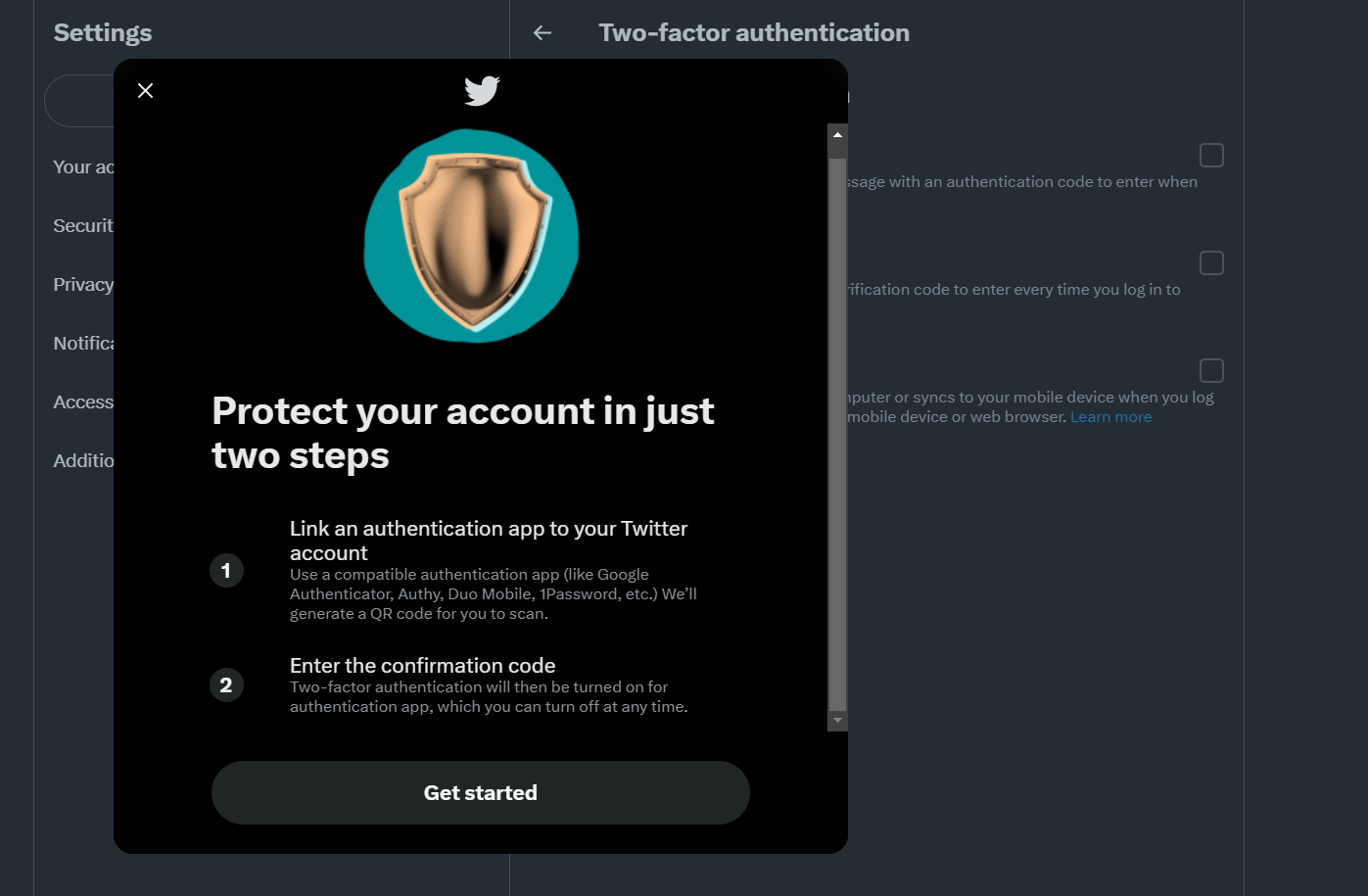
The app’s users may alter their 2FA app by entering the settings of their account. After pressing on the likes of security and account access, you’ll see three options enlisted in a space designated 2FA.

The news from Twitter came a few hours after a tweet from Zoe Schiffer came forward about the change.

But users may not be too happy as this looks like another means through which the app is enticing more people to subscribe as advertisers take a step back.

The company has been struggling on the revenue generation front and therefore is trying to search for alternatives by which it can make money without having to rely heavily on ads.

Today, the app’s subscriber count stands at 180,000 in America so as you can imagine, it’s not loved by too many of the app’s people. But it still hasn’t given up hope yet. It wants to offer new blue ticks, more exciting features, and some more options for longer tweets across the board.

Meanwhile, the change also arises at a time when the platform is facing a lot more scrutiny amid complaints from top whistleblowers about how the firm fails to do more to protect its own users on the app.

In 2022, so many complaints arose about how the 2FA system was not even functioning properly. And that’s when the app under the leadership of Musk hoped to search for cases where SMS codes failed to get delivered to respective users demanding it.

Twitter has similar spoke about how the feature is often used and abused by those wishing to inflict harm on the app such as hackers and other bad actors.

These individuals try to gain access to certain codes sent out via texts by transferring a user’s phone number to other devices via a procedure called sim swap.

For security-savvy users Google Authenticator is still a good option to try.


Read next: Twitter users will soon be able to choose the quality of uploaded videos
by Dr. Hura Anwar via Digital Information World

According To This Poll, Bing Chatbot Will Take Up Just 2% Of Google’s Market Share

With the craze of AI-powered technology reaching new heights, both Google and Microsoft have opted to launch their own chatbots.

The news comes after the success seen with OpenAI’s ChatGPT. While Google is yet to announce a timeline for the release of its chatbot named Bard, Microsoft is going full throttle with its new Bing Search Engine.

It has really turned into a massively popular endeavor with huge success at the App Store in terms of record-breaking downloads. A lot of people are holding great expectations with it as they’re put on a waiting list before actually being given the chance to use it.

But a recently published poll on the Twitter platform by Matt McGee is shedding light on some very interesting news. The poll asked users of the app how much market share of Google’s search engine would the new Bing Search end up taking. And most of the responses generated turned out to be less than 5%.

Yes, you heard that right. It’s actually quite interesting when you come to think of it. Moreover, there were at least 560 people who produced a response so not a lot of people did end up taking part. However, the breakdown is definitely very interesting.

60% of respondents opted for the 0 to 5% market share. On the other hand, 20% claimed the answer would be around 6 to 10%. And then 10% said it would be near 11 to 20% but then another 10% felt the answer would be greater than 20%.

The results are awfully interesting, and not what a lot of critics would probably guess. But again, the responses generated were rather low. And to just predict a change in the market based on this isn’t the best way to go about the situation.

At the same time, let’s not forget how Google is a huge search engine so at the end of it all, Bing requires just a fraction of the percentage to produce big bucks. And in case you didn’t know, the Bing Search engine is already a profitable affair for software giant Microsoft. Hence, any major increase is going to be huge for a firm like Microsoft.

What do you think? How big of an impact can Bing end up making on Google’s total market share?


Read next: 70 percent of Americans believe websites will be replaced by apps in the next 10 years
by Dr. Hura Anwar via Digital Information World

Friday, February 17, 2023

Microsoft Says Its New Bing Experience Is Being Loved By 71% Of Its Userbase

Ever since Microsoft went public with its new AI-powered Bing Search experience, we’ve seen some great responses from the masses.

It exceeded many people’s expectations in terms of popularity, generating millions of downloads at the App Store. People were quick to get their hands on the waiting list. But that’s not all.

Software giant Microsoft is also celebrating after new figures have proven more signs of success. According to the firm’s new blog post, at least 71% of its users are loving the new Bing experience. And that too is only in its first week since the launch going live.

The organization claims that most searchers noted having a positive experience and gave it a thumbs-up review. Moreover, you might even be shocked to learn that there were a few chat sessions taking place on the app where the duration went up to two hours! Yes, that’s definitely something to rave about considering you’re working with an interface comprising a Bing chatbot.

Furthermore, the company hailed the new experience by users because they provided a lot of great feedback on how this feature could improve further in the future. They expected that to arise because it is still very new.

Microsoft has outlined since day one that it needs all the feedback it can get to help bring about a more enhanced user experience.

As far as the areas delineated for improvement are concerned, there were quite a few that the company has noted down. This includes answers requiring data on a more timely basis like reports from the finance world or the sports industry.

Similarly, queries linked to social entertainment and general global discovery of the world were another place many felt the chatbot was lacking. Others highlighted how a lot of the answers seemed too repetitive while others spoke about a weird tone being attached to them.

Others shed light on a few technical errors including broken links, inadequate formatting, and also slow speed downloads. And last but not least, searchers felt there was a general lacking of domains linked to travel and booking flights and even sending out mail or sharing news with proper responses.

The company knows that there is a long way to go before they can call it perfect but so far, so good. They have already started working on the major issues based on the feedback so that clearly gives rise to more exciting times ahead.


Read next: Battle of the Brains: Chat GPT Takes on Google Search in AI Showdown
by Dr. Hura Anwar via Digital Information World

Twitter users will soon be able to choose the quality of uploaded videos

According to Nima Owji, an app researcher, Twitter is working to let its users choose the quality of their uploaded video content. Nima, while sharing the news with his followers through his Twitter profile, uploaded a screenshot offering 720p as the recommended video quality and 1080p as the rarely needed quality (something like YouTube, but we wonder if the micro-blogging platform is ever going to offer 2K or 4K option).

The video quality issue is not new, and Twitter is not the only platform having video quality problems. It has been observed that whenever video content is uploaded, it gets compressed significantly. This step is taken to provide a better experience to the users. Video content of high quality will need more bandwidth. As a result, viewers with low-speed Internet won’t be able to enjoy the uploaded media on time and may get frustrated. Hence, a compressed video will be able to get itself loaded even on a low-speed Internet connection.

Twitter may compress the video due to several factors, including the techniques used for compression. Compression on the platform is not similar to the way users' devices deal with it. Hence, the content may end up getting compressed for reasons that are better known to the regulator.

The speed of the internet connection is also an important factor that determines the compression level. Users with the “Save Data” feature enabled will be viewing videos in low quality as the content will be displayed according to its optimized format.

If a user tried to upload an optimized video, the platform wouldn’t have any reason to compress it; however, if a user uploaded a non-optimized video that may go against video specifications, the content would be compressed.

If a video is being uploaded from a device carrying a virus, the file may end up corrupt. As a result, the content may get blurry and get uploaded with the same blurriness.

Hence, to ensure that the content doesn’t get compressed, users can make sure that they are uploading an optimized version of the video that follows the video specification available on the platform. It is better to keep the original version of the video as well. By following the video requirements, videos won’t be tampered with and will be uploaded in their original form.


Read next: Pay Rates for Sponsored Posts on TikTok Have Declined by 5% YoY
by Arooj Ahmed via Digital Information World

Report Reveals Alarming Data Breach Trends Among Data Brokers in the US: Over 200 Million Records Compromised

What’s worse than data brokers collecting and selling personal information? Data brokers that suffer data breaches resulting in the exposure of your info.

Research conducted by Incogni established that out of the 506 registered, US-based data brokers, 23 had experienced a data breach. How many records were compromised? And where did these breaches occur? Here's everything you need to know.

What are data brokers?

Data brokers are companies that collect, aggregate, and sell personal information. This information can include names, contact details, addresses, financial data, criminal records, and even Social Security numbers.

Data brokers scrape the web for this personal data, gathering it from various public sources, such as public records or social media sites, but also from your search history or purchase history. Further, data brokers may also obtain it from one another or when a data breach occurs. The latter has been a particular cause for concern, especially regarding data privacy.

What are data breaches, and how do they happen?

A data breach is an incident during which sensitive (such as personally identifiable information) or confidential information is accessed by an unauthorized party. The affected entity may not even be aware that the breach has occurred and only learn about it after a significant amount of time has passed.

Data breaches can occur for various reasons, ranging from human error (like succumbing to phishing attacks, incorrectly setting up firewalls, delaying updates, etc.) to a deliberate cyberattack which can be carried out by using malware, DNS tunneling, SQL injection, and more.

Is the number of data broker data breaches on the rise?


Incogni recently conducted an analysis of data broker breaches in the United States. According to their findings, the first data broker data breach occurred in 2002 and involved Acxiom, which actually suffered two breaches. The only other data broker breach during that decade took place in 2005 when LexisNexis was breached.

Once 2011 hit, things started to go downhill, with a data breach happening almost every year, 2014 and 2022 being the only two exceptions. The year 2017 experienced a massive spike, with six companies being breached.

With the COVID-19 pandemic spreading, 2020 was a challenging year that witnessed a significant surge in cybercrime. The number of cybercrime victims increased dramatically, by 69%, highlighting the severity of the situation. As a result, it is perhaps not surprising that a total of nine data breaches occurred during this time.

There was a decrease in the number of data breaches in 2021, with only three breaches reported. While no reports of data breaches were received in 2022, it’s important to note that data breaches are not always immediately discovered. That’s why the accuracy of this information is yet to be confirmed.

Exceptions like the 2021 decline notwithstanding, the trend throughout the first two decades of the 21st century has been one of increasing numbers of data broker data breaches.

Where do data breaches happen most often?

To understand why data breaches happen where they happen, we must first look at where data brokers are registered. With a total of 113, California takes first place in the most significant number of registered data brokers. Second is New York, with 82 data brokers, and the third is Florida, with a "mere" 41 brokers.

Keeping this data in mind, it should come as no surprise that it is also California that saw the greatest number of data broker breaches, with five of its registered brokers experiencing data breaches. New York followed with three breached data brokers, and Washington and New Jersey tied for third place, each with two breached data brokers.


Note: Experian and Equifax were excluded from this data set, as these data brokers operate through multiple subsidiaries located in different states, thus making it difficult to attribute their breaches to a specific location.

Largest data broker breaches

The graph below illustrates the ten most substantial data broker breaches, which collectively impacted an astounding 444.5 million accounts. Interestingly, all occurred between 2012-2021.


California-based People Data Labs accounted for most breaches, making up 40% of the total, with 179 million records leaked. Following in second place was Apollo.io, with 17.8% of the breaches resulting in 79.2 million records leaked, and in third place was ShareThis, with 10.8% of the breaches and 41 million records leaked.

The global impact of data broker breaches

Since 2004 the US has had a staggering 207.6 million accounts leaked. The other four countries affected the strongest by these breaches include India, the UK, Brazil, and Canada.


Conclusion

“Data privacy is becoming increasingly alarming, yet many people are still unaware of the hidden market in which data brokers operate. Upon reviewing the findings, we have seen that data brokers can also experience a data breach, just like any other company. However, they are the ones dealing with massive amounts of sensitive data.” - says Darius Belejevas, Head of Incogni.

“Even though there is nothing we can do about data leaks, there are ways to minimize the amount of our data that ends up on data broker websites in the first place. Apart from optimizing your online privacy settings and removing unused accounts, you can also opt out of data broker records.”

You can manually send opt-out requests to data brokers asking them to remove your personal information or turn to a data removal services that will automatically send removal requests to data brokers and people search sites on your behalf without you having to lift a finger.

Read next: Study Shows Refund and Tech Assistance Frauds Are on the Rise
by Web Desk via Digital Information World