Sunday, February 19, 2023

Conducting Effective Breach and Attack Simulations: 4 Tips for Success

Last year was the worst year in history in terms of the number of cyber attacks and the total damage that they caused for businesses. Across the board, from malware and ransomware to phishing and hijacking, every single form of threat is reaching new peaks. And, considering that on average a single breach takes 277 days for a security team to fix, this is time that your business simply doesn’t have.

In order to keep your business protected, companies are turning to the world of cybersecurity more than ever before. At the current rate, the total global spend on cybersecurity training alone will surpass $10 billion per year by 2027. All eyes are on this field, with any defensive strategy needing to be taken to a new level as soon as possible.

Let’s dive into one of the most effective formats of security refining, breach and attack simulations (BAS). We’ll dive into this method, detailing how businesses can conduct them better to obtain better results, more benefits, and help to reduce the overall threat to their company.

Tip #1: Understand The Strengths and Weaknesses of Your Security Posture

Every business, no matter how international or how effective they are, will have a distinct security posture. In this context, a security posture is the current cyber security status of a network or system, directly referring to the defenses that the business has in place. While some businesses may excel in one or two areas, their current configurations could be leaving holes in their overall defenses.

Before running a breach and attack simulation, your business should take time to recognize its own security posture. What do you excel in? Where could you use a little extra support? Making a list of your current configurations and their strengths and weaknesses will allow you to then create a targeted breach and attack simulation.

When you have a specific area of focus or target, it becomes much easier to then run effective breach and attack simulations. Always start off by running this pre-plan exercise before starting with your actual BAS.

Tip #2: Practice Guilt By Association

Throughout your breach and attack simulation exercises, you’re going to encounter a number of vulnerabilities within different software components. Most of the time, you’re going to be balancing open source software, third-party components, and your own home software in any platform or application.

As a rule of thumb, practice guilt by association when you come across a vulnerability. That is to say, if a particular third-party vendor has one or two vulnerabilities in one bit of software, predict that all of their components will contain similar errors. While you can spend time checking each piece of software, it often saves time to simply look for a replacement.

The time you spent checking each component is much better spent simply replacing this culprit altogether. While this may seem like a pain at the time, being able to move to a more reliable vendor will help ensure the longevity of your safety. With that in mind, it’s always a great idea to practice guilt by association when running your breach and simulation exercises.

Tip #3: Use External Teams

Breach and attack simulations aren’t just something you run once per year. Ideally, you should conduct these as often as possible if you’re going to be better equipped to deal with the mounting cyber threat. Yet, if the same team members occupy the same roles in the red and blue team, then you’re going to run into a knowledge problem fairly quickly.

Even if your team is familiar with the MITRE Attack Framework, there will be certain areas that they overlook or simply don’t have the skills to investigate. That’s where bringing in external teams comes in handy. Not only do external teams have a blank slate to work with, meaning they’ll stumble upon vulnerabilities more naturally, but they may also have other specialized knowledge.

Illustration: Jcomp / Freepik

By working with external teams, you can put your systems against a more realistic threat. Just like real hackers, this external BAS team will work through your systems and attempt to break in. Their broad and distinct knowledge will radically increase how effective your BAS exercises are.

Equally, when putting external teams against your home blue team, it often turns into a very fun - and productive - cybersecurity exercise for everyone.

Tip #4: Practice Kindness

Our final tip is one that we’ve included to help ensure your team remains positive while running breach and attack simulations. A lot of the time, BAS exercises will expose vulnerabilities that your own software engineers have created. Instead of making your team feel bad or embarrassed because of these vulnerabilities, you should practice kindness.

Ensure that you use a no-fault policy. Finding these vulnerabilities is in the best interest of your business. If you want your employees to feel safe and cared for at work, they also need to feel as safe as possible. A no-fault policy will help your team fix errors without a sense of shame or guilt.

In the long run, this will be better for your team, your business, and your pursuit of vulnerabilities through breach and attack simulations.

Final Thoughts

Breach and attack simulations aren’t going anywhere. As one of the most effective methods of screening your own security defenses, this method is a vital part of every cyber security expert’s tool book. Yet, we can push BAS to be even better and deliver more when we include the tips outlined in this article.

From practicing guilt by association to positioning your team in reaction to your unique security posture, there are a number of ways that you can improve the outcome of BAS. If you’re looking to conduct effective breach and attack simulations, then working through this list should be at the top of your list of priorities.
by Web Desk via Digital Information World

What Impact Will Generative AI Have? This Survey Reveals the Answers

Generative AI such as ChatGPT has showed us the true capabilities of AI in the modern world, but in spite of the fact that this is the case some people still seem to have mixed feelings about it. It is quite common for people who are hearing about this AI for the first time to look at it with a lot of trepidation because of the fact that this is the sort of thing that could potentially end up replacing them in the workplace.

With all of that having been said and now out of the way, it is important to note that a YouGov survey recently revealed what public opinion regarding AI truly looks like. It turns out that 36% of the people who participated in this survey think that AI is bad for society. 28% said that they were not sure, 23% said that it wasn’t a good thing or a bad thing and just 13% said that AI was a force for good in the world.

Men seem to be more optimistic about AI in general. 16% of men said that generative AI was a good thing, whereas only 9% of women said the same. Also, the statistics tend to skew when you separate them based on the age of the respondents.

People between the ages of 30 and 44 seem the most optimistic, but even there only 20% of them felt that generative AI could have a positive impact on the world around them. The 18 to 29 age bracket was not far behind, with 19% of them saying the same. As for people between 45 and 64, only 9% of them felt that there was any good that can come from AI.

This just goes to show that the widespread use of AI has many roadblocks ahead. Even if it proves useful, it will still have an uphill battle in terms of convincing people that it will not end up doing any kind of grievous harm. Interestingly, 52% of survey respondents said that never using AI is bad for society as well, so perhaps the solution is occasional usage.


Read next: Here Are the 7 Biggest Roadblocks to AI Assisted Search Engines
by Zia Muhammad via Digital Information World

More Than 50% Of Americans Feel News Outlets Intentionally Mislead People As Per This Study

If you think the news you’re reading is actually misleading you in more than one way, well, you might not be the only one.

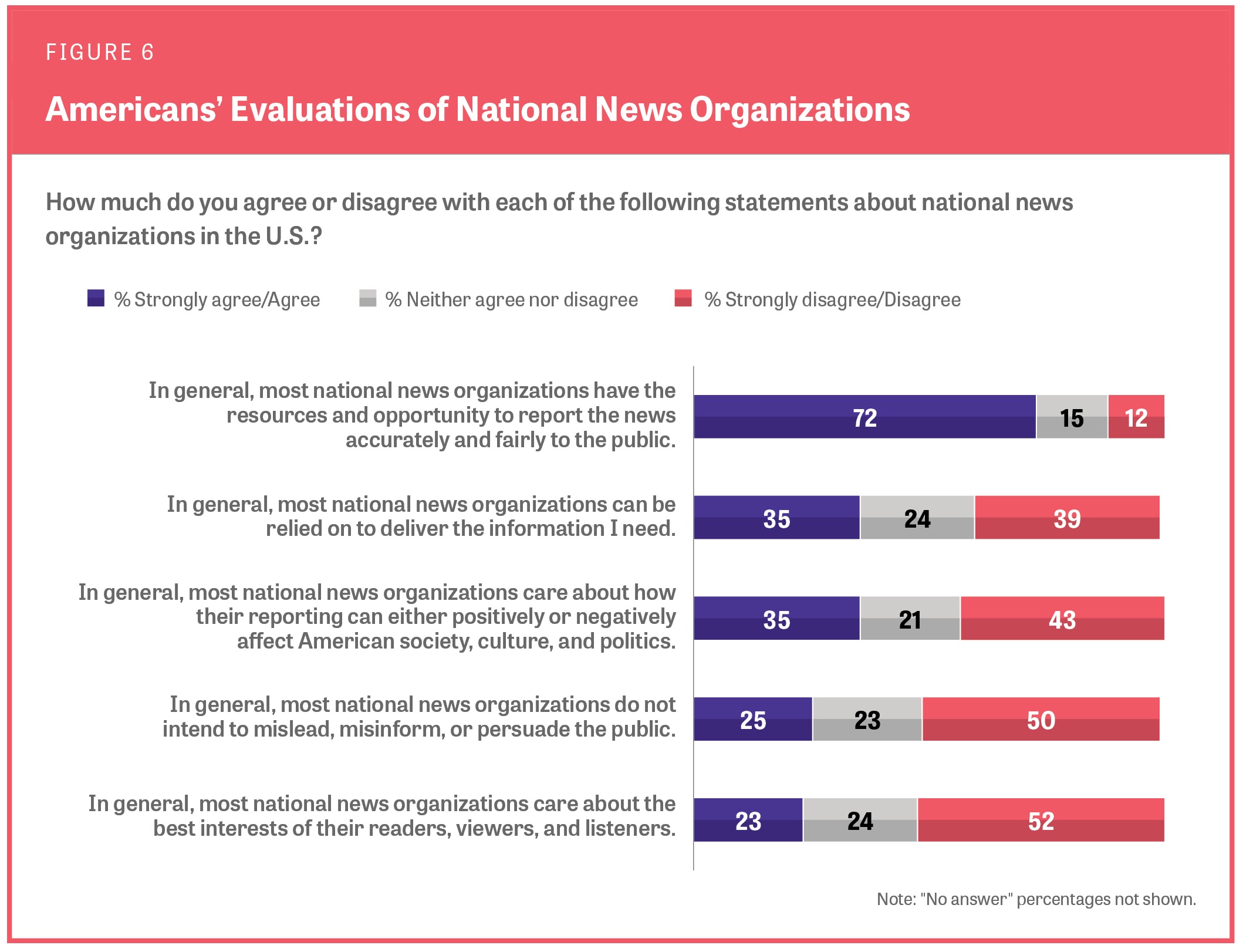
A new study says that more than 50% of Americans feel that they can’t trust local and national media outlets because the news is designed to mislead, misguide, and misinform them on purpose.

This new report comes to us thanks to the Gallup & Knight Foundation. Their national survey proved that only 25% of Americans held an optimistic view of the news but the rest were convinced that the news radiated no sense of positivity or responsibility toward providing the real picture.

More emphasis was placed on local news outlets that so many respondents feel so skeptical about. 23% mentioned how their local news channels could care less about the people reading the information including those viewing and listening to them too. On the other hand, 35% mentioned how they deeply cared about the likes of influencing society with their reporting while the rest felt otherwise.

In terms of generations, it was the American adult population that seemed more positive about local news channels. Here is where 25% disagreed about local papers and news stations that didn’t intend to misguide or persuade the general public.

Similarly, 53% did agree on how local media outlets cared about what effects their reporting would have on the population. Moreover, one recipient of a focus group mentioned these decisions might have to do with local organizations knowing a certain area more specifically.

Therefore, they’re more likely to comprehend the disturbances their wrong actions can bring. Similarly, they felt strongly about the people to which they were communicating their news stories.

As far as topics like funding are concerned, most respondents of this survey felt that both types of news organizations held resources and chances to report the news as accurately and as justly as possible to the general public. Meanwhile, 72% argued that it was just the national news outlets that cared while 65% felt it was the local news outlets that showed more concern.

Whatever the case may be, this report definitely paints a gloomy picture of how much readers and viewers trust the country’s media outlets. Moreover, it provides a clear image of people aren’t keen on reading the news as much as they once used to be in the past.


Read next: 70 percent of Americans believe websites will be replaced by apps in the next 10 years
by Dr. Hura Anwar via Digital Information World

Recession is a Major Concern for 64% of Consumers

The state of economy has been in shambles for quite some time now, and consumers are really starting to feel the burn. As many as 64% of consumers have stated that they are worried about the prospect of a recession. 72% also said that various factors including climate change, inflation and others are having a more significant impact on their life over the past few years.


In spite of the fact that this is the case, there are some consumers who seem unbothered by all that is happening. For example, the Free-to-Be consumer is a category of market participants who stated that they are 52% less worried about inflation or the recession. These are useful consumers for luxury products since their lack of concern means that they are more likely to spend their extra cash instead of saving it.

With all of that having been said and now out of the way, it is important to note that another category of consumer is that of the Anxious-Avoidant consumer. Focusing on issues might be useful because of the fact that this is the sort of thing that could potentially end up making a brand more palatable to consumers who are in this category. Studies show that the likelihood of them buying from a brand goes up by 45% if the brand has the same values as they do.

Finally, we have the category of Cautiously Optimistic consumers. They are not exactly anxious, but they are still wary of what could occur. Such consumers tend to prefer products that have some kind of familiarity or nostalgia value attached to them. They also like products that can boost their self esteem with all things having been considered and taken into account.

This data from State of the Consumer 2023 reveals that grouping customers by demographic might distort the actual factors at play here. Brands must adapt their approach to the new classifications of consumers that are emerging, since not all of them are going to overlap with the categories that brands and marketers may have gotten used to over the past few years and decades.

Read next: Even The Best Websites Are Failing At Catching AI-Generated Content Made By ChatGPT
by Zia Muhammad via Digital Information World

Here’s What the World Thinks About Freedom of Religion in the US

The United States was established on the notion that people would be free to practice whichever religion they chose, and the nation has kept up this tradition to the present day. In spite of the fact that this is the case, many are claiming that the rights and freedoms of Muslims to practice their religion are frequently curtailed, whereas Christians tend to be given a free pass.

With all of that having been said and now out of the way, it is important to note that the US has a fairly positive perception across many countries in the Muslim world. 47% of people living in the UAE said that the US had an excellent level of religious freedom, with 20% saying it was fair and just 17% claiming that it was poor or terrible.

The largest Muslim population in the world currently resides in Indonesia, and the people over there seem to have a fairly positive view of religious freedoms in the US as well. Similarly to the UAE, 47% of Indonesians have a very good perception of freedom of religion in the US, with 25% saying that the US is fair in such matters and only 14% claiming that it is underwhelming.

Malaysia is the only Muslim majority country that serves as an outlier here, with only 34% of Malaysians saying that freedom of religion in the US is excellent.

However, it should also be noted that the five countries that seem to have the highest opinion of the US in terms of religious liberties are all Christian majority nations. Kenya comes at the top of the list with a whopping 64% of Kenyans agreeing that the US has excellent freedom of religion laws. Colombia and Ghana came in second with 60% apiece, followed by Poland with 52% and Chile with 51%.

In spite of the fact that this is the case, there are several Western countries that happen to have Christian majorities which have a very poor few of how people of different religions are treated within the United States of America. For example, only 32% of Germans, 26% of Canadians, 21% of Australians, and 19% of UK citizens think that freedom of religion in the US is in any way excellent.

As for people who think that the state of freedom of religion in America is poor or terrible, the numbers are quite high for these western countries. 25% of Canadians believe this, as do 27% of Australians and 27% of people in the UK.

People who responded to this survey generally felt like Muslims were not treated fairly in the US. 41% of Canadians felt like Muslims were treated worse than other religious minorities. 32% of Australians, 39% of Malaysians, and 36% of people from the UK said the same.

Even countries like Indonesia and the UAE that have generally favorable views of religious freedoms in the US agreed. 34% of Indonesians and 37% of UAE residents stated that Muslims are not treated fairly in the US and that they face a lot more discrimination than members of any other religious group which makes America’s image as the land of the free less believable than might have been the case otherwise.


H/T: Morning Consult

Read next: Most of the Retailers Throw Your Returns in the Landfill and You Can Avoid This By Following Some Tips
by Zia Muhammad via Digital Information World

Saturday, February 18, 2023

96 Percent of Mobile Marketing Consists of Video, Here’s Why

If there is one thing that has truly begun to change the shape and face of marketing, it is the rise of video. It turns out that 91% of businesses are now using video in their various marketing campaigns, as per Wyzowl data. This is a huge increase from the 61% that was seen back in 2016, and it indicates that marketing is becoming ever more central since almost every single business out there seems to find some value in its usage.

With all of that having been said and now out of the way, it is important to note that the reasons behind why video is being used more frequently in marketing are rather diverse. When advertisers were surveyed, 41% of them said that creating videos in house had become easier which could help make their use in marketing more affordable than might have been the case otherwise.

Ease of access seems to have played a huge role in the rise of video in marketing with all things having been considered and taken into account. 34% said that it is easier to make videos than it ever was in the past, which makes their preference for this form of content quite understandable in numerous different ways.

What’s more, marketers tend to prefer video because of the fact that this is the sort of thing that could potentially end up making it easier for them to convince their clients of the value of the marketing campaigns. Decision makers at companies that are hiring marketers clearly feel like they can do a lot with video, which helps to make it a more appealing option.

In spite of the fact that this is the case, a lack of time is a significant factor that is inhibiting further growth of video from a marketing standpoint. That actually presents an opportunity for marketers who can step in to help businesses manage their time and create video based content on their behalf. Hence, 70% of marketers that don’t already offer video are planning to hop on the bandwagon in 2023 which could further stimulate growth in a burgeoning sector of the marketing industry.
Read next: 70 percent of Americans believe websites will be replaced by apps in the next 10 years
by Zia Muhammad via Digital Information World

Next WhatsApp Update to Bring Two Major Changes to the Table

With WhatsApp now firmly secure in its status as the single most popular instant messaging app in the world after a brief scare from up and coming services, the platform has been making some changes to further optimize the services it can provide to users. There a couple of new features that are currently in the beta testing phase, and both of them are likely going to level up the user experience on WhatsApp.

The first major update that has been noted for an upcoming version of WhatsApp is largely centered around the desktop version of the messaging service. Users will now have a shortcut that will enable them to send pictures and videos without having to open up their app. This will allow for faster image sharing, although users will still have to contend with the file compression that is a standard part of services like WhatsApp.


Previously, users had the option of selecting a file, but they then had to pick through all the different file types until they found what they were looking for. With all of that having been said and now out of the way, it is important to note that users will now be able to scroll through their gallery, similarly to how they user the smartphone app for WhatsApp.

The second update, as per WBI, that is on the cards for WhatsApp has to do with WhatsApp for business. More specifically, the WhatsApp for Business app will now have a communities section because of the fact that this is the sort of thing that could potentially end up bringing the feature to enterprise grade users.


This is a feature that has been requested for a long time, and it is great that WhatsApp has finally gotten around to it.

Both of these updates appear to indicate that WhatsApp is constantly working behind the scenes to tweak and upgrade the app. While the wider rollout of these updates is not currently confirmed, beta testing seems to indicate that the release is just around the corner with all things having been considered and taken into account.

Read next: Study by CIRP found where people buy the most Apple products in the US
by Zia Muhammad via Digital Information World