At the start of this month, both Google and Microsoft introduced their AI chatbots to the world.
The new AI-powered Bing search by Microsoft is already in the market with some users grabbing a hold of it as we speak while others wait patiently on a waiting list. Google on the other hand is being more careful with the launch as it feels it might not be ready just yet. So the Android maker is busy conducting internal tests so that everything is perfect before it expands its reach to the masses.
Each company is speaking in detail about how much it’s loving the chatbot and what great advantages are on offer. But what they fail to mention are the costs related to their operations. And let us tell you that it does not come cheap.
Think along the lines of expenses that are ten times the usual for operating the regular Google search. Reuters was quick to mention in the report how this type of technology with such a huge language model is probably going to strike huge expenses. This might be one reason they’re doing everything they can to make it so popular that people start attaining subscriptions in the future and also the addition of ads can make a huge difference too.
When it was December 2022, the CEO of OpenAI claimed on Twitter how the costs can be eye-watering. This is one reason why it ended up getting launched in February with a lot more features and better speed which would now make it available for $20 monthly.
A report from Reuters further elaborated on how Google was left with paying just a fifth of a cent every time a user made a search in 2022. But if chatbots like Bard come into play, the search expenses may be up by nearly $6 in the next year. This is if we assume that this chatbot takes on 50% of Google’s respective searches.
Now the costs linked to this have to do with the fact that a CPU is used to generate some natural answers through the likes of an AI chatbot. This further means more expenses in the world of electrical power would be needed to ensure the right functioning of servers.
In case you’re wondering how the costs may end up getting reduced, well, that can happen as the efficiency linked to chatbots increases, allowing fewer costs to be attached. Another idea might be showcasing links for advertisements for chatbot answers. This would produce more revenue that compensates for the costs linked to running such servers.
Read next: What Impact Will Generative AI Have? This Survey Reveals the Answers
by Dr. Hura Anwar via Digital Information World
"Mr Branding" is a blog based on RSS for everything related to website branding and website design, it collects its posts from many sites in order to facilitate the updating to the latest technology.
To suggest any source, please contact me: Taha.baba@consultant.com
Thursday, February 23, 2023
The Illusion of Privacy: New Research Reveals Fundamental Flaws In The Metaverse
As the metaverse continues to gain momentum, concerns are growing about the ability to maintain privacy in this virtual world. A new study conducted by researchers at the University of California Berkley suggests that privacy in the metaverse might be impossible.
The study looked at how user data is collected and used in the metaverse. They found that even with the best intentions, it is almost impossible to maintain user privacy in a virtual world that relies on data collection for its basic functions.
Simple motion data is not so simplistic, the researchers found. Even the most basic data, like movement and location, can reveal significant amounts of personal information. With enough data points, a person's behavior patterns can be analyzed and even predicted. Unique identification in seconds is possible due to the specificity of motion data.
Eliminating anonymity is another issue in the metaverse, according to the study. Platforms often require users to register with a username, and socializing and interacting with other users is a core feature of the metaverse. This means that a user's activities are not only tied to their unique identification but also to their social network. The study suggests that the social pressure to conform may lead to further data sharing, limiting a user's ability to control their information.
Motion data is fundamental to the metaverse, and the researchers argue that it is impossible to maintain privacy while also enabling the full range of experiences available. In virtual worlds like Second Life, VR Chat, and Roblox, motion data is collected and analyzed to create immersive experiences for users. But the data collected is not limited to just movement and location, it can also include biometric data like heart rate and skin conductance. This data can then be used for targeted advertising or even identity theft.
While this data collection is often done to improve the user experience, it can also be used for more nefarious purposes, such as targeted advertising or even identity theft. The researchers note that there is a fundamental tension between the need for data collection in the metaverse and the need for privacy.
In addition to the collection of user data, the researchers also found that the metaverse is rife with surveillance. Platforms such as Second Life and VR Chat have moderators who can monitor user behavior and even kick users out of the platform if they violate the rules. This kind of surveillance, the researchers argue, can be used to silence dissent and stifle free speech.
The study concludes that while there may be some ways to mitigate the loss of privacy in the metaverse, such as using encryption or decentralization, these solutions are not foolproof. As the metaverse continues to grow and evolve, it will be important for users to remain aware of the privacy risks involved and to take steps to protect themselves.
The study has important implications for the development of the metaverse, which is already attracting significant investment from tech giants such as Facebook and Microsoft. These companies have made privacy a key focus of their product development in recent years, but the study suggests that even with the best intentions, it may be impossible to maintain privacy in the metaverse.
As the metaverse continues to grow, it will be important for policymakers, industry leaders, and users to work together to develop new standards and guidelines for data collection and privacy. The researchers suggest that this could include developing new encryption technologies, promoting decentralization, and providing users with more control over their data.
While it is unclear what the future of the metaverse will look like, one thing is clear: privacy will be a key concern posing challenges for the users and the creators in the future too.
Read next: Trust in Government and Business Hits All-Time Down, Edelman Survey Shows
by Arooj Ahmed via Digital Information World
The study looked at how user data is collected and used in the metaverse. They found that even with the best intentions, it is almost impossible to maintain user privacy in a virtual world that relies on data collection for its basic functions.
Simple motion data is not so simplistic, the researchers found. Even the most basic data, like movement and location, can reveal significant amounts of personal information. With enough data points, a person's behavior patterns can be analyzed and even predicted. Unique identification in seconds is possible due to the specificity of motion data.
Eliminating anonymity is another issue in the metaverse, according to the study. Platforms often require users to register with a username, and socializing and interacting with other users is a core feature of the metaverse. This means that a user's activities are not only tied to their unique identification but also to their social network. The study suggests that the social pressure to conform may lead to further data sharing, limiting a user's ability to control their information.
Motion data is fundamental to the metaverse, and the researchers argue that it is impossible to maintain privacy while also enabling the full range of experiences available. In virtual worlds like Second Life, VR Chat, and Roblox, motion data is collected and analyzed to create immersive experiences for users. But the data collected is not limited to just movement and location, it can also include biometric data like heart rate and skin conductance. This data can then be used for targeted advertising or even identity theft.
While this data collection is often done to improve the user experience, it can also be used for more nefarious purposes, such as targeted advertising or even identity theft. The researchers note that there is a fundamental tension between the need for data collection in the metaverse and the need for privacy.
In addition to the collection of user data, the researchers also found that the metaverse is rife with surveillance. Platforms such as Second Life and VR Chat have moderators who can monitor user behavior and even kick users out of the platform if they violate the rules. This kind of surveillance, the researchers argue, can be used to silence dissent and stifle free speech.
The study concludes that while there may be some ways to mitigate the loss of privacy in the metaverse, such as using encryption or decentralization, these solutions are not foolproof. As the metaverse continues to grow and evolve, it will be important for users to remain aware of the privacy risks involved and to take steps to protect themselves.
The study has important implications for the development of the metaverse, which is already attracting significant investment from tech giants such as Facebook and Microsoft. These companies have made privacy a key focus of their product development in recent years, but the study suggests that even with the best intentions, it may be impossible to maintain privacy in the metaverse.
As the metaverse continues to grow, it will be important for policymakers, industry leaders, and users to work together to develop new standards and guidelines for data collection and privacy. The researchers suggest that this could include developing new encryption technologies, promoting decentralization, and providing users with more control over their data.
While it is unclear what the future of the metaverse will look like, one thing is clear: privacy will be a key concern posing challenges for the users and the creators in the future too.
Read next: Trust in Government and Business Hits All-Time Down, Edelman Survey Shows
by Arooj Ahmed via Digital Information World
Mark Zuckerberg Puts Up Major Restrictions Before The Launch Of His Meta Verified
Meta’s Zuckerberg is now making sure his every step is carefully planned before being executed.
This decision appears to come at a time when we see the troubles that Twitter’s CEO Elon Musk continues to face. Hence, when it came down to the guardrails of Meta Verified, Zuckerberg made no compromises.
He feels this is necessary to ensure a smooth sailing launch. The news comes as he spoke about plans for a subscription that is all set for launch in places like New Zealand and even Australia. This would arise in the next couple of days.
Meanwhile, those paying for Meta Verified are not going to get the chance to alter their respective profile names, pictures, birthdays, or usernames. The company hopes to block out these types of efforts. But at the same time, it mentioned how if a user wants a change to any of these things, they can unsubscribe again and then send out an application.
During this time, it’s confirmed how Meta Verified would only be showing support for the likes of your actual name on the profile. After that gets verified, you cannot change the image, the username, and the birthdate or image on the profile without passing through the app’s subscription.
A spokesperson for the company mentioned that Meta is really working hard on enabling a fast-follow offering. This allows users to make changes to any of the following via a process of verification. Hence, this means it won’t be canceling such a subscription.
Other guidelines needed for subscription are a user that’s above the age of 18, having the two-factor authentication enabled, and submitting a government ID that coordinates with pictures on Facebook or the Instagram app. Similarly, users would be required to take part in minimal activity requirements like posting on a post from the past. The firm adds how it would go on to publish some more nitty-gritty details whenever the option for paid plans gets available by this week.
Meta even highlighted some interesting notes on the plan for a verification badge. It claims this blue badge would appear just like how it should and focus on likes of authenticity. Similarly, it hopes to put the follower count on display pertaining to those having the legacy verified version. Hence, viewers would be easily able to differentiate them from the usual accounts.
So if you have two accounts having similar names, you get to see follower counts of the legacy verified one whenever you are checking the search. For now, it’s not clear how simple it is to search for average users that might be glaring over the surface and screens with ease.
Similarly, users might not be able to check follower counts after seeing posts and that is what could end up causing more confusion. Similar was the case with Twitter. We saw it adding some guardrails later to protect against impersonation but even that did not help in searching for loopholes across the system.
Read next: 68% Use VPNs For Business/Personal Use
by Dr. Hura Anwar via Digital Information World
This decision appears to come at a time when we see the troubles that Twitter’s CEO Elon Musk continues to face. Hence, when it came down to the guardrails of Meta Verified, Zuckerberg made no compromises.
He feels this is necessary to ensure a smooth sailing launch. The news comes as he spoke about plans for a subscription that is all set for launch in places like New Zealand and even Australia. This would arise in the next couple of days.
Meanwhile, those paying for Meta Verified are not going to get the chance to alter their respective profile names, pictures, birthdays, or usernames. The company hopes to block out these types of efforts. But at the same time, it mentioned how if a user wants a change to any of these things, they can unsubscribe again and then send out an application.
During this time, it’s confirmed how Meta Verified would only be showing support for the likes of your actual name on the profile. After that gets verified, you cannot change the image, the username, and the birthdate or image on the profile without passing through the app’s subscription.
A spokesperson for the company mentioned that Meta is really working hard on enabling a fast-follow offering. This allows users to make changes to any of the following via a process of verification. Hence, this means it won’t be canceling such a subscription.
Other guidelines needed for subscription are a user that’s above the age of 18, having the two-factor authentication enabled, and submitting a government ID that coordinates with pictures on Facebook or the Instagram app. Similarly, users would be required to take part in minimal activity requirements like posting on a post from the past. The firm adds how it would go on to publish some more nitty-gritty details whenever the option for paid plans gets available by this week.
Meta even highlighted some interesting notes on the plan for a verification badge. It claims this blue badge would appear just like how it should and focus on likes of authenticity. Similarly, it hopes to put the follower count on display pertaining to those having the legacy verified version. Hence, viewers would be easily able to differentiate them from the usual accounts.
So if you have two accounts having similar names, you get to see follower counts of the legacy verified one whenever you are checking the search. For now, it’s not clear how simple it is to search for average users that might be glaring over the surface and screens with ease.
Similarly, users might not be able to check follower counts after seeing posts and that is what could end up causing more confusion. Similar was the case with Twitter. We saw it adding some guardrails later to protect against impersonation but even that did not help in searching for loopholes across the system.
Read next: 68% Use VPNs For Business/Personal Use
by Dr. Hura Anwar via Digital Information World
Hackers Steal Login Details For Data Centers Used By Apple And Others
A team of unknown hackers has ended up stealing crucial login information linked to data centers.
These alarming reports have to do with some of the biggest tech and banking firms out there, researchers have mentioned.
Moreover, cybersecurity experts even spoke about how one threat actor managed to breach GDS Holdings as well as ST Telemedia Global Data Centers. These are two of the biggest data center firms linked to third parties across Asia. Among them, providers are able to cover some of the largest brands entail Apple, Amazon, Goldman Sachs, and BMW.
Such data breaches by hackers may result in them getting customer support logins for different firms like Apple. Similarly, they were able to gain access to security cameras that were connected to the web. Moreover, they could even make use of the data for physical access across various servers.
While such incidents arose around two years ago, experts noted how it was only recently brought to light. All of these actors were making use of login credentials till the year 2023. This is when in January 2023, two data center companies began to reset it and lock all of the attackers out.
While we do agree that compromise can be damaging, some physical access to the likes of endpoints is very concerning. And talking to experts linked to Intel, it was mentioned how the compromise of these kinds may cause huge consequences.
And we do believe that compromises made of any kind can be awfully damaging, gaining access to some endpoints can be very concerning. Just look at the figures outlined for compromises done to surveillance cameras. This was nearly 30,000. And a lot of them were either weak or entailed passwords having a factory default.
Read next: 2023 Annual Report on the Antivirus Industry Reveals Interesting Insights
by Dr. Hura Anwar via Digital Information World
These alarming reports have to do with some of the biggest tech and banking firms out there, researchers have mentioned.
Moreover, cybersecurity experts even spoke about how one threat actor managed to breach GDS Holdings as well as ST Telemedia Global Data Centers. These are two of the biggest data center firms linked to third parties across Asia. Among them, providers are able to cover some of the largest brands entail Apple, Amazon, Goldman Sachs, and BMW.
Such data breaches by hackers may result in them getting customer support logins for different firms like Apple. Similarly, they were able to gain access to security cameras that were connected to the web. Moreover, they could even make use of the data for physical access across various servers.
While such incidents arose around two years ago, experts noted how it was only recently brought to light. All of these actors were making use of login credentials till the year 2023. This is when in January 2023, two data center companies began to reset it and lock all of the attackers out.
While we do agree that compromise can be damaging, some physical access to the likes of endpoints is very concerning. And talking to experts linked to Intel, it was mentioned how the compromise of these kinds may cause huge consequences.
And we do believe that compromises made of any kind can be awfully damaging, gaining access to some endpoints can be very concerning. Just look at the figures outlined for compromises done to surveillance cameras. This was nearly 30,000. And a lot of them were either weak or entailed passwords having a factory default.
Read next: 2023 Annual Report on the Antivirus Industry Reveals Interesting Insights
by Dr. Hura Anwar via Digital Information World
48% of People Say That Recording People Without Consent Should Be Illegal
The ubiquity of advanced recording technology meant that getting recorded in public became a very real possibility for people around the world. However, things started to take a dark turn once professional content creators started posting videos on YouTube. TikTok took the trend of recording people without their consent to the next level, and social media is full of such videos that might infringe on people’s right to privacy.
A YouGov survey recently asked people what their opinions are on such things. With all of that having been said and now out of the way, it is important to note that 48% of all people who participated in this survey said that taking pictures or videos of someone without their consent should be made illegal.
One thing to mention here is that there is a stark contrast based on gender that can be seen in the data. 55% of women said that they felt like something like this should be illegal, whereas only 41% of men said the same.
Non-consensual recording can impact women more because of the fact that this is the sort of thing that could potentially end up being a part of sexual harassment that usually targets women disproportionately. In spite of the fact that this is the case, a large chunk of men clearly feel the same way with all things having been considered and taken into account.
Another thing to note about this survey is that a decent proportion of survey respondents said that they didn’t know what the answer to the question should ideally be. More people will have to land in one camp or the other in order to make the passing of a law more likely than might have been the case otherwise.
It is hard to ignore that just 18% of women feel like non-consensual recording should be legally allowed. It can pose a serious threat to them, but it also happens to create some of the most viral content on the internet. Significant work will have to be done to come up with a solution to the problem at hand.
Read next: Report Reveals Alarming Data Breach Trends Among Data Brokers in the US: Over 200 Million Records Compromised
by Zia Muhammad via Digital Information World
A YouGov survey recently asked people what their opinions are on such things. With all of that having been said and now out of the way, it is important to note that 48% of all people who participated in this survey said that taking pictures or videos of someone without their consent should be made illegal.
One thing to mention here is that there is a stark contrast based on gender that can be seen in the data. 55% of women said that they felt like something like this should be illegal, whereas only 41% of men said the same.
Non-consensual recording can impact women more because of the fact that this is the sort of thing that could potentially end up being a part of sexual harassment that usually targets women disproportionately. In spite of the fact that this is the case, a large chunk of men clearly feel the same way with all things having been considered and taken into account.
Another thing to note about this survey is that a decent proportion of survey respondents said that they didn’t know what the answer to the question should ideally be. More people will have to land in one camp or the other in order to make the passing of a law more likely than might have been the case otherwise.
It is hard to ignore that just 18% of women feel like non-consensual recording should be legally allowed. It can pose a serious threat to them, but it also happens to create some of the most viral content on the internet. Significant work will have to be done to come up with a solution to the problem at hand.
Read next: Report Reveals Alarming Data Breach Trends Among Data Brokers in the US: Over 200 Million Records Compromised
by Zia Muhammad via Digital Information World
Wednesday, February 22, 2023
New Study Says A Whopping 96% Of Users Spend 13 Hours Weekly On Social Media
A new study is shedding light on some fascinating statistics regarding the world of social media.
The study highlights how mobiles are now the leading platform in terms of media consumption. And by that, we mean users are spending nearly 4 hours each day on their smartphones.
This was in comparison to the likes of PCs and televisions where people were spending just 3 hours each day. The research comes to us thanks to the likes of a report by leading experts at Newzoo. They managed to survey nearly 2,500 people across the US.
Furthermore, it was proven how so many generations engaged differently than all others in terms of the world of social media and entertainment.
As far as engagement is concerned, social media was crowned the front-runner. And to be honest, there aren’t a lot of shocked faces here. We all are social beings and we love staying informed about what is happening in our circle and across the globe.
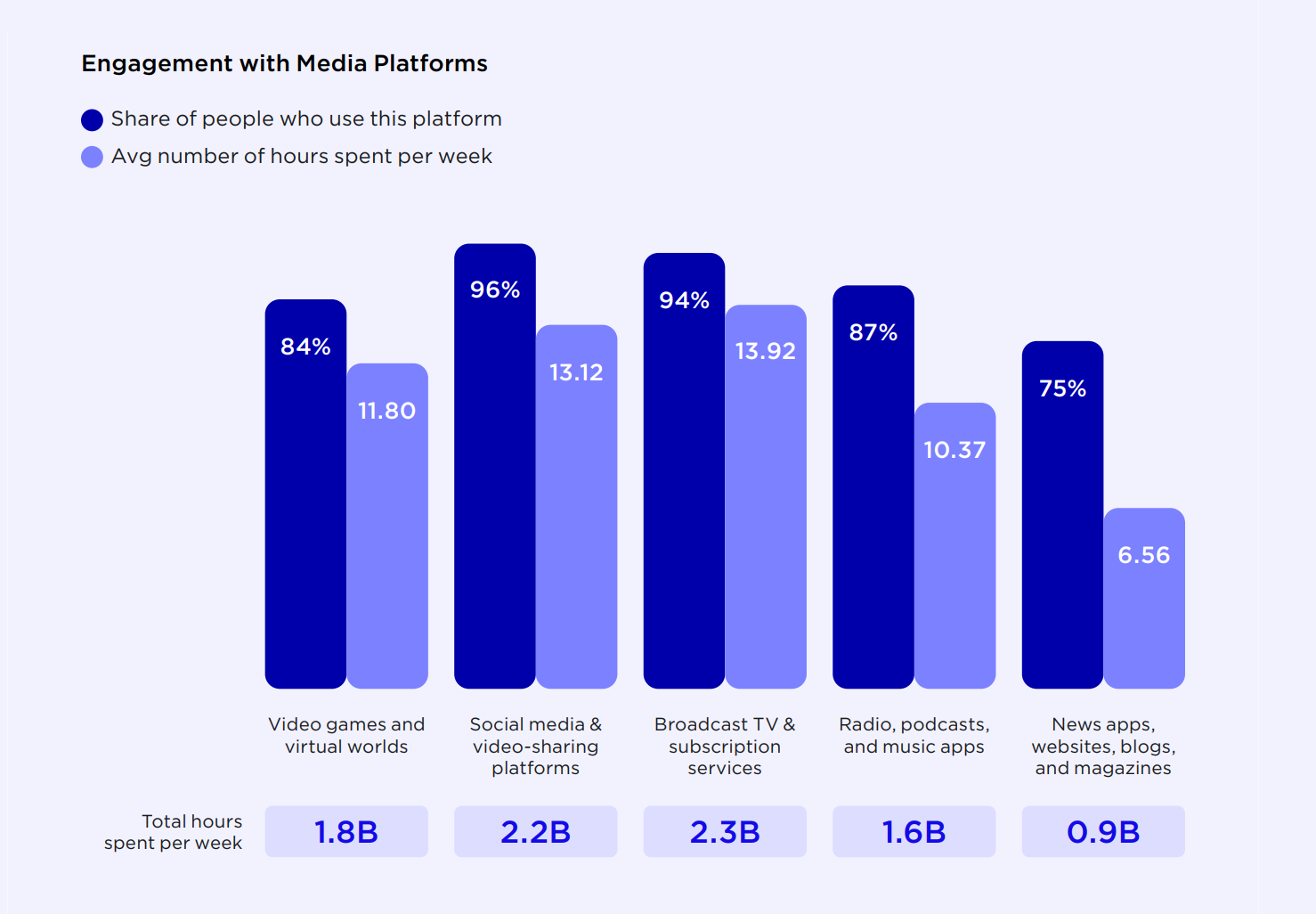
96% of users admitted they spend 13 hours each week on various social media apps including those that share videos. And no surprise here that TikTok and Instagram were classified among the favorites.
But the world of entertainment is just as crucial as all others. And that’s why 94% claim they spend 14 hours on the likes of subscription services as well as broadcast television. Meanwhile, 87% gave credit to the likes of podcasts and music platforms, where they spent 11 hours weekly.
So many video gaming platforms would attract 84% of the user base, where they were functioning at 12 hours each week. Moreover, such findings pointed to the huge trend linked to the world of active engagement as well as entertainment. So many individuals are playing with the likes of digital content and call it a rewarding affair.
Clearly, a lot of this has to do with the world of smartphones. The majority of engagement arises through such means. And the key driver here is social media where engagement goes up to 73% on smartphones than other types of devices. But we did see how a lot of people preferred TV over phones for the categories like broadcast television.
In the same way, this research shed light on the great popularity of video gaming applications. They command a massive amount of the key hours of engagement that are closely followed up by mediums including comics and books. After that, apps linked to sports and fitness arise.
But another interesting aspect highlighted by this study has to do with the likes of users not only watching content. They are also getting more and more involved with various platforms. The goal is to share more content with other people too. And as one can expect, the younger lot leads the race.
On average, 69% spoke about spending 7 hours each week in developing digital content. This was in stark comparison to Gen X where just 46% spend around 6 hours weekly to publish their images or videos on various apps.
When you take on the report as a whole, it’s easy to see that apps are not just linked to media consumption. They also have to do with the likes of user engagement.
The main take-home message if you may put it is that most people spend 13 hours every week engaging with social media. And the majority of this is through their mobiles. And it’s Gen Z who spend 7 hours each week producing digital content.
Read next: US Media Consumption Changed Dramatically In The Past 12 Months, Here’s What You Need To Know
by Dr. Hura Anwar via Digital Information World
The study highlights how mobiles are now the leading platform in terms of media consumption. And by that, we mean users are spending nearly 4 hours each day on their smartphones.
This was in comparison to the likes of PCs and televisions where people were spending just 3 hours each day. The research comes to us thanks to the likes of a report by leading experts at Newzoo. They managed to survey nearly 2,500 people across the US.
Furthermore, it was proven how so many generations engaged differently than all others in terms of the world of social media and entertainment.
As far as engagement is concerned, social media was crowned the front-runner. And to be honest, there aren’t a lot of shocked faces here. We all are social beings and we love staying informed about what is happening in our circle and across the globe.
96% of users admitted they spend 13 hours each week on various social media apps including those that share videos. And no surprise here that TikTok and Instagram were classified among the favorites.
But the world of entertainment is just as crucial as all others. And that’s why 94% claim they spend 14 hours on the likes of subscription services as well as broadcast television. Meanwhile, 87% gave credit to the likes of podcasts and music platforms, where they spent 11 hours weekly.
So many video gaming platforms would attract 84% of the user base, where they were functioning at 12 hours each week. Moreover, such findings pointed to the huge trend linked to the world of active engagement as well as entertainment. So many individuals are playing with the likes of digital content and call it a rewarding affair.
Clearly, a lot of this has to do with the world of smartphones. The majority of engagement arises through such means. And the key driver here is social media where engagement goes up to 73% on smartphones than other types of devices. But we did see how a lot of people preferred TV over phones for the categories like broadcast television.
In the same way, this research shed light on the great popularity of video gaming applications. They command a massive amount of the key hours of engagement that are closely followed up by mediums including comics and books. After that, apps linked to sports and fitness arise.
But another interesting aspect highlighted by this study has to do with the likes of users not only watching content. They are also getting more and more involved with various platforms. The goal is to share more content with other people too. And as one can expect, the younger lot leads the race.
On average, 69% spoke about spending 7 hours each week in developing digital content. This was in stark comparison to Gen X where just 46% spend around 6 hours weekly to publish their images or videos on various apps.
When you take on the report as a whole, it’s easy to see that apps are not just linked to media consumption. They also have to do with the likes of user engagement.
The main take-home message if you may put it is that most people spend 13 hours every week engaging with social media. And the majority of this is through their mobiles. And it’s Gen Z who spend 7 hours each week producing digital content.
Read next: US Media Consumption Changed Dramatically In The Past 12 Months, Here’s What You Need To Know
by Dr. Hura Anwar via Digital Information World
Instagram is About to Implement Two Important Changes
With Meta’s stock in a downward spiral and Facebook becoming one of the least popular social media platforms in the world, the burden has been placed on Instagram to save its parent company’s flagging fortunes. Verified users have been a big part of the platforms push these past few years because of the fact that this is the sort of thing that could potentially end up bringing content and viewers to the platform in large quantities.
With all of that having been said and now out of the way, it is important to note that Instagram is adding a new feature that will expand the appeal of verification for the users that are opting for it. It is a minor feature, but in spite of the fact that this is the case it will add a new layer to the verification process.
Essentially, Instagram users who have received the verification tick on the platform will soon receive a new section on their profile, as spotted by Matt Navarra. This section will reveal the exact date at which they received their verification with all things having been considered and taken into account.
Users will now be able to publicize how long they have been verified for, which might add to the exclusivity and make it seem more premium than might have been the case otherwise. However, this is not the only update that beta testers have noted for the platform.
The second update that is being noted here is that of a new sticker. More specifically, Instagram users will now have a Before and After sticker pairing, according to Alessandro Paluzzi. Instagram and Instagram Reels in particular have become popular places to post dramatic physical changes or something along those lines, and these stickers will definitely promote that kind of usage.
These two features show that Instagram is constantly tweaking its platform in order to make it more in line with what users have come to expect. With these updates on the horizon, users can look forward to an improved experience, especially with the sticker since it is something that pretty much every user will be able to take advantage of.
Read next: Researchers release a list of top apps Americans want to keep and delete
by Zia Muhammad via Digital Information World
With all of that having been said and now out of the way, it is important to note that Instagram is adding a new feature that will expand the appeal of verification for the users that are opting for it. It is a minor feature, but in spite of the fact that this is the case it will add a new layer to the verification process.
Essentially, Instagram users who have received the verification tick on the platform will soon receive a new section on their profile, as spotted by Matt Navarra. This section will reveal the exact date at which they received their verification with all things having been considered and taken into account.
Users will now be able to publicize how long they have been verified for, which might add to the exclusivity and make it seem more premium than might have been the case otherwise. However, this is not the only update that beta testers have noted for the platform.
The second update that is being noted here is that of a new sticker. More specifically, Instagram users will now have a Before and After sticker pairing, according to Alessandro Paluzzi. Instagram and Instagram Reels in particular have become popular places to post dramatic physical changes or something along those lines, and these stickers will definitely promote that kind of usage.
These two features show that Instagram is constantly tweaking its platform in order to make it more in line with what users have come to expect. With these updates on the horizon, users can look forward to an improved experience, especially with the sticker since it is something that pretty much every user will be able to take advantage of.
Read next: Researchers release a list of top apps Americans want to keep and delete
by Zia Muhammad via Digital Information World
Subscribe to:
Posts (Atom)


