YouTube is commonly recognized as a platform that has made a significant contribution to the entire creator ecosystem.
Each year, the app manages to churn out billions that assist hundreds of creators, thanks to the company’s Partner Program initiative and more.
But did you ever wonder how much the company is contributing to the American economy? Well, there’s no reason to guess because a new study by Oxford is revealing all the details on the matter.
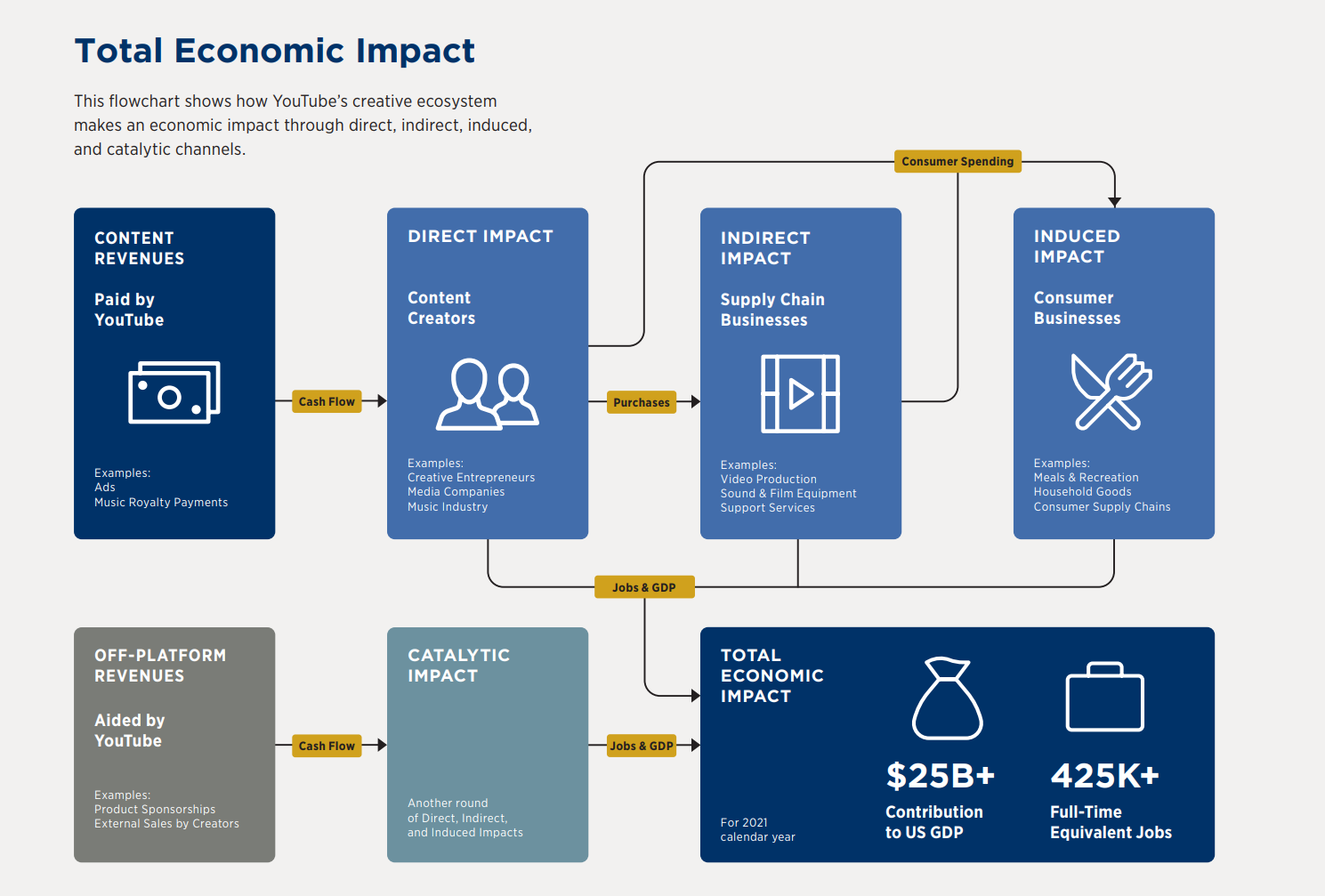
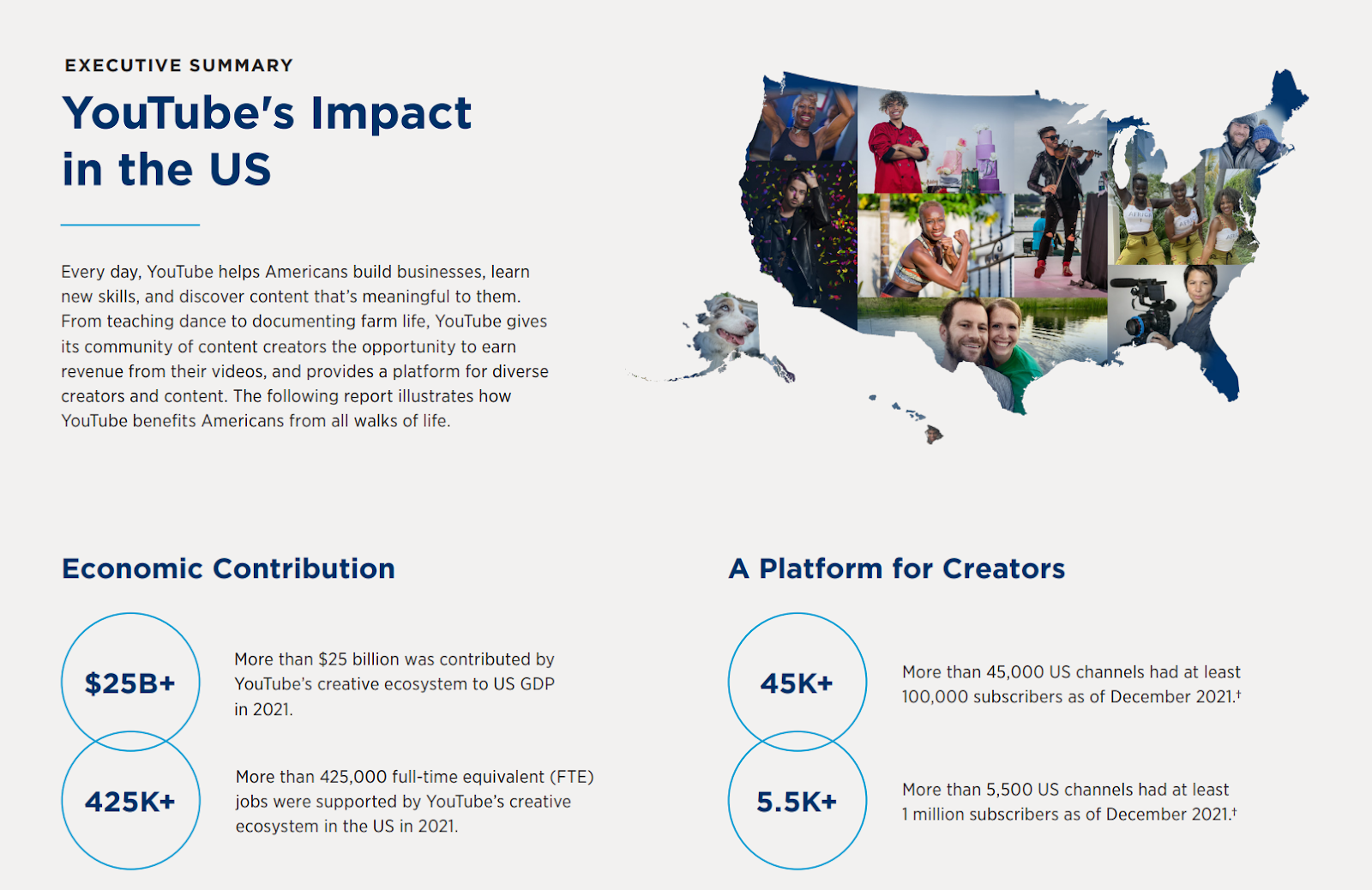
According to its latest findings, YouTube has managed to contribute a staggering $25 billion in terms of revenue generated for the US economy last year.
Oxford Economics' new revelations have surprised plenty, as other findings went on to prove that the firm also supported 425,000 jobs for Americans working full time.
This new report was published today and it sheds light on some very interesting insights regarding the leading social media platform. Who knew the app was doing so much in terms of supporting creators through various means.
An average of 6,000 different users of the app were taken into consideration for the study, along with creators, and other relevant firms. And that is what provided researchers with a huge data pool from which they could deduce their findings.
The news is being sought out as a huge advantage for the app, especially when other leading and competitive platforms are taken into consideration. For instance, TikTok, which is seen as a big rival, and even Meta, whose video tools are reigning supreme in the market.
YouTube providing a significant platform for creators to establish better earnings is definitely a win-win situation for many who look up to the app for their livelihood. Also, it’s another huge incentive to have some of the world’s biggest creators get on board.
This might be one of the biggest reasons why we’re seeing YouTube’s Shorts format turn out to be an archrival for TikTok. It’s not only because Shorts is so great or the fact that it can stand as a competitor on its own to the app. But it has a lot to do with the simple fact that it complements so many creators’ feed across an app where creators get the chance to build their own audience.
The better your channel, the more people would engage, and the greater your chances to monetize from all of your hard efforts. This is definitely one thing that TikTok creators are on the lookout for.
Soon, we could even see some of TikTok’s biggest stars migrate toward YouTube for this particular reason.
On the other hand, the study also took a closer look at companies that were trying to make the most of the app with huge insights into how small brands managed to gain benefits by creating a great presence on the platform.
We believe the whole study is super interesting and engaging, providing so many people with information about YouTube and how it continually fuels the competitive economy of creators on a regular basis.
Today, it’s the battle for the best video content and so far, the app is doing great.
Read next: YouTube Partners Up With Shopify And Launches Exciting New Shopping Features
by Dr. Hura Anwar via Digital Information World
"Mr Branding" is a blog based on RSS for everything related to website branding and website design, it collects its posts from many sites in order to facilitate the updating to the latest technology.
To suggest any source, please contact me: Taha.baba@consultant.com
Thursday, July 21, 2022
Google Docs Will Provide Users With Notifications Whenever Edits Are Made To Collaborative Projects
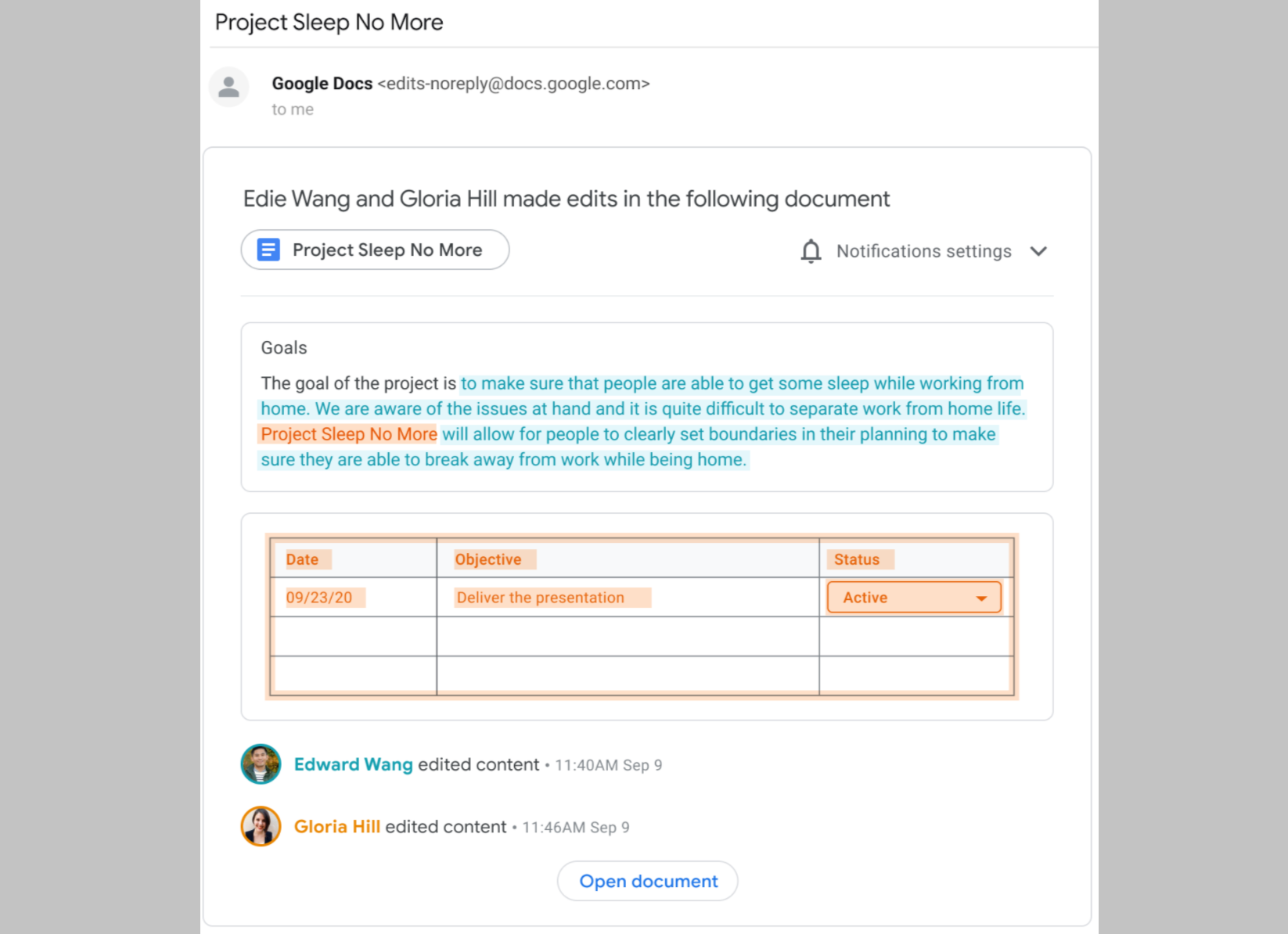
Google Docs is getting an update wherein all users working on a collaborative project will be informed if updates are made to say project.
Google Docs is honestly such a useful tool, and while it may not be as definitive of a platform for the company as say Gmail or Google Search, it’s still one of the most widely used options. Docs allow you to work with an online product that is essential of the same caliber as Microsoft Word without having to purchase Office. The tool’s ready online availability also means that you can continue writing and typing at literally any point so long as an internet connection is available; which, if we’re going to be honest, is almost always nowadays. However, Google Docs isn’t just content on being a Microsoft Office alternative: not only does it also provide a variety of other tools such as Sheets (as an Excel competitor) and Slides (for PowerPoint), but it also adds in collaborations! When multiple people have to work together on a project, which seems to keep popping up as a theme in both middle school and professional life, that’s where you need Docs.
Before Google Docs, users would have to rely on emailing each other documents with partially finished segments, and one person would have the duty of compiling everything together into a single file. This would lead to the occasional miscommunications, with someone’s work bleeding into the others’ or people accidentally finishing another’s assigned task. Since a single person is usually compiling these documents, edits are also harder to make, leading to occasional mistakes. Docs have erased the need for all of this; now, users can work together on a document and observe updates being made to it live. This way, any misconceptions can be cleared up at the drop of a hat, and edits are much more thorough as well.
However, mistakes can still occur, and while they’re much easier to clear up with Docs, users usually don’t notice them occurring until a bit later. That’s because unless they’re looking at the document 24/7, someone’s bound to make an edit or two that escapes attention until later. That’s where the new update rolls into the room: Google Docs will now provide notifications that help cover such lapses. These notifications, which can be activated or deactivated by users, will inform them about general changes, such as parts of a document being either removed or added.
The updates and alerts will be sent across all of a user’s Google devices, ensuring that nothing is missed or left out.
Read next: Google is planning to bring back Augmented Reality Glasses i.e 'Subtitles for the world’ after a decade
by Arooj Ahmed via Digital Information World
Google Docs is honestly such a useful tool, and while it may not be as definitive of a platform for the company as say Gmail or Google Search, it’s still one of the most widely used options. Docs allow you to work with an online product that is essential of the same caliber as Microsoft Word without having to purchase Office. The tool’s ready online availability also means that you can continue writing and typing at literally any point so long as an internet connection is available; which, if we’re going to be honest, is almost always nowadays. However, Google Docs isn’t just content on being a Microsoft Office alternative: not only does it also provide a variety of other tools such as Sheets (as an Excel competitor) and Slides (for PowerPoint), but it also adds in collaborations! When multiple people have to work together on a project, which seems to keep popping up as a theme in both middle school and professional life, that’s where you need Docs.
Before Google Docs, users would have to rely on emailing each other documents with partially finished segments, and one person would have the duty of compiling everything together into a single file. This would lead to the occasional miscommunications, with someone’s work bleeding into the others’ or people accidentally finishing another’s assigned task. Since a single person is usually compiling these documents, edits are also harder to make, leading to occasional mistakes. Docs have erased the need for all of this; now, users can work together on a document and observe updates being made to it live. This way, any misconceptions can be cleared up at the drop of a hat, and edits are much more thorough as well.
However, mistakes can still occur, and while they’re much easier to clear up with Docs, users usually don’t notice them occurring until a bit later. That’s because unless they’re looking at the document 24/7, someone’s bound to make an edit or two that escapes attention until later. That’s where the new update rolls into the room: Google Docs will now provide notifications that help cover such lapses. These notifications, which can be activated or deactivated by users, will inform them about general changes, such as parts of a document being either removed or added.
The updates and alerts will be sent across all of a user’s Google devices, ensuring that nothing is missed or left out.
Read next: Google is planning to bring back Augmented Reality Glasses i.e 'Subtitles for the world’ after a decade
by Arooj Ahmed via Digital Information World
Google is planning to bring back Augmented Reality Glasses i.e 'Subtitles for the world’ after a decade
On Tuesday, a blog post from Google confirmed that they will be bringing back their old invention, the augmented reality glasses after a massive fail around ten years ago.
In the post, the company specified all the shortcomings of their previous failures and how they plan to overcome them. For starters, it was mentioned that some of the prototypes are designed to look like normal glasses but will consist of microphones and cameras. The glasses will also have transparent displays.
Although it is said to be tested on the general public, these glasses haven’t been marketed as a product just yet and will not be available to the public. Yes, their main goal is to help with daily tasks like translation or working similar to a GPS, but due to the massive backlash from last time, Google seems hesitant.
While the invention of Augmented Reality is harder than anything, it is said to be a game-changer. Most of the tech world is working on virtual reality, or the Metaverse, which is creating a complete fake world, a virtual one. While augmented reality aims to superimpose the digital world on the real world. A mixture of both. This way, one will enjoy a glimpse of the Metaverse while staying in the real world.
The biggest problem Google faced last time was how users were concerned with the privacy of these new glasses. Since the glasses were equipped with a front camera, users were afraid of being recorded without consent. To overcome this, Google is focusing mainly on business users this time around. The company assured over and over again that privacy is their main concern this time.
To further emphasize this, the blog post mentioned that users will not wear these glasses in public settings like schools, offices, government buildings, churches, or such places. The glasses will have a red light turn on as an indicator that the camera is recording. Also, the glasses will only record when the user needs to store something for future reference or the technology needs to identify someone or something.
As for the testing, Google confirmed that the glasses will only be tested on trusted users and selective audiences.
Since all the other tech giants like Meta, Microsoft, etc. Are all working towards developing the ‘perfect’ Augmented tools first, it is going to be a long and hard competition. As for the products already launched or soon-to-be-launched, we feel like Microsoft’s HoloLens is indeed the best. We do have high hopes for Apple's and Meta’s mixed reality headsets as well.
Read next: Google And Facebook Accused Of Favoring Their Own Products To Eliminate Competition, Internal Document Reveals
by Arooj Ahmed via Digital Information World
In the post, the company specified all the shortcomings of their previous failures and how they plan to overcome them. For starters, it was mentioned that some of the prototypes are designed to look like normal glasses but will consist of microphones and cameras. The glasses will also have transparent displays.
Although it is said to be tested on the general public, these glasses haven’t been marketed as a product just yet and will not be available to the public. Yes, their main goal is to help with daily tasks like translation or working similar to a GPS, but due to the massive backlash from last time, Google seems hesitant.
While the invention of Augmented Reality is harder than anything, it is said to be a game-changer. Most of the tech world is working on virtual reality, or the Metaverse, which is creating a complete fake world, a virtual one. While augmented reality aims to superimpose the digital world on the real world. A mixture of both. This way, one will enjoy a glimpse of the Metaverse while staying in the real world.
The biggest problem Google faced last time was how users were concerned with the privacy of these new glasses. Since the glasses were equipped with a front camera, users were afraid of being recorded without consent. To overcome this, Google is focusing mainly on business users this time around. The company assured over and over again that privacy is their main concern this time.
To further emphasize this, the blog post mentioned that users will not wear these glasses in public settings like schools, offices, government buildings, churches, or such places. The glasses will have a red light turn on as an indicator that the camera is recording. Also, the glasses will only record when the user needs to store something for future reference or the technology needs to identify someone or something.
As for the testing, Google confirmed that the glasses will only be tested on trusted users and selective audiences.
Since all the other tech giants like Meta, Microsoft, etc. Are all working towards developing the ‘perfect’ Augmented tools first, it is going to be a long and hard competition. As for the products already launched or soon-to-be-launched, we feel like Microsoft’s HoloLens is indeed the best. We do have high hopes for Apple's and Meta’s mixed reality headsets as well.
Read next: Google And Facebook Accused Of Favoring Their Own Products To Eliminate Competition, Internal Document Reveals
by Arooj Ahmed via Digital Information World
Google And Facebook Accused Of Favoring Their Own Products To Eliminate Competition, Internal Document Reveals
A new set of internal documents are putting a fresh set of allegations against prominent tech companies like Facebook and Google and how they managed to favor their own products. The firms aimed to wipe out competition through such anti-competitive moves, the document further revealed.
The documents were published on Tuesday and they have since then detailed how the world’s tech giants should be further investigated while pushing for enhanced antitrust legislation to occur by this year.
The paperwork has been obtained by the country’s Judiciary Committee which just managed to wrap up an entire comprehensive investigation. This was related to a theme of anticompetitive tactics used by numerous companies such as Apple, Meta, Google, and Amazon. While the investigation was completed by 2020, these new documents that arose in the form of emails, letters, and some reports have really raised more questions in regulators’ minds.
This is being called out as the newest type of evidence available that supports calls for greater advancements and strict rules to avoid such behavior from taking place in the tech world. Meanwhile, one member of the anti-trust committee even went as far as stating how the time had come for Congress to step in.
To be more specific, these documents proved how firms like Google and even Amazon tried to force various sellers and producers of smart devices to come forward and favor products belonging to them.
There are some details about a conversation from a Google executive raising eyebrows about a new service from Samsung which could serve as a stark competitor to Google’s ‘core search’. Meanwhile, there are some mentions of Amazon executives arguing over whether they could restrict some brands from advertising across their websites.
You’ll also find conversations by Google trying to consider the competition provided by Amazon’s voice assistants while another memo directed at Mark Zuckerberg spoke about how Facebook was being co-dominated by Instagram and WhatsApp.
The timings of these documents are pretty interesting. They are being published when a final report of the investigative committee came into the picture and how the competition had been outlined as a growing concern.
So many lawmakers feel that there’s a definite lack of competition as far as the tech industry is concerned. And that is what gives rise to poor product quality over a certain span of time. Also, no Republicans were seen signing the document and that, in turn, indicates how Democrats would be having some huge problems with the passing of anti-trust reforms.
We feel such moves can provide substantial evidence for a further push for bills that actually eliminate tech firms from offering favoritism to their own good and services.
As one top Rep. mentioned, companies as big as Google, Apple, Amazon, and Meta are just incredibly powerful to care about people. Instead, they’re more concerned about their profits and hence would put the latter over the former any day.
Whether the publicizing of such internal memos can actually make a difference or not, well, only time can tell.
Read next: The new bill limits personal data collection by companies to generate targeted Ads
by Dr. Hura Anwar via Digital Information World
The documents were published on Tuesday and they have since then detailed how the world’s tech giants should be further investigated while pushing for enhanced antitrust legislation to occur by this year.
The paperwork has been obtained by the country’s Judiciary Committee which just managed to wrap up an entire comprehensive investigation. This was related to a theme of anticompetitive tactics used by numerous companies such as Apple, Meta, Google, and Amazon. While the investigation was completed by 2020, these new documents that arose in the form of emails, letters, and some reports have really raised more questions in regulators’ minds.
This is being called out as the newest type of evidence available that supports calls for greater advancements and strict rules to avoid such behavior from taking place in the tech world. Meanwhile, one member of the anti-trust committee even went as far as stating how the time had come for Congress to step in.
To be more specific, these documents proved how firms like Google and even Amazon tried to force various sellers and producers of smart devices to come forward and favor products belonging to them.
There are some details about a conversation from a Google executive raising eyebrows about a new service from Samsung which could serve as a stark competitor to Google’s ‘core search’. Meanwhile, there are some mentions of Amazon executives arguing over whether they could restrict some brands from advertising across their websites.
You’ll also find conversations by Google trying to consider the competition provided by Amazon’s voice assistants while another memo directed at Mark Zuckerberg spoke about how Facebook was being co-dominated by Instagram and WhatsApp.
The timings of these documents are pretty interesting. They are being published when a final report of the investigative committee came into the picture and how the competition had been outlined as a growing concern.
So many lawmakers feel that there’s a definite lack of competition as far as the tech industry is concerned. And that is what gives rise to poor product quality over a certain span of time. Also, no Republicans were seen signing the document and that, in turn, indicates how Democrats would be having some huge problems with the passing of anti-trust reforms.
We feel such moves can provide substantial evidence for a further push for bills that actually eliminate tech firms from offering favoritism to their own good and services.
As one top Rep. mentioned, companies as big as Google, Apple, Amazon, and Meta are just incredibly powerful to care about people. Instead, they’re more concerned about their profits and hence would put the latter over the former any day.
Whether the publicizing of such internal memos can actually make a difference or not, well, only time can tell.
Read next: The new bill limits personal data collection by companies to generate targeted Ads
by Dr. Hura Anwar via Digital Information World
The new bill limits personal data collection by companies to generate targeted Ads
A bipartisan bill has been passed recently by the United States House of Representatives which imposes restrictions on big tech companies including Alphabet’s Google, Meta, and others to refrain from catching users’ sensitive information based on their online browsing interests.
The sensitive information outlines the data gathered from consumers’ internet activity as well as social security numbers. All individual data excluding which is essential for providing product services must be protected. The American Data Privacy and Protection Act (ADPPA) specifically puts a ban on third-party websites and tech giants to offer a safe and protected environment for people using the internet.
The measure passed by the House Energy and Commerce Committee is still some steps away to become law. Earlier, bipartisan online privacy bills withstand firm opposition from big tech companies, as their policies are entirely based on the consumer data for showcasing advertisements. The previous version somehow let companies serve advertisements gleaned from the public’s internet browsing data exclusively with the user’s clear consent. The advertising companies opposed that as well. They demand that organizations should be allowed to generate targeted ads on an opt-out basis. But, now the revised bill will disallow the major opportunities for ad targeting. In addition, the data privacy bill would let web users pull out themselves from targeted ads and restrict advertisements aimed at children or minors under seventeen years of age. The comprehensive bill will allow users to get an entire opportunity to withdraw targeted ads.
Shortly after the privacy bill got around, the companies began to criticize provisions that would outlaw web-based behavioral advertising. From an organization’s point of view, data is the driving force of consumer spending, which enables companies to compete with each other. Many companies unite together and have a concrete stance that they would not follow this law enforcement. The businesses wrote a joint letter to U.S lawmakers including Interactive Advertising Bureau, American Advertising Federation, Insights Association, and so forth. The business group added that the provision would repress the data-acquiring process. Further, they added that demographic data collection and web browsing activity will be halted and as a result, it will impact responsible and competent advertising.
The VP of Network Advertising, David LeDuc communicates that the revised version raises amplified concerns indicating to block micro-manage creative data utilization. Furthermore, the bill also prohibits the collection of biometric data, emails, voice notes, etc. because this information also comes under Sensitive data.
On the end note, much of the debate over these acts is intent on whether consumers would be able to file a case of privacy violations against companies or not. Because the federal legislation would take action against state laws, it will become very difficult for them to oppose the enforcement of the law.
Read next: 70% of Gen Z Consumers Are Unhappy With Their Purchase Journeys on Social Media, New Survey Reveals
by Arooj Ahmed via Digital Information World
The sensitive information outlines the data gathered from consumers’ internet activity as well as social security numbers. All individual data excluding which is essential for providing product services must be protected. The American Data Privacy and Protection Act (ADPPA) specifically puts a ban on third-party websites and tech giants to offer a safe and protected environment for people using the internet.
The measure passed by the House Energy and Commerce Committee is still some steps away to become law. Earlier, bipartisan online privacy bills withstand firm opposition from big tech companies, as their policies are entirely based on the consumer data for showcasing advertisements. The previous version somehow let companies serve advertisements gleaned from the public’s internet browsing data exclusively with the user’s clear consent. The advertising companies opposed that as well. They demand that organizations should be allowed to generate targeted ads on an opt-out basis. But, now the revised bill will disallow the major opportunities for ad targeting. In addition, the data privacy bill would let web users pull out themselves from targeted ads and restrict advertisements aimed at children or minors under seventeen years of age. The comprehensive bill will allow users to get an entire opportunity to withdraw targeted ads.
Shortly after the privacy bill got around, the companies began to criticize provisions that would outlaw web-based behavioral advertising. From an organization’s point of view, data is the driving force of consumer spending, which enables companies to compete with each other. Many companies unite together and have a concrete stance that they would not follow this law enforcement. The businesses wrote a joint letter to U.S lawmakers including Interactive Advertising Bureau, American Advertising Federation, Insights Association, and so forth. The business group added that the provision would repress the data-acquiring process. Further, they added that demographic data collection and web browsing activity will be halted and as a result, it will impact responsible and competent advertising.
The VP of Network Advertising, David LeDuc communicates that the revised version raises amplified concerns indicating to block micro-manage creative data utilization. Furthermore, the bill also prohibits the collection of biometric data, emails, voice notes, etc. because this information also comes under Sensitive data.
On the end note, much of the debate over these acts is intent on whether consumers would be able to file a case of privacy violations against companies or not. Because the federal legislation would take action against state laws, it will become very difficult for them to oppose the enforcement of the law.
Read next: 70% of Gen Z Consumers Are Unhappy With Their Purchase Journeys on Social Media, New Survey Reveals
by Arooj Ahmed via Digital Information World
Meta Will Allocate More Funds For Its Creator Economy And Metaverse By Scaling Back Investments From News Content
Meta has recently announced its decision to allocate more resources to the metaverse and creator economy by scaling back on investments from news content and newsletters.
The company has chosen to provide its metaverse and creator ecosystem with more funds by reallocating its resources to places where it feels need them the most. And if that means stripping out investments made to Facebook’s news bulletins, then so be it.
Meta revealed how it has plenty of plans for its metaverse future and that’s why such decisions are important to make at the right time which it believes is now.
The news comes to us by a report from the Wall Street Journal which highlighted a recent internal note made by a leading Meta executive. According to him, the resources are getting reallocating directly through the News Bulletins and News Tabs on Facebook.
Hence, engineering and support systems are being removed from such products and reallocated towards strengthening the company’s creator economy.
For now, we’re not quite clear about what the exact projects delineated for its Creator Economy could be. But the sudden developments are not being taken too well by many publishers who have continued to struggle with Meta’s sudden decision-making.
Many publishers feel the company quite often tends to lose interest in so many projects, even if it's overnight. And as you can probably imagine, such shifts aren’t appreciated when you’re a publisher.
A great example of such behavior is a case study that we saw in the past. Facebook informed its publishers that it wished to see more video content on the app and hence told brands to post more so that consumption patterns could change.
But that’s when all of a sudden, things went downhill when the platform opted to change its algorithm. At one point in time, we were dealing with 12 million subscribers but soon enough, 75% of all organic traffic had been lost.
This way, so many publishers lost out as Facebook was forced to lay off hundreds of employees too. Hence, as you can see, Meta is quite unpredictable and you just never really know what sorts of games it can end up playing.
For now, it appears that Meta is focusing more on short-form videos that are trending on the web. You’ll find Reels on Instagram short form videos on TikTok, and YouTube Shorts garnering the greatest profits too.
One of Meta’s leading executives also mentioned in his memo how the content format that Meta is following right now is short-form videos and other projects that come aligned with its metaverse model.
This means we’re going to see so many other projects of Meta lose out, especially in cases where it plans on allocating resources elsewhere by stripping others from the benefit. Let’s not forget how it needs to harness back major losses made from ad spending.
There is plenty of talk about Meta’s Bulletin suffering, a media project that the firm launched in April 2022. Here is where so many writers along with publishers united to produce the most exclusive deals related to content for its platform.
But Meta has failed to record much value in terms of engagements from the platform, despite countless publications making their way. In addition to that, we saw the firm funding nearly 25 different journalists related to producing local news stories. But even then, nothing worked.
Next in line comes Facebook’s News Bulletin and News Tab. So many millions have been invested to allow publishers to produce content but Meta feels the output received is just not cutting it and it would like to scale back on such investments.
Thankfully, a lot of the deals are expiring soon with publishers so Meta might be taking the exit door soon.
Read next: URL Stripping Might Not Stop Facebook From Tracking You Anymore, Here’s Why
by Dr. Hura Anwar via Digital Information World
The company has chosen to provide its metaverse and creator ecosystem with more funds by reallocating its resources to places where it feels need them the most. And if that means stripping out investments made to Facebook’s news bulletins, then so be it.
Meta revealed how it has plenty of plans for its metaverse future and that’s why such decisions are important to make at the right time which it believes is now.
The news comes to us by a report from the Wall Street Journal which highlighted a recent internal note made by a leading Meta executive. According to him, the resources are getting reallocating directly through the News Bulletins and News Tabs on Facebook.
Hence, engineering and support systems are being removed from such products and reallocated towards strengthening the company’s creator economy.
For now, we’re not quite clear about what the exact projects delineated for its Creator Economy could be. But the sudden developments are not being taken too well by many publishers who have continued to struggle with Meta’s sudden decision-making.
Many publishers feel the company quite often tends to lose interest in so many projects, even if it's overnight. And as you can probably imagine, such shifts aren’t appreciated when you’re a publisher.
A great example of such behavior is a case study that we saw in the past. Facebook informed its publishers that it wished to see more video content on the app and hence told brands to post more so that consumption patterns could change.
But that’s when all of a sudden, things went downhill when the platform opted to change its algorithm. At one point in time, we were dealing with 12 million subscribers but soon enough, 75% of all organic traffic had been lost.
This way, so many publishers lost out as Facebook was forced to lay off hundreds of employees too. Hence, as you can see, Meta is quite unpredictable and you just never really know what sorts of games it can end up playing.
For now, it appears that Meta is focusing more on short-form videos that are trending on the web. You’ll find Reels on Instagram short form videos on TikTok, and YouTube Shorts garnering the greatest profits too.
One of Meta’s leading executives also mentioned in his memo how the content format that Meta is following right now is short-form videos and other projects that come aligned with its metaverse model.
This means we’re going to see so many other projects of Meta lose out, especially in cases where it plans on allocating resources elsewhere by stripping others from the benefit. Let’s not forget how it needs to harness back major losses made from ad spending.
There is plenty of talk about Meta’s Bulletin suffering, a media project that the firm launched in April 2022. Here is where so many writers along with publishers united to produce the most exclusive deals related to content for its platform.
But Meta has failed to record much value in terms of engagements from the platform, despite countless publications making their way. In addition to that, we saw the firm funding nearly 25 different journalists related to producing local news stories. But even then, nothing worked.
Next in line comes Facebook’s News Bulletin and News Tab. So many millions have been invested to allow publishers to produce content but Meta feels the output received is just not cutting it and it would like to scale back on such investments.
Thankfully, a lot of the deals are expiring soon with publishers so Meta might be taking the exit door soon.
Read next: URL Stripping Might Not Stop Facebook From Tracking You Anymore, Here’s Why
by Dr. Hura Anwar via Digital Information World
URL Stripping Might Not Stop Facebook From Tracking You Anymore, Here’s Why
The prevalence of third party tracking for internet users has become a major problem because of the fact that this is the sort of thing that could potentially end up violating your right to privacy. Major social media platforms like Facebook are notorious for tracking their users without informing them or obtaining their express consent, and while Apple’s recent privacy policies have prevented them somewhat, Facebook has still managed to continue tracking users despite such setbacks.
Mozilla’s URL stripping feature which was launched just last month helped users to automatically remove tracking parameters from the sites that they were visiting, and Brave also has a feature similar to this one. With all of that having been said and now out of the way, it is important to note that Facebook has found a workaround for this by encrypting their tracking links. Instead of the simple and easy to spot fbclid parameter, Facebook has started using impossibly complex encrypted links that can trick and bypass URL strippers.
Users might have been hoping that they could get a bit more privacy online thanks to URL strippers, but in spite of the fact that this is the case it seems that Facebook is not going to go down without a fight. The social media platform simply won’t have a sustainable business model if it is unable to harvest large quantities of tracking data from all of its users, and it will continue to find workarounds for the various privacy boosting features that web browsers and other tech companies try to put out.
The only way to truly protect yourself from Facebook’s omniscience is by logging out of your Facebook account and regularly clearing your cache of cookies. However, some studies have shown that Facebook can continue tracking you even if you are not logged in, so many users might feel the need to completely delete their Facebook profiles with all things having been considered and taken into account.
Facebook’s tremendous growth in the previous decade has stalled, but the social media platform still has billions of users. While it is failing to target the younger demographics who much prefer TikTok, Facebook is still managing to extract a lot of value since it is now primarily catering to older users who aren’t very tech savvy.
Merging the tracking link with the overall URL makes it difficult to remove the link without killing it. Privacy conscious users might not have any choice other than deleting their accounts, because it seems unlikely that Facebook would be able to build a business model that isn’t entirely reliant on the illicit and underhanded collection of user data.
H/T: Ghacks
Read next: US Agencies Are Getting Easy Access To Users’ Personal Information Online
by Zia Muhammad via Digital Information World
Mozilla’s URL stripping feature which was launched just last month helped users to automatically remove tracking parameters from the sites that they were visiting, and Brave also has a feature similar to this one. With all of that having been said and now out of the way, it is important to note that Facebook has found a workaround for this by encrypting their tracking links. Instead of the simple and easy to spot fbclid parameter, Facebook has started using impossibly complex encrypted links that can trick and bypass URL strippers.
Users might have been hoping that they could get a bit more privacy online thanks to URL strippers, but in spite of the fact that this is the case it seems that Facebook is not going to go down without a fight. The social media platform simply won’t have a sustainable business model if it is unable to harvest large quantities of tracking data from all of its users, and it will continue to find workarounds for the various privacy boosting features that web browsers and other tech companies try to put out.
The only way to truly protect yourself from Facebook’s omniscience is by logging out of your Facebook account and regularly clearing your cache of cookies. However, some studies have shown that Facebook can continue tracking you even if you are not logged in, so many users might feel the need to completely delete their Facebook profiles with all things having been considered and taken into account.
Facebook’s tremendous growth in the previous decade has stalled, but the social media platform still has billions of users. While it is failing to target the younger demographics who much prefer TikTok, Facebook is still managing to extract a lot of value since it is now primarily catering to older users who aren’t very tech savvy.
Merging the tracking link with the overall URL makes it difficult to remove the link without killing it. Privacy conscious users might not have any choice other than deleting their accounts, because it seems unlikely that Facebook would be able to build a business model that isn’t entirely reliant on the illicit and underhanded collection of user data.
H/T: Ghacks
Read next: US Agencies Are Getting Easy Access To Users’ Personal Information Online
by Zia Muhammad via Digital Information World
Subscribe to:
Comments (Atom)