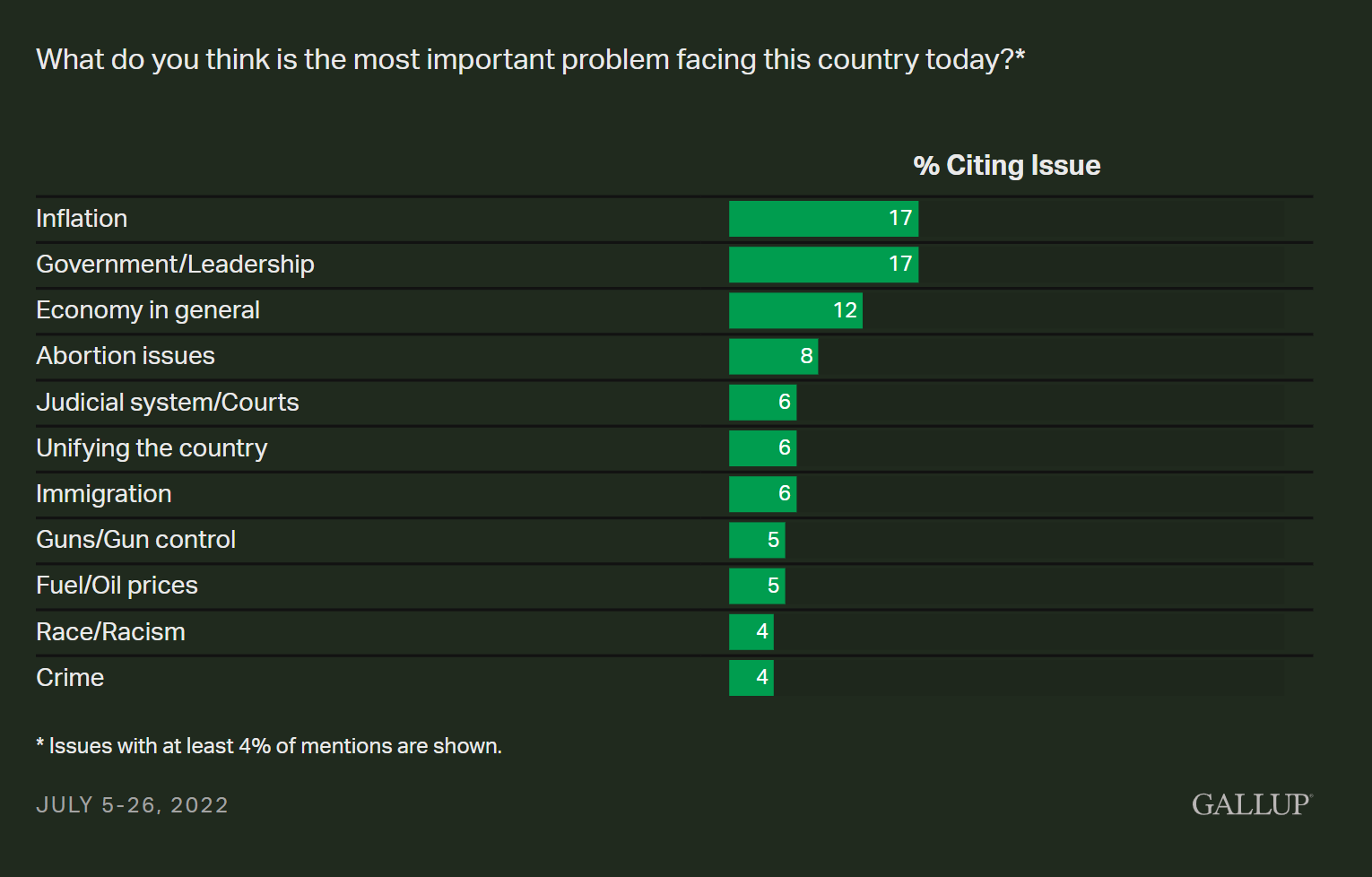
US-based research firm Gallup has conducted a study on what Americans believe to be the most important issue facing their country.
Just going into the topic blind, I'm almost certainly expecting to encounter healthcare or the government to show up. The former because US healthcare, despite being so well funded, is an absolute nightmare for the average citizen even with insurance. The latter because if there's one thing right and left America can agree upon, it's the fact that the government's never doing well enough. I don't blame each side either: between having the outrageously horrifying Trump and the ridiculously feeble Biden, Republicans and Democrats just aren't enough for the US populace. Ah well, at least billionaires continue to remain content in their exploitation of the masses, am I right people?
Upon actually leafing through the admittedly well-conducted study, it turns out I was right on the money with the government point. Turns out, the number one concern of US citizens was the government or the country's current leadership. Both tied for first place with 17% each, which is such a surprise; oh my Lord, who could have ever seen that coming? These two were joined at the top three by inflation, which is currently a worldwide fear. With gas prices being driven up the wall and absolutely no one coming up with coherent solutions, middle America's in a bad place right now. On the bright side, crypto, and NFTs tanked with the economy as well, so at least crypto bros will finally shut up about the art of the stock or whatever.
Abortion issues became a decidedly hot topic this month, what with Roe v. Wade being overturned. I'm sure Republicans are patting themselves on the back over this decision, even as studies have proven time and time again that such measures don't markedly affect abortion rates. Instead, we'll just have a myriad of unsafe abortions, combined with women who need abortions for medical reasons wasting precious time waiting for approval. Have eclampsia and are under severe risk of debilitating seizures? Too bad, wait for upper management to allow doctors to perform a C section.
Immigration, the courts, and unifying the country tie for the last three slots on our top ten list. Immigration has seen a month-over-month drop in concern by 1%, joining leadership as the only entries displaying any such decreases. I'd like to think that this is because people are more accepting of immigrants, but it's probably because everyone's just distracted by all the other asinine daily occurrences.
Read next: Survey reveals that Cyber security breaches can come from inside the company
by Arooj Ahmed via Digital Information World
"Mr Branding" is a blog based on RSS for everything related to website branding and website design, it collects its posts from many sites in order to facilitate the updating to the latest technology.
To suggest any source, please contact me: Taha.baba@consultant.com
Friday, August 5, 2022
Mobile app usage now rises to more than 240 minutes per day, and Instagram leads as the most downloaded app
People from all walks of life turn to their cell phones throughout the coronavirus pandemic, and even after the lockdowns and restrictions have lifted all over the world, people are still spending a lot of time on their cell phones. As per a study by mobile app tracking platform DataAI, people are more indulged in their smartphones, spending approximately 4 to 5 straight hours in a single day.
This year, consumers' cell phone app consumption is rapidly escalating, and people in most markets are employing more than 4 hours per day on multiple applications. Considering the average daily time spent on applications differs geographically. Now there are almost thirteen markets where consumers are spending a lot of time using applications. The countries in the market list include Russia, Indonesia, South Korea, Singapore, Turkey, Brazil, the United Kingdom, Mexico, the United States, and so forth. Among these countries, Singapore, Brazil, and Indonesia report consumers' over five hours of smartphone app consumption.
Earlier in 2020, the app usage trend set to normal, which means the usage decreased a bit in the Q2, but it is important to mention here that, two years before when coronavirus drove app usage for users belonging to any age group or profession, people performed most of their tasks, be it shopping, banking, schooling, meetings, etc., on mobiles. Still, we see in the data that shows smartphone consumers who previously adopted new applications during the lockdowns are still used to that online behaviors despite the circumstances have returned to normal this year. Furthermore, some markets noticed a remarkable increase in app consumption in the previous two years. In Q2 of 2020, Singapore consumers were using apps for 4.1 hours, whereas now, the usage time has heightened to 5.7 hours. In addition, Australian users spend 4.9 hours on mobile applications compared to the previous, which was 3.6 hours. Both of these countries show a forty percent increase in time spent.
Additionally, markets other than these show a down growth pattern, including Canada at +20 percent, Indonesia at above 10 percent, the U.K at over 5 percent, and India, Japan, and the U.S at +5 percent, respectively. In comparison, several markets saw stagnant growth, for instance, Mexico with no change, Turkey and Argentina each at -5 percent. Here the point to be noted is that when COVID arrived, there was a lot more usage of mobile apps, but now the trends are gradually coming to before the COVID period.
Finally, the data from the mobile app tracking firm’s report also mentioned the most used applications and games for the Q2 of 2022, and the data shows that Meta-owned Instagram was the top app to be downloaded. While TikTok was ranked first by consumer time spent and as far as monthly active users are concerned, Facebook got No.1 place. Moreover, in the Q2 of 2022 Indian app, Meesho moved to number 8th place in the downloads category. In addition to it, Fill the Fridge, Pokemon GO, and Stumble Guys saw a massive boost in the gaming apps category. Take a look at below charts for more insights:
Read next: Can Microsoft Edge Overtake Google Chrome As The World's Top Browser On Desktop? New Stats Show Edge Performing At Its Best
by Arooj Ahmed via Digital Information World
This year, consumers' cell phone app consumption is rapidly escalating, and people in most markets are employing more than 4 hours per day on multiple applications. Considering the average daily time spent on applications differs geographically. Now there are almost thirteen markets where consumers are spending a lot of time using applications. The countries in the market list include Russia, Indonesia, South Korea, Singapore, Turkey, Brazil, the United Kingdom, Mexico, the United States, and so forth. Among these countries, Singapore, Brazil, and Indonesia report consumers' over five hours of smartphone app consumption.
Earlier in 2020, the app usage trend set to normal, which means the usage decreased a bit in the Q2, but it is important to mention here that, two years before when coronavirus drove app usage for users belonging to any age group or profession, people performed most of their tasks, be it shopping, banking, schooling, meetings, etc., on mobiles. Still, we see in the data that shows smartphone consumers who previously adopted new applications during the lockdowns are still used to that online behaviors despite the circumstances have returned to normal this year. Furthermore, some markets noticed a remarkable increase in app consumption in the previous two years. In Q2 of 2020, Singapore consumers were using apps for 4.1 hours, whereas now, the usage time has heightened to 5.7 hours. In addition, Australian users spend 4.9 hours on mobile applications compared to the previous, which was 3.6 hours. Both of these countries show a forty percent increase in time spent.
Additionally, markets other than these show a down growth pattern, including Canada at +20 percent, Indonesia at above 10 percent, the U.K at over 5 percent, and India, Japan, and the U.S at +5 percent, respectively. In comparison, several markets saw stagnant growth, for instance, Mexico with no change, Turkey and Argentina each at -5 percent. Here the point to be noted is that when COVID arrived, there was a lot more usage of mobile apps, but now the trends are gradually coming to before the COVID period.
Finally, the data from the mobile app tracking firm’s report also mentioned the most used applications and games for the Q2 of 2022, and the data shows that Meta-owned Instagram was the top app to be downloaded. While TikTok was ranked first by consumer time spent and as far as monthly active users are concerned, Facebook got No.1 place. Moreover, in the Q2 of 2022 Indian app, Meesho moved to number 8th place in the downloads category. In addition to it, Fill the Fridge, Pokemon GO, and Stumble Guys saw a massive boost in the gaming apps category. Take a look at below charts for more insights:
Read next: Can Microsoft Edge Overtake Google Chrome As The World's Top Browser On Desktop? New Stats Show Edge Performing At Its Best
by Arooj Ahmed via Digital Information World
Twitter Is Allowing PAC-12 Athletes To Monetize Their Gameplay Via Posting Replays On The Platform
Twitter’s launching a new project via which PAC-12 athletes can get paid through videos of their performances being replayed on the platform.
Looking at the US and its policies from any angle is just so tiring to me. We have unnecessary waves of individuals arguing against free healthcare, even as mere ambulance rides and trips to the ER cost hundreds over hundreds of dollars. People are actively stopping safe abortions dead in their tracks, even hindering medically required ones because of their personal beliefs. And then, there’s the USA’s obsession with college sports, which I for the life of me cannot wrap my head around.
For context, as an Asian individual, I’m more than familiar with fanaticism over sports. We idolize cricketers over here like they’re the solution to all our problems. However, even then, we don’t spend an insane amount of time watching school-going children play sports, we don’t pay to go to such events, and we certainly don’t encourage such players to be paid absolutely nothing.
Here’s the thing: if divisional collegiate sports weren’t as profitable as they currently are, I’d maybe even understand athletes not being paid. After all, many such individuals do get sports-based scholarships and even full rides to universities of their choice. Regardless, when coaches for such college sports are being paid in the millions, and ad revenue being generated is similarly so per university, it feels like the kids are being severely short-changed.
And yes, I’d like to draw attention to the fact that the individuals are very much kids, at best in their mid-20s. But yeah, what’s a little bit of head trauma and life-debilitating CTE amongst a few youngsters playing rugby (or American football, whichever one it is)? The University of Utah raked in approximately USD 51 million in the 2020-2021 PAC-12 Conference, but students still have to pay thousands for their textbooks.
It’s even more ridiculous that Twitter of all platforms is offering athletes an opportunity to monetize themselves. Congratulations: the text-based platform is letting players make money off of video replays. At any rate, PAC 12 athletes will have to post the replays on their accounts, which will automatically trigger a monetization mechanism within them. Then, with every view that drops by, such individuals will earn their money. Of course, universities could have easily put their heads together and figured out a monetization system, but they were probably too busy barring teachers from crowdfunding basic classroom appliances.
Read next: Twitter Rolls Out A Location Spotlight Feature That Helps Users Find Businesses Easily
by Arooj Ahmed via Digital Information World
Looking at the US and its policies from any angle is just so tiring to me. We have unnecessary waves of individuals arguing against free healthcare, even as mere ambulance rides and trips to the ER cost hundreds over hundreds of dollars. People are actively stopping safe abortions dead in their tracks, even hindering medically required ones because of their personal beliefs. And then, there’s the USA’s obsession with college sports, which I for the life of me cannot wrap my head around.
Game Highlights 🤝 Student Athletes
— David Herman (@davidbherman) August 4, 2022
Could not be more proud to announce our latest partnership with @opendorse allowing student athletes to monetize game highlights via -
Amplify.
Huge thanks to @Blake_Lawrence @TJCiro, Tempus Ex and the Pac 12 for leaning in to this idea https://t.co/ISlDADEq2M
For context, as an Asian individual, I’m more than familiar with fanaticism over sports. We idolize cricketers over here like they’re the solution to all our problems. However, even then, we don’t spend an insane amount of time watching school-going children play sports, we don’t pay to go to such events, and we certainly don’t encourage such players to be paid absolutely nothing.
Here’s the thing: if divisional collegiate sports weren’t as profitable as they currently are, I’d maybe even understand athletes not being paid. After all, many such individuals do get sports-based scholarships and even full rides to universities of their choice. Regardless, when coaches for such college sports are being paid in the millions, and ad revenue being generated is similarly so per university, it feels like the kids are being severely short-changed.
And yes, I’d like to draw attention to the fact that the individuals are very much kids, at best in their mid-20s. But yeah, what’s a little bit of head trauma and life-debilitating CTE amongst a few youngsters playing rugby (or American football, whichever one it is)? The University of Utah raked in approximately USD 51 million in the 2020-2021 PAC-12 Conference, but students still have to pay thousands for their textbooks.
It’s even more ridiculous that Twitter of all platforms is offering athletes an opportunity to monetize themselves. Congratulations: the text-based platform is letting players make money off of video replays. At any rate, PAC 12 athletes will have to post the replays on their accounts, which will automatically trigger a monetization mechanism within them. Then, with every view that drops by, such individuals will earn their money. Of course, universities could have easily put their heads together and figured out a monetization system, but they were probably too busy barring teachers from crowdfunding basic classroom appliances.
Read next: Twitter Rolls Out A Location Spotlight Feature That Helps Users Find Businesses Easily
by Arooj Ahmed via Digital Information World
Google Is Testing An Increase In Local Service Ads Across Its Search Results Pages
Google is moving full throttle with its plans to increase local service advertisements across its search results.
The company would soon be incorporating three ads instead of the usual two on its results page, the tech giant explained as a part of its new test.
The news was recently confirmed by the company’s Ads Liaison who says the whole target is to build up customer confidence across LSAs.
H/T: @lenraleigh
But nothing is final yet as Google reiterated how it’s just a part of its experiment and it hopes to gauge the value of its tests back to its loyal consumers and associated providers. Google aims to increase one added service provider for its Local Service ad unit.
The whole purpose is to assist consumers in exploring as well as booking different services thanks to all of its trusted providers with whom it shares great confidence.
It’s interesting to point out here how the experiment being done by Google right now is actually the exact opposite of what it intends to carry out. And that’s because there is plenty of attention being drawn to the current issues of LSA spam.
So, what happens when we see another LSA being added in the form of an ad unit to the search results page? Well, it’s a positive change or has the capability to be one for different entities out there that are busy promoting all of their services across the search engine.
Local service advertisements have a number of growing concerns surrounding them. For instance, there are so many fake ads linked to businesses circulating. Next, the unlimited number of fake reviews linked to business profiles is also plenty.
And lastly, there are several ads looming around related to business profiles that cease to exist or have been deactivated.
Now, Google claims that all of these matters are being screened by the search engine giant but experts feel there has to be some sort of gap regarding the confirmation of quality assurance there.
Google says it realizes the growing issues surrounding LSAs today and that’s why it recently made a commitment to combat the challenges, after taking users’ reports into consideration.
We can see that Google cares but again, actions are judged by intentions so until it’s done, people won’t be convinced.
Therefore, the next time you come across any fraudulent ads, please feel free to click on the Report button immediately.
Read next: Google Adds New Label To Assist Searchers In Finding Asian-Owned Businesses
by Dr. Hura Anwar via Digital Information World
The company would soon be incorporating three ads instead of the usual two on its results page, the tech giant explained as a part of its new test.
The news was recently confirmed by the company’s Ads Liaison who says the whole target is to build up customer confidence across LSAs.
H/T: @lenraleigh
But nothing is final yet as Google reiterated how it’s just a part of its experiment and it hopes to gauge the value of its tests back to its loyal consumers and associated providers. Google aims to increase one added service provider for its Local Service ad unit.
The whole purpose is to assist consumers in exploring as well as booking different services thanks to all of its trusted providers with whom it shares great confidence.
It’s interesting to point out here how the experiment being done by Google right now is actually the exact opposite of what it intends to carry out. And that’s because there is plenty of attention being drawn to the current issues of LSA spam.
So, what happens when we see another LSA being added in the form of an ad unit to the search results page? Well, it’s a positive change or has the capability to be one for different entities out there that are busy promoting all of their services across the search engine.
Local service advertisements have a number of growing concerns surrounding them. For instance, there are so many fake ads linked to businesses circulating. Next, the unlimited number of fake reviews linked to business profiles is also plenty.
And lastly, there are several ads looming around related to business profiles that cease to exist or have been deactivated.
Now, Google claims that all of these matters are being screened by the search engine giant but experts feel there has to be some sort of gap regarding the confirmation of quality assurance there.
Google says it realizes the growing issues surrounding LSAs today and that’s why it recently made a commitment to combat the challenges, after taking users’ reports into consideration.
We can see that Google cares but again, actions are judged by intentions so until it’s done, people won’t be convinced.
Therefore, the next time you come across any fraudulent ads, please feel free to click on the Report button immediately.
Read next: Google Adds New Label To Assist Searchers In Finding Asian-Owned Businesses
by Dr. Hura Anwar via Digital Information World
KnowBe4 report highlights the frequently-clicked email scam content in the second quarter of 2022
A security-oriented platform, KnowBe4 released a periodical report on frequently-clicked spam emails. Some helpful information has revealed which business-related phishing emails are predominantly clicked. The scammers make fake firm logos and insert them in the email content to fool employees. They target employees using spoofed domains, concealing email sources, and sometimes including workers' names in phishing emails.
Another helpful insight revealed from the report is that in the Q2 of 2022, the emails comprising subjects regarding the HR department are more often clicked. In today's era, people have become more aware of scam messages and emails, and it's not easy to fool them. If they receive SMS cross-checking a $1700 shipment they've not placed, or simply a text that says you won a prize or something related, they neglect and move on. But, what if they receive information about the company's internal details or employee performance reports? KnowBe4's head, Stu Sjouwerman, said that over eighty percent of enterprise data breaches arise from human error.
KnowBe4 analyzed the content of phishing emails that could contain a malware attachment or link. They found that these links result in the exposure of the company's data and lead to ransomware. According to KnowBe4, the attack vectors that lead to vulnerable threats are spoofed domains, PDF attachments, and scam links. I'll clear your concept if you don't know what a spoofed part is. Domain spoofing is a phishing tactic where a hacker usually impersonates a famous brand or known personality with fraud websites or phishing emails to fool others and cause them to believe they are authentic and trustable.
As per KnowBe4, the most common in the wild attacks are phishing emails, and the subjects of them include 7 percent employee expense and 15 percent Human Resource vacation policy update. In addition, 15 percent HR: dress code changes, 13 percent password check required urgently, 9 percent weekly performance report, 8 percent internet report, and so on. In the second quarter of 2022, typical in the wild emails include IT forms, fax previews, Facebook login, Money withdrawal statements, etc.
On the end note, to protect the organization from data breaches and phishing scams, businesses need to provide training sessions to their employees to make them aware of the methods to protect from threats. In this way, workers gain the confidence to detect fraudulent emails, even if they come from a familiar source. As an impact of training, they would be able to question emails, which is a critical element of promoting a protected security culture that helps minimize risk.
Read next: Next Generation Post-Quantum Encryption May Not Be As Secure As Many Tech Experts Had Hoped
by Arooj Ahmed via Digital Information World
Another helpful insight revealed from the report is that in the Q2 of 2022, the emails comprising subjects regarding the HR department are more often clicked. In today's era, people have become more aware of scam messages and emails, and it's not easy to fool them. If they receive SMS cross-checking a $1700 shipment they've not placed, or simply a text that says you won a prize or something related, they neglect and move on. But, what if they receive information about the company's internal details or employee performance reports? KnowBe4's head, Stu Sjouwerman, said that over eighty percent of enterprise data breaches arise from human error.
KnowBe4 analyzed the content of phishing emails that could contain a malware attachment or link. They found that these links result in the exposure of the company's data and lead to ransomware. According to KnowBe4, the attack vectors that lead to vulnerable threats are spoofed domains, PDF attachments, and scam links. I'll clear your concept if you don't know what a spoofed part is. Domain spoofing is a phishing tactic where a hacker usually impersonates a famous brand or known personality with fraud websites or phishing emails to fool others and cause them to believe they are authentic and trustable.
As per KnowBe4, the most common in the wild attacks are phishing emails, and the subjects of them include 7 percent employee expense and 15 percent Human Resource vacation policy update. In addition, 15 percent HR: dress code changes, 13 percent password check required urgently, 9 percent weekly performance report, 8 percent internet report, and so on. In the second quarter of 2022, typical in the wild emails include IT forms, fax previews, Facebook login, Money withdrawal statements, etc.
On the end note, to protect the organization from data breaches and phishing scams, businesses need to provide training sessions to their employees to make them aware of the methods to protect from threats. In this way, workers gain the confidence to detect fraudulent emails, even if they come from a familiar source. As an impact of training, they would be able to question emails, which is a critical element of promoting a protected security culture that helps minimize risk.
Read next: Next Generation Post-Quantum Encryption May Not Be As Secure As Many Tech Experts Had Hoped
by Arooj Ahmed via Digital Information World
Google Is Testing To Add Explore More To Search Refinement For Any Of Your Product Queries
Google is rapidly updating some of its very useful features so that users can easily go through them with some added functionality. Now Google is testing to add explore more to your search refinement so if you have any product queries, this little update can easily help you with that.
The feature is in testing for a while now and by this, you will see an 'Explore more' button on your Google results whenever you search for a product. This is an addition to the already added features on the Google search page. Product Grids and Popular Products are also a result of Google's refinement of search features.
Twitter users are sharing their thoughts about this feature and some are saying that this feature looks exactly like the old one, just renamed. And that is kind of true too. For example, if you search 'Shoes' you will get a 'Explore More' option on your result page and it will be related to the thing you searched for. For the shoe search, you can get shoes for women, shoes for kids, etc. on exploring more.
Previously the explore more button was named 'Refine by Search. If you search for birthstones, you get an option about 'Refine by Months'. It is almost the same as the new feature.
Another example of this update is if you search for clothes. You will immediately get the results and explore more options with related searches like 'Clothes for Women', 'Clothes for Men, etc. Now we all have to wait and see what changes this feature will bring to Google's overall work. But Google must have a strategy behind all of this. Maybe it is a way to engage the most number of people on their web search. This new update can also be helpful for people as it will help them to find whatever they are looking for easily. In our opinion, it doesn't change much of the functions and Google will work like it always does.
H/T: @Punit6008
Read next: Google Adds New Label To Assist Searchers In Finding Asian-Owned Businesses
by Arooj Ahmed via Digital Information World
The feature is in testing for a while now and by this, you will see an 'Explore more' button on your Google results whenever you search for a product. This is an addition to the already added features on the Google search page. Product Grids and Popular Products are also a result of Google's refinement of search features.
Twitter users are sharing their thoughts about this feature and some are saying that this feature looks exactly like the old one, just renamed. And that is kind of true too. For example, if you search 'Shoes' you will get a 'Explore More' option on your result page and it will be related to the thing you searched for. For the shoe search, you can get shoes for women, shoes for kids, etc. on exploring more.
Previously the explore more button was named 'Refine by Search. If you search for birthstones, you get an option about 'Refine by Months'. It is almost the same as the new feature.
Another example of this update is if you search for clothes. You will immediately get the results and explore more options with related searches like 'Clothes for Women', 'Clothes for Men, etc. Now we all have to wait and see what changes this feature will bring to Google's overall work. But Google must have a strategy behind all of this. Maybe it is a way to engage the most number of people on their web search. This new update can also be helpful for people as it will help them to find whatever they are looking for easily. In our opinion, it doesn't change much of the functions and Google will work like it always does.
H/T: @Punit6008
Read next: Google Adds New Label To Assist Searchers In Finding Asian-Owned Businesses
by Arooj Ahmed via Digital Information World
LinkedIn launches a new human-based discovery feature making big changes to the platform
LinkedIn’s Discover feature is getting a new update where the content being displayed will be curated by humans instead of algorithms.
As you may know, many social media apps use complex algorithms to display new content on users’ feeds. The basic aim of this feature is to get users to engage in new content outside of the usual content that they consume.
But LinkedIn is putting a spin on this feature where instead of the process being automated, an editorial team will select the type of content to display on the users' feeds. This feature is currently in its beta phases according to the lead developer.
LinkedIn’s VP of product, Blake Barnes says they’re making a feature where you’ll be able to discover new content from people and companies whom you never heard of. This will greatly enhance the users’ professional connections by opening up relevant content for them to engage in.
From what we know so far, the feature isn’t limited to just plain text which is the case in other similar platforms with a Discovery feature. You will also see posts with images, videos, links, news, and other mediums to make the post appear more attractive.
You might be wondering what type of content we’ll see with the LinkedIn Discovery feature. Well, Barnes has answered the question by saying that the beta tests will display the content gathered by LinkedIn’s news and editorial team. They will try their hardest to make relevant posts that will relate to the professional careers and interests of the users. The feature will improve with time as user opinion is vital to deciding whether to keep or remove the feature.
Lastly, LinkedIn says that the feature will aim for a mixed variety of content that will cater to a user’s professional interest and career. This will also help those individuals or organizations, whose posts get chosen to be displayed first on the discovery feature boosting their audience
The drawbacks of this feature include the content being limited to just established and well-off users on the platform. This is true because human based Discovery feature will rely on achievements and news to push the content on everyone’s feeds which means there’ll be fewer opportunities for less established people.
As of now, we don’t know whether small publishers will get any benefits from this feature or even be affected negatively. The feature is only available in the international language and can be accessed from the Discover tab from LinkedIn’s iOS and Android apps.
Read next: Microsoft's LinkedIn Is On A Winning Streak As App Witnesses Record-Breaking Engagement Levels And Growth
by Arooj Ahmed via Digital Information World
As you may know, many social media apps use complex algorithms to display new content on users’ feeds. The basic aim of this feature is to get users to engage in new content outside of the usual content that they consume.
But LinkedIn is putting a spin on this feature where instead of the process being automated, an editorial team will select the type of content to display on the users' feeds. This feature is currently in its beta phases according to the lead developer.
LinkedIn’s VP of product, Blake Barnes says they’re making a feature where you’ll be able to discover new content from people and companies whom you never heard of. This will greatly enhance the users’ professional connections by opening up relevant content for them to engage in.
From what we know so far, the feature isn’t limited to just plain text which is the case in other similar platforms with a Discovery feature. You will also see posts with images, videos, links, news, and other mediums to make the post appear more attractive.
You might be wondering what type of content we’ll see with the LinkedIn Discovery feature. Well, Barnes has answered the question by saying that the beta tests will display the content gathered by LinkedIn’s news and editorial team. They will try their hardest to make relevant posts that will relate to the professional careers and interests of the users. The feature will improve with time as user opinion is vital to deciding whether to keep or remove the feature.
Lastly, LinkedIn says that the feature will aim for a mixed variety of content that will cater to a user’s professional interest and career. This will also help those individuals or organizations, whose posts get chosen to be displayed first on the discovery feature boosting their audience
The drawbacks of this feature include the content being limited to just established and well-off users on the platform. This is true because human based Discovery feature will rely on achievements and news to push the content on everyone’s feeds which means there’ll be fewer opportunities for less established people.
As of now, we don’t know whether small publishers will get any benefits from this feature or even be affected negatively. The feature is only available in the international language and can be accessed from the Discover tab from LinkedIn’s iOS and Android apps.
Read next: Microsoft's LinkedIn Is On A Winning Streak As App Witnesses Record-Breaking Engagement Levels And Growth
by Arooj Ahmed via Digital Information World
Subscribe to:
Comments (Atom)


