Monday, August 8, 2022

Twitter Lawyers Hit Back At Elon Musk Saying His Tool Once Classified Him As A Bot

We all know by now that Twitter is not happy with billionaire Elon Musk for failing to fulfill his promises and acquire the company for $44 billion.

Therefore, they’ve dragged the Tesla and SpaceX CEO to court with a lawsuit holding him accountable for his wrongful actions. But now, more details are surfacing regarding the legal proceedings including an in-depth analysis of what tools Musk was using to back up his accusations.

Let’s do a quick recap before we proceed to make sure everyone’s on the same page. Musk continues to allege Twitter lied about the actual number of bot accounts, calling them out for undercounting and painting a picture that was far from reality.

Twitter denied the accusations and even provided Musk with details on how the figures were reached and any other relevant information that would be needed to help reassure him that what they were doing was right.

Again, that wasn’t good enough for Musk and his legal team who continually stand by their claims and now want to exit the deal.

But Twitter’s lawyers are hitting back at the world’s richest man by finding fault in the tools that were used to calculate the company’s spam and bot accounts. According to them, the tool that Musk was using had even classified his account as a bot so there shouldn’t be much reliance on that factor.

Thanks to a recent article published by the Washington Post yesterday, Twitter shed light on the tool that was linked to an internet service offered publicly called Botometer.

This was used to determine an estimated number of fake profiles seen on the app, which the firm finds beyond amusing.

Putting more emphasis on the actual working of the Botometer, we know that this method finds fake accounts through a means that’s very different from the method used by the platform Twitter.

Digging deep down into its mechanism of action through the website from which its creators had developed it, the lawyers found that the tool uses machine learning for its algorithm to try and get a score to see which profiles are more likely to be a bot than others. And this is in regard to the activity seen on the app.

Musk has continually accused the firm of arguing and misleading him and his team and investors regarding spam accounts and bots. They feel as if they’ve been misled and not given an accurate picture of the firm’s prospects.

According to the Tesla and SpaceX CEO, the platform actually also failed to outline the right number of users on the app, which it feels has been exaggerated by nearly 65 million than what the reality truly is.

It also mentioned how about 16 million viewers visit the app on a daily basis and see the ads projected on Twitter.

In addition, Musk’s lawsuit adds how this was a strategy from day one used by the company to distract potential investors from the truth and secure a deal it feels is based on nothing but lies.

The court battle will begin in October when both sides will put their arguments forward and we think it’s going to be exciting to see who comes out on top.


Read next: Twitter Rolls Out A Location Spotlight Feature That Helps Users Find Businesses Easily
by Dr. Hura Anwar via Digital Information World

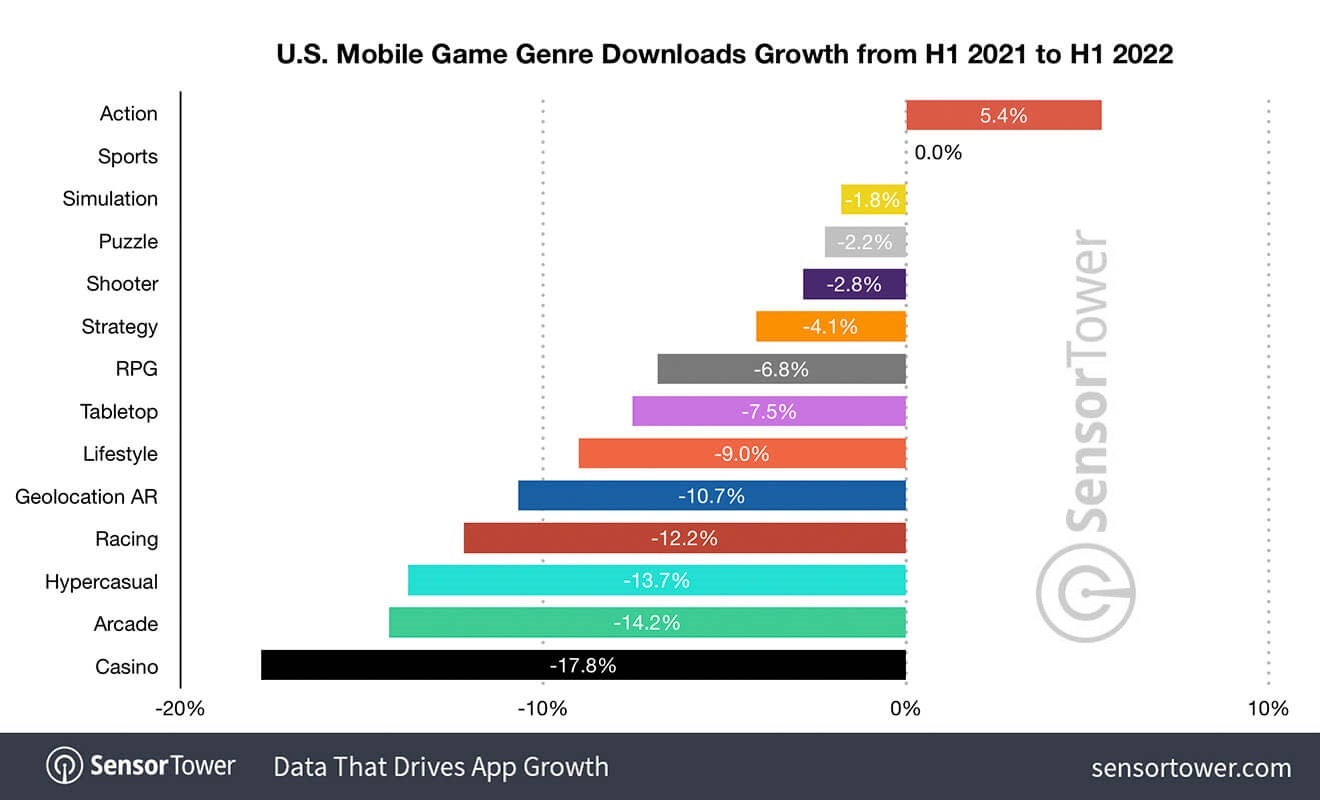
Many mobile app gaming genres have started facing a decline in their app downloads in the first half of 2022

Games of all types have always been a family favorite. Somewhere between playing board games with siblings and cousins at grandma's house to playing them online with friends, we all grew up. Ever since board games like monopoly were invented, games have always been a great source of entertainment and fun for the family, however, our topic for today is how some types of mobile games both online and offline through different genres have been seeing a decline in their revenue.

In the first half of 2022, according to data from SensorTower, most mobile apps spread across many genres have seen a huge downfall in in-app spending of players and the downloads of their app.

In the first half of the year, it was revealed that the gaming market fell by 9.6 percent after comparing it year by year and resulting in an end value of 11.4 billion dollars.

All of this data was collected using Sensor Tower's Game Taxonomy and Game Intelligence features. Now what these two features do is not very interesting but very useful instead. These two features separate and then sort games into their specific genres and sub-genres that they belong to. Then that data is used by expert analysts to check trends.

The fastest rising genre of this half of the year was Arcade with the player spending amount shooting up 14.8 years over year to almost over $176 million. The largest sub-genre of Arcade was Idler which generated almost 88 million dollars going up 35.3 percent when compared year by year.

The second most growing genre of mobile games was Tabletop, which saw an increase of approximately 1 percent and came close to total revenue of 388.8 million dollars.

All other mobile game genres except these two saw a huge decrease in either their player spending or the downloads of their apps and sometimes apps faced both at the same time.
Read next: Children between the ages of 10-12 are spending the most on video games, survey reveals
by Arooj Ahmed via Digital Information World

Altas VPN Reveals That 2020 Was The Worst Year For Router-Oriented Cybersecurity Threats

A study by Atlas VPN reveals that a record number of routers with cybersecurity vulnerabilities were identified in the past few years.

My writing about cybersecurity threats has almost become a chore at this point; there are just so many vulnerabilities out there, and many can be dealt with if everyone just paid a tad bit more attention than they currently do. The Google Play store, for example, keeps letting in malware disguised as apps; unaware individuals download them, even if someone familiar with the internet needs only to take a single glance at the copy-paste reviews and the terrible grammar to know that something’s wrong. However, Google refuses to put in the necessary legwork and people suffer. Cases of cybersecurity breaches just seem to be increasing at an alarmingly exponential rate, with incremental damages due to more and more personal information being stored online. People have their literal social security details available on their phones, and yet refuse to download password managers or go through the minute annoyance of two-factor authentication. At some point, it’s just shooting oneself in the foot to not invest in security options. Then again, the average individual should be blamed less for falling into security traps when we can hold the corporations behind building such fragile equipment accountable.

To make matters worse, cybercriminals seem to be exceeding their chosen career paths with every coming day. Lockdown probably helped out a ton, since it forced everyone to shift towards online work and gave such seedy individuals more time to find new loopholes in pre-existing systems. Android isn’t infallible, Apple isn’t infallible, and routers certainly aren’t. The Atlas VPN study utilized data from Kaspersky, which itself relied on many government sources for information. The figures we’re looking at may vary in the specifics but paint the same general picture. That is to say that since 2010, there has been a massive uptick in router vulnerabilities being exposed by cyber criminals.

In all data compilations, 2017 seems to be a real tipping point for cybersecurity threats, with a second, much more significant uptick being noted in 2020. While I can’t exactly speak for the former, the latter makes sense for reasons that I’ve highlighted above. All sources agree that 2020 was the worst year in terms of router-oriented cybersecurity threats (and I’d wager cybersecurity threats in general as well). However, there is some good news: 2022 seems to be much, much better than 2020, even if conditions are much worse than in preceding years.


Read next: Apple Plans To Wipe Out Passwords Forever As Company Puts Its Passkeys Into The Spotlight
by Arooj Ahmed via Digital Information World

What jobs have the biggest and smallest freelance gender pay gap?

Women's rights have come a long way in the last half-century. But we need to do (much) more, especially when it comes to equal pay for the sexes. Figures from the US Census Bureau reveal female workers are still earning 17% less than their male counterparts.

And going freelance won't help women break through the corporate glass ceiling. A survey by FreshBooks found that male freelancers out-earn women by 28%.

ZenBusiness decided to do a deep dive into the freelance gender pay gap. Using data from freelance platform Upwork and other sources, it created several charts showing which industries have the biggest and smallest freelance gender pay gap.

And it put together a seven-step guide to help women set higher rates and earn more.

How much do freelancers charge?

According to the research from ZenBusiness, the average male freelancer makes $68.58 p/h (pay per hour), while a female freelancer picks up just $46.30 p/h.

Women charge 48% less than men for freelance work, new study finds

That's a per-hour pay gap of $22.28 p/h, which equates to around 48%. In other words, men earn almost half as much more for doing the same freelance jobs and gigs.

The largest freelance pay gap

After crunching the numbers, ZenBusiness researchers found that the freelance accounting and consulting industry has the largest gender pay gap. Overall, men offering these types of freelance services charge (and get paid) an extra $33 p/h.

The widest pay gaps in specific job roles are in accounting and business analysis, where men make over $20 more p/h.

Thankfully, there's far more pay parity in some of the other accounting and consulting roles ZenBuiness looked at. The gender pay gap in bookkeeping and management consulting is less than $5 p/h. And females working as freelance HR Admin consultants actually earn more than men.

The widest gender pay discrepancy

DevOps engineers are highly skilled IT professionals who work with software developers, system operators, and other production IT staff to oversee code releases and new pieces of software.

It's a complex and challenging role. And it's always in high demand. DevOps are the most recruited people on LinkedIn.

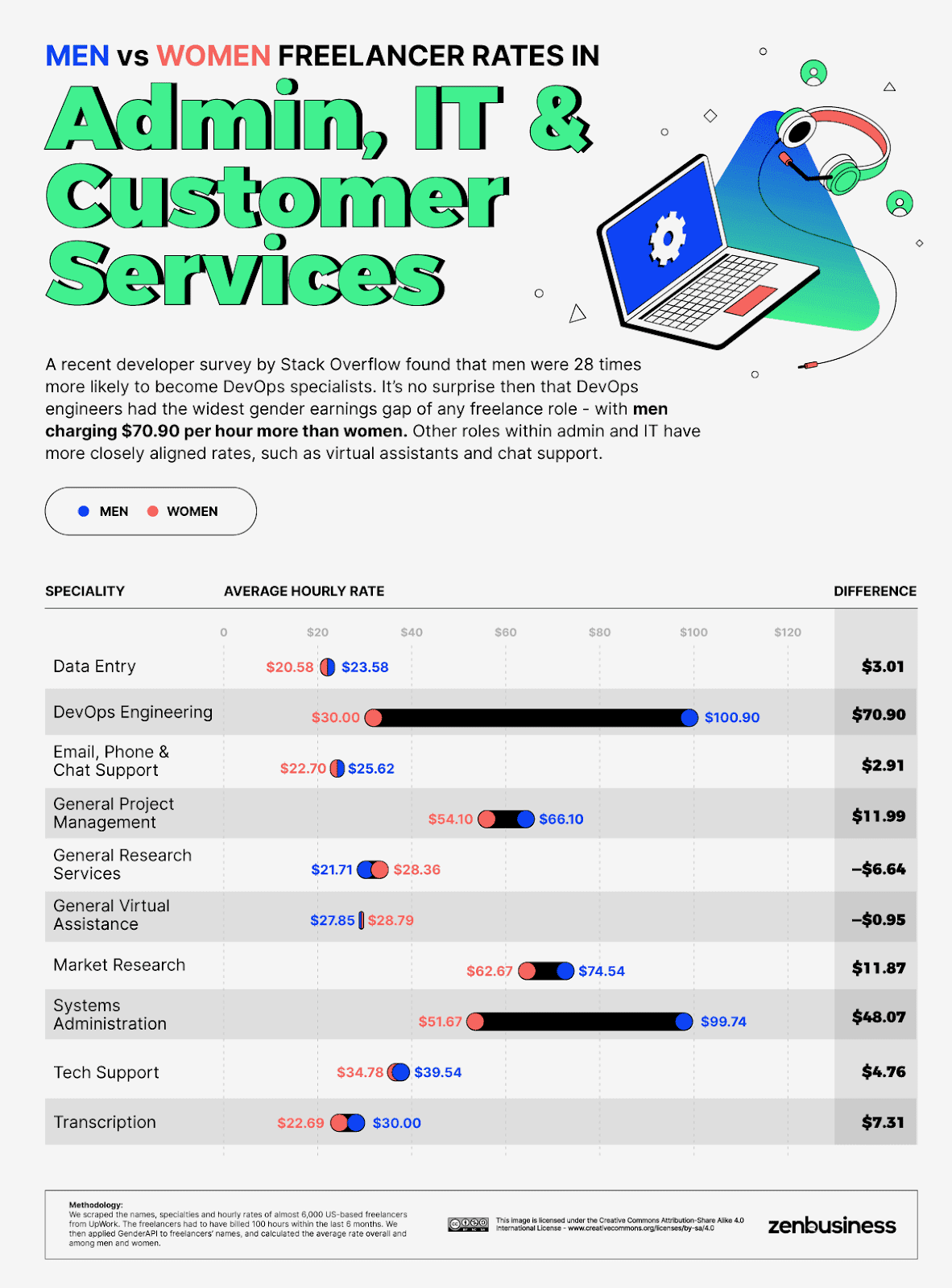
The most skilled and experienced DevOps professionals can expect to earn well over $100 p/h - as long as they are men. The average p/h rate for female DevOps specialists is just $30. Shocking. That $70 pay gap is the biggest gender pay discrepancy of any single role in the study.

Things aren't much better for women trying to make a freelance career in IT systems administration. They earn over $50 p/h. It sounds pretty impressive, but they're still making over $40 less p/h than the male freelance system administrators.

The freelance industry where men and women (almost) earn the same

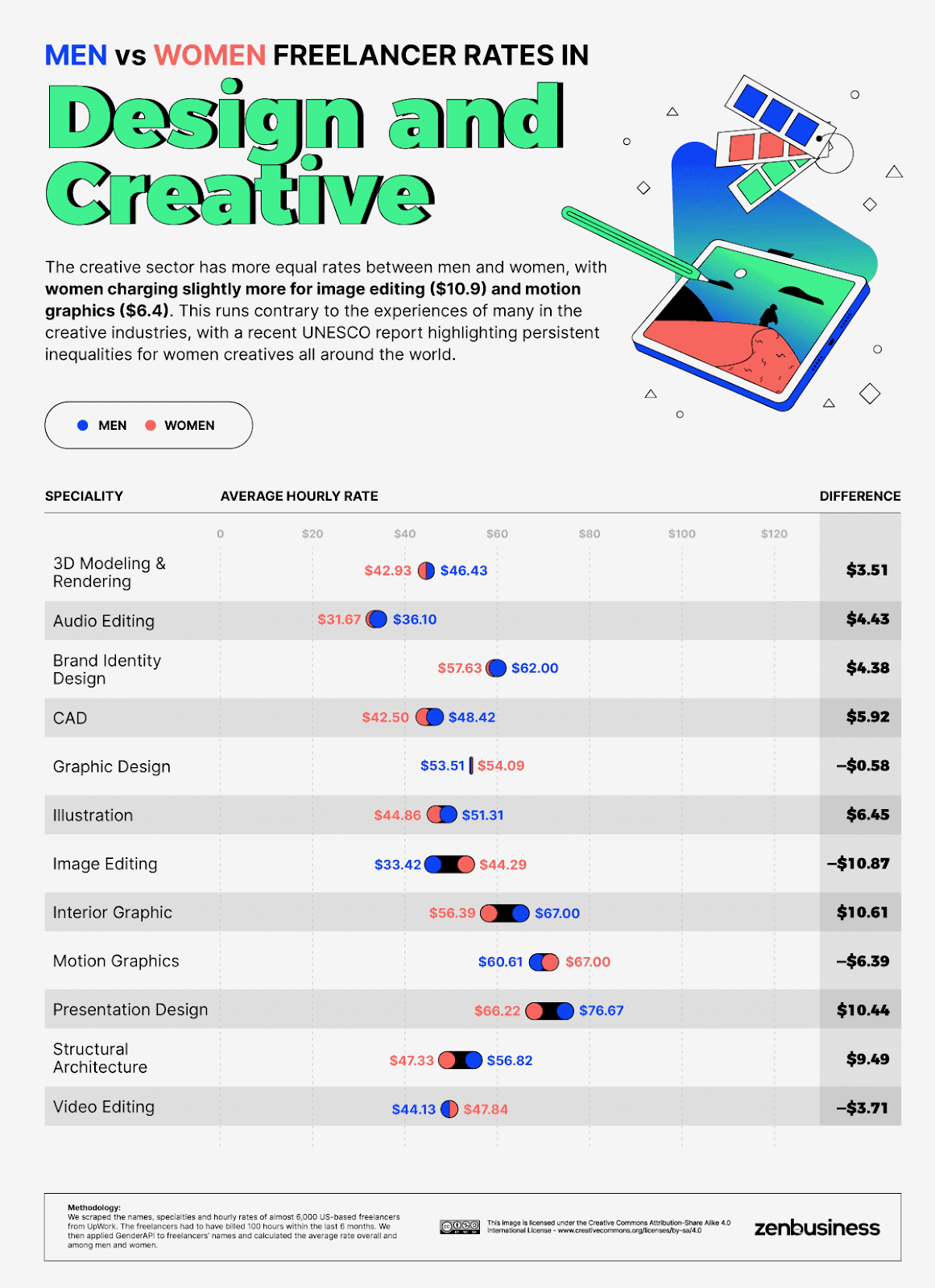
A look at freelance pay in the creative industries paints a much fairer picture. In the 12 creative freelance roles that ZenBuiness looked at, the widest gender pay disparities are in presentation design ($10.44 p/h) and interior graphics ($10.61.)

It's less than $5 p/h in audio editing, brand identity design, and 3D modeling roles.

And there are several creative freelance roles where women can expect to make more than men, including motion graphics, video and image editing, and graphic design.

Near perfect pay parity

Things are (almost) perfectly equal in the world of freelance UX/UI design. The gender pay gap in this new and exciting industry is just $0.03. And that's weighted in favor of the girls.

Female desktop software developers working freelance are close to earning salaries reflecting their true value. They need to take home less than $1 p/h more to be on par with the men doing similar roles.

Unfortunately, we can't say the same for most of the other freelance software development and data science roles. And there's lots of work to be done to ensure women have the same opportunities to succeed in these highly paid tech roles. Currently, nearly 80% of computer programmers or coders are men.

Girls Who Code is one of the many nonprofit organizations looking to address this worrying gender imbalance. It's helping to increase the number of women in computer science by equipping young women with the computing skills and confidence to write code and write their own futures.

Freelance rate in sales and marketing

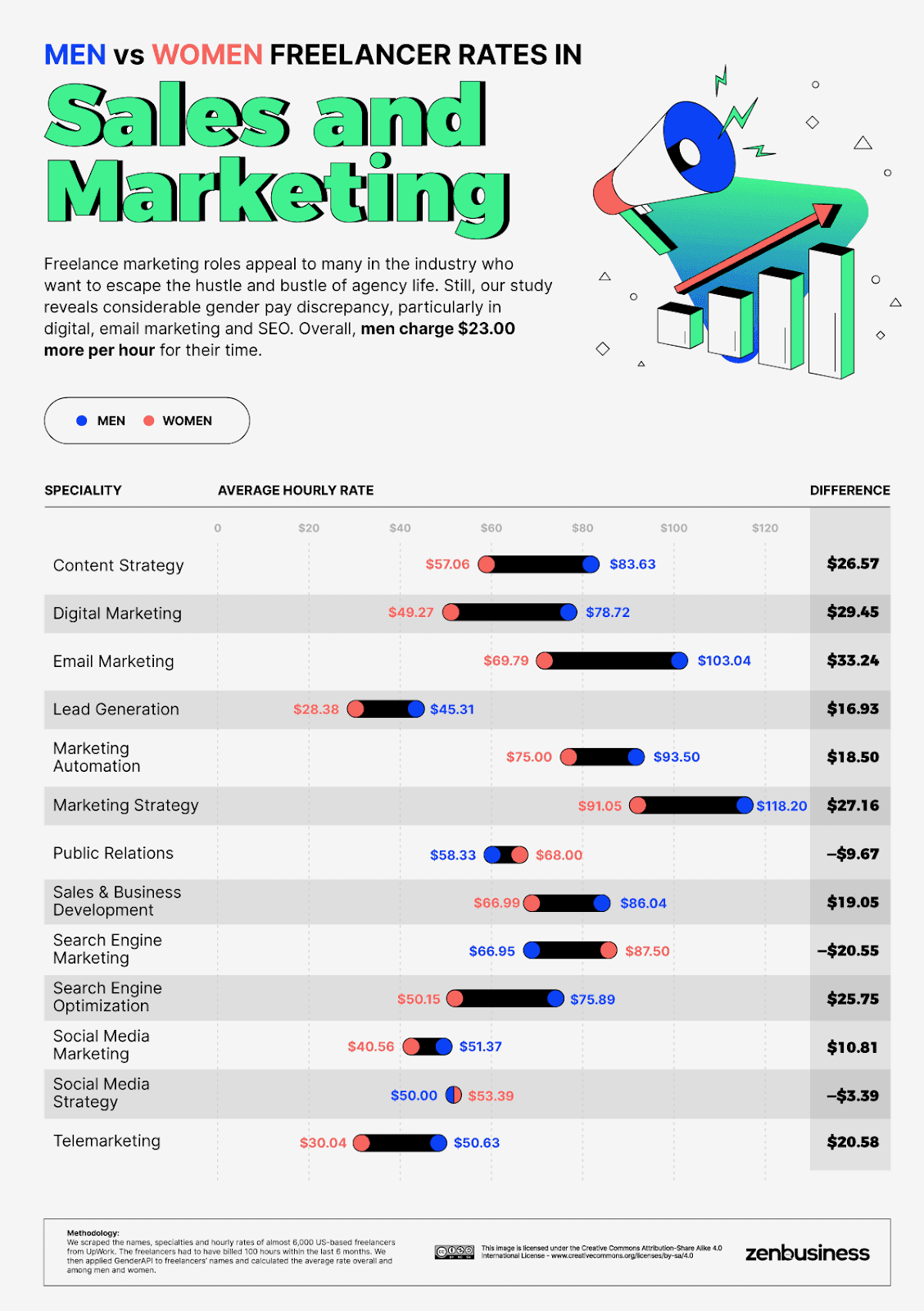
LinkedIn data shows that women account for 60% of all freelance sales and marketing roles. But they're still lagging behind the men in terms of pay.

Male freelancers command higher hourly rates for content strategy, lead generation, marketing automation, and search engine optimization. On average, men freelancing in these roles make between $15-25 p/h more than women.

But the biggest pay gap is in freelance email marketing, where men make $130 p/h. Women earn $69.70 p/h.

Search engine marketing is the only freelance role in the study where women make significantly more than men. On average, female freelance SEO marketers earn $87.50 p/h; the men make over $20 less p/h ($66.95.)

Writing and translation

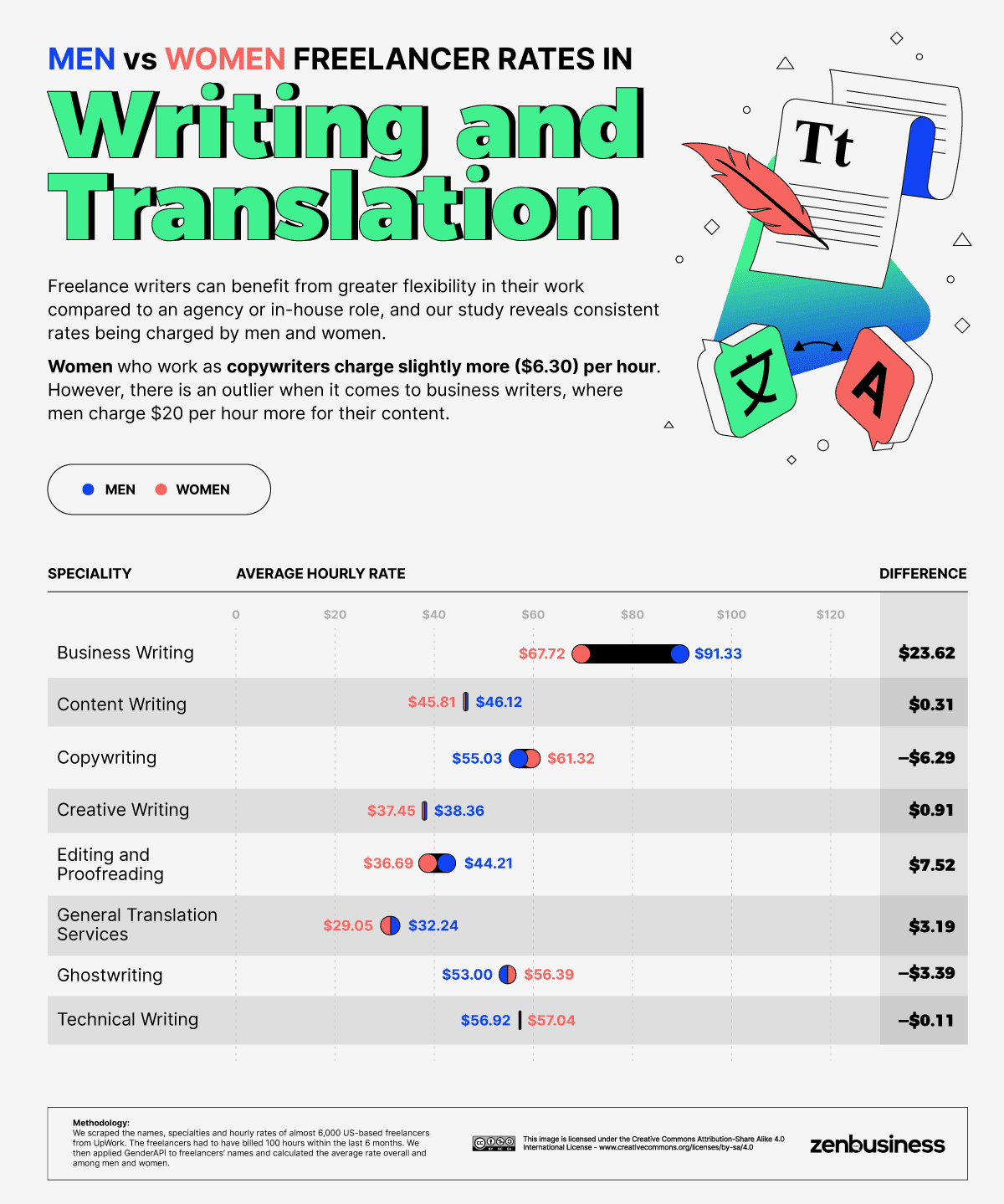
There's a definite glass ceiling for female freelancers in business writing. They earn $67.72 p/h. Compared to the $91.33 p/h rate that male freelancers charge, female business writers are underpaid by over $20 p/h.

The other writing and translation gigs included in the study are far more equitable regarding gender pay. Many have near equal pay between men and women. The gender pay gap in creative, technical, and content writing is under $1.
The Freelancer Pay Gap

Earning what you deserve

So what can women do to close the pay gap and earn what they deserve?

ZenBuiness put together seven tips on how to set the proper freelance rates for your skill level. They are:
  • Know your market
  • Understand your clients
  • Factor in expenses
  • Account for days off
  • NEVER undersell yourself
  • Get comfortable talking about money
  • Be flexible
Everybody should be judged (and paid) on their merits and abilities. So check out the seven tips in more detail below and use them to start earning what you're really worth.

The Freelancer Pay Gap is Real: Here’s How You Can Earn the Rates You Deserve - infographic

Read next: Facebook Highlighted For Having The Most Difficult Terms Of Service That Only College Graduates Can Comprehend
by Irfan Ahmad via Digital Information World

Gen Z is the most likely to ditch a brand, study reveals

Loyalty from a consumer to a brand is the most important thing for brands in these unpredictable times. With the economy reaching new depths and taxes on the people rising, loyalty to their favorite brands is not exactly what is on citizens’ minds.

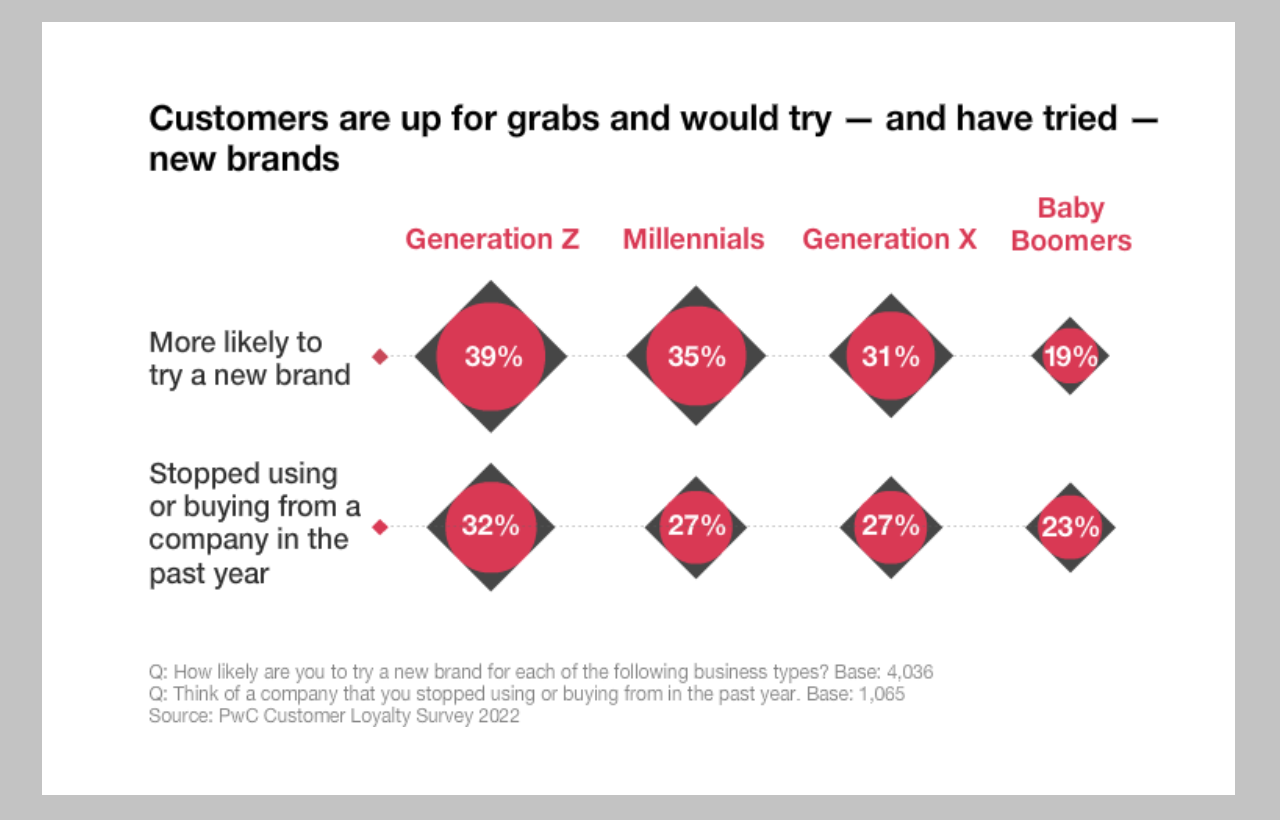
According to a survey conducted with 4000 people from different generations and presented in a study by PwC, Gen Z is the one that is most likely to try different and emerging brands as 39% say that they would do so in contrast with the 35% of millennials and 31% of Generation X.

Certainly, 32% Gen Z respondents stopped buying or using a company’s products in the last year and with them, 27% of millennials and Gen Xers dumped a company. Overall in the past year, 26% of consumers have stopped using products from different brands. Only boomers seem to be sticking to the old ways as 19% of the older generation said that they were likely to try out an undiscovered brand and as another step forward 23% of Boomers did stop belittling a brand for any reason at all.


In the end, it all comes down to the category as to where the product belongs. 44% of customers are the most likely to switch to a new restaurant, also for Consumer Goods (38%) and supermarkets (36%). In addition to this 52% of consumers say that they would be less loyal to any of the businesses belonging to any of the above-mentioned sectors if their online experience was not in the same way enjoyable as the in-person one.

On a brighter note, 82% of customers said that they would gladly give up their data if it meant that it will result in better consumer service for them. Adding to this 87% of consumers are looking for a personalized experience and 53% of them say that the pricing of the brand (which can sometimes be overpriced but sometimes rightly so) is the reason why they patronize a brand.

Now there is the question of why consumers are starting to leave brands that they have been loyal to for years. Well the answer is here, and most consumers say that they leave brands because:
  • They had a bad experience with one or a few of their products, say 37%
  • 32% say that they had a sort of history with the brand’s consumer service
  • 18% say that they left the brand to support some issues that they feel have importance in society
  • Because prices went up and discounts stopped coming, say 17%
  • The quality of their service went down-17%
  • 15% like their time with another brand better
  • Another brand had better prices that were in my budget, say 11%
  • They weren’t available everywhere-10%
  • 7% of consumers said that they don’t trust that brand with their data
  • And lastly, through Friend/Social media another brand was introduced to me
Read next: Facebook Highlighted For Having The Most Difficult Terms Of Service That Only College Graduates Can Comprehend
by Arooj Ahmed via Digital Information World

Sunday, August 7, 2022

Most of the machinery that is hacked is from America and China

Machinery is the backbone of almost any sort of work done whether it is domestic or commercial rate. Machinery is a very important aspect of commercial work as it speeds things up and helps reduce the amount of manpower that would be required to do those things.

As we all know China is the hub of inventions and manufacturing and most of the machines and tech that we use comes from China.

We also know that China isn't the only superpower in the world, it shares that title with America and it makes sense that those two countries have the most amount of Machines and it makes even more sense that they are in the lead most times machines have been hacked in one country, according to research by Nozomi Networks.

The company named the two countries as the most attacking countries but also added that with so many technological advancements being made every day, it is hard to tell where the attack may originate from. So all we know is an attack on a machine in Los Angeles might have come from any corner of the world or vice-versa. (no offense to anyone from or living in LA)

It further went on to say that there is no need for a direct connection between the place that was attacked or was attacking because any server in the world can be used and manipulated to attack any sort of machine in the world.

Instead, it somehow seems like both America and China might be victims of their success in the tech field because hacking into one of the world’s best systems is quite a thing to be able to brag about.

The research by Nozomi also revealed that there are some specific credentials that hackers use to get access to the files. The list of credentials included “admin” and “root” but the most used one was “nproc”. Using this stock name over 12,000 URLs were targeted in the six months that this report covered.


H/T: CN

Read next: Social Media Profiles Are Getting Hacked At Alarming Rates, Confirms New Report
by Arooj Ahmed via Digital Information World
Influencer marketing is on the rise and here is all you need to know about it

Social media plays a huge role in the overall branding of a company no matter how big or small. Whenever a social media influencer is chosen to endorse a new product, their review of it reaches hundreds of fans. Then, when those fans see that video or post of their favorite content creator checking out a new product and giving their review they instantly are attracted to it and most likely buy or consider buying this product, with the mentality that it makes them more like their favorite content creator.

A new report on the state of Business to Business and influencer marketing shared quite a lot of insights on business opportunities coming in the second half of this year and beyond that also. According to the report, Influencer marketing has been going in the right direction for most marketing people.

A new study from Lee Odden’s TopRank Marketing blog found that 86% of Business to Business (aka businesses that use other businesses as their middle man) have been successful with influencer marketing. By using influencer marketing most brands have started boosting their brand awareness and with its reputation as well. All this has led to sales increasing if not by a tremendous amount but increasing all the same.


Almost a third of businesses have said that their revenues have gone up ever since they got their products marketed by a social media influencer and 85% of people have the belief that the interest rates one has to pay while working with influencers will increase in the upcoming year because of Inflation, rising housing prices and much more.

The report answers the questions many people have about influencer marketing and also gives some solid advice on what are the factors to consider when picking an influencer to market your brand, so let’s dive in.

First things first, we need to know what B2B marketing is and how it involves Influencers. This specific type of marketing starts as a one-time deal but after checking the outcomes of this deal, most marketers are thinking of making it into a long-term deal based on the result and the performance of that specific influencer. The study surveyed marketing professionals and experts on their experience with Influencer Marketing and here are the results:-

• 86% of respondents said that it was either remotely or very successful for their company,

• 72% said that it helped them increase their brand’s reputation,

• 70% said that it helped in increasing awareness about their brand,

• 56% said that it helped them with creating new leads,

• 33% said that it was a direct source of revenue for their company.

Now arises the question of finding an influencer trustworthy enough to become a B2B partner with them. In this case, you need to see beyond basic things like followers and reach, according to the report.

According to professionals, when thinking of going into Influencer Marketing, you need to look above vain qualities like followers/subscribers and start thinking about relevance because audience size does not matter as much as audience relevance

Read next: Altas VPN Reveals That 2020 Was The Worst Year For Router-Oriented Cybersecurity Threats
by Arooj Ahmed via Digital Information World