While Google Chrome reigns supreme in today’s market of leading browsers, a new report managed to prove how Microsoft Edge shouldn’t be underestimated as its popularity continues to increase as we speak.
This might be another reason why Microsoft is working hard to really bring its Edge browser to par with other leading competitors by announcing updates that could really enhance user performance.
Microsoft will soon be launching a security update that helps the browser function at its best in the next few days. This update will be seen through the Edge Stable Channel to overcome all security defaults users might be experiencing while visiting less famous websites.
For starters, the company is hoping to move forward by switching on its most famous security level whenever it finds the ‘enhance security on web’ option is toggled on by users who wish to get that added level of protection in their settings section.
After being switched on, you get another layer of security against threats or vulnerabilities linked to memory on the browser.
This new feature would work to provide protection by simply disabling Javascript compilation while adding a series of OS protections that serve as extra care when a user is busy browsing online and passing through sites that they might not be familiar with.
After users update their browsers to attain this latest feature, their basic level gets activated in the latest browser as a default setting, where it’s only applied when using websites that a user visits on a less than frequent basis.
So the next time you visit an area that’s alien or new to you, you can be sure that this new security advancement gives so much protection. And what more can a user ask for than preserving user experience while visiting all sorts of famous sites across the web?
Microsoft confirmed the news recently via a blog post that put this new feature in the spotlight. It also mentioned how the update will give users the chance to have their data imported via Google Chrome while carrying out its experience for the First Run.
Through this method, you don’t even require to have your web browser downloaded across your device.
With the update, users can bring forward their data from Chrome via a log-in attempt to their classic Google accounts on the First Run Experience by Edge.
And whenever users wish to switch it off, they can do so by toggling off by clicking on Hide your First Run Experience or simply by clicking on disabled.
There are also quite a few new policies available that allow users to have their data imported from a long list of browsers on each launch. They’ll then be configured back to Microsoft Edge for further confirmation, right before all the windows with different tabs are shut.
The news comes to us at a time when the company revealed last week how it would be providing its users with enhanced browsing performances, especially when working on systems that have low memory on their disk drive.
H/T: BC
Read next: What jobs have the biggest and smallest freelance gender pay gap?
by Dr. Hura Anwar via Digital Information World
"Mr Branding" is a blog based on RSS for everything related to website branding and website design, it collects its posts from many sites in order to facilitate the updating to the latest technology.
To suggest any source, please contact me: Taha.baba@consultant.com
Tuesday, August 9, 2022
Snapchat Is Launching A New Supervision Tool That Allows Parents To Keep Tabs On Their Kids
One of the biggest drawbacks of social media is the danger of impacting young minds, especially when platforms are used without guardian supervision.
Therefore, keeping that very same notion at the forefront, Snapchat is launching a new supervision tool for parents and associated guardians. This is another way they can keep tabs on how their kids are making use of the app.
The company revealed the decision of doing so as a part of their latest efforts for child safety on Tuesday. And according to them, the tool does a great job at mimicking the real-world interactions of parents and their respective teens.
The tool is dubbed Snap’s ‘Family Center’ and it provides a glimpse of who young children are messaging, without actually showing what the conversation comprises.
But in order for it to actually work, well, both parents as the teenagers involved need to accept the invitation. And we believe that in itself can be a major task.
After the specific invitation is given a green signal, parents get the chance to see their teen’s conversation list of contacts as well as their list of friends. Anyone that a young user has interacted with in the last one week will be shown too.
Anything that a parent or guardian feels is threatening or unsafe for their child can be forwarded in the form of a report to Snap’s team as well as their trust board.
Snapchat revealed recently through a recent blog post how it hoped the added measure of safeguard and security would help in reflecting what really goes on in the world of social media, in terms of relationships.
At the same time, they hoped that it would create a greater bond of trust between teenage users and their parents. You can best think of it as a situation where parents allow their kids’ friends over.
While they’re allowed to monitor everything that’s going on, they’re actually not eavesdropping on the conversations taking place.
We should be seeing the launch of the new innovative parental supervision tool called Family Center take centerstage in the next couple of weeks. This includes any new friends added and some more content control features as well.
News about the launch of Snapchat’s new tool comes to us at a time when so many lawmakers are urging social media platforms to create policies that better protect young users online.
Let’s not forget how leading whistleblowers of Facebook have proven through leaked papers how the company is designed to affect children’s safety negatively.
Some of the biggest names in the tech industry have also been invited to explain their cases to Congress who wants answers on what steps these tech giants are implementing to safeguard children.
Common names included the likes of TikTok, YouTube, and Snap as well.
Last year, we saw Snap’s VP claim how the company was very different in functioning when compared to archrivals. She called the firm an antidote to the world of social media.
This was closely followed up by the signing of several bills in the US that were created to better tackle the safety of users online.
Clearly, this move and a few others are clear proof to us all that Snap is keen on taking the safety of its young users very seriously. They have mentioned time and time again how their goal is to empower young minds so they end up making the right decisions in today’s fast-paced digital world.
This year in January, Snapchat unleashed a new feature that would restrict friend suggestions for teen users on the app. And this next move seems to be following in the same footsteps as that theme.
Read next: Snap Gears Up To Fire More Employees As Company Isn’t Happy With How Business Is Performing
by Dr. Hura Anwar via Digital Information World
Therefore, keeping that very same notion at the forefront, Snapchat is launching a new supervision tool for parents and associated guardians. This is another way they can keep tabs on how their kids are making use of the app.
The company revealed the decision of doing so as a part of their latest efforts for child safety on Tuesday. And according to them, the tool does a great job at mimicking the real-world interactions of parents and their respective teens.
The tool is dubbed Snap’s ‘Family Center’ and it provides a glimpse of who young children are messaging, without actually showing what the conversation comprises.
But in order for it to actually work, well, both parents as the teenagers involved need to accept the invitation. And we believe that in itself can be a major task.
After the specific invitation is given a green signal, parents get the chance to see their teen’s conversation list of contacts as well as their list of friends. Anyone that a young user has interacted with in the last one week will be shown too.
Anything that a parent or guardian feels is threatening or unsafe for their child can be forwarded in the form of a report to Snap’s team as well as their trust board.
Snapchat revealed recently through a recent blog post how it hoped the added measure of safeguard and security would help in reflecting what really goes on in the world of social media, in terms of relationships.
At the same time, they hoped that it would create a greater bond of trust between teenage users and their parents. You can best think of it as a situation where parents allow their kids’ friends over.
While they’re allowed to monitor everything that’s going on, they’re actually not eavesdropping on the conversations taking place.
We should be seeing the launch of the new innovative parental supervision tool called Family Center take centerstage in the next couple of weeks. This includes any new friends added and some more content control features as well.
News about the launch of Snapchat’s new tool comes to us at a time when so many lawmakers are urging social media platforms to create policies that better protect young users online.
Let’s not forget how leading whistleblowers of Facebook have proven through leaked papers how the company is designed to affect children’s safety negatively.
Some of the biggest names in the tech industry have also been invited to explain their cases to Congress who wants answers on what steps these tech giants are implementing to safeguard children.
Common names included the likes of TikTok, YouTube, and Snap as well.
Last year, we saw Snap’s VP claim how the company was very different in functioning when compared to archrivals. She called the firm an antidote to the world of social media.
This was closely followed up by the signing of several bills in the US that were created to better tackle the safety of users online.
Clearly, this move and a few others are clear proof to us all that Snap is keen on taking the safety of its young users very seriously. They have mentioned time and time again how their goal is to empower young minds so they end up making the right decisions in today’s fast-paced digital world.
This year in January, Snapchat unleashed a new feature that would restrict friend suggestions for teen users on the app. And this next move seems to be following in the same footsteps as that theme.
Read next: Snap Gears Up To Fire More Employees As Company Isn’t Happy With How Business Is Performing
by Dr. Hura Anwar via Digital Information World
Monday, August 8, 2022
Contrary to Predictions, Ecommerce Growth Continues Despite Return of In-Person Shopping
A recent study by ecommerce funding firm 8fig revealed that 52% of online stores reported growth in Q2 of 2022 compared to Q2 of 2021. These results defied an expected decline in online sales as consumers return to in-person shopping.
Governments have begun to relax their COVID-19 mandates in efforts to sustain the reopening of their economies. In the United States, a third of workers are expected to be back physically in their offices by the end of 2022. Schools and universities are also resuming face-to-face classes.
This increase in mobility is allowing in-person shopping to come back as part of people’s routines. Because of this, there has been a growing belief that online sales are to enter a downtrend as more people venture out and go about their activities physically rather than virtually.
However, 8fig's study shows that the resurgence of in-person shopping is not happening just yet. Analysis of the financial data gathered from 543 Amazon and Shopify stores revealed that over half of the businesses surveyed still saw an uptick in sales this Q2 compared to their previous year’s figures.
The pandemic gave ecommerce a major boost. During the first year of the pandemic in 2020, ecommerce sales increased by 43% or $244.2 billion from 2019. Health mandates compelled consumers and businesses to shift transactions to online channels.
The sustained growth by over half of businesses, while not as strong as the initial boom, indicate that the trend is still pointing upwards.
According to the 8fig study, electronics is the strongest segment, with 76% of stores under the category reporting increased sales. Nearly a third of businesses in the health segment also experienced growth. Over half of stores selling home and baby products also generated more business over the past year.
However, not all categories were able to sustain their growth. Online sales of fashion and beauty products declined, with only about a third of businesses in these categories experiencing an uptick in sales
There is also a stark difference between Amazon and Shopify stores’ performance. 60% of Amazon stores included in the study posted stronger year-on-year numbers. In contrast, only 41% of those on Shopify showed growth.
Other studies also affirm the research’s general findings. Data from a Cowen study shows that global ecommerce penetration is still expected to widen in the coming years. US online grocery shopping in Q1 2022 is already double from Q4 of 2019, indicating that consumers are now comfortable buying their basic needs online. Similar trends on online grocery sales are also being observed globally.
Insights from these studies even point at the possibility that buyer behaviors may have already shifted. Consumers appear to be becoming more comfortable using online stores to avail of certain products and services. A full return to pre-pandemic life remains unlikely for now, so the preference for online shopping may endure.
Even big tech companies seem to affirm the projected growth of ecommerce. For example, Google is set to roll out a new search function for ecommerce. It allows retailers to serve customers relevant search results, potentially helping improve buying experiences and raise stores’ conversion rates. YouTube is also set to implement a “products you see in this video” feature.
Aside from this support from big tech, new funding platforms targeted specifically for ecommerce are also emerging. These platforms provide businesses with financing plans that are customized to drive growth. A fresh influx of capital should enable stores to capitalize on these positive trends whether through expansion or the improvement of their fulfillment capabilities.
Such developments should come as welcome news to ecommerce entrepreneurs. As buying behaviors shift and online stores become preferred channels for transactions, online stores can look for opportunities to further bolster their business. They can venture into the stronger segments and optimize their products and services to cater to the emerging demands of the market.
by Web Desk via Digital Information World
Governments have begun to relax their COVID-19 mandates in efforts to sustain the reopening of their economies. In the United States, a third of workers are expected to be back physically in their offices by the end of 2022. Schools and universities are also resuming face-to-face classes.
This increase in mobility is allowing in-person shopping to come back as part of people’s routines. Because of this, there has been a growing belief that online sales are to enter a downtrend as more people venture out and go about their activities physically rather than virtually.
However, 8fig's study shows that the resurgence of in-person shopping is not happening just yet. Analysis of the financial data gathered from 543 Amazon and Shopify stores revealed that over half of the businesses surveyed still saw an uptick in sales this Q2 compared to their previous year’s figures.
The pandemic gave ecommerce a major boost. During the first year of the pandemic in 2020, ecommerce sales increased by 43% or $244.2 billion from 2019. Health mandates compelled consumers and businesses to shift transactions to online channels.
The sustained growth by over half of businesses, while not as strong as the initial boom, indicate that the trend is still pointing upwards.
According to the 8fig study, electronics is the strongest segment, with 76% of stores under the category reporting increased sales. Nearly a third of businesses in the health segment also experienced growth. Over half of stores selling home and baby products also generated more business over the past year.
However, not all categories were able to sustain their growth. Online sales of fashion and beauty products declined, with only about a third of businesses in these categories experiencing an uptick in sales
There is also a stark difference between Amazon and Shopify stores’ performance. 60% of Amazon stores included in the study posted stronger year-on-year numbers. In contrast, only 41% of those on Shopify showed growth.
Other studies also affirm the research’s general findings. Data from a Cowen study shows that global ecommerce penetration is still expected to widen in the coming years. US online grocery shopping in Q1 2022 is already double from Q4 of 2019, indicating that consumers are now comfortable buying their basic needs online. Similar trends on online grocery sales are also being observed globally.
Insights from these studies even point at the possibility that buyer behaviors may have already shifted. Consumers appear to be becoming more comfortable using online stores to avail of certain products and services. A full return to pre-pandemic life remains unlikely for now, so the preference for online shopping may endure.
Even big tech companies seem to affirm the projected growth of ecommerce. For example, Google is set to roll out a new search function for ecommerce. It allows retailers to serve customers relevant search results, potentially helping improve buying experiences and raise stores’ conversion rates. YouTube is also set to implement a “products you see in this video” feature.
Aside from this support from big tech, new funding platforms targeted specifically for ecommerce are also emerging. These platforms provide businesses with financing plans that are customized to drive growth. A fresh influx of capital should enable stores to capitalize on these positive trends whether through expansion or the improvement of their fulfillment capabilities.
Such developments should come as welcome news to ecommerce entrepreneurs. As buying behaviors shift and online stores become preferred channels for transactions, online stores can look for opportunities to further bolster their business. They can venture into the stronger segments and optimize their products and services to cater to the emerging demands of the market.
by Web Desk via Digital Information World
Integral Ad Science research outcasts the rising concerns of ad tech marketers about digital audio frauds
A new survey from Integral Ad Science (IAS), a media firm known for addressing digital advertising fraud, unveils eighty-seven percent of advertisers are highly concerned about audio ads fraud. Along with this, some vital pieces of information are also gathered by the company, which I will discuss further.
These days programmatic audio ads are gaining publishers' and ad buyers' interest due to their record-breaking consumer engagement capability. The ongoing growth in the volume of online audible stuff is increasing, and everyone is enjoying it. People prefer podcasts, audio blogs, etc., while traveling or doing home chores. Also, streaming audios are popular on mobile phones, and consumers are adopting audio devices such as speakers in their homes.
In response to the enhancement in the audio streaming business, marketers are adding audio to their campaigns to scale up their reach to relevant audiences. As consumers are already used to the audio ad formats, more media experts will adopt audio ads in the current year. The study says digital audio advertisements are expanding the overall performance and brand awareness for sixty-three percent of ad tech marketers surveyed. In addition, the study delves into whether marketers are satisfied with the current audibility metrics and highlights the importance of the third-party verification process in preserving premium quality standards for digital advertising.
The MD of integral Ad Science, Csaba Szabo, believes that with the widespread growth of digital audio content, marketers and advertisers want complete satisfaction with the adequacy of current metrics. About seventy-three percent of media publishers say that programmatic audio ad purchasing is more convenient and a better way to scale brands. Most ad buyers are adopting automated transactions while focusing on good-quality audio ads. Nearly half, almost forty-five percent of publishers said that it's essential to analyze the performance across visual ads, audios, video, etc. For most advertisers, audibility criteria are inadequate as a whole to compare viewability with performance benchmarks.
Furthermore, forty-three percent of mobile marketers would likely serve more frequent audio advertisements, and thirty-one percent of ad buyers would acquire more digital audio ads with integrated third-party support. The verification aids advertisers in tackling ad metrics by sharing in-depth analysis of performance and future novel ideas.
Spotify and IAS are collaborating to establish a third-party verification process to ensure the safety of digital audio ad marketers. So, it is essential to mention that by incorporating third-party support, most tech ad experts will purchase ads.
Read next: Social Media Profiles Are Getting Hacked At Alarming Rates, Confirms New Report
by Arooj Ahmed via Digital Information World
These days programmatic audio ads are gaining publishers' and ad buyers' interest due to their record-breaking consumer engagement capability. The ongoing growth in the volume of online audible stuff is increasing, and everyone is enjoying it. People prefer podcasts, audio blogs, etc., while traveling or doing home chores. Also, streaming audios are popular on mobile phones, and consumers are adopting audio devices such as speakers in their homes.
In response to the enhancement in the audio streaming business, marketers are adding audio to their campaigns to scale up their reach to relevant audiences. As consumers are already used to the audio ad formats, more media experts will adopt audio ads in the current year. The study says digital audio advertisements are expanding the overall performance and brand awareness for sixty-three percent of ad tech marketers surveyed. In addition, the study delves into whether marketers are satisfied with the current audibility metrics and highlights the importance of the third-party verification process in preserving premium quality standards for digital advertising.
The MD of integral Ad Science, Csaba Szabo, believes that with the widespread growth of digital audio content, marketers and advertisers want complete satisfaction with the adequacy of current metrics. About seventy-three percent of media publishers say that programmatic audio ad purchasing is more convenient and a better way to scale brands. Most ad buyers are adopting automated transactions while focusing on good-quality audio ads. Nearly half, almost forty-five percent of publishers said that it's essential to analyze the performance across visual ads, audios, video, etc. For most advertisers, audibility criteria are inadequate as a whole to compare viewability with performance benchmarks.
Furthermore, forty-three percent of mobile marketers would likely serve more frequent audio advertisements, and thirty-one percent of ad buyers would acquire more digital audio ads with integrated third-party support. The verification aids advertisers in tackling ad metrics by sharing in-depth analysis of performance and future novel ideas.
Spotify and IAS are collaborating to establish a third-party verification process to ensure the safety of digital audio ad marketers. So, it is essential to mention that by incorporating third-party support, most tech ad experts will purchase ads.
Read next: Social Media Profiles Are Getting Hacked At Alarming Rates, Confirms New Report
by Arooj Ahmed via Digital Information World
Here’s How China Went From Emerging Economy to Superpower in Just 20 Years
China’s rise to economic might has been a very interesting tale, as the country’s political struggles and turmoil have borne great fruit. Back in 2002, the two dominant economic super powers in the world were the US and the EU, with each having a 19.8% and 19.9% share of the global GDP when looked at with Purchasing Power Parity in mind. With all of that having been said and now out of the way, it is important to note that both of these regions have seen their powers diminish due to a rapidly rising China.
China’s share of the world’s GDP when adjusted for PPP was around 8.1% in 2002, but 20 years later we are seeing a completely different picture. China now accounts for 18.8% of the world’s GDP, and both the US and the EU have seen a decrease of 4 and 5.1 percentage points respectively. The US now has a 15.8% share of the global economy, and the EU has just 14.8% which is a far cry from the unassailable dominance that they showed in decades prior.
The global recession will likely make the gap wider because of the fact that this is the sort of thing that could potentially end up bringing the economies of the US and the EU to a halt. China, on the other hand, is projected to continue showing modest growth rates which will allow it to cement its place as the world’s foremost super power.
China is not the only country that has been rising rapidly either. India managed to climb its way to an over 7% share of the world’s GDP, and while it is still short of China its growth rate will allow it to get closer to the US and the EU in terms of global GDP share.
The twin powers of China and India might create an entirely new economic paradigm with these two countries now vying for global dominance perhaps similarly to how the US and the Soviet Union were struggling against each other all throughout the 20th century.
H/T: Statista.
Read next: Gallup Conducted Its Monthly Study On American Fears And Concerns For The Month Of July
by Zia Muhammad via Digital Information World
China’s share of the world’s GDP when adjusted for PPP was around 8.1% in 2002, but 20 years later we are seeing a completely different picture. China now accounts for 18.8% of the world’s GDP, and both the US and the EU have seen a decrease of 4 and 5.1 percentage points respectively. The US now has a 15.8% share of the global economy, and the EU has just 14.8% which is a far cry from the unassailable dominance that they showed in decades prior.
The global recession will likely make the gap wider because of the fact that this is the sort of thing that could potentially end up bringing the economies of the US and the EU to a halt. China, on the other hand, is projected to continue showing modest growth rates which will allow it to cement its place as the world’s foremost super power.
China is not the only country that has been rising rapidly either. India managed to climb its way to an over 7% share of the world’s GDP, and while it is still short of China its growth rate will allow it to get closer to the US and the EU in terms of global GDP share.
The twin powers of China and India might create an entirely new economic paradigm with these two countries now vying for global dominance perhaps similarly to how the US and the Soviet Union were struggling against each other all throughout the 20th century.
H/T: Statista.Read next: Gallup Conducted Its Monthly Study On American Fears And Concerns For The Month Of July
by Zia Muhammad via Digital Information World
Let's Take A Look At How Much E-commerce Is Affecting The Economies Of Different Countries
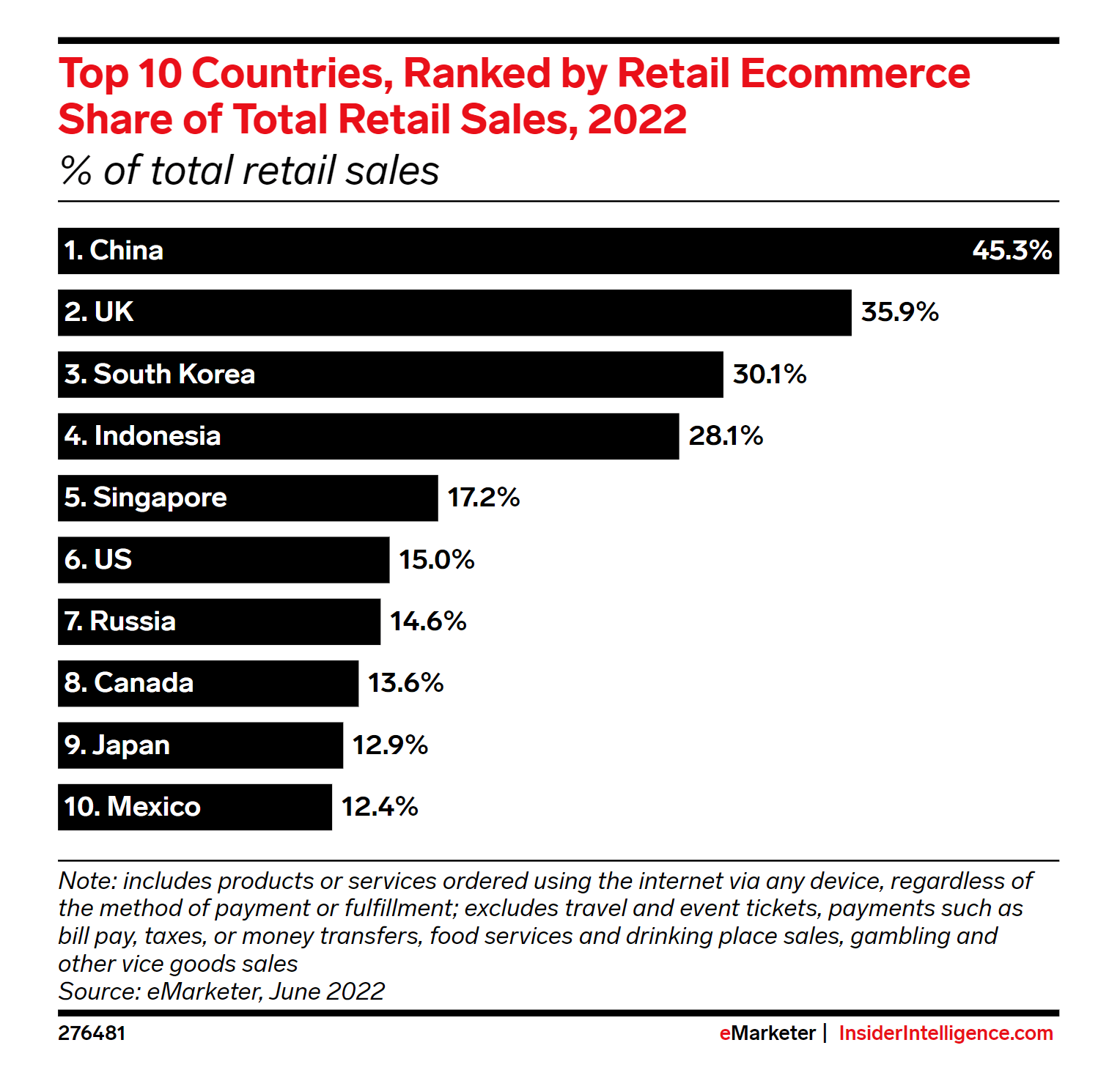
With the e-commerce business being so in fashion nowadays, a breakdown was also on its way. As we know, China is the biggest contributor to e-commerce services with roughly 45.3% of online sales occurring this year on different platforms. The UK is next to China in its second spot, with over 35.9% of online sales happening this year and the third spot is South Korea, where 30.1% of online retail sales happened this year via e-commerce. The other countries following them are Indonesia, Singapore, the US, Russia, Canada, Japan, and Mexico respectively.
E-commerce is the most emerging source of income right now in the world right now and every country is breaking their sweat into making it a larger part of their economies. And right now China is exceeding every country in being the biggest part of e-commerce. China is the top country that has the largest e-commerce sales for retails this year. With over $2.879 trillion this year, it has become the top country for e-commerce services. China is the biggest e-commerce market that is led by different groups. The well-known being Ali Baba and the other companies associated with it. China is getting bigger and bigger in online marketing and leaving all these countries behind.
The next in the race is the United Kingdom(England, Scotland, Ireland, and Wales). This year the US is in the race to earn more than a trillion dollars with its e-commerce marketing getting higher and higher. Its sales can reach up to $1.050 trillion this year, all because of the effort the country is putting to make its online economy grow. Most of the reports are saying that e-commerce is going to be up to 15% of the online retail sales of the United States economy. USA buyers are slowly adapting to buying things online as it was not a much-done activity before covid-19. That being said, covid-19 is one of the big reasons for shoppers to buy most things online. The future of e-commerce is bright and it is going to stay here for infinity.
H/T: eMarketer
Read next: Many mobile app gaming genres have started facing a decline in their app downloads in the first half of 2022
by Arooj Ahmed via Digital Information World
E-commerce is the most emerging source of income right now in the world right now and every country is breaking their sweat into making it a larger part of their economies. And right now China is exceeding every country in being the biggest part of e-commerce. China is the top country that has the largest e-commerce sales for retails this year. With over $2.879 trillion this year, it has become the top country for e-commerce services. China is the biggest e-commerce market that is led by different groups. The well-known being Ali Baba and the other companies associated with it. China is getting bigger and bigger in online marketing and leaving all these countries behind.
The next in the race is the United Kingdom(England, Scotland, Ireland, and Wales). This year the US is in the race to earn more than a trillion dollars with its e-commerce marketing getting higher and higher. Its sales can reach up to $1.050 trillion this year, all because of the effort the country is putting to make its online economy grow. Most of the reports are saying that e-commerce is going to be up to 15% of the online retail sales of the United States economy. USA buyers are slowly adapting to buying things online as it was not a much-done activity before covid-19. That being said, covid-19 is one of the big reasons for shoppers to buy most things online. The future of e-commerce is bright and it is going to stay here for infinity.
H/T: eMarketer
Read next: Many mobile app gaming genres have started facing a decline in their app downloads in the first half of 2022
by Arooj Ahmed via Digital Information World
Twitter Finally Fixes Security Vulnerability That Exposed User Data Of Over 5 Million Accounts
The statement 'better late than never' surely applies to Twitter’s behavior as the company was finally seen finding a solution to a security vulnerability issue that is the latest to strike the firm in recent years.
Twitter revealed how it got to the bottom of a bug that was exposing user data belonging to nearly 5.4 million accounts on the app. A number of threat actors managed to bypass the app’s security checkpoints and compile sensitive data.
This information was then being offered for sale at a top cybercrime forum, the company’s new report revealed.
More details proved how the security threat enabled any individual to break in by simply adding relevant information pertaining to user accounts. Hence, that could be possible with the simple addition of an email ID or perhaps a phone number of the known user.
Then, the details were checked if they were indeed linked to an account on the app and if yes, the technique went about exposing the user identities of countless accounts.
We came to know of all this on Friday when Twitter revealed the shocking news through a blog post that shed light on the matter.
The statement mentioned that any user who submitted their email IDs or number to the app’s systems would be liable for having their identities exposed as the Twitter system was built in a way that would allow this.
Therefore, it warned against such practices and told people to be aware, making sure they were in the loop of what was going on.
Interestingly, the company revealed how they had actually gone about fixing the bug linked to the same problem in January of this year. But six months down the line, the fact that we’re still speaking about this means that things were either not done properly or the bug really managed to reappear.
The bug’s details and its entrance into Twitter’s codebase were outlined by one researcher who was awarded $6000 for making the discovery. After that, a report was generated that spoke in detail about how the threat was a serious one to all account holders on the app.
Therefore, private account holders were the most at risk and their information would potentially be used to make an entire database.
We can best recall this incident to be similar to that seen during the later part of 2019, where one security analyst was able to align phone numbers of almost 17 million users and link them to respective accounts on the app.
But in this case, we certainly feel the warning by the researcher had come a tad bit too late as that six-month period was enough for the bug to extract user account details of more than 5 million users which is actually a lot of information.
Twitter revealed recently how it only came to know about all of this type of exploitation thanks to a press release that was released last month.
It spoke about Twitter account holders’ data being up for sale on an online forum and that really raised the alarm for many as the site was a renowned cybercrime destination.
Common people whose data was sold included the likes of celebs and firms as well as other sought-after personalities from the world of gaming and social media today.
Twitter says they are now busy informing all of their relevant account holders that may have been affected by the bug.
Clearly, this is one massive incident that has really struck the app greatly in recent times with many users shocked at how easily the bug managed to defeat the security protocols in place.
Read next: Twitter Lawyers Hit Back At Elon Musk Saying His Tool Once Classified Him As A Bot
by Dr. Hura Anwar via Digital Information World
Twitter revealed how it got to the bottom of a bug that was exposing user data belonging to nearly 5.4 million accounts on the app. A number of threat actors managed to bypass the app’s security checkpoints and compile sensitive data.
This information was then being offered for sale at a top cybercrime forum, the company’s new report revealed.
More details proved how the security threat enabled any individual to break in by simply adding relevant information pertaining to user accounts. Hence, that could be possible with the simple addition of an email ID or perhaps a phone number of the known user.
Then, the details were checked if they were indeed linked to an account on the app and if yes, the technique went about exposing the user identities of countless accounts.
We came to know of all this on Friday when Twitter revealed the shocking news through a blog post that shed light on the matter.
The statement mentioned that any user who submitted their email IDs or number to the app’s systems would be liable for having their identities exposed as the Twitter system was built in a way that would allow this.
Therefore, it warned against such practices and told people to be aware, making sure they were in the loop of what was going on.
Interestingly, the company revealed how they had actually gone about fixing the bug linked to the same problem in January of this year. But six months down the line, the fact that we’re still speaking about this means that things were either not done properly or the bug really managed to reappear.
The bug’s details and its entrance into Twitter’s codebase were outlined by one researcher who was awarded $6000 for making the discovery. After that, a report was generated that spoke in detail about how the threat was a serious one to all account holders on the app.
Therefore, private account holders were the most at risk and their information would potentially be used to make an entire database.
We can best recall this incident to be similar to that seen during the later part of 2019, where one security analyst was able to align phone numbers of almost 17 million users and link them to respective accounts on the app.
But in this case, we certainly feel the warning by the researcher had come a tad bit too late as that six-month period was enough for the bug to extract user account details of more than 5 million users which is actually a lot of information.
Twitter revealed recently how it only came to know about all of this type of exploitation thanks to a press release that was released last month.
It spoke about Twitter account holders’ data being up for sale on an online forum and that really raised the alarm for many as the site was a renowned cybercrime destination.
Common people whose data was sold included the likes of celebs and firms as well as other sought-after personalities from the world of gaming and social media today.
Twitter says they are now busy informing all of their relevant account holders that may have been affected by the bug.
Clearly, this is one massive incident that has really struck the app greatly in recent times with many users shocked at how easily the bug managed to defeat the security protocols in place.
Read next: Twitter Lawyers Hit Back At Elon Musk Saying His Tool Once Classified Him As A Bot
by Dr. Hura Anwar via Digital Information World
Subscribe to:
Comments (Atom)