Wednesday, August 10, 2022

The Role of a Digital Adoption Platform in The Digital Transformation Era

For certain, we are in the digital transformation era; every business knows how important it is to digitally transform its processes. There is an urgent need to integrate new technologies, revamp legacy systems, and everybody is seeing the need to make organizational cultures as flexible as possible.


While every business is taking digital transformation very seriously, it’s frightening to realize, according to a report, that 73% of organizations that embarked on digital transformation failed to add value to their operations. What is also very surprising about this revelation is that though there are a lot of factors that can contribute to this whopping figure, the human factor is the most outstanding; after all, 70% of digital transformation programs were reported to have failed due to resistance from employees.

This should not be the case since we have digital adoption platforms that have come to ease the burden of integrating digital transformation processes.

What is a digital adoption platform?

According to WalkMe, a digital adoption platform (DAP) is a software platform that can enable your organization to measure, drive, and act to ultimately maximize the impact of your digital transformation initiatives and quickly increase the return on your software investment. This ability comes from DAP being able to seamlessly facilitate software learning by employees in a very simple process, making your employees more proficient on any software platform, app, and website.

Why do you need a digital transformation platform?

The essence of embarking on digital transformation is to enhance your business in such a way that you can effectively increase customer experience and your ROI on software investments.

This is not quite an easy endeavor, especially with hundreds of apps or even more, you may need to incorporate into your business processes based on your need to digitally transform and fit into the new business setting. When doing this, you will have to contend with a lot of resistance from employees across boards.

Jumping from one app to another, especially if you take their complexities into account, you may experience employee burnout, dissatisfaction, and performance that is below par. The need to seamlessly streamline digital transformation and ensure that you don’t encounter these problems that can hinder your progress are exactly why you need a digital adoption platform.

Incidentally, technological advancements in the process of reshaping the IT industry, have ensured that digital adoption platforms are powered by artificial intelligence (AI) and machine learning, forcing a dramatic rethink of strategies; to this extent, it is relatively easy for you to personalize a digital adoption platform to address any specific needs. By integrating AI and machine learning into DAPs you can use the insights you gather to identify an employee’s shortcomings and provide tailored guidance in real-time that will ease the friction that occurs due to biases employees have to re-training.

Frictions and resistance occur when employees find it difficult to adopt any new technology and as a fundamental aspect of digital transformation, this can greatly hurt the project. Successful businesses in the world, today, know the importance of data and large volumes of data.

Handling these large volumes of data is not an easy task if you want to do it manually; hence, you need to integrate AI and machine learning to sort out some knotty issues. When employees find it difficult to grasp the relevant training required to understand the workings of the new technology, they tend to resist your change initiative.

You end up with missed revenue and employee turnover. Traditionally, your IT team should be responsible for handling employees’ surface key training and the requisite knowledge for onboarding; this places a lot of burden on IT, hence limiting effectiveness in the more serious areas of enhancing productivity and ensuring customer satisfaction.

This is the area a digital adoption platform can help to address with the digital adoption software. The problem, however, is, do you have a digital adoption strategy?

What is a digital adoption strategy?

A digital adoption strategy is a process you need to create a plan to seamlessly adopt any digital transformation initiative. It enables you to optimize the process, sideline frictions, and resistance, and create a roadmap that seamlessly supports your organization's goal.

If you go about optimizing your legacy system, that may not be a bad initiative, but you need to ensure that you also have a plan in place to remove any resistance. Once you leave room for resistance to crop up, you will have created problems.

To enable a resistance-free digital transformation, you must have a digital adoption strategy, which a digital adoption platform will enhance. The digital transformation vision comes from the CEO which is then relayed to the C-suite and the middle managers, even where everybody in the organization buys into the vision, if it’s not backed up with an appropriate strategy, it will be just wishful thinking; it can never work.

The strategy is the most important thing that will make your vision work. Employees come up with resistance when they don’t understand your strategy; because of the simplicity of a digital adoption platform, your strategy becomes readily understandable due to the strategic guidance it gives to employees.

Your end goal becomes achievable without any iota of confusion. DAP enables you to save time and all other unnecessary conflicts you may have come across in your digital transformation project.

DAP ensures that you can effectively embark on your digital transformation initiatives by:
  • Automating all aspects of an employee or customer onboarding
  • Providing in-app software training and guidance
  • Collecting and analyzing usage data
  • Providing proactive support to solve any challenge your employees may encounter

Conclusion

The role of a digital adoption platform in the digital transformation era borders on benefits you can derive for your business; every business focuses on how to improve customer experience and hence, increase ROI. The digital adoption platform helps to reduce onboarding time, the burden on IT support, resistance from employees on new software technology, friction from employees, and builds higher morale across departments.

It enables you to understand what works and what does not work in real-time based on the insight you get from the integration of AI and machine learning.

Featured illustration: Freepik / Rawpixel

by Web Desk via Digital Information World

Fake Followers And Social Media, How Authentic Are The World’s Biggest Influencers?

Whether you like it or not, fake followers have become a part of the social media industry. Today, so many accounts are forced to suffer from the reality that not everyone following them is real. And that goes for some of the world’s biggest apps in today’s digital market.

We all have made social media an integral part of our daily routine. It’s a race to reach the top and some people are willing to do everything to get there. After all, that feeling of fame that you see some of your favorite influencers bounce around with can be enticing.

Everyone wants to have their audiences engage with them, share their experiences, and get on board with high follower counts too. But little do many of us know that there’s a price to pay and seeing isn’t always believing. Just because the number of followers is huge doesn’t mean they’re all authentic.

We thought it would be interesting to see some of the world’s popular social media apps and put things into perspective to better understand the concept of fake followers and their growing presence. Thanks to the good folks at PostBeyond who have done some research on this topic, here's what they found.

For starters, let’s begin with Instagram. More often than not, we see the app being criticized for having fake or spam accounts. Also, it’s deemed shady for offering users a simple way to purchase followers too.


The situation really got out of hand and in the end, Instagram really had to launch measures to ensure its accounts were authentic.

But when you glance over some of the biggest profiles on the app and by that we mean through their follower count, you’ll be amazed to learn that they’ve got over one billion un-authentic accounts.

And if we were to name the profile that had the biggest fake fan following, well, it’s none other than leading sports brand Nike whose 65 million accounts are fake. How’s that for a huge wake-up call?

Next up are the Kardashian family who may seem to be growing in popularity as are their number of followers on Instagram. But did you know that the sisters each have millions of fake fans that simply don’t exist? This is especially true for Kourtney and Khloe but we must give Kylie Jenner credit for being more authentic than her siblings.

Let's look at Twitter now, considering the fact that Elon Musk continually raises questions about its account authenticity. Twitter says it only has 2.1% fake accounts or bot accounts. And while the figure may appear small, well, that’s around 2 million un-authentic profiles.


The person with the most real account on the app happens to be the Indian Prime Minister who interestingly tied with Tesla and SpaceX CEO Elon Musk. Both had just 2% fake followers while the celeb with the biggest spam account following was actually Taylor Swift. Her followers were 8% fake.

Let’s now turn our attention to TikTok. The popular short-form video format app is leading the pack in terms of being the most loved app by the newer generation. But how authentic is it really in terms of its followers?


The app has outlined from the start how it follows a rather different format in terms of taking account authenticity into consideration. They have assigned a score that’s based on the following: credibility factor, audience involved, how engaging it is, and the creator involved.

The TikTok account scored 90, proving how authentic it is. Meanwhile, top influencers who are a part of the most followed accounts like Kimberly Loaiza also ranked at 90. Other popular TikTok stars like sister duo Charli & Dixie D’Amelio scored 80.

And renowned superstar Khaby Lame scored 73 for his authenticity. So that means, the app isn’t too bad in terms of fake fan following, unlike other archrivals.

Read next: Instagram Reels Trends and Performance Insights For 2022
by Dr. Hura Anwar via Digital Information World
Report shows 1 in 3 organizations now reply weekly ransomware attacks

Being secure while on the internet is the foremost priority of every company that has a website and handles transactions online. However, cyber-attacks are still prominent and can damage a company beyond compensation. These malicious attacks can come from any direction in any form, and sometimes they can also come from inside the company as well.

The most common form of Cyber-attacks is Ransomware, which is exactly like its name suggests, the data stored in the hacked device is blocked off to the owner until they pay a decided amount of money to the hacker. While personal laptops and computers are the usual targets for this kind of attack, it wasn’t long before people started targeting businesses in hopes of getting more money.

According to new research published by Menlo Security, a third of businesses are facing Ransomware attacks at least once a week, with a tenth of them saying that they experience Ransomware attacks more than one time per day.


The research which was conducted with more than 500 IT decision makers from organizations in the UK and the U.S. which have more than 1000 employees sheds some light on what the effect of these attacks is on the mental well-being of the people responsible for the security of the company. When asked about why they stay awake at night overthinking, most of them replied that the majority of their worries are that somehow a Ransomware attack will develop more than the skills and the capabilities of their team and the company will face a huge loss. In addition to this 395 security experts worry that a Ransomware attack will grow into something that is way beyond their company’s security protections.

However, that is not their biggest concern; the biggest concern of tech security experts is that their employees, despite being given warnings, will click on to unsecure links for no reason thus inviting hackers into their database with 46% expressing this as their main concern.

Respondents worry about this happening more than they worry about losing their job with only 26% saying that they worry about losing their job.

The report also states that around 61% of companies from the U.S. and 44% from the UK have been the victims of successful Ransomware attacks in the past 18 months with prospects and consumers being the largest and most likely point of origin of the attack.


Read next: Most of the machinery that is hacked is from America and China
by Arooj Ahmed via Digital Information World

Tuesday, August 9, 2022

Metaverse Employees Are Worried About Their Privacy If Meta Decides New Workplace Settings

Right now, Metaverse is ruling the world, in technical as well as cultural aspects. You can make your avatars, find some friends and even real-life fashion brands are styling clothes for those avatars. It is safe to say that Metaverse is the most important thing to the whole Meta company. But what type of work environment Metaverse is given to their employees? With the pandemic, a lot of things changed and the idea of workplaces did too. Now, Meta is offering its employees to work virtually by generating a Metaverse Office where they won't have to be physically available 24/7.

ExpressVPN decided to ask the 1500 employees of Metaverse about their thoughts on that virtual office. Here's what they said about this measure:

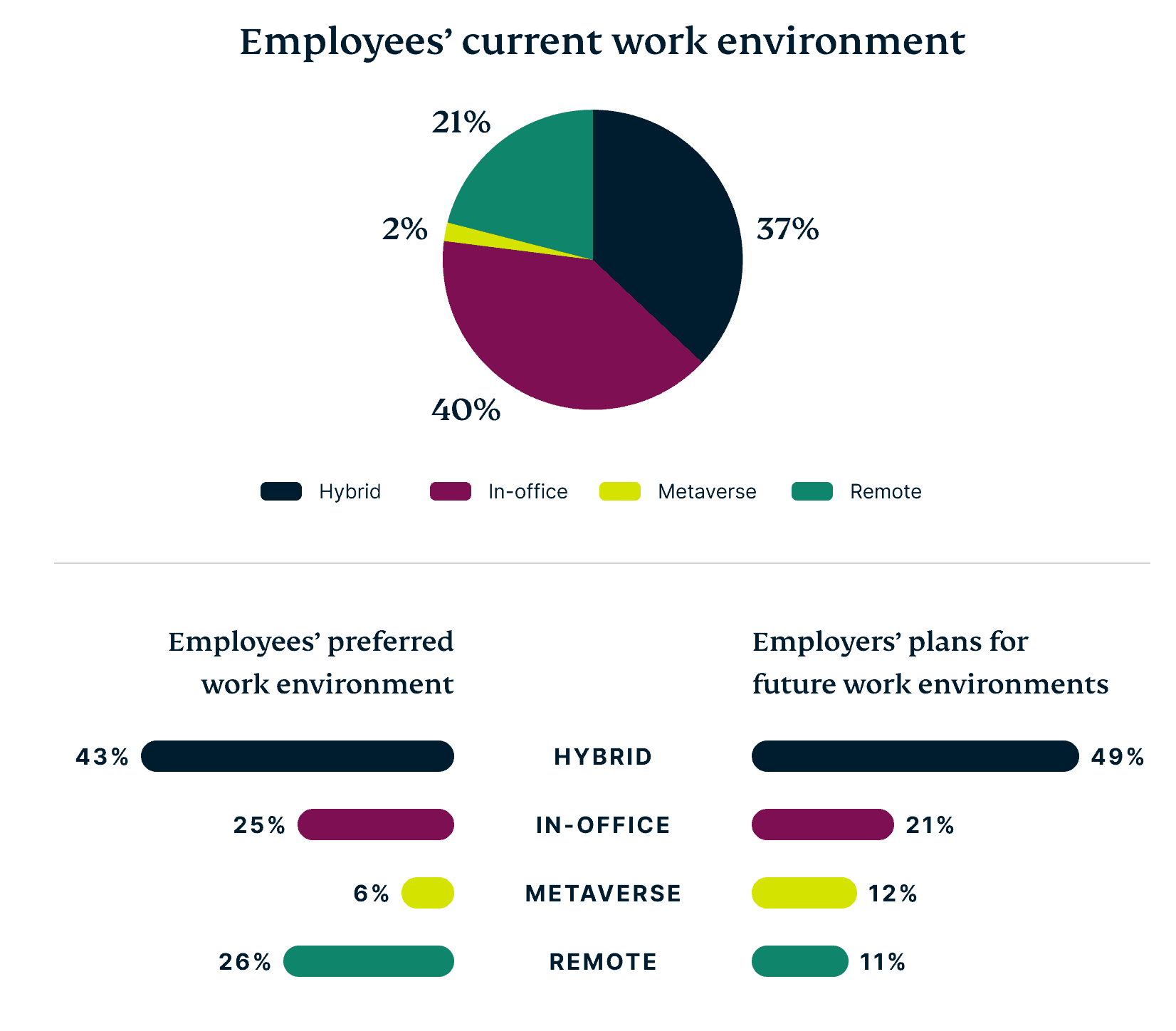
Less than 2% of employees said that they work in a Metaverse environment. 6% of them said that they are willing to work there and 12% of employees said that working in a Metaverse environment is part of their plans, but not right now. The percentage of the people who prefer working in the metaverse office is 77%, which is higher than the ones who said that they are not willing to work there, 57%. Some people said that they will work at the metaverse office but under some conditions. 45% of them said that they need a flexible opportunity to work from home and 36% said that they want to work with their coworkers easily without any problems if Meta wants them to work at the virtual office. 33% said they need more work opportunities and a permit to travel virtually. 32% of them said that they want more social interactions in their workplace and 31% want another alternative other than Zoom Conference Calls. 29%, 25%, 24%, 24%, 23%, and 17% want more opportunities, fewer physical limitations, permission to make avatars, less work traveling, and use of cryptocurrency respectively.

Most employees are worried about their privacy if they decide to work in the Metaverse Office. 63% of them are worried that employers will gain access to their data and as a result, their privacy will be neglected. They think they would be under surveillance and their location, screen time, visited websites, social interactions, biometrics, etc. will be tracked. Employers also admitted that this is a genuine problem because they have to record the screen time, location, social interactions, apo usage, etc to keep an eye on their employees.


Read next: Gen Z is the most likely to ditch a brand, study reveals
by Arooj Ahmed via Digital Information World

Microsoft Is Rolling Out A New Update For Its Edge Browser To Overcome Security Defaults

While Google Chrome reigns supreme in today’s market of leading browsers, a new report managed to prove how Microsoft Edge shouldn’t be underestimated as its popularity continues to increase as we speak.

This might be another reason why Microsoft is working hard to really bring its Edge browser to par with other leading competitors by announcing updates that could really enhance user performance.

Microsoft will soon be launching a security update that helps the browser function at its best in the next few days. This update will be seen through the Edge Stable Channel to overcome all security defaults users might be experiencing while visiting less famous websites.

For starters, the company is hoping to move forward by switching on its most famous security level whenever it finds the ‘enhance security on web’ option is toggled on by users who wish to get that added level of protection in their settings section.

After being switched on, you get another layer of security against threats or vulnerabilities linked to memory on the browser.

This new feature would work to provide protection by simply disabling Javascript compilation while adding a series of OS protections that serve as extra care when a user is busy browsing online and passing through sites that they might not be familiar with.

After users update their browsers to attain this latest feature, their basic level gets activated in the latest browser as a default setting, where it’s only applied when using websites that a user visits on a less than frequent basis.

So the next time you visit an area that’s alien or new to you, you can be sure that this new security advancement gives so much protection. And what more can a user ask for than preserving user experience while visiting all sorts of famous sites across the web?

Microsoft confirmed the news recently via a blog post that put this new feature in the spotlight. It also mentioned how the update will give users the chance to have their data imported via Google Chrome while carrying out its experience for the First Run.

Through this method, you don’t even require to have your web browser downloaded across your device.

With the update, users can bring forward their data from Chrome via a log-in attempt to their classic Google accounts on the First Run Experience by Edge.

And whenever users wish to switch it off, they can do so by toggling off by clicking on Hide your First Run Experience or simply by clicking on disabled.

There are also quite a few new policies available that allow users to have their data imported from a long list of browsers on each launch. They’ll then be configured back to Microsoft Edge for further confirmation, right before all the windows with different tabs are shut.

The news comes to us at a time when the company revealed last week how it would be providing its users with enhanced browsing performances, especially when working on systems that have low memory on their disk drive.


H/T: BC

Read next: What jobs have the biggest and smallest freelance gender pay gap?
by Dr. Hura Anwar via Digital Information World
Snapchat Is Launching A New Supervision Tool That Allows Parents To Keep Tabs On Their Kids

One of the biggest drawbacks of social media is the danger of impacting young minds, especially when platforms are used without guardian supervision.

Therefore, keeping that very same notion at the forefront, Snapchat is launching a new supervision tool for parents and associated guardians. This is another way they can keep tabs on how their kids are making use of the app.

The company revealed the decision of doing so as a part of their latest efforts for child safety on Tuesday. And according to them, the tool does a great job at mimicking the real-world interactions of parents and their respective teens.

The tool is dubbed Snap’s ‘Family Center’ and it provides a glimpse of who young children are messaging, without actually showing what the conversation comprises.

But in order for it to actually work, well, both parents as the teenagers involved need to accept the invitation. And we believe that in itself can be a major task.

After the specific invitation is given a green signal, parents get the chance to see their teen’s conversation list of contacts as well as their list of friends. Anyone that a young user has interacted with in the last one week will be shown too.

Anything that a parent or guardian feels is threatening or unsafe for their child can be forwarded in the form of a report to Snap’s team as well as their trust board.


Snapchat revealed recently through a recent blog post how it hoped the added measure of safeguard and security would help in reflecting what really goes on in the world of social media, in terms of relationships.

At the same time, they hoped that it would create a greater bond of trust between teenage users and their parents. You can best think of it as a situation where parents allow their kids’ friends over.

While they’re allowed to monitor everything that’s going on, they’re actually not eavesdropping on the conversations taking place.

We should be seeing the launch of the new innovative parental supervision tool called Family Center take centerstage in the next couple of weeks. This includes any new friends added and some more content control features as well.


News about the launch of Snapchat’s new tool comes to us at a time when so many lawmakers are urging social media platforms to create policies that better protect young users online.

Let’s not forget how leading whistleblowers of Facebook have proven through leaked papers how the company is designed to affect children’s safety negatively.

Some of the biggest names in the tech industry have also been invited to explain their cases to Congress who wants answers on what steps these tech giants are implementing to safeguard children.

Common names included the likes of TikTok, YouTube, and Snap as well.

Last year, we saw Snap’s VP claim how the company was very different in functioning when compared to archrivals. She called the firm an antidote to the world of social media.

This was closely followed up by the signing of several bills in the US that were created to better tackle the safety of users online.

Clearly, this move and a few others are clear proof to us all that Snap is keen on taking the safety of its young users very seriously. They have mentioned time and time again how their goal is to empower young minds so they end up making the right decisions in today’s fast-paced digital world.

This year in January, Snapchat unleashed a new feature that would restrict friend suggestions for teen users on the app. And this next move seems to be following in the same footsteps as that theme.

Read next: Snap Gears Up To Fire More Employees As Company Isn’t Happy With How Business Is Performing
by Dr. Hura Anwar via Digital Information World

Monday, August 8, 2022

Contrary to Predictions, Ecommerce Growth Continues Despite Return of In-Person Shopping

A recent study by ecommerce funding firm 8fig revealed that 52% of online stores reported growth in Q2 of 2022 compared to Q2 of 2021. These results defied an expected decline in online sales as consumers return to in-person shopping.


Governments have begun to relax their COVID-19 mandates in efforts to sustain the reopening of their economies. In the United States, a third of workers are expected to be back physically in their offices by the end of 2022. Schools and universities are also resuming face-to-face classes.

This increase in mobility is allowing in-person shopping to come back as part of people’s routines. Because of this, there has been a growing belief that online sales are to enter a downtrend as more people venture out and go about their activities physically rather than virtually.

However, 8fig's study shows that the resurgence of in-person shopping is not happening just yet. Analysis of the financial data gathered from 543 Amazon and Shopify stores revealed that over half of the businesses surveyed still saw an uptick in sales this Q2 compared to their previous year’s figures.

The pandemic gave ecommerce a major boost. During the first year of the pandemic in 2020, ecommerce sales increased by 43% or $244.2 billion from 2019. Health mandates compelled consumers and businesses to shift transactions to online channels.

The sustained growth by over half of businesses, while not as strong as the initial boom, indicate that the trend is still pointing upwards.

According to the 8fig study, electronics is the strongest segment, with 76% of stores under the category reporting increased sales. Nearly a third of businesses in the health segment also experienced growth. Over half of stores selling home and baby products also generated more business over the past year.

However, not all categories were able to sustain their growth. Online sales of fashion and beauty products declined, with only about a third of businesses in these categories experiencing an uptick in sales

There is also a stark difference between Amazon and Shopify stores’ performance. 60% of Amazon stores included in the study posted stronger year-on-year numbers. In contrast, only 41% of those on Shopify showed growth.

Other studies also affirm the research’s general findings. Data from a Cowen study shows that global ecommerce penetration is still expected to widen in the coming years. US online grocery shopping in Q1 2022 is already double from Q4 of 2019, indicating that consumers are now comfortable buying their basic needs online. Similar trends on online grocery sales are also being observed globally.

Insights from these studies even point at the possibility that buyer behaviors may have already shifted. Consumers appear to be becoming more comfortable using online stores to avail of certain products and services. A full return to pre-pandemic life remains unlikely for now, so the preference for online shopping may endure.

Even big tech companies seem to affirm the projected growth of ecommerce. For example, Google is set to roll out a new search function for ecommerce. It allows retailers to serve customers relevant search results, potentially helping improve buying experiences and raise stores’ conversion rates. YouTube is also set to implement a “products you see in this video” feature.

Aside from this support from big tech, new funding platforms targeted specifically for ecommerce are also emerging. These platforms provide businesses with financing plans that are customized to drive growth. A fresh influx of capital should enable stores to capitalize on these positive trends whether through expansion or the improvement of their fulfillment capabilities.

Such developments should come as welcome news to ecommerce entrepreneurs. As buying behaviors shift and online stores become preferred channels for transactions, online stores can look for opportunities to further bolster their business. They can venture into the stronger segments and optimize their products and services to cater to the emerging demands of the market.


by Web Desk via Digital Information World