Wednesday, August 17, 2022

Which Type Of Content Do Social Media Marketers Hire Creators To Make? This Study Says It All

If you’re an avid social media influencer, you’re probably well aware of the fact that different brands really do leverage creators to make content. And in return, they offer financial incentives that work out well for both parties.

Quite often, it’s the content creators that are seen leading the pack and asking brands if they’d like to make use of their services for advertisement purposes. Not only is this cost-effective and authentic, but it also guarantees the content gets views from the intended audience too.

So, yes, engagement really does play an imminent role in the world of social media. But what are the trends seen in the US regarding topics being covered? A better way to put it would be, which subjects are marketers most interested in when hiring creators to promote their content?

Well, thanks to a new report by Sprout Social, the various types of trending content that marketers are hiring creators for have finally been outlined for this year. And it’s safe to say, some were a little surprising in terms of their ranking.

Interestingly, it seems that social media marketers are willing to spend big bucks on educational type of content, testimonials, and unboxings for products more than other things. This way, their audience or followers get a chance to explore the topics with the creators themselves.

Educational content topped the list, taking the lead with 50%. Testimonial content came second, comprising 43% while trailing right behind at 42% were giveaways and challenges. Tied with the latter were unboxings or revelations for new products.

Content present behind the scenes stood at 31% while trending content took the fifth position at 28%. In last place, skits and other comic scenarios trailed with just 24%.

These stats are for the US influencer economy, which in case you didn’t know, is truly bigger now than ever. On average, the spending has reached nearly $5 billion this year.


H/T: InsiderIntelligence

Read next: What Do People Really Search For Online And Why? New Survey Highlights Top Ten Secret Search Topics
by Dr. Hura Anwar via Digital Information World

Meta Announces New Reels Features For Both Facebook And Instagram

Meta has confirmed today that it would be rolling out an array of new Reels features for both of its social networks, Facebook and Instagram.

To be more specific, the company mentioned how the features would include an innovative ‘Add Yours’ sticker to the Reels update.


The purpose is to enable users to generate responses to other Reels in the same manner. This is right after a certain prompt is announced or even when there’s a particular topic in question.

For instance, users could be sharing their Add Yours prompt that requests their own followers to put up video content related to food.

The whole idea seems related to having more and more users unite, but some are calling it out as a way to find more people to connect with.

We first heard about this same feature coming forward through the app last year in the fall season. Now, it’s getting fame as a popular feature for users’ Stories. And that’s why Meta is very keen on adding it as a valuable addition to their Reels.

Remember, Meta is very keen on sticking to its promotion of all short-form content. This way, even those who aren’t familiar with the format would be motivated to share a Reel through either app.

Meta has also recently sent out a confirmation that it would be opening its Stars feature. This is another name given to virtual items that enable fans to provide support for all the popular and eligible content creators out there on Facebook’s Reels.

Previously, we saw the firm expand the same offering toward its Facebook Reels. But now, it seems to be launching it for all creators that fulfill the platform’s eligibility criteria.

Meta also highlighted how it has managed to launch an array of mobile options that help users get started with the Stars feature and also help them stay updated with their earnings.

The tech giant is giving all of its content creators the chance to post Reels from one app to another. So if you post a Reel on Instagram, you can do the same for Facebook and vice versa.

Meta hopes this entire initiative will assist creators in making communities across both popular apps while enabling them to take part in various monetization initiatives being offered by various social media apps.

This reminds us, that Meta has also brought forward a new option where users can produce Facebook Reels through automated means. Basically, any Facebook story can be easily converted into a Reel now.

This is a fabulous way to help users go down memory lane and share their favorite blasts from the past moments through the Reels format. And to be honest, we’re not surprised here. Meta has mentioned how its clear focus relies on Reels and seeing Stories transform into just that makes sense.

Today, Meta added to its announcement that users would soon be able to get more insights regarding their Facebook Reels, thanks to the Creator Studio app. This way, they’ll be notified immediately about which Reels are doing great and which ones are not so much.

We feel metrics are always welcomed by users of social network platforms. In this case, it would be great to see how much content is being viewed, for how long, and how far the content has reached the target audience.

Last but not least, Meta has spoken about the launch of an innovative Remix feature for its Reels on Facebook. This allows creators to mix old clips with more latest ones- ending up with a fabulous product where old meets new.

The company doubling down on its Reels feature is definitely no surprise. After all, it’s where all the money lies.

Read next: Facebook And Instagram Users Can Now Schedule All Reels Through Meta’s Creator Studio App
by Dr. Hura Anwar via Digital Information World

6 Email Personalization Techniques to Build Customer Engagement

All successful businesses are built on a foundation of great customer relationships. However, building customer engagement is easier said than done, especially for companies operating in the digital age. Embracing e-commerce and online marketing is essential for a company to thrive in today's economy, but it also brings new challenges to overcome, and this is especially evident when it comes to developing email marketing strategies.

Consumers naturally want companies to treat them as individuals, and to feel they're being offered a product that recognizes and addresses their specific needs. At the same, it's difficult to engender this sentiment when sending out marketing emails en masse to hundreds or even thousands of people. Email personalization helps to reconcile these two things, however, by empowering businesses to provide bespoke experiences to large customer bases. Here are six personalization techniques to build customer engagement:
  • Personalized Your Sender Info
  • Segment Your Subscribers
  • Utilize Dynamic Offers
  • Create Trigger Emails
  • Offer Tailored Recommendations
  • Establish a Reward System

1. Personalized Your Sender Info

When we talk about email personalization, the first thing many of us likely think of is marketing emails that include the recipient's name at the beginning. Few of us immediately consider the details of the sender, but they are nonetheless equally important. Customers need to feel recognized, but they also need to identify something in your organization that resonates with them, and they're much less likely to do so if the marketing content they receive comes from a nameless, faceless entity. According to a report, 82% of marketers worldwide were using email marketing as of 2020, so the need the stand out is abundantly clear. Using the name and face of a real person in your marketing emails can help to establish a human connection and build brand engagement with subscribers. It sounds like an extremely simple technique – and that's because it is – but its effectiveness is inarguable.

2. Segment Your Subscribers

One of the most crucial parts of email marketing is segmentation. In modern business, sending out generic emails to all of your subscribers is highly counterproductive. While it may be tempting to cast a wide net with your marketing copy, the truth is that a targeted approach is much more effective. For this reason, it is advisable to construct consumer personas, each of which represents the needs and priorities of a substantial percentage of your subscribers. Segmenting recipients in this way will enable you to parse your marketing content and ascertain what is most relevant to each group. Consequently, you will be able to craft more resonant and engaging marketing emails that will have a favorable effect on conversion rates. There are now also innovative email marketing platforms, such as Ongage, which can help you to segment subscribers effectively.

3. Utilize Dynamic Offers

Creating an effective marketing campaign necessitates having a finger on the pulse of your subscriber community. To this end, data collection is your friend. Nowadays, there is a wide variety of sophisticated platforms that can enable your company to collate information about subscribers, from time and location to demographics. Having access to such information can yield key insights about their motivations and priorities, enabling your company to create appealing offers and deals for them using automation. Not only can these offers help to build engagement with active customers, but they can also play an important role in re-engagement email campaigns, which aim to reinvigorate dormant customer relationships.

4. Create Trigger Emails

An effective way to personalize a marketing email campaign is to set up trigger emails. These emails are sent automatically in response to specified user behavior or even a lack of action, such as neglecting to complete an online purchase, for instance. Trigger emails are a major aspect of personalization because they show subscribers that your organization is engaged with their interests and activities, and this goes a long way when it comes to building engagement. What's more, thanks to modern software innovations like CRM platforms, it is extremely easy to set up automated responses, so trigger emails also provide a substantial return on time investment.

5. Offer Tailored Recommendations

Perhaps the most valuable information that a company can have is purchasing records. As opposed to browsing data, for example, purchasing data provides far more definitive and actionable insights; ones that can be put to use to create tailored recommendations. Tailored recommendation emails can be generated automatically based on your customers' purchase history, enabling you to provide them with suggestions for products that complement what they've already purchased. This type of marketing has a powerful effect on customers and drives customer engagement. Moreover, it is likely to produce an uptick in open rates and conversions because subscribers can see that the marketing content they're receiving is genuinely relevant to them and their purchasing preferences.

6. Establish a Reward System

Returning customers are the lifeblood of a successful enterprise, and your communication with them should reflect that. As such, establishing a reward system and communicating its details via email is a great way to personalize customers' experiences. These emails may feature notifications marking important milestones reached by customers, such as spending thresholds or subscription anniversaries, and can inform them of a reward that they are to receive for their loyalty. This can take the form of a special discount, for instance, or store points, depending on how your specific reward system is configured. Reward emails boost engagement substantially as they communicate to customers that you both recognize and value their business.

Personalization has quickly become a top priority for customers, with one report indicating that as much as 71% expect personalized interactions from companies. The simple truth is that, in 2022, to neglect personalisation is to put a hard ceiling on what you can achieve with your email marketing campaign. At a time when businesses can reach thousands of people with a single click, it's the personal touches that will separate the wheat from the chaff.

Illustration: Freepik/Storyset
by Web Desk via Digital Information World

Hybrid Phishing Attacks Using Callback Method Increase by 625% Since Q1 2021

Phishing attacks have been commonplace for decades, but in spite of the fact that this is the case malicious actors have managed to continue updating them to make them difficult to mitigate. A new report by Agari just revealed a massive 625% increase in a specific type of phishing attack, namely one that involves social engineering and callbacks with all things having been considered and taken into account.

According to this report, the total number of phishing attacks have only increased by 6% in the same time period. With all of that having been said and now out of the way, it is important to note that hybrid phishing attacks known as “vishing” have seen a much more astonishing increase of about 625%. These attacks are usually initiated with an email, after which the victim receives a voice call that tries to use social engineering to get them to click on the link and put in their log-in details because of the fact that this is the sort of thing that could potentially end up allowing them to steal said information.

Scammers present a problem with an invoice or some other kind of payment in the phishing email, and they provide a number for victims to get in touch with an ostensible customer service representative who can provide them with some assistance. Receiving the call allows malicious actors to obtain backdoor access to devices, so this is clearly a type of phishing attack that can do tremendous harm if steps are not taken to reduce its presence in various sectors.

Hybrid phishing attacks now comprise nearly 1 out of every 4 threats that are reported, or 24.6% to be precise. The staggering growth rate of these attacks indicates that malicious actors are doubling down on them, and we might see an even more dangerous increase in the coming year. These types of phishing attacks were first noted in March of 2021, and in the 15 or so months since they were first noticed they have been increasing far more than regular phishing attacks and other types of cyber attacks online.


Read next: What Do People Really Search For Online And Why? New Survey Highlights Top Ten Secret Search Topics
by Zia Muhammad via Digital Information World

Google Collaborated With A Notable Researcher To Discuss The Attitudes That Different Age Groups Hold Towards Online Misinformation

Google partnered up with a researcher from MediaWise to gauge how people establish trust across the unruly beast that is the internet.

Alex Mahadevan is more than just a mere researcher: the man is currently MediaWise’s director, which puts him in a prime position to take apart and discuss our current online behaviors and predilections. MediaWise, which is a further off-shoot of the Poynter Institute journalistic school, is a non-profit organization that aims to spread as much awareness about online safety as possible. The organization’s work caters to age groups of all sorts because no one is unexposed to the internet nowadays. Online corners of the world in turn have molded themselves to provide as much damage and harm as possible to say, individual groups. The likes of cyberbullies, literal pedophiles, scammers, phishers, and all other sorts of cybercriminals major or minor (in both stature and criminal status) have managed to populate the online world. It’s important to not only keep a safe eye out but to effectively report and out such instances of illicit or dangerous behavior. MediaWise and groups like it fight the good fight by raising awareness in the form of lectures, campaigns, and the provision of online resources.

At any rate, Google’s work with Mahadevan is mostly derived from research that the man himself conducted with YouGov over online attitudes towards trust and its defined parameters. As Mahadevan himself stresses in his interview with the tech giant, misinformation spreads across the internet like an especially contagious and long-lasting virus (that I’m sure no real-life examples exist of). The YouGov study, which was a survey conducted amongst a whopping 8,500 individuals across all age groups, attempted to map out how different backgrounds respond to similar online situations.

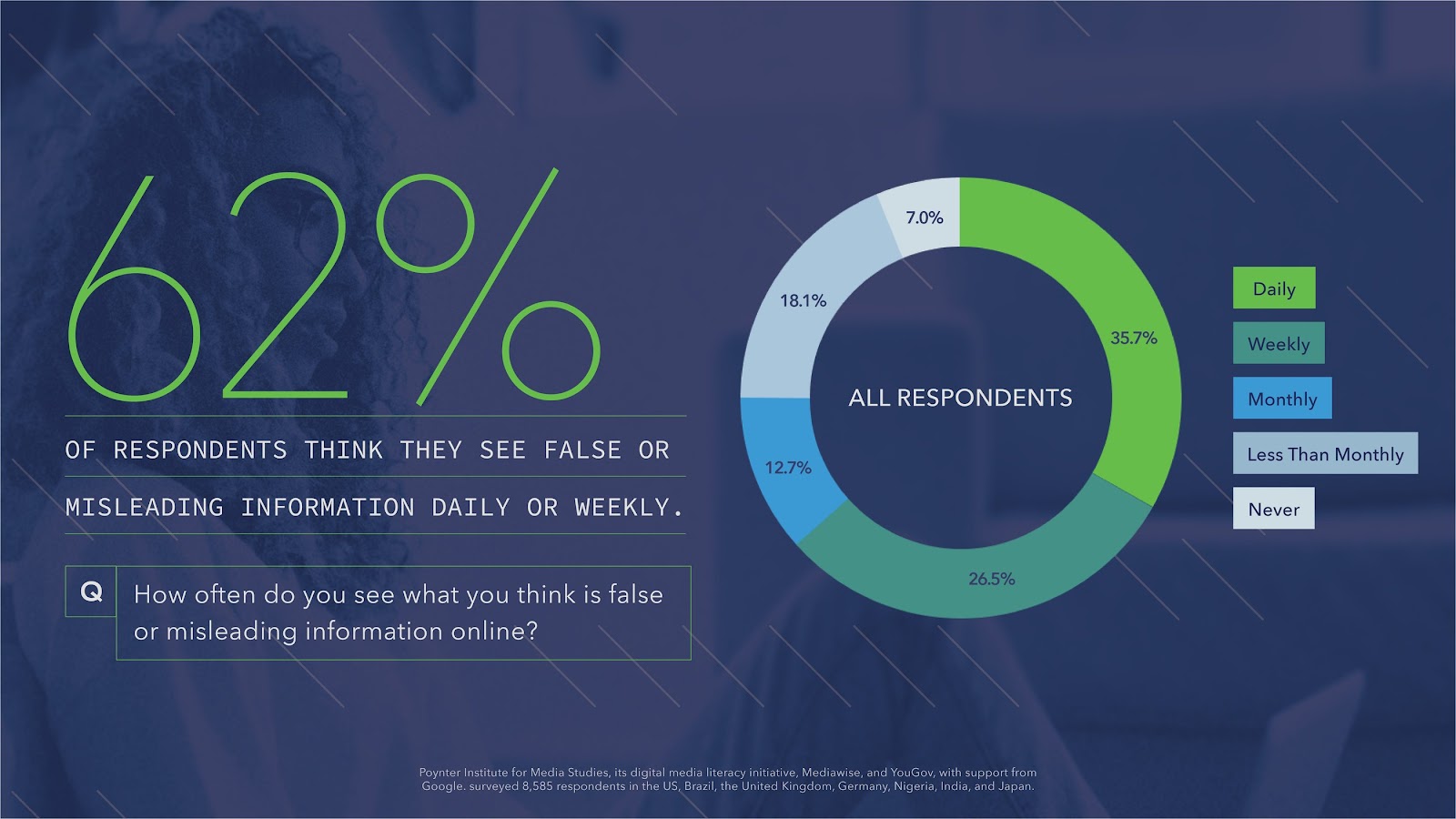
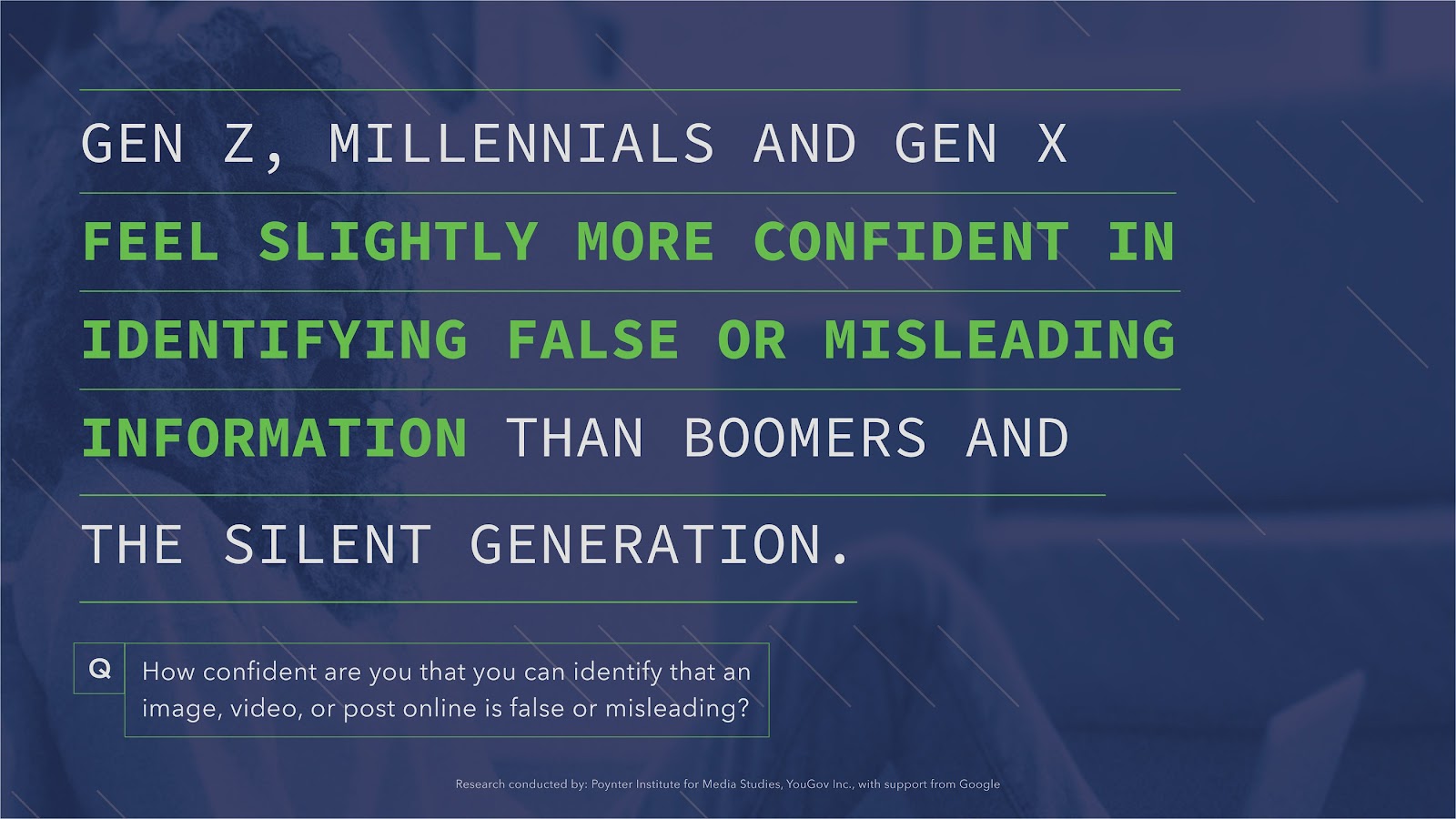
The research’s geographical borders were ultimately limited to respondents from the USA, Brazil, the UK, Germany, India, Nepal, and Japan. The results ultimately stated that a worrying 62% of the population encountered misinformation on a near-daily basis. Roughly 50% of the population from ages 18 to 57 shared the concern that such information could impact their relatives adversely. The research also helps identify that ultimately gen X, millennials, and gen Z are much more confident in their ability to identify misinformation than either baby boomers or the silent generation. Then again, the latter two have had much more limited exposure to online life.
Read next: Study Shows Some Of The Most Common Complaints That Apple Users Have Against iPhones
by Arooj Ahmed via Digital Information World

Tuesday, August 16, 2022

A Study Details The Importance Of Customer Service, With Ineffectual Examples Leading To Customers Moving Elsewhere

A new study reveals that customers are incredibly unlikely to recruit further services from a brand if they’ve faced even a singular bad experience in the past.

Sure, everyone likes to talk about how fickle customers are, but then again so are brands. I suppose it all depends on perspective: if we talk about a small business, then a customer’s impatience can be very trying; if we’re referring to a massive conglomerate, then such annoyances are more than justified. The former usually involves a small team of self-made individuals where occasional human error is more than likely to occur. The latter involves a brand that’s based its entire business model upon exploiting the masses, so the grievances are more than acceptable. I’d further ask everyone to at least not be aggressive or untoward with regards to the actual frontline retail workers, but I’m positive these words will go unheeded by at least a quarter of the individuals who read this.

The study was conducted by Invoca, a conversation intelligence company that heavily relies on AI to build conversation models that its clientele can then rely upon. They recently conducted a study on the importance of customer service during a consumer’s interaction with a brand. A total of eight different industries were taken into the mix, and five hundred individuals were asked to take part in a survey, serving as the sample population. Their answers were then compiled into the study set before us; now, let’s delve into the results and see what we can glean.


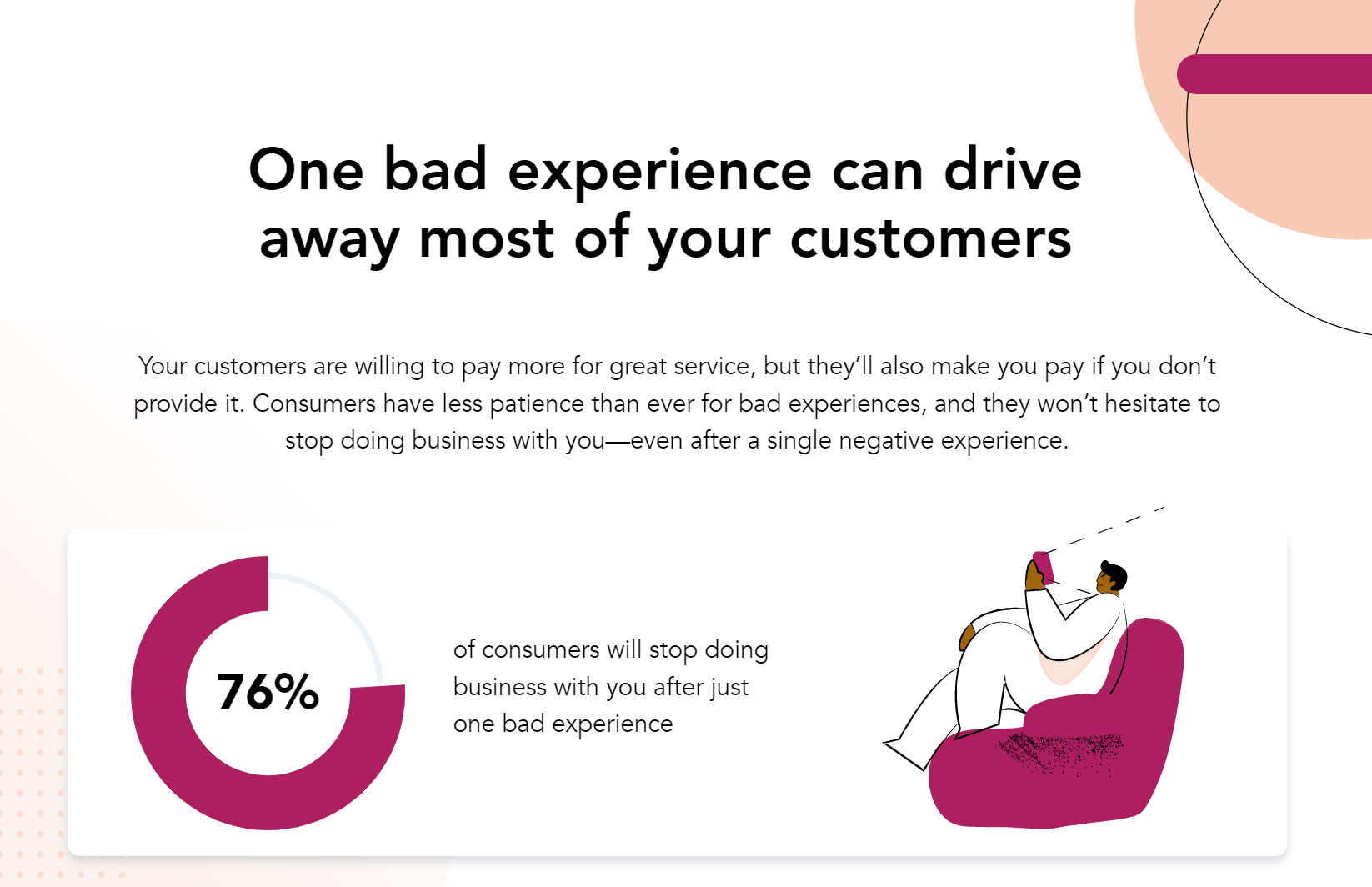
So, right off the bat, the importance of good customer service is underlined by just how quickly consumers abandon a brand if it’s not provided well enough. 76% of the sample population stated that they would discontinue a vendor’s services if even a single bad experience was encountered. This puts the onus on customer service reps to control a customer’s experience as much as possible, either ensuring that effective service is provided or putting out fires whenever problems arise. Bad experiences for the most part involve rude agents (59%), long hold times (58%), or customer service reps transferring consumers amongst different lines too much (58%). Pretty sure I know at least four major banks that are guilty of that last one.

A lot of customer service has moved towards either online platforms or the phone; with 68% of the sample population stating that they make a phone call at some point in the purchasing process. 85% of the current population also expects businesses to keep some record of past interaction, such as recalling if an individual has called before and remembering certain details of a prior transaction.

Read next: People have started cutting down on expenses they don’t need and you might be surprised to learn that it isn’t because of inflation
by Arooj Ahmed via Digital Information World

Innovation At Peak For TikTok As App Launches Its New In-App Text-To-Image AI Generator

TikTok certainly appears to be on a roll when it comes down to innovation. The famous short video format platform has recently rolled out its new text-to-image AI generator inside the app.

The feature is designed to enable users to add respective prompts by typing them in. And in return, they’ll get an image that could be applied in the background for their own video content.

This particular effect is known as the famous AI Greenscreen, which TikTok says could be easily accessed through the camera screen. And we’ve got confirmation on the news thanks to the media outlet The Verge which was the first to report the new finding.

The new filter’s launch arrives at a time when such features are growing in trend across various platforms, turning into one of the most sought-after trends today. This is true after we saw the DALL-E-2 getting rolled out by OpenAI.

We’d also like to mention how the pictures produced by the new feature from TikTok are very basic at first glance. And that’s especially true when you look at the other images coming out from other leading models like Google’s Imagen.

Moreover, TikTok’s model is definitely one of the forces to be reckoned with as it makes abstract images. On the other hand, the other more famous generators are able to make photorealistic imagery in the most beautiful manner.


It’s actually very possible that this was an intentional move by the famous app, making sure its version of the model sticks to the platform’s policies and community guidelines. This is especially true when it comes down to violence and nude images, that go strictly against the guidelines.

Also, we believe that had the model been as picture-perfect as the rest, well, it could well be utilized for incorrect reasons like making disturbing content. Therefore, that’s why the model we’re seeing getting launched by TikTok is done to avoid such problems.

After enabling the new effect, TikTok offers users a wide array of prompts. For instance, you can find serene views of people snorkeling in the ocean or a stellar display of the rainbow volcano. And then there are some real gems out there like hidden villages amid beautiful greenery.

The whole idea behind the prompts is to make users visualize how diligently focused the platform is to bring forward striking abstract imagery. And if you want, you can play around to produce unique content that’s absolutely beautiful.

In cases where users’ prompts do happen to include wording that is offensive and goes against the app’s policies, well, you may get abstract images that feature the theme and colors but definitely something vague. This is to make sure the guidelines of censorship aren’t missed out.

For now, we know that such filters are only coming forward for a selected few trends on the app. There is one where users can add names to the model to get a glimpse of what their esthetics appears like.

Meanwhile, the app is also following another similar trend where users plug in their birthdays while others are intrigued to see what is produced when they include specific parts of their body into the model.

As you can see, the world is definitely your playground in terms of what you can use the app to do. This model is about creativity and abstract visualization at the most basic level. Remember, there are limitations because access is given to millions out there.

But we feel it’s a unique and innovative start, especially in terms of giving users the best background for their content.

Read next: New Social Media Survey Says American Teens Are Addicted To YouTube As TikTok Trails Behind
by Dr. Hura Anwar via Digital Information World