Friday, August 26, 2022

About Half Of The Premium Phones Sold In China Are Reported to Be iPhones With Over 46% of Sales

According to a report by Counterpoint, Apple's smartphone sales have skyrocketed in China and one-half of the premium phones sold in China are iPhones. This is such a record, keeping in mind the population of China. iPhone sales in China were about 46% and Vivo was in second place, with only 13% of sales. The difference is major. After Vivo, Huawei stands in third place with 11% sales. After these companies Honor, Xiaomi and Oppo are leading the chart. Samsung sales weren't very impressive and they were categorized under the 'others' category with roughly 4% of premium sales.

The Premium sector of Apple iPhone sales are doing so well in China, with over 147% YoY growth and Samsung sitting at 133% YoY growth in the $1,000 category. These brands have risen due to the sale decrease of Huawei phones and Chinese customers being interested in Premium phones all of a sudden. Vivo also grew by about 504% YoY with the success of its new model, the X80 series. Vivo has worked hard on its performance and design, that's why it's being so successful in this new segment.

Premium phone sales undoubtedly declined in the second quarter of this year, 10% to be precise, and it took down the market to 14%. Due to this reason, the premium market grew its share. This means it got up to 33% from 31%. The Q2 of 2022 was a crucial time for mobile sales in China but they are tackling it slowly and everything will come back to normal eventually.

An analyst explained China's phone sales in these words: "After covid-19, the phone sales in China suddenly increased in Q1 of 2021 but it all declined at its lowest in Q2 of 2022. The premium segment suffered from all this. It all happened because of the lockdown in big cities as most of the premium buyers belong from these cities".

Now Apple is doing so well that half of the premium sales are of the iPhone in China. Now we all have to wait back and see where these premium iPhone sales will take China.


Read next: Report shows Americans have lost $3.56 billion in fraudulent schemes this year
by Arooj Ahmed via Digital Information World

WhatsApp is working on a feature that will let users hide their last seen and online status

On the internet, the utmost priority for most users is privacy. With WhatsApp being the reigning king of chatting apps, many people use it for multiple purposes like chatting to friends or family and work stuff. The app like all major apps can let you see when a person is online, whether they have you your messages and left you on reading etc. but, as part of a new 3 feature privacy campaign by Meta the step-parent company of WhatsApp, this feature is going away and new features like the screenshot blocker and past participants are going to take its place.

This feature is still under development so much has not been released about it, but as we can see in this screenshot posted by WABetainfo, WhatsApp is working on a feature that will let users hide their last seen and if they are online or not.

According to the screenshot even though the feature is marked under development the feature and its tab are completely ready to come out into the world for desktop users as well. As you can see in the screenshot when the Tab is opened it gives you two main headings Who can see your last seen and Who can see when I am online?


This feature will let users control their online presence, to ward off any unpleasant and irrelevant messages and people.

Moving on, there is one more thing I want to talk about, and that is the reaction feature. According to a screenshot posted by WBI, the reaction preview feature is now coming to iOS as well. Right now this feature is still under development and will be coming to iOS soon. This feature will let users see a text preview of how the other user has reacted to their message or story.


Read next: WhatsApp is rolling out 2 features that will let admins delete posts and android users create communities
by Arooj Ahmed via Digital Information World

This New Demo App Can Notify You Whenever Google Gets Data From Your Device

Many of the most popular services on the internet are free to use, but in spite of the fact that this is the case they still earn a lot of money by mining your data. Many users find this to be concerning because of the fact that this is the sort of thing that could potentially end up infringing on their right to privacy, but it can be hard to traverse the internet without handing over at least some of your personal information.

With all of that having been said and now out of the way, it is important to note that privacy advocate Bert Hubert just made a new demo app that can help users to get notified whenever their device sends Google some of their data. This app is called Googerteller, and the way it works is that it has a list of publicized IP addresses owned by Google and it will send you a notification whenever your device connects to these IPs.

The app is currently only compatible with web browsers, and it can reveal the shocking extent of Google’s data mining with all things having been considered and taken into account. For example, when you are typing something out in the address bar in Chrome, you might notice each stroke causing a notifying beep. That’s because Google monitors your keystrokes to improve the efficiency of this algorithm, and most search engine users might not be aware that this is the case.

Google advocates might suggest that these beeps are not being caused by data being sent to Google, but rather because Chrome is very thoroughly integrated with the rest of Google’s network. Regardless, Google clearly keeps a close eye on all of its users, and the fact that this app is currently only available on Linux is even more concerning since Linux based operating systems offer a lot more privacy than Windows or Mac. It will be interesting to see if this impacts Google users since they might not want to use the services of such a data hungry company that violates their privacy.


Read next: Here Are 5 of the Biggest Privacy Trends Among Consumer
by Zia Muhammad via Digital Information World

Thursday, August 25, 2022

Report shows Americans have lost $3.56 billion in fraudulent schemes this year

A recent report released by Atlas VPN highlighted that in the first half of 2022, the Federal Trade Commission (FTC) got over 793,000 complaints against fraudulent activities, including 27 percent of complaints about financial losses.

The data from FTC shows how much cybercrimes are becoming frequent in the United States. The Atlas VPN report reveals that overall a loss of $3.56 billion has been recorded in H1 2022, which is a piece of shocking news. According to the insights shared by FTC, online fraud damages incurred by Americans shows $1.18 billion in the first half of 2020, $2.33 billion in the first half of 2021, and $3.56 billion in the first half of 2022. There is a notable increase of 53 percent during the same time in the previous year. In 2022, the most financial loss took place for investment-related scams. Also, the complaints related to investment fraud increased to 52,000. Compared to 2021, 43,000 complaints were reported by FTC.

The report reveals an average investment strategy lures out forty thousand dollars per victim, whereas other online scams deceive over a 3-digit sum. Cybercriminals received $1.63 billion from U.S investors in the first half of 2022, 2.7 times more than in the first half of 2021. Data from FTC also shows a $143.8 million loss due to fake investment-related schemes in the first half of 2020, while in 2022, the loss is significant, which is doubled to $1.63 billion in H1, 2022.

That said, threat actors can acquire a typical six months’ salary from just swindling a single investment fraud, which is why they continue making schemes to deceive people and get money by making endeavors in this direction.

Cybercriminals usually broadcast global events and issues to convince U.S investors to invest in their schemes to get a handsome amount of money in return. For the safe side, investors pay their utmost attention to such plans and begin to invest in them.

Next, the frequently reported fraud category was imposter scams, with over 361,000 complaints received, 22 percent financial loss reported, and caused a total of $1.33 billion loss this year.

Imposter fraud has been the most prevalent online fraud since 2018. In this type of fraud, an immoral person tricks you into transferring an amount to them. Imposter frauds have caused Americans to lose a tremendous amount of money, and that’s why it is the most devastating kind of fraud.

Furthermore, the data from FTC represents that online shopping and employment opportunities, prizes, and lotteries are the most common online frauds after investment-related and imposter scams, which is $184 million for online shopping, $164 million for employment scams, and lotteries $114 million.

It is essentially important to validate while investing in new technologies such as NFTs and other related projects to keep yourself safe from such frauds. Believe it or not, fraudsters target unaware consumers so that they can trick them easily into believing in their scams and cause them to invest their hard-earned money in their fake schemes.


Read next: Microsoft States That Cryptocurrency Cybercriminals Are Still At Large, Despite The Currency Losing Its Value
by Arooj Ahmed via Digital Information World

Google Research Comes Up With A Mind-Blowing Image Noise Reduction Feature Powered By AI Technology

The great thing about the digital world is how it continuously evolves as we speak. And believe it or not, each passing day brings forward something more innovative than the rest.

If you’ve got some great lighting and a professional photographer at hand, you’ll definitely be treated to some decent-looking images. And that’s true even if your camera isn’t the best device out there. But if the lighting is poor, well, so will the results.

The same thing goes for digital noise when you’re shooting stills using nothing but a smartphone. The more the noise, the more the clutter, and the end result is just poor.

But what if we told you that Google Research has devised a great new tool that can combat all of this? This happens to be the case with Google Research's latest tool that comprises an image noise reducer, powered by AI technology. And from what we’re hearing so far, it’s a mind-blowing tool that’s been discovered.


It’s a great open-source project that’s getting plenty of raving reviews as we speak. It’s titled MultiNerf and we feel that things could finally be changing for the better.

The algorithms are seen running on data obtained from raw images and this combined with AI magic really sets the stage for something brilliant. See, the tool decides and showcases what a particular video appears like without the disturbances seen with noise that gets generated from image sensors.


If you happen to be just as excited as us with the news, well, we’d like to inform you that this is still in the making. The product is undergoing its research phase and is nowhere near to being launched just yet.

Whatever the case may be, one thing is for sure. We love how the developments are already causing wild excitement in the digital world.

Read next: Digital roles are the highest paid and the most in-demand freelance jobs hired by SMEs
by Dr. Hura Anwar via Digital Information World
Binance Faces Spam Crisis As Thousands Falsely Claim To Be Working For The Firm On LinkedIn

The problem related to spam is taking over the digital world as we speak. More and more platforms are being accused of holding fake accounts. And now, a new report related to Binance has really opened the world’s eyes to what’s going on.

What may have begun as Elon Musk trying to buy Twitter and then backing out after hearing news about fake accounts, the world is now becoming weary of bots and spam. Recently, Binance’s CEO shed light on how so many accounts or profiles on the popular job-seeking app LinkedIn were fake.

This past week, CEO Changpeng Zhao revealed how he’s got a hold of 7,000 profiles that claim to be a part of his workforce. These users boldly delineated the same in their CVs and it really surprised him and his company because they’re fake.


We mean to say 50 out of those 7000 are real, and that’s why he’s calling such people scammers. Moreover, he’s also requesting his own followers to be careful of those pretending to be someone that they aren’t.

The CEO also called upon LinkedIn to launch a feature so the firm could better verify real accounts and distinguish them from all others. And the reason this report is alarming isn’t only because people are boosting their CVs with fake job experience but much more.

Two months back, we saw the FBI reveal to CNBC how it was conducting a series of investigations into fraud schemes of investments. This had to do with crypto on LinkedIn, and it’s definitely a huge threat to vulnerable users that fall into the trap.

One cybercrime expert revealed how it was the responsibility of such platforms to keep a check on who has accounts on the app and who doesn’t. Be it apps for professional networking, dating, and so on and so forth.

As far as the current alarming report revealed by the CEO of Binance is concerned, the cybersecurity expert named Brett Johnson feels these 7,000 members could be a part of a cryptocurrency scam. Some people may be thought to believe they really are working for Binance when they’re not.

Interestingly, Binance is not disagreeing with this news. They agree that they don’t have that much time to go through a long list of profiles and make sure everything and everyone is real. Remember, investigations take time.

At the same time, LinkedIn has its own userbase growing by the second so dealing with spam is another issue that the company has been forced to deal with on a routine basis.

This past year, we were made aware of a Standford research that specialized in social media apps and spam accounts seen on them. The researcher found that around 1000 accounts were fake on LinkedIn and were being powered using AI technology. Wow, how’s that for a real eye-opener?

Not only did their resumes comprise of fake work experiences but there was also discussion about fake education histories too.

LinkedIn’s spokesperson was recently seen mentioning how the firm works hard at making sure fake profiles are kept in check and limited. But it seems they’ll be needed to do more than just that.

Read next: Microsoft States That Cryptocurrency Cybercriminals Are Still At Large, Despite The Currency Losing Its Value
by Dr. Hura Anwar via Digital Information World

Meta Finally Allows Quest VR Users To Sign Up And Log In Using Their Facebook Accounts

In what is being termed a decision that has been a long time coming, Meta has finally given its Quest VR users more flexibility.

The company announced in March how it would be allowing those users the chance to sign up and log in using their accounts on Facebook. And now it appears that rollout day has finally arrived.


The introduction of Meta accounts has been looked upon as a great and flexible act and now that the accounts are finally available, it’s definitely being appreciated.

Meta has revealed that despite news of the launch, it might not be hitting your device right now. They’re still in the process of rolling it out gradually to everyone so a little patience will go a long way here.


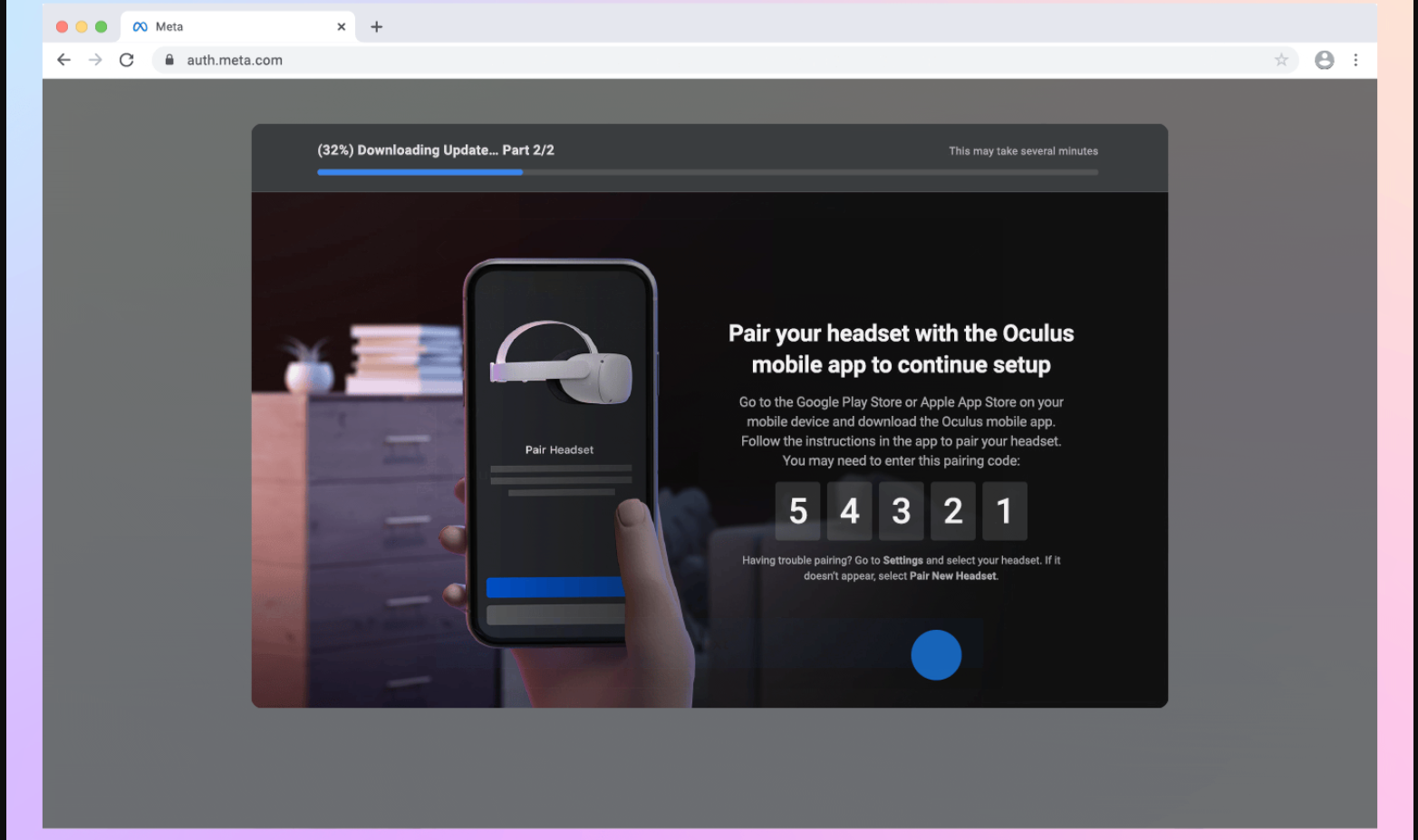
For those wondering how they can set up their new Meta accounts, well, we’ve got a step-by-step guide for you. Ok, so firstly, you’re provided with three different options. You can either make use of Instagram or Facebook or simply make your registration through your email too.

After you see the option being available, open up the Oculus application through your mobile phone and select the way you wish to sign in.

For those who already have Facebook accounts, well, the process will be a little different for them, when compared to those setting it up otherwise.

Users will need to search for one external portal that allows them to join both of their accounts. Through this manner, you’re given the chance to gain control of any data that already exists on those accounts, while moving forward with your new account on Meta.

Remember, when you make your new account on Meta using your email ID, you’ll be asked to provide important details like your email and some more information such as your birthday and even your name.

The company adds that the addition of birthday details is guaranteed to ensure the content gets distributed in an age-appropriate manner. Currently, the age limit that has been designated is 13.

Meta has also mentioned to users that Oculus account holders need to make their Meta account before January 1 of next year. They’ll be required to sign in and make accounts by putting in codes that are unveiled through their headsets. And once it’s done, they can sync all the data together.

Setting up Meta accounts isn’t the last step. Users must then make their Horizon accounts on Meta which would end up being their social profiles when embarking on the VR journey experience.

This will be complete with Avatars and some more exciting details like any personal connections you make. For those users who aren’t interested, well, simply make your profile private. As of now, the whole Meta Quest 2 headset experience comes at a staggering price tag of $400 and that’s just the start.

There were reports about how this cost would only end up increasing so if you’re interested, you’d be better off making the purchase sooner than later.

Read next: Meta Reaches $37+ Million Settlement After Being Accused Of Tracking Users' Location Without Consent
by Dr. Hura Anwar via Digital Information World