Buy now, pay later schemes are starting to allow people to purchase items even if they don’t have the full amount on hand, but in spite of the fact that this is the case they can also be a path to financial ruination if one is not careful. Users are often unaware of the high rates of interest that they are accruing which is dangerous because of the fact that this is the sort of thing that could potentially end up leaving them greatly in debt.
With all of that having been said and now out of the way, it is important to note that the British financial regulatory authority known as the Financial Conduct Authority (aka FCA) for short highlighted the risky nature of ads that might misrepresent BNPL products. The products themselves are indeed closely regulated, but many users are not cognizant of how unmanageable their debt would truly be.
17 million people living in the UK have now used a BNPL option with all things having been considered and taken into account. When looking at just users who are between the ages of 20 and 29, 30% of them have used such a payment plan. The UK’s financial watchdog has highlighted the lack of warnings that influencers are putting up when advertising BNPL products, especially those that target young adults who might not know the consequences of what they are being socially engineered to do.
There should be warnings that would tell users about how debt can become hard to afford, along with clearly mentioning what would occur if a payment were to be missed. Most users are also in the dark about how this debt and its subsequent payment might impact their credit score, which his another thing that should be mentioned in ads in the form of a disclaimer.
BNPL options are becoming increasingly popular, and since they are not nearly as tightly regulated as normal banking institutions they might be able to prey on users who are not educated enough about such matters. That is why such oversight is so undoubtedly important.
Read next: Influencers Might Be More Trusted by Gen Z Than Reviews on Product Pages
by Zia Muhammad via Digital Information World
"Mr Branding" is a blog based on RSS for everything related to website branding and website design, it collects its posts from many sites in order to facilitate the updating to the latest technology.
To suggest any source, please contact me: Taha.baba@consultant.com
Sunday, August 28, 2022
Microsoft and ByteDance to Work on AI Project Despite US-China Tensions
The US was arguably the undisputed leader of the world of tech during most of the 20th Century, but in spite of the fact that this is the case China has managed to make up a lot of lost ground. Now, China is facing off with the US for supremacy of one of the most consequential and revolutionary forms of tech in the world: Artificial Intelligence.
While the rivalry between these two competing superpowers is starting to heat up, amidst the tension emerges an unlikely partnership between a well established American tech juggernaut and an upstart Chinese corporation that has upset the paradigm of the social media industry.
These two companies are Microsoft and ByteDance respectively, and with all of that having been said and now out of the way, it is important to note that they are collaborating to create a brand new kind of AI that they are referring to as KubeRay. Engineers from each of these massive and influential companies are coming together to push the boundaries of what AI can accomplish with all things having been considered and taken into account.
Representatives from ByteDance and Microsoft attended and spoke at the recent Ray Summit in San Francisco, and they highlighted the benefits of their current project. By combining data science, machine learning and a wide range of other specialties, these researchers are attempting to allow AI apps to run on several devices simultaneously.
This project is going to be an open source one because of the fact that this is the sort of thing that could potentially end up greatly expanding its reach. Microsoft has been doubling down on AI as of late in an attempt to break new ground after performing quite successfully these past few years, and it is interesting that they are partnering with TikTok to make discoveries.
Many experts are excited by this project, and if cross-border cooperation like this continues to come to fruition we might just enter a brave new world in which anything would be possible. ByteDance will likely be looking to leverage TikTok’s popularity to facilitate more projects like this.
H/T: CNBC
Read next: This Research Reveals the Massive Problem of Password Fatigue
by Zia Muhammad via Digital Information World
While the rivalry between these two competing superpowers is starting to heat up, amidst the tension emerges an unlikely partnership between a well established American tech juggernaut and an upstart Chinese corporation that has upset the paradigm of the social media industry.
These two companies are Microsoft and ByteDance respectively, and with all of that having been said and now out of the way, it is important to note that they are collaborating to create a brand new kind of AI that they are referring to as KubeRay. Engineers from each of these massive and influential companies are coming together to push the boundaries of what AI can accomplish with all things having been considered and taken into account.
Representatives from ByteDance and Microsoft attended and spoke at the recent Ray Summit in San Francisco, and they highlighted the benefits of their current project. By combining data science, machine learning and a wide range of other specialties, these researchers are attempting to allow AI apps to run on several devices simultaneously.
This project is going to be an open source one because of the fact that this is the sort of thing that could potentially end up greatly expanding its reach. Microsoft has been doubling down on AI as of late in an attempt to break new ground after performing quite successfully these past few years, and it is interesting that they are partnering with TikTok to make discoveries.
Many experts are excited by this project, and if cross-border cooperation like this continues to come to fruition we might just enter a brave new world in which anything would be possible. ByteDance will likely be looking to leverage TikTok’s popularity to facilitate more projects like this.
H/T: CNBC
Read next: This Research Reveals the Massive Problem of Password Fatigue
by Zia Muhammad via Digital Information World
LG Is Revealing A New Computer Monitor That Adjusts Itself To Meet A User’s Eye Line At The New IFA Convention
LG is planning on displaying a new AI-powered monitor that continuously moves to meet a user’s eye level at the upcoming IFA in Germany.
The IFA, or the Internationale Funkausstellung Berlin (Berlin Radio Show), is one of the oldest and most prestigious gatherings for the exhibition of consumer electronics. Starting in 1924 as a humble annual project, the IFA has now become a massive convention, with big hitters in the electronics field such as Phillips, Huawei, LG, Panasonic, and Fender joining the fray. What makes the IFA so interesting is that it’s not just a showcase for industry big shots; many up-and-coming smaller names make it into the convention as well, providing them with the platform needed to promote their state-of-the-art gadgetry. Honestly, it’s Comic Con for individuals who are really into technology and daily life maintenance.
While some products can be more gimmicky than others, I think LG’s new product is tracing the very thin in-between line. The UltraFine Display Ergo AI is a new monitor that the company will be showcasing at IFA, and according to devs, it utilized a mixture of algorithmic learning and solid camerawork to continuously change positions according to a user’s eye level. The aim is to provide users with consistently ergonomic positions via which they can view their content, work, and so forth.
Currently, the monitor is projected to make subtle changes in height, ranging from zero to 160 mm, coupled with a +20º to -20º range in tilt, promoting good posture in the process. The monitor can also be manually fiddled with, swinging upwards of 270º in extreme conditions. How the monitor itself moves is a question that LG has not answered or even addressed as of yet. I’m sure they’re waiting for the product to be unveiled at IFA before making any future announcements.
The monitor does raise a lot of interesting questions, however, about just how effective it will be in the real world. After all, even changes to a screen’s height in millimeters can lead to a ton of annoyance and neck pain if they keep occurring. The screen will have to adjust with either a relatively restrained pace or be lightning quick in its adjustments.
Read next: Incogni Published A Research, Explaining Just How Much Free Android Apps Siphon User Data
by Arooj Ahmed via Digital Information World
The IFA, or the Internationale Funkausstellung Berlin (Berlin Radio Show), is one of the oldest and most prestigious gatherings for the exhibition of consumer electronics. Starting in 1924 as a humble annual project, the IFA has now become a massive convention, with big hitters in the electronics field such as Phillips, Huawei, LG, Panasonic, and Fender joining the fray. What makes the IFA so interesting is that it’s not just a showcase for industry big shots; many up-and-coming smaller names make it into the convention as well, providing them with the platform needed to promote their state-of-the-art gadgetry. Honestly, it’s Comic Con for individuals who are really into technology and daily life maintenance.
While some products can be more gimmicky than others, I think LG’s new product is tracing the very thin in-between line. The UltraFine Display Ergo AI is a new monitor that the company will be showcasing at IFA, and according to devs, it utilized a mixture of algorithmic learning and solid camerawork to continuously change positions according to a user’s eye level. The aim is to provide users with consistently ergonomic positions via which they can view their content, work, and so forth.
Currently, the monitor is projected to make subtle changes in height, ranging from zero to 160 mm, coupled with a +20º to -20º range in tilt, promoting good posture in the process. The monitor can also be manually fiddled with, swinging upwards of 270º in extreme conditions. How the monitor itself moves is a question that LG has not answered or even addressed as of yet. I’m sure they’re waiting for the product to be unveiled at IFA before making any future announcements.
The monitor does raise a lot of interesting questions, however, about just how effective it will be in the real world. After all, even changes to a screen’s height in millimeters can lead to a ton of annoyance and neck pain if they keep occurring. The screen will have to adjust with either a relatively restrained pace or be lightning quick in its adjustments.
Read next: Incogni Published A Research, Explaining Just How Much Free Android Apps Siphon User Data
by Arooj Ahmed via Digital Information World
Twitter Insiders Admit There Is Some Truth To Whistleblower Peiter Zatko’s Shocking Claims
In the past few days, we saw Twitter’s former security chief Peiter Zatko boldly disclose some striking revelations to Congress. It was a shock for some but now, there is more news about insiders agreeing to some claims made.
Zatko called the company out for having some major security flaws. He even added details about how he was strictly informed not to make any reports to the board too.
And while so many of the firm’s board members and insiders felt his intentions behind the act were not correct, they are making affirmations that some claims are true.
Speaking to BusinessInsider recently, an unnamed employee says there are plenty of skeletons in Twitter’s closet but that happens with all firms. But you can’t dismiss what Zatko has to say. The company doesn’t have a reputation for lying when looking at its past but these revelations coming out in the open are concerning.
Zatko served as the platform’s leading information security officer. His whistleblower report has been a really big controversy because the claims are huge and they arise as a series of wrongdoing.
The claims were first publicized via a report in the Washington Post on Wednesday and since then, the company’s CEO says they’re still evaluating what has been alleged because there’s a lot.
Interestingly, the striking claims allow things to move in favor of Elon Musk. And we feel the timing here is pivotal as Musk’s legal battles’ trial date begins in October.
Musk is trying hard to gather evidence to show how much fraud the firm has been busy with so he gets an easy way out of the mega $44 million Twitter acquisition deal.
A total of three different employees belonging to Twitter say Zatko is a man of his word and can be trusted. Hence, they have outlined that there are quite a few truthful parts included in his report.
Since the matter is sensitive and controversial, the employees have requested not to be named.
Zatko accused Twitter of suffering from some major deficiencies and poor leadership. Similarly, he accused the CEO of not allowing him to send an entire report to the firm’s board of directors. It contained plenty of content related to different issues that Twitter was facing.
The employees do claim that Twitter’s leadership needs improvement as at that time, CEO Jack Dorsey was never available to talk. Therefore, matters linked to the betterment of employees could never be openly discussed.
Now, another ex-Twitter executive feels a firm may meet all rules but still suffer from great weaknesses. This is what’s happened here.
The former executive explained that while he was working with the firm, communication was very open and he was allowed to express his thoughts without any stops. But if Zatko wasn’t allowed to delineate major security flaws that Twitter was suffering from openly, the issue is huge.
But the controversies continue as many people find it strange as to why everything was being disclosed now and not before. What are his intentions in whistleblowing a department that he was instructed to overlook?
Hence, you’ll find insiders disagreeing with some claims made too. This brings us to the topic of spam and the number of monetizable active users.
They say Zatko’s wordings and accusations are confusing and very conflated. Also, what he claims now was never spoken about when he worked for Twitter. Also, the fact that he was fired by the organization could mean revenge was at stake.
Then there is talk about how no one kept a check on what Zatko was really up to because he had his hands everywhere. The greatest interaction you could have with him was via email about security.
Read next: Twitter Is Testing Out Some Exciting New Features Including Tweet Tiles And New Link Preview Designs
by Dr. Hura Anwar via Digital Information World
Zatko called the company out for having some major security flaws. He even added details about how he was strictly informed not to make any reports to the board too.
And while so many of the firm’s board members and insiders felt his intentions behind the act were not correct, they are making affirmations that some claims are true.
Speaking to BusinessInsider recently, an unnamed employee says there are plenty of skeletons in Twitter’s closet but that happens with all firms. But you can’t dismiss what Zatko has to say. The company doesn’t have a reputation for lying when looking at its past but these revelations coming out in the open are concerning.
Zatko served as the platform’s leading information security officer. His whistleblower report has been a really big controversy because the claims are huge and they arise as a series of wrongdoing.
The claims were first publicized via a report in the Washington Post on Wednesday and since then, the company’s CEO says they’re still evaluating what has been alleged because there’s a lot.
Interestingly, the striking claims allow things to move in favor of Elon Musk. And we feel the timing here is pivotal as Musk’s legal battles’ trial date begins in October.
Musk is trying hard to gather evidence to show how much fraud the firm has been busy with so he gets an easy way out of the mega $44 million Twitter acquisition deal.
A total of three different employees belonging to Twitter say Zatko is a man of his word and can be trusted. Hence, they have outlined that there are quite a few truthful parts included in his report.
Since the matter is sensitive and controversial, the employees have requested not to be named.
Zatko accused Twitter of suffering from some major deficiencies and poor leadership. Similarly, he accused the CEO of not allowing him to send an entire report to the firm’s board of directors. It contained plenty of content related to different issues that Twitter was facing.
The employees do claim that Twitter’s leadership needs improvement as at that time, CEO Jack Dorsey was never available to talk. Therefore, matters linked to the betterment of employees could never be openly discussed.
Now, another ex-Twitter executive feels a firm may meet all rules but still suffer from great weaknesses. This is what’s happened here.
The former executive explained that while he was working with the firm, communication was very open and he was allowed to express his thoughts without any stops. But if Zatko wasn’t allowed to delineate major security flaws that Twitter was suffering from openly, the issue is huge.
But the controversies continue as many people find it strange as to why everything was being disclosed now and not before. What are his intentions in whistleblowing a department that he was instructed to overlook?
Hence, you’ll find insiders disagreeing with some claims made too. This brings us to the topic of spam and the number of monetizable active users.
They say Zatko’s wordings and accusations are confusing and very conflated. Also, what he claims now was never spoken about when he worked for Twitter. Also, the fact that he was fired by the organization could mean revenge was at stake.
Then there is talk about how no one kept a check on what Zatko was really up to because he had his hands everywhere. The greatest interaction you could have with him was via email about security.
Read next: Twitter Is Testing Out Some Exciting New Features Including Tweet Tiles And New Link Preview Designs
by Dr. Hura Anwar via Digital Information World
Saturday, August 27, 2022
Incogni Published A Research, Explaining Just How Much Free Android Apps Siphon User Data
Incogni has published a study asserting that “free” Android apps aren’t truly free, because users pay for them in their data.
I’m sure this is entirely common knowledge at this point; hey, if any horror movie buffs out there have seen Unfriended 2, there was an exact joke about Facebook being free because its user base is the product. Ridiculously specific references to mildly received movies aside, everyone’s rather aware of how applications are used to track specific user data. The discrepancy usually tends to come over just how much such apps track you; most people are aware of how their browser history is “borrowed” by applications looking to target ads their way. What most people are not aware of is that the same also occurs for location history, online purchasing trends, job titles, and so on. All such information that’s so personal to a user, and that can be incredibly dangerous in the wrong hands, is freely extracted and sold to third-party companies. Of course, when I say extracted, I should just say stolen.
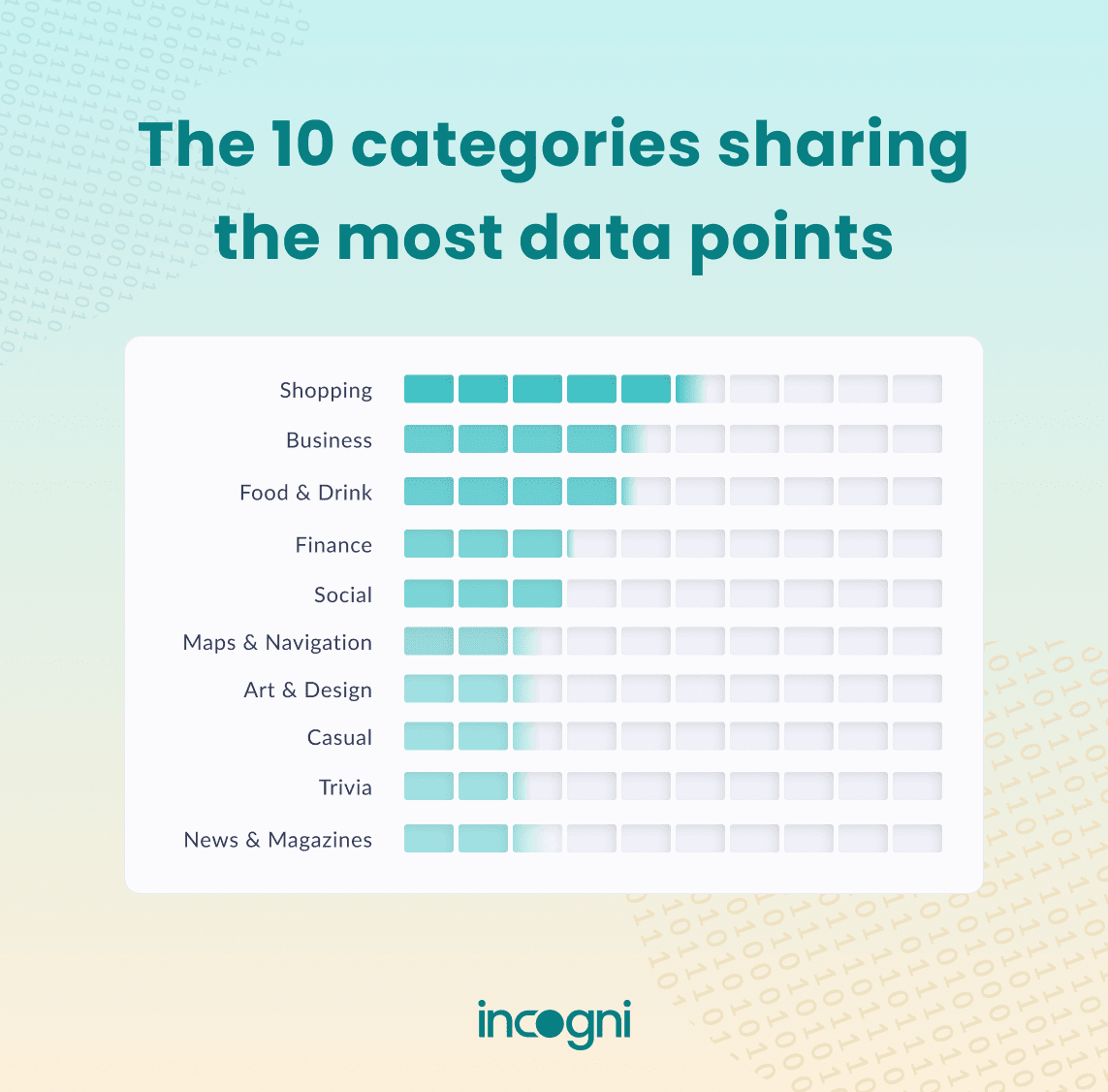
Incogni’s research reveals that of the top 1,000 paid and unpaid apps that it looked into, over half shared personal data with third-party companies and advertisers. All of these applications also collect and share this information on very different levels. For example, all of Meta’s social media platforms collect a significant amount of personal user data but then share a very limited amount in return. The Incogni study categorized apps on the amount of information they collected and dispensed, dividing said info into eighteen separate points (i.e. email addresses, credit score, race & ethnicity). The Meta apps collected a total of thirty-six points, but only dispensed four of them. Chromecast, however, shares almost every bit of information that it collects from users.
Of course, then there’s the issue with who or what the data are being shared with. Naturally, some of the larger companies are probably doing their business with corporations and moguls in the advertising business; however, smaller platforms have been known to sell data to cybercriminals and the like, either out of sheer negligence or a need to make a profit. This, and data siphoning as a whole really, can prove detrimental to users who just want a free app that can tune their guitar or whatever. Take a look at below charts for more insights on the privacy practices of the top Android apps available on the Play Store.:
Read next: This New Demo App Can Notify You Whenever Google Gets Data From Your Device
by Arooj Ahmed via Digital Information World
I’m sure this is entirely common knowledge at this point; hey, if any horror movie buffs out there have seen Unfriended 2, there was an exact joke about Facebook being free because its user base is the product. Ridiculously specific references to mildly received movies aside, everyone’s rather aware of how applications are used to track specific user data. The discrepancy usually tends to come over just how much such apps track you; most people are aware of how their browser history is “borrowed” by applications looking to target ads their way. What most people are not aware of is that the same also occurs for location history, online purchasing trends, job titles, and so on. All such information that’s so personal to a user, and that can be incredibly dangerous in the wrong hands, is freely extracted and sold to third-party companies. Of course, when I say extracted, I should just say stolen.
Incogni’s research reveals that of the top 1,000 paid and unpaid apps that it looked into, over half shared personal data with third-party companies and advertisers. All of these applications also collect and share this information on very different levels. For example, all of Meta’s social media platforms collect a significant amount of personal user data but then share a very limited amount in return. The Incogni study categorized apps on the amount of information they collected and dispensed, dividing said info into eighteen separate points (i.e. email addresses, credit score, race & ethnicity). The Meta apps collected a total of thirty-six points, but only dispensed four of them. Chromecast, however, shares almost every bit of information that it collects from users.
Of course, then there’s the issue with who or what the data are being shared with. Naturally, some of the larger companies are probably doing their business with corporations and moguls in the advertising business; however, smaller platforms have been known to sell data to cybercriminals and the like, either out of sheer negligence or a need to make a profit. This, and data siphoning as a whole really, can prove detrimental to users who just want a free app that can tune their guitar or whatever. Take a look at below charts for more insights on the privacy practices of the top Android apps available on the Play Store.:
Read next: This New Demo App Can Notify You Whenever Google Gets Data From Your Device
by Arooj Ahmed via Digital Information World
A LinkedIn post generator has gone viral for its cringe-worthy posts
When a post goes viral on the internet, it is either for two reasons, it is very cringy and supposedly quirky or two, or it is related to someone famous. The former is the more likely one statistically speaking. While LinkedIn does not seem like an app that would harbor posts like these, it is after all a social media app albeit one made for people looking for jobs and people looking to give them.
There is a viral post generator made specifically for LinkedIn and well the generator itself went viral and got so popular that a company paid real money to buy the thing. The generator uses prompts like what did you do today and asks for a piece of inspirational advice. The post then gives you the option to change the cringe level of the post. After clicking on the create option, the AI generates a very cringe-worthy post for your feed.
The generator was created by Tom Orbach who is a marketer and was accomplished by using AI. The generator made its debut on August 15th and has taken the internet by storm since. The generator was created by using AI that analyzed more than 100,000 posts that had gone viral on the app. then, this made the generator able to create detestable posts all by itself.
The results that came through after were both hilarious and masterpieces in themselves. They were very entertaining and that aspect was very pleasing to the masses of the internet. The posts had a very wide range of content. Most of it was just useless advice that was just pretending to be information. The advice was anything from chase your dreams and don’t let the haters get to your stuff.
Overall, it was a very fun experience, and testing it out was also very amusing because we all need a laugh these days anyway.
Read next: Influencers Might Be More Trusted by Gen Z Than Reviews on Product Pages
by Arooj Ahmed via Digital Information World
There is a viral post generator made specifically for LinkedIn and well the generator itself went viral and got so popular that a company paid real money to buy the thing. The generator uses prompts like what did you do today and asks for a piece of inspirational advice. The post then gives you the option to change the cringe level of the post. After clicking on the create option, the AI generates a very cringe-worthy post for your feed.
The generator was created by Tom Orbach who is a marketer and was accomplished by using AI. The generator made its debut on August 15th and has taken the internet by storm since. The generator was created by using AI that analyzed more than 100,000 posts that had gone viral on the app. then, this made the generator able to create detestable posts all by itself.
The results that came through after were both hilarious and masterpieces in themselves. They were very entertaining and that aspect was very pleasing to the masses of the internet. The posts had a very wide range of content. Most of it was just useless advice that was just pretending to be information. The advice was anything from chase your dreams and don’t let the haters get to your stuff.
Overall, it was a very fun experience, and testing it out was also very amusing because we all need a laugh these days anyway.
Read next: Influencers Might Be More Trusted by Gen Z Than Reviews on Product Pages
by Arooj Ahmed via Digital Information World
DuckDuckGo Rolls Out Beta Version Of A New Email Protection Tool
Users are free to try out a new email protection tool by DuckDuckGo as the company recently rolled it out in Beta.
While it was first spoken about in 2021, DuckDuckGo unveiled during the time that it was going to be a great, free, and worthwhile option for email forwarding.
They added how it was designed to conceal any email IDs whenever users wished to sign up for its online service, newsletters, and more.
Similarly, the tool also puts an end to tracking artifacts that are prevalent in emails. Now that it's arriving in beta, the popular internet privacy firm says that it can provide more protection by shielding all trackers hidden in web links.
We can see this new launch as one that lies midway between classic email forwarding tools that route texts via users' inboxes without putting their address on display, and those related to private email services such as ProtonMail.
The whole goal is to provide protection against the threat surrounding user profiling. This is done by hiding user identity and overcoming advanced tracking systems that are created by various ad firms, web players, and the world of online retailers too.
In a recent blog post put up by the company, we saw them speak in detail about how firms very Sneakily add trackers through pictures and links. These become embedded inside email messages and can freely gather information by simply opening up a text.
It could provide details like where you happened to be when you opened that text up and what type of device you ended up using too.
Since your email IDs are literally linked to almost everything and anything online like social media, work, and purchases, they can easily make the best use of their tracking strategies.
Using this new tool, users are allowed to produce personal and unlimited private addresses. These can even be the most random ones, providing that’s what they want.
Whenever a message arrives on these accounts, it will be stripped away from any form of tracking. You can even deactivate the tool, if and when you wish to stem spam flow toward the inbox.
The biggest advantage of Email Protection is related to a very efficient email tracking protection system. You don’t need to switch your provider or even deal with multiple accounts if you don’t want.
If you like the sounds of it, feel free to sign up by going to the settings menu on the application.
Read next: New Warning Issued Against Google Chrome’s ‘Internet Download Manager’ Which Has Received 200,000+ Downloads
by Dr. Hura Anwar via Digital Information World
While it was first spoken about in 2021, DuckDuckGo unveiled during the time that it was going to be a great, free, and worthwhile option for email forwarding.
They added how it was designed to conceal any email IDs whenever users wished to sign up for its online service, newsletters, and more.
Similarly, the tool also puts an end to tracking artifacts that are prevalent in emails. Now that it's arriving in beta, the popular internet privacy firm says that it can provide more protection by shielding all trackers hidden in web links.
We can see this new launch as one that lies midway between classic email forwarding tools that route texts via users' inboxes without putting their address on display, and those related to private email services such as ProtonMail.
The whole goal is to provide protection against the threat surrounding user profiling. This is done by hiding user identity and overcoming advanced tracking systems that are created by various ad firms, web players, and the world of online retailers too.
In a recent blog post put up by the company, we saw them speak in detail about how firms very Sneakily add trackers through pictures and links. These become embedded inside email messages and can freely gather information by simply opening up a text.
It could provide details like where you happened to be when you opened that text up and what type of device you ended up using too.
Since your email IDs are literally linked to almost everything and anything online like social media, work, and purchases, they can easily make the best use of their tracking strategies.
Using this new tool, users are allowed to produce personal and unlimited private addresses. These can even be the most random ones, providing that’s what they want.
Whenever a message arrives on these accounts, it will be stripped away from any form of tracking. You can even deactivate the tool, if and when you wish to stem spam flow toward the inbox.
The biggest advantage of Email Protection is related to a very efficient email tracking protection system. You don’t need to switch your provider or even deal with multiple accounts if you don’t want.
If you like the sounds of it, feel free to sign up by going to the settings menu on the application.
Read next: New Warning Issued Against Google Chrome’s ‘Internet Download Manager’ Which Has Received 200,000+ Downloads
by Dr. Hura Anwar via Digital Information World
Subscribe to:
Comments (Atom)