A Jewish Google employee has recently quit her job but left the firm with plenty to say regarding alleged retaliation.
Ariel Koren didn’t shy away when it came down to speaking her mind. She accused the search engine giant of complicity in its violations of human rights belonging to Palestinians. This came in the form of a letter that was recently addressed to fellow Google members.
Koren also boldly declared how bad she and other employees were made to feel when they decided to raise their voices and speak for Palestine. In the same way, she adds that instead of Google being fair and listening to what she and others said, as mentioned in their ethics policy, the firm shut them out completely.
The search engine giant also chose to aggressively put ahead military contracts and banned people from voicing their thoughts via a classic silencing pattern. This came in the form of retaliation toward her and so many others. Koren expressed these thoughts on a Medium blog as well.
The Jewish employee also outlined how she’s been affiliated with the organization for nearly seven years now. And she just so happened to be one of the two members of the firm who spoke against the company last year when Project Nimbus was announced.
The latter was a deal held between Google, Israel’s government, Amazon, and the military too. This came ahead when Israel was involved in killing innocent Palestinians located in Gaza. And on that note, Google decided it wished to be a part of the project, raising eyebrows for many.
It was declared that via this project Nimbus, both Google and Amazon would provide their assistance in creating a computing system. Moreover, this would help give Israel’s government and its military the support they required as far as artificial intelligence with support through machine learning tools was concerned.
Koren didn't stop there. She highlighted that during her tenure, she constantly saw Google behaving unfairly and silencing those that supported Palestinians. It also didn’t have a keen interest in diversity, hence failing to live up to its claims of being an ethical organization.
But it’s not just Palestine that Google doesn't support, Koren claims. It’s Arabs, Muslims, and Jews too who raise voices against violations of human rights for Palestinians. And if that means retaliating against their own employees and instilling an aura of fear, then so be it.
Koren called out Google’s behavior as weaponizing and one that was unjust for various reasons. She said that to retaliate against employees that stand up for what’s right and raise their voices against the firm’s work is just wrong.
There is previous evidence that showed how the company requested Koren to shift to Brazil in 2021 after she raised her voice against Project Nimbus. At that time, she happened to be on disability leave.
While Koren adds that her decision to quit the organization was a tough one, she knows that it was the right decision. After all, this was the only way she could raise her voice against the oppression taking place.
She called herself fortunate for having the privilege to talk against Google in a safe manner. And that’s one thing that her fellow colleagues and pals hailing from Palestine do not have.
Recently, an email was shared by Insider that showed a spokesperson from Google confirming that they do not allow retaliation at its workplace. They also investigated claims by former employee Koren, sharing that there was zero retaliation over there too.
In addition to that, Google says that the case was also dismissed by one government agency when the same employee filed claims of facing retaliation at the firm.
Read next: Google Docs is updated with an easy-to-use emoji command. Here’s all you need to know
by Dr. Hura Anwar via Digital Information World
"Mr Branding" is a blog based on RSS for everything related to website branding and website design, it collects its posts from many sites in order to facilitate the updating to the latest technology.
To suggest any source, please contact me: Taha.baba@consultant.com
Wednesday, August 31, 2022
Facebook No Longer Interested In Its Independent Gaming App As Shutdown Date Announced
It may be just two years since Facebook launched its standalone gaming application. But now, it’s keen on shutting it down forever.
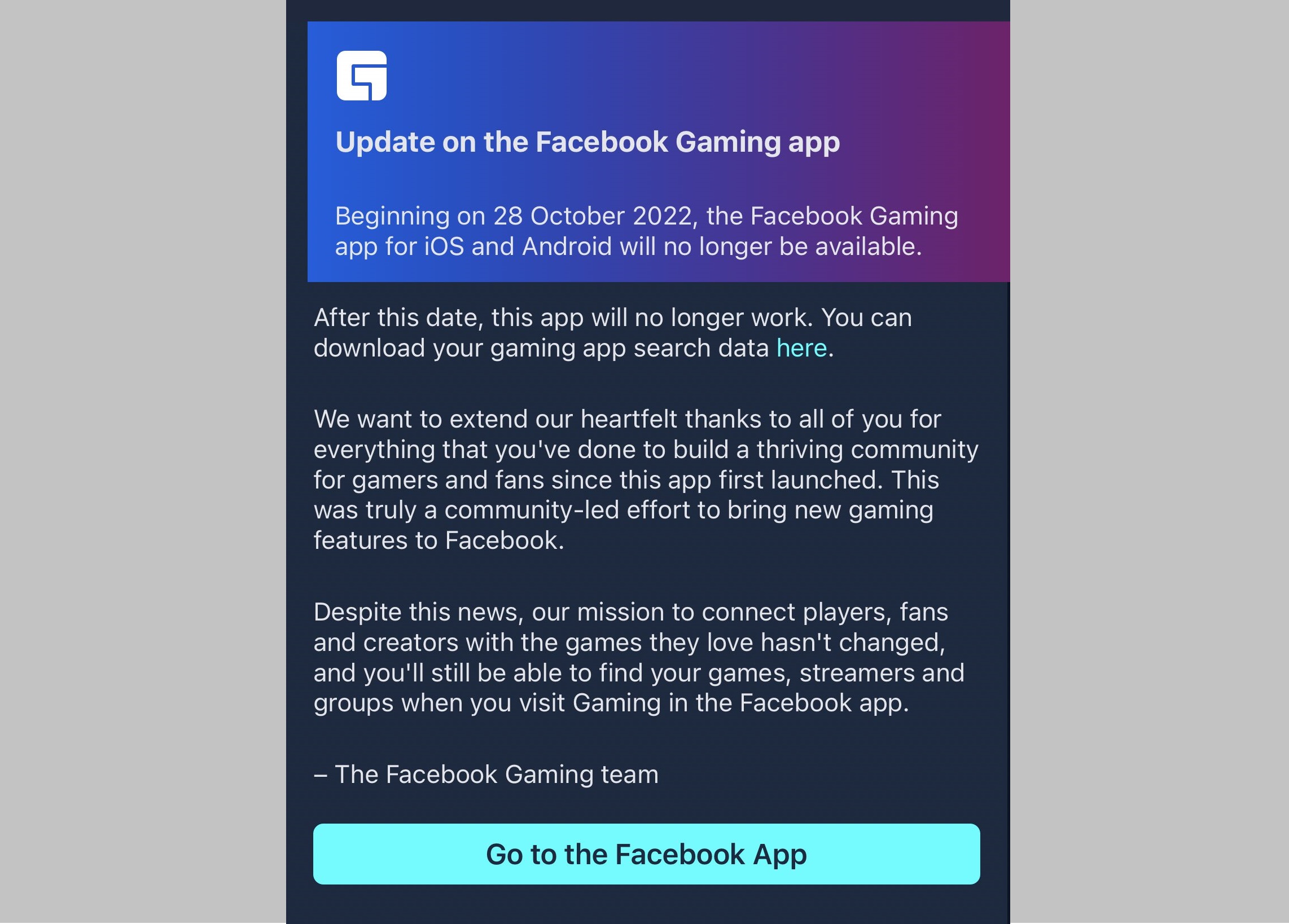
The date for the shutdown has been revealed to be October 28 of this year. Therefore, now, when users open the app up, they’ll find a banner stating how the app isn’t going to be available on both the App Store and Google Play Store after the date outlined.
At the same time, users won’t be finding the app in these particular stores anymore too.
The company recently unveiled a message that highlighted the change. Facebook adds that despite this news coming forward, its main mission will continue to be connecting players, their fans, and creators as one with all the games they adore.
They also extended gratitude to everyone that actively took part in the venture and showed great interest and enthusiasm since the launch. Those who have been a part of the app can download search data as the date for the app’s discontinuation is coming near.
We saw the app launch in 2020, and that is when the pandemic struck. Many witnessed their favorite players participate while taking part in championships themselves.
It’s no denying the fact that Facebook experienced its fair share of hurdles along the way too. Remember, a lot of rejections of the gaming app came from Apple’s side. According to Apple, it went against its rules that prevent apps whose main purpose is simply distributing games.
Hence, Apple forced the company in getting rid of actual gameplay content seen on the app.
Speaking to media outlets recently, one spokesperson from Meta says they realize how important of a factor gaming is for everyone. And they will continue to remain committed to providing entertaining content that users love.

H/T: @MattNavarra
With a promise to continue supporting the gaming community, the spokesperson said it would be seeing new projects soon on the main Facebook app where users can play, watch, and connect with all others every month.
For now, we’re not quite sure why Facebook has opted to shut down its gaming app. But there are chances that the firm may shed light on the decision in the future.
The news comes as Meta has been engaged in testing out new ordeals while getting rid of older ones. One of the most recent ones is related to Facebook shutting down the live shopping program. The reason outlined was so the app would focus more on its Reels, which are generating more revenue.
Therefore, after October 1, users would no longer be allowed to host shopping events via live streams on Facebook. This feature was first launched around two years back and did well at providing users with convenience at the time.
Meanwhile, there is news about Meta being busy with a test for another live streaming platform called Super. Here, influencers will get the opportunity to host live events, earn money, and also engage with audiences directly.
And to help make sure the app is a success, it has even paid influencers anywhere between $200 to $3000 to use the feature for half an hour!
Read next: Meta’s Stock Price is Crashing, And This Data Shows It Might Fall Further
by Dr. Hura Anwar via Digital Information World
The date for the shutdown has been revealed to be October 28 of this year. Therefore, now, when users open the app up, they’ll find a banner stating how the app isn’t going to be available on both the App Store and Google Play Store after the date outlined.
At the same time, users won’t be finding the app in these particular stores anymore too.
The company recently unveiled a message that highlighted the change. Facebook adds that despite this news coming forward, its main mission will continue to be connecting players, their fans, and creators as one with all the games they adore.
They also extended gratitude to everyone that actively took part in the venture and showed great interest and enthusiasm since the launch. Those who have been a part of the app can download search data as the date for the app’s discontinuation is coming near.
We saw the app launch in 2020, and that is when the pandemic struck. Many witnessed their favorite players participate while taking part in championships themselves.
It’s no denying the fact that Facebook experienced its fair share of hurdles along the way too. Remember, a lot of rejections of the gaming app came from Apple’s side. According to Apple, it went against its rules that prevent apps whose main purpose is simply distributing games.
Hence, Apple forced the company in getting rid of actual gameplay content seen on the app.
Speaking to media outlets recently, one spokesperson from Meta says they realize how important of a factor gaming is for everyone. And they will continue to remain committed to providing entertaining content that users love.

H/T: @MattNavarra
With a promise to continue supporting the gaming community, the spokesperson said it would be seeing new projects soon on the main Facebook app where users can play, watch, and connect with all others every month.
For now, we’re not quite sure why Facebook has opted to shut down its gaming app. But there are chances that the firm may shed light on the decision in the future.
The news comes as Meta has been engaged in testing out new ordeals while getting rid of older ones. One of the most recent ones is related to Facebook shutting down the live shopping program. The reason outlined was so the app would focus more on its Reels, which are generating more revenue.
Therefore, after October 1, users would no longer be allowed to host shopping events via live streams on Facebook. This feature was first launched around two years back and did well at providing users with convenience at the time.
Meanwhile, there is news about Meta being busy with a test for another live streaming platform called Super. Here, influencers will get the opportunity to host live events, earn money, and also engage with audiences directly.
And to help make sure the app is a success, it has even paid influencers anywhere between $200 to $3000 to use the feature for half an hour!
Read next: Meta’s Stock Price is Crashing, And This Data Shows It Might Fall Further
by Dr. Hura Anwar via Digital Information World
How to Use Instagram for Your Brand's Social Media Marketing
Isn’t Instagram the worst place to conduct branding exercises and sell stuff? Well no, actually, Twitter holds the record for being the worst thing to happen to businesses on social media. It is so stuffed with bots that there is no level of engagement analytics you can trust. Instagram is a tough nut to crack, but it isn't bought and paid for by celebrities (even though they try), so there is still plenty of space for small and large businesses. Here is how you use Instagram for your brand’s social media marketing.
If you are showing off any sort of product, you are supposed to add around 30% of glamour and shine. Don’t just show your boxes of nails, show your boxes of nails with shiny sharp spiked tips that twinkle against the sunrise of the exotic land that you have photo-shopped into the background.
Actually, the sunrise was a very purposeful choice. Nails are used by people who work during the day. They are a get-up-and-go product, and a sunrise is better suited for such a product.
Framing and context is another way of saying your setting, atmosphere, your hidden meaning and your overt meaning. Liquor adverts are shown at night, not during the sunrise in the morning. Cars are shown running through brightly lit streets or on brightly lit roads. They are not shown on gloomy days because it suggests a gloomy time. Yet, funeral posts on Instagram are set during gloomy and rainy days. The framing and context of your posts is important if you want to create the correct image and impression on your viewer.
Instagram bases your worth and your future promotions on your history. They care a little bit about your content’s meaning, though it isn't nearly as sophisticated as how YouTube picks what it promotes. Instead, Instagram looks at how many people clicked like on your posts in the past, and if you have no history or a history with few likes, then Instagram will promote other accounts over your own.
When you buy likes and followers, they don't follow the usual curve of likes and followers. They don't taper off as they would in real life. Bought interactions start and then they stop, and this is a problem because Instagram will just mark those interactions as abnormalities and will pay them no more mind. It isn't that they think you bought Instagram followers or likes, they won’t care at all, they will just continue to rank your profile based on your previous likes and interactions rather than the chunk you just bought.

by Web Desk via Digital Information World
Make it 70% Real World and 30% Shine
There is an almost accepted feeling on Instagram that the best accounts represent life with a 30% shine to it. Be it women using nose and eyelash filters, to cars using Photoshop to add that extra sparkle.If you are showing off any sort of product, you are supposed to add around 30% of glamour and shine. Don’t just show your boxes of nails, show your boxes of nails with shiny sharp spiked tips that twinkle against the sunrise of the exotic land that you have photo-shopped into the background.
Framing and Context
You may have wondered why the last example had a sunrise. Why not a sunset? Wouldn’t screws sparkle better in the starlight? Perhaps with a beautiful sky of stars behind your sparkling nails?Actually, the sunrise was a very purposeful choice. Nails are used by people who work during the day. They are a get-up-and-go product, and a sunrise is better suited for such a product.
Framing and context is another way of saying your setting, atmosphere, your hidden meaning and your overt meaning. Liquor adverts are shown at night, not during the sunrise in the morning. Cars are shown running through brightly lit streets or on brightly lit roads. They are not shown on gloomy days because it suggests a gloomy time. Yet, funeral posts on Instagram are set during gloomy and rainy days. The framing and context of your posts is important if you want to create the correct image and impression on your viewer.
Growing Your Channel
If you are looking to grow your Instagram profile organically, then you are in for a long road because it takes years. If you are looking to get started right away, then you need a head start with something like a website that offers Instagram Accounts for Sale. Buy an account that already has a following, and even if you lose 60% of those followers when you take over, you are still in a better position than somebody starting out with 100 followers.Instagram bases your worth and your future promotions on your history. They care a little bit about your content’s meaning, though it isn't nearly as sophisticated as how YouTube picks what it promotes. Instead, Instagram looks at how many people clicked like on your posts in the past, and if you have no history or a history with few likes, then Instagram will promote other accounts over your own.
Should I Buy Likes and Followers?
No you shouldn’t. As mentioned earlier, Instagram does judge your profile by how many likes and followers you have had in the past, but it looks at rank averages and median numbers. Suddenly, getting several thousand likes on your account will make no difference over the long term. It will be eliminated as an abnormality.When you buy likes and followers, they don't follow the usual curve of likes and followers. They don't taper off as they would in real life. Bought interactions start and then they stop, and this is a problem because Instagram will just mark those interactions as abnormalities and will pay them no more mind. It isn't that they think you bought Instagram followers or likes, they won’t care at all, they will just continue to rank your profile based on your previous likes and interactions rather than the chunk you just bought.

by Web Desk via Digital Information World
Tuesday, August 30, 2022
According to new data your home device might know you better than your family
As technology develops, man makes living easier for himself using that advanced technology, and today’s time is just that. We have a multitude of devices that make living and housework easier for us. Some of these home assistant devices include Alexa and smart home systems.
Well, TechShielder had a long look into what home assistant devices collect data to know more about their owner and shortlisted it down to 10. The 10 that were shortlisted included the Amazon Echo Dot, Chromecast with Google TV, Samsung SmartThings Hub, Nest Protect, Ring Indoor Cam, Levoit LV-PUR131S, Sonos One, TP-Link Kasa Smart Plug, Roborock S6, and Philips Hue.
All of them collect some basic data information about their owner such as name, address, time zone, IP address, etc.
But most of them go beyond that fine line with voice recording (70%), 50% save your PFPs, 40% take videos, and 40% save a personal description of you. Your home device could know you better than your own family because 70% of them know what you buy, and what you see on the internet (50%). They also know what apps you use (40%) and all of your internet history (40%).
Out of those 10, Amazon Echo Dot devices take the top place with 43% of data collection points. The device stores a lot of personal information about a user like address personal data and online browsing history even. The device also has access to personal data like photos and videos and also keeps live video records of everything that goes around the house.
However, according to Tech Shielder, Echo Dot storing this much data makes sense because it does a lot of work too. While other devices are just thermostats and security cameras, you can you the Echo Dot to make phone calls, operate the TV, and more.
Read next: Here's How Much Free Android Apps Siphon User Data
by Arooj Ahmed via Digital Information World
Well, TechShielder had a long look into what home assistant devices collect data to know more about their owner and shortlisted it down to 10. The 10 that were shortlisted included the Amazon Echo Dot, Chromecast with Google TV, Samsung SmartThings Hub, Nest Protect, Ring Indoor Cam, Levoit LV-PUR131S, Sonos One, TP-Link Kasa Smart Plug, Roborock S6, and Philips Hue.
All of them collect some basic data information about their owner such as name, address, time zone, IP address, etc.
But most of them go beyond that fine line with voice recording (70%), 50% save your PFPs, 40% take videos, and 40% save a personal description of you. Your home device could know you better than your own family because 70% of them know what you buy, and what you see on the internet (50%). They also know what apps you use (40%) and all of your internet history (40%).
Out of those 10, Amazon Echo Dot devices take the top place with 43% of data collection points. The device stores a lot of personal information about a user like address personal data and online browsing history even. The device also has access to personal data like photos and videos and also keeps live video records of everything that goes around the house.
However, according to Tech Shielder, Echo Dot storing this much data makes sense because it does a lot of work too. While other devices are just thermostats and security cameras, you can you the Echo Dot to make phone calls, operate the TV, and more.
Read next: Here's How Much Free Android Apps Siphon User Data
by Arooj Ahmed via Digital Information World
New survey reveals internet users are more concerned about data safety
A survey conducted by Integral Ad Science (IAS) reveals that 50 percent of internet consumers are assured that their web data is secured. While, 67 percent of consumers are more alert about their data safety.
Integral Ad Science collaborated with international data analytics and market research company, YouGov, and surveyed more than one thousand internet users and 350 media specialists. The survey's key findings reveal that users have become more cautious of online data safety and have raised concerns about the lack of knowledge of cybersecurity legislation. In addition to that, how their data is being harvested by third-party apps and other unauthorized websites for advertising objectives.
According to the survey, 9 in 10 of online users are knowledgeable about how different websites and apps gather data without consent for personalized advertisements, but despite knowing the reason, 68 percent of them are still annoyed with these advertising strategies. Moreover, 66 percent of consumers visit websites that offer them the product they have been looking for. They will likely stay and purchase products from the brand's websites when they see relevant ads.
Other than this, less than one third (29 percent) of media specialists have carried out contextual targeting, and 51 percent think that using the practice of showing ads based on a webpage's content would become significant in targeting the relevant audiences. The survey also highlighted what media experts assume about paying attention to data safety. According to Integral Ad Science, 62 percent of market experts believe that awareness of data privacy is essential. However, only 53 percent of media specialists know the privacy policy of browsers, 51 percent understand regulations, and 45 percent are familiar with mobile identifiers.
When asked what media experts think about the safety of personally identifiable information (PII), they say that privacy related to PII is the priority for brands. PII protection is essential for privacy and information security as it could expose consumers’ email, phone numbers, and other personal information to thieves.
Lastly, IAS's chief officer says that data privacy is a significant issue. For data security, changes have been made in the data privacy guidelines which will let consumers and media specialists prioritize privacy. He further added that the IAS platform is convenient for simplifying the concerns of updated privacy guidelines. The solutions provided by IAS are complementary and are made to assist marketers in targeting their relevant audiences and generating revenue while maintaining privacy gaps.
Read next: Phishing Emails Increased by 88% Month Over Month, Here’s Why That Should Worry You
by Arooj Ahmed via Digital Information World
Integral Ad Science collaborated with international data analytics and market research company, YouGov, and surveyed more than one thousand internet users and 350 media specialists. The survey's key findings reveal that users have become more cautious of online data safety and have raised concerns about the lack of knowledge of cybersecurity legislation. In addition to that, how their data is being harvested by third-party apps and other unauthorized websites for advertising objectives.
According to the survey, 9 in 10 of online users are knowledgeable about how different websites and apps gather data without consent for personalized advertisements, but despite knowing the reason, 68 percent of them are still annoyed with these advertising strategies. Moreover, 66 percent of consumers visit websites that offer them the product they have been looking for. They will likely stay and purchase products from the brand's websites when they see relevant ads.
Other than this, less than one third (29 percent) of media specialists have carried out contextual targeting, and 51 percent think that using the practice of showing ads based on a webpage's content would become significant in targeting the relevant audiences. The survey also highlighted what media experts assume about paying attention to data safety. According to Integral Ad Science, 62 percent of market experts believe that awareness of data privacy is essential. However, only 53 percent of media specialists know the privacy policy of browsers, 51 percent understand regulations, and 45 percent are familiar with mobile identifiers.
When asked what media experts think about the safety of personally identifiable information (PII), they say that privacy related to PII is the priority for brands. PII protection is essential for privacy and information security as it could expose consumers’ email, phone numbers, and other personal information to thieves.
Lastly, IAS's chief officer says that data privacy is a significant issue. For data security, changes have been made in the data privacy guidelines which will let consumers and media specialists prioritize privacy. He further added that the IAS platform is convenient for simplifying the concerns of updated privacy guidelines. The solutions provided by IAS are complementary and are made to assist marketers in targeting their relevant audiences and generating revenue while maintaining privacy gaps.
Read next: Phishing Emails Increased by 88% Month Over Month, Here’s Why That Should Worry You
by Arooj Ahmed via Digital Information World
FTC Jumps In To Prevent Analytics Company From Selling Geo-Location Data Belonging To Millions
The Federal Trade Commission has reportedly jumped in to put an end to a controversial matter that has been a huge concern for a while now.
The FTC has filed a lawsuit against an analytics firm to stop it from selling users’ location data including details like where they’re living and if they can be traced to abortion clinics.
These accusations have been hurled at a company based in Idaho that goes by the name Kochava. According to statistics obtained by the FTC, it’s been involved in illegal behavior for a while now, taking help from data brokers.
Using some assistance from social media apps too, Kochava has sold off the information for reasons that it outlines to be analytics and marketing.
As far as 125 million users data were taken whose status was active on a monthly basis. Moreover, they were seen charging thousands each month to gain access. The type of data even comprised exact longitude and latitude coordinates pertaining to users’ smartphones. Similarly, there was even mention of their IP addresses as well.
To help provide protection to such users, the company was seen stripping out the identities of such users while assigning a particular advertising identification along the way.
In addition to that, the FTC was caught detailing how data could be compiled easily using other types of information taken from third parties that would delineate any user’s identity.
For instance, users’ mobile location devices could combine with various property records to help give a better idea of their identity.
Additionally, the same data could be taken to expose other types of sensitive information like the locations visited. There was special emphasis on abortion clinics, domestic violence areas, and places people go to for worship.
There is more striking evidence on Amazon’s marketplace where stats show how some data had been offered free of cost via free samples over a seven period of time. And on average, one day would entail 62 million devices.
It’s interesting to note that the firm put zero to minimal safeguards into play to prevent threat actors from getting access to the same data. All that was needed was for users to fill out forms.
In the lawsuit, the FTC boldly declares how any purchaser would pop up and utilize personal email IDs to describe their use as simply conducting business. The request would be forwarded for approval and they’ve managed to say yes to requests in less than 24 hours.
To help stop the firm from carrying on with the practice, the FTC says the lawsuit was the only option forward. Selling users’ data for the purpose of tracing them down is wrong and identifies different people. It also puts them at risk for exposure to things like stigma, discrimination, violence, and stalking too.
As of now, we’re still waiting for a request to come forward from Kochava’s side. And while we wait, it’s quite clear what this lawsuit is suggesting. The FTC wants the practice to end and has even asked the US Supreme Court to intervene as a part of the crackdown.
Read next: Adobe Reveals Content Creators Are Increasing At A Steady Pace, And Influencers Are Earning Hefty Amounts In The Process
by Dr. Hura Anwar via Digital Information World

The FTC has filed a lawsuit against an analytics firm to stop it from selling users’ location data including details like where they’re living and if they can be traced to abortion clinics.
These accusations have been hurled at a company based in Idaho that goes by the name Kochava. According to statistics obtained by the FTC, it’s been involved in illegal behavior for a while now, taking help from data brokers.
Using some assistance from social media apps too, Kochava has sold off the information for reasons that it outlines to be analytics and marketing.
As far as 125 million users data were taken whose status was active on a monthly basis. Moreover, they were seen charging thousands each month to gain access. The type of data even comprised exact longitude and latitude coordinates pertaining to users’ smartphones. Similarly, there was even mention of their IP addresses as well.
To help provide protection to such users, the company was seen stripping out the identities of such users while assigning a particular advertising identification along the way.
In addition to that, the FTC was caught detailing how data could be compiled easily using other types of information taken from third parties that would delineate any user’s identity.
For instance, users’ mobile location devices could combine with various property records to help give a better idea of their identity.
Additionally, the same data could be taken to expose other types of sensitive information like the locations visited. There was special emphasis on abortion clinics, domestic violence areas, and places people go to for worship.
There is more striking evidence on Amazon’s marketplace where stats show how some data had been offered free of cost via free samples over a seven period of time. And on average, one day would entail 62 million devices.
It’s interesting to note that the firm put zero to minimal safeguards into play to prevent threat actors from getting access to the same data. All that was needed was for users to fill out forms.
In the lawsuit, the FTC boldly declares how any purchaser would pop up and utilize personal email IDs to describe their use as simply conducting business. The request would be forwarded for approval and they’ve managed to say yes to requests in less than 24 hours.
To help stop the firm from carrying on with the practice, the FTC says the lawsuit was the only option forward. Selling users’ data for the purpose of tracing them down is wrong and identifies different people. It also puts them at risk for exposure to things like stigma, discrimination, violence, and stalking too.
As of now, we’re still waiting for a request to come forward from Kochava’s side. And while we wait, it’s quite clear what this lawsuit is suggesting. The FTC wants the practice to end and has even asked the US Supreme Court to intervene as a part of the crackdown.
Read next: Adobe Reveals Content Creators Are Increasing At A Steady Pace, And Influencers Are Earning Hefty Amounts In The Process
by Dr. Hura Anwar via Digital Information World
Here’s What Makes TikTok Users Buy Products Through the App
TikTok is just one of the many social media companies who are trying to make a foray into the world of ecommerce, but it is unique in that it has experienced a lot more success than many of its better established rivals. Insider Intelligence recently published a report that shows what makes TikTok users make a purchase through the app because of the fact that this is the sort of thing that could potentially end up helping marketers to plan their campaigns accordingly.
With all of that having been said and now out of the way, it is important to note that the vast majority of TikTok users, or 71.2% to be precise, stated that they start shopping after randomly seeing a product in their feed as well as seeing them in Stories that they watch. 58.2% also go to TikTok to find inspiration for products that they should buy, and 47.9% also stated that they go to TikTok to gather information about a product that they are considering purchasing.
All of this seems to suggest that TikTok could very well become a social commerce powerhouse before too long, but in spite of the fact that this is the case one potential obstacle for the upstart social platform is the reluctance of its users to trust it with their data. Only 36% of TikTok users said that they felt safe in giving personal information to TikTok, which is quite low with all things having been considered and taken into account.
Companies like Amazon, Microsoft, Netflix and Apple all have over 70% of users saying they trust these platforms with personal data. With 74%, 71%, 71% and 70% respectively, these platforms clearly have an edge over TikTok as far as user privacy is concerned.
However, TikTok’s numbers are not far beyond those of its competitors. 49% of Instagram users said they trusted the platform with private data, 44% said the same of Facebook and the numbers for Twitter were around 41%. That suggests that TikTok is not alone in facing difficulties acquiring the trust of its users, though it is still behind the rest of the pack.
Read next: Influencers Might Be More Trusted by Gen Z Than Reviews on Product Pages
by Zia Muhammad via Digital Information World
With all of that having been said and now out of the way, it is important to note that the vast majority of TikTok users, or 71.2% to be precise, stated that they start shopping after randomly seeing a product in their feed as well as seeing them in Stories that they watch. 58.2% also go to TikTok to find inspiration for products that they should buy, and 47.9% also stated that they go to TikTok to gather information about a product that they are considering purchasing.
All of this seems to suggest that TikTok could very well become a social commerce powerhouse before too long, but in spite of the fact that this is the case one potential obstacle for the upstart social platform is the reluctance of its users to trust it with their data. Only 36% of TikTok users said that they felt safe in giving personal information to TikTok, which is quite low with all things having been considered and taken into account.
Companies like Amazon, Microsoft, Netflix and Apple all have over 70% of users saying they trust these platforms with personal data. With 74%, 71%, 71% and 70% respectively, these platforms clearly have an edge over TikTok as far as user privacy is concerned.
However, TikTok’s numbers are not far beyond those of its competitors. 49% of Instagram users said they trusted the platform with private data, 44% said the same of Facebook and the numbers for Twitter were around 41%. That suggests that TikTok is not alone in facing difficulties acquiring the trust of its users, though it is still behind the rest of the pack.
Read next: Influencers Might Be More Trusted by Gen Z Than Reviews on Product Pages
by Zia Muhammad via Digital Information World
Subscribe to:
Comments (Atom)


