Saturday, October 1, 2022

YouTube Offers Subscription To Its Standalone Add-On Channels Without Purchasing A Base Plan

YouTube says it’s now giving users the chance to take on a subscription plan for add-on channels that don’t require them to sign up for the app’s $65 base plan.

There are a total of 20 channels up for grabs that you can avail yourself of easily without a sign-up. Moreover, you’re going to be given the chance to select between the likes of Showtime, NBA League Pass, and even HBO Max. Other than that, Epix and Starz are also going to be up for grabs as they’ll be rebranded at certain destinations.

YouTube TV appears to be following in the footsteps of channels like Apple TV, Roku, Sling TV, and even Amazon Prime Video. These will all be a new part of its subscriptions for standalone channels.

This particular base plan costs around $65 and is very much like a cable-style television ordeal. There are about 85 channels and you won’t be needing that for access to such channels via this service.

In addition to that, users that opt-out from this can continue to avail advantages of the features on offer by YouTube TV like unlimited DVR space, three streams taking place simultaneously, and around six profiles per home.

For a lot of people, it would be unnecessary to make such a subscription for standalone channels via services such as these when they’ve got their own apps to avail. However, you’ll be amazed to learn that this does come with quite a few benefits. And that’s true if you end up subscribing to more than just a few.

The features can be accessed via one particular app that is going to be available on several different platforms as compared to just the single standalone apps designated for Shudder and more. We also find managing all of your subscriptions using just one bill would be super useful as well.


Read next: Top YouTuber Mr. Beast Reveals He Was Given An Offer Of $1 Billion To Sell His Empire But Refused
by Dr. Hura Anwar via Digital Information World

Apple CEO Tim Cook Throws Shade On Facebook’s Metaverse And Its Complex Workings

The battle between tech giants Apple and Meta has always been interesting to witness. And today, we’re bringing you some facts about a recent interview with the Apple CEO who seemed to be throwing shade on Facebook again.

Tim Cook is currently touring Europe and that’s when he sat down for a one-on-one interview with a leading news outlet of the Dutch called Bright. As one can imagine from the Apple CEO, there seems to be a major focus on the world of AR. And then there’s plenty of talk about climate change and coding too.

As far as the world of augmented reality is concerned, Tim Cook says that the number of AR apps continues to increase as we speak. They’re flourishing on the App Store but that doesn’t mean there isn’t space for the world of technology to go much further.

At the moment, AR apps can be found conveniently but their potential can reach new heights, the Apple CEO says. He added how AR technology affects everything we see today. Just the thought of being able to teach using AR and put things on display in that way is mindblowing. Even the field of medicine can be transformed with such modern means.

He also adds how we’re going to stop and look back at how much this form of technology has revolutionized the world. It’s actually quite interesting he adds. But something that we found to be so much more interesting was his take on the Metaverse.

Meta has been seen doubling down on it for a while now but Tim Cook doesn’t see what Meta sees. Instead, he claims that if you ask the average common man what it means, they’ll lack an understanding of the concept.

Moreover, Cook feels that making people understand something is just so quintessential. And he was sure people lacked a basic understanding of the project.

Other bold comments by Cook were related to how the world of virtual reality is an amazing innovation but you can’t live your entire life in that manner.

You can really have yourself immersed in that. And it’s going to be utilized in a great manner. But you certainly don’t wish to live life according to that. He continued by stating how VR is great for a set period of time. But you can’t communicate through it too well. Hence, he was not against it but just offered his point of view on it.

Other than the usual comments regarding climate change and the coding that comes with it, Cook was seen touching down on some basic opinions of the entire political process and the associated climate regarding the context.

He felt strongly how technology has what it takes to tackle plenty of problems affecting humanity today. Being politically correct, he did take a moment to acknowledge the efforts of others that serve them. He added that he’s certainly not one of those but has a different role.

This comprises empowering people with all kinds of products that enable them to carry on with things that wouldn’t have been possible otherwise. Be it making them more creative or adding greater productivity to life, the list is endless. And that just means leaving the world of today in a better shape than the way we initially found it.

We’re not quite sure about how Meta is going to take this comment as it does come with a pinch of salt. Nevertheless, he is the CEO of Apple, and just like anyone else, he’s got the right to this opinion.


Photo: Tim Cook / Twitter

Read next: Many Businesses Are Still Using A Password As A Security Measure And This Is Something That Should Be Avoided At All Costs
by Dr. Hura Anwar via Digital Information World

Google is shutting down Google Surveys as of November 1st

After ten years of continuous service, Google has finally announced that the Google survey will be discontinued on November 1st, 2022.


According to the company, both Google Surveys and Survey 360 will be shut down, and users will have time till December to save their data. The decision did not come out of the blue; instead, survey users have been receiving emails and notifications from the service provider about the plan for this feature. The email being shared by the company states that users still have 2 months. Any impending survey won’t be processed until after November 1st. However, they will have an additional one-month time period to download the data from their surveys so it can be stored before Google Survey shuts down completely.

A link has also been added in the email which will lead the users to the question and answer forum related to surveys. One of the most frequently asked questions is why this step is being taken by the company. While answering this question, Google responded that the company has other plans for the surveys and that the service was meant to help businesses of every level grow based on user reviews. However, the company believes that the service being provided by the surveys is not up to expectations and is planning to look for alternative methods that can give a much better insight into such businesses and help them grow through advertising products and data from market research.

Because the company does not refer to an alternative service, several other companies provide the same service as Surveys.

These alternatives may include Formsort, which offers both premium and basic features Another is Tally, which offers almost 99% of its services without any payment, and if a user still wants to avail of other customizable features, they’ll be required to pay a monthly subscription fee.

Wordforms, Typeform, and 123 Form Builder also work in the same way as the above-mentioned ones, which means they also allow both free and paid services, whereas Appinio is a high-end service provider which works for certain groups only and does not offer any free services to their users.

One misconception which seems to be taking place is that the shutting down of Google Surveys means that Forms won’t be available as well. However, the company has already made it clear that both of these services are different, and Google Forms will keep working.

Read next: Popular Game Streaming Service Stadia Comes To An End As Google Announces Shut Down
by Arooj Ahmed via Digital Information World

One cyber attack can cause a $100,000 loss to over 40% of businesses

Cyber attacks are becoming more frequent at an alarming rate. These attacks not only cause financial problems for the attacked businesses, but they can also jeopardize their working relationships with clients and investors due to their failure to provide data security.

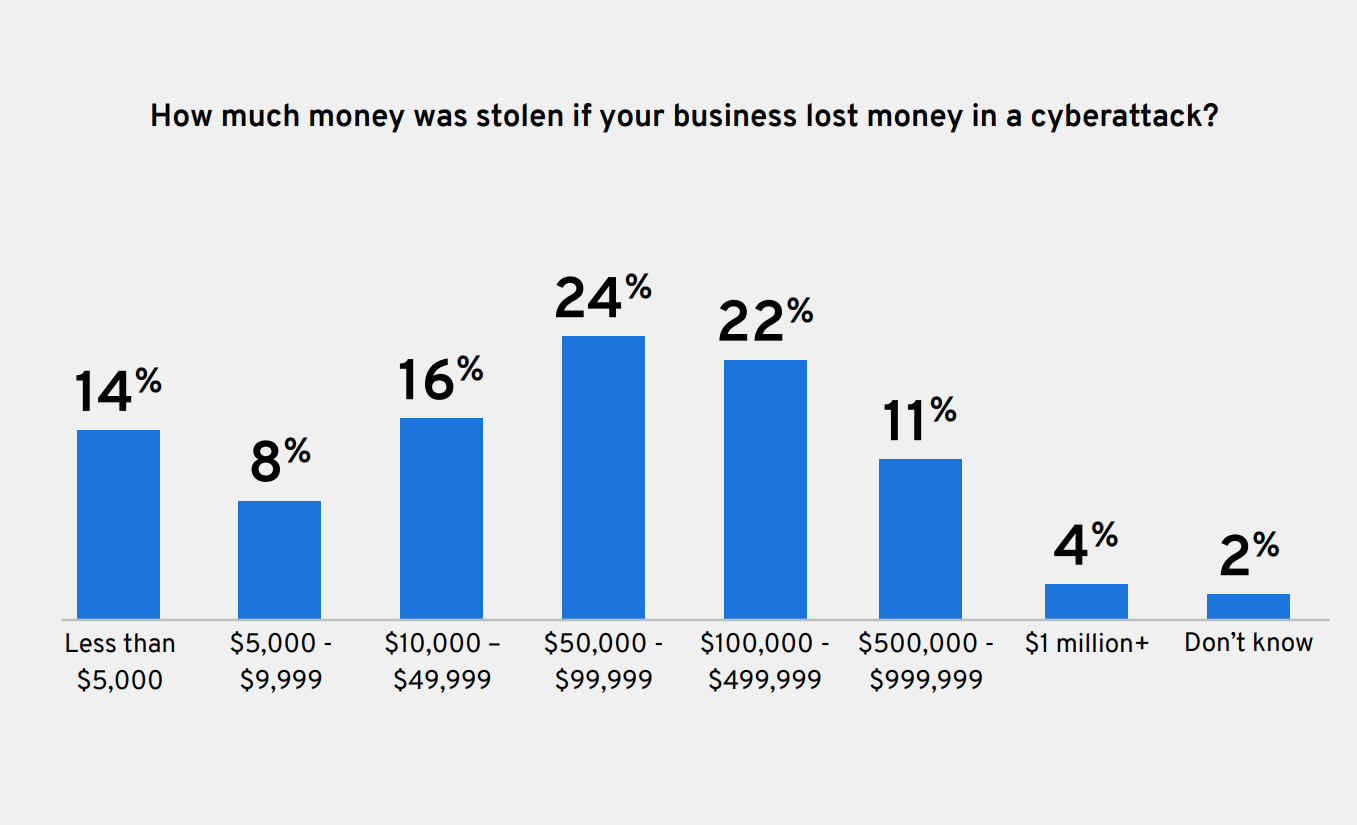
According to the survey conducted by US Cybersecurity firm Keeper, over 24% of businesses had to face a $50,000–$99,999 loss after being hit by a full-fledged cyber attack. These figures were followed by 22% of businesses that lost somewhere between a hundred thousand dollars and five hundred thousand dollars.

Most small-scale businesses don’t have a high-end cybersecurity system, making them more susceptible to such attacks. Though the attackers may not make much money from these businesses, the survey results show that 14% of the companies lost nearly $5,000, another 8% lost nearly $10,000, and another 16% lost somewhere around $50,000.

It is understandable that if a company has millions in its online account, it’d be keeping it secure with a strong anti-cyber attack system. This is why only 4% of the businesses had to go through a million-dollar loss.


Furthermore, it is also observed that businesses operating in the United States come across over 40 to 42 cyberattacks per year. While most of them are countered, the 2 or 3 attacks that get their hands on the data cause most of the problems.

As discussed above, a cyber attack not only causes an economic crisis but is capable of causing far greater damage. These damages may include a spoiled image of the attacked company for failing to protect its data. Their clients and customers will eventually start to lose trust in them and may even end up losing their investors or partners.

Over 28% of the firms that went through a cyber attack also faced a compromised image problem, while nearly 23% of them started to face difficulties in their trading operations.

To dodge the consequences faced after a cyberattack, many companies have now started to not disclose any such attacks and try to solve the matter on their own without involving any third party in this matter.

The survey results were based on 516 IT companies, and the report was released globally on September 15th.

Read next: Study shows Over stimulation caused by smartphones, while they promise the opposite
by Arooj Ahmed via Digital Information World

Google Disables Access To Its Translate App In Certain Areas Of China

Internet users in China are complaining of disabled access to Google Translate. And that is causing them to be redirected to the app’s domain situated in Hong Kong. While it might not seem like a huge problem to many, well, this isn’t accessible via the mainland and that’s a major concern.

Users of Reddit claim Google tried to swap out its Translate interface at translate.google.cn using a generic search page on Google at a certain point in the past 24 hours.

This particular change is really causing an uproar as the main translation features are getting affected such as KOReader. This is the name given to the document viewer that’s based on users in China. Similarly, it’s designed to facilitate Google Chrome’s translation feature that’s built into the app.

At the moment, Google is yet to respond to any request for comments.


We know that Google hasn’t had the best relationship with China’s government. In the year 2006, we saw the firm enter the market in China with a new version of its Search Engine. This was reportedly subject to great censorship rules by the government.

However, after a few state-sponsored tricks up their sleeve and some government-ordered blocks on a series of services, Google was really seen shutting down its Search in main areas of China. This was followed by a rerouting of searches via Hong Kong’s uncensored domain.

Google also was seen exploring the relaunch of its Search in China in the years 2018 and 2019. This was a part of its new project called Dragonfly. This would have censored out results and also be able to record locations of so many users with a complete history of internet browsing. Thankfully, such plans were removed after a few clashes that came about due to the search engine giant’s privacy team, as mentioned in a report by The Intercept.

Meanwhile, in the year 2020, we saw a new law regarding national security come forward in Hong Kong. This gave way to locals who would be seen expanding their surveillance powers. For now, Google says it’s not keen on sending out a response to any form of data request related to Hong Kong’s law and its enforcement.

They would much rather go forward with a legal obligation treat with America on the matter.

For them, this is no longer a technical issue. Google Translate gets disabled in most parts of the mainland and needs to be related to the new National Congress of the country’s Communist Part. This will occur on the 16 of this month.

In case you didn’t know, China’s government has blocked out services by Google surrounding some huge political events. And then there’s an issue related to sensitive anniversaries such as the Tiananmen Square Massacre.

China has also been accused of silencing its own citizens from speaking about the government so as you can see, it’s a sensitive matter altogether.

Read next: 77% of Companies Plan Tech Budget Increases Despite Economic Turmoil
by Dr. Hura Anwar via Digital Information World
77% of Companies Plan Tech Budget Increases Despite Economic Turmoil

There have been a series of economic and geopolitical disruptions that have created obstacle after obstacle for numerous industries, and the tech industry is no different. This type of climate creates a lot of unpredictable scenarios, and if companies are not certain about the way the future is going to look they would be hesitant to commit their budgets to any type of advancement or progress with all things having been considered and taken into account.

In spite of the fact that this is the case, a new report from Bain revealed that around 77% of companies still plan on increasing their tech budgets for 2023 when compared to budgets for 2022. This is a decrease from last year’s 90% that said the same, but with all of that having been said and now out of the way it is important to note that the vast majority are still planning on investing even more than they have in the past due to the importance of tech related innovation.


Venture capital investments over the past few years seem to confirm that the tech train is not showing any signs of stopping. Around 75% of venture capital dollars have gone towards enterprise software and IT infrastructure. It makes sense that the focus would shift to the commercial sector now that IT has so thoroughly dominated the consumer sector, and it will be interesting to see if the current global climate has implications in the future that have not played out as of right now.

Additionally, AI seems to be a hot topic for investors. Around 86% of tech professionals and experts who responded to this survey said that AI is becoming standard in terms of acquiring customers and sustaining growth. That means that companies currently can’t afford not to invest in AI, so we will likely see a continued increase in investment in this sector for the foreseeable future.

Despite that, only 20% of companies actually have the infrastructure to properly utilize AI. That might create some roadblocks down the road and it suggests that current investment inflows are purely speculative rather than utilitarian.

Read next: The Fintech Marketplace Has A Larger Share Of Investors From Across Android Devices As Opposed To Apple Ones
by Zia Muhammad via Digital Information World

Android now has a record-breaking 57% of hypercasual game ad spending

People have shifted their interest in downloading hypercasual games that are more likely to be addictive and fun to play. The new game genre has rapidly grown over the years and hit a very high bar among other games. According to the reports, it reached the third position compared to the other 100 games globally in 2021.

Hypercasual games are more of a big deal in the western market, with more than 49% of downloads in the US, 41% in the UK, and 9% in Korea. These games are similar to traditional arcade games. The developers and publishers are creating more games just like hypercasual to relieve the stress of its people from everyday work.


Developers are also spending a vast amount of money on game advertisements to get more revenues and expand the business. Advertising platform Tenjin has released a new report claiming that Android accounted for an unprecedented 57% share of hypercasual advertising expenditure.

Furthermore, hypercasual titles spending has increased rapidly. According to the recent report by Hypercasual Benchmark for Q3 2022, Android improved its share of ad spending by 7% points compared to Q1. Whereas hypercasual titles spending was 43% by iOS.

IOS is always one step ahead of Android, as its Median cost-per-install (CPI) is higher than Android, which is at a $0.10 difference. However, this indicates that Android is becoming more competitive, as it went down from an average of $0.15 over the previous four years.

In addition, Tenjin examined the hypercasual game's regional ad spending breakdown in Brazil, Japan, and the United States. With median CPIs of $0.56, $0.44, and $0.06, these three nations appear at the top of the list for Android in Q3 2022. Brazil is one of the best platforms for Android developers and marketers, owing to its record low CPI.

Additionally, Brazil’s low CPI benefits iOS developers and has provided more opportunities, as its median CPI is $0.41. Whereas other countries also make it to a top opportunity such as the US, Japan, and UK CPIs are ($0.71), ($0.66), and ($0.39) are considered the top three countries which have spent in Q3 2022 for hypercasual games.

Integral had the lowest CPI for Android at just $0.08, according to a comparison of the top 10 ad networks by ad spend, while Meta had the highest CPI at $0.30. Unity Ads had the lowest CPI on iOS, with $0.15, followed by Integral, with $0.19. On iOS, Apple Search Ads cost the most ($0.62).

Roman Garbar, Marketing Director at Tenjin, has said that on a macro-level they have decided to increase ad spending and CPIs on Android. The recent control of Android and dethroning of iOS indicates that it could target the devices to target a larger audience and gain maximum impact. Although the retention rate of iOS is still higher than Android.

Developers have conducted a few tests and concluded that iOS has higher day one and day seven retention rates than Android. The top 2% of games: iOS and Android retention on day 1 was 51% and 42%, respectively, while iOS retention was 22% and 16% on day 7.

Hypercasual titles should have a low rate of retention at around one day. To add more in-depth gaming content, developers are putting in a lot of effort to encourage players to play for longer periods.

Read next: App Developers Are Scrambling To Find New Avenues For Monetization After The Discontinuation Of IDFAs And Cookies
by Arooj Ahmed via Digital Information World