Tuesday, October 18, 2022

Here Are the Biggest Sources of Tech Talent in North America

The tech industry has been exploding these past few decades thanks to the wider adoption of various devices as well as a diversification of what this industry can provide with all things having been considered and taken into account. North America has been a hub for technological advancement during this period of growth, but where are the biggest pools of talent located in this continent? There are about 5.5 million tech workers in the US and another million in Canada, and a report from Visual Capitalist highlights where the majority of these workers originate from.

With all of that having been said and now out of the way, it is important to note that the biggest tech talent market in North America happens to be San Francisco, more specifically the Bay Area of this city. There are over 378,000 tech workers in this area, and there has been a 13% growth in talent between 2016 and 2021.

New York comes in second with a total talent pool of around 344,520, but its growth rate stands at a meager 3% in the same period. The third place on this list belongs to Toronto, which has about 289,700 workers in this field right now. Interestingly, Toronto has a stunning growth rate of about 44%, which indicates that it might quickly surpass New York in the coming years and potentially even San Francisco in due course.

The US definitely has more tech workers than major Canadian cities, but in spite of the fact that this is the case the growth rate for tech talent in Canada is far higher than that of its southern counterpart. Vancouver is seeing the highest rate of growth in all of North America with a staggering 63% increase in the number of workers between 2016 and 2021.

Other Canadian cities like Montreal and Ottawa are also seeing healthy rates of growth with 27% and 22% respectively. The only US city that surpasses these Canadian cities in terms of growth rate is Seattle with a 32% growth in the same period. Denver comes close with 23%, but most other American cities are seeing single digit growth rates in the tech talent pool save for Los Angeles that barely manages to break the 10% mark.

Vancouver is an especially interesting case, since its dramatic growth in the number of tech jobs is thanks to so many major tech companies investing in the city. Microsoft and Amazon established offices in this city, and Google is also planning to open up a fiber optic cable that will originate in Vancouver and extend all the way to Asia, and it will be exciting to see how much this would impact the growth of tech talent in Vancouver in the coming years.

The rise of the pandemic has shifted the landscape of the tech industry considerably because of the fact that this is the sort of thing that could potentially end up forcing companies to reprioritize what matters to them. Remote work became much more commonplace, and this gave tech workers more freedom about where they can live than might have been the case otherwise.

They no longer have to stick to coastal cities. Indeed, many tech workers are flocking to interior cities that are a lot smaller due to their lower cost of living. This will disperse the number of tech workers across the continent instead of concentrating them in various hubs. Canada is a rising star here, and if it manages to surpass the US that will be a huge upset for the industry as a whole since it goes against the trend that has been seen for quite a long time. If this trend persists, anywhere from Charlotte to Calgary could be the next big tech hub.


Read next: 54% of Workers Prefer Going to the Office, Here’s Why
by Zia Muhammad via Digital Information World

This New Survey Shows How Buzzword Compliance Leads to Inflated Tech Trends

Corporate executives are responsible for charting the path that their companies will take, but many of them get mislead by their desire to use buzzwords with all things having been considered and taken into account. A new report released by KPMG revealed that upper management might be taking current fads a bit too seriously because of the fact that this is the sort of thing that could potentially end up sounding good in a board room meeting but might not have any actual value.

With all of that having been said and now out of the way, it is important to note that around 70% of all companies are investing heavily in the most talked about tech trends. These trends include NFTs, Web3, cryptocurrencies, VR and AR, 5G, the Metaverse as well as quantum computing among others. 58% of companies said that they plan to invest in the Metaverse, with 62% saying the same for Web3.


In spite of the fact that this is the case, many of these trends are already starting to die out. NFTs were touted as the next big thing, but the majority of NFTs are currently being traded at a small percentage of their initial market value. Cryptocurrencies have followed a similar route, with most new forms of crypto being derided for not providing anything worthwhile and often being parts of pump and dump schemes that are designed to scam trustworthy people.

Major companies have been doubling down on the metaverse as well, none more so than the recently rebranded Meta. Facebook’s new name may have been an attempt to distance it from past controversies, but it also suggests that the company thinks the metaverse will be a big earner for them moving forward.

New reports indicate that consumer interest in the metaverse is minimal at best, and there are only very specific use cases that most consumers would not relate to. Hence, this might potentially create another tech bubble with so many investors pouring billions into industries that may not pan out, and when the bubble bursts only the strongest companies will survive.

Read next: A New Study Has Showed That Over 5 Billion Phones Are Going To Be Thrown Away In 2022 Even When They Can Be Used For A Bigger Cause
by Zia Muhammad via Digital Information World

Why Your Business is Losing Millennial Talent - And How To Retain Them

The millennial generation is known for its progressive views, creativity, and long-term thinking. As a hard-working generation that’s grown up with technology, much of the active workforce currently belongs to this generation.

Yet, with some of the worst future outlooks, a society that seems to be falling apart, and the worst cost of living crisis in over 100 years, this age group has definitely got the short end of the stick. Alongside the dire external circumstances, the mounting pressure at work due to always being plugged in is leading to unparalleled levels of burnout.

At present, only 29% of millennials are actively engaged in their jobs, with the vast majority looking for new opportunities wherever they can. If your business is losing millennial talent, you’ve come to the right place.


We’ll move through some of the very best ways that you can make your workplace a better place to be. With better engagement, your business will have millennial talent stay on for longer, be more productive at work, and contribute to the success of your business.

Let’s get right into it.

Why Is Millennial Talent Participating in the Great Resignation?

Over the past few years, the great resignation has begun, with millennials across all sectors quitting their job in search of something more. Millennials are some of the most valuable assets in the workplace, with their balance of experience in a field yet a high number of remaining years before retirement making them incredibly valuable.

Companies that don’t treat this group like a commodity are often seeing hoards of workers leave. And, with a rescission on the horizon, now is not a good time to have to spend thousands on interviewing, hiring, and onboarding new talent.

There are a range of reasons that millennials are leaving the workforce:
  • Burnt Out from Stressful Work
  • Poor Workplace Culture
  • No Career Movement
  • Rigid Work Schedule
  • Poor Management
If you believe your company has any of the above factors, then that could be a major reason why you’re experiencing high levels of workplace quitting. Always look inward, discuss with your employees, and make sure you ask questions during your exit interviews.

Understanding why people are leaving is the first step toward actually fixing the problem and steering your business toward better working conditions. Often, treating the root cause is also the cheapest and most effective way of keeping talent on. Especially as we head into a recession, we recommend you look inward sooner rather than later.

How to Stop Losing Talent? Create a Workplace That People Want to Work In

One of the very best methods of retaining millennial talent is making sure your work environment is one where people actually want to work. If your job adverts describe a work hard, play hard style of working, you might want to reassess. People don’t want to sell their whole lives to the corporate world. They want to do the work they’re paid for, and not a second more.

Creating a workplace that allows millennials to do their best work possible is vital. There are a few strategies you should employ here:

Keep Hours - Try to make sure that no one goes over their working limit. Keeping overtime as a paid commodity will help make sure people stop when it’s time to stop.

Create a Diverse Atmosphere - If you take a look into the diversity metrics within your company and see that inclusion is lacking, you should try and reshuffle. Making an effort to create a diverse and inclusive atmosphere where everyone feels welcome is a great way of increasing workplace morale and creating a nicer place to work.

Remote Working - Offering your employees the ability to work from home is one of the very best methods of retaining top talent. Long gone are the days of an hour commute being acceptable. Unless you’re paying your employees for commuting time, you shouldn’t force them to come into a physical office. Remote work is equally as productive, means you don’t have to rent office space, and improves employee happiness. This is one of the best things you can implement.

Across these three methods, you’ll be able to create a workplace that more people are happy to be in. Work shouldn’t be something that people dread coming into. As managers, we’re able to construct better environments that keep people engaged and happy while at work.

Understand What Millennial Talent Wants

The millennial category is actually incredibly vast. Everyone born in the period of 1981 to 1996 is technically a millennial, with younger members of the workforce belonging to Generation Z. Having a 15-year age span, there’s a big difference between a millennial born at the start and end of this period.

In 2022, the youngest millennial will be 26, while the oldest will have just begun their 41st year. The difference between a 26-year-old and a 41-year-old is immense, meaning it’s hard to pin down what this group could be doing with their lives. A younger millennial could just be figuring out their life, while an older one could be settling down and starting a family.

Despite the age difference, what connects all of these people? A need for money. No matter where your millennial staff are in their life, money is something that they will value. Especially with global inflation increasing, the US entering a recession, and the cost of living crisis in full swing, keeping your top talent could come down to money.

Gone are the days of workplace loyalty because, realistically, it didn’t really get anyone anywhere. Instead, millennials are actively looking for jobs that pay better salaries. In fact, around 37% of employees are currently searching for a new job. This figure reflects the fact that people need money to live. If a different company is going to pay better, then you’re not going to win them over with a few pizza parties each month.

If you really want to keep millennial talent in your business, you need to invest in them. Do market research, find out what your competitors are offering, and beat it. If you’re wondering where the money is going to come from, look upward. Companies are reporting the highest profit margins in decades, yet worker pay has hardly shifted.

If you’re willing to pay your staff what they deserve, they’ll stay.

Wrap Up

By creating a better work environment, your employees are more likely to enjoy their time at work. Fixing central issues and streamlining communication can go a long way.

That said, the hard truth is that the best way to keep talent is to pay them to be there. If you don’t want to pay your top talent what they deserve, that’s your prerogative. But, don’t be surprised when your millennial team members start walking over to competitors that will.

by Web Desk via Digital Information World

Monday, October 17, 2022

The most popular US and UK cities for remote workers

‘Home working’ is the new normal. Or at least for many people in the US and the UK.

Two years after COVID-19 lockdowns closed offices and schools, nearly half (45%) of all US employees still work remotely or partly remotely.

There's a similar story in the UK. In a recent survey by the UK government, 38% of working adults reported having worked from home at some point within the past seven days.

But how does the new army of remote workers feel about remote work? Are they loving working from home? Or are they desperate to get back into the office, if only for a quick gossip around the coffee machine?

To understand how people feel about working from home in 2022, researchers from CV-building expert Resume.io decided to see what they're saying about it on Twitter.

The resume.io research team ran over 500,000 geotagged homeworking tweets through a sentiment-tracking software called Hugging Face. And it used that data to create some maps of the UK and US highlighting where people love remote work and where they seem to hate it.

Here's a summary of the results.

But first, let's take a brief look at the homeworking revolution.

Will people be going back to the office full-time soon?

Probably not. Remote work looks like it’s here to stay.

The adoption of remote working increased in the UK and the US during 2022, with the trend expected to continue into 2023 and beyond.

Many employment experts predict that over 80% of companies will adopt a remote or hybrid working model by 2030.

Are remote workers more productive?

The data is clear: remote working is good for business.

A study by Stanford University researchers found that working from home increased productivity by 13%. In the same study, employee retention rates rose by an impressive 50%. And the number of sick days taken fell dramatically, with more workers prepared to put in a shift at home when feeling a little under the weather.

ConnectSolutions conducted a similar study. It showed that 77% of people who work from home just a few days a month increase productivity and efficiency. Those working remotely for a few days every week reported even greater results. Some reported doing up to 30% more work in less time. Another 24% said they were doing more work in the same amount of time.

The best things about working from home

50% of participants in the Stanford study said they felt happier and more satisfied since the switch to remote/hybrid working. This was primarily due to an improved work/life balance, including the opportunity to spend more time with family or pursue hobbies and creative pursuits.

Other commonly reported benefits include:
  • Saving time and money on the daily commute
  • Less interference from micromanagers
  • A quieter and more calming working environment
  • Escaping the office politics and gossip
  • Feeling more in control of your time and day

Why homeworking can sometimes suck

But everything has its drawbacks.

The autonomy (and responsibility) of working from home doesn't suit everyone.

Some employers struggle to motivate themselves, leading to frequent breaks and a drop in productivity.

Others live in households that aren’t conducive to home working. House-sharing can be a major issue for remote workers, especially when other tenants are of the less than considerate type. Living in a house or apartment with poor digital connectivity can also make home working a frustrating experience.

Then there are the extroverts who miss the buzz of being in the office and around other people every day.

Home working created a new phenomenon called Zoom fatigue. And it's real. According to neuroscientists, human eyes are not designed to stare directly at other people's faces on a screen for hour after hour. It creates a data overload in the brain, leading to that all-to-familiar burn-out feeling.

Virtual meetings make it harder for us to pick up on the unspoken (but very important) elements of human interaction, like body language, micro-expressions, and non-verbal cues. It’s why home workers can find Zoom meetings frustrating and unproductive, especially when having difficult conversations.

Home working sentiment in the US States

We've looked at WHY people love and hate home working. Now let's look at WHERE people love and hate home working.

Delaware is the US state where you'll find the highest proportion of happy home workers; 46% of all related tweets coming out of 'The First State' say nice things about the laptop lifestyle.

Utah comes next (42.7%), followed by South Carolina (42.1%) and Idaho (41.8).

The home working sentiment is relatively positive across all 50 US states, with scores averaging between 35%-40%.

South Dakota scored lowest of all (29.%.) It was the only state to come in under the 30% range.

The US cities that love home working

Workers living in El Paso, Texas, are grateful for the chance to spend a few days working from home. 45.4% of their tweets mentioning home working were positive.

The folk in Wichita, Kansas, are almost as happy. Just under 45% of their tweets (44.8%) suggest that they think homeworking beats the 9-5, Monday to Friday, office routine.

Many workers in San Diego, Arlington, Indianapolis, and Omaha also prefer the hybrid work model. All of these cities scored above 40%.

Baltimore is the least friendly home-working US city. Still, only around 26% of its home working tweets were analyzed as negative by Hugging Face’s AI software.

Home working in London, UK

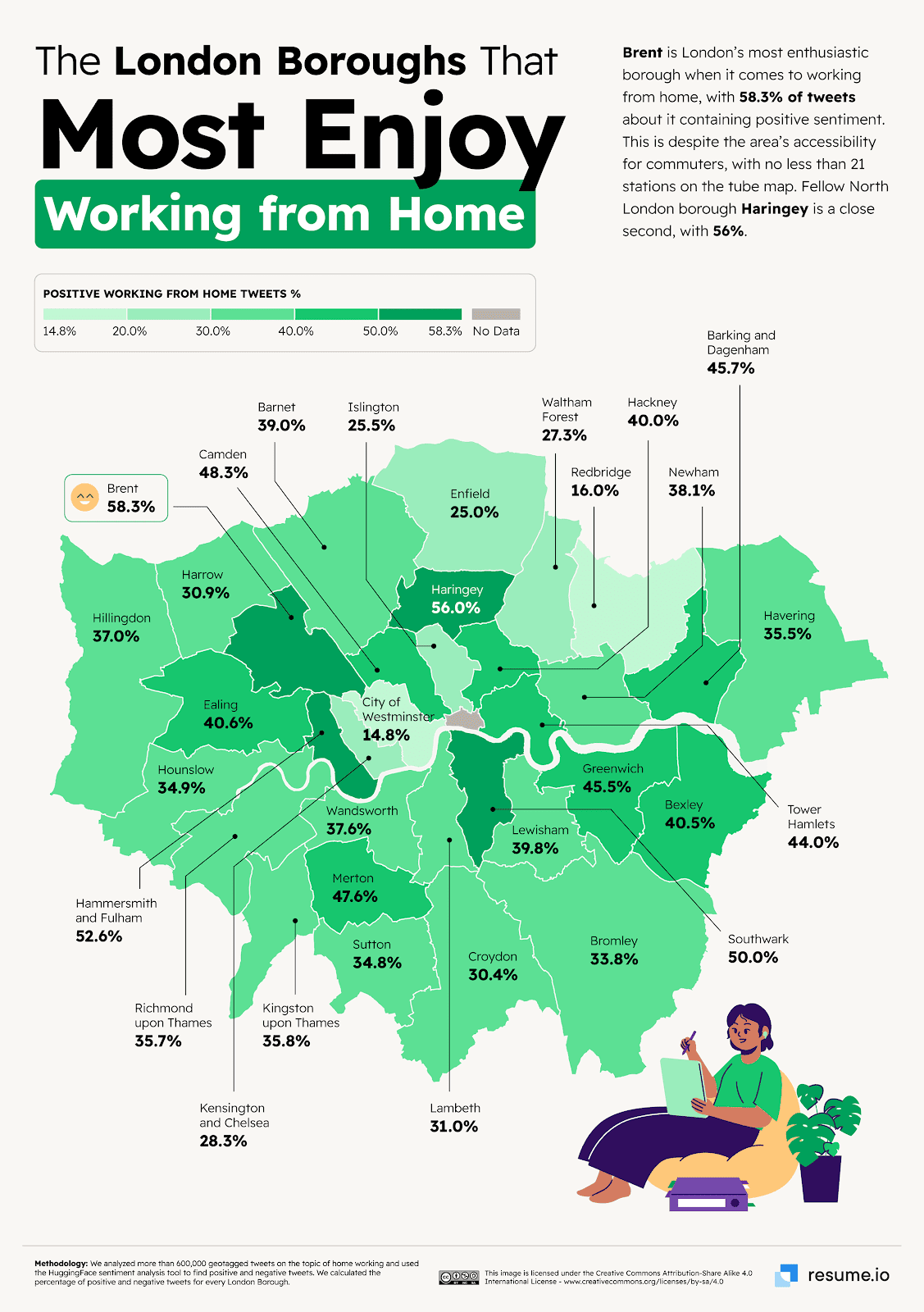
In the UK, Londoners are loving home working. Many of the capital city's boroughs scored above or close to 50%. Brent scored 58.3% - the highest proportion of positive home working tweets out of anywhere included in the study.

Other high-scoring boroughs include Haringey, Hammersmith, and Southwark.

The City of Westminster is London's big outlier. Just 14.8% of its remote working tweets were positive. The City of Westminster is home to the United Kingdom's Houses of Parliament and much of the British government, but it's unclear why the country's MPs hate remote work. Maybe you can't claim as many expenses when working from home? Just saying.

Which UK cities enjoy home working the most

You don't have to travel too far from London to find the UK city with the highest percentage of pro-home working tweets. Warford is around 20 miles from the capital and scored 54.9% in this study by Resume.IO.

And travel pains (or the lack of them) are probably why so many Watford residents appreciate hybrid working. Watford is right on the London commuter belt; it can take up to 90minutes to get into the capital during the morning rush hours.

Watford also has the most dangerous drivers in the UK, with 1 in 10 road users having points on their license. No wonder the city's residents are glad to be off those roads on a Monday morning or Friday afternoon.

In the North of England, two more commuter towns scored highly. They are Warrington, which sits between Manchester and Liverpool, and Huddersfield town, which is a popular location for office professionals who work (but don't want to live) in Leeds.

The tables below show a full breakdown of the remote-work Twitter sentiment in all UK and USA's major cities.
WFH Happiness: The US and UK cities that most enjoy working from home (study)
Read next: The 6 types of annoying co-workers. And how you can deal with them (infographic)
by Irfan Ahmad via Digital Information World

Apple’s Search Ads See Market Share Triple After ATT Update

The widely publicized update that came to Apple phones last year which toggled third party tracking off by default was met with criticism from some companies because of the fact that this is the sort of thing that could potentially end up hamstringing their business model. Meta was the most vocal critic citing how this tracking transparency feature could hurt small businesses, but in spite of the fact that this is the case it seems that their interests were focused solely on themselves.

With all of that having been said and now out of the way, it is important to note that Apple has also benefited from the rollout of this feature. The tech giant has seen its Search Ads product triple in its market share, becoming the single best media spruce for iOS devices with all things having been considered and taken into account. However, in the world of Android it appears that Google still reigns supreme, with Meta close at its heels.

Both Google as well as Android have seen their influence in the world of iOS diminish, although their performance on Android phones is seeing a bit of a recovery. Their performance is still lower than might have been the case otherwise had ATT not been launched, and the rise of TikTok to the number three spot will be a cause for alarm given that the app could overtake Meta at any moment.

With ad spends for app installs falling by 14% in the second quarter of 2022, app marketers are looking to put their money where it will be most effective. Apple’s App Tracking Transparency means that the company’s own search ads are the best option for iOS devices, and the popularity of its phones means that marketers will have to adjust to that as the new normal.

Apple’s self interest in this regard has not gone unnoticed, although the company claims that its motives were purely altruistic. However, it is highly unlikely that such an occurrence is coincidental or accidental. Meta and Google have been hit hard by Apple, and Meta might not be able to recover.


H/T: AppFlyer

Read next: Instagram Reels Provide Superior Engagement and Reach for Brands According to This Report
by Zia Muhammad via Digital Information World
Phishers Are Leveraging Google Translate to Steal User Data

Phishing attacks can be quite harmful because of the fact that this is the sort of thing that could potentially end up allowing log in credentials to fall into the wrong hands. Cybersecurity researchers are always on the lookout for new phishing attempts, and their studies have shown that phishers are new developing new and evolved techniques for stealing user data with all things having been considered and taken into account.

A new phishing campaign has just been discovered, and with all of that having been said and now out of the way it is important to note that it involves Google Translate. More specifically, phishing attackers have managed to successfully impersonate Google Translate so that their artificial log in pages seem more trustworthy than might have been the case otherwise.


Researchers noted a number of phishing emails that contained language that tried to convince users that they needed to log in with the given link otherwise they would lose access to their unread messages. Many of these emails were originally written in Spanish, and if a user clicks on the provided link they would be taken to a page that has a fake version of Google Translate that gives it a sense of legitimacy and lulls users into a fall sense of security.

Above the fake Google Translate box would be a field where users can enter their log in details. If the user were to enter their information into the blank field, this data will get sent to the hackers in question and they can then sell it on the Dark Web or choose to lock said user of their accounts.

Users need to be extremely vigilant if they want to avoid getting preyed on by such attacks. Any email that tries to get you to log in whilst threatening the loss of data is almost always going to be fraudulent in nature. Users also have to be educated about the dangers of phishing, because a lack of knowledge usually makes them unaware of the risks associated with opening links in emails that are from unknown or impersonated senders.

Read next: Password Thieves Are Detecting Body Heat to Track Keystrokes
by Zia Muhammad via Digital Information World

Apple's Mixed Reality Will Be Built From Aluminium And Will Have Iris Scanning And Several Cameras And Many More Exciting Features

News about Apple's reality headset is always the talk of the town and now we have received the latest update about some features this new headset will have. From what we know, this reality headset is going to have a powerful biometric authentication feature, a wonderful design, and many more exciting things. According to a source, Apple isn't making its things boring and its new mixed reality biometric authentication is proof of it. Users will be able to scan their iris to secure their devices. This will also be used to help users easily switch to another account or do Apple payments without having to enter a password. Not only this, the iris scanning feature will give users a better experience of seeing the screen. The images seen on Apple's reality headset will be of quality your eyes have never seen before.

Always in competition, Apple's Reality Headset is not anything like Meta's Quest Pro. Meta's headset also isn't anything far from extraordinary, but it is made from plastic. Not Apple's Mixed Reality Headset though. Always being special, Apple has made its headset from aluminum and plastic. This is the reason that the headset weighs almost nothing and also gives a premium feeling to anyone who will use it. Another thing about this headset is that its front area will be covered with a mesh fabric. This will give a unique look to the headset, one we have never seen from Apple before. The good news for people with prescription glasses is that Apple will allow the lenses to be used and they will automatically attach to the inside of the headset with a magnet.

Apple is all set to release this headset. Most people might be wondering about its cost and it is expected to be between $2000 to $3000. This headset also comes with a chip that is also used in Apple's latest MacBook laptops. Moreover, Apple will also do an external display that will show the experience of the user using the headset. We still do not know the exact date of the release of this exciting technology. But speculations are that it will be released in 2023. This will be a big step for Apple as this product is its first new product in a very long time.


Read next: 1 Out of 3 US Teens Now Own an Apple Watch According to This Report
by Arooj Ahmed via Digital Information World