Monday, October 31, 2022

This Study Shows the Severe Impact of Inflation on Global Consumers

Prices have been rising drastically over the course of this past year, and consumers are worried about it because of the fact that this is the sort of thing that could potentially end up making their income less valuable than might have been the case otherwise. First Insight has published a report that sheds some light on how inflation is impacting consumers in various markets, and it turns out that German consumers are the most fearful about how severe inflation might become in the future.

Around 86% of German consumers reported a lower than usual level of confidence with respect to spending and purchasing power. UK based consumes are also similarly unconfident with all things having been considered and taken into account, with a reported 83% of consumers feeling this way. With all of that having been said and now out of the way, it is important to note that American consumers are also feeling the burn, with 79% of them showing concerns about decreased purchasing power.

Other countries in Europe are reporting lower spending caused by inflation, with 84% in Spain and Italy saying the same. 67% of American consumers reported that their groceries are becoming too expensive, with 64% stating similar sentiments for gas prices

Interestingly, while 46% of German consumers and 43% of American consumers are feeling the sting of inflation while eating out, this number dropped to just 31% in France and the UK. This indicates that the inflation effects are not consistent across the board, with consumers in various countries feeling them in different areas.

US based consumers are using a variety of methods to combat the effects of inflation and reduce the financial burden. 40% are now trying to look for more discounts and deals while online shopping, and 42% are creating a budget and sticking to it. 29% of consumers have decided to cut their spending down to save money, and 22% are trying to buy items when they are out of season to take advantage of the lower price points with all things having been considered and taken into account.


Read next: The smartphone market was at its lowest in the third quarter due to the global economic crisis
by Zia Muhammad via Digital Information World

Elon Musk Goes Right To Work On First Day As Twitter’s Chief By Quietly Changing The App’s Homepage

It’s been less than a day since the news broke out about Elon Musk taking control of Twitter. But this billionaire means business and he has already decided to alter the platform’s homepage, as reported by TheVerge.

The Twitter Chief was seen issuing a new request for logged-out users on the app about how they needed to be redirected to a new page on Explore that displays all trending happenings like Tweets, stories, and more. These facts were detailed by employees that are familiar in regards to the matter.

In the past, any logged-out user visiting the website would show a signup form that promoted account creation so users could better view Tweets.

The instructions put out by Musk on Friday encouraged the likes of VP involvement that would override measures like code freeze that stopped staffers from making amendments while the process of acquisition occurred.

For now, Elon Musk is yet to shed light on details as to why the change is taking place as a few employees have observed it so far. But it’s quite clear what message was being rolled out and that’s related to how there’s no room for sacred crows anymore.

If this was the old Twitter, decisions like this would be argued over with various teams for a while now. However, this is the new world of Twitter and Musk wants everyone to know that.

So three days into his reign and Twitter’s homepage is getting changed already. So he wants changes and he wants them quick. And while he may be starting his plans for planned layoffs and creating new oversight boards to better the entire content moderation policy, one thing is for sure. He knows the direction he wants to head in.

While he wants to lay off a huge portion of employees in the next few days, the changes are being fast-tracked to the app. There is some major news about Twitter now forcing subscribers to pay a subscription fee called Super Follows and which would now be labeled as Subscriptions.

Then there are some plans to utilize Starlink which is the billionaire’s internet service at the company SpaceX. This would allow the app to be easily accessible in nations that are having trouble accessing the platform.

Those members of the Twitter workforce that were given the task of working with Musk are now being forced to go home late and sacrifice weekends to make a list comprising team members that need to be fired.

The whole reason is to prevent the firm from paying out millions in stock which would be given to them. Hence, that’s why Musk has fired the executives for the cause.

Some major layoffs are predicted to occur before the first of November and there’s a huge percentage of people who are expected to get stock grants. While Musk fails to acknowledge all of this news regarding firing employees, it is definitely a thing people are preparing for.

For help, Musk is placing great reliance on his personal inner circle. He feels who better to make him understand than them. We just hope he makes the right decision because getting rid of top executives in a firm like this can be risky.


Read next: Elon Musk Cannot Reverse Any Twitter Account Bans Without Approval From Content Moderation Council
by Dr. Hura Anwar via Digital Information World

Here’s What Consumers Are Expecting From Retailers This Year

Consumer sentiment has been diminished due to rising inflationary pressures, but in spite of the fact that this is the case retailers are still hopeful that they can make adjustments to meet their needs and drive a solid rate of sales in the coming year. Emailed offers have been seen as more appealing by consumers according to surveys, with 19% of them preferring email offers this year as compared to 10% saying the same last year with all things having been considered and taken into account.

This doubling of preference when it comes to emails is interesting because of the fact that this is the sort of thing that could potentially end up modifying retailer strategies moving forward. With all of that having been said and now out of the way, it is important to note that social media has managed to surpass emails in terms of popularity, with 21% of consumers saying that they prefer it.

Cost is still a big factor at play here, with 47% of consumers saying that they want lower costs to entice them into becoming buyers. 77% of these consumers have already started shopping around for the best offers, and retailers who are willing to meet them halfway might see a higher rate of sales than might have been the case otherwise.

Payment plans and financing that allow consumers to make purchases and pay for them in instalments are preferred by 71% of consumers, although 25% admitted that they had never used a plan like this before. 73% of consumers also stated that they will be focusing more on budget brands, and these brands may be able to generate a higher sale volume due to their organically lower price points.

A lack of money is a major concern for consumers this year, with 34% fearing that they might run out of money before they get all of their buying done. 36% also spoke out about fears that their favorite gift items would be more expensive this year which might make them financially unviable, and it remains to be seen if the holiday shopping season would go smoothly.


H/T: Oracle Study.

Read next: The ransomware attack is growing increasingly these past few years
by Zia Muhammad via Digital Information World

90% of Workers Reuse Passwords Despite Security Protocols

Workplace accounts that get compromised by malicious actors can be dangerous because of the fact that this is the sort of thing that could potentially end up allowing these hackers to gain access to a company’s wider system. Reusing old passwords repeatedly can make it easier for accounts to get compromised, but in spite of the fact that this is the case around 90% of workers admitted that they have reused account passwords in the past.

This comes from a report released by Bitwarden that involved a survey of 800 top level IT professionals in the UK as well as the US. With all of that having been said and now out of the way, it is important to note that 84% of the people who responded to this survey said that they use a password manager, but there are quite a few insecure methods that are still being used. 54% of people store their passwords on documents on their systems, and 45% try to remember them by memorizing them which can make their systems far less secure than might have been the case otherwise.

The sharing of passwords is necessary for most companies so that workers can collaborate and use shared accounts, but the means by which these passwords are shared are highly risky. 41% of people apparently send each other account passwords through emails, and 38% use shared online documents that contain the passwords. These modes of password sharing can be easily intercepted by malicious actors, and they can put a company’s sensitive data and IP at risk.

There is good news to glean from this report as well, including that the number of people using multi factor authentication has increased to 92% from 88% last year. Password hygiene is a real problem in workplace culture, with some mistakes including the use of overly simple passwords such as numerical sequences or common phrases. Using the same password across numerous accounts is also a big mistake, as is sharing these passwords with people who don’t need to access the accounts such as friends or members of one’s family.
Read next: What Brand Gets Impersonated the Most During Phishing Attacks? The Answer Might Surprise You
by Zia Muhammad via Digital Information World

Video Call setups creating delays in businesses meeting

The pandemic has brought many people to its knees and created hurly-burly in the daily lives of business people. People have started taking different approaches after the remote working scenarios, and one of the few changes is turning up to video calls. To attend an important meeting with clients abroad, one needs to have a faster internet connection and good video quality.

The lag in connecting video calls has taken more time than expected, and many have agreed that this could be a deal breaker. A recent study by MAXHUB concluded that more than 2,000 Britons faced an issue regarding video calls. 59% of people take approximately ten minutes to set up a video meeting call.

Let’s suppose an average person connects with his employees through video calls every week, and it takes up to 200 minutes per month to connect conference calls with them. Overall if we see the results of lagging video calls, it seems that they lose forty hours a year. 34% of workers said they deal with the issue of poor connection to video calls every day.

Moreover, there has been a contrast between younger users and adult users, and it seems that young workers take less time to connect to video calls as compared to adults. 78% of people between the ages 18 to 24 need only ten minutes to connect the call in contrast with the 55 to 64 years old people. The problem doesn’t lie in technological deprivation, but it could be the case that younger users are more conscientious when it comes to technology, whereas adults face issues connecting to the calls.

The majority of employees, according to the study, are dissatisfied with the audiovisual calls setup. 28% claim that they are not provided with the appropriate tools for working under pressure. 23%, on the other hand, claim that this is a deal breaker for us because tech giants are failing to address their difficulty connecting with remote employees.

Additionally, 54% of respondents said that not having the right tools would be a problem when starting a new job, especially for those between the ages of 18 and 24, whereas 74% said that it would create complications for them later in life.

The new epoch enables people to connect with each other more easily, but the study says otherwise. According to Tony McCool of MAXHUB, businesses have suffered as a result of remote employees and flexible working arrangements since the pandemic. But the problem lies with the company not fixing the issue of lagging video calls. During this rapidly changing environment, companies need to work fleetingly to improve the quality of video calls.

Furthermore, MAXHUB asserted that a lack of sufficient technology for hybrid working is hindering workplace collaboration. Because people are more comfortable dealing with remote and in-office employees in person rather than choosing a platform where they have to wait for another person to get a stable connection on their video calls.

MAXHUB showed additional research on the technology behind video conferencing and found that comfort is the top priority for 48% of people. Additionally, 37% of respondents stated that successful hybrid work requires immediate meetings that begin without interruptions from technology. For meeting clarity, a good microphone was also rated as essential 37% of the time.


Read next: How to have fewer (and better) work meetings
by Arooj Ahmed via Digital Information World

Sunday, October 30, 2022

Over 155K Minecraft Players Get Infected With Malware

The rate of growth of the gaming industry has spurred many cyber attackers to use these games as a platform for launching malware campaigns, and it turns out that Minecraft is one of their most popular choices with all things having been considered and taken into account. Over 131,000 Minecraft users on PC were infected with malware, and 26,000 mobile users were also infected which brings the total number of Minecraft players who were attacked by malware past the 150,000 mark.

With all of that having been said and now out of the way, it is important to note that malicious actors seem to be disproportionately targeting players who prefer Minecraft. The second highest number of malware infections belonged to Roblox with just under 39,000, so Minecraft users are over four times likelier to get infected by malware than Roblox players.

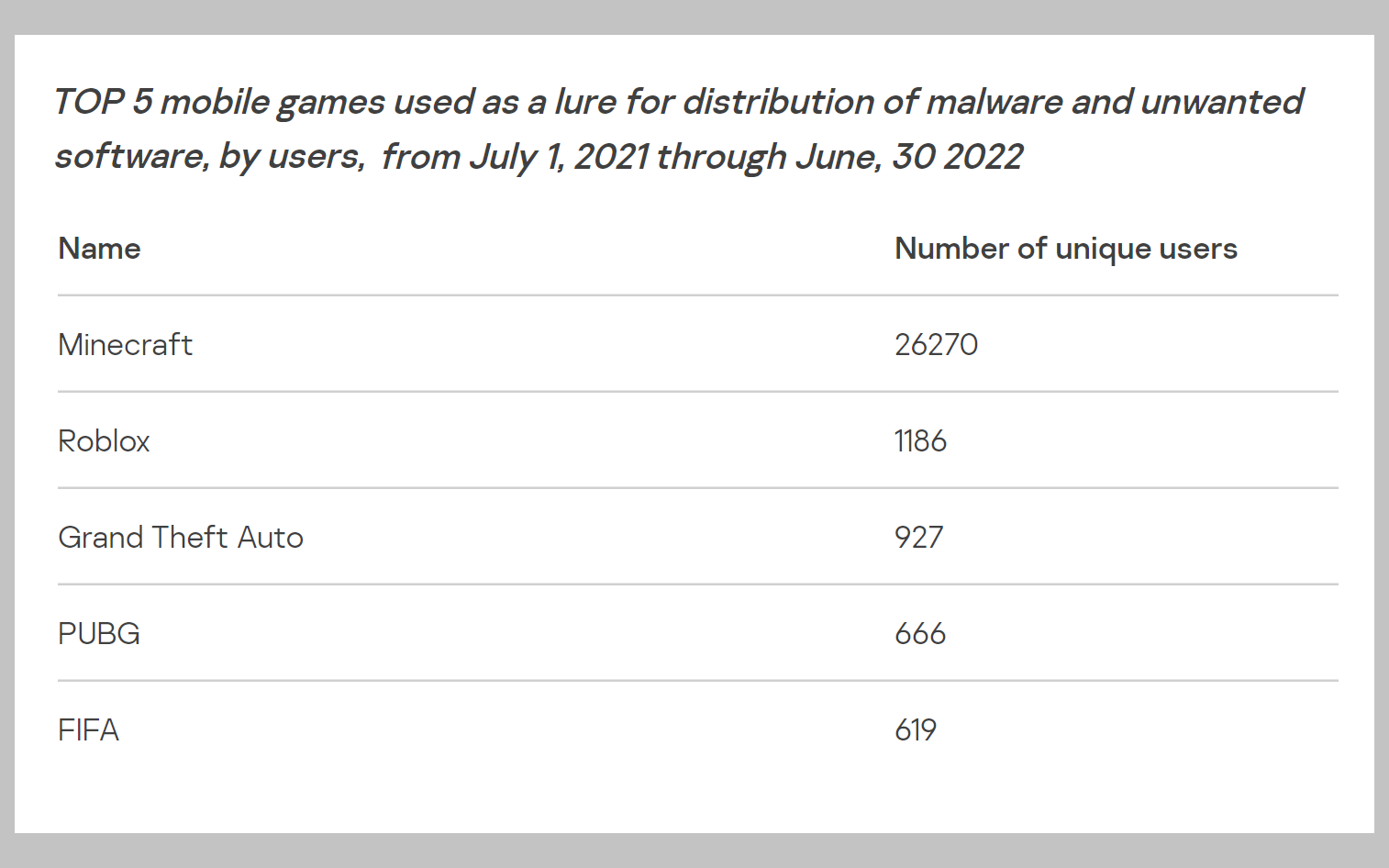
In the world of mobile gaming this disparity is even more pronounced. Roblox came in second again, but with only 1,186 infections reported so far. That is only a small fraction of the 26,000 Minecraft players who had malware infiltrate their systems which suggests that playing Minecraft could expose a user to far more cyber attacks than might have been the case otherwise.

Around 90% of the total malware infections seen in mobile games went to Minecraft users, and 76% of all the malware was from the notorious RedLine Stealer malware family. It works by stealing browser data and skimming passwords because of the fact that this is the sort of thing that could potentially end up allowing malicious actors to lock users out of their own accounts.

It should be mentioned that the downloading of so called cracked games might be contributing to this trend. These games are free since they can be downloaded through piracy, and the people who are offering these free downloads often include malware in the source code. This can allow malicious actors to spy on users without them realizing it, and if users started using 2FA more frequently such forms of malware might become less useful to cyber attackers and hackers in the future.


H/T: Securelist

Read next: The smartphone market was at its lowest in the third quarter due to the global economic crisis
by Zia Muhammad via Digital Information World

How a NextGen SIEM Platform Supports Fledgling Digital Transformation Efforts

While there are no recent surveys on how many organizations are yet to embrace digital technologies, it is safe to say that a majority of companies are pushing efforts toward digital transformation. According to a survey by Gartner, 91 percent of businesses are engaged in some form of digital initiative, with 87 percent of senior business leaders saying that digitalization is a priority.

It won’t be a stretch to presume that ten to thirty percent of organizations are still far from having full-on digital transformation efforts. Some may already be on the way but are still figuring things out, too inexperienced to get things done efficiently.


To make matters worse, there’s the problem of cyber threats. Being new to the digital world does not excuse anyone from hacking and other cyberattacks. Digital transformation is essential in the modern way of doing things, and it should come with meaningful efforts to address risks and threats.

NextGen SIEM

SIEM is an acronym for security information and event management. As the phrase suggests, it is about managing security information and incidents. It deals with security alerts, notifications, and other data as well as the corresponding responses to this information, especially when security events such as data breaches and malware infections are detected.

NextGen SIEM is the progression of a SIEM platform (a conventional one, that is) into a system that is more capable of handling the more aggressive and complex cyberattacks at present. It usually entails the use of artificial intelligence, automation, and an emphasis on greater effectiveness and efficiency.

A NextGen SIEM platform typically consolidates multiple security tools under a comprehensive interface that significantly simplifies operations and makes processes more efficient while reducing the overall costs of cyber defense activities. These consolidated tools include user entity and behavior analytics (UEBA), threat intelligence platform (TIP), and network detection and response (NDR).

Next-generation SIEM brings together various advanced security technologies to ensure better protection. It provides machine learning correlation, flexible data sourcing, and sensor-driven data collection. Additionally, it enables multi-modal threat detection, purpose-built data normalization and enrichment, deterministic incident response, and automated threat hunting.

These details may already sound technical and intimidating, but they are a part of the necessary difficulties organizations should face. Even those that are having their initial dip into digital transformation must be aware of the threats and the suitable solutions. NextGen SIEM is of particular interest because of its role in addressing the latest attacks, especially in optimizing existing security solutions.

NextGen SIEM in new digital transformation

Why should organizations that are still familiarizing themselves with buzzwords like business process automation and low-code/no-code apps care about NextGen SIEM? The answer is simple: because it is one of the best ways they can protect themselves, especially as they are likely using a slew of security tools as part of their cybersecurity efforts.

While Anton Chuvakin of Gartner, the organization that introduced SIEM, submits that SIEM is not the best threat detection technology there is, he opines that it is "indeed the best beginner threat detection." The log-centric nature of SIEM makes it easy for organizations with minimal experience in comprehensive cybersecurity to undertake sensible and efficient security monitoring.

So why not conventional SIEM? Why the need for the next-gen iteration? It’s because legacy SIEM is quickly losing its effectiveness in dealing with threats as threat actors become more aggressive and sophisticated. The technology has been updated to keep up with the worsening threats modern organizations are facing.

The main benefits of NextGen SIEM can be summed up as follows:
  • Meeting security and regulatory compliance requirements without the need for additional resources
  • Automated identification of crucial threats resulting in more efficient threat detection and response
  • Rapid deployment and scalability

Compliance

Compliance is one of the major points many organizations that are new to digital transformation fail to take into account. They try to make the most out of their digital tools and connectivity without realizing that there are rules to follow. Data privacy regulations like the General Data Protection Regulation (GDPR) and Healthcare Insurance Portability and Accountability Act (HIPAA) can spell serious problems to organizations that become unwitting violators.

IBM says that “SIEM solutions are a popular choice for organizations subject to different forms of regulatory compliance.“ SIEM is designed to automate data collection and analysis, making it a valuable tool for the collection and verification of compliance data throughout an organization. SIEM platforms, especially the NextGen iterations, can produce real-time compliance reports for HIPPA, GDPR, SOX, and PCI-DSS compliance.

Efficient threat detection and response

Next-generation SIEM offers a multitude of features and functions that make it easier and faster to detect and stop threats. For one, it supports flexible data sourcing, wherein security data from various existing security tools are consolidated to achieve broad security visibility. This can be done automatically with the help of sensor-driven data collection and purpose-built data normalization and enrichment. Hence it significantly reduces the burden on cybersecurity teams.

In addition, it harnesses machine learning correlation to contextualize data and achieve more accurate assessments. NextGen SIEM also provides multi-modal threat detection that employs supervised and unsupervised machine learning and AI-driven threat hunting. It can also implement deterministic incident response through predefined response actions or customizable threat response playbooks.

These functions have significant contributions toward the goal of becoming highly efficient in detecting and responding to threats. Organizations that have only started fully digitalizing understandably have very lean cybersecurity teams. Some do not even have one. The availability of NextGen SIEM is a boon for these organizations.

Scalability and rapid deployment

Moreover, NextGen SIEM is designed to be highly scalable and easy to deploy. Organizations do not need to adopt a system with a fixed set of features and functions to address specific situations. Instead, they get to choose what security tools to have or integrate into the SIEM platform depending on their needs. They can also decide to go cloud-scale and work with Big Data once they are ready for these advanced technologies.

SIEM is also suitable for multi-tier, multi-tenant, and multi-site setups. This enables organizations to deploy the platform and their data anywhere, be it on-premise, in the cloud, or under a hybrid arrangement. It also supports the setting of granular access controls and custom tenant structures to match specific needs.

Organizations that have only recently undertaken significant digital transformation tend to be the ones that seek to expand and operate agilely. As such, they require a platform or solution that affords them the scalability and rapid deployability they require.

In conclusion

Digital transformation guarantees that organizations will significantly expand their cyber-attack surfaces. At the same time, it shoves organizations into unfamiliar territory, especially when it comes to cyber threats. Unfortunately, most organizations do not have the resources to operate cybersecurity teams with the most proficient members and access to the best security products.

NextGen SIEM offers an excellent solution for fledgling digital transformation programs, most of which are likely unprepared for the overwhelming cybersecurity challenges. It addresses three vital aspects, namely regulatory compliance, effectiveness and efficiency, and rapid deployment and scalability.

Image: freepik/rawpixel
by Web Desk via Digital Information World