Wednesday, November 9, 2022

Meta Goes Public With Its Efforts To Tackle Climate Change

This week the world’s leading COP27 summit was held and so many representatives from different nations took part to talk about the growing concerns of climate change.

All world leaders sat down and put their heads together for one cause and that was tackling the crisis on a global level and how its current impacts could be reduced as we move forward.

Meta chose to rise to the occasion and take advantage of this crucial timing by setting a leading example of its own efforts to fight against climate change. A number of offerings were put on display and we have to give Facebook’s parent firm credit for really stepping up to the plate.

So far, Meta has really taken a lot of action in terms of providing the right forms of climate information on its apps. This includes any measures implemented to be as carbon-neutral as possible by the year 2030.

For starters, the company has put forward its own page regarding climate overview. This highlights all sorts of climate change moves it has made in a single place.

You can find all kinds of details like misinformation policies regarding climate change and tools with adequate resources that really put the topic of climate change in the spotlight. In the same way, Meta was seen expanding its own Climate Science Center to various regions and there is information now present in at least 165 different countries.

The tech giant would now be expanding its own Climate Inform Labels that provide greater context regarding climate change on its app and stream with other tools like Climate InfoFinders.

The latter is another name for a reliable source for users on the Facebook app that may be in search of data regarding climate change. Links would then be provided to such in the comments section.

There is also a Climate Science Literacy Initiative that removes misinformation on climate change by putting informational elements on display. It highlights five techniques that many uses to misrepresent the topic so others can be well aware of what’s going on.

Meanwhile, another new feature called Climate Pledge would be incorporated into Facebook Groups to engage audiences and spark chats to make people understand the actions being taken. In this way, the admins of such groups would be the ones selecting solutions that pertain to their particular area or community.


As far as Meta is concerned, this is definitely one positive step forward in the right direction. Tackling misinformation alone in this regard can really alter people’s opinions or perspectives regarding climate science. This would end up resulting in more calls for action globally on leading issues.

Considering the alarming rate at which global climate change is taking place and the great devastation that has already occurred, it’s high time that we understand the reality of the situation and act before it’s too late.

Even if everyone begins contributing a little in terms of recycling or even reducing waste and carbon footprints, we could all be in a better space altogether.

Read next: Over-apologizing can lead to low self-esteem and should be avoided
by Dr. Hura Anwar via Digital Information World

Tuesday, November 8, 2022

Who Makes The Most Use of Wearable Health Devices?

Nowadays, people use advanced health devices to keep on updated with their health conditions. Many of them just use them without any concern but, on the other hand, 80% of them are conscious about acknowledging their health issues and desperate to overcome them.

To find out the ratio between people in the U.S. who use any kind of wearable health device due to the imminence of cardiovascular diseases to those who are not dependent on them, a survey of health information was conducted titled "Health Information National Trends Survey" (HINTS) and the report was sent to an American Scientific Session of 2022.

According to the report, there are some factors due to which people are incapable to use health wearables; the major factor is their age, then comes their education (many people are unknown of the significance of these tiny gadgets with a lot of benefits) and the third one is their monthly income (as some people could barely afford living and are having families at their back to raise). If these factors fall in the favor of people, their urge to use health devices could be fulfilled and they could easily be able to purchase wearable health devices as safety measures for the betterment of their health.
"An estimated 3.6 million people with cardiovascular disease and 34.4 million people at risk of cardiovascular disease in the U.S. used wearables. That translates to only 18% of all people with cardiovascular disease, and 26% of all people at risk for cardiovascular disease. In comparison, 29% of the total adult U.S. population used wearable devices."

The study further explains the advantages of the devices for instance; wristwatches and fitness bands are helpful for a person in; self-monitoring, measuring blood pressure, sugar, and cholesterol levels and with the assistance of health wearables, the root of the disease can be detected. In accordance, an individual could ask doctors freely for a cure as he or she would be aware of his or her cardiovascular illness. The pieces of advice from an expert can help to resolve drastic health casualties.

According to the researchers of HINT, there should be an accessible distribution of wearable health devices for people who could not afford them and are extremely needy. In this regard, a proper funding system should be introduced officially, so that every individual from the lower level to big organizations and corporations from the upper level could contribute to this cause.

A nation is an asset of any state or country and it is the responsibility of the state’s government to provide quality health to its people by arranging good health-maintaining awareness programs and establishing fundraising campaigns for the distribution of worthy health devices among the deserved ones. Cardiovascular diseases are common all around the world without any boundary of age class, color, gender, or religion. Other key stats from the study includes:
"Only 12% of people with cardiovascular disease older than 65 years of age used wearable devices, even though it is estimated half of all people with cardiovascular disease are older than age 65. In comparison, 17% of people with cardiovascular disease ages 50 to 64 years reported using wearables, and 33% of those in the 18 to 49-year age group with diagnosed cardiovascular disease used wearables. While 22% of all people at risk of heart disease are 65 years or older, only 14% of elderly patients at risk of heart disease used wearable devices."

Read next: For half of Americans, Wi-Fi and electronics are now essential for living
by Arooj Ahmed via Digital Information World

Over-apologizing can lead to low self-esteem and should be avoided

Accepting mistakes and saying "I am sorry" is a good gesture, but not every situation requires an apology. Sometimes apologizing in situations that don’t need anyone to say anything can backfire in professional settings. Those who over-apologize can end up with low self-esteem as it makes the other person look down on them.

According to Patrice William Lindo, Chief Executive Officer at Career Nomad, such gestures arise from people having insecurity, which is quite common for black women. Lindo added that such people are brought up traditionally by believing that they should always be down to earth, as being the opposite and highlighting the things they have achieved can cause problems for them.

Lindo further added that when someone has doubts about themselves, this is where such habits originate. The best way to deal with the situation is to use alternative statements instead of saying, "I am sorry."

For example, over the last two years, online video sessions have become more frequent as things shift online. At a time like this, technical difficulties seem to occur more often. Network issues or technical glitches can hinder the meeting. The silence followed by technical difficulties make it difficult for some people to stand, and they may end up apologizing for things that are out of their control. In such circumstances, instead of saying “I am sorry,” the user can say “Thank you for your patience,” which can also help to overcome the prevailing awkwardness in such conditions while maintaining confidence.

Similarly, if someone wants to join an ongoing discussion, they’d normally say, “Sorry, but I’d like to add." This is not a situation that requires an apology, especially if the person who wants to contribute has impactful things to add to the discussion.

Instead of apologizing, they can go in by using an alternative statement starting with “I would love to add” or “I believe." Wordings like these give confidence to the person instead of scaring them.

While the above two scenarios are for someone who wasn’t at fault and still apologized, what if the other person made an error? Mistakes are common and can happen to anyone. Saying “I’m sorry” can work but won’t be the best response; instead, accepting the mistake and telling them that they’ll take action to resolve it would be more effective.

According to Lindo, apologizing is not a bad gesture, but it should only be done under appropriate circumstances.

H/T: Heathermonahan / Pinterest
Read next: 66% of Americans Prefer Buying From Real People Instead of AI
by Arooj Ahmed via Digital Information World

The major UK and US cities where people love (and hate) hybrid working [Infographic]

Hybrid working might not be the new normal, but it's certainly a big part of it. Two years after the Covid-19 lockdowns, around 24% of UK employees are still working from home for at least one day a week.

That figure is even larger across the pond. Nearly six out of 10 (58%) of 'white-collar' workers in the US operate on a hybrid working model, with the average worker spending three to four days in the office.

And hybrid working isn't a passing fad. 78% of US firms have (or are planning to adopt) a hybrid working model, and the number of people working from home in the UK has continued to rise through 2022.

And hybrid working is working out pretty well for businesses. A survey by banking giant HSBC found that 77% of companies reported higher productivity levels after switching to a hybrid model. And a similar proportion (66%) believe it helps attract more talent and expand into new markets.

But what do the people doing hybrid work think about hybrid work?

Infographic: Where hybrid work causes the most stress (and how to manage it)

Business solutions provider Brother.co.uk used Twitter to find out. Its researchers ran thousands of geotagged tweets through an AI-powered sentiment tracking software to pinpoint the locations where people love hybrid working - and where they absolutely hate it.

Find out where they are in the maps below.

But first, let's look at what the switch to hybrid working means for businesses and workers.

What do workers think of hybrid working?

Generally speaking, people have embraced the opportunity to work from home for a few days per week. In fact, many shudder at the thought of returning to the 5-day week, 9 to 5, office life.

Overall, people feel better when they have more control over their day. Numerous studies have shown that working hybrid improves work/life balance, reduces the risk of professional burnout, and cuts work-related stress by up to 50%.

According to research by Gallup, over half (53%) of employees now expect hybrid working options, while 24% expect a chance to work from home exclusively.

The downsides of hybrid working

But it’s not for everybody.

Working from home doesn't suit those office extroverts who thrive off other people's energy.

It can also exacerbate feelings of loneliness and anxiety for workers experiencing mental health issues.

Others simply struggle to stay motivated.

And some home workers have more practical concerns, like living in shared accommodation or a rage-inducing poor Wi-Fi connection.

Hybrid working in the UK

Infographic: Where hybrid work causes the most stress (and how to manage it)

Bolton is the UK's most anti-hybrid working city. Over one in three (35.5%) related tweets geotagged in Bolton had a stressful sentiment.

And it's probably because of the Wi-Fi.

The Northern city is notorious for its lack of 21st-century digital infrastructure. Broken connections, slow download times, and glitchy Zoom calls are a daily struggle for Bolton's remote workers.

Hybrid working in the UK's capital

In London, nearly half of hybrid workers living in the borough of Lambeth would much prefer to be in the office. More than 4 out of 10 (42.9%) of its related tweets expressed stressful sentiments; that's the highest percentage coming out of anywhere included in the entire study.


One of the world's most pro-hybrid-working locations is also in the UK's capital. It's Chelsea; only 6.9% of related tweets sent in this borough were negative. But life in Chelsea is always pretty sweet. Chelsea is the "richest" local authority area in the UK, with residents earning three times the national average. The average house price is over $2.5million.

Hybrid working in the US states

Spare a thought for all the Alaskans working from home right now. Because many of them are having (another) bad day. 31.3% of related tweets in the Last Frontier state have nothing good to say about hybrid work.


It’s a very different story in Hawaii. Most Haiwanians love remote work. Only 16.4% of their related tweets expressed stressful sentiments about the hybrid model. Then again, it's hard to stay stressed when you live in a state with over 250 days of sunshine every year.

Sitting in the back garden with a fresh coffee while 'tidying up' your emails on a Monday morning? Yes, please.

Hybrid working in US cities

Oakland is the US city with the highest proportion of stressful-sounding hybrid work tweets (31%).

Memphis comes next (30.3%), followed by Washington (27.1%), Mesa (26.9%), and Detroit (26.6%.)


The folk of El Paso, Texas, are pure chill when it comes to working from home. Only 6.7% of their tweets complain about the stresses of hybrid work.

The people of Bakersfield and Indianapolis have a similar outlook. In both cases, less than 15% of relevant tweets from these cities included anything about being annoyed, frustrated, or stressed by hybrid work.

Tips for building the perfect hybrid working model

So what can companies do to help all their employees feel more engaged when working from home?

Brother.co.uk put together 7 tips for creating a stress-free hybrid-working working model. They include:

● Encouraging workers to invest in a dedicated home-working space, including ergonomic chairs and height-adjustable desks.

● Working off digital collaboration tools like Slack or Monday

● Virtual break-out spaces where employees can connect and relax (and maybe even share a little bit of virtual office gossip.)

● Ditching KPI tracking and measuring outcomes instead ● Frequent check-in calls or messages

● Providing flexi-time options

● Drafting a company hybrid working policy that everyone can follow

The major UK and US cities where people love (and hate) hybrid working

Hybrid working is here to stay. So it's up to companies and employers to find ways of making hybrid working ‘work' for everyone.

Read next: Top 10 workplace apps with the most confusing features
by Irfan Ahmad via Digital Information World

Instagram Launches Scheduling Posts For Professional Accounts And New Age Verification Tools

Instagram has launched its much-awaited scheduling post feature for professional accounts. The news comes after it experimented with a few selected individuals in the past several weeks.

The test went as planned and now, all professional accounts on the platform can benefit from it.

As can be witnessed in this particular overview, the app’s post-scheduling feature will allow users to put up images, Reels, and even carousels directly through the app, nearly 75 days ahead.

Instagram even put out a few basic steps that need to be followed for Reel scheduling.


This can be done easily by clicking on Advanced Settings, moments before the post is shared. And then simply press schedule the post. The time and date would be according to your personal preference that you wish to include. And the final step is pressing on post composer.

As mentioned, Instagram has been running trials over the past several weeks and we saw live posts being outlined last month with this feature.

While we do believe it’s not adding a whole lot of new options functionally since the same commands could be done via the app’s Creator Studio, it is going to be great for those who wish to schedule on the go. Let’s not forget you can even schedule your Reels to maximize content performance.

Depending on Instagram’s texting, it would only be up for grabs for Professional Accounts right now. But if you’d like to switch to a professional layout on the app by altering your option in the account settings, you can really do that.

Next up, the app is introducing more age verification tools for users in the United Kingdom and EU. The news comes as it’s a part of a huge safety update to help keep kids safe.

Instagram mentioned how anybody that tries to change their birthdate from below 18 to over 18 would now need to verify their age through a proper ID or a video selfie. This could be examined through technology used for age estimation.


Instagram says this new update could pave the way for an experience that was more age-appropriate. And it’s about time that this took place as campaigners for cyber safety were rooting for child protection after an inquest took place that ended last month.

This was linked to an incident where a 14-year-old ended up taking her life after getting exposed to the harmful side linked to online content.

Therefore, now, the app would be linked with a UK-based tech firm called Yoti to pave the way, for a new system that estimates age. Once a user is seen recording a selfie that gets shared with Yoti for analysis of their facial features, there would be an estimate of the age of a user. This would be sent directly to the app, it went on to reveal.

New research conducted by Ofcom spoke about how so many people below the age of 18 were setting up accounts belonging to adults. It’s important that this app takes out the needed steps to make sure kids aren’t at risk of being harmed or exposed to any risk, the research adds.

But at the same time, there is still major concern about how such measures will do little to nothing in terms of stopping young users from making adult accounts on the app or even guarding kids that are currently using them.

Meanwhile, a lot of push is being added to things like a new Online Safety Bill that ensures all social media sites have a legal obligation to help keep kids protected from harm on the platform.

Read next: After Twitter, Meta Gears Up For Major Layoffs That Could Affect Thousands Of Employees
by Dr. Hura Anwar via Digital Information World

Stress-free day could be helpful for Mental Health

In today's world, having a stress-free day and taking good care of one's mental health are critical to survival. Americans, in particular, would give anything to have a stress-free day once in their hectic lives. The purpose of the examination was to determine the number of people who would go to any lengths to have a stress-free day.

According to the survey, 2,000 young adults have trouble recalling the last time they took time for themselves. They don't even remember doing the housework because the workload was too much for them. In addition, when they do have time to relax, 20% of them avoid doing housework like vacuuming and laundry. If it relieves some of their stress, others have agreed to give up sex (26 percent), their entire paycheck (28 percent), and not working for a day.

The issue was highlighted during a survey conducted by OnePoll, commissioned by Noom. The study found that 83% of people would prefer to prioritize their mental health more because it will help them in numerous ways.


Taking mental health seriously should be the priority of everyone. As it not only helps you balance your work but also keeps the balance in your personal life. 81% believe that they are satisfied with their current state of mind, whereas 65% gave only the thought of amending their health but did not take any steps.

The more we talk about the issue, the more people will come up with their life stories to inspire others to take better care of their mental health. The survey noted that by discussing the issue among people, 66% were motivated to take crucial steps toward their health.

Most of us have experienced breakdown issues due to the separation from loved ones (39%), breakups (33), moving to another city (38%), experiencing stress at work (47%), weight gain (29%), anxiety (29%), depression (25%), and loss of a dear one (22%). To deal with melancholy, one has to step show up to a community where they provide an environment to talk about your stress.

In addition, people are more likely to attend a talk if they see that other people's mental health has improved and the mental health community has had an impact on them. As a result, people frequently learn from their surroundings and become motivated when they observe how their mental health affects others.

People start prioritizing their health after seeing a companion taking care of their mental health (53%) and discussing it with a close family person (46%), whereas 24% of people feel no energy to take care of themselves.

Give them accurate information to make them more concerned about their mental health. You might be taking a lot of stress and not talking about it with friends and family, which could be the cause of lethargy.

According to Andreas Michaelides, Ph.D., going to the doctor requires a sign of great courage, and one must be motivated by multiple sources to do so. People take influence from their surroundings, and they make decisions based on the motivators around them. In addition, 42% of people would prefer that their employers provide benefits for mental health and health insurance.

In addition, 71% of people feel at ease sharing their problems and talking about their mental illness with a trusted person. However, 81% of respondents stated that they now monitor their mental health. It's critical to keep an eye on your health and share your feelings with trusted family and friends. Be surrounded by people who have the same objective as you do.


Read next: Smartwatch readings are not nearly as accurate as we think them to be
by Arooj Ahmed via Digital Information World

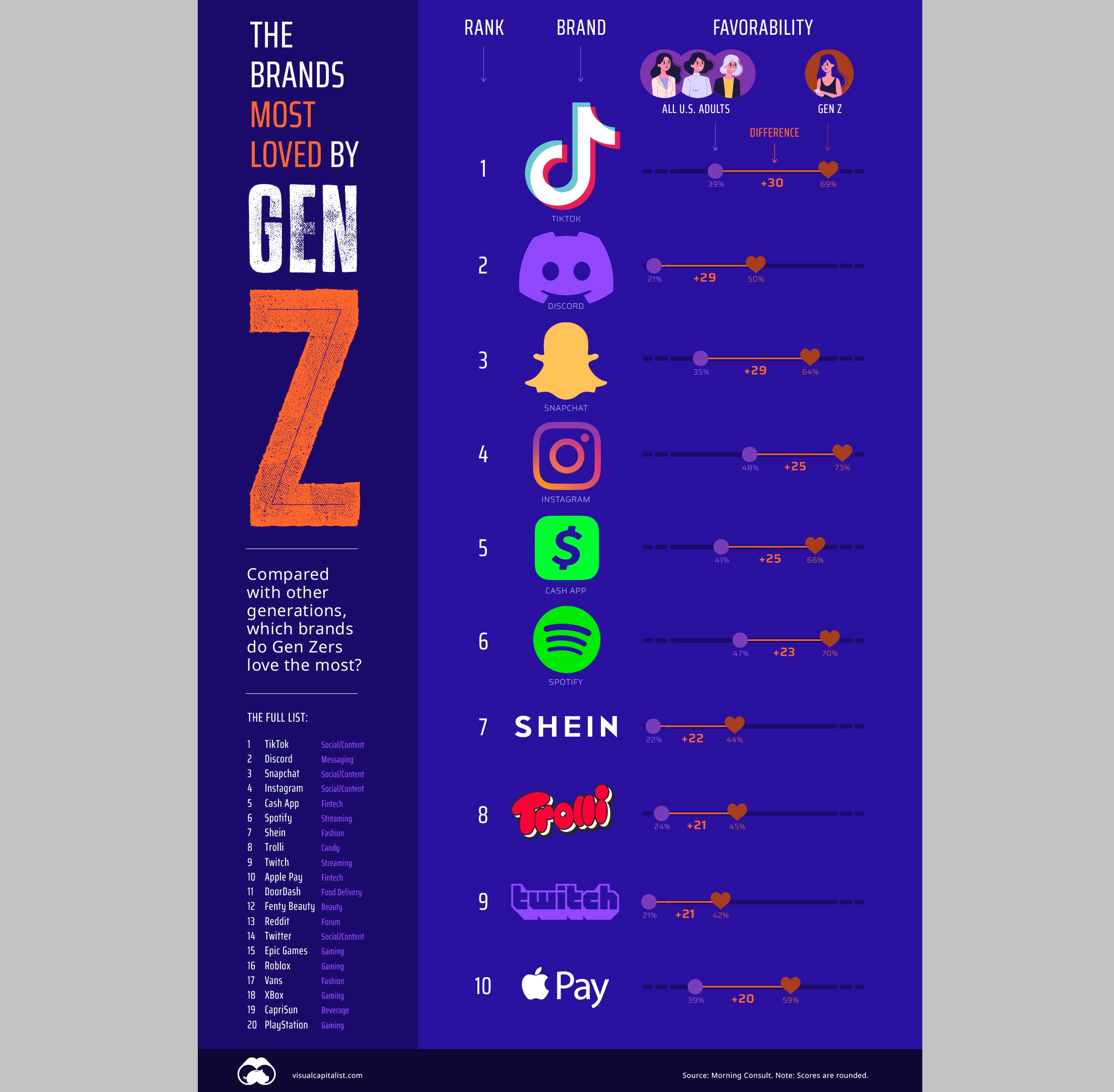
Comparison between Gen Z's favourite brands and those of other generations

Recent data analysis by Morning Consult aimed to highlight brands that were specifically favored by Gen Z in comparison with everyone else.

While overviewing the data, it has been noticed that overall, the favorite brands are not very distinctive as compared to the ones preferred by people from other generations. The data showed Netflix and Walmart among the top favorite brands for people from different generations; however, based on those platforms that give their best for Gen Z, the results become unique.

Social media applications such as TikTok, Discord, or Snapchat may not have their hype among Gen X, Boomers, or millennials, but Gen Z, love these platforms. Data shows TikTok as one of the most popular platforms for Gen Z, with a 69 percent favorability rating; however, the adult percentage was just 39%. Similarly, Discord and Snapchat, followed by Instagram and Cash App, are the top 5 brands with the highest difference in favorability.

TikTok's being at the top of the list didn’t come as a surprise. The short video platform is getting famous among Gen Z, with more and more users joining the application daily. The reason behind Gen Z being more inclined towards such brands could be because they were brought up in the era of modern digital technologies. This could be the reason why the Gen Z population prefers social media applications or online services to get their work done.

What differentiates Generation Z from other generations is that these people are more conscious regarding the ethics, morals, and consumption of their favorite brands than any other population.

However, this difference doesn’t stand due to one of the brands that go against it. Shein is one of the most famous clothing brands among Gen Z. This company promotes clothing on a mass scale, which leads to many items getting wasted. Not only this, but the company came under the spotlight after it was called out for going against labor laws. This goes against the brand's ethics, but still, it is one of the favorites among others.

While comparing Gen Z and millennials side by side, it can be seen that the short video platform TikTok performs better with Gen Z than millennials; similarly, Pixar and Crocs also do the same.

However, brands that are good for all generations don’t follow the trend mentioned above. Instead, these brands are preferred by people of all generations. This list was topped by YouTube with 86.2% favorability, followed by Google, Netflix, Amazon, and M&Ms as the top 5 brands for everyone.

The data shows that Gen Z favors brands that can meet their expectations and don’t go against their ethics or morals. It is difficult for any platform or brand to be accepted by Gen Z.

H/T: VC
Read next: 66% of Americans Prefer Buying From Real People Instead of AI
by Arooj Ahmed via Digital Information World