TikTok is boasting its safety and privacy tools for teenagers who love using the app and parents will also have control over their activities. There were some concerns about the content teenagers were consuming on TikTok. TikTok's algorithms work this way and it just continued showing inappropriate and indecent content to teens. Due to this, TikTok received too many complaints and criticism, that's why it decided to introduce some safety features for users.
There are many concerns about the content shown on TikTok. It's not something teens should be watching and parents should keep an eye on what type of TikToks their teen is watching on the app. Many types of blackmailing tactics and scams also happen to teens and children who are not careful enough on the app.
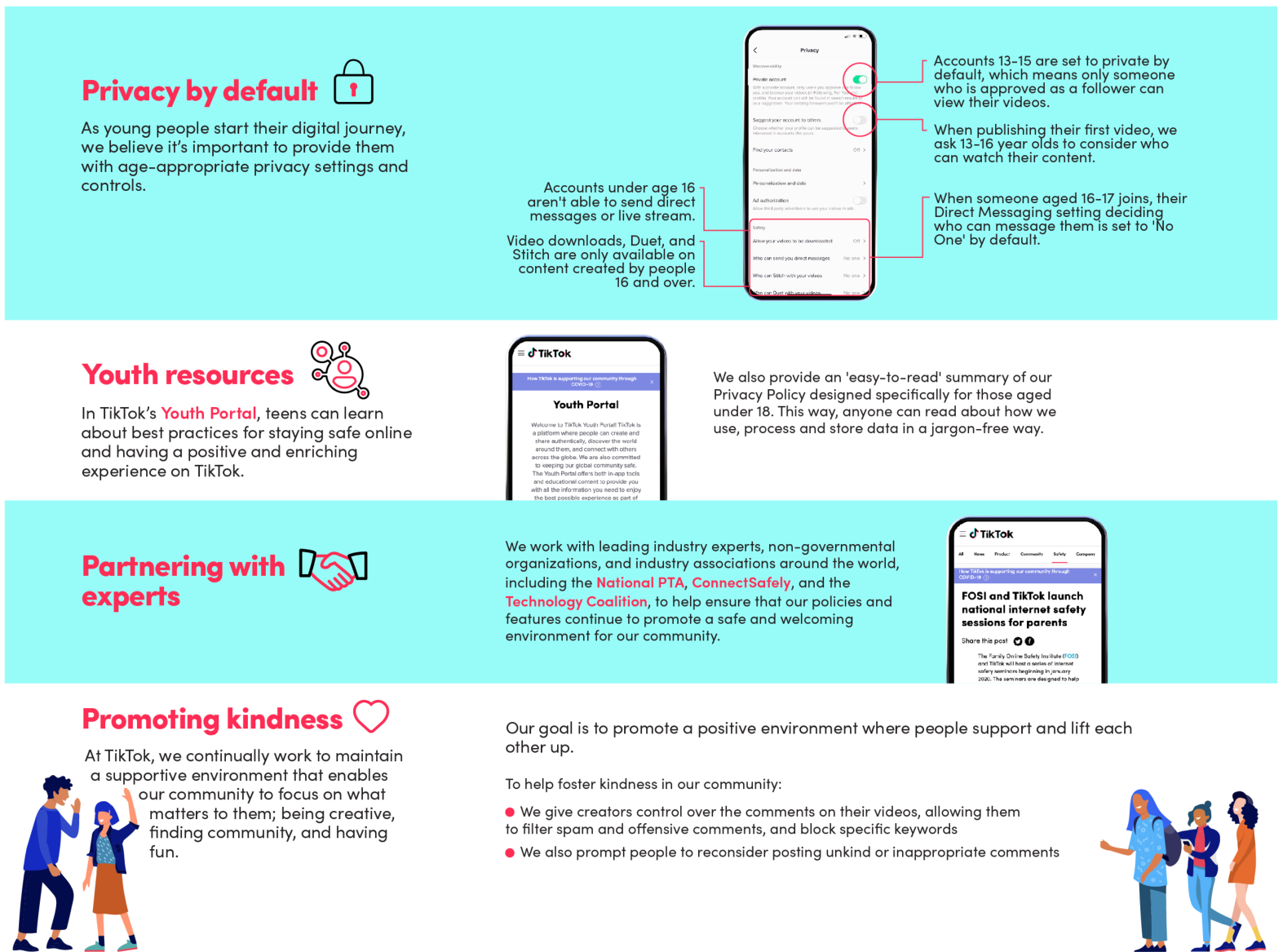
At the Brand Safety Conference, TikTok announced that it has added handy privacy and safety tools to the app. Even if these features are for children, they are especially for parents to use. By using these tools, parents can control the activities of their teens on TikTok. They can see what their child is watching and will also be able to manage the screen time of their child.
An overview of these new tools shows that it includes family tools by which the guardian will be able to link their account to that of their child. This way their activity will be monitored. TikTok will also provide teens with privacy by default on the app. TikTok is also introducing Youth Resources on the app by which teens can learn about how to be safe on the app through Youth Portal. TikTok is currently working with many lead companies to promote safety and kindness on the app. Now we all have to wait and see how these new tools are going to help in keeping teens away from improper content on TikTok.
Read next: 66% of Americans Prefer Buying From Real People Instead of AI
by Arooj Ahmed via Digital Information World
"Mr Branding" is a blog based on RSS for everything related to website branding and website design, it collects its posts from many sites in order to facilitate the updating to the latest technology.
To suggest any source, please contact me: Taha.baba@consultant.com
Thursday, November 10, 2022
48% of Workers Faced Increased Passive Aggressiveness At Work After Covid
The workplace is one of the most crucial of social arenas for people to thrive in because of the fact that this is the sort of thing that could potentially end up enabling them to enjoy well paying and satisfying careers. In spite of the fact that this is the case, passive aggressive behavior can be a huge hindrance to their success. It is something that usually can’t be reported to HR for fear of seeming overly sensitive, but it can nonetheless have a strong impact on how people feel at work.
A new survey by OnePoll conducted on behalf of Go1 has revealed that 69% of Americans now experience passive aggressive behavior in the workplace. With all of that having been said and now out of the way, it is important to note that 48% have reported that such behavior has become more frequent in the aftermath of Covid than might have been the case otherwise.
64% of workers who responded to this survey reported facing passive aggression at least once a week. About 16% of all workers said that they faced it every single day, but it is notably higher for women 19% of whom reported experiencing passive aggressive behavior whereas the numbers were at just 12% for men with all things having been considered and taken into account.
The most common type of passive aggressive behavior was that of talking behind someone’s back which was reported by 54% of survey respondents. 50% also reported complaints and resentment as a source of passive aggressiveness, while nearly as many or 49% to be precise said that they often face the silent treatment. Sarcasm and dishonesty are also frequently cited by workers with 42% and 37% respectively.
Interestingly, 68% of these survey respondents admitted to being passive aggressive themselves in the past. These sorts of things can happen when someone is stressed out at work, but it can come together to create a very hostile work environment. 51% of these incidents are caused by poor time management, so that is something that must be rectified moving forward.
Read next: Stress-free day could be helpful for Mental Health
by Zia Muhammad via Digital Information World
A new survey by OnePoll conducted on behalf of Go1 has revealed that 69% of Americans now experience passive aggressive behavior in the workplace. With all of that having been said and now out of the way, it is important to note that 48% have reported that such behavior has become more frequent in the aftermath of Covid than might have been the case otherwise.
64% of workers who responded to this survey reported facing passive aggression at least once a week. About 16% of all workers said that they faced it every single day, but it is notably higher for women 19% of whom reported experiencing passive aggressive behavior whereas the numbers were at just 12% for men with all things having been considered and taken into account.
The most common type of passive aggressive behavior was that of talking behind someone’s back which was reported by 54% of survey respondents. 50% also reported complaints and resentment as a source of passive aggressiveness, while nearly as many or 49% to be precise said that they often face the silent treatment. Sarcasm and dishonesty are also frequently cited by workers with 42% and 37% respectively.
Interestingly, 68% of these survey respondents admitted to being passive aggressive themselves in the past. These sorts of things can happen when someone is stressed out at work, but it can come together to create a very hostile work environment. 51% of these incidents are caused by poor time management, so that is something that must be rectified moving forward.
Read next: Stress-free day could be helpful for Mental Health
by Zia Muhammad via Digital Information World
Wednesday, November 9, 2022
A Complete Rundown Of Why People, Especially Gamers, Install And Delete An App
More than half of the users download different apps for a specific use and gaming apps are downloaded to gain some free offers. A new study shows why people download apps and the reason isn't only about playing games. In the research, it was found that 54% of people use apps to do specific tasks. 53% of people download apps because they are convenient and useful for them. 46% say that they like using the app because they are fun and help them pass the time.
This research was also made on Gamers and they were asked why they download specific games on mobile. 37% of them said that most of the gaming apps on mobile have some special offers and amazing discounts that they need to avail of. However, all this isn't available on the games on the web. The offers on the game apps motivate the users to download apps and that's how they get popular.
People who love playing games on their phones also use many other apps. About 82% of those gamers use retail apps frequently and 75% of them like to use entertainment and video streaming apps. 67% of these users are interested in finance apps. This further proves that gamers enjoy using apps that offer them brand awareness in one way or another. These people love playing puzzles, word, and strategy apps.
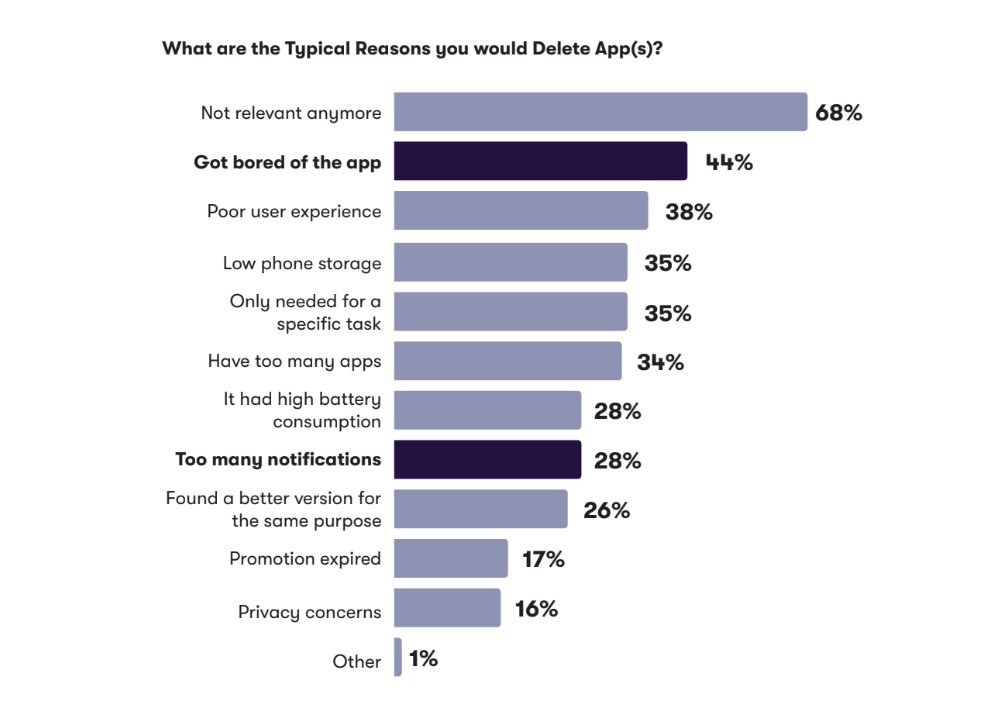
52% of the gamers download an app because they trust its developers and 50% redownload a game if they have previously used and loved it. 65% of people avoid downloading an app if it has no or bad reviews. If we talk about the number of people deleting an app for some reason, 44% say that they delete an app because it's no longer relevant and interesting to them. 38% gave the reason that they delete an app when it isn't according to their preference and 28% do it when they receive too many notifications from it. 15% of users said that they delete an app when it has some privacy problems or when it is asking for their private information.
Read next: Video Games Might Actually Be Good for Children According to This New Report
by Arooj Ahmed via Digital Information World
This research was also made on Gamers and they were asked why they download specific games on mobile. 37% of them said that most of the gaming apps on mobile have some special offers and amazing discounts that they need to avail of. However, all this isn't available on the games on the web. The offers on the game apps motivate the users to download apps and that's how they get popular.
People who love playing games on their phones also use many other apps. About 82% of those gamers use retail apps frequently and 75% of them like to use entertainment and video streaming apps. 67% of these users are interested in finance apps. This further proves that gamers enjoy using apps that offer them brand awareness in one way or another. These people love playing puzzles, word, and strategy apps.
52% of the gamers download an app because they trust its developers and 50% redownload a game if they have previously used and loved it. 65% of people avoid downloading an app if it has no or bad reviews. If we talk about the number of people deleting an app for some reason, 44% say that they delete an app because it's no longer relevant and interesting to them. 38% gave the reason that they delete an app when it isn't according to their preference and 28% do it when they receive too many notifications from it. 15% of users said that they delete an app when it has some privacy problems or when it is asking for their private information.
Read next: Video Games Might Actually Be Good for Children According to This New Report
by Arooj Ahmed via Digital Information World
Twitter’s Ex-Employee Raises The Curtain On The ‘Most Unethical’ Thing He Was Told To Do
Elon Musk taking charge meant bad news for so many members of Twitter’s workforce. The goal was to bring the workforce down by 75% and right now, they’ve managed to reduce it by half.
That’s a major firing spree if you ask us but what’s even more shocking is linked to how some of those given the boot are now being rehired and asked to return. So as you can see, so many questions are in people’s minds about what has taken place and what the future holds.
But now, an ex-employee of the app is shedding light on how he was asked to do the most unethical thing for the platform. His name is Steve Krenzel and his claims are definitely eyebrow-raising.
The incident in question has to do with something that took place between the years 2015 to 2016. And now that the ownership has changed, he is opening his mouth on an act that he simply can’t get over because that’s how bad it was.
Thankfully, the task given wasn’t exactly by Twitter but by those representatives arising from a large telecom company. He was asked to track the moment users left the house, left for their work, and also anywhere they wanted to go.
Krenzel mentioned how he was famous as the mobile guy as he was always trying to search for ways to better the Twitter app on smart devices. So his goal was to enhance uploaded logs as the platform logs all things that users did such as delay, swipe, edit, and more.
A lot of apps do this for purposes like debugging, trials, and even for the sake of metrics. But it’s never being done to sell off data to other third parties out there. But being pulled into a shocking conversation by the sales team to fulfill this request of tracking users really opened up his eyes and his mind.
He was asked by the giant telecom firm to give data in return for payments. The tracking was for users based in North America and he was just too shocked at what was going on. Certainly, it was a suspicious request and they wanted to see how many of the app’s users were entering stores belonging to archrivals.
Keeping a track of users’ daily schedules was never something that he wanted to do. It’s like behaving like a spy and invading their privacy. At that, CEO Jack Dorsey disapproved and so did he because it was absurd. There was no way he planned on selling details of users’ location data.
But what about Elon Musk? Would the billionaire be ready to use that data for his own gains? Well, we can’t say for sure but Krenzel fears the new Twitter owner might plan on doing things that were far worse than just that.
Certainly, this was an eye-opener for us about how the concerns of watchdogs in today’s time hold true for obvious reasons.
Read next: Twitter Says Its New Verification Scheme Will Include Three Accounts With Official, Paid, And Unlabeled Tags
by Dr. Hura Anwar via Digital Information World
That’s a major firing spree if you ask us but what’s even more shocking is linked to how some of those given the boot are now being rehired and asked to return. So as you can see, so many questions are in people’s minds about what has taken place and what the future holds.
But now, an ex-employee of the app is shedding light on how he was asked to do the most unethical thing for the platform. His name is Steve Krenzel and his claims are definitely eyebrow-raising.
The incident in question has to do with something that took place between the years 2015 to 2016. And now that the ownership has changed, he is opening his mouth on an act that he simply can’t get over because that’s how bad it was.
Thankfully, the task given wasn’t exactly by Twitter but by those representatives arising from a large telecom company. He was asked to track the moment users left the house, left for their work, and also anywhere they wanted to go.
Krenzel mentioned how he was famous as the mobile guy as he was always trying to search for ways to better the Twitter app on smart devices. So his goal was to enhance uploaded logs as the platform logs all things that users did such as delay, swipe, edit, and more.
To set the stage, this was the 2015-2016 era. @dickc was just ousted, though he was wonderful and made us feel like family. @jack came in as part-time CEO. Twitter had been near death for a while and was desperately trying to find a buyer. Facebook and Google both refused.
— Steve Krenzel (@stevekrenzel) November 7, 2022
A lot of apps do this for purposes like debugging, trials, and even for the sake of metrics. But it’s never being done to sell off data to other third parties out there. But being pulled into a shocking conversation by the sales team to fulfill this request of tracking users really opened up his eyes and his mind.
He was asked by the giant telecom firm to give data in return for payments. The tracking was for users based in North America and he was just too shocked at what was going on. Certainly, it was a suspicious request and they wanted to see how many of the app’s users were entering stores belonging to archrivals.
Keeping a track of users’ daily schedules was never something that he wanted to do. It’s like behaving like a spy and invading their privacy. At that, CEO Jack Dorsey disapproved and so did he because it was absurd. There was no way he planned on selling details of users’ location data.
But what about Elon Musk? Would the billionaire be ready to use that data for his own gains? Well, we can’t say for sure but Krenzel fears the new Twitter owner might plan on doing things that were far worse than just that.
Certainly, this was an eye-opener for us about how the concerns of watchdogs in today’s time hold true for obvious reasons.
Read next: Twitter Says Its New Verification Scheme Will Include Three Accounts With Official, Paid, And Unlabeled Tags
by Dr. Hura Anwar via Digital Information World
Can TikTok’s Algorithm Predict What Users Like? This Experiment Reveals It All
TikTok is the world’s leading platform when it comes to short video content. Users, whether young or old can’t get enough of the app. But did you ever wonder how the platform’s algorithm decides what users like?
Time after time, we do get an eerie feeling that apps may know more about us than we think. It’s like you’re thinking about something and it pops up on your screen. While scary at first, you do begin to realize that it’s more than just a coincidence.
An interesting experiment was recently conducted by The Guardian to determine how one of the world’s leading apps actually ends up deciding what it is that users like and what they should be serving them while browsing.
TikTok actually has one of the strongest platforms out there. Not only is it super effective in guessing your likes and dislikes, but it’s also hard to study too. The experiment we’re discussing today went on to shed light on how the algorithm ends up treating different people.
The participants were provided the same rules. They had to make a new account on the app using their actual ID, despite the fact of having one. Next, they had to open up their For You page at the exact same time during the morning hours. And lastly, they had to jot down the first ten videos being served up on their app. This particular set of rules was repeated for one week.
Other than that, they weren’t bound to do anything else. The week-long experiment continued and they were entitled to like, follow, post, and more as per their liking. See, the whole purpose was to witness how this ‘For You’ page altered with time. Similarly, what assumptions did the app end up making about them?
Yes, the findings may not be too scientific but they end up looking at the TikTok experience as a whole and how it altered from one individual to another. Hence, it ended up raising questions about how the app alters people’s minds, engagement, and the whole information ecosystem.
The four people on whom the experiment was conducted had different opinions on how the algorithm ended up judging them. A lot of people were appalled at the way assumptions were made about them. While a few were relatable, others were not so much.
One college student claims that the algorithm ended up assuming she was a teen who would adore a 12 year’s humor. Unfortunately, that didn’t go down too well and her ‘For You’ page had weird jokes across the board and other content that she found to be beyond her liking. Some videos were about viral trends like those linked to napkins. She enjoyed that though and says she would watch it for hours.
She says that the app never managed to figure out she was a desi but it did think she was a Muslim thanks to her headscarf. So that’s why it put up videos in that genre.
Another participant who was a professional working woman says she was appalled at the types of dad jokes, silly humor content, and weird stick figure viral trend that popped up. She did get cooking and pet videos too but as a whole, she was not impressed as most content was the viral kind as the app assumed she was the older mom type.
The same went for the retired man who says he used the app for the first time. He claims the algorithm threw viral content his way while the rest of the videos seemed to be designed to evoke an emotion of some kind.
So as you can see, it all depends on what you like and what sort of content you engage with. We personally feel no algorithm can predict what’s going on in your mind unless you lead the way.
Read next: These Are the Biggest Security Threats According to Microsoft
by Dr. Hura Anwar via Digital Information World
Time after time, we do get an eerie feeling that apps may know more about us than we think. It’s like you’re thinking about something and it pops up on your screen. While scary at first, you do begin to realize that it’s more than just a coincidence.
An interesting experiment was recently conducted by The Guardian to determine how one of the world’s leading apps actually ends up deciding what it is that users like and what they should be serving them while browsing.
TikTok actually has one of the strongest platforms out there. Not only is it super effective in guessing your likes and dislikes, but it’s also hard to study too. The experiment we’re discussing today went on to shed light on how the algorithm ends up treating different people.
The participants were provided the same rules. They had to make a new account on the app using their actual ID, despite the fact of having one. Next, they had to open up their For You page at the exact same time during the morning hours. And lastly, they had to jot down the first ten videos being served up on their app. This particular set of rules was repeated for one week.
Other than that, they weren’t bound to do anything else. The week-long experiment continued and they were entitled to like, follow, post, and more as per their liking. See, the whole purpose was to witness how this ‘For You’ page altered with time. Similarly, what assumptions did the app end up making about them?
Yes, the findings may not be too scientific but they end up looking at the TikTok experience as a whole and how it altered from one individual to another. Hence, it ended up raising questions about how the app alters people’s minds, engagement, and the whole information ecosystem.
The four people on whom the experiment was conducted had different opinions on how the algorithm ended up judging them. A lot of people were appalled at the way assumptions were made about them. While a few were relatable, others were not so much.
One college student claims that the algorithm ended up assuming she was a teen who would adore a 12 year’s humor. Unfortunately, that didn’t go down too well and her ‘For You’ page had weird jokes across the board and other content that she found to be beyond her liking. Some videos were about viral trends like those linked to napkins. She enjoyed that though and says she would watch it for hours.
She says that the app never managed to figure out she was a desi but it did think she was a Muslim thanks to her headscarf. So that’s why it put up videos in that genre.
Another participant who was a professional working woman says she was appalled at the types of dad jokes, silly humor content, and weird stick figure viral trend that popped up. She did get cooking and pet videos too but as a whole, she was not impressed as most content was the viral kind as the app assumed she was the older mom type.
The same went for the retired man who says he used the app for the first time. He claims the algorithm threw viral content his way while the rest of the videos seemed to be designed to evoke an emotion of some kind.
So as you can see, it all depends on what you like and what sort of content you engage with. We personally feel no algorithm can predict what’s going on in your mind unless you lead the way.
Read next: These Are the Biggest Security Threats According to Microsoft
by Dr. Hura Anwar via Digital Information World
Google to Make Links Less Effective for SEO
Link building used to be a core component of search engine optimization because of the fact that this is the sort of thing that could potentially end up making a website seem more legitimate to web crawlers. In spite of the fact that this is the case, it seems that Google is going in a bit of a different direction when it comes to giving a website a ranking on its SERP. It turns out that Google will not be giving an abundance of links the same level of credence as before.
This comes from comments made by John Mueller of Google on a recent podcast where he claimed that Google’s search algorithm is being altered to make links less useful from an SEO standpoint. This is similar to what former Google exec Matt Cutts claimed back in 2014, and with all of that having been said and now out of the way it is important to note that his words proved to be fortuitous since links have seen a continuous decline in value since that era.
Google itself put out a statement a couple of years ago stating firmly that links are no longer considered a top factor whilst determining rankings on the SERP. That means that link building efforts will prove to be less fruitful in the future than might have been the case otherwise, and it might shake the SEO industry to its very core.
Most SEO specialists have put a lot of stock into link building, and they might need to come up with new techniques and methods with all things having been considered and taken into account. Google often makes changes to further tweak the quality of its search results, and people working in the industry usually need to keep up with these alterations lest they end up falling behind.
It remains be to be seen whether these changes will be drastic or if they are staggered, but whatever the case may be SEO pros will have to switch things up. It will be interesting to see what the aftermath of these changes might end up looking like.
Read next: What Was the Top Trending Google Search Every Year?
by Zia Muhammad via Digital Information World
This comes from comments made by John Mueller of Google on a recent podcast where he claimed that Google’s search algorithm is being altered to make links less useful from an SEO standpoint. This is similar to what former Google exec Matt Cutts claimed back in 2014, and with all of that having been said and now out of the way it is important to note that his words proved to be fortuitous since links have seen a continuous decline in value since that era.
Google itself put out a statement a couple of years ago stating firmly that links are no longer considered a top factor whilst determining rankings on the SERP. That means that link building efforts will prove to be less fruitful in the future than might have been the case otherwise, and it might shake the SEO industry to its very core.
Most SEO specialists have put a lot of stock into link building, and they might need to come up with new techniques and methods with all things having been considered and taken into account. Google often makes changes to further tweak the quality of its search results, and people working in the industry usually need to keep up with these alterations lest they end up falling behind.
It remains be to be seen whether these changes will be drastic or if they are staggered, but whatever the case may be SEO pros will have to switch things up. It will be interesting to see what the aftermath of these changes might end up looking like.
Read next: What Was the Top Trending Google Search Every Year?
by Zia Muhammad via Digital Information World
These Are the Biggest Security Threats According to Microsoft
Corporations have been assailed by an almost endless variety of cyber attacks these past few years, and these attacks are making it rather difficult for these companies to do good business. Microsoft has just released the latest iteration of its annual Digital Defence Report or the MDDR for short, and this revealed some concerning insights into the state of cybersecurity as of right now.
Ransomware as a service, or RaaS, was highlighted particularly because of the fact that this is the sort of thing that could potentially end up making it easier for malicious actors to conduct their cyber attacks. They are currently being used to spread all sorts of fake news and misinformation and giving them a much more elevated platform than might have been the case otherwise.
With all of that having been said and now out of the way, it is important to note that the current invasion of Ukraine by Russia took center stage in this report. In spite of the fact that this is the case, other nation states have also been engaging in cyber warfare, and this has resulted in a huge number of cyber attacks that target critical infrastructure. 40% of all cyber attacks launched by one nation state to target another now target critical infrastructure with all things having been considered and taken into account.
Ransomware in general is seeing a huge uptick, and it is a core component of the wider attacks on infrastructure that are being conducted. The healthcare sector is quite vulnerable to such attacks since people’s lives could be put at risk if the encrypted information is not reacquired, and educational organizations are also at risk here which is dangerous considering how much sensitive data they can hold that pertains to underage minors.
There are also examples national emergencies being declared due to ransomware attacks as can be seen in the case of Costa Rica. All of this data suggests that security threats are reaching unforeseen proportions, and unless drastic steps are taken their rate of increase will only continue to rise and that can pose a lot of risks.
Read next: If You Are Using Outdated Android And iOS Operating System, There Is A High Risk That Your Device Can Come Under Security Attacks
by Zia Muhammad via Digital Information World
Ransomware as a service, or RaaS, was highlighted particularly because of the fact that this is the sort of thing that could potentially end up making it easier for malicious actors to conduct their cyber attacks. They are currently being used to spread all sorts of fake news and misinformation and giving them a much more elevated platform than might have been the case otherwise.
With all of that having been said and now out of the way, it is important to note that the current invasion of Ukraine by Russia took center stage in this report. In spite of the fact that this is the case, other nation states have also been engaging in cyber warfare, and this has resulted in a huge number of cyber attacks that target critical infrastructure. 40% of all cyber attacks launched by one nation state to target another now target critical infrastructure with all things having been considered and taken into account.
Ransomware in general is seeing a huge uptick, and it is a core component of the wider attacks on infrastructure that are being conducted. The healthcare sector is quite vulnerable to such attacks since people’s lives could be put at risk if the encrypted information is not reacquired, and educational organizations are also at risk here which is dangerous considering how much sensitive data they can hold that pertains to underage minors.
There are also examples national emergencies being declared due to ransomware attacks as can be seen in the case of Costa Rica. All of this data suggests that security threats are reaching unforeseen proportions, and unless drastic steps are taken their rate of increase will only continue to rise and that can pose a lot of risks.
Read next: If You Are Using Outdated Android And iOS Operating System, There Is A High Risk That Your Device Can Come Under Security Attacks
by Zia Muhammad via Digital Information World
Subscribe to:
Comments (Atom)


