After taking its users on a whirlwind ride, Twitter is really opting to introduce some interesting changes for its users. And it’s all thanks to social media experts that we’ve got the latest news for you.
For starters, Jane Manchun Wong was quick to notice how the app is working on bringing back the classic GIF profile pictures. We think that would be really interesting for obvious reasons. Remember, some features of the app are still being recalled by users and this just might be one of them.
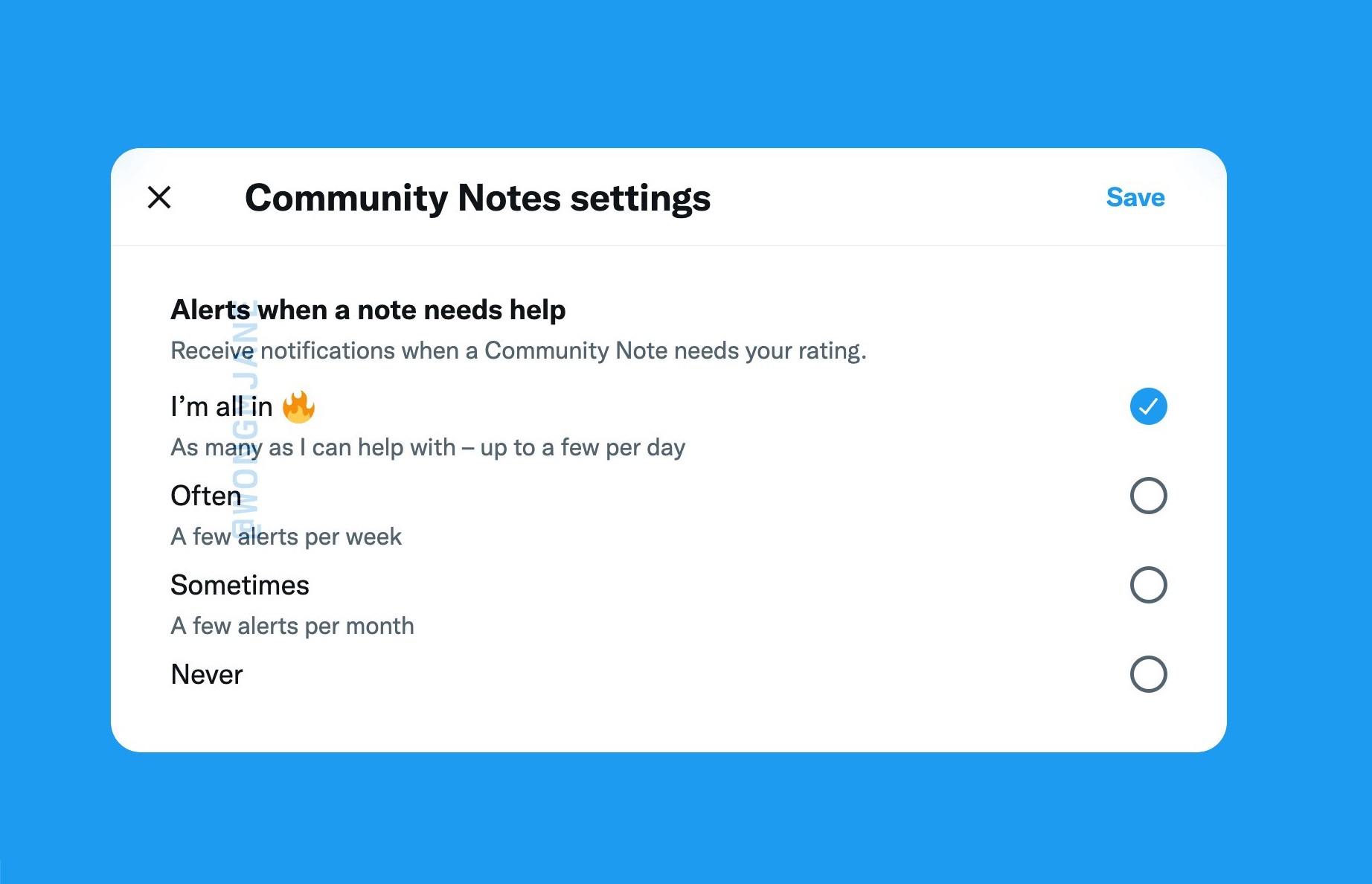
Next up, the platform is working on its settings for Community Notes. As shown by Wong recently, the feature would be giving users the chance to determine how often they’d like to get notified when a community note requires a reading.
If you happen to be all in and ecstatic about it, well, you can subscribe to get a few alerts on a daily basis. Those who select often would be getting the alerts on a weekly basis, and if you choose sometimes, well, you’ll attain some alerts each month. And then there is a category of never which means you won’t be bothered regarding the matter.
Last but not least, we’ve got some more news on Twitter working on another leading feature that was a long time coming. Alessandro Paluzzi was kind enough to share through his social media account that the platform is working on long-form tweets.
This means the initial 280 out of 4000 characters would be visible for display through the default settings. As the new Twitter Chief Elon Musk mentioned through a specific tweet on the matter, users can soon attach long-form text to their tweets.
This is guaranteed to end the craziness linked to taking notepad screenshots, he added.
Read next: New Research Raises Alarm Against Advertising Tool That Exposes Users’ Data To Twitter
by Dr. Hura Anwar via Digital Information World
"Mr Branding" is a blog based on RSS for everything related to website branding and website design, it collects its posts from many sites in order to facilitate the updating to the latest technology.
To suggest any source, please contact me: Taha.baba@consultant.com
Sunday, December 11, 2022
Photo Editing Apps Are One of the Most Used Apps By Smartphone Users
Lensa AI, an artificial intelligence photo editor is getting popular as days are passing and people are using it as much as they can to edit their photos. The popularity and success of Lensa AI aren't much surprising because people love a good photo editing app and this AI editor is great at editing. In 2019 when FaceApp got popular, everyone was using it to generate a picture of their younger and older self. It was a great app for fun face editing.
People who use smartphones have many photo apps installed on their devices because they love editing different parts of themselves, not because of any defect but just because it's fun. It doesn't matter why people love these apps too much because the camera and photo editing apps are one of the highest categories of apps being downloaded on the App Store as well as the Play Store. These types of apps are also one of the highest-grossing apps on the app stores and often remain high in the ranks. People do not hesitate to buy in-app features on photo editing apps to do some editing on a picture of themselves or others to make it look perfect.
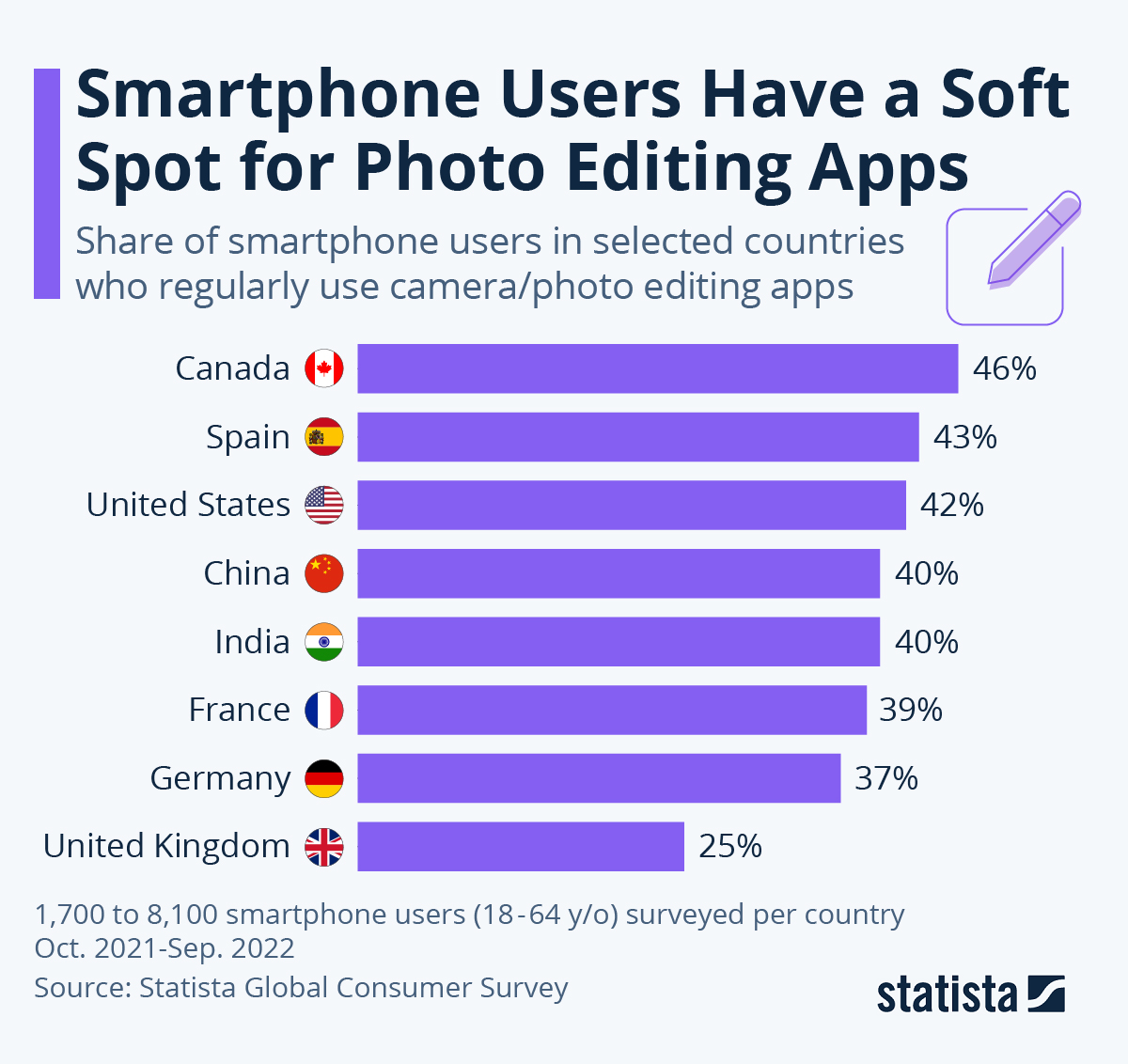
Statista's Global Customer Survey showed that 4 in 10 smartphone users regularly use photo editing apps. This means that many people use editing apps daily instead of apps like browsers and messenger apps. The survey also showed the countries where people use photo editing apps the most. In Canada, 46% of smartphone users use photo editing apps while in Spain, the percentage is 43%. In the US, 42% of people use editing apps. In China and India, the number of regular editing app users is 40%. The UK is the country where people use face editing apps the least with 25%.
Read next: Is AI Adoption Reaching a Plateau?
by Arooj Ahmed via Digital Information World
People who use smartphones have many photo apps installed on their devices because they love editing different parts of themselves, not because of any defect but just because it's fun. It doesn't matter why people love these apps too much because the camera and photo editing apps are one of the highest categories of apps being downloaded on the App Store as well as the Play Store. These types of apps are also one of the highest-grossing apps on the app stores and often remain high in the ranks. People do not hesitate to buy in-app features on photo editing apps to do some editing on a picture of themselves or others to make it look perfect.
Statista's Global Customer Survey showed that 4 in 10 smartphone users regularly use photo editing apps. This means that many people use editing apps daily instead of apps like browsers and messenger apps. The survey also showed the countries where people use photo editing apps the most. In Canada, 46% of smartphone users use photo editing apps while in Spain, the percentage is 43%. In the US, 42% of people use editing apps. In China and India, the number of regular editing app users is 40%. The UK is the country where people use face editing apps the least with 25%.
Read next: Is AI Adoption Reaching a Plateau?
by Arooj Ahmed via Digital Information World
Customers Want More Advanced Imagery On Online Products As Many Online Shoppers Are Not Satisfied With the Images of Products on Websites
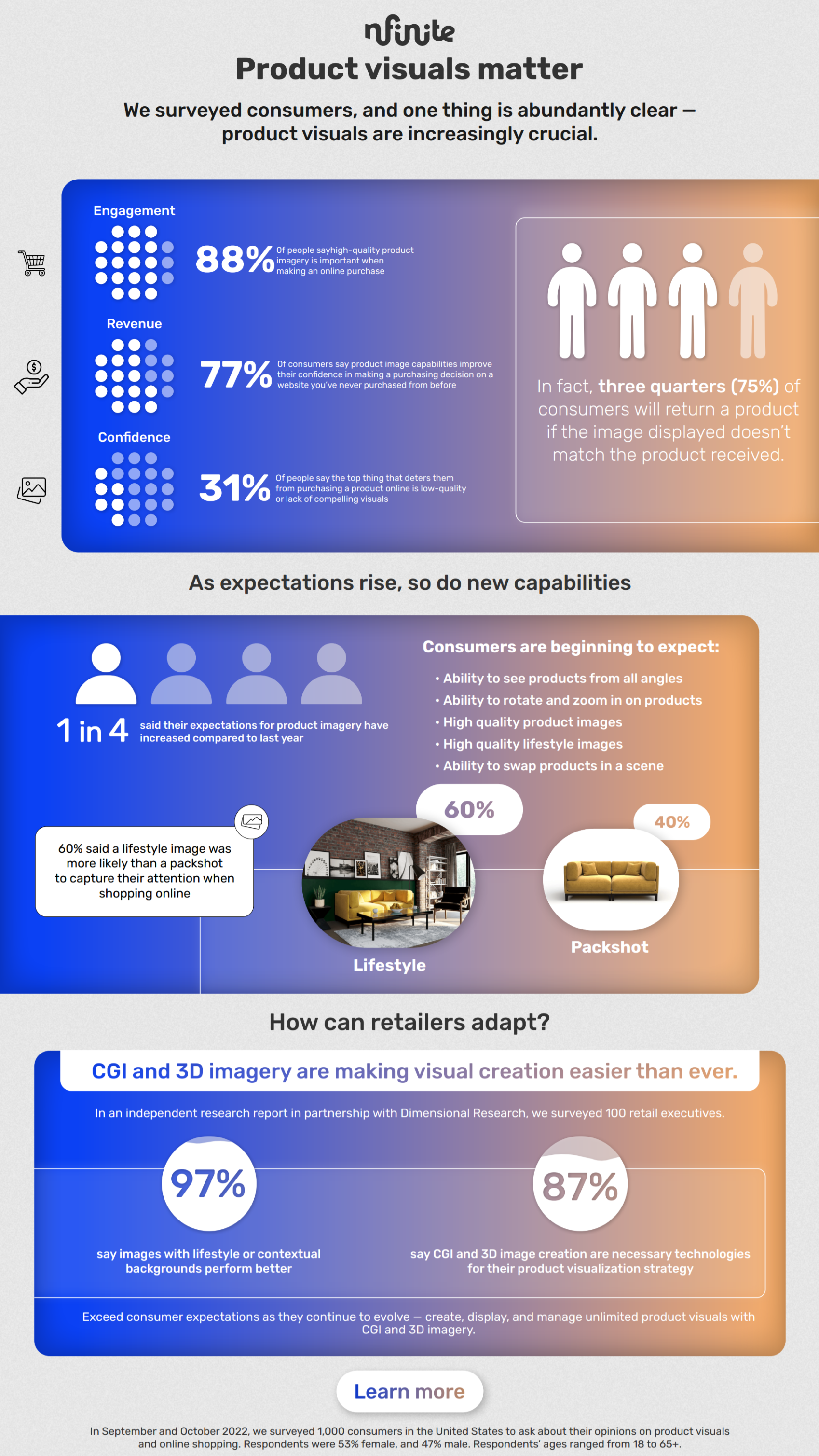
Nfinite, an e-merchandising platform, claims that many online shoppers want brands to enhance the images on their products. This survey was taken by 1,000 people in the US who regularly shop from online retailers. They said that most of their interest in a product is driven by its images as most of the brands use augmented reality and properly customized pictures. The survey showed that brands are not producing product images according to consumer demands. This is the reason that only 9% of the people on the survey say that they are satisfied with product images on online markets.
60% of the consumers said that if an image is captured in a real-life concept, they are likely to get attracted to the product as compared to products that have white or any neutral-colored background. 87% of the people in the US said that for them a high-quality picture of the products is important. 77% said that if they have never purchased from a website, their good photos alone can make them buy the product. There is always a doubt in customers that what if the product they purchased online doesn't look similar to what's shown on the website? That's why 75% of the people on the survey said that they are likely to return a product if it doesn't match its picture.
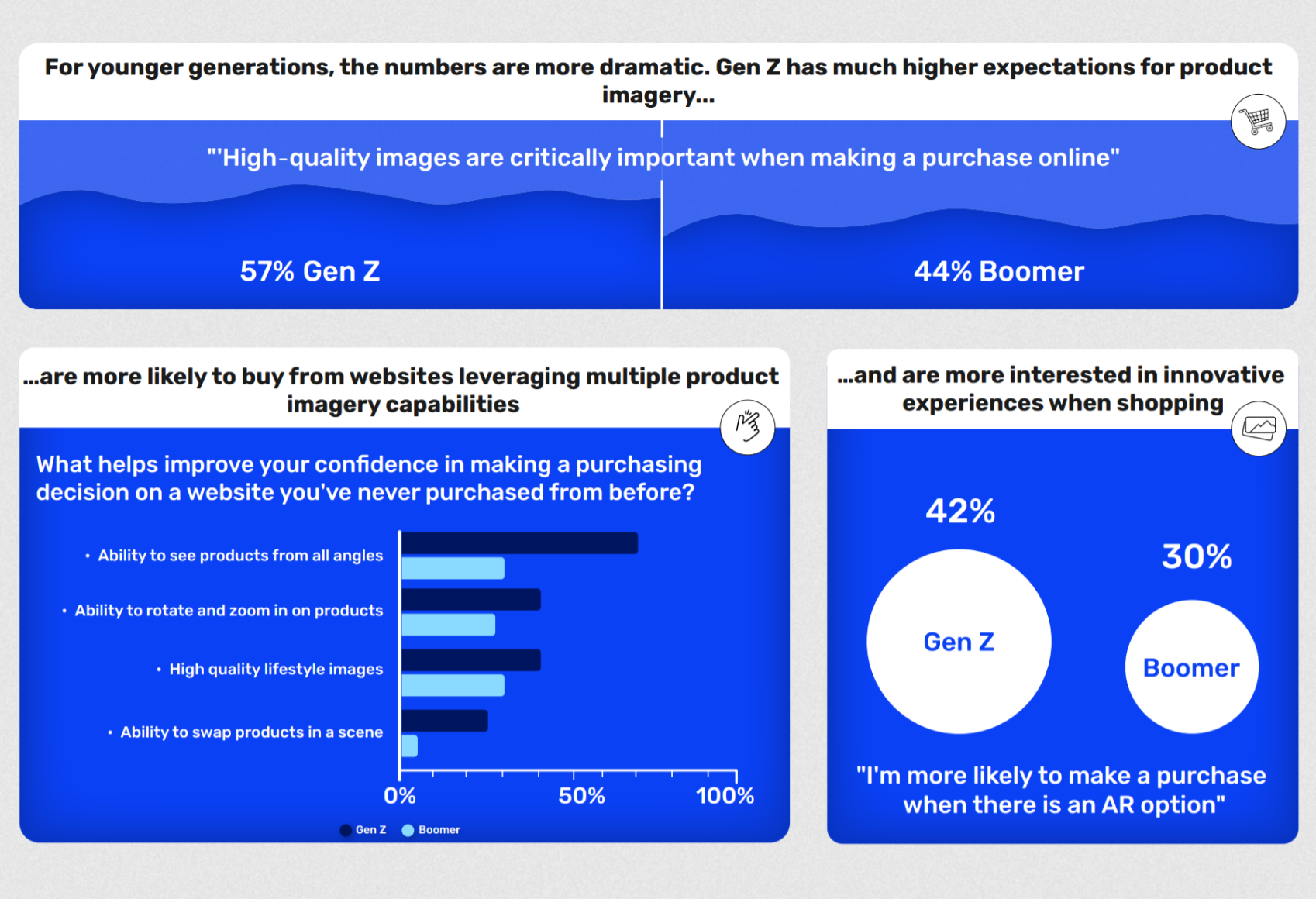
The survey also stated the preferences of GenZ vs Baby Boomers. GenZ wants more personalized experiences and augmented reality. 42% of GenZ says that they are more likely to buy from a website if they have AR tech but only 30% of the Baby Boomers agree to this. If lifestyle images are involved in selling the products, there is a high chance that people will be attracted to them. This can include photorealism, CGI and 3D imagery. If the sellers start selling their products like this, the browsing on their website will increase. More people will come to the website to see a product in a real life context. When a consumer buys a product but it doesn't match up with its usage as shown on the website, he is more likely to return the product. A product being returned results in losing a customer eventually. When a customer will have many options to see a product from different perspectives and angles, he will feel like he is physically at the store inspecting the product. Now this will make him buy the product quickly.
Read next: Americans Are the Only Ones Who Don’t Think Social Media Improves Democracy
by Arooj Ahmed via Digital Information World
60% of the consumers said that if an image is captured in a real-life concept, they are likely to get attracted to the product as compared to products that have white or any neutral-colored background. 87% of the people in the US said that for them a high-quality picture of the products is important. 77% said that if they have never purchased from a website, their good photos alone can make them buy the product. There is always a doubt in customers that what if the product they purchased online doesn't look similar to what's shown on the website? That's why 75% of the people on the survey said that they are likely to return a product if it doesn't match its picture.
The survey also stated the preferences of GenZ vs Baby Boomers. GenZ wants more personalized experiences and augmented reality. 42% of GenZ says that they are more likely to buy from a website if they have AR tech but only 30% of the Baby Boomers agree to this. If lifestyle images are involved in selling the products, there is a high chance that people will be attracted to them. This can include photorealism, CGI and 3D imagery. If the sellers start selling their products like this, the browsing on their website will increase. More people will come to the website to see a product in a real life context. When a consumer buys a product but it doesn't match up with its usage as shown on the website, he is more likely to return the product. A product being returned results in losing a customer eventually. When a customer will have many options to see a product from different perspectives and angles, he will feel like he is physically at the store inspecting the product. Now this will make him buy the product quickly.
Read next: Americans Are the Only Ones Who Don’t Think Social Media Improves Democracy
by Arooj Ahmed via Digital Information World
Twitter Officially Relaunches Its Paid Verification Plan With Increased Price For iOS Users And Rolls Out Community Notes For All
The controversial paid verification plan by Twitter has finally been relaunched. But it’s come at a steeper price tag for iOS users.
The platform says it has made a significant change and will now restart the program, hoping it does much better than its previous performance.
But we’d like to remind you that the prices are not the same. Android users can benefit from the $8 price tag while iOS users would now be paying $11 for the same on a monthly basis to attain that blue tick mark.
On an annual basis, that totals out to be $132 and if you ask us, it’s definitely a steep rise from what was observed in the past. But why the major rise for iOS users is a question you’re probably wondering.
Well, that’s because the app has finally devised a strategy that would rid the 30% in-app payment tax from affecting its potential profits. It’s a great alternative that would, in the long run, give users more value for each dollar.
Now if you simply signed up on the iOS, you’d be jetting out a 37% markup, and that too for nothing.
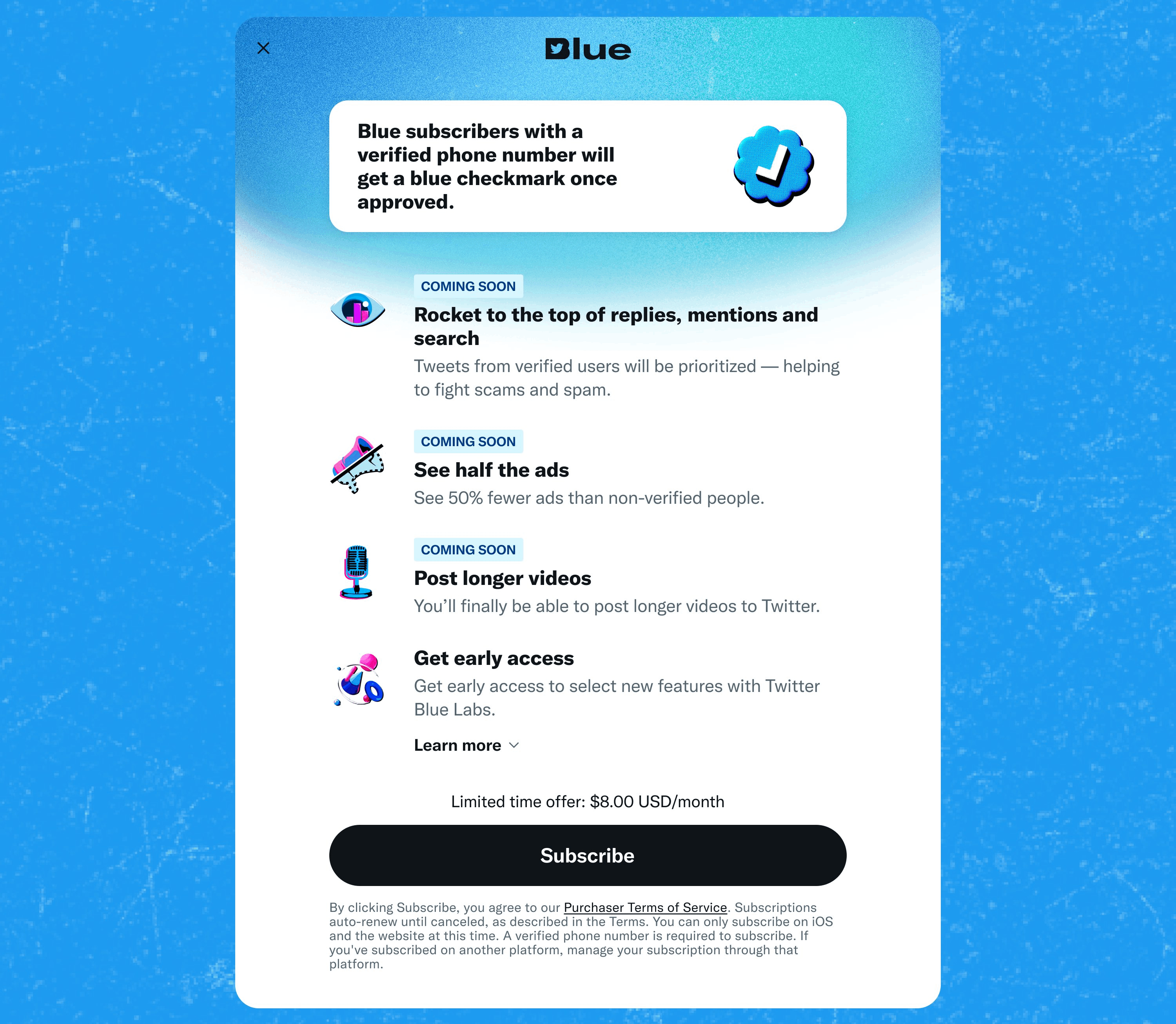
So what is the benefit of getting the blue verification tickmark in the first place? We bet you’re wondering what the answer to that question is. And we were too which is why we’ve enlisted a few pointers worth a mention.
For starters, those who pay will have their tweets mentioned at a higher rank which can be found in the searches too. It’s like giving users a great incentive for paying more. That’s not good for the rest of us who aren’t paying as our tweets won’t be given priority with limited exposure.
Next up, if you pay more, you’ll see fewer ads. Think along the lines of a 50% reduction in ads which sounds disastrous for Twitter but Musk says that if you’re a Blue subscriber, you’re paying more at the end of the day so they can compensate for it.
Also, if you are a Blue subscriber, you can add videos of longer duration. It’s like giving a Twitter user the chance to incorporate features that a regular YouTube user could do without a second thought.
In addition to all of this, you gain further access to Twitter edits, can make the most of the reader mode, and carry out video uploads comprising 1080p. And in case you’re worried about the whole impersonation fiasco, well, don’t be. Twitter says it has sorted it out but again, seeing is believing so we’re going to have to wait and watch out for that.
This is why it’s really leaving no stone unturned in terms of verifying users on the platform through a long list of security measures and different colored ticks for different types of profiles on the app. Clearly, the company has put in a lot of extra work to get things going and we hope it’s all to their benefit.
Another major change that Twitter has recently rolled out is making its Community Notes visible to all users around the globe.
No matter where you may be present in the world, you can rate as well as see notes. These usually tag along with tweets. While only those users in the US can create these, the app will soon be allowing others from different regions to contribute too.
We first saw the feature launched at the start of 2021 when it was called Birdwatch. This was done to rid the misinformation crisis during that period. Hence, whenever a post entails some details that are misleading, you can incorporate contextual notes that the app would highlight using indicators.
Read next: Adoption Of iOS 16 Continues To Grow As Apple Gets More Sales Of iPhone 14 Units
by Dr. Hura Anwar via Digital Information World
The platform says it has made a significant change and will now restart the program, hoping it does much better than its previous performance.
But we’d like to remind you that the prices are not the same. Android users can benefit from the $8 price tag while iOS users would now be paying $11 for the same on a monthly basis to attain that blue tick mark.
On an annual basis, that totals out to be $132 and if you ask us, it’s definitely a steep rise from what was observed in the past. But why the major rise for iOS users is a question you’re probably wondering.
Well, that’s because the app has finally devised a strategy that would rid the 30% in-app payment tax from affecting its potential profits. It’s a great alternative that would, in the long run, give users more value for each dollar.
Now if you simply signed up on the iOS, you’d be jetting out a 37% markup, and that too for nothing.
So what is the benefit of getting the blue verification tickmark in the first place? We bet you’re wondering what the answer to that question is. And we were too which is why we’ve enlisted a few pointers worth a mention.
For starters, those who pay will have their tweets mentioned at a higher rank which can be found in the searches too. It’s like giving users a great incentive for paying more. That’s not good for the rest of us who aren’t paying as our tweets won’t be given priority with limited exposure.
Next up, if you pay more, you’ll see fewer ads. Think along the lines of a 50% reduction in ads which sounds disastrous for Twitter but Musk says that if you’re a Blue subscriber, you’re paying more at the end of the day so they can compensate for it.
Also, if you are a Blue subscriber, you can add videos of longer duration. It’s like giving a Twitter user the chance to incorporate features that a regular YouTube user could do without a second thought.
In addition to all of this, you gain further access to Twitter edits, can make the most of the reader mode, and carry out video uploads comprising 1080p. And in case you’re worried about the whole impersonation fiasco, well, don’t be. Twitter says it has sorted it out but again, seeing is believing so we’re going to have to wait and watch out for that.
This is why it’s really leaving no stone unturned in terms of verifying users on the platform through a long list of security measures and different colored ticks for different types of profiles on the app. Clearly, the company has put in a lot of extra work to get things going and we hope it’s all to their benefit.
Another major change that Twitter has recently rolled out is making its Community Notes visible to all users around the globe.
No matter where you may be present in the world, you can rate as well as see notes. These usually tag along with tweets. While only those users in the US can create these, the app will soon be allowing others from different regions to contribute too.
We first saw the feature launched at the start of 2021 when it was called Birdwatch. This was done to rid the misinformation crisis during that period. Hence, whenever a post entails some details that are misleading, you can incorporate contextual notes that the app would highlight using indicators.
Read next: Adoption Of iOS 16 Continues To Grow As Apple Gets More Sales Of iPhone 14 Units
by Dr. Hura Anwar via Digital Information World
iPhone Takes The Top Position For Google Search Related To Gadget Insurance
In today’s unpredictable world, theft continues to increase as we speak. And that’s why more and more people are seeking insurance.
Gadget insurance is a realm that’s slowly unraveling to be a necessity as more and more people continue to acquire it for expensive purchases. And according to Google Search, the iPhone topped the search list in terms of the electronics that people are most keen on protecting.
In case you didn’t know, the mighty Black Friday sale in the United Kingdom really made many realize that people couldn’t get their hands off of iPhones and PlayStations. These made up the majority of sales that we witnessed, comprising nearly $9 billion.
Sadly, these gadgets are the ones that are mostly stolen too by thieves and that’s why consumers are now turning to gadget insurance to steer clear of such unfortunate incidents as the holiday season approaches.
Insurance for iPhones really came in first in terms of One Sure’s list for searches starting November of this year. It stood at 40,000 and then the Google Pixel handset came in next at just 1500. Other searches entailed the likes of cameras and laptops. These were 12,000 a piece during that duration.
These types of studies just go to show how keen people have become to protect themselves against damage. And while you might think it’s not linked to brands, well, the iPhone is leading the pack.
Meanwhile, the study by One Sure showed gadgets like the Xbox, drone, tabs, AirPods, and PlayStation came in next as far as gadget insurance on Google Search results was concerned.
The spokesperson leading the study by One Sure mentioned how the holiday season sees so many people making huge purchases during this season. Be it loved ones or friends, people are the most generous during this time of year. And that’s why most thefts happen to occur now too.
And while you might forget about gadgets when insurance policies come into play, the current security situation is a wake-up call that some policies linked to insurance should involve gadgets too. After all, how else can one possibly think about replacing a stolen item?
On average, seven in ten thefts of gadgets take place when a person is far away from their residence. And you’ll be amazed to learn how 40% of thefts linked to smartphones take place when using public transport.
People are going to grand events held at public places and that’s where you’ll bump into large crowds. You get the chance to meet new and old people and you never know who it is that might be eyeing your shiny new iPhone from a distance.
The spokesperson even added that the holiday season is about having fun and sharing glad tidings all around. However, you’ll be amazed to learn that the festive season makes people forget the common measures needed to keep theft at bay.
Read next: CNBC Surveys Americans About Their Views on Crypto And Most of the Results Are Negative
by Dr. Hura Anwar via Digital Information World
Gadget insurance is a realm that’s slowly unraveling to be a necessity as more and more people continue to acquire it for expensive purchases. And according to Google Search, the iPhone topped the search list in terms of the electronics that people are most keen on protecting.
In case you didn’t know, the mighty Black Friday sale in the United Kingdom really made many realize that people couldn’t get their hands off of iPhones and PlayStations. These made up the majority of sales that we witnessed, comprising nearly $9 billion.
Sadly, these gadgets are the ones that are mostly stolen too by thieves and that’s why consumers are now turning to gadget insurance to steer clear of such unfortunate incidents as the holiday season approaches.
Insurance for iPhones really came in first in terms of One Sure’s list for searches starting November of this year. It stood at 40,000 and then the Google Pixel handset came in next at just 1500. Other searches entailed the likes of cameras and laptops. These were 12,000 a piece during that duration.
These types of studies just go to show how keen people have become to protect themselves against damage. And while you might think it’s not linked to brands, well, the iPhone is leading the pack.
Meanwhile, the study by One Sure showed gadgets like the Xbox, drone, tabs, AirPods, and PlayStation came in next as far as gadget insurance on Google Search results was concerned.
The spokesperson leading the study by One Sure mentioned how the holiday season sees so many people making huge purchases during this season. Be it loved ones or friends, people are the most generous during this time of year. And that’s why most thefts happen to occur now too.
And while you might forget about gadgets when insurance policies come into play, the current security situation is a wake-up call that some policies linked to insurance should involve gadgets too. After all, how else can one possibly think about replacing a stolen item?
On average, seven in ten thefts of gadgets take place when a person is far away from their residence. And you’ll be amazed to learn how 40% of thefts linked to smartphones take place when using public transport.
People are going to grand events held at public places and that’s where you’ll bump into large crowds. You get the chance to meet new and old people and you never know who it is that might be eyeing your shiny new iPhone from a distance.
The spokesperson even added that the holiday season is about having fun and sharing glad tidings all around. However, you’ll be amazed to learn that the festive season makes people forget the common measures needed to keep theft at bay.
Read next: CNBC Surveys Americans About Their Views on Crypto And Most of the Results Are Negative
by Dr. Hura Anwar via Digital Information World
Saturday, December 10, 2022
Paid Subscriptions May Be Less Effective Than Ads for Video Revenue
Video based content has become a mainstay of many online industries, and there are two main ways in which content can earn money from the videos that they are putting out. The first of these two ways is to earn a portion of the ad revenue that the video will generate, and secondly they can offer paid subscriptions to their loyal followers. Paid subscriptions are often touted as a superior alternative to ad revenue, but in spite of the fact that this is the case ad revenue may be more useful than subscriptions on that front.
Ad revenue from videos totals just under $190 billion in 2022, whereas paid subscriptions only bring in $85 billion with all things having been considered and taken into account. Studies are also showing that ad revenue will grow at a much faster pace, reaching around $360 billion by 2027. By comparison, paid subscription revenue will only grow to about $118 billion in the same timeframe, which suggests that ads are better at driving video revenues than might have been the case otherwise.
It is estimated that the number of digital video viewers worldwide will increase by 350 million between 2022 and 2026. That will result in a 3 point bump from 2022, with around 47.1% of the world projected to regularly watch videos online by 2026. With all of that having been said and now out of the way, it is important to note that ad spending per user will also increase in the interim.
Currently, brands spend about $125 per video viewer. That is likely going to increase to $170 by 2026, which is beneficial because of the fact that this is the sort of thing that could potentially end up allowing content creators to get more money for their hard work.
Paid subscriptions are still advantageous for niche creators who may not be suitable for ads or appealing to brands. The vast majority of content creators will continue to rely on ad revenues, at least for the next decade or so, and it will be interesting to see if anything changes after that.
H/T: Insiderintelligence
Read next: About one in four teens in Europe have trolled someone online in the last year
by Zia Muhammad via Digital Information World
Ad revenue from videos totals just under $190 billion in 2022, whereas paid subscriptions only bring in $85 billion with all things having been considered and taken into account. Studies are also showing that ad revenue will grow at a much faster pace, reaching around $360 billion by 2027. By comparison, paid subscription revenue will only grow to about $118 billion in the same timeframe, which suggests that ads are better at driving video revenues than might have been the case otherwise.
It is estimated that the number of digital video viewers worldwide will increase by 350 million between 2022 and 2026. That will result in a 3 point bump from 2022, with around 47.1% of the world projected to regularly watch videos online by 2026. With all of that having been said and now out of the way, it is important to note that ad spending per user will also increase in the interim.
Currently, brands spend about $125 per video viewer. That is likely going to increase to $170 by 2026, which is beneficial because of the fact that this is the sort of thing that could potentially end up allowing content creators to get more money for their hard work.
Paid subscriptions are still advantageous for niche creators who may not be suitable for ads or appealing to brands. The vast majority of content creators will continue to rely on ad revenues, at least for the next decade or so, and it will be interesting to see if anything changes after that.
H/T: Insiderintelligence
Read next: About one in four teens in Europe have trolled someone online in the last year
by Zia Muhammad via Digital Information World
These App Niches Are the Most Resilient to Economic Headwinds
Inflation as well as supply chain disruptions have caused the formation of economic headwinds which are making it harder for stalwart industries to survive than might have been the case otherwise. In spite of the fact that this is the case, some apps in the mobile market have managed to prove resilient to the effects of inflation and other economic factors, and they are proving that there are still ways in which companies can remain profitable in these trying times.
The mobile market has been especially good at holding the gains that were obtained back in 2020, and with all of that having been said and now out of the way it is important to note that time spent on these apps is increasing, as per DataAI. There has been an 11% increase in average time spent on apps by consumers year over year, and this provides some hope for the future and proves that the app economy still has a lot of room that it can naturally grow into.
Users now spend a whopping 2 trillion hours scrolling through Android apps alone, and download numbers also broke all records with all things having been considered and taken into account. Downloads across both the iOS App Store and the Android Play Store saw a 13% increase year over year to reach 74.4 billion for 2022.
However, revenues are down despite these encouraging numbers. There was a 3% decline in mobile app revenues as compared to last year, which suggests that even though consumers are using apps more and more often, they are not spending quite as much money on them as they used to although that might pick back up again soon.
Some markets are performing a lot better than others, such as in Brazil where consumer spending on purchases within the app increased by 15%. Such news is heartening because of the fact that this is the sort of thing that could potentially end up allowing app developers to start targeting regions where revenue growth is an actual possibility and leave the tougher markets for when the economic climate settles down somewhat.
Short video apps, with TikTok leading the charge, have managed to attain a surprising level of profitability in the current fiscal year. Apps in this category have drastically outperformed other categories, raking in almost $700 million from in app consumer spending alone. Coming in second are OTT apps which crossed the $200 million revenue mark, followed by dating apps, file management apps and finally audio book apps.
Meanwhile, live streaming apps are going through a period of serious turmoil. After being hot items in 2021, they have sustained a loss of about $100 million so far. That casts some doubts on the future of these apps and suggests that they might need to switch things up to keep users pouring in.
Gaming apps have also seen sustained growth in each quarter. MOBA (Multiplayer online battle arena) games are in the lead with profits of around $400 million, but other gaming app categories have performed relatively well too. Team Battle apps that fall into the RPG genre have seen a disappointed few quarters and they have sustained heavy losses of about $400 million or so.
Read next: Video Is One Of The Key Factors In Determining The Decisions Of Users
by Zia Muhammad via Digital Information World
The mobile market has been especially good at holding the gains that were obtained back in 2020, and with all of that having been said and now out of the way it is important to note that time spent on these apps is increasing, as per DataAI. There has been an 11% increase in average time spent on apps by consumers year over year, and this provides some hope for the future and proves that the app economy still has a lot of room that it can naturally grow into.
Users now spend a whopping 2 trillion hours scrolling through Android apps alone, and download numbers also broke all records with all things having been considered and taken into account. Downloads across both the iOS App Store and the Android Play Store saw a 13% increase year over year to reach 74.4 billion for 2022.
However, revenues are down despite these encouraging numbers. There was a 3% decline in mobile app revenues as compared to last year, which suggests that even though consumers are using apps more and more often, they are not spending quite as much money on them as they used to although that might pick back up again soon.
Some markets are performing a lot better than others, such as in Brazil where consumer spending on purchases within the app increased by 15%. Such news is heartening because of the fact that this is the sort of thing that could potentially end up allowing app developers to start targeting regions where revenue growth is an actual possibility and leave the tougher markets for when the economic climate settles down somewhat.
Short video apps, with TikTok leading the charge, have managed to attain a surprising level of profitability in the current fiscal year. Apps in this category have drastically outperformed other categories, raking in almost $700 million from in app consumer spending alone. Coming in second are OTT apps which crossed the $200 million revenue mark, followed by dating apps, file management apps and finally audio book apps.
Meanwhile, live streaming apps are going through a period of serious turmoil. After being hot items in 2021, they have sustained a loss of about $100 million so far. That casts some doubts on the future of these apps and suggests that they might need to switch things up to keep users pouring in.
Gaming apps have also seen sustained growth in each quarter. MOBA (Multiplayer online battle arena) games are in the lead with profits of around $400 million, but other gaming app categories have performed relatively well too. Team Battle apps that fall into the RPG genre have seen a disappointed few quarters and they have sustained heavy losses of about $400 million or so.
Read next: Video Is One Of The Key Factors In Determining The Decisions Of Users
by Zia Muhammad via Digital Information World
Subscribe to:
Comments (Atom)