Wednesday, December 14, 2022

CIRP Has Published Data About the Places From Where Consumers Buy iPhones the Most And the Top Place Is Not The One You Are Thinking

New data published by CIRP shows where the people in the USA get their iPhones from and it's not directly from Apple stores. According to this data, it is revealed that most people in the USA buy their iPhones from carrier stores. Physical as well as online carrier stores are the ones that make the most with iPhone sales. After these carrier stores comes the Apple Store. It is rather shocking that Apple Stores aren't the first place people go to if they want to buy iPhones.


Best Buy retailers are also included in the list of where people buy the most iPhone from. Third-party retail stores are not very popular when it comes to buying iPhones but they still have a percentage in the list. The list goes like this: Physical and Online Carrier stores have 67% of iPhone sales, Apple Stores come second in the list with 24% and other stores have 5%. Third-party Best Buy stores have 4% iPhone sales. The 'others' in this list mean retail stores like Walmart and Target, as well as other stores.

This isn't a good thing because the Apple Store being second in the list is a weak spot because if Apple cannot even sell its products, what's the point of everything? If more than 75% of iPhone sales are not from Apple Store, it means that there is no effort from Apple for iPhone sales. When a person wants to buy a new iPhone, he goes to a carrier site but not to the Apple Store directly even if Apple is giving them offers like long warranty and other accessories. Other carrier websites also have offers for customers, but it's a point to ponder for Apple because why are customers getting attracted to other sales instead of Apple's?

This data is surprising because everyone was expecting that Apple iPhone sales will be bigger than any other shop. One of the reasons why carrier stores are getting high iPhone sales is because the customers think that their carrier will help them in moving their service to the new iPhone. Carriers are also good at advertising their stuff, especially when a promotion is associated with it. Carriers also know who their target audience is so they always advertise in that range. They do most of their advertisements by texting and emailing iPhone users and for the most part, this seems to work.

Read next: The most dangerous pieces of software to search for and download
by Arooj Ahmed via Digital Information World

Ethical Hackers - Pothunter Of Software Vulnerabilities

According to HackerOne’s Report of 2022 on Hacker-Powered Security, ethical hackers have found a 21% increase in software vulnerabilities which is above 65,000 in the year 2022.

Before further digging into the results of the report, there are two terms you must be aware of. The first is software vulnerabilities which refer to the software codes having faults or weaknesses. Vulnerabilities can affect the functionality and security of your program if they are not fixed. They could even provide unreliable agents access to your information and products for exploitation. The second term is an ethical hacker who breaks into a computer network without any harmful or criminal intent but to test or assess its security.

Based on the crowdsourced cybersecurity platform’s analysis of the flaws found by its ethical hackers, vulnerabilities in projects involving digitalization have increased remarkably over the previous year, with their related configuration errors growing by nearly half and inappropriate authorization protocols by two and a half times. The research highlights the fact that in-house security staff cannot manage to depend on manual and traditional approaches to vulnerability assessment while demonstrating the capabilities of ethical hacker groups to uncover weaknesses at scale.

In a poll of more than 5,000 hackers, HackerOne discovered that more than a third of hackers believed that a lack of experience was the main obstacle to the firm’s security situation.

The research shows that many businesses are experiencing the strain of dealing with an increased number of exploits. According to the report, 66% of security representatives report having a load of above 1,000,000 vulnerabilities, and 54% of them are capable to fix only about half of them. Due to a large number of vulnerabilities, a more scaled method of handling them is required, just as companies like HackerOne are supplying.

According to the perception of Chris Evans, the chief hacking officer of HackerOne, corporations learn to create special programs to attract the best hackers with ideas based on insights and experiences, as suggested by the hacking department of the company. He further concludes the demonstration of data that hackers are skilled at finding newly discovered vulnerabilities so that our clients can overcome them before an issue occurs.


Read next: Privacy concerns about some products? Mozilla's buyers guide is always at help
by Arooj Ahmed via Digital Information World

Digital media profits decrease in third quarter of 2022, OAREX digital media revenue report shows

As per the 2022 Q3 report issued by OAREX, digital media income has decreased for publicly traded US companies in the third quarter of 2022, which was higher in the second quarter.

As we speak, Meta has seen a 4% fall in its year-on-year revenue, Google Networks has declined by 2% but Snap has seen an increase of 6%.

Moving towards MediaAlpha, a drop of a massive 42% has been recorded in its YOY revenue. But that’s not the case with every company, as a considerable amount of growth in revenues has been noted for IAC/Interactive, Zeta Global, Perion Network, Integral Ad Science, The Trade Desk, Hubspot and DoubleVerify are among the companies that have experienced more than 25% growth in their revenues during Q3.

According to Nick Carrabbia, Executive Vice President at OAREX, he said that current trend as depicted by the report shows that revenues are lowering down and late payments are increasing and that is concerning. He continued by saying that this Q3 report has opposed the previous revenue reports that showed a rise in revenues and thus confirmed the idea of a true slowdown. He also suggested that companies should consider this report as they decide their objectives for 2023.

To make sure that report does not contain any bias in its graphs and reflects the true performance of a particular sector, Tech giants like Google, Meta, and Snap are not included in its analysis and have been discussed separately. In the separate discussion for the above-said companies, it was found that they are performing the same and have the same dip in their graphs just like the other companies in the report. Although Twitter is a private company now, the dip in its revenue is visible as well. Unlike Google Networks, an increase of 6% has been recorded for Google Inc.

The OAREX Revenue Report for Q3 2022 also consolidated the fact that bigger is better, so the bigger a company is, the more revenue it will generate.

Speaking about the companies that faced a downfall of more than 10%, included Criteo (-12%), Telaria (-19%), and Marin Software (-19%) as well.

This report is a part of OAREX’s quarterly digital media revenue analysis series. OAREX, which stands for Online Revenue Ad Exchange and works on exchanging digital revenues for digital media-based companies to exchange future revenue pay-outs over currently generated capital.


Read next: New Report Unravels The Biggest Trends Of Brands On Instagram And TikTok
by Arooj Ahmed via Digital Information World

Meta Develops New Open-Source Tool For Moderating Abusive Content Online

Facebook’s parent firm has recently rolled out a new tool for content moderation.

Meta claims the new open-source offering can fight against the likes of terrorist and extremist content. It’s been allotted the term HMA or Hasher-Matcher-Actioner.


The tool can highlight content that’s suspicious on the platform and that entails copies of pictures and videos that go against the company’s policies and were flagged as disturbing by other users on its apps. After that, the tool would be able to act against these types of materials in a collective manner.

HMA has the capability of being adopted by different firms with ease that wishes to fight against inappropriate content online and put an end to its spread at the same time too. Meta says this is very handy for a number of different organizations that work on a smaller scale than the rest and do not possess the flexibility of huge reserves like the big shots in the industry.

Companies that really do desire to make use of such products can deeply benefit by running their content through such content moderation tools online via a database for hash-sharing. They can then follow it up with steps designed to assist themselves and put Meta in line with curbing the amount of hate and abuse seen through posts generated online.

The decision to have this tool up for grabs in the public eye came at a time when the company gears up to assume the leading position on the board for the Global Internet Forum to Counter Terrorism, which would occur in January of next year.

The group helps to bring various member firms together as one to better tackle issues linked to terrorist and extremist activities taking place online. And for those who may not be aware, Meta is the founding member of this platform.

The parent firm of Facebook says it has gone about spending a staggering $5 billion on the likes of safety and security in 2021. Moreover, it was seen dedicating an entire team comprising hundreds of individuals that worked round the clock alongside professionals hailing from law enforcement and industries related to national security. They would counteract such extremist activities. Therefore, Meta really does hope this new online tool would better strengthen its goals one step more.

Similarly, we’re seeing Meta take more steps toward combating the likes of data scraping.

Rea next: Meta Bids Farewell To All The Resources Linked To Its ‘Creativity’ Division After Ten Years
by Dr. Hura Anwar via Digital Information World

Say Hello To Twitter’s New Feature Called VIT’s That Allows Users To Engage With Famous People

Social media expert Matt Navarra has brought forward news about a new Twitter feature that allows users on the app to engage with all types of public figures and celebrities.

The feature is appropriately dubbed VITs or Very Important Tweeters where you can interact and engage with famous people through various mediums on the platform. This includes editorial content, campaigns, collaborations, and even social events/ happenings in the industry.


Navarra broke the news through his social media account on Twitter where he tweeted the feature and how it entails all sorts of cool features. It’s a VIP app and rightly so because it features some exclusive offerings.

But it was definitely interesting to note how the Social Media commentator says this tool is not something new. However, it wouldn’t be wrong to mention that so few people have gained access to it in recent times. Moreover, you’ll find Navarra crediting another fellow user on Twitter who goes by the name Nicholas Mauro. He set out more details about the VIT feature and called it out for being an invite-only application that’s exclusive for VIP account holders on the platform.

So what exactly are these very cool features for the very important tweeter? Well, a recent screen recording showed features of the likes of Question and Answer, Instant Lock, and Hype.

The feature for Q&A entails allowing followers to generate responses through text or video content on the app. The Instant Lock feature would allow the publishing of exclusive news that can only be unlocked through a tweet. This way, more and more people would be encouraged to publish the news on Twitter. Lastly, the Hype is for the purpose of marketing and promotion a certain endeavor by incorporating URLs, headlines, or even a customized video into such tweets.
Mauro reiterated how there are many points worth a mention here in the form of valuable tools on the Twitter VIP application. They’ve been around for quite some time now. Moreover, making such offerings available for all others would certainly be a great venture.

During the time when such a feature was published, Elon Musk who is the app’s chief yet to let out a word or give feedback. Hence, we’re curious what his take on it all would be now that it’s out in the open.

Read next: New Twitter Survey Claims More Than 50% of Brands Will Not Pay Extra For Verification
by Dr. Hura Anwar via Digital Information World

Find out what the real experts think about mental health content posted on TikTok

Easy and affordable access to mental health support is crucial. Nearly 20% of adults in the US are now living with a mental health issue, with many more going undiagnosed.

The 21st-century mental health crisis is real. Many people are desperate for help, guidance, and someone to talk to.

But for any support to be effective, it has to be administered by a licensed and trained professional who knows what they're doing. 'Help' or 'advice' from an amateur, albeit a well-meaning amateur, will probably be a waste of time and money. It might even be counterproductive, leaving the patient feeling worse than before.

With so many people turning to TikTok for mental health advice, the big question is obvious - how reliable and accurate is mental health advice on TikTok?

PlushCare thought this was a question demanding an answer. So the online health provider asked its team of mental health professionals to analyze 500 TikTok videos on mental health issues.

Here’s a look at what they thought of them…

The quality of TikTok mental health content

According to the data collected and analyzed by PlushCare, more than 80% of mental health content on TikTok contains misleading information.

Doctors are ringing alarm bells around town against the bucketload of mental health videos being promoted on the app.

The news comes to us thanks to startling findings seen by PlushCare which is a leading healthcare firm. Moreover, the study was seen extracting and even transcribing up to 500 different TikTok videos that come under the hashtag of mental health and mental health tips too. This enmassed nearly 25 million views and the network comprised so many doctor reviews.

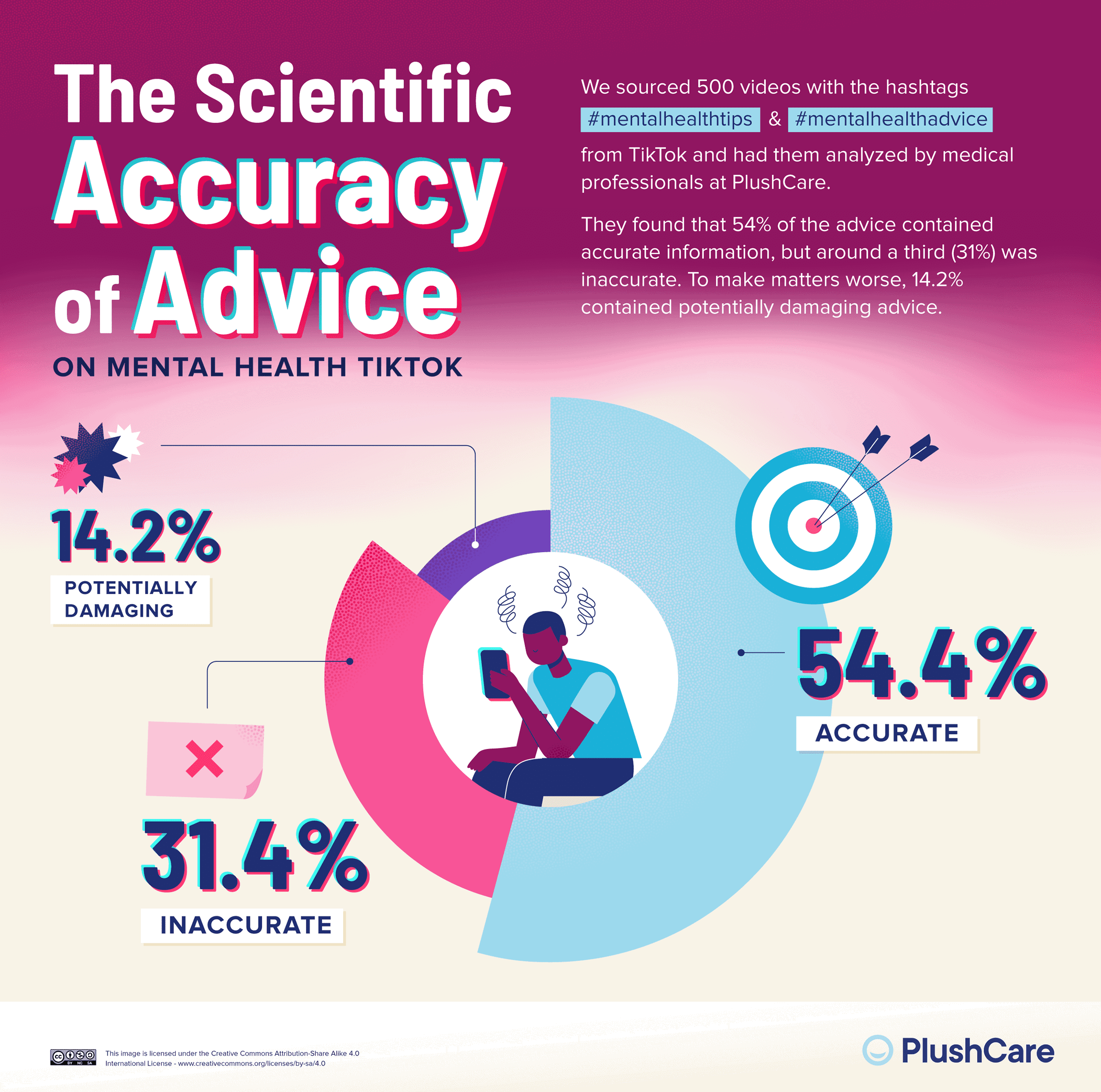
It gets worse. PlushCare also found that:
  • 31.4% of mental health TikTok content contains inaccurate advice
  • 14.2% of relevant content includes potentially damaging advice
  • Only 1% of all mental health content distributed via TikTok comes with a disclaimer.
Some of the most concerning examples include untrained content creators suggesting medications and treatments, as well as encouraging viewers to self-diagnose by Google searching their symptoms.

How many people use TikTok for mental health advice?

A session with a fully-qualified psychotherapist costs somewhere between $100 and $200. On average, people need 10 - 20 sessions to reach their goals, although those living with deep-rooted trauma often require longer-term work that can last for years.

High-quality therapy is super-expensive. And that explains why so many people consume so much free mental health content on TikTok.

The 500 videos analyzed by PlushCare clocked up almost 25 million views. And the content creator accounts that made these videos have more than 40 million followers.

In other words, a lot of people (including many in a vulnerable or impressionable state) are consuming mental health advice deemed inaccurate and harmful by trained medical professionals.

The most misrepresented medical conditions

According to several major medical organizations - including the American Psychiatric Association - attention deficit hyperactivity disorder (ADHD) is a neurodevelopmental disorder characterized by excessive inattention, hyperactivity, and compulsive behavior.

Doctors claim it’s appalling to see so many young individuals leaning more and more toward the world of social media and apps for free mental health advice. They feel it’s so much more convenient and cost-effective to make use of this as compared to booking an appointment with a therapist which could cost you a staggering $100 to $200.

Critics say the condition is overdiagnosed, especially among boys and young men, while some voices within the mental health community reject ADHD as a disorder.

Either way, ADHD is a controversial topic. Moreover, ADHD requires a series of complicated tests and ongoing evaluations before an accurate diagnosis is possible.

Anyone with serious concerns about ADHD should speak to a trained professional in person.

But many are still researching (and even self-diagnosing) ADHD via TikTok. And the content they're consuming is - to put it mildly - not good.

100%(!) of ADHD content posted on TikTok contained misleading advice, according to the real experts brought in by PlushCare.

TikTok content on bipolar disorder and depression is also full of misleading information. PlushCare found that more than 9 in 10 videos covering both topics contained information that was not medically accurate.

And the TikTokers producing content on anxiety aren't doing much better; Just under 9 out of 10 (89.6%) of the videos they make got the thumbs down from mental health professionals.

The least accurate mental health advice on TikTok

It's great that we're paying more attention to our mental health. But now that mental health issues are in the spotlight, there's a tendency (in some circles) to overemphasize terms and conditions - and often in an inappropriate context.

Trauma is the perfect example. Trauma is an emotional response to an overwhelming event, like an accident or crime. Short and long-term symptoms include exhaustion, confusion, sadness, anxiety, agitation, numbness, dissociation, and blunted emotions.

Some people live with undiagnosed trauma for years, even decades, which has a devastating effect on their well-being.

Trauma is not a word or condition to be treated lightly. It shouldn't be used as a label to explain natural feelings and responses to every uncomfortable situation. Feeling 'bad' about something doesn't mean we're traumatized.

Worryingly, trauma is the most misrepresented condition within all mental health content posted on TikTok. More than half of the content (58.33%) of trauma content on TikTok is inaccurate. And 8.33% is potentially harmful.

This free advice is not something new. It’s been trending online since the start of the pandemic and the study shows how the term mental health grew by a staggering 81% since then. The results seen over here are beyond terrifying and the major concern here has to do with providing some misleading facts to the public. Doctors claim that nearly 84% of the videos are filled with misinformation.

One particular area that was concerning had to do with trauma where just 33% of such content was accurate. These findings are quite logical because trauma is a very variable category. It alters from one person to another. And the fact that we’re talking about an app like TikTok where people try to amplify the message in the greatest manner imaginable is definitely not the right app for such endeavors. 91% of the content on the app related to mental health had people giving advice that was not suitable in any way, shape, or form. And that has to say a lot.

Another interesting point of this study had to do with content linked to ADHD. It was really misleading but at the same time, it also had a lot of accurate facts too that were amalgamated in it. So you really don’t know who or what to believe at the end of it all.

Study: How accurate is mental health advice on TikTok? Medical professionals find out
Final thoughts

Less than 10% of TikTok mental health content creators have relevant medical qualifications and credentials. The other 90% are 'self-taught,' which essentially means they read stuff on Google.

Don't trust these amateurs with your mental health!

Always speak to a professional.

Read next: Toxic Social Media Comments Grab More Attention Than Positive Ones According to Eye Tracking Study
by Irfan Ahmad via Digital Information World

Tuesday, December 13, 2022

Social media no longer focuses on "social" and is being inclined towards entertainment

Lately, it has been observed that social networks are no longer being used for what they were intended for and are becoming more of an amusement hub. As it appears, the developers of such applications are also going with the flow by changing the algorithm based on the user’s preferences.

According to Nick Cicero, the VP of strategy at the video optimization service provider company Conviva, social media platforms have now reached a point where the content being posted is more important than maintaining social connections.

Based on the latest study by research firm Omdia, ByteDance’s famous short video platform, TikTok, has taken over the online streaming application, Netflix, by emerging as the 2nd most talked-about application among users below the age of 35. Another big achievement was also secured by TikTok in 2022 after the application became the most famous spot for content watching. Back in 2021, TikTok was just a few seconds short in mean watch time in comparison to Facebook.

Maria Rua Aquete, head director of the research company, said that for those advertising agencies who are looking forward to staying connected with their young users, TikTok’s influence in their lives must not be left unattended.

Currently, the short video app hosts over eighty million monthly users. Out of this number of people, eighty percent of the audience from the United States lie in the range of sixteen to 34 years of age. Hence, the site is inviting marketing brands to include TikTok in their marketing plans.

However, the query remains whether TikTok is still a social platform or a source of relaxation.

The creative head of 160over90, Leroyson Figueira, answered this question by stating that lately every other new digital application or site is termed a "social networking site," whereas it should be given a thought as to whether it fulfills the definition. Furthermore, Figueira added that TikTok is not like its competitor applications, such as Meta owned apps; in fact, the short video platform is more like a television house or Netflix. While other platforms count TikTok among social media applications, the app itself believes it to be more of a relaxation tool.

The business leader of the app, Blake Chandlee, said that other applications move their algorithm along with the social graph, whereas TikTok doesn’t follow this trend.

After watching the unmatched achievements of TikTok, other rivals such as Instagram and Snapchat started to roll out short video features of their own, focusing more on entertainment than making connections.

A survey conducted 12 years ago had already shown that people considered social apps to be a pleasure source and that these applications were a better source of relaxation in comparison to television shows or listening to music.

Dara Denney, performance manager at Thesis, expressed that while TikTok appears to be more reachable when it comes to finding people with the same interests and making them follow their favorite creators as well, on the other hand, Meta’s Facebook is a platform on which the advertisements appear to be more targeted and engaging instead of other users.

Cicero differentiated between being a public figure and a content maker. According to Cicero, influencers are more like public figures having a bond with their followers, while content uploaders don’t have to be fake; instead, it is more transparent about their lives, and the difference is quite visible for everyone to see.

On the one hand, marketing agencies focus mainly on entertaining users while attracting them to a brand. On the other hand, people look up to TikTok not only for entertainment but for their personal growth as well.

TikTok is focusing on bringing people with similar interests together to form a community, while other similar sites are only using their platform as an entertainment medium.


Read next: The World’s Biggest Social Media and Messaging Apps Visualized
by Arooj Ahmed via Digital Information World