Friday, December 23, 2022

What is 'Scalable DeFi'?

With the current Rose coin price fluctuating massively as well as the decreasing value we are seeing occur in most platforms, many are beginning to point towards scalable DeFi as being the only viable long-term fix, and interest behind this topic is higher than ever before.

Illustration via: fullvector/freepik

However, unless you have delved deep into finance or happen to be a technology fanatic, you might not be all too sure of what scalable DeFi is. In spite of its somewhat daunting name, scalable DeFi is actually a pretty simple idea at its core, and we are going to be telling you everything you need to know about scalable DeFi in this article.

Decentralised Finance On a Whole New Scale

If you have been involved in the investing/technology scene for a while, then you are likely already going to have a pretty good idea what decentralised finance is. However, in the slight chance that you don’t, let us give you the rundown.

Decentralised finance refers to a system that is not controlled by any external parties. This would mean that nobody would be able to coerce people into buying certain coins or promote different companies, and the entire platform would be entirely neutral.

To put it simply; decentralised finance takes out the middleman and ensures that a project/platform can not be monetised. This would mean that there are no extra fees, no promotions for certain cryptos/tokens, and no pesky companies trying to highlight their own products/services.

After hearing this, the next logical question to ask would be: who creates and runs DeFi (decentralised platforms)? Well, it’s you and me. DeFi software utilises open-source technology, and this means that the code is accessible to everyone and anyone can work on said project at will.

Essentially, platforms/softwares that are centred around decentralised finance are built by the people, for the people. Knowing what decentralised finance is is essential to know before delving into scalable DeFi, and now that you know what regular DeFi is as well as why it is useful, we can now take a look at scalable DeFi.

The Definition Of Scalability

To give you the definition of scalability; scalability is a term that describes the capacity to change in size or scale. It also has another definition that is specific to computers: the ability of a computing process to be used or produced in a range of capabilities.

Just from these two definitions alone, you can probably get a pretty good idea of what scalable DeFi is. Scalable DeFi would simply be a system/platform/software that could be scaled to meet current needs or demand, and this would mean that people could get access to services that are much more comprehensive/adaptable.

To give an example of this; just imagine if a DeFi crypto platform had a slider that could be changed on a moment's notice to accommodate a huge influx of new investors.

Not only would the aforementioned situation mean that far less development time is needed, but it would also guarantee that the platform in question would be able to handle anything that is thrown at it.

Such a thing on a much wider thing would revolutionise the finance industry as we know it, and it would allow for much more advanced platforms/softwares/systems to be created.

What Would Be The Primary Uses For Scalable DeFi?

Scalable DeFi would have a ton of applications all over the finance industry. Issues such as server overloads or over-exceeded capacity boundaries would become a thing of a past, and developers could alter a platform as soon as any issues crop up.

This idea would just make the finance sector run much more smoothly, and in an industry as delicate as this, this could mean the difference between millions of dollars.

At this stage, scalable DeFi is still mostly an idea. While there has been some success out there, scalable DeFi has yet to be rolled out on a mass scale, and there are even some people out there that do not believe scalable DeFi is actually possible on a wide scale.

Whether or not this is actually the case is still to be foreseen - but from all the information we have available to us right now, scalable DeFi is looking more and more possible everyday, and we just come to see it take over the finance sector in the near future.

We hope we have been able to give you a better idea of what scalable DeFi is as well as how it could revolutionise the finance industry.

While the debate as to whether or not scalable DeFi could actually be used in the real world is still going strong, it’s fair to say that developments in this area are coming in at an ever-increasing rate, and it might not be long until we see scalable DeFi platforms in action.

Either way; if scalable DeFi is able to be developed, then you can near-guarantee that it is going to take over the industry in the future, and this is going to be a good thing for everyone involved. See you next time.

by Web Desk via Digital Information World

Which Android Brand Won Out in 2022?

Android phones are already looking to 2023, with a lot of exciting new releases in store. In spite of the fact that this is the case, 2022 has brought a number of excellent phones to the table, and as the year draws to a close we felt it was time to take a look back and see which brands saw the most success. The folks at Android Central recently conducted a poll to see which Android brands their readers feel most loyal too, and the answers might surprise you.

Samsung has been making a lot of waves as of late by releasing phones that cater to practically every section of the market. The foldable phones that it added to its line up went over particularly well, but with all of that having been said and now out of the way it is important to note that this was not enough to help Samsung reach the top spot. Instead, Google itself reached first place in terms of the most beloved Android phone brand.

42.64% of people who responded to this poll said that Google made the biggest splash, followed by Samsung which got 28.16% of the vote. Google’s launch of the Pixel Tablet created the first Android tablet that actually generated some buzz and lived up to expectations, and the incorporation of flagship features into the budget Pixel 6a smartphone also helped to move the needle with all things having been considered and taken into account.

A surprise entry at number 3 is nothing! 13.27% of respondents said that no particular Android phone brand impressed them this year, although the numbers might be lower than might have been the case otherwise due to votes from iPhone fans.

Motorola makes an entry at number 4 with 3.87% of the vote, followed by Xiaomi with 3.29%. Motorola’s Razr 2022 indicated a comeback for the once dominant company and its entry into a brave new market. Meanwhile, Xiaomi’s 200 megapixel camera in its flagship smartphone has also been turning a few heads which explains why it got a decent chunk of the vote despite stiff competition from other brands.


Read next: Infographic: Smartphone Market Activity Trends For Q3 Of 2022
by Zia Muhammad via Digital Information World

The Rise Of AI-Powered Chatbots Causes Google’s Management To Issue Code Red

Chatbots driven by AI-powered technology are proving to take over the tech world by storm and it was Google who was recently seen issuing a code red as the release of ChatGPT took center stage.

We saw the buzzy conversational AI chatbot produced by OpenAI spark some massive concerns across the board regarding the future of the search engine as reported by NYT.

The CEO of Google was seen taking part in a few meetings around the company’s AI strategy and has therefore ended up addressing the massive threat linked to ChatGPT that it has on the search engine’s business. This was revealed through an internal memo and an audio recording that had gotten reviewed by the Times.

A few teams working at Google research spoke about the Trust and Safety division and a few other departments that direct users to switch gears and help in the creation and launch of several AI prototypes and services. There were a few workers that were requested to design AI products that produce art and graphics that are very similar to the likes of DALL-E that’s used by millions out there as reported by the Times.

While Google is yet to respond to any direct comments being made it's way, the company’s drive to create a robust AI product portfolio arises at a time when workers at Google as well as experts debate on ChatGPT that’s run by an ex-Y Combinator president. This carries the potential to get rid of search engines and in turn, may affect Google’s business model linked to advertising revenue.

Such chatbots were highlighted because they end up stopping users from pressing Google links that entail ads. And that was responsible for producing revenue worth $208 billion, which is generally 80% of revenue generated through Alphabet in the year 2021.

ChatGPT has managed to amass a little over one million users around five days after the pandemic struck. It produces a great conversational tone that’s very human-like and produces information through millions of web pages. Hence, users end up asking such chatbots for help in writing college-level essays and even provide coding advice or serve to give them therapy.

But it’s not uncommon to notice how this bot gets riddled with some major errors. It can’t fact-check what is being said and is unable to distinguish between facts that are verified and any misinformation being outlined as explained by AI experts. Similarly, it can make answers that some deem to be hallucinations.
This bot can generate responses that people regard to be offensive or even racist. And there happens to be a huge margin of error here while vulnerability to toxicity is another factor why Google is too hesitant to have its own chatbot named LaMDA out in the market.

Google’s head of AI says chatbots aren’t something that can be made use of so reliably. For this reason, the company is putting more effort into making improvements to its search engine with time instead of taking it away as a whole.


Read next: What Country Has the Fastest 5G Speeds?
by Dr. Hura Anwar via Digital Information World

Thursday, December 22, 2022

Google and Meta are facing some tough competition in the ads industry

Ads, as consumers a lot of us hate them, are annoying little things that pop-up right when we don’t want them to and just make surfing on the internet or watching YouTube videos unbearable with the number of ads put in them. But these ads, however annoying for us, are the backbone of even the biggest of companies.

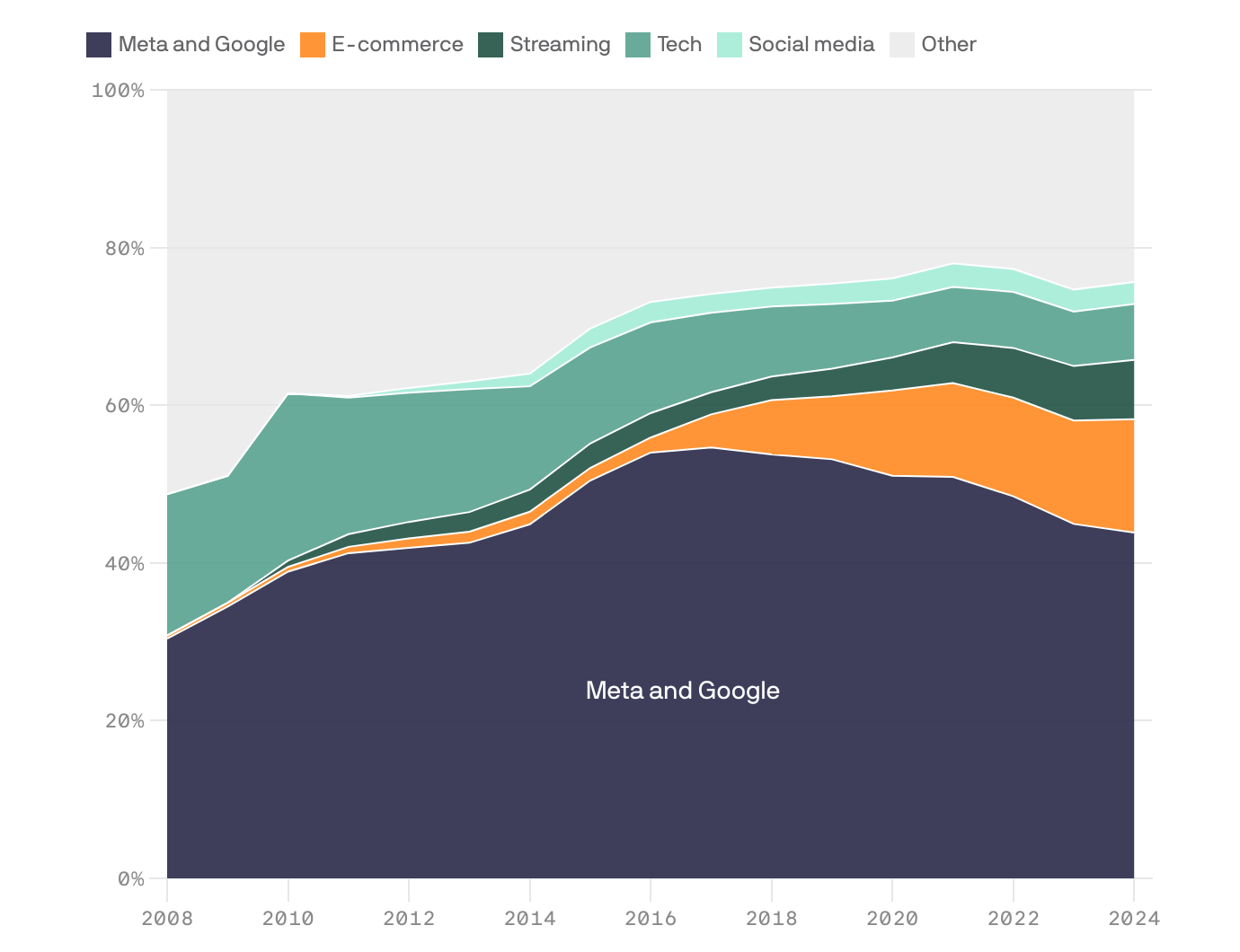
The famed “Duopoly” is the combined name given to the tech giants of today Google and Meta. For both of these companies, Ads are extremely important as the former is dominant in basic digital advertising, and the latter has gained complete control of specified social media advertising. But their dominance is being targeted by newcomers into the ad market that are in surprising ways looking to bring down some of the leverage that the big companies hold over them.

If we talk specifically about Google, then more and more people are going to TikTok and Amazon to look for products and ideas online, shying away from the usage of the biggest search engine and thus taking away some of the force of Google’s towering dominance.

However, things are also not looking good for Meta in the iOS sector as the new changes in Apple’s tracking policy have made Meta lose a lot of their ability to check and target what the interests of the users are and place ads based upon them. According to Meta, this change is probably going to cost them around $10 billion just this year.

Alongside that both of the tech companies are currently placing their best bets on the growth of digital video; that is Instagram for Meta and YouTube for Google to stay well in the competition that has been going on for years.

Both companies are all set to be responsible for 48.4% of all U.S. digital advertising revenue this year, but this is not the mark of good news. This year it would be the first time since 2014 that Duopoly has generated less than half of the total Digital advertising revenue of the country. As a small comparison, both companies together generated 54.7% of Digital advertising revenue in 2017 just when social media apps like Instagram were beginning to take off.

The main problem for them is Amazon, which is expected to be responsible for 12.7% of U.S. ad revenue by 2024 catching up with Meta at 17.9%.


H/T: Axios.

Read next: Here’s How Much Influencers Charge for TikTok, YouTube and Instagram Ads
by Arooj Ahmed via Digital Information World

Google’s Data Centers Used 4 Billion Gallons of Water in 2021

The storage of data is necessary, but it can also be directly contributing to the climate crisis around the world. Google is an especially egregious culprit in this regard, with the tech juggernaut’s data centers using around 3.3 billion gallons of water in the US alone back in 2021. If you include the nearly 1 billion gallons of water it used elsewhere, or 971 million to be precise, this comes up to a total of around 4.3 billion gallons.

This information came out during a legal dispute between the The Dalles in Oregon and a media agency known as The Oregonian. This dispute was about how much of the local community’s water Google was using for its data centers, and it turned out that that city alone was providing over 274 million gallons of water to the tech company with all things having been considered and taken into account.


It is important to note that the amount of water Google’s data centers are using has increased dramatically over the past five years. Water usage has tripled in that time, and that sheds some light on how unsustainable such practices might be in the future. Water will become more scarce, and that will make it harder for Google to justify using so much of it than might have been the case otherwise.

Google has admitted that it uses as much water as about 29 golf courses. That isn’t heartening because of the fact that this is the sort of thing that could potentially end up draining entire communities of their much needed water supplies.

In spite of the fact that this is the case, Google has stated that it plans to build two more data centers in The Dalles area. That will put a further strain on the community, and it will be interesting to see if anyone manages to do anything about it. Google is an innovative enterprise, so they might be able to come up with a long term solution on their own if they are urged to.

Read next: Top 10 Biggest Internet Outages For 2022 Revealed
by Zia Muhammad via Digital Information World

Facebook’s Ex-Security Head Says Musk Lied About FBI’s Payments To Twitter For Content Moderation

Elon Musk’s claims that the FBI sent out payments to Twitter for content moderation are being dubbed a lie. The ex-security head of Facebook says there is zero truth in those statements.

The news by Alex Stamos comes after a top journalist shared screenshots from 2021 featuring an email that had Twitter collecting $3 million from a reimbursement initiative for time spent dealing with requests from the FBI. This was an integral part of Musk’s famous Twitter Files that are currently the center of attention.

But despite Musk providing proof of the payments made by the US Government to Twitter for censoring content from the public eye, he’s still being dubbed a liar.

Stamos has gone on to speak about how government agencies have the ability to gain access to stored communications from platforms like Twitter under a famous d-order, which must be signed by the judge. Therefore, firms have the right to ask for reimbursements for any such requests and that is exactly what Twitter ended up doing.

This law goes on to detail that any agency like the FBI can request information legally to conduct an investigation. The payments made in the form of reimbursements cover expenses and are necessary. They’ve been incurred directly to conduct searches, carry out assembly, reproduce, and even provide more details.

Any other details from such firms may be requested by the government-based firms and include billing details, basic subscribers, sessions, and emails or voice mails too. These guidelines don’t entail demands regarding firms censoring different accounts.

The nature of such requests hasn’t been scrutinized but we did see Twitter lose out on a legal case that it filed in 2012 against the American government to have details about an account called Occupy Wall St. He was a protester being charged with disorderly conduct.

In more recent terms, we saw emails come forward regarding the Twitter Files that featured pushbacks from top executives from Twitter about rejecting certain requests made. This entails one instance where the firm’s Trust and Safety head had blatantly denied giving out account details. He felt the best way to give out details was through a legal process that was legal in the country.

In that particular email, he has also gone about detailing more about Twitter’s policy and how it prohibits the use of certain data products and tools for surveillance and gathering of intelligence.


Read next: The Cyber-Security market has grown despite the challenges it faced within the economy
by Dr. Hura Anwar via Digital Information World

Apple On A Mission To Make Its AR Headsets Feel More Immersive Through The Addition Of Gyroscopic Technology

Tech giant Apple is working hard on making its AR headsets feel more real and immersive.

The company was outlined recently to be researching the addition of a gyroscope to its AR headsets for this reason, as it would provide users with non-stop haptic feedback.

VR technology has the capability of showing users things they like but in case you don’t get a feeling of it being too immersive, well, that’s because it has its limitations. And that’s probably one reason why VR games get attached to the likes of treadmills.

Similarly, this is why so many movie theaters end up causing your seats to shake as a painful attempt to give you that feeling of being involved in some sort of car chase that you’re witnessing.

Recently, we saw Apple suggesting its new patent that allows users to get the most real experiences with gyroscopes to give that immersive feel via haptics. This is called Gyroscopic Precision Engine and it’s for devices that users can wear. Hence, any device can benefit that has the tendency to get attached to a human’s body part.

Haptic Engines can put forward a unique physical experience through sensations on the wearer’s body that really make you feel like you’re taking part in the adventure, Apple claims. But it did reiterate that it’s different from that added to devices like smartphones as these only give a vibration that’s aligned on a single axis.

Apple says how such technology is really useful when you’ve got alert apps but it’s not the same as any HMD, even though such patents do end up focusing on HMDs that use gyroscopes. And to provide that feeling on a user’s body part, spinning gyroscopes are used which sync seamlessly alongside visual content.

You can, for instance, attain that airwave sensation or one that has centrifugal forces attached like a roller coaster adventure or something related to car racing.

Other than headsets, such technology may assist with wearable devices for exercising the head, neck, and wrist. Similarly, it can help with giving a reaction force in various VR apps, and also help with correcting a user’s posture too. Who knows, we might even be seeing the launch of headsets with the likes of smart gloves.

Apple says it has applied for the likes of patents linked to AR and while it does receive them, it’s never too sure if such technology can really end up being used or not. But what it does do is provide the tech giant with a direction of whether it’s for use in AR and VR devices.

We could be seeing the adoption of such technology by early next year but it all depends on the condition of the company’s supply chain.

Rumors from the past hinted at the launch of 2023 but they claim Apple is working on better versions of its model 2024. It’s really not too surprising as the tech giant is working on productions of the future like 2024, despite it being a product that’s yet to be launched.


H/T: Patentlyapple

Read next: About 70% companies utilizing anti-bot solutions lost revenue as bot-driven account fraud increases, shows new report
by Dr. Hura Anwar via Digital Information World