Sunday, February 5, 2023

Hacked Streaming Accounts Are Being Sold On Dark Web For Around $11 Each

A recent study by Whizcase has shed light on the cost of hacked streaming accounts on the dark web. The study revealed that hackers hack the streaming accounts for popular websites, like Netflix and Hulu, and then sell them at very low prices. According to the research, the average cost of a hacked streaming account is $11

The cheapest account is Soundcloud which can easily be bought for just $6. Apple Music account is the most costly on the dark web as it costs about $15 on average. After Apple Music is Disney+ Account, which costs $14 on average. Other accounts include Spotify, Amazon Prime, HBO Max, and Twitch.

The study highlights the growing problem of cybercrime, specifically the sale of stolen or hacked streaming accounts on the dark web. These types of illegal activities often go unnoticed and the victims may not even realize that their personal information has been compromised. The information of the victim can then be used to create fake accounts or be sold on the dark web for profit.

Cybersecurity experts warn that using a hacked streaming account is not only illegal but also extremely dangerous. The accounts are often obtained through malicious means and can contain malware or other security threats. Using such an account puts the user's personal and financial information at risk and can lead to identity theft or other types of fraud.

Consumers should find ways to protect their personal as well as financial data. They can protect their data by using string passwords, enabling 2FA, and checking if their account is showing any suspicious activity. Additionally, using a reputable VPN service can help protect against hackers and cybercriminals.

In conclusion, the study by Whizcase shows the increasing prevalence of cybercrime, specifically the sale of hacked streaming accounts on the dark web. The average cost of a hacked account is not too much and it is advised that users take the necessary precautions to protect their personal and financial information. Using a trusted VPN service can provide an added layer of security against hackers and cybercriminals.


Read next: Identity Theft Incidents Increased by over 41% in 2022
by Arooj Ahmed via Digital Information World

How many former employees from the world's biggest companies now run their own businesses?

Everyone has to start somewhere. It's just one of those rules of life. Even the most successful business owners and start-up tycoons had to get a 'real job' first.

And putting in some work before you start a business of your own is not a bad idea. Because as this latest study from OnDeck shows, certain companies have a history of producing the business leaders of the future.

Let's take a look at who those companies are.

But first, what does it really take to become a successful business founder?

What does it take to become a successful business founder?

To be a successful business founder, you need to have a clear vision and plan for your business. You also need strong leadership skills, the ability to attract and retain talented team members, and a deep understanding of the industry and market in which you operate.

Additionally, successful business founders often possess strong financial acumen, effective communication and negotiation skills, and the ability to take calculated risks.

Advice for aspiring business founders

Quitting a secure, well-paid position at a reputable firm to start a new business is a decision that you should never take lightly, no matter how talented or hard-working you are.

Even if you've got the next big business idea sitting in the back of your brain, there are several things to consider before handing in your notice and flying solo.

Here are some important pieces of advice for leaving your job to start your business:
  • Make sure you have a solid business plan before leaving your job.
  • Build a support network, including mentors, advisors, and potential partners or investors.
  • Save enough money to sustain yourself during the early stages of your business. Starting a business can be financially challenging, and having enough savings to cover your expenses while you work to get your business off the ground is important.
  • Be prepared for long hours and hard work. Starting a business requires significant time and effort. You will be working harder and longer hours than you did at your previous job.
  • Stay flexible and be prepared to adapt your business plan as needed.
  • Be prepared for setbacks and failures. Be resilient and stay focused on your goal.
  • Be prepared to learn as you go. Starting a business requires a lot of learning, and you will likely need to develop new skills and knowledge as you go along.

The value of experience

Experience is priceless. It's arguably one of the most important attributes any aspiring business owner needs.

But, unfortunately, experience is something you can't buy or learn from a book (or from a few 'inspirational' Youtube tutorials!)

Instead, the only way to build up your experience is to...build up your experience. In other words, you need to dive down into the corporate trenches and get some hands-on experience.

Everyone starts somewhere

Paying your dues as an executive can set you up for long-term business success as a founder. Many of today's most famous (and super-successful) business founders started their careers by working for someone else.

For example, did you know that Jeff Bezos was an analyst on Wall Street before he started Amazon?

And Elon Musk worked at the energy storage company Pinnacle Research Institute prior to starting his first start-up during the dot-com bubble of the early 90s.

Then there’s Peter Thiel, founder of PayPal, Palantir, and Valar Ventures. His first job out of college was as a law clerk, followed by a stint as a derivatives trader at Credit Suisse.

The companies that produce the most founders

The biggest and best companies in the world have a track record of breeding the entrepreneurs and business founders of the future, with many of their former employees going on to do amazing things.

Take Bain & Company, for example. More than 8% of the company's former staff are now running their own businesses.

They include the US billionaire, investor, and serial entrepreneur Steve Cook. After leaving Bain & Company, Cook co-founded financial software giant Intuit, which produced hugely popular products like Quickbooks. Inuit is now worth around $300million more than Bain & Company.

Working in tech is a major stepping stone

Big tech and Silicon Valley are built upon innovation and the start-up spirit. So it makes sense that many business founders started their careers with positions at firms like Twitter, Meta, Google and Microsoft.

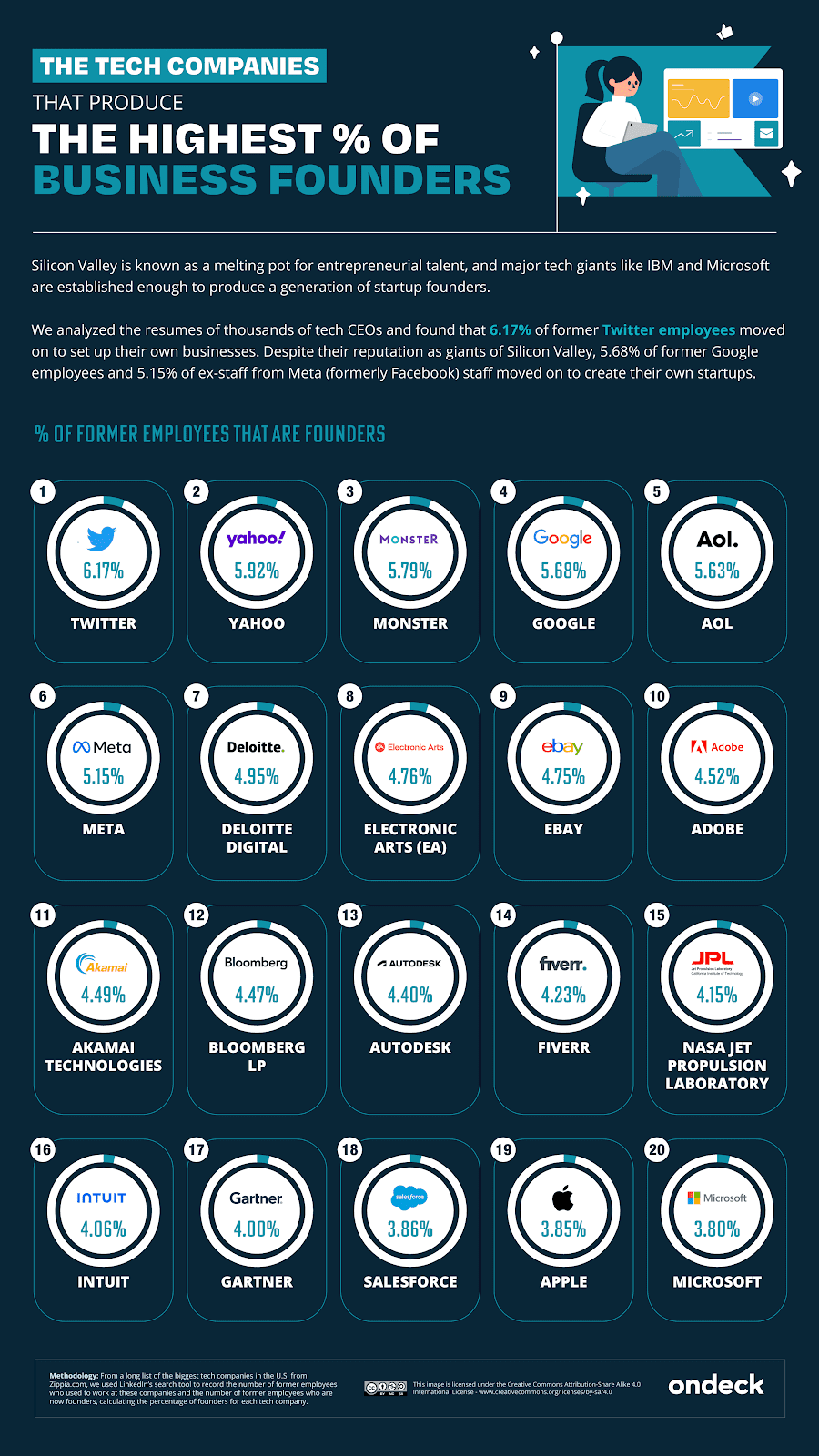
Here's a breakdown of how many of their employees went on to set up companies
  • Twitter: 6.7% of former staff are now business owners
  • Google: 5.9% of former staff are now business owners
  • Meta: 5.15% of former staff are now business owners
  • Microsoft: 3.8% of former staff are now business owners
Antony Pompliano is a former Meta employee who has achieved incredible success as an entrepreneur. After leaving the US Military, Pompliano spent two years working as a Product Manager for Meta, where he led the growth team for Facebook pages.

Pompliano took that experience to launch Full Tilt Capital, an investment advisory firm specializing in digital assets. Full Tilt then became Morgan Creek Digital Assets, which now has over $1billion of assets under management.

It's not about where you are right now; it's about where you want to go in the future. And learning the ropes as a corporate exec can be the springboard to launch yourself toward start-up success.
The 30 U.S. companies that produce the most business founders (study)
The Companies That Produce The Most Business Founders - infographic
The Companies That Produce The Most Business Founders - infographic 2
The Companies That Produce The Most Business Founders - infographic 3
The Companies That Produce The Most Business Founders - infographic 4
The Companies That Produce The Most Business Founders - infographic 5
The Companies That Produce The Most Business Founders - infographic 6
The Companies That Produce The Most Business Founders - infographic 7
The Companies That Produce The Most Business Founders - infographic 8
The Companies That Produce The Most Business Founders - infographic 9
Read next: Survey of almost 500 founders highlights the biggest factors that cause startups to fail
by Irfan Ahmad via Digital Information World

66% of Consumers Worry That Generative AI Could Cause Privacy Issues on Social Media

Generative AI has been one of the biggest leaps forward for tech in recent memory, but in spite of the fact that this is the case a lot of consumers seem to be approaching it with caution. A study from Big Village just revealed that as many as 76% of consumers are worried that images produced using generative AI could end up being abused, with 19% concerned that these abuses could be quite significant.

With all of that having been said and now out of the way, it is important to note that this could make the use of generative AI in social media advertising less useful than might have been the case otherwise. 66% of consumers are worried about how the use of generative AI could impact their privacy, and 60% don’t have all that good of an idea regarding how it can even work in a social media context.


However, it should also be mentioned that 48% of the consumers who responded to this survey have already witnessed generative AI on social media in the past. 48% of them never want to use AI generated faces in social media advertising, going so far as to say that even photoshopped images should be banned with all things having been considered and taken into account.
Fake faces can be harmful because of the fact that this is the sort of thing that could potentially end up giving an unfair representation of the products that are being depicted. That’s why only 25% of consumers said that they are comfortable with both photoshopped as well as AI generated faces in all of the social advertising that they are faced with.

15% said that generative AI is fine but photoshopping isn’t, and 13% said that photoshopped images are acceptable but refused to accept AI generated images. All in all, this is going to prove to be a huge challenge for the burgeoning AI industry to surmount. Marketers have been looking forward to using this tech for social marketing, but studies like this suggest that that might not be a good idea.

Read next: Most SEOs won’t recommend using AI to write their content
by Zia Muhammad via Digital Information World

Saturday, February 4, 2023

Twitter Allows Creators To Start Earning From Tweets As Musk Proposes Charging Developers For Access To Its API

Twitter is giving creators the chance to start earning revenue through the likes of tweets on the platform.

The news is certainly exciting but we’d like to take a moment to announce how there is a catch attached. And that includes how those eager users keen on making money through the platform would be required to first attain the company’s premium Twitter blue subscription.

If you happen to be a creator and are curious as to how this whole endeavor would work, well, we’ve got news for you. Elon Musk is sharing how it’s all very possible through a series of small steps outlined via a recent thread.

He says that the more engagement that a post on the platform gets, the greater the advertising revenue that may be generated by creators. Moreover, Twitter Blue is costing $8 each month. And if you plan on subscribing via the iOS application, you end up paying a little over $11 each month.

Twitter hopes to provide users with small discounts if they end up paying the entire fee for the year and that would mean you get $1 off each month. Obviously, there must be more to just this than simply signing up for the subscription and getting great forms of engagement. This way, the app really hopes to attain the right support page so it can explain the ins as well as the outs of all this soon.

Additionally, this revenue-sharing news came with another announcement including how Twitter hopes to be charging all of its developers a small fee. Musk proposed the new change, claiming it was the right decision for those developers who wished to attain access to the firm’s API. Hence, that would no longer be for free, he adds.

At $100, developers would gain complete access. Moreover, Musk says that before, it was as if the app’s API was being taken for granted as it was for free by both opinion manipulators and bot scammers. With no check and balance in place, it was easy for them to do so many things wrong and there was no verification process in check, he adds.

Now, at about $100 a month, complete with identity verification, it would really be cleaning things up in a great manner. This proposal even outlined how the fee charges would begin as early as next week.

Musk says that Twitter’s data is among the strongest from around the globe and the company is very much committed to ensuring quick and detailed access so users can help work side by side in building a sturdy platform. For now, there were no other details provided on the matter.

Twitter has been setting out both free and paid packages for all users when it comes down to API. Their premium one costs between $149 to $2499 each month and that depends on the number of tweets that developer sends out.

Developers will be using the company’s API to come up with third-party services like Tweetbot and Twitterrific as other options. But such tools had to be shut down as the firm blocked access to the API during the middle part of last month.

Here, the information reported was linked to speculations about the application getting its access suspended as it failed to enable a rise in revenue. Meanwhile, some users of the tool claim that access to it being removed meant that they had no purpose of staying on the app and would like to leave.


Read next: The role of Twitter officials in throwing employees under Musk’s bus
by Dr. Hura Anwar via Digital Information World

Bill Gates Just Called Elon Musk Out for His Improbable Mars Fantasy

One of the many things that Elon Musk is notorious for is making bold claims. Perhaps the boldest of all of these claims involves the tech mogul and recent owner of Twitter stating his desire to travel to Mars. He has often been criticized for not taking part in any significant philanthropic endeavors, but in spite of the fact that this is the case he asserts that he is trying to amass wealth to fund humanity’s push into outer space.

It turns out that Bill Gates doesn’t seem to be a huge fan of this idea. The Microsoft founder recently said in an interview with Amol Rajan of BBC that going to Mars would be incredibly expensive, and that money might be put to better use by funding measles vaccines at $1,000 a pop.

When asked if he believed that Elon Musk would join him and many others such as Warren Buffett in their goal of giving away most of their wealth, Gates said that he was hopeful. With all of that having been said and now out of the way, it is important to note that he also said that Musk is already doing a lot of good through his ventures such as Tesla even if he does not end up becoming a philanthropist.

Musk has often come under fire for his dreams of Mars because of the fact that this is the sort of thing that could potentially end up costing far too much to be feasible in his lifetime. Many assert that he should play his part in improving humanity in the present era instead of saving up for pipe dreams that are impractical and will not address some of the core issues that society is facing right now.

This isn’t the first time that Gates has publicly disagreed with Musk, nor vice versa. The two have often taken opposing viewpoints, which makes sense considering that they have very different ways of doing things with their money. Musk has only given a small portion of his wealth away as charity, or 0.05% to be precise, whereas Gates plans to give it all away.


Photo: BBC

Read next: Bill Gates Shared His Thoughts About ChatGPT And Said It’s Going To Be As Important As PCs Emergence
by Zia Muhammad via Digital Information World

Continuity camera-like feature is on its way for Android users

Apple’s renowned Continuity camera feature is under development for Android devices. Since 2012, Google has given users access to external webcams that can be used with either mobile phones or tablets, using these webcams for video calling. Not only this, but several third-party applications also offer services that would allow mobile phones to be used as a webcam for laptop or desktop calls.

But as per the latest reports, tech giant Google is planning to offer it as a built-in feature to their audience, a feature that works just like Apple's smartphones. Coding for this feature has already been sent to Android Open Source Project Gerrit, where it will be reviewed by engineers. The code was identified by Mishaal Rehman, an AOSP expert. According to Mishaal, Android will soon be able to offer a continuity camera-like feature that can be used on personal computers, whether Chromebooks or Macs.

With this feature on board, Android devices will be identified as having a USB video camera, which will make them compatible with several devices. The latest USB UVC-enabled file has already been created, which will be read by authorized apps only, including the main settings and gadget HAL.

Furthermore, a USB video class device driver has also been boarded on the generic kernel image. It is expected that the mentioned feature will make its debut this year with the latest Android version. However, it won’t be the first time with Android if the feature goes through several versions before reaching the goal that was originally set. Hence, if that’s the case with the feature, then it may take some time.

Those who want to use their mobile phone as a webcam without this feature, they can simply install an app that offers this service. The app needs to be installed on the mobile phone as well as the device with which the phone will be linked. Once the connection has been created, users will be able to use their Android phone as a webcam to be used either in video calls, recording lectures, or streaming.

Photo: The MobileDrop / YouTube

Read next: Android Users Beware, Deceptive Reward Apps Are Making Rounds On Google Play Store
by Arooj Ahmed via Digital Information World

The role of Twitter officials in throwing employees under Musk’s bus

Ever since Elon Musk took over Twitter, the microblogging platform has become controversial with new Twitter policies and a large portion of the employees being laid off by the company.

From the beginning, when Elon Musk showed interest in buying the platform, everyone had their eyes set on what was about to happen. Initially, Elon Musk backed out after showing interest but was later forced to seal the deal.

Since that moment, Twitter employees, or as the company used to refer to them “Tweeps,” had no idea what was about to hit them. A recent study on this whole situation revealed how board members and executives played their role in going against their own words and values just for the sake of upcoming profit.

The top executives of Twitter left their stockholders at Musk’s mercy. Soon to be a trillionaire, Elon Musk offered to buy Twitter at a 38% stock price premium. Which means that he was ready to pay an extra amount to buy the platform. With this offer, the four executives collected $74.3 million. Not only this, but the restricted stock unit and performance stock unit added 138 million dollars to executives’ pockets. Eight non-executive directors also benefited from the deal, as they made 93 million dollars from it.

However, when it came to the employees’ protection, all hands were off deck. The deal didn’t include any limitations, such as how many employees could be laid off or at what pace the whole operation could take place. Not only this, but the deal didn’t include any compensatory steps that will be taken for laid-off workers.
Back in April 2022, Parag Agrawal, the CEO at that time, told employees that the company had no intention of laying off workers. The platform even had a special webpage devoted to the employees working at Twitter. The webpage was aimed at showing how much Twitter valued its staff and supported them. But at the time of action, executives and board members went against their values.

When Elon finally took over the platform, he assigned 80 hours of work per week, with 40 hours to be spent in the headquarters. Followed by making his employees sign an agreement to either follow the long working hours or quit their job. However, the study believes that proper management could’ve prevented the long working shifts.


Read next: Twitter's Verification Process Under Scrutiny: Researchers Uncovers Dozens Of Bot Profiles With Blue Ticks
by Arooj Ahmed via Digital Information World