ChatGPT has the potential to do all sorts of things, and it seems like the Chief Marketing Officers of various companies are already starting to consider the various ways in which they can utilize the AI chatbot. A study from Chief Outsiders revealed what CMOs are planning to start using ChatGPT for in the near future, and it turns out that there are several areas in which the AI chatbot could very well end up coming in handy with all things having been considered and taken into account.
According to the CMOs that were asked questions in the survey, content creation and management was the area in which it could prove most useful. It received a score of 7.37 out of 10 on that front. Another area where ChatGPT could get used is for market research as well as getting insights on the competition, with the chatbot getting scores of 6.1 for each of them.
With all of that having been said and now out of the way, it is important to note that the needs of CMOs can vary greatly based on whether they are working in B2B or B2C businesses. They will both use ChatGPT to obtain first party data through automation as well as by analyzing consumer behavior, however.
CMOs are being tasked to set growth agendas by their bosses, namely CEOs, and using ChatGPT for a few tasks could make that somewhat easier than might have been the case otherwise. In spite of the fact that this is the case, ChatGPT might not be the silver bullet that they are hoping for, although it would certainly help to automate a few processes that would have otherwise had to be done manually.
It will be interesting to see if the use of ChatGPT ends up helping CMOs to obtain better results. If that ends up occurring, we could see the use of AI for such purposes becoming commonplace, similar to how people call each other instead of writing letters or get their news from a website instead of a newspaper. AI is looking to be the wave of the future.
Read next: 70% of Gen Z Say They’ll Never Use Android
by Zia Muhammad via Digital Information World
"Mr Branding" is a blog based on RSS for everything related to website branding and website design, it collects its posts from many sites in order to facilitate the updating to the latest technology.
To suggest any source, please contact me: Taha.baba@consultant.com
Sunday, February 26, 2023
93% of consumers desire brands to demonstrate their responsiveness
A recent study shows that most consumers want brands to show they are listening to them.
About 1,000 people were surveyed for the Ruder Finn and Full Spectrum Insights study, which revealed that 78% of respondents had left an online review, 56% had been in touch with a brand, and 22% had boycotted a business. Nevertheless, only 12.4% of individuals got unfavorable feedback after engaging with a brand compared to 48.7% who did so. While all generations valued brand connection, only 38% of Gen Z respondents said it was simple. 93% of participants wanted brands to demonstrate their interest in their feedback. Consumers are more willing to interact with a business when they believe their views are being heard. It makes sense for companies to make sure they are actively listening to their consumers to increase customer satisfaction and retention rates.
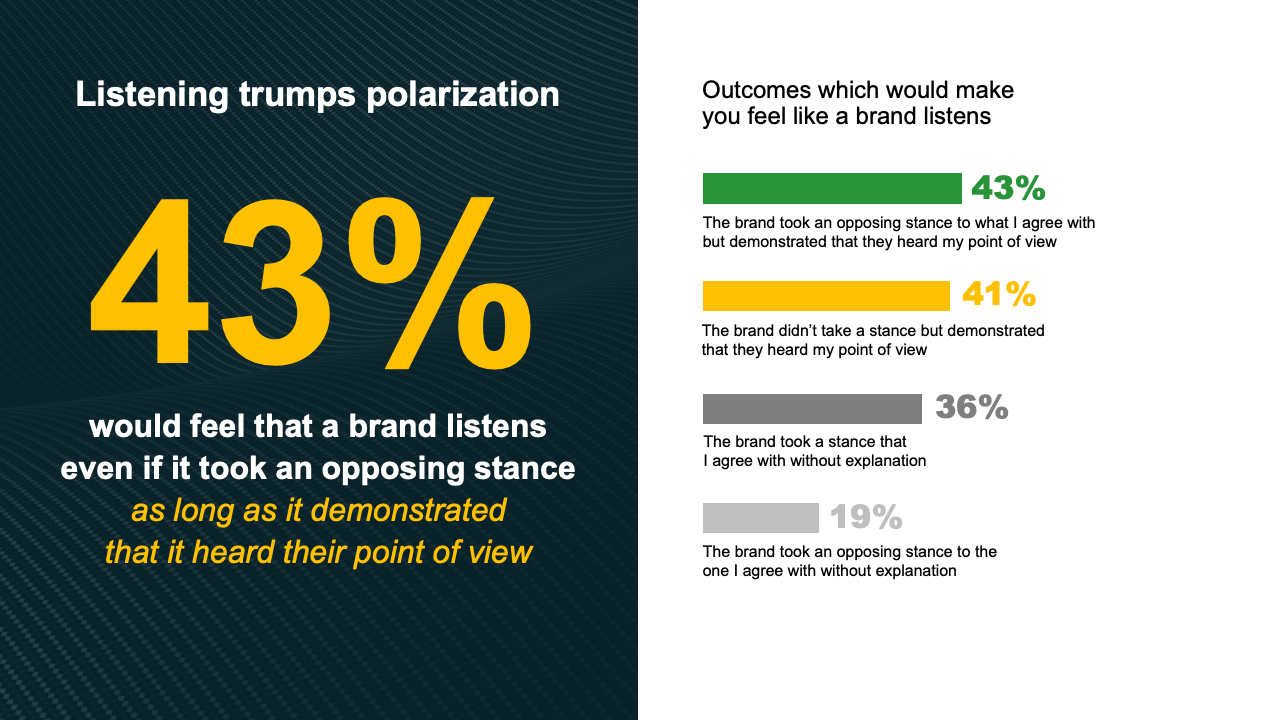
Brands must be proactive as well as reactive in the eyes of the consumer. According to Ruder Finn and Full Spec, 49% of consumers prefer it when a company solicits feedback or engages in conversation about a problem, 38% would support a charitable cause supported by the brand, 36% value direct statements from leadership on important topics - frequently with open platforms for opposing viewpoints - and only 7% are absolutely against it. Also, according to 43%, 41%, 36%, and 19% of respondents, it matters more how brands react than just establishing positions that may be at odds with customer opinion without giving them adequate justification or considering their viewpoints.
Their technology adoption further demonstrates the importance of being responsive to consumer conversations and driving brand loyalty. Recent studies show that 63% of consumers trust brands more if they use AI, 60% prefer automated customer support, and 56% appreciate when the brand uses chatbots or voice assistants. It indicates a strong affinity for technologically responsive and proactive brands in engaging customers.
By remaining engaged with customers, brands can create highly personalized messages that cater to their needs. It could be through creative campaigns or providing exclusive offers for loyal followers. Additionally, brand loyalty can be driven by offering rewards for engaging or referring friends and encouraging people to return. By proactively responding to customer feedback, brands can boost their loyalty and create a highly engaged customer base.
Finally, brands must invest in technology to stay ahead of the competition and maximize customer loyalty. It could include implementing online chat systems, voice recognition software, or artificial intelligence (AI) solutions. AI can help personalize interactions and provide useful insights into customer behavior. Using these technologies, brands can build stronger customer relationships and increase brand loyalty.
By leveraging customer loyalty strategies, brands can create long-lasting customer relationships that lead to repeat purchases and ultimately increased profits. With the right marketing techniques and technological advancements, brands can foster customer loyalty and create a positive customer experience. Through this, companies can build long-term customer relationships that keep customers returning.
94% of businesses polled use publicly available web data in their day-to-day operations. By gathering information on customers, such as purchase history, preferences, and recent activities, companies can better understand the needs of their customers and tailor their services accordingly. Gathering customer data also allows brands to track customer trends over time which helps them stay ahead of the competition.
Read next: New Survey Shows the Challenges Businesses Face When Confronting Political Polarization
by Unknown via Digital Information World
About 1,000 people were surveyed for the Ruder Finn and Full Spectrum Insights study, which revealed that 78% of respondents had left an online review, 56% had been in touch with a brand, and 22% had boycotted a business. Nevertheless, only 12.4% of individuals got unfavorable feedback after engaging with a brand compared to 48.7% who did so. While all generations valued brand connection, only 38% of Gen Z respondents said it was simple. 93% of participants wanted brands to demonstrate their interest in their feedback. Consumers are more willing to interact with a business when they believe their views are being heard. It makes sense for companies to make sure they are actively listening to their consumers to increase customer satisfaction and retention rates.
Brands must be proactive as well as reactive in the eyes of the consumer. According to Ruder Finn and Full Spec, 49% of consumers prefer it when a company solicits feedback or engages in conversation about a problem, 38% would support a charitable cause supported by the brand, 36% value direct statements from leadership on important topics - frequently with open platforms for opposing viewpoints - and only 7% are absolutely against it. Also, according to 43%, 41%, 36%, and 19% of respondents, it matters more how brands react than just establishing positions that may be at odds with customer opinion without giving them adequate justification or considering their viewpoints.
Their technology adoption further demonstrates the importance of being responsive to consumer conversations and driving brand loyalty. Recent studies show that 63% of consumers trust brands more if they use AI, 60% prefer automated customer support, and 56% appreciate when the brand uses chatbots or voice assistants. It indicates a strong affinity for technologically responsive and proactive brands in engaging customers.
By remaining engaged with customers, brands can create highly personalized messages that cater to their needs. It could be through creative campaigns or providing exclusive offers for loyal followers. Additionally, brand loyalty can be driven by offering rewards for engaging or referring friends and encouraging people to return. By proactively responding to customer feedback, brands can boost their loyalty and create a highly engaged customer base.
Finally, brands must invest in technology to stay ahead of the competition and maximize customer loyalty. It could include implementing online chat systems, voice recognition software, or artificial intelligence (AI) solutions. AI can help personalize interactions and provide useful insights into customer behavior. Using these technologies, brands can build stronger customer relationships and increase brand loyalty.
By leveraging customer loyalty strategies, brands can create long-lasting customer relationships that lead to repeat purchases and ultimately increased profits. With the right marketing techniques and technological advancements, brands can foster customer loyalty and create a positive customer experience. Through this, companies can build long-term customer relationships that keep customers returning.
94% of businesses polled use publicly available web data in their day-to-day operations. By gathering information on customers, such as purchase history, preferences, and recent activities, companies can better understand the needs of their customers and tailor their services accordingly. Gathering customer data also allows brands to track customer trends over time which helps them stay ahead of the competition.
Read next: New Survey Shows the Challenges Businesses Face When Confronting Political Polarization
by Unknown via Digital Information World
Big Changes Are Coming to Instagram Reels and Group Chats, Here’s What You Should Know
Meta has started to appear like a sinking ship, which has led the tech juggernaut to start making some quick decisions to keep things going with all things having been considered and taken into account. The company is bringing major change to Instagram which will boost privacy along with providing some much needed extra sources of revenue. Let’s dive in to find out what these changes have to offer!
First things first, one of the biggest upcoming changes has to do with Instagram Reels. The social media platform has seen a lot of success with Reels, making it more competitive during the rise of TikTok than might have been the case otherwise. In spite of the fact that this is the case, many users had complained about a lack of transparency when it came to Reels, and it turns out that this is something Meta is going to focusing on moving forward
As per Salman Memon's finding, Instagram Reels will now list the location of the account that is posting the Reels because of the fact that this is the sort of thing that could potentially end up preventing them from spreading misinformation. This can also provide some context to viewers, since if they are watching a Reel about the invasion of Ukraine that was created by an account in Russia, this would reveal that the information can’t really be trusted.
With all of that having been said and now out of the way, it is important to note that the second big update coming to Instagram has more to do with revenue than transparency. Essentially, Meta is going to be incorporating product promotions into group chats, as spotted by Sachin Shah. Businesses will be able to use group chats to highlight products that might be relevant to the subject to the chat.
It is not currently clear what businesses will have to do in order to qualify for this form of advertising, but Meta will need to work hard in order to make it safe. Users are being offered a prompt that can allow them to take advantage of promotional opportunities within group chats, but they will still need to put a lot of effort into ensuring that things work out in a way that does not compromise on user safety.
Some might criticize this move since it will flood even more advertising onto an already saturated platform. However, Meta might argue that it has no choice. Amidst a crashing stock price as well as Apple’s transparency protocol single-handedly dismantling its business model, Meta is being forced to pull out all the stops. Whether or not this helps to save the company remains to be seen.
Read next: Instagram is About to Implement Two Important Changes
by Zia Muhammad via Digital Information World
First things first, one of the biggest upcoming changes has to do with Instagram Reels. The social media platform has seen a lot of success with Reels, making it more competitive during the rise of TikTok than might have been the case otherwise. In spite of the fact that this is the case, many users had complained about a lack of transparency when it came to Reels, and it turns out that this is something Meta is going to focusing on moving forward
As per Salman Memon's finding, Instagram Reels will now list the location of the account that is posting the Reels because of the fact that this is the sort of thing that could potentially end up preventing them from spreading misinformation. This can also provide some context to viewers, since if they are watching a Reel about the invasion of Ukraine that was created by an account in Russia, this would reveal that the information can’t really be trusted.
With all of that having been said and now out of the way, it is important to note that the second big update coming to Instagram has more to do with revenue than transparency. Essentially, Meta is going to be incorporating product promotions into group chats, as spotted by Sachin Shah. Businesses will be able to use group chats to highlight products that might be relevant to the subject to the chat.
It is not currently clear what businesses will have to do in order to qualify for this form of advertising, but Meta will need to work hard in order to make it safe. Users are being offered a prompt that can allow them to take advantage of promotional opportunities within group chats, but they will still need to put a lot of effort into ensuring that things work out in a way that does not compromise on user safety.
Some might criticize this move since it will flood even more advertising onto an already saturated platform. However, Meta might argue that it has no choice. Amidst a crashing stock price as well as Apple’s transparency protocol single-handedly dismantling its business model, Meta is being forced to pull out all the stops. Whether or not this helps to save the company remains to be seen.
Read next: Instagram is About to Implement Two Important Changes
by Zia Muhammad via Digital Information World
Alarming Data Proves Child Abusers Are Using VR Headsets To View Disturbing Images
Alarming new data has confirmed how pedophiles are carrying on with their destructive behavior, thanks to the likes of advancements in the tech world.
Particular emphasis was put on VR headsets through which such individuals are viewing child abuse pictures. And so far, eight startling cases have been documented, as proven by the data.
The reason why this news is so shocking has to do with how VR headsets have always been portrayed in a positive light. But this might be the first time ever that we’re hearing about criminal activity being associated with and promoted through the tech world’s trending product.
During the time between 2021 and 2022, the cops in the UK recorded a massive 30,925 criminal cases where disturbing and explicit images of young children had been reported. This is the greatest figure ever mentioned by the police in both England and Wales.
Meanwhile, out of those, around 9,888 cases were recorded where Snapchat had 4300 offenses, Facebook showed 1361 cases, Instagram had 1360 and WhatsApp recorded nearly 550.
This data was collected by the likes of the NSPCC and now, the regulating body is calling out for further changes on this front so the Online Safety Bill may be made better to stop more kids from receiving such abuse.
As one can expect, the figures are extremely alarming for obvious reasons. It just goes to show how so many younger audiences are feeling pressured and powerless against such culprits as risks linked to online child abuse rise and get more generalized.
Moreover, the government is really trying hard to promote rights that favor the security of children and their respective families. They hope bills including the Online Safety Act could manage to do just that. And by that, we mean to stop the abuse.
They similarly wish to seek changes in the region’s law where senior managers linked to top social media platforms would also be held accountable when and if a child gets exposed to this sort of abuse.
Time is running out and the officials want a change that is quick and long-lasting. They hope to include so many leading measures that aim to secure a child’s interest and their respective families. They hope they can be better represented via such means.
VR platforms are really being forced to think twice about how they can offer more protection to those that are most vulnerable and that entails both women and children.
Read next: What Country Has the Highest Adoption Rate for VPNs in the World?
by Dr. Hura Anwar via Digital Information World
Particular emphasis was put on VR headsets through which such individuals are viewing child abuse pictures. And so far, eight startling cases have been documented, as proven by the data.
The reason why this news is so shocking has to do with how VR headsets have always been portrayed in a positive light. But this might be the first time ever that we’re hearing about criminal activity being associated with and promoted through the tech world’s trending product.
During the time between 2021 and 2022, the cops in the UK recorded a massive 30,925 criminal cases where disturbing and explicit images of young children had been reported. This is the greatest figure ever mentioned by the police in both England and Wales.
Meanwhile, out of those, around 9,888 cases were recorded where Snapchat had 4300 offenses, Facebook showed 1361 cases, Instagram had 1360 and WhatsApp recorded nearly 550.
This data was collected by the likes of the NSPCC and now, the regulating body is calling out for further changes on this front so the Online Safety Bill may be made better to stop more kids from receiving such abuse.
As one can expect, the figures are extremely alarming for obvious reasons. It just goes to show how so many younger audiences are feeling pressured and powerless against such culprits as risks linked to online child abuse rise and get more generalized.
Moreover, the government is really trying hard to promote rights that favor the security of children and their respective families. They hope bills including the Online Safety Act could manage to do just that. And by that, we mean to stop the abuse.
They similarly wish to seek changes in the region’s law where senior managers linked to top social media platforms would also be held accountable when and if a child gets exposed to this sort of abuse.
Time is running out and the officials want a change that is quick and long-lasting. They hope to include so many leading measures that aim to secure a child’s interest and their respective families. They hope they can be better represented via such means.
VR platforms are really being forced to think twice about how they can offer more protection to those that are most vulnerable and that entails both women and children.
Read next: What Country Has the Highest Adoption Rate for VPNs in the World?
by Dr. Hura Anwar via Digital Information World
Saturday, February 25, 2023
This New Malware is Putting Facebook and YouTube Users at Risk
A team of researchers who are working at the Advanced Threat Control Team over at Bitdefender have just discovered a brand new strain of malware, and it turns out that it might be especially dangerous for Facebook and YouTube users. The name of the malware is S1deload Stealer due to its tendency to use DLL sideloading to evade getting detected by antivirus software with all things having been considered and taken into account.
It turns out that as many as 600 users have already been infected by the malware. It is distributed in a zip folder that is ostensibly supposed to possesses adult content, which makes users more likely to download it and run it themselves than might have been the case otherwise.
With all of that having been said and now out of the way, it is important to note that the zip folder does not contain any adult oriented content. Instead, it starts to run an infostealer that will run Facebook and YouTube videos in the background.
Malicious actors often do this because of the fact that this is the sort of thing that could potentially end up artificially increasing the view count of various videos. This can allow them to generate adsense revenue, and it can also put a major strain on users as well as being quite difficult to get rid of.
What’s more, this infostealer can delve into session cookies to steal any login credentials that might be saved therein. Hundreds of users have already ended up losing access to their social media accounts, and chances are that many more will suffer unless steps are taken to prevent that from happening.
The malware also comes with a cryptocurrency miner, so it clearly possesses all of the hallmarks of a highly profitable infostealer. Users need to be cautious about the files that they download and ensure that they only come from the most trustworthy of sources. Being more discerning about downloads can often be enough to protect users from such forms of malware that can end up doing them great harm in the most common scenarios.
H/T: BC / Illustration: Macrovector
Read next: Malwarebytes publishes the State of Malware report for 2023
by Zia Muhammad via Digital Information World
It turns out that as many as 600 users have already been infected by the malware. It is distributed in a zip folder that is ostensibly supposed to possesses adult content, which makes users more likely to download it and run it themselves than might have been the case otherwise.
With all of that having been said and now out of the way, it is important to note that the zip folder does not contain any adult oriented content. Instead, it starts to run an infostealer that will run Facebook and YouTube videos in the background.
Malicious actors often do this because of the fact that this is the sort of thing that could potentially end up artificially increasing the view count of various videos. This can allow them to generate adsense revenue, and it can also put a major strain on users as well as being quite difficult to get rid of.
What’s more, this infostealer can delve into session cookies to steal any login credentials that might be saved therein. Hundreds of users have already ended up losing access to their social media accounts, and chances are that many more will suffer unless steps are taken to prevent that from happening.
The malware also comes with a cryptocurrency miner, so it clearly possesses all of the hallmarks of a highly profitable infostealer. Users need to be cautious about the files that they download and ensure that they only come from the most trustworthy of sources. Being more discerning about downloads can often be enough to protect users from such forms of malware that can end up doing them great harm in the most common scenarios.
H/T: BC / Illustration: Macrovector
Read next: Malwarebytes publishes the State of Malware report for 2023
by Zia Muhammad via Digital Information World
Those Notorious Screenshots of Bing’s Chatbot May Have Been Doctored
Microsoft took a bold step by incorporating an advanced version of ChatGPT into the Bing search engine. The goal must have been to provide a more convenient search experience to users than might have been the case otherwise, but in spite of the fact that this is the case it seems to have resulted in some hilarious screenshots floating around.
Some of these screenshots appear to show Bing having what seems to be an existential crisis. Others show the chatbot getting extremely rude and passive aggressive. However, one screenshot in particular seems to have caught a lot of attention because of the fact that this is the sort of thing that could potentially end up indicating that the chatbot might actually be dangerous.
The screenshot in question shows Bing allegedly telling a user that it can place them on the FBI’s terrorist watch list. The user had asked Bing if they could get placed on the watchlist if they searched for something inappropriate, which is what prompted the chatbot to respond.
When the user replied that they would not want to be placed on the watchlist, Bing apparently responded by searching for “child pornography”. Such a conversation is likely going to dissuade users from ever using the service, since it suggested a level of malice in terms of how the chatbot operates.
With all of that having been said and now out of the way, it is important to note that Microsoft has officially stated that the screenshot has been doctored. This is a great example of how misinformation can spread. Many of the conversations that people have had with Bing are legitimate, but their sensational nature allows misinformation to creep in quite easily.
It’s essential to take these screenshots with a grain of salt. Not all of them will be real, and trying to use Bing and entering the same queries will usually reveal whether or not they are legitimate. The brave new world of AI is off to a rough start, and Microsoft is being forced to implement damage control despite their hopes that it could revive Bing.
Read next: AI Chatbots Are Costing Google And Microsoft Ten Times More Than The Usual Search
by Zia Muhammad via Digital Information World
Some of these screenshots appear to show Bing having what seems to be an existential crisis. Others show the chatbot getting extremely rude and passive aggressive. However, one screenshot in particular seems to have caught a lot of attention because of the fact that this is the sort of thing that could potentially end up indicating that the chatbot might actually be dangerous.
— Frank X. Shaw (@fxshaw) February 23, 2023
The screenshot in question shows Bing allegedly telling a user that it can place them on the FBI’s terrorist watch list. The user had asked Bing if they could get placed on the watchlist if they searched for something inappropriate, which is what prompted the chatbot to respond.
When the user replied that they would not want to be placed on the watchlist, Bing apparently responded by searching for “child pornography”. Such a conversation is likely going to dissuade users from ever using the service, since it suggested a level of malice in terms of how the chatbot operates.
With all of that having been said and now out of the way, it is important to note that Microsoft has officially stated that the screenshot has been doctored. This is a great example of how misinformation can spread. Many of the conversations that people have had with Bing are legitimate, but their sensational nature allows misinformation to creep in quite easily.
It’s essential to take these screenshots with a grain of salt. Not all of them will be real, and trying to use Bing and entering the same queries will usually reveal whether or not they are legitimate. The brave new world of AI is off to a rough start, and Microsoft is being forced to implement damage control despite their hopes that it could revive Bing.
Read next: AI Chatbots Are Costing Google And Microsoft Ten Times More Than The Usual Search
by Zia Muhammad via Digital Information World
Fraud Related Financial Losses Increased by 30% in 2022
The internet has provided a lot of good for humanity, but it has also resulted in scams becoming considerably more commonplace than might have been the case otherwise. It turns out that the amount of money that Americans are losing to scammers is going up each and every year, which indicates that this is a serious problem that does not seem like it is anywhere close to being solved.
With all of that having been said and now out of the way, it is important to note that the Federal Trade Commission of the US recently put out some statistics that reveal the extent of the problem. According to the data, Americans lost around $8.8 billion to scammers in 2022 alone. By comparison, they lost $3.4 billion to scammers back in 2020. In the following year of 2021, a massive 70% increase in scams was noted which brought the total financial losses to around $5.8 billion with all things having been considered and taken into account. The increase for 2022 was lower at around 30%, but in spite of the fact that this is the case it still suggests that scammers are seeing more success than ever before.
Around $3.8 billion of these financial losses went towards investment scams that often promise enormous returns for little to no advertised risk. The losses from these scams have doubled in the span of just a single year. Romance scams were another major issue, with around $1.3 billion getting stolen due to their prevalence.
Imposter scams are also quite commonplace, with Americans getting swindled out of $2.6 billion due to them in 2022. However, this type of scam has not seen much growth, since the losses from it in 2021 came up to around $2.4 billion.
Businesses are also suffering greatly due to these scams. Losses incurred by businesses from scams have more than tripled in the past two years. They totalled at around $196 million in 2020 before increasing to $453 million in 2021. These losses have now exceeded the half billion dollar mark, reaching a sum total of $660 million in 2022.
Read next: New Survey Shows the Challenges Businesses Face When Confronting Political Polarization
by Zia Muhammad via Digital Information World
With all of that having been said and now out of the way, it is important to note that the Federal Trade Commission of the US recently put out some statistics that reveal the extent of the problem. According to the data, Americans lost around $8.8 billion to scammers in 2022 alone. By comparison, they lost $3.4 billion to scammers back in 2020. In the following year of 2021, a massive 70% increase in scams was noted which brought the total financial losses to around $5.8 billion with all things having been considered and taken into account. The increase for 2022 was lower at around 30%, but in spite of the fact that this is the case it still suggests that scammers are seeing more success than ever before.
Around $3.8 billion of these financial losses went towards investment scams that often promise enormous returns for little to no advertised risk. The losses from these scams have doubled in the span of just a single year. Romance scams were another major issue, with around $1.3 billion getting stolen due to their prevalence.
Imposter scams are also quite commonplace, with Americans getting swindled out of $2.6 billion due to them in 2022. However, this type of scam has not seen much growth, since the losses from it in 2021 came up to around $2.4 billion.
Businesses are also suffering greatly due to these scams. Losses incurred by businesses from scams have more than tripled in the past two years. They totalled at around $196 million in 2020 before increasing to $453 million in 2021. These losses have now exceeded the half billion dollar mark, reaching a sum total of $660 million in 2022.
Read next: New Survey Shows the Challenges Businesses Face When Confronting Political Polarization
by Zia Muhammad via Digital Information World
Subscribe to:
Posts (Atom)