Monday, June 12, 2023

Revealing the Most Beloved Apps: 10% App Downloads Growth in May

With the advent of June, we find ourselves immersed in the realm of mobile app downloads, eagerly uncovering the most coveted applications that have captivated users worldwide. The lineup of the most popular apps in May exhibits some resemblances to the rankings of April, but there have been notable changes that pique our interest. Without any delay, let's delve into the specifics and uncover the intriguing shifts that have taken place.

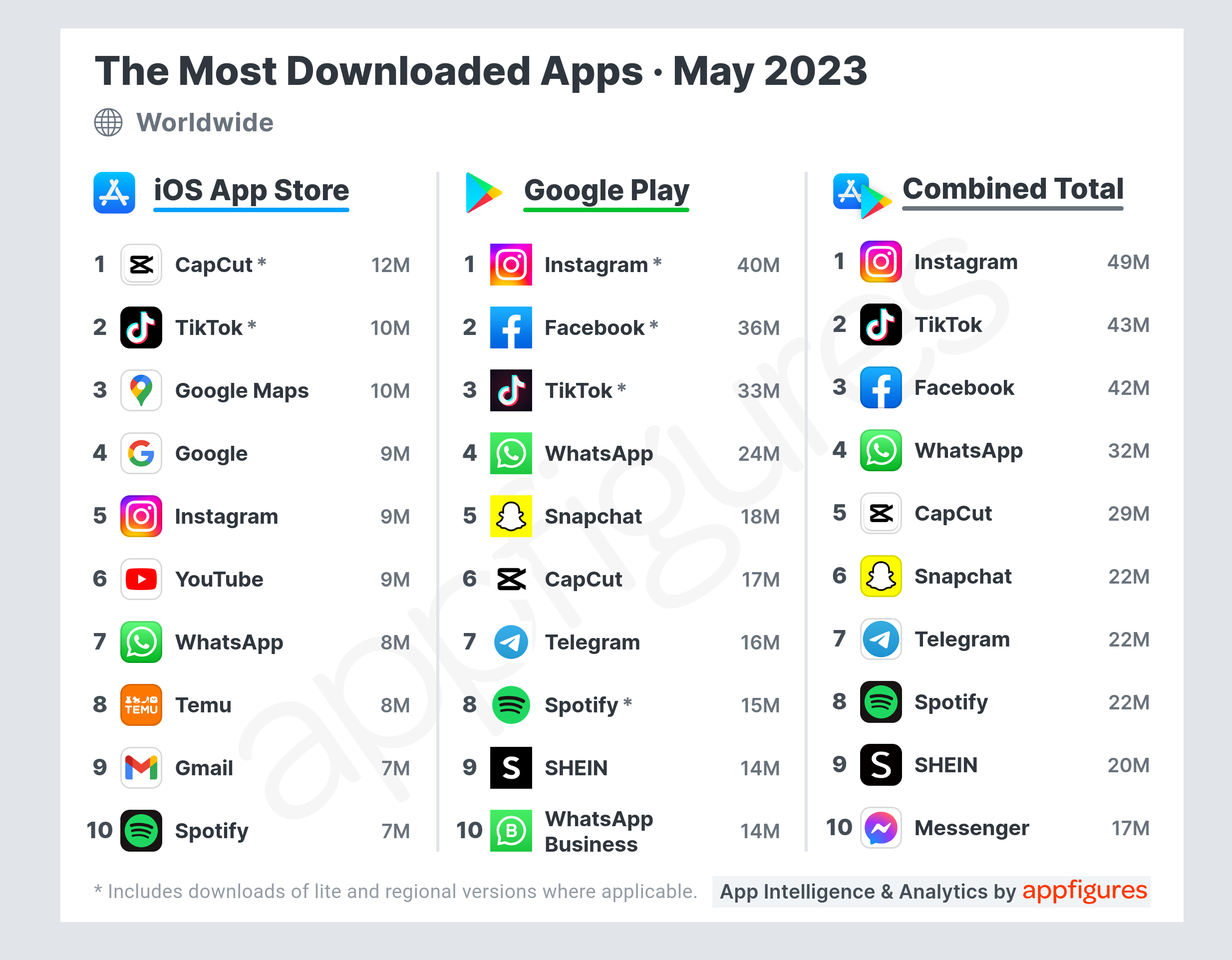
Instagram emerged as the frontrunner in global app downloads during the month of May. App Intelligence data reveals that Instagram experienced an extraordinary surge in popularity, attracting a remarkable 49 million new users from both Google Play Store and App Store. The month-on-month growth in downloads reached an impressive 12 percent, positioning May as the second-most successful month for Instagram in terms of app downloads this year. Notably, this achievement also marks the third consecutive month that Instagram has secured the coveted top position in the app download rankings.

Following closely behind is TikTok, a rival social media platform that has been playing catch-up to Instagram since March, relinquishing its previous position of dominance. However, TikTok witnessed a remarkable resurgence in May, accumulating a notable 43 million downloads, reflecting a substantial 19 percent surge compared to April. Despite this impressive growth, TikTok still falls short of Instagram's popularity, largely due to its unavailability in the Indian market.

Although TikTok may have a slight advantage over Instagram in terms of App Store downloads, the difference between the two is not significant enough to claim the top position overall.

In general, the month of May has seen a positive trajectory for app downloads, with all the apps in the AppFigures extensive list recording growth in user downloads. However, it is worth noting that Meta's Messenger app remained unchanged in terms of its download figures. This stagnant performance may have prompted Meta to explore alternative strategies, such as the development of a Twitter clone, in an effort to regain momentum and stay competitive in the market.

In the list of the most downloaded apps in May, data shows Facebook, WhatsApp, and CapCut solidifying their positions in the top 5. Interestingly, this lineup mirrors the identical top five apps list from April, with only a slight change in the rankings. Specifically, Facebook and TikTok have switched positions, while the others have maintained their consistency in the rankings.

CapCut, a widely recognized video editing software associated with TikTok, has maintained its position as a powerful force in the field. Recording approximately 29 million downloads in May, slightly higher than the previous month, it is clear that this pattern of popularity is on a steady incline.

Based on the insights provided by App Intelligence, it is evident that the most popular apps in May achieved a remarkable milestone by being downloaded on a staggering 298 million iOS and Android devices worldwide. This represents a notable increase of 10 percent compared to the total number of downloads recorded in April. As we embark on the summer season, there is strong anticipation for June to witness an even higher surge in app downloads, given the ongoing demand and thriving popularity of mobile applications.

In conclusion, May experienced a notable 10 percent surge in app downloads compared to April, reaching a remarkable 298 million devices worldwide. The strong demand for mobile apps is expected to persist in the coming months, highlighting the continued significance of mobile technology in our daily lives.

Read next: Mobile App Revenue Report Reveals TikTok's Monetization Dominance Over Gaming Apps
by Ayesha Hasnain via Digital Information World

Sunday, June 11, 2023

Revolutionizing Ads with An Advanced Bot; Zuckerberg's Ambitious Vision for AI

During a podcast conversation with Lex Fridman, the Chief Executive Officer of Meta, Mark Zuckerberg revealed his strategy for integrating artificial intelligence (AI) into the company's future plans. Zuckerberg emphasized the implementation of a wide variety of Large Language Models (LLMs) customized to meet the diverse requirements of different industries and individuals. One particular area of interest is fostering companionship through AI assistants that facilitate friend connections, aid in remembering important dates like birthdays and enhance overall social engagement.

In Zuckerberg's vision for the future, AI assistants are poised to transform into multifaceted companions, playing the roles of mentors, life coaches, and cheerleaders. These virtual companions will provide invaluable support and motivation to individuals as they navigate life's challenges and seek personal growth. By harnessing the capabilities of advanced language models, Meta aims to revolutionize the way people communicate by overcoming the inherent limitations of traditional methods. With these innovative tools at their disposal, users will be empowered to articulate their thoughts and emotions more effectively, transcending the boundaries of conventional expression. Through the fusion of artificial intelligence and human interaction, Meta envisions a future where individuals can truly unlock their potential and forge deeper connections with others in a more authentic and meaningful manner.


In addition, Zuckerberg emphasized how AI can play a crucial role in streamlining business transactions. Meta's platform offers creators the opportunity to utilize AI assistants, which can aid in negotiating with brands and establishing advantageous collaborations. Meta envisions a future where ad agencies become unnecessary for brands as the company's integrated language and image models can generate customized ad units based on the brands' objectives. This approach ensures that brands reach their target audience effectively and efficiently.

Meta has established itself as a prominent player in the AI technology landscape, competing alongside industry leaders such as Microsoft and Google. However, what truly distinguishes Meta is its unwavering dedication to openness and collaboration within the field of AI development. In stark contrast to other companies that have faced scrutiny for their lack of transparency, Meta places great value on the concept of open-sourcing technology. This strategic approach is believed to cultivate an environment of innovation by granting wider access to resources and empowering the broader community to contribute their insights and feedback.

Mark Zuckerberg, Meta's CEO, recognizes the immense potential of community-driven training and the collaborative spirit it fosters. By embracing the principles of open-source, Meta aspires to create a nurturing ecosystem that nurtures creativity, encourages exploration, and inspires the generation of novel ideas. Through this approach, Meta envisions unlocking a wealth of innovation within the AI realm while proactively identifying and addressing potential risks and challenges that may arise. By prioritizing transparency and active community involvement, Meta seeks to establish a strong foundation for the responsible and ethical advancement of AI technologies.

Regarding concerns about AI's existential risks, Zuckerberg acknowledged the need for ongoing discussions as technology progresses. However, he emphasized that addressing immediate challenges, such as misuse of AI tools, remains crucial regardless of potential future risks.

In conclusion, Zuckerberg's vision for AI revolves around enhancing social connections and transforming advertising practices. Meta's AI assistants aim to improve users' friendships and facilitate meaningful interactions, while also revolutionizing the way businesses negotiate and advertise. As Meta continues to innovate in the AI space, Zuckerberg stresses the importance of balancing future risks with addressing present challenges and maximizing the positive impact of AI technology.


Read next: Google Provides Innovative Insights On Its Imagen Editor Tool For Text-Guided Photo Edits
by Ayesha Hasnain via Digital Information World

Extortion Scammers Are Making Explicit Deepfakes From Public Photos

The phenomenon of “sextortion” is by no means unique to the present era. The term refers to scammers digitally manipulating pictures in order to make it seem like the person in the photograph is taking part in explicit deeds. These pictures are then used to blackmail the person, with the malicious actor behind the scam threatening to publicize these pictures. The victim ostensibly pays the extortion scammers in order to prevent them from posting the manipulated pictures.

With all of that having been said and now out of the way, it is important to note that the existence of AI has allowed scammers to take their malicious activities to the next level. Social media has also made it easier for scammers to get their hands on public pictures than might have been the case otherwise. The combination of these two innovations is creating a dangerous situation because of the fact that this is the sort of thing that could potentially end up leading to sextortion scams rising in number and severity.

The FBI has gone public with a statement claiming that they are receiving a concerningly high number of reports of this nature. Scammers are taking publicly posted photos and then using them to create AI generated nudes which can then be used to blackmail the victim.

Another way in which this scam is being conducted is that malicious actors are using AI generated pictures of minor girls to trick underage boys into exchanging nudes. These nudes are then used in the aforementioned blackmail schemes, revealing that even minors are not safe from these types of practices.

States like California have already started to draft legislation that will serve to outlaw deepfakes once and for all. It will be interesting to see where things go from here on out, since the rise in the number of these incidents may result in widespread harm done to children as well as to adults. It bears mentioning that the current bills that are attempting to get passed only target non-consensual deepfakes, but the reactive nature of the legal system may lead to all deepfakes getting banned before too long.


Read next: From Manipulation to Breach: How Social Engineering Tactics Compromise Cybersecurity
by Zia Muhammad via Digital Information World

Could AI Make the Loneliness Epidemic Worse?

The current bout of loneliness that seems to be gripping all of America is often attributed to the Covid-19 pandemic. In spite of the fact that this is the case, the pandemic simply sped up a trend that was already occurring, and while it made it worse than might have been the case otherwise, it bears mentioning that the loneliness epidemic has been growing for quite some time. Genuine physical (in real life) social interactions are declining, and it turns out that AI might be making things even worse.


With all of that having been said and now out of the way, it is important to note that the Surgeon General of the US recently put out a report revealing the negative health symptoms of loneliness. It turns out that this much loneliness is equivalent to smoking twelve cigarettes, and some are beginning to refer to this as a “friendship recession”.

Young people are being especially hit by loneliness, with them spending only forty minutes with their friends per day on average. This has gone down considerably, with the number being as high as two hours and thirty minutes a day just two decades ago.

With AI now replacing socialization in so many ways, many are beginning to wonder if it will exacerbate the current loneliness pandemic. It makes it somewhat less necessary to talk to others since AI can answer most of your questions for you, and this is leading to many young people lacking the necessary daily social interaction that they require in order to stay healthy.

Even weak social ties, such as bidding your neighbor a good morning or waving to a co-worker, have been shown to have a demonstrably positive impact on one’s mental and physical wellbeing. More interactions with a diverse range of people can allow for several health benefits to start to take shape, but with AI replacing the need for these interactions to such a tremendous degree, we might begin to see the loneliness epidemic become accepted as a normal part of life.

Immersive AI can often act as a replacement for interaction, such as with apps like Replika. That could further disrupt normal socialization and cause the loneliness epidemic to spiral out of control.

Read next: The Rise of Ghostbots: What You Need to Know About AI-Powered Digital Reincarnations
by Zia Muhammad via Digital Information World

Parents Overusing Phones May Lead to Smartphone Addiction Among Teenagers According to This Study

A lot of research has been done into the harmful impact that smartphones can have if used by teenagers. In spite of the fact that this is the case, it appears that negativity can come about even if parents are the ones doing the scrolling. A study that was recently published in Frontiers in Psychology revealed that parental phubbing, which refers to when parents ignore their children to use their phones, can lead to smartphone addiction among adolescents.

With all of that having been said and now out of the way, it is important to note that this study sourced its data from around 1,200 Chinese adolescents who are currently in junior high. A higher rate of parental phubbing was found to directly coincide with higher rates of smartphone addiction. Adolescence can be a challenging time because of the fact that this is the sort of thing that could potentially end up putting strain on relationships, and many teenagers are turning to smartphones in order to get over their loneliness.

A low level of cohesion between children and parents coupled with a general lack of friendships in a child’s social life are proven to be detrimental in this regard. This can also lead to a cascading effect that can make the addiction harder to overcome than might have been the case otherwise.

Children that turn to smartphones and social media due to loneliness might get sucked into an addictive user interface that preys on their developing minds. This study has revealed that parents should not place the blame squarely on children for their smartphone usage, but should rather look inwards to see if they might be contributing to the problem at hand.

One thing that might make this study less reliable is its use of self reported data. However, it does seem to point to a glaring issue that does not get talked about often enough whenever teenage smartphone addiction is being discussed. More research will be needed to get to the bottom of this data, after which even more patterns might start to emerge.


Read next: Survey Finds Majority of Parents Concerned About Negative Impact of Social Media Image Editing Apps and Filters on Children’s Body Image
by Zia Muhammad via Digital Information World

In Just 15 Minutes, Create your voice with Apple’s New ‘Personal Voice’ Feature

Apple has unveiled two new features, Live Speech, and Personal Voice, as part of its accessibility updates for iOS 17. Live Speech allows users to type their messages and have them spoken aloud during phone calls and in-person conversations. It also enables the saving of commonly used phrases for quick responses. Personal Voice, on the other hand, caters to individuals at risk of losing their ability to speak, particularly those diagnosed with conditions like amyotrophic lateral sclerosis (ALS). By reading a set of text prompts and recording 15 minutes of audio, users can create a synthetic voice that sounds like their own. This voice can then be integrated with Live Speech for use in FaceTime calls and personal interactions.


Apple's commitment to accessibility has been well-known, and these new features further demonstrate their dedication. For individuals like Philip Green, who was diagnosed with ALS, the ability to communicate with loved ones in a voice that resembles their own is invaluable. Green commended Apple's efforts, stating that being able to create a synthetic voice on an iPhone in just 15 minutes is extraordinary.

The Personal Voice feature gives hope to individuals with ALS and other speech-impairing conditions, offering them a means to communicate in their own voice.

Apple's dedication to accessibility extends beyond these two features. The company has also announced various other accessibility updates that will be introduced later this year. Apple has consistently led the way in providing inclusive features, and their commitment to improving the lives of individuals with disabilities is commendable.

The tech giant emphasizes the importance of considering accessibility features for everyone, as it is inevitable that many will require them at some point in their lives. Whether due to aging or unforeseen circumstances, the need for accessibility can arise for anyone. The Personal Voice feature, in particular, is encouraged for all users to set up, as the ability to speak can diminish rapidly, and it may be too late to establish this feature once it is needed.

Unlike other voice synthesis tools that rely on uploading voice samples to the cloud, Personal Voice operates entirely on-device, ensuring privacy and security for users. Additionally, users will have the option to sync their voices across devices using iCloud encryption.

In conclusion, Apple's introduction of Live Speech and Personal Voice showcases its commitment to accessibility and improving the lives of individuals with speech impairments. These features provide a means for individuals at risk of losing their ability to speak to communicate effectively and maintain their unique voices. As accessibility becomes increasingly important, Apple's dedication to pushing boundaries in this area deserves recognition.

Read next: China Still Fears Apple’s AirDrop And Will Soon Introduce New Legislature On The Feature
by Ayesha Hasnain via Digital Information World

Saturday, June 10, 2023

Google Provides Innovative Insights On Its Imagen Editor Tool For Text-Guided Photo Edits

Tech giant Google is giving out more insights on its respective Imagen Editor which is an exclusive tool that’s designed to enable inpainting.

For those who might not be aware, this is a unique form of text-guide picture edits where users have to practically edit visuals that are either taken manually or produced through technology. This means you’re saved from redoing an image completely with this endeavor.

On a bigger scale, this Imagen Editor enables users to put out pictures, select regions that they’d like to edit, and then add text prompts for a certain area. Meanwhile, the rest of the image isn’t touched, the Android maker revealed.

One common example that the company provided related to this particular tool was a picture where a dog’s body was on display and it was altered to include a new kind of attire featuring a red-toned spacesuit. On the extreme right, you’ll find a rocked produced from cardboard with the biggest impression being the addition of gaming headphones in the color blue.

On the other hand, we saw Google lay down a few more examples and some more research on the matter. But it’s not launching this Imagen Editor for the public to benefit as it cited major issues in regards to making the best use of AI technology.

In the same way, it was putting out EditBench which is a meaningful way to gauge the quality of models designed to edit pictures.

As far as the practicality of such a feature is concerned, it’s related to the tech giant pointing out how it may enable fast, controllable, and even automatic forms of edits as the best answer when you might be short on time or have a limited budget.

Remember, recreating an image may sound simple but it’s a complex task that consumes so much time, not to mention how it requires a hefty budget.

The news of this tool comes at a time when we’re seeing Google Photos attain a new project called Magic Editor. This is designed to leverage parts of the world of generative AI technology.

As far as products being offered to consumers are concerned, we’re talking about Imagen and more similar models that need to be up for grabs for those making use of Google Slides. But don’t worry as the testing for this feature has started only recently where users can design customized backgrounds for Google Meet.


Read next: ChatGPT May Have Launched Like A Rocket But It’s Declining In Growth As Google Bard Records Great Performance
by Dr. Hura Anwar via Digital Information World