In the world of tech, 2023 is shaping up to be a year filled with innovation and opportunity. Gartner's recent survey sheds light on the advice for technology leaders, and it's all about growth, collaboration, and operational efficiency.
First things first, the focus is on what needs to be accomplished in the upcoming year. Growth is the buzzword, and it's on everyone's lips, especially CEOs. It's like the New Year's resolution for businesses, except it's about expansion, not hitting the gym.
Productivity, surprisingly, doesn't get much love on the priority list. Maybe tech leaders are onto something we haven't figured out yet. But what's interesting is that the worry over recession has eased, and now it's all about business risks. The tides are changing, my friends.
In this evolving landscape, CIOs have a couple of action items on their to-do list. They need to set the stage for a robust business strategy and paint the AI future that executives can bet on. CEOs are on the hunt for "responsible profitability" and continue their journey into the digital realm.
Digital is like an endless adventure, and companies are just setting sail or barely mid-voyage. As for supply chains, "reglobalization" and talent are hot topics. It's like a plot twist in a business novel.
But, let's not forget that AI is taking center stage in boardroom discussions. CEOs are eyeing it, likely getting help from our AI buddy, ChatGPT. AI is set to make waves, and CIOs are looking at it for growth, not layoffs.
Now, how do tech leaders navigate this exciting world? Studies offer different opinions, but partnering with business leaders investing in digital technology is key. It's like a tech-business convergence—sharing the load and success.
Franchising digital delivery is a buzzword, too. It's about businesses and IT owning the process together. Co-ownership is the secret sauce, leading to better outcomes and reducing risks. It's like turning your business ship into a well-oiled machine.
Now, when it comes to investments, the usual suspects are in the spotlight: cybersecurity, data analytics, cloud platforms, and AI/machine learning. No surprises there. Tech leaders are preparing for a digital revolution.
But how can CIOs contribute to growth? It's all about simplifying the business, finding AI treasures, and exploring new digital opportunities. Think of it as a treasure hunt with a tech twist.
For midsize companies, it's a different ball game. They're focused on operational excellence and looking to integrate their tools. Security vendor consolidation is trending, and the cloud is evolving for them. It's like the midsize companies are the superheroes of operational efficiency.
Feel free to explore the following charts for additional insights:
H/T: Gartner/ PCMAG
So, 2024 promises to be a year of growth, innovation, and collaboration in the tech world. Get ready for the ride, because it's going to be a wild one!
Rad next: IDC's Crystal Ball Reveals GenAI's Magical Ascension
by Irfan Ahmad via Digital Information World
"Mr Branding" is a blog based on RSS for everything related to website branding and website design, it collects its posts from many sites in order to facilitate the updating to the latest technology.
To suggest any source, please contact me: Taha.baba@consultant.com
Saturday, October 21, 2023
Netflix's Price Hike Dilemma: To Stream or Not to Stream
In a world where every online service seems to be raising prices faster than your blood pressure during a scary movie, Netflix is no exception. They recently announced a price hike for two of their four plans, leaving consumers scratching their heads like they just watched a plot twist they never saw coming.
So, let's get to the nitty-gritty. A whopping 39 percent of Netflix subscribers and potential binge-watchers are eyeing the exit if the price goes up. That's right; they'd cancel Netflix faster than a TV show you lost interest in after the first season. On the flip side, 31 percent are ready to embrace the cheaper, ad-supported plan, probably thinking they can endure those annoying ads – it's like a quirky friend who talks too much.
But hold on, there's still that 29 percent who are raising their hands for the ad-free bliss. They refuse to compromise, and honestly, who can blame them? After all, who wants to hear about car insurance in the middle of a gripping series?
Now, onto the prices, because, well, money talks, right? The basic plan, which was already a budget option, will now set you back $12 instead of the old $10. Premium Netflix lovers, those who can't get enough of those 4K streaming vibes, are looking at a future bill of $23, up from $20. But don't worry, the ad-free standard plan is holding steady at $15.49, while the ad-supported cousin is still hanging out at $6.99.
Oh, and here's a little plot twist of our own: a recent survey revealed that those who savor their Netflix sans ads are less likely to jump ship. A whopping 48 percent of them are sticking around for the good stuff. Only 17 percent in this group can even fathom the horror of watching ads. It's a tough choice, but hey, it's like picking between your favorite characters in a show – you just can't make everyone happy.
Courtesy of Civic Science.
In the wild world of video streaming, price hikes are the new normal. So, as Netflix tries to balance its books, subscribers are left pondering whether it's worth sticking around for the next season of their binge-watching journey. The choice is yours, fellow couch potato, and it's a comedy-drama all on its own.
Read next: Meta's Wild Ride: Facebook's Funhouse Losing Steam
by Irfan Ahmad via Digital Information World
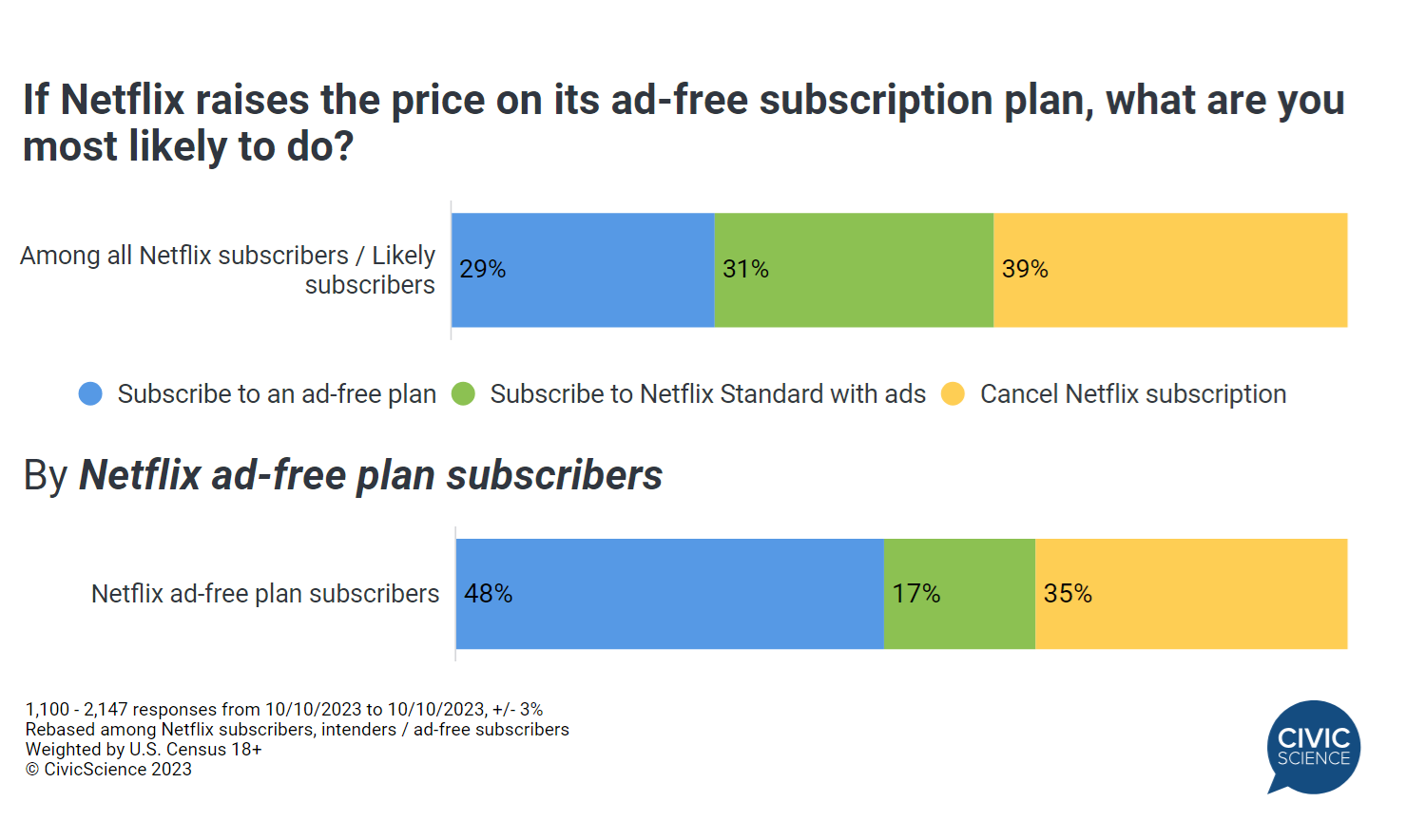
So, let's get to the nitty-gritty. A whopping 39 percent of Netflix subscribers and potential binge-watchers are eyeing the exit if the price goes up. That's right; they'd cancel Netflix faster than a TV show you lost interest in after the first season. On the flip side, 31 percent are ready to embrace the cheaper, ad-supported plan, probably thinking they can endure those annoying ads – it's like a quirky friend who talks too much.
But hold on, there's still that 29 percent who are raising their hands for the ad-free bliss. They refuse to compromise, and honestly, who can blame them? After all, who wants to hear about car insurance in the middle of a gripping series?
Now, onto the prices, because, well, money talks, right? The basic plan, which was already a budget option, will now set you back $12 instead of the old $10. Premium Netflix lovers, those who can't get enough of those 4K streaming vibes, are looking at a future bill of $23, up from $20. But don't worry, the ad-free standard plan is holding steady at $15.49, while the ad-supported cousin is still hanging out at $6.99.
Oh, and here's a little plot twist of our own: a recent survey revealed that those who savor their Netflix sans ads are less likely to jump ship. A whopping 48 percent of them are sticking around for the good stuff. Only 17 percent in this group can even fathom the horror of watching ads. It's a tough choice, but hey, it's like picking between your favorite characters in a show – you just can't make everyone happy.
Courtesy of Civic Science.
In the wild world of video streaming, price hikes are the new normal. So, as Netflix tries to balance its books, subscribers are left pondering whether it's worth sticking around for the next season of their binge-watching journey. The choice is yours, fellow couch potato, and it's a comedy-drama all on its own.
Read next: Meta's Wild Ride: Facebook's Funhouse Losing Steam
by Irfan Ahmad via Digital Information World
Meta's Wild Ride: Facebook's Funhouse Losing Steam
In the whimsical world of Meta Platforms Inc., the third quarter brought a carnival of innovation, from AI wizardry to the launch of Threads, a new social playground. But don't let the flashy lights and catchy tunes distract you from the alarming signs of wear and tear on the merry-go-round of its advertising empire.
Let's take a spin on this amusing rollercoaster of numbers and insights:
According to SimilarWeb data, worldwide, Facebook.com had a -6.4% tumble when it comes to web traffic, while Instagram.com surprisingly surged by 2.9%.
In the Land of Stars and Stripes, Meta's mobile apps had a bumpy ride when it comes to monthly active users. Facebook -3.8% decline, and Instagram -8.2%.
For some context, Threads is still ahead of Bluesky, another social media contender. Threads boasts a whopping 65 million monthly active users globally just on Android, while Bluesky, well, it's still sipping on a small invite-only cocktail. Threads may be the new kid on the block, but it's no match for the big shots like X, Instagram, or Facebook.
Will there be a surprising plot twist? These digital numbers paint a gloomy picture, but Meta's magic tricks might have a surprise in store. They're working on audience growth strategies while juggling cost control initiatives and diversification away from their ad-centric past.
So, as the Meta circus marches on, with Threads doing somersaults and the metaverse keeping us entertained, who knows what surprises the next act will bring?
Take a look at the charts below for more insights:
Read next: Meta's Threads Surpasses X in Q3 Downloads: A Deep Dive into DataAI's Latest Insights
by Irfan Ahmad via Digital Information World
Let's take a spin on this amusing rollercoaster of numbers and insights:
Facebook's Freefall:
Traffic to Meta's business hub, business.facebook.com, took a nosedive of 11.4% in Q3, hinting at a waning enthusiasm for placing ads or any monkey business with Facebook, Instagram, and the Meta gang.According to SimilarWeb data, worldwide, Facebook.com had a -6.4% tumble when it comes to web traffic, while Instagram.com surprisingly surged by 2.9%.
In the Land of Stars and Stripes, Meta's mobile apps had a bumpy ride when it comes to monthly active users. Facebook -3.8% decline, and Instagram -8.2%.
Where's the Party, Threads?
Threads joined the circus in July, creating quite a buzz. However, the initial frenzy turned into a muffled hum. In the US, September saw Threads on Android take a nosedive of 40% from its launch days.For some context, Threads is still ahead of Bluesky, another social media contender. Threads boasts a whopping 65 million monthly active users globally just on Android, while Bluesky, well, it's still sipping on a small invite-only cocktail. Threads may be the new kid on the block, but it's no match for the big shots like X, Instagram, or Facebook.
The Metaverse Masquerade:
Meta, once the shining star of the metaverse, is still dancing to that tune. Their Meta Quest 3D headsets and other hardware are gaining traction. The website for Meta's Horizon Worlds metaverse had a traffic fiesta over the summer, showing promise.Will there be a surprising plot twist? These digital numbers paint a gloomy picture, but Meta's magic tricks might have a surprise in store. They're working on audience growth strategies while juggling cost control initiatives and diversification away from their ad-centric past.
So, as the Meta circus marches on, with Threads doing somersaults and the metaverse keeping us entertained, who knows what surprises the next act will bring?
Take a look at the charts below for more insights:
Read next: Meta's Threads Surpasses X in Q3 Downloads: A Deep Dive into DataAI's Latest Insights
by Irfan Ahmad via Digital Information World
WhatsApp Is Rolling Out Much Needed Chat Privacy Feature and Quick Action Bar
WhatsApp, that trusty companion of late-night secrets and viral videos, is gearing up to unveil a nifty new feature. Soon, you'll be able to cloak your locked chats in secrecy. Yes, you heard it right, your clandestine conversations can be even more covert!
This exciting development comes via the latest WhatsApp beta for Android update, version 2.23.22.9, available on Google Play Store. The brilliant sleuths at WABetaInfo unearthed this gem. So, what's the deal with this new feature? It’s designed to up your chat privacy game by hiding those locked chats more effectively.
At present, the entry point to your locked chats is plain for all to see in your chat list if you've got even one classified convo. Well, the forthcoming update lets you perform some chat magic. After enabling this feature, you can banish that entry point from sight and only reveal it by entering a secret code into the search bar. It’s like having a secret handshake for your chats!
But that's not all, folks! WhatsApp is also showing some love to its business users. With the latest WhatsApp Business beta for Android update, version 2.23.22.10, also on Google Play Store, they're rolling out a snazzy new quick action bar feature.
This feature adds a shiny new icon above the microphone button, making it super convenient for users to perform a slew of actions in a jiffy. You can create orders, access quick replies, and send products from your catalog with ease. These functions were already accessible through the chat attachment menu, but this nifty update makes them more accessible, streamlining interactions with customers.
In conclusion, WhatsApp is stepping up its game with these new features, ensuring your chats stay under wraps while making it a breeze for businesses to engage with customers. So, stay tuned for these exciting updates coming to your WhatsApp soon!
Read next: New study finds that daily time spent on social media has dropped in 36 of 48 markets
by Irfan Ahmad via Digital Information World
This exciting development comes via the latest WhatsApp beta for Android update, version 2.23.22.9, available on Google Play Store. The brilliant sleuths at WABetaInfo unearthed this gem. So, what's the deal with this new feature? It’s designed to up your chat privacy game by hiding those locked chats more effectively.
At present, the entry point to your locked chats is plain for all to see in your chat list if you've got even one classified convo. Well, the forthcoming update lets you perform some chat magic. After enabling this feature, you can banish that entry point from sight and only reveal it by entering a secret code into the search bar. It’s like having a secret handshake for your chats!
But that's not all, folks! WhatsApp is also showing some love to its business users. With the latest WhatsApp Business beta for Android update, version 2.23.22.10, also on Google Play Store, they're rolling out a snazzy new quick action bar feature.
This feature adds a shiny new icon above the microphone button, making it super convenient for users to perform a slew of actions in a jiffy. You can create orders, access quick replies, and send products from your catalog with ease. These functions were already accessible through the chat attachment menu, but this nifty update makes them more accessible, streamlining interactions with customers.
In conclusion, WhatsApp is stepping up its game with these new features, ensuring your chats stay under wraps while making it a breeze for businesses to engage with customers. So, stay tuned for these exciting updates coming to your WhatsApp soon!
Read next: New study finds that daily time spent on social media has dropped in 36 of 48 markets
by Irfan Ahmad via Digital Information World
Friday, October 20, 2023
Lost in AI Translation: Instagram's Language Blunder Sparks Controversy
In the world of tech, sometimes even the smartest algorithms have their "oops" moments. This time, it was Instagram's auto-translation feature that left users bewildered, adding a controversial term where it didn't belong.
Instagram user @ytkingkhan stumbled upon this mishap, sparking a mini social media storm. His bio was a cocktail of "Palestinian" in English, a Palestinian flag emoji, and the Arabic phrase "alhamdulillah." Yet, when Instagram's auto-translation wizard got involved, it concocted a bewildering sentence, insinuating support for "Palestinian terrorists fighting for their freedom."
But here's the twist, remove "Palestinian" and the flag, and suddenly, the Arabic phrase transformed into the more peaceful "Thank God." That's one wild translation ride!
Meta, Instagram's parent company, was quick to acknowledge their blunder and offer an apology, though not before some users accused them of censoring pro-Palestine content. They claim it was a bug that mistakenly shuffled stories and led to posts vanishing from users' feeds, which they insist had "nothing to do with the subject matter of the content."
Social media erupted with confusion and frustration, and one has to wonder, "How did this get pushed to production?" The mysterious origin of digital biases is a real concern, but one thing is clear – tech companies are in dire need of transparency and better quality control.
In the end, Meta sorted the issue out, and now, "Thank God," the translation is far less controversial.
Read next: AI Technology May Be Growing Rapidly But It Fails To Provide Adequate Transparency, New Study Proves
by Irfan Ahmad via Digital Information World
Instagram user @ytkingkhan stumbled upon this mishap, sparking a mini social media storm. His bio was a cocktail of "Palestinian" in English, a Palestinian flag emoji, and the Arabic phrase "alhamdulillah." Yet, when Instagram's auto-translation wizard got involved, it concocted a bewildering sentence, insinuating support for "Palestinian terrorists fighting for their freedom."
But here's the twist, remove "Palestinian" and the flag, and suddenly, the Arabic phrase transformed into the more peaceful "Thank God." That's one wild translation ride!
Meta, Instagram's parent company, was quick to acknowledge their blunder and offer an apology, though not before some users accused them of censoring pro-Palestine content. They claim it was a bug that mistakenly shuffled stories and led to posts vanishing from users' feeds, which they insist had "nothing to do with the subject matter of the content."
Social media erupted with confusion and frustration, and one has to wonder, "How did this get pushed to production?" The mysterious origin of digital biases is a real concern, but one thing is clear – tech companies are in dire need of transparency and better quality control.
In the end, Meta sorted the issue out, and now, "Thank God," the translation is far less controversial.
Read next: AI Technology May Be Growing Rapidly But It Fails To Provide Adequate Transparency, New Study Proves
by Irfan Ahmad via Digital Information World
98% of Deepfakes Are Used in Explicit Content, New Study Reveals
Deepfakes were perhaps the first example of AI’s true capabilities, and they’ve only gotten better over the years. While the first few deepfakes that made the rounds were relatively light-hearted, such as the many videos where people posed as Tom Cruise, it didn’t take long for the more sinister aspects of the tech to come to light.
Their usefulness in political disinformation, or misinformation in general, has already made them a contentious topic. However, the real danger of deepfakes actually lies elsewhere. The 2023 State of Deepfakes by Home Security Heroes revealed that 98% of all deepfakes end up in one specific genre: explicit content.
It’s unsurprising that technology that can flawlessly mimic someone’s appearance is used to make adult videos, but the fact the vast majority of deepfakes are used here is a cause for concern. 98% of the people whose likenesses are used in explicit deepfakes are women, but 48% of viewers are men. More importantly, 74% of men stated that they don’t see anything wrong with explicit deepfakes, or at least they see no reason to feel guilty about it.
Another alarming statistic from this report: there has been a 550% increase in the number of deepfakes online between 2019 and 2023, with all but a few being used in the adult content industry. Sites specializing in explicit deepfakes received just under 5 million unique visitors so far this year, but 7 out of 10 of the most popular adult video streaming sites featured them as well.
If this was simply a question of adult actresses being replaced by AI, this would be a different debate. Of course, most explicit deepfakes don’t involve consent. Countless women have been blackmailed with deepfakes portraying them in a variety of compromising scenarios, and many of these cases can be seen as a form of assault. Minors aren’t safe from deepfakes either, with a recent case in Spain involving 30 young girls all of whom were just 12 to 14 years old.
With women being the main victims, and nearly 3 out of 4 men failing to see how unethical deepfakes are, it’s more important than ever that governments pass regulations to mitigate the massive psychological damage they can cause. Unfortunately, hardly any states have passed laws regarding deepfakes. Fewer still have labelled creating an explicit deepfake without consent a criminal offense, forcing many victims to settle cases in civil court.
Read next: When AI Gets Too Friendly: CEO Altman's Worries About AI Companions
by Zia Muhammad via Digital Information World
Their usefulness in political disinformation, or misinformation in general, has already made them a contentious topic. However, the real danger of deepfakes actually lies elsewhere. The 2023 State of Deepfakes by Home Security Heroes revealed that 98% of all deepfakes end up in one specific genre: explicit content.
It’s unsurprising that technology that can flawlessly mimic someone’s appearance is used to make adult videos, but the fact the vast majority of deepfakes are used here is a cause for concern. 98% of the people whose likenesses are used in explicit deepfakes are women, but 48% of viewers are men. More importantly, 74% of men stated that they don’t see anything wrong with explicit deepfakes, or at least they see no reason to feel guilty about it.
Another alarming statistic from this report: there has been a 550% increase in the number of deepfakes online between 2019 and 2023, with all but a few being used in the adult content industry. Sites specializing in explicit deepfakes received just under 5 million unique visitors so far this year, but 7 out of 10 of the most popular adult video streaming sites featured them as well.
If this was simply a question of adult actresses being replaced by AI, this would be a different debate. Of course, most explicit deepfakes don’t involve consent. Countless women have been blackmailed with deepfakes portraying them in a variety of compromising scenarios, and many of these cases can be seen as a form of assault. Minors aren’t safe from deepfakes either, with a recent case in Spain involving 30 young girls all of whom were just 12 to 14 years old.
With women being the main victims, and nearly 3 out of 4 men failing to see how unethical deepfakes are, it’s more important than ever that governments pass regulations to mitigate the massive psychological damage they can cause. Unfortunately, hardly any states have passed laws regarding deepfakes. Fewer still have labelled creating an explicit deepfake without consent a criminal offense, forcing many victims to settle cases in civil court.
Read next: When AI Gets Too Friendly: CEO Altman's Worries About AI Companions
by Zia Muhammad via Digital Information World
Wednesday, October 18, 2023
Is Elon Musk Really Pulling X (Twitter) out of Europe?
Elon Musk, the owner of the social media platform X, is contemplating the removal of the service from Europe due to new internet regulations, as reported by Business Insider. Musk is frustrated with the Digital Services Act (DSA) in Europe, which requires platforms like X to have transparent systems for content moderation. X is already facing potential violations of the DSA due to the spread of misinformation on the platform.
The European Commission is officially investigating X's compliance with the DSA and may impose fines up to 6% of the company's global revenue. Musk has previously considered limiting Twitter's operations to the United States to cut costs and even closed many of the company's global offices.
Despite no official action yet, most of X's employees in Europe have been laid off, and daily usage in the region has declined significantly. Musk is known for his quick, daring and sometimes unconventional decisions, such as charging users for the platform. Recently, he met with EU Commissioner Breton about compliance with the DSA but he appears to have grown impatient with the situation.
Musk's response to Commissioner Breton's DSA post on X was sarcastic, and he stated he wouldn't engage in secret agreements, Musk has a reputation for taking swift actions when faced with challenges or opposition.
As the situation unfolds, the future of X in Europe remains uncertain, but Musk's willingness to make significant changes is evident.
Photo: DIW
Read next: OpenAI's Billion-Dollar Dreams: Valuation Reaches $86 Billion
by Irfan Ahmad via Digital Information World
The European Commission is officially investigating X's compliance with the DSA and may impose fines up to 6% of the company's global revenue. Musk has previously considered limiting Twitter's operations to the United States to cut costs and even closed many of the company's global offices.
Despite no official action yet, most of X's employees in Europe have been laid off, and daily usage in the region has declined significantly. Musk is known for his quick, daring and sometimes unconventional decisions, such as charging users for the platform. Recently, he met with EU Commissioner Breton about compliance with the DSA but he appears to have grown impatient with the situation.
Musk's response to Commissioner Breton's DSA post on X was sarcastic, and he stated he wouldn't engage in secret agreements, Musk has a reputation for taking swift actions when faced with challenges or opposition.
As the situation unfolds, the future of X in Europe remains uncertain, but Musk's willingness to make significant changes is evident.
Photo: DIW
Read next: OpenAI's Billion-Dollar Dreams: Valuation Reaches $86 Billion
by Irfan Ahmad via Digital Information World
Subscribe to:
Comments (Atom)


