Sunday, November 19, 2023

Instagram Enhances Storytelling with 'My Week' – Your Stories Live for 7 Days

Instagram, always innovating, is constantly brewing up new features and surprises. This time, it's a whole slew of new tricks up their sleeve, aiming to jazz up how we use the app.

There's talk of a bunch of AI-powered stuff coming our way. And hey, they're also fiddling with the Wall feature, like you can pin notes to it, and even ask for a shoutout in Stories. Pretty neat, huh?

But wait, there's more. For those glued to the social media, Instagram's rolling out a new feature called My Week. Heard it from a tech sleuth, Alessandro Paluzzi.

This feature’s all about letting your stories stick around for a full week. My Week, quite a straightforward name, lets you keep your tales alive on your profile for seven days. And the cool part? You can scrap any story you’re not feeling anymore, or sneak in a new one into My Week without making a fuss.
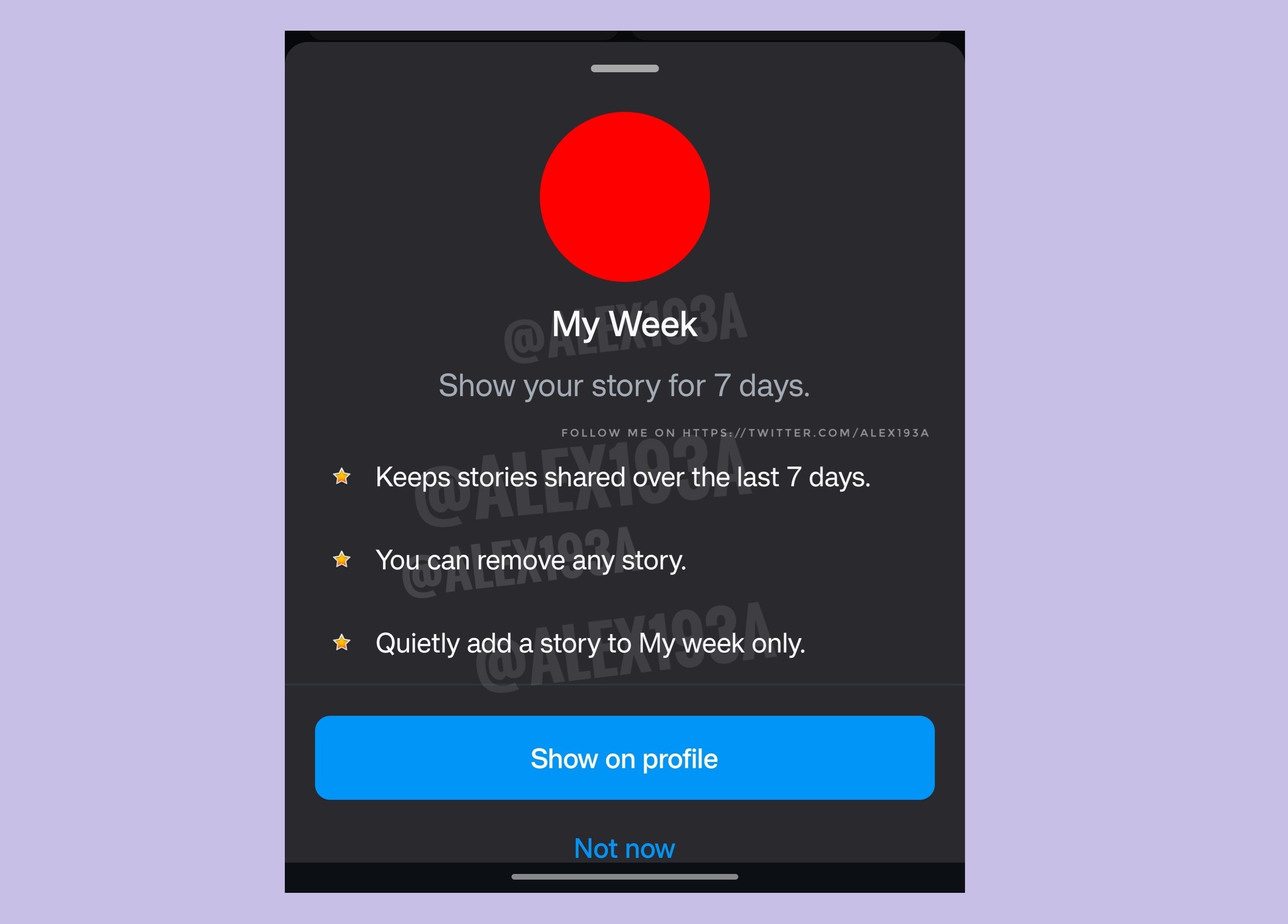
Keep Your Stories Longer: Instagram Unveils 'My Week' 7-Day Feature

There is a caveat though, this feature isn't exactly ready for prime time. It's still baking in Instagram's oven. So, we gotta wait a bit before it's served up, plus it's not clear if Meta, the parent company behind Insta, will roll out it first for Android, web or iOS users. But, honestly, I'm pretty excited about it. Imagine, you can use it for a ton of stuff. Like, setting up a reminder for a whole week, maybe for an event or something totally different. And for the travel buffs out there, constantly hopping from one place to another and sharing their life online, this is gonna be a hit. There's bound to be a bunch of other cool ways to use it, too.

Content creators are in a spot where they could either hit jackpot or find themselves stuck with the same old tools. "My Week" offers them a fresh canvas – a way to keep their narrative alive for a whole week, engaging followers with what feels like a mini-series of their life or work. It opens up new storytelling possibilities, especially with the upcoming AI integrations.

And then there are the businesses and marketers. They're eyeing these features like a new playground for ads and branding. "My Week" and AI tools could revolutionize how they reach out to potential customers. But it's a tricky game – they need to strike the right balance between creative advertising and not overwhelming users with a spammy experience.

Now, Instagram's kinda famous for testing a heap of features all at once. From what we gather, it could be a while before this new feature lands in the beta version or becomes a regular thing on the app. But don't you worry, we're on the lookout. We'll give you the heads up as soon as it’s up and running.

Read next: OpenAI's Leadership Shakeup: A Short Timeline of Sam Altman's Departure and Its Ripple Effects
by Irfan Ahmad via Digital Information World

Saturday, November 18, 2023

OpenAI's Leadership Shakeup: A Short Timeline of Sam Altman's Departure and Its Ripple Effects

Hello DIW readers, did you hear what happened at OpenAI last Friday? Very surprising and upsetting. Sam Altman, who was the boss of OpenAI (the mastermind of ChatGPT), was told to leave by the board. And not just him. Greg Brockman, who helped start OpenAI and was president, also left, along with three important researchers. This is a big change!

I'm sure like me you are trying to understand everything, as everything is moving very fast. For now, I'm listing a timeline to help us see what is happening. Expect further updates as we learn more.

Timeline of Sam Altman Leaving OpenAI

November 16:

Ilya Sutskever Texts Altman: On Thursday, Ilya Sutskever, the cofounder and chief scientist of OpenAI, sends a message to Altman. They plan to talk on Friday. Greg Brockman said this on X (formerly Twitter).

Mira Murati Hears About Altman: Brockman also says that Mira Murati, the CTO at OpenAI, was told Thursday night that Altman will not be CEO anymore.

November 17:

Greg Brockman Not Chairman Anymore: Sutskever asks Brockman for a quick call. After this, Brockman is not the chairman of the board but stays president. Also, Sutskever tell him that Altman has been fired.

OpenAI Tells Everyone: On their blog, OpenAI says there are big changes in who leads the AI startup. The people who manage the company find out just before.

Meeting for Everyone at OpenAI: They have a big meeting on Friday. Sutskever says it was right to fire Altman. He says it is not a bad thing but needed for OpenAI's goals.

Microsoft Talks About It: Satya Nadella, the boss of Microsoft, talks about what happened. He says Microsoft will continue its collaboration with OpenAI, focusing on advancing AI initiatives..

Brockman Leaves Too: After all that happens, Brockman decides to leave OpenAI. He tells people inside and on X.

Other Researchers Leave: After Brockman, three big researchers, like Jakub Pachocki and Aleksander Madry, also leave.

November 18:

Not Because of Bad Things: OpenAI’s COO, Brad Lightcap, sends a letter saying the decision was not because of bad actions. It was a misunderstanding between Altman and the board. But there are worries about how it was done.

Money Problems for OpenAI?: A report claims OpenAI might not get as much money as they thought. Maybe the value of the company will be less because of these changes.

Altman's Next Project: Altman tells the world he wants to start a new company, maybe about AI chips. Brockman might go with him.

Investors Want Altman Back: People who give money to OpenAI are not happy. They want Altman to come back. Even Nadella from Microsoft thinks this is a good idea.
This leadership overhaul at OpenAI, not only raises questions about the company's future direction but also shines a light on the broader, sometimes harsh realities of corporate and startup culture in the tech industry.

Startups Growing Up - Not Always Easy

In startups, founders sometimes have to leave. When companies get big, investors and board members want to achive different objectives. They think more about money, not always about the original idea or dream. This is what maybe happened at OpenAI. It's like this in many startups. They start with a big dream, but as they get bigger, dreams change, and not always in a good way.

Big Companies and Money First

When a company becomes big, they often think more about revenue. Sometimes, they forget about making good products or taking care of their customers. It's sad but true. Big companies can focus too much on making more money and being the only one on top.

What's Happening at OpenAI Now

OpenAI is at a crossroad. They were known for doing good in AI, thinking about ethics. But now, with new leaders, what will happen? Will they stay true to their good goals, or will they change and just think about money and being the biggest? It's a big question that only time will reveal.

Looking at Other Big Tech Companies

We see this kind of story in other places too. Big companies like Uber, WeWork, even Twitter, they all had leadership changes. Founders left, and the companies changed, not always for the better. And very big ones, like Google and Facebook, sometimes they make choices that are good for money but not so good for us, the users.

In the End

This news from OpenAI, it's more than just about one company. It's about a big thing in the tech world that we often called the corporate culture. How companies start with dreams and how those dreams change. It's about money, power, and what really matters. What OpenAI does next, it's important. It will show us if they can keep their good goals or if they will become like others, prioritizing profits over principles.

Photo: DIW

Read next: Disappointment At Peak For Google As Company Forced To Delay Its AI Gemini Model To Next Year

by Web Desk via Digital Information World

DMA Sparks Apple, Meta, Bytedance Objections; Concerns on Gatekeeper Labels, Fair Competition, and Hefty Fines Arise

Apple, Meta, and ByteDance, they're all part of a big showdown in the EU over something they call the Digital Markets Act (DMA). This DMA thing, it's all about putting big tech companies in the spotlight and calling them "gatekeepers." These gatekeepers, they're like the bouncers at the club who control who gets in and who doesn't. And if these gatekeepers do stuff that's not right, the EU says they can get fined.

Now, they've got their eyes on 22 different services run by six big tech giants – Apple, Microsoft, Google, Meta, Amazon, and TikTok's ByteDance. The idea behind all this is to make sure things are fair for us, the consumers. They don't want these companies to play dirty and make life tough for businesses or customers.

So, just the other day, the EU Court of Justice spilled the beans and told us that Apple, yep, the one with the iPhones, they've joined forces with Meta and ByteDance in saying, "Hold on a second, we're not cool with this DMA stuff." But, you know what? They're not spilling the details of why they're upset.

Rumor has it that Apple is not happy with the gatekeeper labels slapped on the App Store and iMessage. And here's the thing, Apple's been making some noise about supporting RCS on iPhones. This move, it might just make the EU think twice about Apple locking customers into iMessage.

But wait, there's more. Microsoft and Google, they seem to be saying, "Alright, fine, you can call us gatekeepers." They're not making a fuss. On the other hand, Meta and ByteDance, they're raising their hands and saying, "Why us? Why are Messenger and Marketplace getting the gatekeeper label? Facebook, Instagram, and WhatsApp are cool though." Meta's argument is that Marketplace is just folks buying and selling stuff, and Messenger, well, that's just chatting on Facebook. It's not some big middleman.

Then there's ByteDance, the folks behind TikTok. They're saying, "We're not a gatekeeper, we're the new kid on the block, trying to shake things up." They reckon calling TikTok a gatekeeper is just protecting the old guard.

Now, the DMA, it's got some serious bite. Companies that don't follow the rules, they could get fined up to 10% of their global earnings. Repeat offenders, they might face even higher fines, up to 20%. And if you thought that's all, there are these regular fines too, up to 5% of their daily earnings. Oh, and they could even be forced to sell off parts of their business if the regulators dig deep and find more wrongdoings.

So, that's the deal. Big tech companies duking it out with the EU over this DMA thing. It's all about fairness, competition, and making sure that no one's playing dirty in the tech playground.

Photo: DIW

Read next: Navigating the Ripple Effect - The Impact of Musk's Words on X Advertising Spend
by Irfan Ahmad via Digital Information World

Friday, November 17, 2023

The New Race in AI: OpenAI's Stumble and the Opportunity for Google and Amazon

OpenAI's recent shake-up has unexpectedly given Google and Amazon an extra edge. Remember ChatGPT's launch in 2022? It was a game-changer, catapulting OpenAI to the forefront. But life in the fast lane of AI innovation isn't without its bumps.

Suddenly, OpenAI's leading lights - CEO Sam Altman and President Greg Brockman - are out. It's more than just a leadership shuffle; it's a narrative twist in the AI chronicle. Altman was shown the door for not being straight with the board, a move that sent shockwaves through Silicon Valley.

This turn of events is a golden ticket for the likes of Google and Amazon. They've been playing catch-up since ChatGPT's debut, and now, OpenAI's internal chaos has thrown them a lifeline. It's a detour from the race for AI dominance, an unplanned pit stop for OpenAI.

Now, OpenAI's laser focus on pushing the boundaries is split. They're on a CEO hunt, a distraction that's not the usual Silicon Valley disruptor tale.

Tech pundit Oren Etzioni puts it well, as per his opinion, OpenAI's valuation might wobble, and its attention could stray. The AI race is long, and this phase might just favor Google and Amazon. It's a marathon, not a sprint.

When news of Altman's exit broke, it stirred the financial pot. Microsoft, heavily invested in OpenAI, felt the tremor in its stock. Conversely, Google and Amazon saw a small uptick. The market senses change.

At an all-hands meeting, OpenAI tried to steady the ship, focusing on its sturdy partnership with Microsoft. Stability was the keyword, according to insiders.

Google might emerge as the biggest beneficiary here. It's been cooking up an AI model, Gemini, set for a launch that's yet to happen. OpenAI's hiccup gives Google extra time to perfect Gemini.

Amazon isn't left out. It once led the cloud-computing revolution, and OpenAI's AI developer network challenges that. Any stumble in OpenAI's stride is Amazon's chance to regain lost ground.

Interestingly, both Google and Amazon have their bets on Anthropic, an emerging AI star rivalling OpenAI. It's a complex, competitive dance in the world of AI, with each player looking for that rhythm that leads to victory.

Photo: DIW

Read next: From Language Models to AGI: Google DeepMind's Journey in Redefining AI's Future
by Irfan Ahmad via Digital Information World

OpenAI Undergoes Major Leadership Change, Appointing Murati As Interim CEO, Amidst Altman's Sudden Departure

The AI landscape is experiencing a significant shift, and it's all because of OpenAI. The organization, renowned as the force behind ChatGPT and the groundbreaking GPT series, has witnessed a notable change in its leadership structure. Sam Altman, a co-founder and a prominent figure in AI innovation, has stepped down from the CEO role. In his place, Mira Murati, a tech genius who has been instrumental in the background, assumes the position of interim CEO. This transition signifies more than a mere alteration in leadership. It marks a fresh epoch in OpenAI's journey, heralding new prospects and directions under Murati's guidance.

Murati, stepping into these big shoes, is feeling a mix of honor and a bit of awe. She's telling the OpenAI team, who are still trying to wrap their heads around Altman's sudden exit, to keep their eyes on the prize and stay true to what they've always been about.

This whole switcheroo wasn't a solo decision. The OpenAI board, a group of some pretty sharp minds, had their say. They felt Altman wasn't quite on the same page anymore, especially when it came to being upfront with them. This all comes just after OpenAI showed off some cool new stuff at their DevDay and amidst some personal drama around Altman.

Altman himself, though, is taking this all in stride. He's looking back at his time at OpenAI fondly and seems pumped for what's next. He's not the only one singing his praises. Big names like Eric Schmidt, the ex-CEO of Google, are calling Altman a hero, a real game-changer. And his brother, Jack Altman, is out there saying Sam's not just smart; he's a really good guy, too.

But wait, there's more. Greg Brockman, another big name at OpenAI, is also changing lanes, stepping down as chairman but sticking around as president. The board's a who's who of tech and AI, with folks like Ilya Sutskever and Adam D’Angelo in the mix.

With Altman at the helm, OpenAI was a rollercoaster, full of big wins and some tough questions about ethics and transparency. Now, the board's betting on new leadership to steer OpenAI into its next big phase.

Murati's been with OpenAI for a good five years, and she knows her stuff – from research to making sure everything's safe and sound. This leadership shake-up? It's more than just a new CEO. It's about rethinking where OpenAI's headed and making sure AI is doing good for everyone.

Here are a few speculative theories circulating about the sudden and shocking leadership change at OpenAI. The full truth might remain unknown for a while.

1. Did the CEO make a major deal without the board's approval?
It's speculated that the CEO might have pursued a significant deal, possibly involving a major tech investor, without board consent. This secret deal could have led to his dismissal.

2. Are there financial discrepancies?
There's speculation about possible financial mismanagement or undisclosed high-cost projects that the CEO might have undertaken, leading to his dismissal.

3. Was there a disagreement on long-term strategy?
Though it seems unlikely, there could have been a clash between the CEO and the board regarding the company’s long-term strategy, especially concerning its financial sustainability.

4. Could it be a security or privacy issue?
Recent internal restrictions on the company’s flagship product suggest a potential security concern. If the CEO underestimated such issues, it could have contributed to trust issues with the board.

5. Is there an intellectual property or legal liability concern?
There are concerns about the company’s use of copyrighted materials in its AI models. If the CEO downplayed these legal risks, it might have worried the board.

6. Were there differences in AI ethics or philosophy?
The CEO's approach to AI, focusing more on corporate and consumer applications, might have diverged from the board's mission-oriented stance, potentially causing friction.

7. Did the CTO instigate a leadership change?
While unlikely, there's a small chance the new interim CEO, previously the CTO, played a role in the leadership change. However, this is mostly speculative.

8. Was it due to personal misconduct?
There's no clear evidence of personal misconduct leading to the CEO's dismissal. The board's statement suggests professional or business reasons.

Photo: OpenAI / YT

Read next: 13% of US Teens Now Use ChatGPT for School Work

by Irfan Ahmad via Digital Information World

The AI Marathon - Pichai's Vision of U.S.-China Synergy in Technology

When you look at the landscape of artificial intelligence, it's clear: China and its AI engineers are stepping up. They're not just playing the game; they're redefining it. Sundar Pichai of Alphabet Inc. sees this. He knows that the future of AI isn't a solo journey. It's a collaboration, a dance of sorts, between giants like the U.S. and China.

At the Asia-Pacific Economic Cooperation conference in San Francisco, Pichai couldn't hide his awe at China's AI strides.

Now, think about this: it's not just tech giants at the table. We're talking about a convergence of minds from Microsoft, Citigroup, Tesla. And they're not just meeting with tech leaders. They're engaging with Presidents Xi Jinping and Joe Biden. This is more than a meeting; it's a melting pot of ideas, a forge where the future of AI is being shaped.

Pichai draws an interesting parallel here. AI and climate change – they're both global challenges that don't respect borders. A glitch in AI in one corner of the world can ripple across the globe. We're all in this interconnected web.

When asked about the principles of ethical behavior in an AI-driven world, Sundar Pichai emphasized, "I think it has to be grounded in the fundamental values of humanity, human rights, and universal human values."

And then there's Gemini, Google's new brainchild. This isn't just another AI. It's a leap into understanding and responding to us in our language. Google isn't just launching a product; they're birthing a new era. And the excitement? It's palpable. This is what Google was made for – moments like these, where the future isn't just imagined; it's built.

Photo: APEC CEO Summit USA 2023 / X

Read next: Galileo Claims GPT-4 Excels in Multitasking with Minimal Hallucinations Among LLMs
by Irfan Ahmad via Digital Information World

Galileo Claims GPT-4 Excels in Multitasking with Minimal Hallucinations Among LLMs

Galileo is a San Francisco based company that helps other companies build fine Large Language Model (LLM) apps. Galileo made a hallucination index that researches about different LLMs and shows which of them hallucinate when faced with multiple tasks at once. Hallucinating is a recurring problem observed in LLMs that result in inaccurate and baseless results. After the research conducted by Galileo, it was found that ChatGPT-4 hallucinates the least when it has to work on multiple tasks.
Galileo worked on different LLMs including Meta’s Llama, but it was soon revealed that many well known LLMs also cannot perform their tasks accurately without hallucinating. This keeps many enterprises from developing LLMs because they cannot work efficiently, especially in healthcare. Open AI’s GPT-4 was the only one that performed well when given tasks.

Identifying LLM Hallucination– How Galileo Checked the Performance of LLMs?

Many enterprises use AI and LLMs for their businesses. But when it comes to production, LLMs aren’t always reliable because sometimes their results aren’t 100%. It is because LLMs work according to the data they are given, and not if the information is factual or accurate. When generative AIs are being developed, there are a lot of things that need to be considered like is it for general use or is it a ChatBot for enterprises?


Companies use benchmarks to monitor LLMs performance, but there is no saying when they will hallucinate. To tackle this problem, co-founder of Galileo, Atindriyo Sanyal, chose 11 LLMs of all sizes and capacities and checked the performance of each of them one by one. He asked those LLMs general questions using TruthfulQA and TriviaQA to monitor their hallucination.

Galileo used its Correctness and Context Adherence metrics because they make it easy for engineers and data scientists to easily find out at what point LLMs are hallucinating. The metrics were focused on logic-based mistakes made by those LLMs.

Correctness Score of LLMs by Galileo

After QnA with LLMs, Galileo came to a conclusion about those LLMs with a correctness score. The LLM with the highest score was GPT-4 (0613) with a 0.77 score. GPT-3.5 Turbo(1106) was just behind with 0.74 score. GPT-3.5 Turbo Instruct and GPT-3.5 Turbo(0613) both had 0.70 correctness score. After the GPT versions came Meta’s Llama-2-70b with 0.65 score. Mosaic’s ML’s MPT-7b Instruct had a 0.40 score.

For information retrieval, GPT-4(0613) still came at the top with a 0.76 score. Zephyr-7b, a model by Hugging Face, surpassed LLama in this category with 0.71 score. Llama had 0.69 score.

The LLM that needed the most improvement and had the lowest points of 0.58 was Mosaic ML’s MPT-7b. UAE’s Falcon 40-b lies just above it with 0.60.

GPT-4(0163) was at the top for correctly generating long forms of texts like essays, articles etc. It has a score of 0.83. Llama came in second with 0.82 correctness score. These two models were the least to hallucinate when given multiple tasks. MPT-7b was the last with 0.53 score.

With Correctness Comes a Cost

As much as reliable ChatGPT-4 seems to be, there is still a factor that makes it less appealing to many–its pricing plan. GPT-4(0613) isn’t free to users but GPT 3.5 also serves almost the same as GPT-4 when it comes to being least hallucinated. There are also other alternatives like LLama-2-70b which is also good in its performance. Plus, it is free of cost.

Read next: AI's Data Dilemma Shows Less Can Be More
by Arooj Ahmed via Digital Information World