Monday, November 27, 2023

Clicker Beware: New Study Reveals the Crypto Search Terms and URLs Most Likely to Contain Malware

The world of cryptocurrency has been a rollercoaster of fortunes and misfortunes, attracting both seasoned investors and newcomers eager for quick riches.

To navigate this landscape, investors must stay vigilant and understand the risks beyond investing. And they include the threat from hackers and criminals. These bad actors are always looking for ways to exploit, deceive, and ensnare crypto enthusiasts. One method involves loading URLs from search results of popular crypto terms with malware and other malicious programs. Oneclick, and the hackers are in your system.

CoinKickOff decided to investigate this very real threat. Its researchers analysed 28,000+ URLs to see which crypto terms most commonly lead to malware or other security risks. They then put all the findings into charts and tables, creating valuable resources to help you avoid these dangerous links.

Here's a full breakdown of the study.

Hackers Targeting Altcoin Investors

Altcoins can yield huge profits if you pick the right coin at the right time. In the frenzy of the crypto bull markets, these coins can surge by thousands of percentage points, turning a few dollars into serious profits.

But what goes up must always come down. And in the crypto world, that comedown crash can wipe out all your gains in seconds.

The get-rich-quick potential of altcoin investments tends to attract a younger, less experienced type of investor. Many have little to no experience with financial products, making them ripe targets for hackers and scammers who circle like sharks.

So it should be no surprise to hear that the most dangerous URLs loaded with potential malware include references to altcoins and altcoin projects.

The CoinKickoff research team found severe red flags in search results for Stellar, a cryptocurrency designed for fast and low-cost cross-border transactions. They contained the highest number of potential malware links. Almost 4 out of 10 (38%) showed signs of malware or ransomware; that's the highest percentage found in the entire study.

Other terms to avoid when researching altcoins online include Aave (36%), Cronos (32%), Tron (30%), and The Graph (29%).

Crypto Wallet Links Hiding Malware

Cybercriminals are a persistent and diligent bunch. They look for (and exploit) every possible opportunity to steal our data and sneak nasty programs onto our devices.

The hacker targeting crypto enthusiasts is no different. They're seeking malware on any crypto-related links, including those in search results for crypto wallets.

Crypto wallets are pretty self-explanatory. A crypto wallet allows individuals to securely store, send, and receive cryptocurrencies like Bitcoin and Ethereum. It consists of a private key for accessing and managing the user's cryptocurrency holdings and a public address for receiving funds.

Crypto wallets allow users to take (virtual) custody of their coins, instead of leaving them on exchanges. Think of exchanges like a bank and a crypto wallet as your personal vault in the basement, with a secret code only you know.

This idea of self-custody is a big deal in the crypto community, especially for the libertarian types who distrust banks, financial institutions, and governments.

But not all wallets are created equal, and not all online searches for wallets are safe.

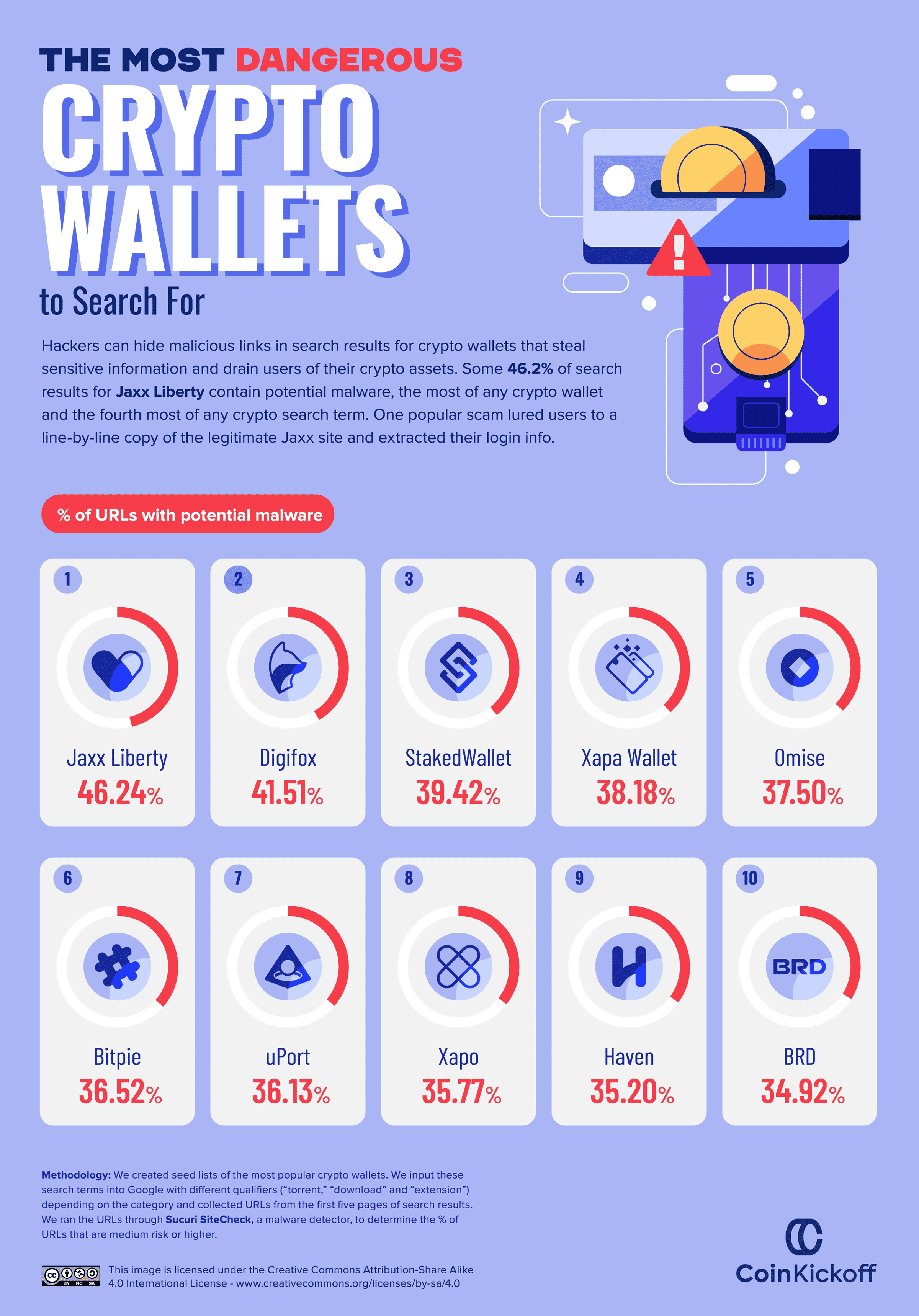
Proceed with (extreme) caution if you're researching Jaxx Liberty wallets. CoinKickoff found that clicking on nearly 47% of URLs mentioning the wallet could turn you into a cyber hacker's next victim.

Cybercriminals are also hiding malware in URLs mentioning Digifox, Staked Wallet, and Xapo Wallet.

"Bad" Crypto Exchange URLs

Let's turn our attention to the cryptocurrency exchange search terms to avoid.

Cryptocurrency exchanges are online platforms that facilitate the buying, selling, and trading of cryptocurrencies. They serve as intermediaries connecting buyers and sellers of cryptocurrencies and provide a marketplace for users to exchange one cryptocurrency for another or fiat currency.

There are an estimated 504 cryptocurrency exchanges to choose from, and search for.

When deciding where to buy your Bitcoin, it's best to avoid researching exchanges like Coinsbit, Latoken, MEXC, and BTCEX. Around 40% of search results for these crypto exchanges contain links that you wish you'd never clicked on.

Instead, stick to the more established players, like Coinbase and Kraken. Neither exchange features in the study, suggesting that the majority of Coinbase/Kraken search results are malware-free.

Malicious Metaverse Links

Next up, the CoinKickOff team looked at the number of malicious links disguised in URLs from popular Metaverse search terms.

Biswap has the dubious honour of coming out on top in this chart. Clicking on Biswap links will take you into an expansive online metaverse ecosystem featuring trading opportunities, NFT platforms, gaming, and virtual marketing spaces.

However, over 40% of these links (42.70%, to be exact) could load up your device or PC with a malware program.

There was also a high percentage of nasty links within search results of other native metaverse tokens, including Efinity Token, Ethernity Chain, and RichQUACK.

The Dangers Lurking within NFT Links

The lack of regulation (and security) within the Non-Fungible Token (NFT) space is a cybercriminal's dream. The NFT ecosystem is anonymous, offers zero consumer protection, and runs on transactions that are 100% irreversible. It's the definition of what some critics have called the "Wild West" economy of digital assets.

And it explains why so many NFT URL search results are loaded with malware designed to steal digital loot from holders.

Searches for Dreadfulz NFTs contain the most danger. CoinKickOff researchers found evidence suggesting that more than 1 in 2 links that come up (51.92%) should never be clicked.

Crypto Mining Links

CoinKickOff rounded off the study with a look at links related to searches for crypto mining software. Crypto mining is the engine of the industry. It’s the complex process of creating new cryptocurrency units and verifying transactions on a blockchain network.

It requires some serious hardware. Miners also need the right software. And this is where the danger lurks for miners or aspiring miners. Searches for several popular forms of mining software, including Hashgains, Startminer, Hashflare, and Etherpool's network, bring up a high number of URLs which may be disguising malware.

But the biggest threat is hiding within searches for OXBTC, a cloud mining software platform. Half of all its search links contain red flags suggesting the presence of malware.

How to Avoid Malware

If you still want to invest in crypto, then you need to do your research. And you need to know how to avoid downloading malware. You can significantly reduce your risk by:
  • Using Reputable Sources: Stick to well-known and trusted websites, forums, and communities for cryptocurrency information.
  • Checking for Phishing Sites: Double-check website URLs for accuracy to avoid phishing sites that mimic legitimate cryptocurrency platforms.
  • Verifying Software Sources: Only download cryptocurrency-related software from official websites or app stores to avoid fake or malicious versions.
  • Keeping Software Updated: Ensure your cryptocurrency wallets and software are updated with the latest security patches.
  • Using Security Software: Install reputable antivirus and anti-malware software to provide additional protection.
  • Enabling Two-Factor Authentication (2FA): Implement 2FA wherever possible to enhance the security of your cryptocurrency accounts.
  • Avoiding Clicking on Suspicious Links: Be cautious when clicking on links in emails or social media, especially if they promise unrealistically high returns or demand urgent action.
Stay safe out there. And good luck!


Read next: The Hidden Cost of Convenience: New Study Exposes the Most Data-Hungry Personal Finance Apps
by Irfan Ahmad via Digital Information World

Putin Unveils AI Plan Emphasizing Cultural Diversity and Global Cooperation, Aiming to Counter Western Influence.

Russia is stepping confidently into the AI frontier, bringing a unique perspective to the table. At an AI conference in Moscow, President Vladimir Putin made a significant announcement: Russia is charting its own course in AI development. This isn’t just about technology; it's about cultural representation in the digital age.

Putin's vision is compelling. He imagines AI that mirrors the world's cultural diversity. It’s a fresh approach, considering most AI today is heavily influenced by Western data and perspectives. Putin's plan? To infuse AI with the richness of global civilizations, ensuring that Russian culture and others are not just footnotes in the digital narrative.

"Our plans include creating a repository for the code of the domestic platform and services that are indispensable for interaction of Russian and international software engineers.", he explained.

But this is more than just talk. Russia is gearing up for serious work in generative AI and language models. They're investing in supercomputing, aiming to transform their AI education, and planning to reshape laws to support this vision. International cooperation is also a key part of their strategy.

Here’s an interesting point of contention, though. Putin is critical of the current AI models. His concern? They tend to overlook non-English cultures, including Russia’s. This, he fears, could lead to a digital world where diverse cultural histories and contributions are invisible.

"I suggest considering granting our partners from friendly countries access to Russian large language and generative models. I am absolutely convinced that the technological world of the future must be multipolar, and we must build it together on the basis of trust and mutually beneficial cooperation. This is what we plan to do.", remarked remarked Mr. Putin.

The global AI landscape, as it stands, is skewed. The US and UK dominate, while Russia lags behind, according to Stanford's Human-Centered AI Institute. This imbalance isn’t just a matter of national achievement. It raises deeper questions about whose voices and values shape the AI of tomorrow.

There's a bit of unease in the scientific community about this, too. Take Geoffrey Hinton, an AI pioneer. He’s openly worried about the misuse of AI, particularly by powerful figures. Putin, however, is undeterred by these concerns. He views the Western hold over AI as something to be challenged, a way to bring balance and inclusivity to the field.

So, what Russia is embarking on isn't just a technological race. It’s about bringing a new cultural dimension to AI, ensuring that the digital world reflects the diversity of human experience. Putin’s vision is to not just catch up but to enrich AI with a broader understanding of our world’s cultural heritage. This journey, with all its technical and cultural aspirations, could very well change how we see and interact with AI in the future.

Photo: Kremlin / YT

Read next: Nations Join Forces to Address the Challenges of Artificial Intelligence Safety
by Irfan Ahmad via Digital Information World

Sunday, November 26, 2023

Nations Join Forces to Address the Challenges of Artificial Intelligence Safety

This Sunday, a big step was taken by the United States, Britain, and 15 other countries. They brought out a 20-page (and 5000+ words) agreement about artificial intelligence (AI) safety. It's about making AI that is safe right from the start.

The agreement says AI should be made and used in a way that keeps everyone safe. It's not a strict rule, but more like good advice "for providers of any systems that use artificial intelligence". It talks about watching AI for wrong use, keeping data safe, and checking who makes the software.

Jen Easterly, who leads the U.S. Cybersecurity and Infrastructure Security Agency, thinks this is very important. She talked to media outlets and said AI shouldn't just be about new features or being cheap. Safety in AI design is what's most important.

"The guidelines are broken down into four key areas within the AI system development lifecycle: secure design, secure development, secure deployment, and secure operation and maintenance", reads the document.

This is part of a bigger effort by many countries to guide AI future. AI is getting more important in work and in our lives. The countries that agreed include Germany, Italy, and others like Australia and Singapore.

The agreement focuses on stopping hackers from using AI in bad ways. But it doesn't answer big questions about how AI should be used or how data for AI is collected.

AI is growing and people worry about it. They fear it could hurt democracy, increase fraud, or cost many jobs.

Europe is doing more about AI rules than the U.S. Countries like France and Germany agree that AI should have rules about how it's used. They want AI models to follow certain codes of conduct.

In the U.S., President Biden wants laws for AI, but Congress is divided and slow to act. The White House, in October, tried to lower the risks of AI to people and national security.

In this effort, everyone is trying to make sure AI is safe and good for everyone. But it's a big challenge and needs everyone to work together.

Photo: DIW - AIgen

Read next: Navigating the New Normal — 73% of Freelancers Integrating AI into Their Workflows
by Irfan Ahmad via Digital Information World

SEO vs CRO: Combine Them for The Best Success

When it comes to marketing strategies, SEO and CRO are the two best options.

While both services are different, you can combine them together to achieve better results.

However, not all businesses know this and often miss out on great opportunities.

If you don’t want to stay behind your competitors, it is best to use them together as a part of your business marketing plan.

Digital Nomads HQ - SEO Agency offers both these services to give you an edge over others. The experts create a consolidated marketing strategy using these two techniques to give a boost to your business.

To know more about SEO vs CRO and how they work together, keep reading this article.

What is SEO vs. CRO?

Image: DIW - AIgen

People often mix up SEO and CRO. They think SEO tricks are the same as CRO or consider boosting conversions as part of SEO. Simply put, they're alike but separate.

SEO works on bringing more people to your site, while CRO works on getting those visitors to do something (signing up for a newsletter or buying a product). CRO basically helps turn the traffic from SEO into actions that benefit you.

SEO and CRO aim for different things, yet marketers often use similar tactics for both. Here are more details about SEO vs CRO.

What is SEO?

Photo: DIW - AI-gen

SEO (Search Engine Optimization) helps raise your website’s position in search engines’ results. When your site lands at the top of search lists, more people discover your business, drop by your site, and eventually make purchases.

SEO plays a vital role in growing any business. Nowadays, people rely on search engines to find what they need. That's why making your website search-friendly matters. Using the right keywords and top-notch content boosts your site's visibility on search engines.

But SEO needs time and patience. It's a continuous process as you have to keep up with new algorithms Google keeps rolling out. It might take 6 to 12 months to really see the impact. Yet, the payoff is huge. Being on the first page of search results means more chances to catch the eye of potential customers.

What is CRO?

Image: DIW- AI-gen

CRO (Conversion Rate Optimization) is about turning website visitors into customers. In marketing, it means shifting their interest into buying what you offer. But it's not just about sales. It includes getting their information by having them sign up for newsletters, fill out forms, or subscribe. These details help stay connected for future conversions.

SEO brings people to your website, but CRO helps turn those visitors into customers. When you tweak your website design and make it user-friendly, it boosts the chances of visitors taking action and buying something. This can increase your conversion rates and bring in more money.

CRO is great because it relies on data from user behaviour, like click rates and time spent on a page, to make smart decisions. It helps spot where visitors might get stuck or confused so you can fix those areas and improve their experience.

Plus, a strong CRO strategy keeps customers coming back. By understanding what makes them tick and using that info along their journey with your brand, you create loyalty through good experiences.

While SEO brings in traffic, focusing only on that without making the website engaging might make visitors leave without doing much. That's why balancing both SEO & CRO is key for lasting growth and hitting business goals.

SEO vs CRO: What’s the Difference?

SEO vs CRO
Image: DIW

SEO vs CRO work differently. CRO relies on the traffic generated by SEO, but they don't always work together for the same goal. SEO aims to boost website visibility and get more visitors, while CRO focuses on turning that traffic into meaningful actions. Here are more details on SEO vs CRO:

SEO

When comparing CRO to SEO, there are some SEO aspects that don't really play into CRO. Here are a few:

1. Invisible stuff

SEO involves building elements within your website that boost its value, like meta tags, alt tags and schema markup. These aren't visible to users but matter a lot for SEO; however, they don't directly impact CRO.

2. Traffic focus

SEO works on getting more traffic and attention to your site through rankings and site improvements. CRO uses that traffic differently. It aims to turn visitors into customers instead of just getting more traffic, as SEO does.

3. Keywords

SEO relies heavily on specific keywords to drive traffic. CRO focuses more on appealing to customers rather than using specific keywords. Changing keywords for CRO purposes can mess with your SEO strategy.

CRO

CRO's job is to turn traffic into action. While it uses the traffic from SEO, there are parts of CRO that don't need SEO:

1. Non-indexed pages

These pages aren't seen by search engines, so SEO isn't a concern. They just need to offer a great user experience for a successful CRO.

2. Grabbing attention

CRO focuses on engaging customers, whether through marketing or user experience. SEO, on the other hand, focuses on keywords and search engine rules to get noticed on search result pages.

3. Design

Good design boosts user experience, which is crucial for a successful CRO. But sometimes, the design that's great for users might clash with SEO needs. Trying to please search engines can hurt user experience, affecting CRO. Finding the right balance in design is key.

Why CRO and SEO Are Both Necessary for Success?

Image: DIW

Here's why both SEO vs CRO are crucial for a successful digital marketing plan:
  • SEO helps you find your audience and makes it simple for them to discover your site.
  • CRO steps in once they're there. It’s all about making it tempting and effortless for them to buy from you.
To really succeed, you need a mix of both. Ignoring one means missing out on key parts of your sales plan.

Imagine focusing only on getting to the top of search results without caring about user experience; you'd miss out on potential sales. On the flip side, if you only concentrate on making your site conversion-friendly without minding SEO, people might struggle to find you. It's all about finding that balance.

SEO vs CRO: How to Combine Them Together for Better Results?

Image: DIW

SEO vs CRO aim for different things but ultimately want the same: success for your business. Even though they're different, when you bring them together, they create the best outcomes. Here are some SEO and CRO tips you can follow to blend the two strategies effectively in your marketing plan for great results:

1. Optimize your content for conversions and well as ranking

When you're creating new content for your website, think about how it'll affect both your conversion rate and your site's ranking. Changes for one might not always favour the other. Be cautious not to harm your SEO efforts while focusing on CRO and vice versa.

For instance, an SEO expert might suggest removing a floating form to speed up the site, which helps SEO. But that form might be crucial for CRO, so ditching it could hurt your conversion strategy.

These dilemmas happen a lot. It's vital to streamline your site while keeping a strong conversion path. A/B testing your web or landing pages helps strike the right balance.

2. Improve the user experience of your website

This is one of the best SEO and CRO tips you can follow to improve user experience. When people search on Google, it suggests things to help them out. But how do you get Google to notice your website?

By focusing on what users want and creating content that matches their needs, you can boost your site's ranking and make it visible on Google. So, how can you make your site better for users and improve its ranking, getting more conversions? Here are some ideas:
  • Optimize your conversion process
  • Use call to action
  • Have a responsive design
  • Educate your leads
  • Create easy-to-digest content
  • Speed up your website
  • Enhance scrolling experience
  • Get feedback
Creating a great user experience isn't easy. You've got to build a strong bond with customers to keep them coming back. How do you do it? By understanding how users behave on your site and interact with your products.

3. Develop SEO and CRO strategy with goals

Create a smart CRO and SEO plan that works hand in hand. When you're starting from scratch or redesigning your site, it's crucial to set clear goals for what you want to achieve.

Here's a step-by-step guide to using SEO and CRO tips:

Set business goals

Figure out what you want to achieve. Is it doubling website traffic in five months or boosting conversions by 30% by the end of 2023? Clear goals help align CRO and SEO efforts.

Check your site

Do a thorough check of your website using tools like Google Analytics. Find areas for improvement in content, design, and technical performance.

Keyword research

Understand the keywords your audience uses in searches. This helps optimize your content for better rankings.

Optimize your site

Make improvements based on your site audit and keyword research. Work on technical aspects, user experience, and content relevance.

Plan content

Create a strategy for content creation and optimization. Target the right keywords and plan how to promote your content.

CRO tactics

Once your site is SEO-ready, focus on strategies to enhance conversion rates. Tweak layout, content, calls to action, and checkout processes.

Track and adopt

Monitor your efforts closely. See what works and what needs fixing. Adjust your strategies accordingly.

Ensure everyone involved shares their actions to avoid conflicting strategies. Whether you outsource or manage in-house, keep a check on every action for a balanced approach.

4. Create relevant and quality content for SEO that aligns with search intent

Creating SEO content is one of the best CRO and SEO tips to follow. Your content should always match what your audience is searching for. Aim to produce top-notch content that boosts your visibility in search results without sacrificing elements crucial for CRO.

Search intent broadly falls into four categories: Informational, Commercial, Navigational, and Transactional. Understanding this helps tailor your content to user needs.

Integrating CRO into SEO content is key. Here's how:

Use internal links

Linking related content keeps visitors on your site longer, nudging them toward a conversion.

Make content readable

Easy-to-understand content keeps users engaged and on your site.

Create clear calls to action

Align CTAs with user intent to guide visitors through the buying process.

Test and refine

Continuously test and enhance your site's design and content for better results.

Focusing on these aspects improves user experience and conversion rates. Remember, SEO content isn't just about ranking high; it's about enhancing user experience and guiding them towards actions that benefit your site.

5. Try experimenting with tactical CRO tests on your site

Experimenting with your site to boost conversions in CRO involves trying out various tactics. Not all will pack the same punch - some quick changes could make a big impact, while others need more thought.

Here are some tests to boost your site's conversion rates:

Caption images

Adding captions to photos helps users and adds relevant keywords for SEO.

Go green

Test using the colour green. It can create a positive vibe for eco-conscious consumers and leave a great impression.

Offer guarantees

People love guarantees. It shows confidence in your product or service and reduces risk for consumers.

Bold important info

Highlighting key details helps skimming readers grasp your offer better, nudging them towards conversion.

Create urgency

Make your offer time-sensitive or limited in quantity. Scarcity tends to make things more desirable.

Use high-quality images

Swap grainy images for high-quality ones. Better images enhance your brand's appearance and keep users engaged.

Test landing page copy

Experiment with different text to improve both SEO and conversion rates. It can help pages rank better and find the best wording for higher conversions.

6. Use data to optimize your content

Once you've made changes to your site and updated content, it's crucial to analyze the results. It is one of the best SEO and CRO tips. Compare the data from both SEO and CRO perspectives.

If different teams handle your CRO or SEO, it's vital they work together to interpret data. This ensures one strategy doesn't overpower the other. Here are examples to illustrate possible scenarios:

Example 1:

You increase target keywords on a page to boost rankings and traffic. The page ranks higher and gets 40% more traffic. However, the conversion rate drops by 5%, suggesting keywords affect user experience. You realize the traffic increase doesn't offset the CR drop. Solution? Test a variant with fewer keywords for a better balance.

Example 2:

You use a UX tool to track how people move around your site. Turns out, 80% of your organic traffic goes straight to the bottom of your homepage and spends about 5 seconds checking out the footer. But your footer doesn't have much; it has just short links to a few pages and no CTA. Here are two ideas to make the most of this:
  • For better SEO, expand the footer by breaking down service categories. Add more links to each specific service.
  • To boost CRO, put a call-to-action next to the footer links. It's another chance to get users to take action.
Review and act on data from both SEO vs CRO perspectives. Heat maps help visualize this. Future tests should serve both SEO and CRO needs.

Regular data checks on CRO vs SEO changes help identify issues for the next site updates. Collaborative analysis ensures a well-rounded approach to your marketing strategy.

7. Improve meta titles and meta descriptions

Enhancing your meta titles and descriptions on the website helps improve SEO and CRO results. Once your site ranks on the first page of search results, the next step is to refine these titles and descriptions.

When assessing these elements, consider both SEO and CRO perspectives. From an SEO viewpoint, focus on the keywords used. From a CRO perspective, prioritize keywords that drive conversions. Analyze this data and share insights with your advertising team for future campaigns.

8. Optimize content for specific keywords

Choosing the right keywords can attract the right customers. It is one of the most basic SEO and CRO tips to follow. Keywords should match where customers are in their buying journey: Awareness, Interest, Desire, and Action.
  • Awareness: It's the starting point, attracting curious visitors.
  • Interest and Desire: This phase uses more specific keywords as people figure out what they want.
  • Action: This is where specific keywords drive higher conversion rates as people are ready to buy or sign up.
Focusing on 'Action' keywords helps generate leads or sales from ready-to-act customers. To be visible to these customers, create content targeting these keywords for better rankings and more traffic in search results.

9. Improve page loading time

Page loading speed affects both your CRO and Google ranking. Slow loading hurts your site in SEO and leads to a high bounce rate as people quickly exit when a page takes too long. This suggests your page doesn't fulfil their needs.

A low bounce rate means people explore more pages, potentially increasing your conversion rate. Aim for a page load speed of two seconds or less to improve these aspects. Top of Form
Focus on macro conversions

To climb up Google's rankings, SEO teams should prioritize major conversions for increased organic traffic. Micro conversions are steps users take toward your main goal, like signing up for a newsletter or viewing a product page.

Macro conversions are the big wins, like making a purchase on an online store. To boost sales and leads, concentrate on these conversion points, streamline them, and create a clear path for customers without causing confusion in their journey.

11. Test and try different types of CTAs

CTAs, or 'call-to-action', work well for both SEO vs CRO. They prompt users and provide extra information. CTAs come in various types, like buttons, forms, text links, phone call links, and more.

Some CTAs offer additional resources for users to explore deeper into your website, keeping them engaged longer. This can lead to more conversions, which is beneficial for CRO. To boost SEO, consider adding keywords to your CTAs to enhance your content.

12. Make your content mobile-friendly

Nowadays, over half of search traffic comes from mobile devices. If your content isn’t set up for mobile, you could lose out on valuable leads and conversions. Ensure that crucial content shows up at the top of the screen on mobile.

For product pages, key details like quick specs, shipping costs, prices, reviews, and product images should appear first. This helps mobile users swiftly find what they're looking for and take the next steps to convert. This is one of the key SEO and CRO tips for business owners.

13. Keep testing your SEO and CRO content from time to time

Constantly testing your SEO vs CRO content is crucial. Whenever you add something new to your site, set up experiments with two different versions.

CRO tools like Google Optimize let you tweak specific page parts and compare the data from each version. This helps refine your CRO strategy.

A/B testing is like putting into practice the CRO tactics we talked about earlier. It's not just for CRO; you can A/B test SEO content to see what boosts your page rankings. It also helps improve site speed, which affects how well you rank.

Don't rely solely on personal preferences for page layout and design. Test different versions to see which works better based on user behaviour. For instance, if you and your developer disagree on website colours, test both options and decide based on the data gathered from user tests.

14. Gain insights from heat mapping tools

Heat mapping tools offer valuable insights that aid both SEO and CRO. They provide data through heat maps and track user interactions like mouse movements and clicks.

These tools are handy as they reveal where visitors focus on your site. You can identify areas needing adjustment to improve the visibility of important information. They also highlight less engaging pages, signalling areas needing strategy updates.

Conclusion

Conversion rate optimization and search engine optimization play key roles in digital marketing strategies. Understanding what SEO vs. CRO is and how they complement each other improves your overall strategy and benefits various aspects of your website. You can follow the SEO and CRO tips we have listed in the article to get the best results.

Managing both CRO and SEO simultaneously can feel overwhelming. Fortunately, there are many digital marketing agencies that offer affordable services to enhance your strategies and add value to your and your websites.

by Web Desk via Digital Information World

Saturday, November 25, 2023

Lawsuit Unveils Meta's Alleged Pursuit of Under-13s, Questions Age Policy Enforcement

The digital landscape is a wild frontier, often lawless and uncharted. This is especially true when it comes to the world of social media and its youngest explorers. Recently, a lawsuit against Meta, the tech giant behind Facebook and Instagram, has thrown a spotlight on a disturbing trend. It's not just a rumbling undercurrent anymore; it's a loud wake-up call.

This lawsuit, brought forth by 33 states, uncovers a startling truth. It alleges that Meta isn't just aware of the fact that children under 13 are navigating its platforms; it's actively pursuing them. Imagine, for years, Instagram, a jewel in Meta's crown, has been a playground not just for teens and adults but for kids barely out of elementary school.

But here's the catch. While Meta's policies clearly state you need to be at least 13 to join, the reality is a stark contrast. The digital world doesn't have a foolproof age gate. Kids, with a little fib about their birth year, can waltz right in. And Meta, according to this lawsuit, hasn't done much to stop this. When over a million reports of underage Instagram users surfaced, only a handful saw their accounts disabled. The rest? They continued to swim in a sea of content, with Meta quietly collecting their data.

This isn't just a minor slip-up. It's a violation of the Children’s Online Privacy Protection Act of 1998, a law designed to safeguard young netizens. But beyond the legal breaches, there's a deeper, more insidious impact. These platforms, the lawsuit argues, are shaping young minds in unhealthy ways. From promoting unrealistic body images to exposing them to harmful content, the digital world can be a treacherous terrain for the young.
Meta's response? They expressed disappointment when the lawsuit first came to light. They believe in creating a safe online experience for teens. But actions speak louder than words. Just this month, they proposed a new approach – putting more onus on parents. Why not make it mandatory for parents to approve app downloads for kids under 16? A step in the right direction, perhaps, but is it enough?

The digital world is evolving, and our young are growing up in its embrace. It's high time we ask: Are we doing enough to protect them? Or are we letting them wander into a maze with no exit in sight? This lawsuit against Meta isn't just about one company; it's a mirror reflecting a broader issue in the social media space. It's about shaping a future where the internet is a safe haven for all, especially the most vulnerable – our children.

Photo: DIW - AI-gen

Read next: The Hidden Cost of Convenience: New Study Exposes the Most Data-Hungry Personal Finance Apps
by Irfan Ahmad via Digital Information World

eCommerce Report: Retailers use these strategies to win end-of-year sales

Ecommerce businesses are finding themselves in one of the busiest times of the year. With Cyber Monday, and other end-of-year sales events just around the corner, it's important for advertisers to stay ahead of the curve. They can do this by understanding what trends are shaping the online retail landscape. As these busy sales roll around, what eCommerce trends can advertisers expect to see in retail sectors?

First, it’s valuable to take a look back at the transition from 2022 to 2023 to see how it compares to how 2023 played out. According to the Multichannel Marketing Report 2023 by DataFeedWatch, there was a 14% year-over-year increase in the number of discounted products during that time. But since 2023, that number has remained stable at 30.66%. But that doesn’t mean there weren’t any significant changes in 2023.


With holiday shopping season poised to amass even more sales than the record breaking 9.12 billion in 2022, retailers are making strategic choices to take up as big of a portion of that share as possible. This includes what kinds of products they’re adding discounts to and how big or small those discounts are. Taking a closer look at product categories and online retailers’ inventory sizes reveals the reasons behind these decisions that fill retailers’ Q4 playbooks.

Which product categories have the highest number of products on sale? In Q2 of 2023, the Furniture category had 48.51% of products on sale. In second place came Food, Beverages, & Tobacco with 41%, and Apparel & Accessories came in third at 35.75% of its products on sale.

November opens with changes in discount strategies

Now, as of the first week of November 2023, the categories with the most products on sale have shifted. Luggage & Bags have 53.17% of products on sale, Home & Garden has 48.39%, and in third place is Furniture with 47.32%. This shift shows that advertisers in these categories have decided that increasing the number of sales they offer is the best course of action at this point in the game.

Changes have also been made on a subcategory level, showing that retailers are getting as specific as possible with their discounts. Retailers advertising Household Supplies have increased the value of their discounts by 41.94% in Q4, while the discount percentages applied to Jewelry have increased by 28.38%.

But not every subcategory has seen increases at the end of the year. Retailers advertising Linen & Bedding products had the opposite strategy and instead decreased their discount values by 17.28%.

The rankings for discount values stayed the same as recorded in November 2023, but each category has slightly increased their discount values. It now stands at Electronics with 41.31%. Media with 38.68%, and Apparel & Accessories with 38.39%.

Retailers choose between two main discount methods

Speaking of discount strategies, a product category with a higher number of sales doesn’t necessarily mean that the discounts will be higher. As of Q2 2023 the three categories with the highest discounts applied to products are Electronics with 38.02%, Media with 39.7% and Apparel & Accessories with 37.71%.


These numbers give us a glimpse into the reasoning that advertisers are putting behind their strategies. To work within their budgets and resources, retailers are typically choosing between one of two main tactics. Either they are discounting a wider variety of products, or discounting fewer products but making the value of those discounts higher. Both can be effective at enticing customers to visit their online shop and improve the chances of an increase in cart value for the end-of-year sale season.

Either way, retailers should make sure that the discounts they apply are in line with their business goals and capabilities. To offset a more aggressive discount strategy, retailers can do things like reduce their overall marketing costs, invest in cost-saving technologies, and put a bigger emphasis on customer retention.

Inventory size impacts discount strategies

The size of stores also seems to have an effect on discount strategies. As it stands in November of 2023, stores with over 200k products in their inventories had a noteworthy decrease in discount values, dropping by 30.86%. On the other hand, stores with 25-50k products increased their discount values during the same time period by 9.17%.

These changes perhaps point to retail giants waiting to discount their products until Black Friday and Cyber Monday are closer in order to have a larger impact during those sales. They may also be more concerned about the changes of perceived value by consumers that longer-lasting discounts will have on their brand.

At the same time, mid-size stores may be increasing their discount values earlier to remain competitive among similarly-sized stores. If other retailers in their size bracket have sales all November long, then they might conform to not lose out on business.

Succeeding in a competitive market

If retailers in specific product niches or inventory brackets aren’t able to offer the same size or variety of discounts as their competitors, not all hope is lost. Other methods, like enhancing product feeds, can push their listings to the top of the SERP, even if another company is offering a lower price.

One of the most common ways to improve product feeds is through custom labels. They allow advertisers to segment products into any kind of category they wish to, like seasonal items, price margins, and best sellers. The main benefit is having greater control over how advertising budgets are spent. For example, advertisers can boost their ROI through placing all the products they have on sale in one group. In fact, 17.91% of custom labels are set up this way, making it the most popular method.

The takeaway

So, how can online retailers use this information to their advantage? By using this data as a benchmarking tool, advertisers can evaluate where they stand at a global level based on what type of products they sell, and the size of their inventories. Then they can adjust the way they position themselves in the market to have a successful 4th quarter.

Read next: The Hidden Cost of Convenience: New Study Exposes the Most Data-Hungry Personal Finance Apps
by Irfan Ahmad via Digital Information World

The Hidden Cost of Convenience: New Study Exposes the Most Data-Hungry Personal Finance Apps

In the digital age, personal finance apps have become indispensable, offering convenience and efficiency. However, beneath their user-friendly interfaces lies a hidden appetite for personal data.

So, what’s more important? Convenience or privacy? These are the questions that inspired this latest study by the research team at Merchant Machine. It uncovered the number of personal data types users must consent to when signing up for the most personal finance apps, then listed them all to find the most (and least) data-hungry apps.

Here's a breakdown of the study results.

The hungriest personal finance apps

Trading and investment platform Robinhood is the hungriest app of all, according to the Merchant Machine research. This greedy piece of software gobbles up over 25 data segments from users, including information on their location, search history, financial info, and purchases.

The app from online shopping firm Klarna is almost as greedy. It eats 24 pieces of your personal data as soon as you sign up. Klarna knows your online habits, your user content history, and even information on your general health and fitness levels.

Third place belongs to a major player in the personal finance space: Paypal. The online payment provider tracks 23 different data segments.

Apps that don't care about your data

But not every personal finance app has an insatiable appetite for data. There are a handful of apps that know almost nothing about their users. For example, the online banking app GO2bank is only interested in two data segments.

And while Paypal collects over 20 data segments, its smaller rival, Paysend, collects only 2 segments.

If you want an easy way to invest in stocks without giving away every single piece of online information, then ditch your Robinhood trading account for TD Ameritrade; this online broker only wants 5 of your data segments, none of which include sensitive information or browsing history.

Banking apps that collect the most data

Fintech start-up Chime offers a range of banking services with no monthly fees or overdraft fees. Sounds great. But you will have to pay for the service with your data. The US banking app requires users to consent to hand over 23 pieces of information. (That's probably the same number of people who read the terms & conditions regarding Chime's data policy.)

Chase Bank is one of the biggest banks in the USA, and it has a massive appetite for its customer data. It collects over 20 different customer data segments, including usage data and diagnostics.

UK finance apps with a hunger for data

Monese and Virgin Money top the table for UK finance apps that want their customer data. Monese collects 18 segments, while the Virgin App analyzes 17 data segments.

Many of the big-name UK banks feature on the list, including Halifax, Natwest, and Bank of Scotland, which collects the fewest segments of all (11).

This table reveals a notable difference between UK and USA-based personal finance apps. While UK apps still have a noteworthy hunger for data, on average, they collect nowhere near as much customer information as their US counterparts.

The buy now, pay later apps

You can buy now and pay later thanks to a range of innovative fintech apps, including Klarna, Sezzle, Zip, and the aptly named Afterpay. But there's something that you'll need to give all of these financial providers up front: your data.

Every single buy now, pay later app featured in the study collects at least 10 segments of customer data, with Klarna (24) and Sezzle coming out on top (23). It just proves that there really is no such thing as free in today's digital economy. Remember, if an app doesn't ask for a fee upfront, then you're paying for that service with your data.

Most invasive investment apps

The Robinhood app takes data from its customers and keeps it all to itself.

And it's not the only investment app that wants to grab packets of customer data. There's a distinct pattern within this sector, with all the major players collecting 15 data segments or more. Some names you'll recognize include JP Morgan Mobile, eToro, Cash App, and Fidelity Investments.

Schwab Online is the only investment app which, relatively speaking, is not that interested in customer data. It only collects 11 segments, which is tiny compared to all the other investment apps out there.

Coupon and cashback apps

Coupon and cashback apps are great ways to pick up some cheap deals. But again, there's a price to pay if you want to get your hands on the latest discounts and offers. And once again, that price is your personal information.

Groupon, one of the biggest and most famous coupon companies, collects 21 segments of data. It shares the number one spot with GoodRX Prescription Saver and Ibotta, a North American mobile technology company offering real cash back on your everyday purchases.

Money management apps

A look at popular money management apps rounds off this latest study from Merchant Machine.

And while they're very different from the apps we've looked at so far, it's the same old story when it comes to data collection. Apps like Mint, Albert, Wise, and PocketGuard can help you manage your monthly budget and track your money better, but you'll pay for it in data. Sign up for any of these services, and you're handing over access to your location, browsing history, and other online habits.

Summary: The 21st Century Trade-off

The trade-off between sharing personal data and app convenience is very real.

As users, we provide data to apps in exchange for personalized services, seamless experiences, and free access. However, this exchange raises concerns about our privacy, data security, and how companies might exploit personal information.

Essentially, the convenience gained from apps comes at the potential cost of losing control over our personal data, which can be used for targeted advertising, influencing behavior, or, in worst-case scenarios, identity theft.

Users must navigate this balance, deciding how much convenience is worth the potential risks associated with data sharing. So how much is convenience worth in data terms? That's up for each of us to decide for ourselves.
Read next: The Most Popular Working Destination For Ex-Apple Employees Is Google, New LinkedIn Analysis Reveals
by Irfan Ahmad via Digital Information World