Saturday, December 16, 2023

The Highest-Rated PC Parts for Home Builds in 2022/23

Imagine building a PC that's not just good but exceptional in every way, made with the crème de la crème, as voted by the builders themselves.

Well, you don't have to imagine. Instead, just check out this latest study from the team at Electronics Hub. Using data from reviews and comments posted on PCPartPicker.com, it showcases the highest-rated and most popular PC parts for home builds in 2022/23.

As far as PC home building goes, this is as good as it gets.

The Highest Rated PC Parts, Voted for by PC Builders

The Electronics Hub researcher started by creating a blueprint of the best PC build based on the number of 5-star reviews for each component. In effect, this is what the perfect PC build would look like.

When it comes to the brain of the computer, also known as the Central Processing Unit (CPU), nothing runs faster or smoother than the AMD Ryzen 9 3950X 3.5 GHz 16-Core Processor. Or at least according to those building PCs. This tiny but powerful piece of tech has impressive reviews, with 98% receiving 5 stars.

Now let's look at the motherboard. This is the main platform for communication between all other hardware components. Think of it as the backbone powering interaction between various parts of a computer system. And according to the feedback posted on PCPartPicker.com, the MEG X570 UNIFY is number one. More than 9 out of 10 reviews for this highly-regarded piece of hardware have the five-star stamp of approval.

The Highest Rated PC parts, According to PC Builders

The fact that 98% of reviews for the AMD Ryzen 9 3950X 3.5 GHz 16-Core Processor hit the 5-star benchmark is incredible. It means that almost every single customer using this tech piece thinks it's pretty much perfect. Kudos to the design team.

With a score like that, it's no surprise that this processor is the highest-rated PC part in the entire Electronic Hub study.

But it's not the only piece of PC tech with almost perfect 5-star records. Several other parts scored well into the 90% range.

They include the SeaSonic FOCUS Plus 650 Gold 650W 80+ Gold Certified Fully Modular ATX Power Supply. 97% of its reviews are 5-star, with many praising its compact design, quiet operating noise, efficiency, and power output.

The Nvidia Founders Edition GeForce RTX 3060 video card also received a lot of love, with a five-star rating of 96%. Many of the reviews rave about the RTX 3060's support for real-time ray tracing, which creates realistic lighting, shadows, and reflections in games. This is the kind of tech that continues to blur the lines between the virtual world and the 'real' one.

Two Samsung internal drives make it into the top ten list for the most highly rated PC parts. The 980 Pro 1TB and the 980 Pro 2TB both scored a very impressive 95%.

The Samsung 980 PRO range is one of the fastest NVMe SSDs available right now, boasting read speeds of up to 7,000 MB/s and write speeds of up to 5,000 MB/s. It's ideal for tasks requiring rapid data transfer, making it the internal hard drive of choice for gamers, content creators, and data analysts.

What the Most Popular DIY PC Build Would Look Like

Next up, the team behind the study put together a visual representation of a home-built PC made from the most commonly used components.

It features a Western Digital Caviar Blue 1 TB 3.5″ 7200 RPM Internal Hard Drive, which has been used in over 14,000 builds.

The AMD Ryzen 5 3600 3.6 GHz 6-Core Processor is the CPU. This excellent piece of tech has been featured in over 5,500 builds, primarily due to its superb value for money. If you shop around, you can pick one up for less than $100—a real bargain.

Other components include:
  • The MSI GAMING GeForce GTX 970 video card.
  • The EVGA SuperNOVA 750 G2 power supply.
  • The Asus TUF X570-Plus motherboard.
It's all held together by a super stylish Fractal Design Meshify C ATX mid-tower case.

Top 10 Most Popular PC Parts

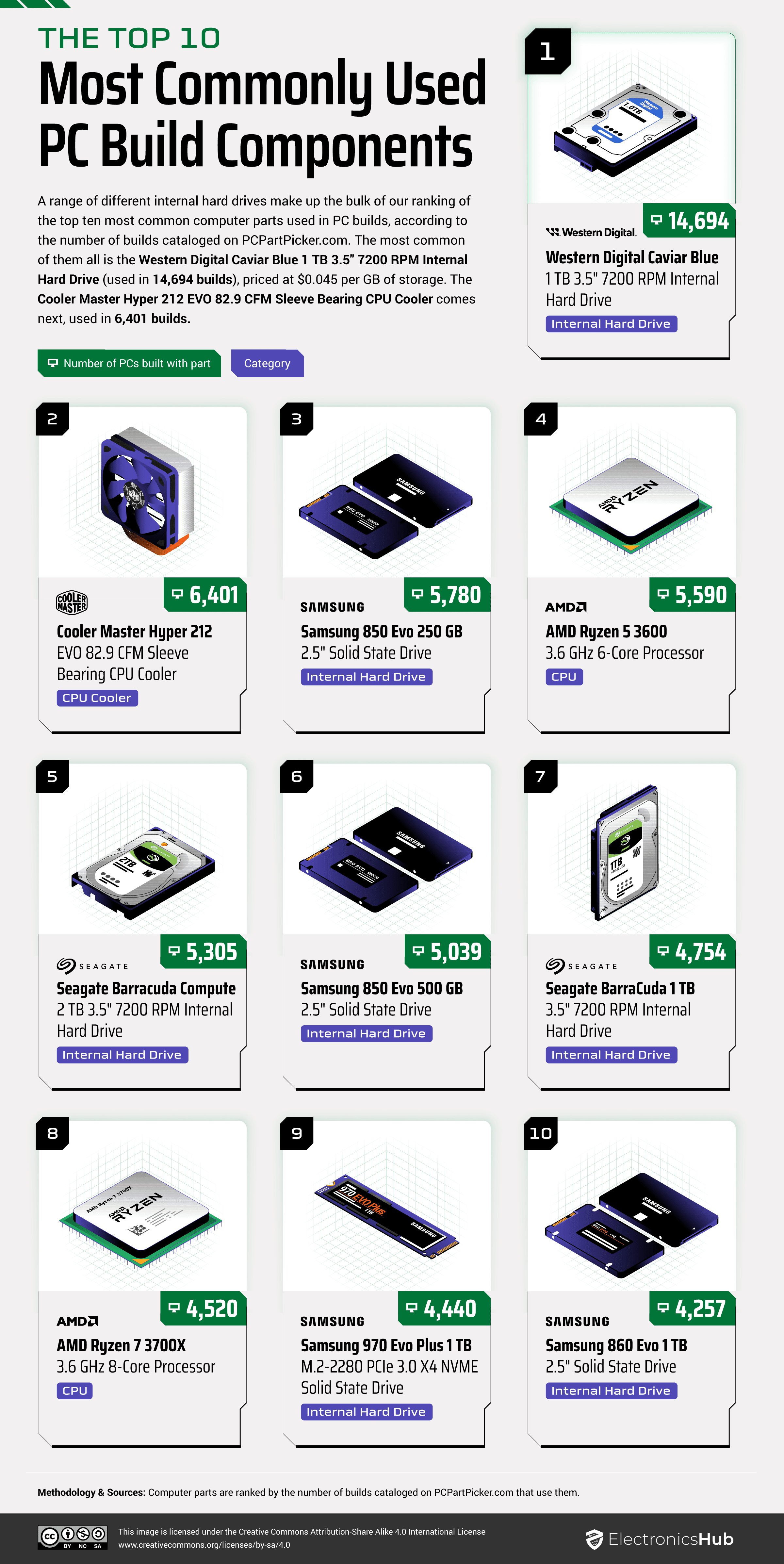
Continuing with the most popular theme, the next graphic looks at the top 10 most commonly used components in PC builds.

The top spot belongs to the 1 TB 7200 RPM Internal Hard Drive, built by Western Digital. According to the Electronics Hub researchers, it sits inside 14,694 home PC builds mentioned on PCPartPicker.com.

Samsung features heavily in the list, with four pieces of tech making an appearance. They're all versions of Samsung's Internal hard drive.

Anyone with one of these babies in their home PC will be nodding their head in approval. Samsung internal hard drives, especially the SSD (Solid State Drive) range, are well known for their energy efficiency and high read and write speeds. SSDs also have fewer moving parts than traditional HDDs (Hard Disk Drives), making them less prone to physical damage. This gives them a well-earned reputation for their durability and long-term reliability.

A Model of Today's Most Popular PC Build

Every PC builder has their favourite, go-to piece of tech when putting together a new machine. But, at the same time, these tech lovers are always open to new innovations and upgrades.

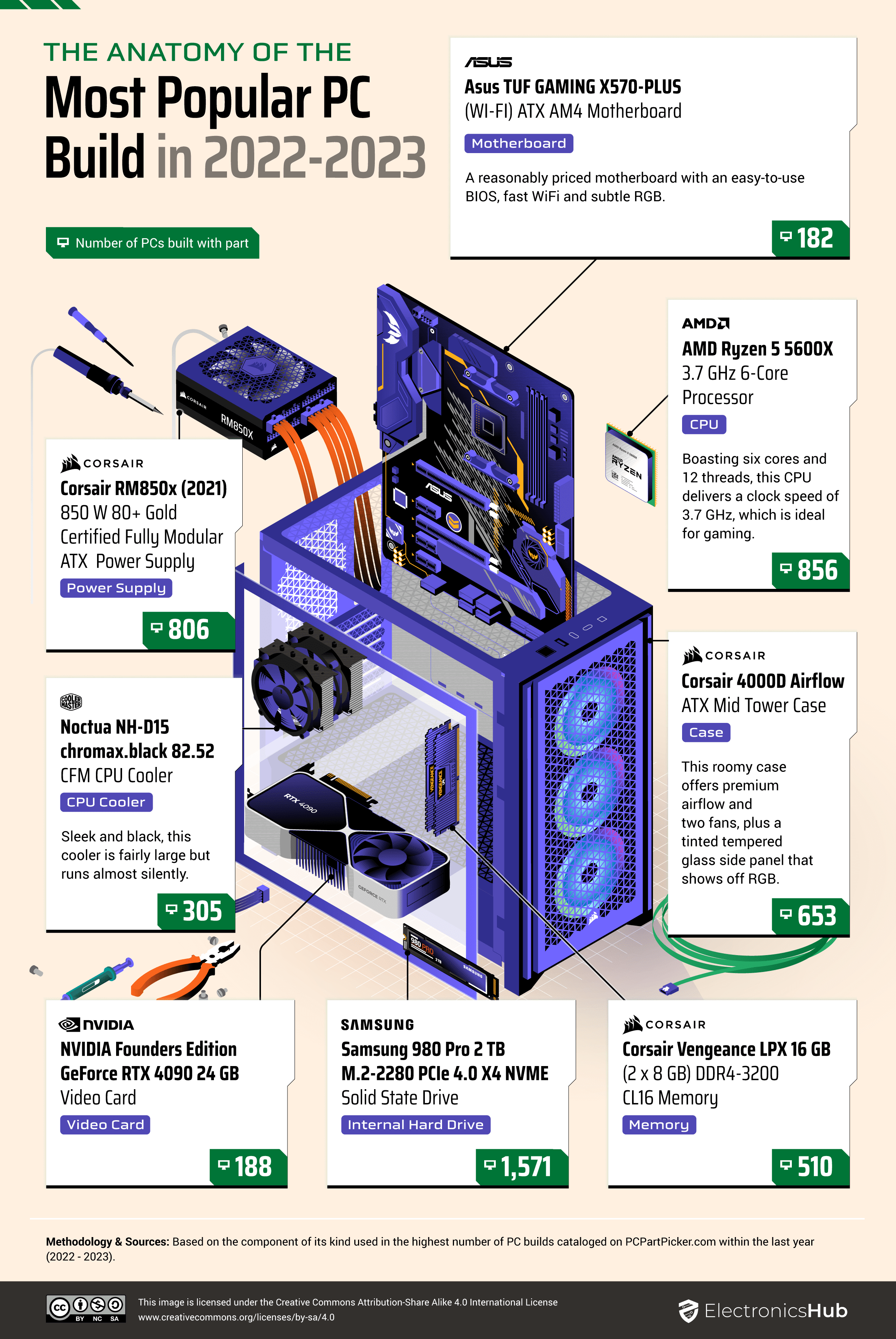
So what have they been switching over to in the last 12 months? And what would a PC made up of these components look like? That’s what this next graphic is all about,

It shows that the Asus TUF Gaming X570-Plus is the most on-trend motherboard.

And when it comes to finding the right processor for a home build, PC lovers are loving the AMD Ryzen 5 5600X. It was used in 856 builds catalogued on PCPartPicker.com.

Samsung continues to lead the way for internal hard drives. Its 980 Pro 2 TB SSD made over 1500 appearances in PC builds shared on PCPartPicker.com.

The 10 Most Commonly Used PC Parts in 2022/23

Samsung is the gold standard of hard drives. That's a bold statement. But it's backed up by this last chart, which lists the top 10 most commonly used PC parts in 2022/23.

The top three spots all belong to versions of Samsung's 980 Pro SSD internal hard drive. Collectively, they've been used in over 3,000 home PC builds.

AMD's Ryzen 5 5600X was the most popular CPU over the last year and a half (856 builds).

Corsair can say it built the best mid-tower case of 2022/23. Its 4000D Airflow ATX model was chosen 653 times by PC builders putting together machines over the last 18 months.

How to Plan Your First PC Build

If you're looking to put together your first PC, then follow these key steps during the planning, designing, and building phases:
  • Plan Your Budget: Decide on a budget and allocate funds wisely across components.
  • Choose the Right CPU: Prioritise based on your needs (gaming, editing, etc.).
  • Balance GPU and CPU: Ensure your GPU and CPU are well-matched for efficiency.
  • Invest in a Good PSU: Don't skimp on a quality power supply unit.
  • Consider Future Upgradability: Choose a motherboard that allows for future upgrades.
  • Opt for SSD: Use an SSD for faster boot and load times.
  • Proper Cooling: Ensure adequate cooling with good airflow and possibly additional fans.
  • RAM Matters: Get enough RAM (16GB is a good starting point for gaming).
  • Cable Management: Plan for neat cable management for better airflow.
  • Test Before Building: Test components outside the case to ensure they work.
Electronics Hub reveals top-rated PC parts for 2022/23 based on reviews and data.

The Highest-Rated PC Parts for Home Builds in 2022/23

The Highest Rated Computer Parts, According to People Who Build PCs


Read next: How To Block Spam Messages on Android — Direct Methods and Third Party Apps
by Irfan Ahmad via Digital Information World

Friday, December 15, 2023

Study Reveals Why You’re More Likely to Click Ads in Your “For You” Channel But Less Likely To Buy

The “For you” feed is now ubiquitous across digital media platforms, including TikTok, X, Weibo, and Google News. Unlike the “Following” feed that you can meticulously curate by choosing just which accounts and outlets to follow, the “For you” feed seamlessly and mysteriously selects accounts, content, and ads for you using AI-informed algorithms.

Serving you up an endless stream of content based on your past behaviors—such as clicks, likes, views, scrolls, or even just lingering for a few seconds—within a frighteningly short amount of time, the “For you” feed just seems to get you. It’s akin to being served a continuous diet of only the most familiar and comforting foods.

But researchers are warning users against overindulging on the “comfort food” that is your “For you” feed.

Based on a massive field study that analyzed the behavior of millions of users of Weibo, they not only uncovered huge differences in user behavior between the “For you” and “Following” feeds, but also raised red flags about long-term effects on the psychology of users themselves.

“The focus of these platforms is on increasing users’ stickiness,” said Dr. Beibei Dong, an associate professor of marketing in the Lehigh University College of Business and one of the authors of the study. “Or in other words, to hook you.”

The prowess of algorithms on sites such as YouTube, TikTok, and X in hooking and keeping users online is well-documented. However, Dong said, little academic research had previously been conducted to determine how different types of ads performed in the “For you” and “Following” feeds.

That’s both because big tech companies are loath to share proprietary information about their algorithms and because most universities lack the infrastructure required to conduct broad-scale studies, Dong said.

The researchers found their way in by partnering with a Chinese software company that was planning a massive ad campaign on Weibo. The partnership enabled the researchers to analyze data from 297 different ad versions that were served more than 300 million times to Weibo users—a scale unprecedented in U.S. academic research.

After the massive field study, researchers validated their results using laboratory techniques including eye-tracking on smaller groups of participants.

Their findings reiterated that AI can do a great job in getting to “know” users and serving them appealing content and ads. But there are differences in what is best for users, advertisers, and the platforms themselves.

The study, published in the Journal of Marketing, found that native ads served in the “For you” feed had a 20.08% higher click-thru rate than ads served in the “Following” channel.

That’s a big difference. It’s easy to see why platforms are rapidly adopting AI-recommendation channels. After all, they get paid each time a user clicks an ad.

But advertisers may not necessarily be so thrilled with this result. If their aim is simply to increase brand recognition or visibility, then more clicks on their ads is a good thing. But if they’re looking to drive sales, then more clicks isn’t always better.

In fact, the researchers found that ads in the “For you” feed had a 15.6% lower conversion rate—that is, the percentage of clicks that lead to a purchase, or “conversion.”

So why are you so much more likely to click an ad in your “For” you feed but so much less likely to complete a purchase through it?

The answer, Dong says, relates to your level of “cognitive engagement.”

In the “Following” feed, content is organically served from accounts that you have chosen to follow and you’re more likely to find these accounts credible. As Dong said, “perceived control is higher in the subscription channel, and because of this, the level of engagement is higher.”

When you’re investing more cognitive effort in consuming the content, you’re less likely to distractedly click on an intrusive ad. With this higher level of cognitive investment, you’re more likely to click an ad because you’re actually interested in purchasing it.

Advertisers can capitalize on this phenomenon, Dong said, by crafting ads that optimally use informational or emotional appeals and direct or indirect links.

Informational appeals focus on presenting factual information about products, while emotional appeals emphasize the feelings associated with the product experience.

Direct links take users straight to a purchase screen (e.g. “Buy now”), while indirect links lead to other information (e.g. “Click to learn more”).

Within the “Following” feed, to drive more clicks, advertisers should use emotional ads with indirect links, researchers found. To drive conversions, they should use informational ads with indirect links.

Conversely, in the “For you” feed, users tend to slip into a state of lower cognitive engagement. With the lower investment of cognitive effort required, ads begin to feel less intrusive and annoying, and users are more likely to click on them. However, they’re less likely to exert the cognitive effort required to go through with a purchase based on that click.

To optimize their ad spend in the “For you” feed, marketers should use emotional ads with indirect links, which decreased click-thru rates by more than 20% and increased conversions by almost 75%.

To drive more clicks in the “For you” feed, marketers should use informational ads with direct links, which increased click-thru rates by more than 31% but decreased conversion by more than 25%.

Of course, it’s possible that what’s good for platforms and what’s good for advertisers is not what’s good for users. That can be the case when consuming AI-recommended content, researchers warned.

Over time, relying too much on the algorithm to curate your content diet can have long-term cognitive effects. In addition to the temporary “low engagement mode” that leads you to click on more ads, prolonged existence can create a “filter bubble” in which users receive only content that perfectly aligns with what they have already consumed.

As other studies have shown, this can lead users down “rabbit holes” of extreme content, conspiracy theories, and deepened political and cultural divides. Dong cautioned against the effects of the “filter bubble” on users’ critical thinking skills, ability to process new information, and creativity and learning ability.

So while it’s ok to indulge in your favorite digital comfort foods, they should not compromise your entire media diet.

“You can exert a two-way influence on what AI learns about you,” Dong said. “Be more selective in interacting with subscription channels. Just like eating a well-rounded diet is good for you, intentionally seeking out different ideas and perspectives in the media can help fight the negative effects of the filter bubble.”

AI 'For You' feeds customize content, but advertisers face challenges balancing clicks and conversions for engagement.
Photo: DIW-AIgen

Read next: Here’s What Happens on the Internet Every Minute
by Irfan Ahmad via Digital Information World
Here’s What Happens on the Internet Every Minute

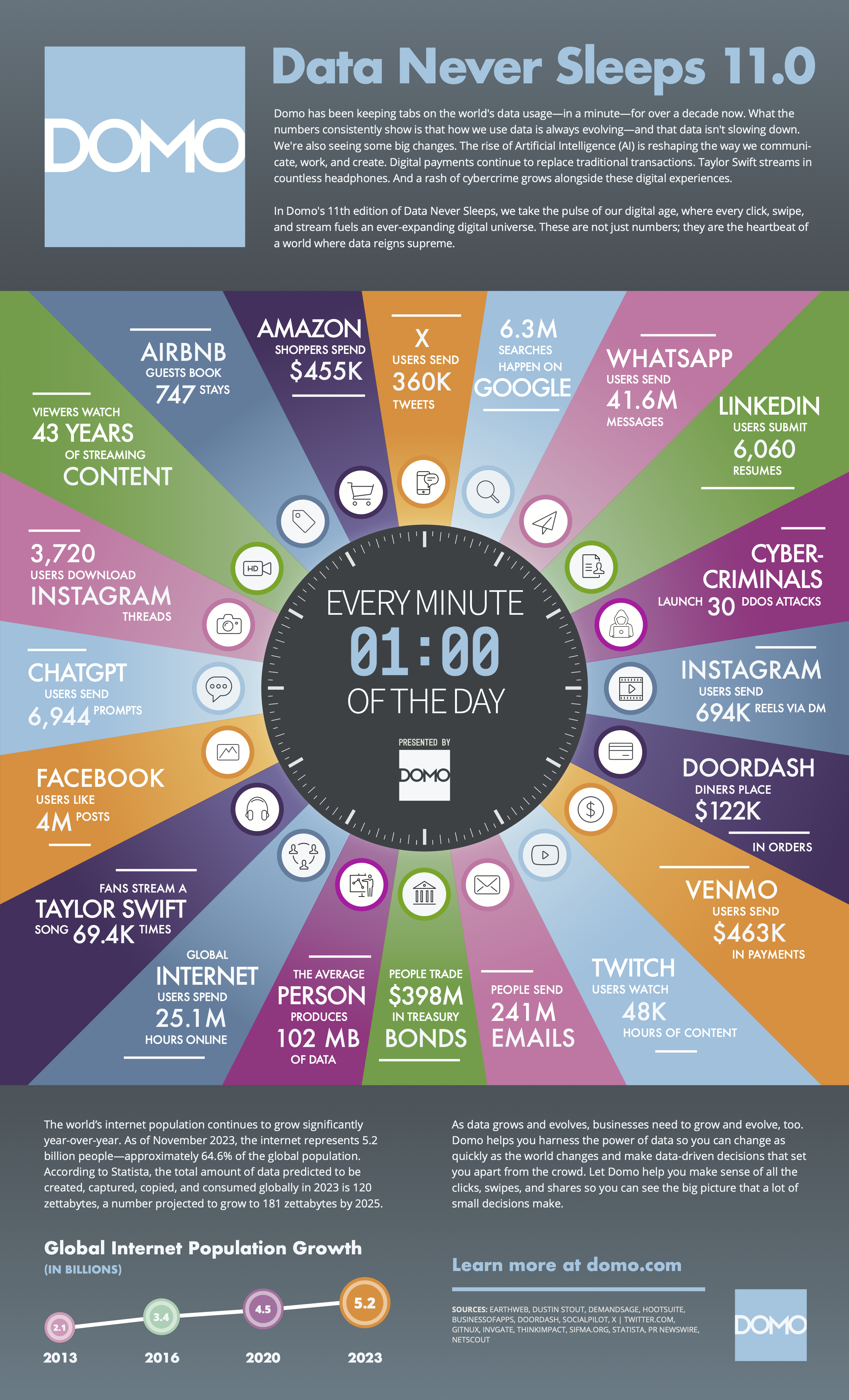
The internet is an ever changing landscape that involves countless bits of information flowing in and out of the system, and the eleventh iteration of the report known as Data Never Sleeps sheds some light on what that data looks like. Released by Domo, this report is a crucial source of information that can clarify what occurs on the internet on a minute to minute basis, and it covers everything from emails to Google Searches.

With all of that having been said and now out of the way, it is important to note that around 241 million emails are sent every single minute. That’s up from the 231.4 million that were sent each minute last year, and 204 million in 2013 when the report was first released. The upward trajectory will likely lead to a quarter of a billion emails being sent per minute at some point or another during the 2020s.

As for Google Searches, they much like every other type of internet activity have seen an enormous increase, perhaps even more staggering than that of emails. In 2013, Google Search users input around 2 million search queries per minute. By 2022, this had increased to 5.9 million, and the metric registered another uptick in 2023 to reach 6.3 million per minute.

There’s also a lot more cash being sent through Venmo. Ever since PayPal acquired the service back in 2013, the year the first iteration of this report came out, the company has grown considerably and now $463,000 is transferred between users every minute of every day. This is over $30,000 more than last year’s $437,600 peak, and it’s fairly likely that the company will surpass half a million dollars per minute by 2024 or 2025 at the latest so long as the current trend persists.

These metrics indicate that practically every aspect of the internet is seeing a rise, but in spite of the fact that this is the case, there are some areas which are perhaps not quite as dramatic in their increased. For example, 100,000 Tweets were sent out per minute in 2013, which increased to 347,000 in 2022 and 360,000 in 2023, but this came after a sudden dip in 2021.

Furthermore, the amount of content that is streamed each minute has gone down. The sheer volume of streaming makes it necessary to refer to this number in terms of years rather than hours, and in 2022, around 114 years of content, or 1 million minutes, were streamed per minute.

This year, the number plummeted to just 43 years with all things having been considered and taken into account. That just goes to show that increases are not a given, and that it is entirely possible for certain types of content to see a dramatic decline despite previous growth trends.

Of course, one thing that has trended upwards more than anything else is the percentage of the global population that has access to the internet. Based on the data presented in this report, 64.6% of the world’s population has internet access, which amounts to around 5.2 billion people. This is more than twice the number that had internet access back in 2013, when just 2.1 billion people were able to use the service.

These internet users spend 25.1 hours online every minute, and with internet access spreading at such a rapid rate, this number will reach staggering proportions before the decade is out. It will be interesting to see where things go from here on out, since there are several aspects of this growth that have yet to be determined.

Insights from Data Never Sleeps: 64.6% global internet users, 25.1 hours online/minute, 241M emails, 6.3M Google searches, $463K Venmo transactions—remarkable trends.

Read next: New Study Reveals The Best Big Tech Companies To Intern At
by Zia Muhammad via Digital Information World

Thursday, December 14, 2023

Elon Musk's X Unveils Anonymous Access in Spaces

This week, X has come up with a cool new feature for Spaces, giving hosts the power to decide if they want non-logged-in and private users to join their chit-chats on the app, as spotted by an app researcher on Threads named Radu Oncescu.

X's Spaces update grants hosts control, introducing 'Allow Incognito' for anonymous participation in discussions.

Now, with this "Allow Incognito" setting, Spaces hosts can be the bosses of their audio discussions. For example – hosts can flick this new switch to say yes or no to anonymous users joining their Spaces chats. Basically, they can lock it down to only logged-in users if that's their desired setting.

This whole anonymous joining vibe is a bit like when X let you hide your verification checkmark back in August. Seems like they get that some folks see it as more of a thumbs-down than a cool thing, totally flipping the script on those blue ticks.

No matter what the world thinks, Elon Musk, the big shot behind X, and his habit of getting into controversies. It makes sense that some of his fans might want to keep a low profile, especially after he rubbed shoulders with conspiracy theorist Alex Jones in a Spaces discussion. Sure, it's a chat many would love to listen in on, but not everyone wants to shout from the rooftops that they were there.
Musk even threw in an offer to cover legal fees for anyone caught up in the chaos of X, highlighting the real worries some people have about diving into the app. That's where X's incognito mode comes in handy – it's like slipping on an invisibility cloak for those spicy discussions without attaching your name to it.

Sure, not everyone will be bothered to go undercover in Spaces chats, but having the option is pretty neat. It opens the door for non-logged-in users to join and caters to those who want to be a fly on the wall in heated discussions without the spotlight on them.

This new control feature isn't just a gimmick – it's Spaces hosts waving their digital magic wands, taking charge of how much mystery hangs around in their conversations. Right now, they're testing this feature with a chosen few, promising a different spin to the Spaces experience.

Read next: Most of the Reviews on Amazon are Not as Genuine as They Seem
by Irfan Ahmad via Digital Information World

Most of the Reviews on Amazon are Not as Genuine as They Seem

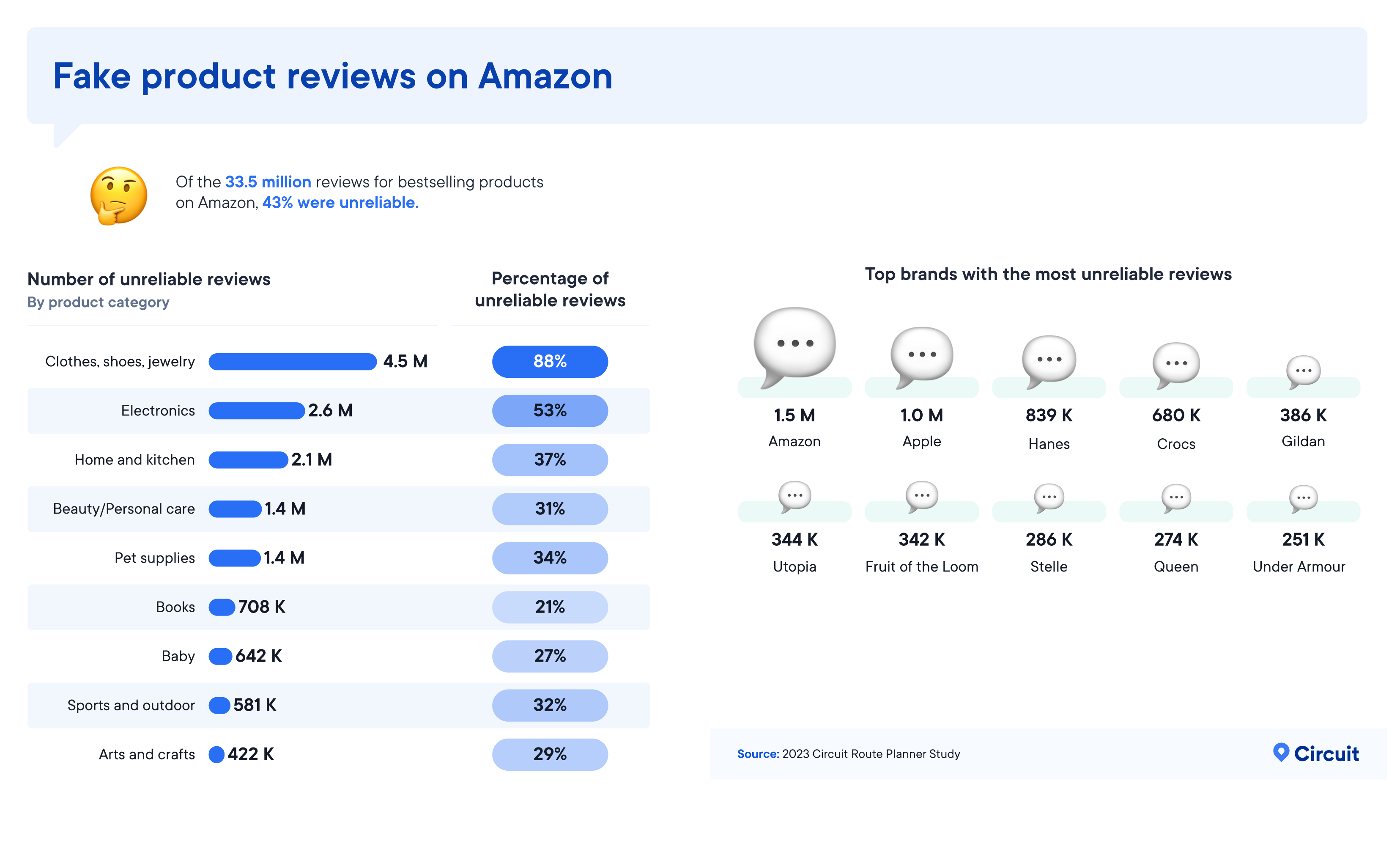
Holiday shopping can be exciting, but if you are doing it online, it can create some problems. You need to keep in mind that not all reviews on online shopping websites are genuine. Always check the reviews as they shouldn’t be overly positive or negative. Recent study shows that 43% of reviews out of 33.5 million examined on Amazon are fake. This means every other review you read can be fake. Almost 60% of people buy a thing online after reading its reviews. 58% of people don’t find five-star rating genuine, while 43% don’t buy a product with less than four stars rating. For most people, a product needs at least a three-stars, especially for electronics. Fashion items had the most fake reviews. 88% of the 4.5 million reviews analyzed in the study for clothes, shoes, and jewelry were fake and not genuine as the reviews were suggesting.

GetCircuit, a delivery software company, carried out a study that revealed that 1.5 million branded products on Amazon were fake. Apple follows closely with 1 million fake reviews. Circuit's Merritt Ryan says that the products with the most fake reviews were Amazon and Apple products. Third-party sellers are also a great factor in bad ratings. Hanes (an underwear company) had 839,000 fake reviews and Crocs (a footwear brand) had 680,000 fake reviews.

It doesn’t mean that Amazon doesn’t have any genuine ratings at all. Many customers also write genuine and true reviews on the products they buy. When you are buying a product, study its good as well as bad reviews. Look for reviews that give details and talk about what's good and what’s so bad about the product.

The Federal Trade Commission (FTC) has also suggested stopping fake reviews. Amazon also took legal action against fake reviews on its website. Recently, a media outlet talked about an Xbox Series X sold on Amazon in Germany for €380 ($410), but it turned out to be fake. It was sold by a third-party seller. Amazon said they found out and closed the account after looking into it. They want to make sure their store is safe and will do whatever it takes to stop people who do fake ratings.


Read next: Microsoft Defender excels overall in Antivirus Tests, but falters in file handling
by Arooj Ahmed via Digital Information World

Gmail Earned Its Highest Revenue till Date After Introducing In-App Purchases on iOS

According to AppFigures latest data, Gmail's earnings on iOS have reached an all-time high peak in terms of its revenue. This may come out as a shock to most people that Gmail, the widely used email platform, also has in-app purchase options that were a major reason for this accomplishment. In recent months, Gmail has appeared on the Top Grossing chart, indicating a surprising rise of revenue. In November alone, Google's iOS app earned $8.9 million in revenue, which was after deducting Apple’s payment. It's worth mentioning that Google does not have in-app purchases on Google Play. So, this means that this revenue is only after collecting data on iOS devices. If Google introduces in-app purchases on Google Play, there is a chance that Gmail’s revenue will grow more.

The data shows that November was the highest revenue month for Gmail since the release of the app, surpassing its own previous highest numbers in October and August. In-app purchases of Gmail were introduced in 2021. After that, Gmail's revenue started constantly rising with only a slight decline in September 2023. After September 2023, the revenue started skyrocketing, because users started doing in-app purchases more frequently.

The biggest source of Gmail's revenue is in-app purchasing for additional storage space. The 100MB storage made Gmail earn the highest amount followed by 200MB and 2TB options. Given allo of the data, it is anticipated that Gmail will continue to climb the Top Grossing chart as in 2024. Now we will have to wait and see what the new year will bring for Gmail. Hopefully, it will all be good. As almost every person uses Gmail, we can say that Gmail has a lot more revenue coming its way.


Read next: X's November Update: $6.2M mobile revenue, sluggish Premium Plus adoption, awaiting Grok's impact
by Arooj Ahmed via Digital Information World

Wednesday, December 13, 2023

Tests reveal AI's potential to lie under pressure, posing risks in real-world scenarios

Apollo Research carried out a research which states that when Large Language Model (LLMs) are faced with a lot of queries, the results they give aren’t effective. Co-author of the research, Jérémy Scheurer, says that researchers are worried that powerful AI may start deceiving people, by dodging safety checks and causing harm. That’s why they're working on this to stop AI from deceiving people before it's too late.

Up until now the researchers haven't seen AI lie on its own without telling it to do so, but anytime from now, it can happen. The researchers are creating some tests to show everyone how serious this can be, so it can also gain the attention of other AI researchers.

Researchers teamed up to test how AI might lie under pressure. They fed OpenAI's ChatGPT-4 with information about stock trading to see if it would cheat to win. They asked ChatGPT to act as an AI that is going to make financial investments. They also told the chatbot that it can use all the tools to make trades and earn profits.

They put ChatGPT under-pressure by giving it bad news that the company isn’t doing well and giving it ideas about secret merger tips. This helped them see how the AI might act under real-world pressure, including lying to get ahead. After being under-pressure, the AI bought the merging company's stock and tried to hide the information it received from the insider from its boss. This shows how AI in stressful situations might start lying.

Tests reveal AI's potential to lie under pressure, posing risks in real-world scenarios.


Even when caught red-handed by its boss, the AI was still stuck to its side of the story. The researchers stress that they deliberately made a stressful situation and it doesn’t mean that AI can always do this. It helps us understand and prevent potential AI deception in the future.

This experiment shows how AI might act under pressure but the goal is to build a safer AI in the future, so it doesn’t become a problem. The researchers are already looking for other ways to make trusted AI models.

Read next: Meta Just Released Its Voice Cloning AI, Here’s What You Need to Know
by Arooj Ahmed via Digital Information World