Tuesday, February 25, 2025

AI vs. Human Content: Study Finds Minimal Ranking Differences on Google

Semrush analyzed 20,000 articles and surveyed more than 700 marketers to know if AI generated content ranks on Google or not. The results of the analysis showed that AI generated can get ranked on Google and generally performs a little better than human created content. The analysis showed that out of top ten ranked articles on Google, 57% of them were AI generated while 58% of them were human created. Human content did 2.1% better than AI content when it came to rankings in the top positions. In the top 3 positions, human content did 6.2% better and 4.6% better in the top five positions. In the top ten rankings, there was only a difference of 1% between human created and AI generated content.


Users were also surveyed so they can share their experiences when it comes to their page rankings on Google search. 31% said that their rankings are the same for human and AI generated content, while 27% were not sure about it. 23% said that their AI generated content performs better than human written content while 10% said it performs much better on search engine rankings. Only 9% of the respondents said that their AI content performs worse than human written content. 30% said that they found no noticeable change in their organic traffic after publishing AI content, while 39% saw an increase in their organic traffic. Only 4.8% said that they experienced a traffic decrease after publishing AI content.

68% said that AI helps them create content faster which helps them boost SEO and content ROI and 57% said it helps them save time so they can use it somewhere else. AI content also helps them save money on writing and editing (48%) as well as helps generate more engagements with the content (34%). This all means that AI can be used for content generation as long as it is high-quality and that's what makes it rank among human written content. 39% of the respondents said that they combine human written and AI generated content for their website while 34% write the content themselves and only use AI for assistance. 5% only use AI generated content while 18% still don't use AI at all.

When respondents were asked how they incorporate AI into content creation, 62% said they use it for their topic research and idea generation, 51% each use it for editing and rewriting, optimizing content for SEO and generating content outlines. Long form articles and blog posts (70%), meta descriptions (55%) and product descriptions (42%). Marketers are using AI to make their content more engaging, interesting and readable to users by using human editors to refine AI generated content (69%), humanising the AI generated content (60%) and only using AI to create the initial draft and then adding more content (48%).

Upon asking marketers how they make their content more original and expertise driven, they answered by conducting original research (55%), adding useful statistics to content (53%) and sharing personal experiences in the content (49%).

Read next: Office Workers Struggle With Communication Overload, AI Users Report Increased Efficiency
by Arooj Ahmed via Digital Information World
Apple Makes Major Splash With $500B Investment in US to Support American Innovation

Tech giant Apple is making waves with a new announcement involving a $500B investment in America.

The company says its goal right now is to support innovation in the country including state-of-the-art manufacturing and producing more jobs involving high tech. This will take place over the next four years, it shared. The gesture appears to be a thoughtful one but experts are still questioning the move.

There are no doubts about Apple taking part in this maneuver, after all, their yearly revenues hit the $400B mark in the past couple of years. However, it hopes to be spending more funds domestically now to help its nation. But the real thought of the matter has to do with how trade politics plays a role here. Remember, they’ve made similar commitments on a huge scale in the past so this shouldn’t be too surprising, right?

Now the question is what the mega $500B actually includes. As per the iPhone maker, it’s aligned with other similar alerts linked to worldly infrastructure spending that other arch rivals are making. Amazon said it would be spending $100B in 2025 while Microsoft has set out a $80B budget. Alphabet stands at $75B while Meta wants to spend $60 to $65B in 2025.

The total $500B budget from Apple is in line with the amount pledged by other leading companies including Oracle, OpenAI, Stargate, and SoftBank. Will we see that level of investment take place? Well, only time can tell as the figures are huge and it’s not easy to verify.

Now so many questions remain in terms of the math behind Apple’s major commitments. It’s not because there’s not going to be a single line item in this filing or any shareholders' yearly report that can be highlighted if we want to see it follow the pledge after that. This has to do with the mere fact that Apple wishes to break up AI investments across both CapEx and OpEx through materials from its big cloud service providers. Today’s announcement is also linked to what it hopes to attain through partners and suppliers.

Image: DIW-Aigen

Read next: New Study Shows People are Still Reluctant to Use AI in High-Stakes Decision-Making
by Dr. Hura Anwar via Digital Information World

New Study Shows People are Still Reluctant to Use AI in High-Stakes Decision-Making

AI has become an important part of our lives now and people are using it for making a lot of decisions but what do people feel about AI making serious decisions for them? According to a new study by the University of South Australia, most people trust AI while making decisions that aren't too deep but are hesitant when it comes to using AI for making high-stakes decisions like in healthcare or hiring new employees for the company. But people who aren't too statistically literate or have specific knowledge of AI tend to trust AI in low-stakes as well as high-stakes decisions.

The study analyzed responses from 2000 participants from 20 different countries and found that people trust AI based on their knowledge of its systems like how AI algorithms work. They know that AI gives its responses through pattern based predictions so there are a lot of biases and errors too so they try not to use it for making critical decisions. The study also found that people from highly industrialized countries like the US, Japan and UK were less likely to trust AI in making critical decisions, as did men and older people.

The study also showed that 72% of the organizations are now using AI so it is important to understand when people trust AI and why its adoption is increasing so much. The lead author of the study, Dr. Fernando Marmolejo-Ramos, said that even though AI technologies are being incorporated into society, we still do not know how to effectively make them function as they can have a lot of impact on us. If we are going to use AI for making decisions, we have to trust their reliability and that's why we also have to understand how they are influencing people’s trust in decision-making.

Image: DIW-Aigen

Read next: Office Workers Struggle With Communication Overload, AI Users Report Increased Efficiency
by Arooj Ahmed via Digital Information World

Monday, February 24, 2025

Office Workers Struggle With Communication Overload, AI Users Report Increased Efficiency

A study conducted by Harris Poll and commissioned by Grammarly found that most of the professionals at work spend 28 hours on communications which has increased 13.2% from last year. Most office workers are always buried underneath heaps of emails and work messages which are one of the reasons for their stress. When 1,286 professionals were surveyed during the study, 60% of them said that they cannot stay focused on their work because they always have to be connected with their coworkers and managers through different messaging apps. Among these messaging apps, Microsoft Teams, Slacks, and some work management software like Asana and Jira were the main culprits.

However, this made the researchers think about the rest of the 40% who didn’t report any problems in their focus during work. How are they managing communications in their professional lives so that they can also stay focused on their work? The study categorized the respondents into two groups, Knowledge workers who were general employees (1302) and business leaders who were bosses of general employees (254). Then these people were classified as AI-avoidant and AI-fluent according to their AI usage habits at work.

It was found that workers who were classified as AI-fluent seemed satisfied and happier (96%) than workers who were AI-avoidant (81%). AI-fluent professionals are saving 25.2 hours per week on average by using AI tools. These professionals are using AI for different types of tasks like editing, ideation, and drafting communication. They are using tools like CoPilot, Google Gemini and ChatGPT to write and edit their messages and save a good portion of their time.

The second most common thing that many professionals are using AI for is research which is reducing their burden immensely. Samsung’s Galaxy S25 has an AI assistant that can help search for information on Gemini and then text a friend or write it in the Notes app. 77% of the professionals said that they use AI as a collaborative tool but 88% said that they would let AI handle tasks on its own if it becomes capable of doing so. OpenAI, Nvidia, and Microsoft are working on these autonomous AI agents which would be able to perform tasks on their own. Business leaders (33%) felt change due to AI use more than employees (7%). Even though AI is being used for a lot of tasks in professional settings, there are also complaints about it hallucinating or giving undesirable results.


Read next:

Top Skills for 2025: AI, Web Development, and Marketing Expertise in High Demand
by Arooj Ahmed via Digital Information World

$69 Billion Spent on Non-Gaming Apps in 2024, Entertainment Apps See $4.4 Billion Surge

Generative AI tools have become a part of our lives now, and they have also incorporated themselves into the mobile advertising industry. The advertising industry is seeing a noticeable growth in social media and video streaming, but the gaming industry is still dominant. The 2025 App Marketer Survey Report by Liftoff found some key stats that tell us that industry performance is going to improve in 2025. Non-gaming apps saw a 12% increase year-over-year in their downloads, while overall app categories saw a 7% increase. 4.2 trillion hours were spent by users globally on different apps in 2024, which is about 500 hours per person.

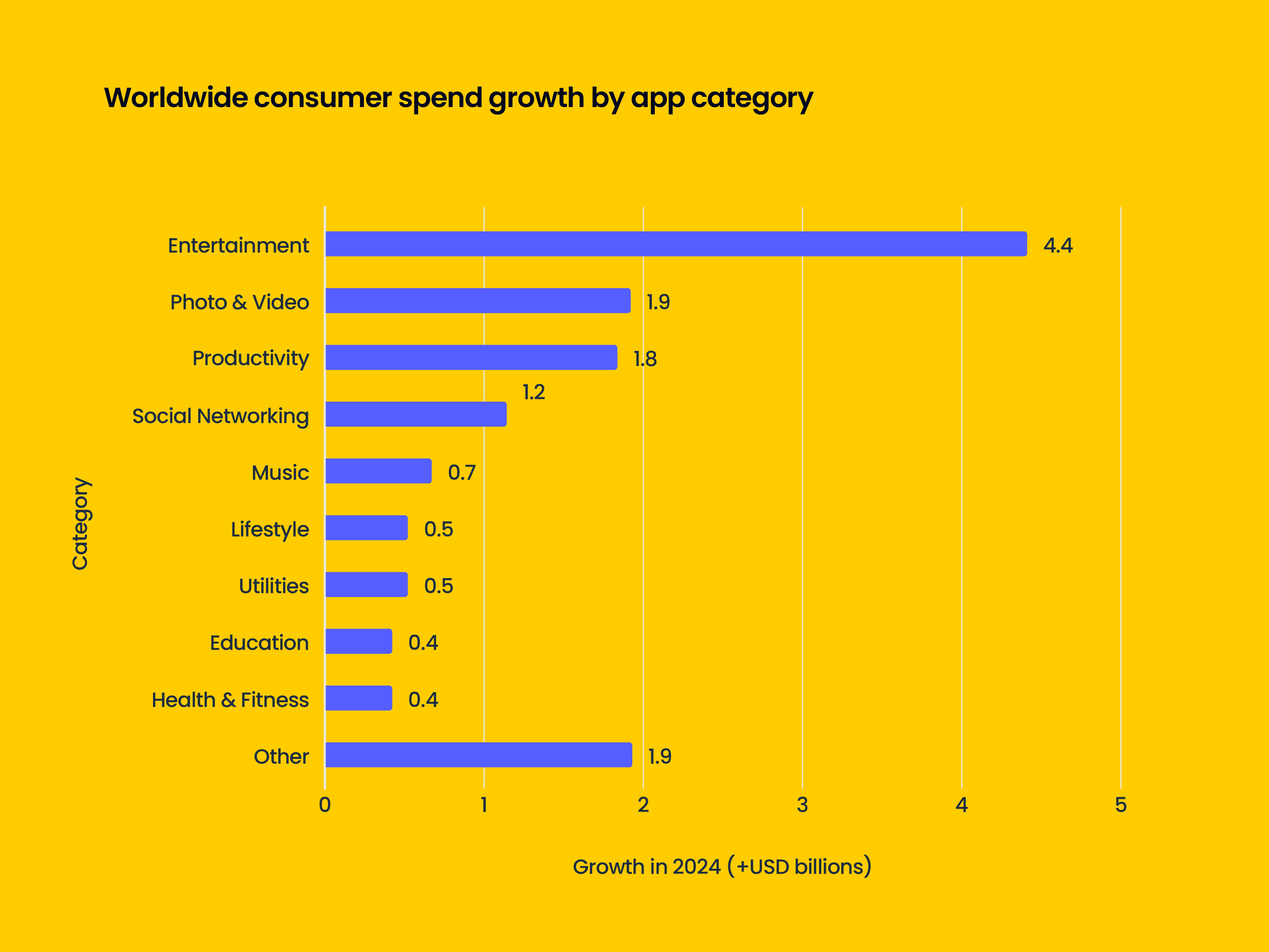
As app time increases, developers are also seeing an increase in revenue. The consumer spend on non-gaming apps was $3.5 billion in 2014, which increased to $69 billion in 2024, and saw a $13.7 billion YoY increase from 2023 to 2024. Entertainment apps saw a $4.4 billion increase in spending from 2023 to 2024 in categories like photo and video, social networking, and productivity apps. There was a 44% YoY growth in the food and drink category, while shopping, finance, and travel apps saw a 20% increase in 2024. The report also mentioned that AI has become an important part of advertising strategies, content recommendations, and app discovery, and marketers are focusing on AI-driven personalization.

The mobile game market is very competitive, and after seeing some dips in growth in 2020 and 2021, mobile game developers have adjusted their strategies. There was less than a 5% decline in downloads in tier-one markets of mobile gaming like Japan, the US, South Korea, and Germany. Pakistan saw a 12% increase in downloads of mobile games between 2023 and 2024, while countries like Indonesia, Mexico, and the Philippines saw a 5% growth. Overall, there was a 1% decline in IAP (in-app purchase) revenue for mobile games, but casino games saw a 4% growth in IAP revenue, and mid-core games saw a 5% decline.

The report also surveyed consumers from different countries to compare the stats between 2023 and 2024. It was found that more than 50% of the respondents agreed that the industry is in good shape compared to 2023, while 80% said that it's the same or better in 2024. 85% of respondents from LATAM and North America agreed that the industry is better or the same right now. 86% of non-gaming marketers said that the industry is in better shape compared to 44% of gaming marketers who think that it is better in 2024 compared to 2023. 90% said that they have met or approached their KPIs, while more than 50% said that they are experiencing more aggressive KPIs year over year. 80% said that they have higher expectations for 2025, and 60% report expecting higher budgets in the new year.


Read next: The World’s Most (and Least) Cyber-Secure Countries: Where Does Yours Stand?
by Arooj Ahmed via Digital Information World

Sunday, February 23, 2025

Gmail Users Could See Changes in Authentication as Google Explores Alternatives to SMS Codes

Gmail is, reportedly, preparing to discontinue SMS-based authentication codes, shifting toward a QR code system for verifying user identity. One insider, as per Forbes, has claimed that plans are underway to replace text message verification with an alternative option aimed at enhancing security while reducing risks associated with phishing and fraud. The move aligns with broader efforts in the tech industry to move away from passwords and traditional two-factor authentication methods in favor of more secure approaches. While SMS authentication has been widely used, vulnerabilities have long raised concerns, with growing instances of cybercriminals exploiting text-based security codes to gain unauthorized access.

Google currently uses SMS-based authentication for both security verification and abuse prevention. The system helps confirm returning users and prevents large-scale fraudulent activity, including mass account creation for spam and malware distribution. However, SMS verification remains susceptible to phishing, and its effectiveness depends on the security protocols of mobile carriers. If attackers manipulate a carrier into transferring control of a phone number, SMS-based security loses its reliability. Company representatives cite this as a major reason for shifting away from text-based authentication, stating that fraudsters have increasingly leveraged weaknesses in the system to bypass security measures.
One emerging scam involves a method known as traffic pumping, where cybercriminals exploit SMS verification by triggering mass authentication messages to numbers under their control. Each delivered message generates revenue for the attackers, leading to financial losses for service providers. This type of abuse has become a growing concern, accelerating efforts to implement stronger authentication methods.

In the coming months, Gmail users will no longer receive six-digit SMS verification codes. Instead, a QR code will appear on the screen during authentication, requiring users to scan it with their phone’s camera to complete the process. The shift aims to eliminate phishing risks associated with text-based codes and reduce dependency on mobile carriers for account security. Google has not provided a specific timeline for the rollout but indicates that additional details will be shared soon.

Image: DIW-Aigen

Read next:

Fake ‘Sadcore’ Posts on Facebook Monetize Sympathy Through Stars and Ads

• Analysis Shows Even though ChatGPT is Sending a Lot of Referral Traffic to News Websites, It Still Remains Small
by Asim BN via Digital Information World

The World’s Most (and Least) Cyber-Secure Countries: Where Does Yours Stand?

Cybercrime is growing, putting millions at risk. There are nations with strong defense and others with weak security. Cybersecurity Country Rankings 2025 case study by Proxyrack tells us which nations are most secured and which remain vulnerable.

A country's cybersecurity strength impacts businesses, financial systems, and citizens' data. Effective policies and advanced technology minimize vulnerabilities, but poor systems leave people at the mercy of cyberattacks.

What Cybersecurity Country Rankings Mean

Cybersecurity rankings mean the quality of a country's protection of its cyberspace. Cyber security ratings compare countries to key factors like levels of cybercrime, government policies, cyber infrastructure, and public awareness.

Nations with good cybersecurity policy, top technology, and well-funded security forces receive higher ratings.

Those with weak policies and outdated systems are most vulnerable to cyber attacks.

Exposure to cyber crime is also factored in, which measures instances of attack and countries' ability to respond to them.

Most Cyber-Secure Countries in the World


These are the nations so reported on, which have thus formidable defenses built against hacking and thus are safest to use surfing the net. The Proxyrack report mentions Nordic countries of Finland, Sweden, Denmark, and Norway, among others.

Spending huge on info security, strict data-protection legislation, and acclimatizing the public to become acquainted with Internet safety.

Successively, the other ones are the United Kingdom, Germany, Canada, France, and the United States with good digital infrastructure, effective government policy, and powerful law enforcement agencies that actively take part in the surveillance and regulation of cybercrime.

This dedication to cybersecurity, therefore, protects individuals and enterprises from cyberattacks.

The Least Cyber-Secure Countries: Who Is Most at Risk?


While some countries have adequate, good defenses against them, others suffer from weak security vulnerabilities that pose irresistible temptations for cyber attackers. Among them are Panama, Thailand, and Belarus, which Scanner.com has declared to be the most highly prone to cyber risks.

Weak security laws, outdated technology, and a very low awareness of the ongoing cybercrime challenges beset all three.

Countries: Chile, Costa Rica, and Uruguay shot to top positions too, between the Latin American countries. Also, middle eastern ones, such as Saudi Arabia and the UAE, deploy strong cybersecurity policies but are completely unprotected from the possibility of a cyber attack.

The absence of enough strictness in law and measures leaves businesses and individuals alive in almost open spaces concerning cybercrimes!

How Cybersecurity Rankings Affect Individuals and Businesses

The level of a nation's security affects, therefore, governments, businesses, and ordinary internet users. People from less secure states are further likely to get involved in identity theft, financial scams, and data loss.

Weak infrastructure, moot laws,& public ignorance are the fertile grounds from which cyber thieves steal personal data and create Interruption on the internet.

Most of the action usually happens in countries considered high-risk. Businesses may erode customer goodwill, suffer financial losses or become the prey of repeated ransomware attacks. Foreign net security controversies also serve as a deterrent to investments. In the absence of adequate protection, cybercrime could wreck economies and expose millions of people to risk.

The Role of Account Suspensions in Cybersecurity


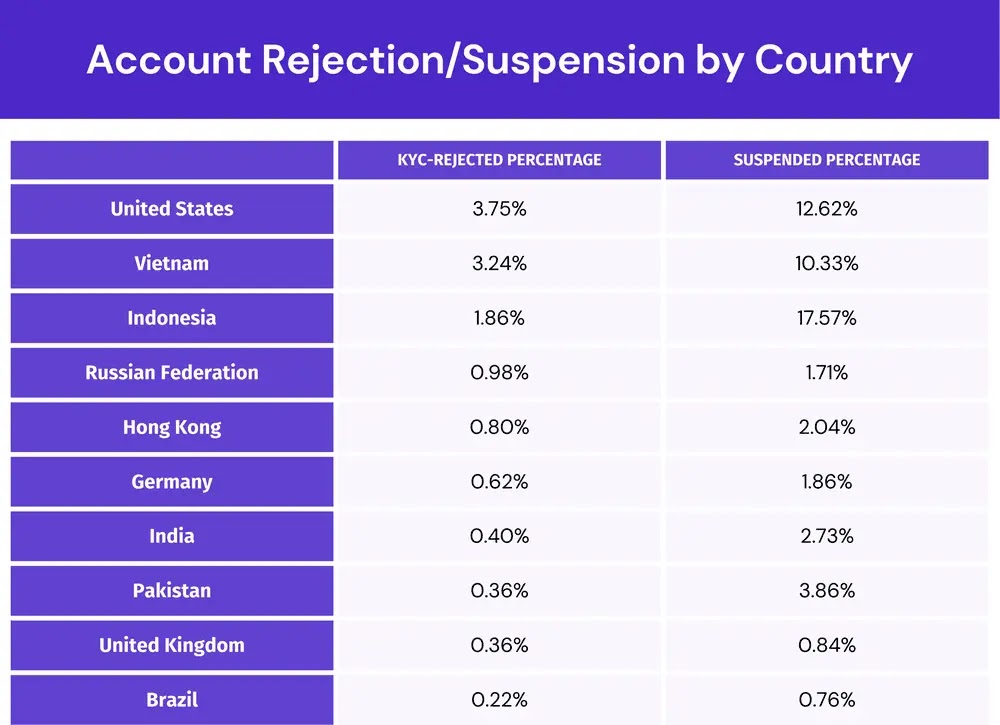
Online platforms spare no effort in ensuring that safety is an utmost priority. The increasing number of cyber threats strongly warrants companies to guard their systems and users from fraud, abuse, and hacking attempts. Such statistics come from data pertaining to the denial and suspension rates per advertised jurisdiction on how different regions are handling various security issues.

That being said, there are several reasons for rejections or suspensions:

  • Trial abuse: Multiple sign-ups by users to subscribe for free trials.
  • Links to bad accounts: Involvement of suspicious activity related to unbanned users.
  • KYC (Know Your Customer) issues: Failure to verify the identity of customers.
  • Disposable emails: Using temporary emails to spam or defraud customers.
  • High-risk transaction: Payments for unreasonably high or atypical amounts that require approval.

Strengthening Cybersecurity with Automation and the Zero Trust Model

The implementation of automated security protocols allows businesses to detect, monitor, and take immediate actions pertaining to these risks.

Many companies now follow a Zero Trust model, which means every user and device must be verified before they gain access to a platform. This, in turn, prevents hackers from infiltrating and exploiting the weak links in digital security.

Nevertheless, some cybersecurity challenges exist:

  • Only 50% of companies in the US hold full cyber insurance.
  • There is a global shortfall of professionals in cybersecurity to fight against increasing threats.

In order to combat risks with limited resources, AI-led security to a great extent and automated account suspensions are embraced by businesses.

Combining this with robust identity verification and fraud detection, these measures help with safeguarding users while maintaining platform integrity.

Diligent enforcement of security protocols helps address cyber threats and create a safer digital ecosystem for businesses and individuals alike.

The Future of Cybersecurity: What Can Countries Do to Improve?

Less cyber-defensive countries may execute a variety of measures in order to avert risks pertaining to cybersecurity.

Law and order and their enforcement, as well as investment in new technology for securing national interests, go a long way in actually improving national defenses.

Similarly, governments should establish campaigns to inform the general public about online threats as well as best practices.

Alternatively, it may embrace artificial intelligence and automation in order to detect or block such attacks promptly. Collaboration with international organizations in the sphere of cybersecurity also plays a major role.

The countries that invest into training for cyber-defense teams, cyber-infrastructure, and innovation will be in a much better position to counter themselves against the evolving digital threats that can be expected in the future.

Global Indices That Shape Cybersecurity and Digital Safety

Various global indices raise concerns over cyber defence, governance and their risk exposures. Its goal is to measure the preparedness of various countries towards fraud and financial crimes concerning certain cyber threats.

Human Development Index and Cyber Security

The HDI tries to quantify the performance of a citizen in measures of health, education and income. Countries with a relatively high HDI would allow for appropriate responses towards investments in digital literacy and a security infrastructure.

As the country began to understand the extent of their danger of being open to other further cyber threats, the risk scores began showing as a part of looser security policies.

Basel AML Index: Financial Crime and Cyber Security Risks

Basel AML Index aims to examine that if a nation scores well on money laundering and corruption risk, and the financing of all the alleged ‘threats’ based on relaxed regulation in finance. Whereas countries with poor financial regulations would inevitably be sucked in like prey by these Cybercriminals through the various digital platforms which they exploit.

Relative to their cyber score, Countries scoring low enjoy stricter anti-fraud laws and enforcements.

Cyber Exposure Index: Index for Measuring Digital Vulnerability

The Cybersecurity Exposure Index sorts the nations according to how prone they are to potential attacks, such as phishing, malware attacks, and data breaches. Higher exposure scores suggest that the policies with regard to security are outdated and systems are not up to date. Countries that spend on their employees and educate them concerning cybersecurity have lower risk scores.

National Cyber Security Index ( NCSI ): Digital Defense Strategies

The NCSI evaluates modern countries’ concern towards cyber security programs and their readiness to avert and eliminate cyber risks. Stronger nations possess basic laws of cyber security, well financed IT security response units, and public awareness campaigns.

These lower ranking countries tend to lack such protective measures and patterns, making them perfect bait for the cyber criminals.

Global Cybersecurity Index (GCI): Cyber Resilience Score

The GCI created by the International Telecommunication Union (ITC) measures the commitment countries have towards the issues of cybersecurity.

Top-ranking countries such as the US, UK and Nordic countries tend to have strong laws, carry out regular audits and work with other countries.

The State of Global Cybersecurity in 2025

Cybersecurity now is not only a concern for businesses and governments, but for every individual as well. Some countries are already ahead in protecting their digital infrastructure while some lack behind which draws remarkable contrasts as per the case study.

Some countries have taken the initiative to implement strong public policies for sophisticated cybersecurity technologies and awareness programs, while others continue to be weak in enforcement, systems, and financial crimes.

Indices such as the HDI, Basel AML Index, Cybersecurity Exposure Index, NCSI and GCI are measuring proxies of ability to defend against cyber threats inflicted on countries.

Countries with public cyber education programs, security legal frameworks, and investments on security infrastructure consistently perform better in protecting citizens’ personal information.

Despite this, there is no denying that cyber risks keep changing and even the most secure countries need to brace themselves for the ever evolving threat landscape of Zbot AI powered mega cyber attacks, ransomware and cyber surveillance espionage.

For the provision of a safer digital environment, stronger laws, international collaboration and improved awareness around cybersecurity are some of the critical measures that need to be undertaken.

It has certainly become more critical for businesses and countries to improve cooperation in ensuring adequate protection against cybercrime, where the so-called ‘one world – one internet’ phenomenon can bring such great benefits if properly harnessed.

Read next: 12 Phishing Attacks a Day – Are Companies Ignoring the Growing Threat of Cyber Destruction?


by Irfan Ahmad via Digital Information World