Wednesday, May 28, 2025

How Student Responsibility Shapes AI Use and Academic Success

A new study shows that students who are more responsible and hardworking are less likely to use AI tools like ChatGPT to help with schoolwork. And when students lean too much on these tools, it can actually hurt their learning. They tend to feel less confident, do worse in their classes, and often feel like no matter what they do, it won’t make a difference.

ChatGPT and similar AI tools can write essays, explain things, and even hold a conversation. They’re tempting when deadlines are tight and stress is high. But while they can offer a quick fix, they may not be helping students in the long run.

The study followed over 300 business students from three universities in Pakistan. Researchers wanted to see how personality traits affected students' use of generative AI, and what the results were. The study was done in three steps: first, students answered questions about their personality and how fair they thought their grades were. Later, they shared how often they used AI for school. Last, they reported how confident they felt in their academic skills, how helpless they felt, and what their grades were.

Out of all the personality traits they looked at, one stood out: conscientiousness. Students who were more organized, disciplined, and goal-focused were much less likely to rely on AI for their work. These same students tended to have higher grades, felt more in control of their success, and didn’t feel as helpless when things got tough.

Interestingly, students who were open to new experiences or who tended to be more anxious didn’t show clear patterns when it came to using AI. Even though you might expect curious students to use new tech more, that wasn’t the case here. One possible reason: they may enjoy thinking for themselves and prefer doing things their own way.

Another finding: students’ opinions about whether their grading system was fair didn’t make much difference in how much they used AI. Only one small connection showed up—students who were both open to new experiences and thought the grading was fair used AI a bit less, but this link wasn’t very strong.

What really stood out was how using AI seemed to affect students. Those who used AI more often said they didn’t feel very confident in their academic abilities. Many also felt like trying hard wouldn’t help, which is a warning sign of learned helplessness. On top of that, they had slightly lower grades overall.

This suggests that while using AI might save time, it could also chip away at a student’s belief in themselves. If someone starts to think they can’t succeed without help from AI, they may stop trying as hard, especially when facing a challenge. Over time, that mindset could turn into a habit—and not a healthy one.

The study also found that conscientious students performed better partly because they didn’t rely on AI. Their good study habits and sense of responsibility seemed to protect them from the downsides of using these tools too much.

Even though this research focused on business students in Pakistan, it points to a bigger question that schools everywhere are starting to face: how should we deal with AI in the classroom? If students start letting AI do the heavy lifting, they might miss out on the kind of learning that builds real skills—like critical thinking, problem-solving, and resilience.

The researchers say it’s not about banning AI. Instead, the key is helping students use it wisely. When used the right way, AI can support learning—helping students brainstorm, check their writing, or think through new ideas. But if it becomes a crutch, it can hurt more than help.

Going forward, the researchers want to look at how AI affects students in the long term—especially things like creativity, independence, and how ready they are for the job market. They also want to figure out what kinds of training or support could help students use AI in a way that boosts learning, not replaces it.

In the end, the message is simple: AI is a tool, not a shortcut. If students overuse it, they might lose touch with the very skills school is supposed to build. And that’s something teachers, schools, and students themselves should keep in mind.


Image: DIW-Aigen

Read next: AI Alters Graduate Hiring as Tech Companies Prioritize Experience Over Fresh Talent
by Irfan Ahmad via Digital Information World


Tuesday, May 27, 2025

Google Rejects Claims AI Search Is Draining the Web, Says Queries Are Rising

Google CEO Sundar Pichai has pushed back against growing concerns that the company's AI-powered search features are hollowing out the internet. Despite ongoing criticism from publishers and industry groups, Google insists that its new search tools are leading to more engagement — not less.

Over the past year, Google has gradually shifted its search platform toward AI-generated summaries and conversational results. This change, now branded as “AI Mode” and “AI Overviews,” offers direct answers instead of just links. That shift has triggered backlash from digital publishers who say their traffic is vanishing and their content is being used without fair return.

Groups representing media organizations argue that the few remaining benefits of Google Search — mainly link-based traffic — are now disappearing. Some describe the new system as an aggressive takeover of content that strips away credit, clicks, and context.

But Google doesn’t see it that way. The company's CEO, in a recent interview, claims that AI features are leading to longer, more detailed queries, and more people are exploring different types of information across the web. According to internal data, Google has recorded query growth even on platforms like Apple’s Safari — where reports recently suggested a dip in user activity for the first time in decades.

In Google's view, the structure of online discovery is evolving, not collapsing. The company argues that it continues to direct significant traffic to outside websites and says it’s indexing more pages than ever before. Google believes its AI-driven model still plays a vital role in connecting users with content creators.

Some in the tech industry aren’t convinced. Critics point to patterns showing user behavior shifting away from clicking links and toward accepting answers directly from Google’s results. They argue that while queries might be increasing, website visits are not — and that’s what truly matters for independent publishers.

Google, however, remains committed to its strategy. The company maintains that AI Mode isn’t designed to replace publishers, but to organize information more effectively. Executives say users are being sent to a broader range of sources than before, especially for topics that benefit from multiple perspectives.

As the debate continues, the company is trying to strike a balance between advancing AI features and keeping the web’s content ecosystem alive. Google says it is aware of its responsibilities and continues to refine how it presents and sources information.

At the same time, the company is betting big on AI. Executives say the technology will drive a new wave of innovation, possibly even surpassing the impact of the early internet. Google expects to see entirely new industries emerge, powered by smarter tools and fresh approaches to how people search, learn, and interact with the digital world.

For now, tensions remain. Publishers want compensation and visibility. Google wants progress and user satisfaction. And in the middle, the web keeps shifting — one query at a time.


Image: DIW-Aigen

Read next: Study Shows Popular AI Chatbots Easily Bypass Safety Filters Using Known Jailbreaks
by Irfan Ahmad via Digital Information World

Study Shows Popular AI Chatbots Easily Bypass Safety Filters Using Known Jailbreaks

Despite all the talk about safety, today’s AI chatbots are still wide open to being tricked — and the consequences could be much worse than most people realize.

A research team from Ben Gurion University in Israel dug into how vulnerable language models really are, especially when it comes to so-called "jailbreaking" — a way of bending the rules and making the models respond in ways they’re not supposed to. What they found paints a pretty troubling picture. Not only are mainstream models like ChatGPT still falling for old tricks, but even the biggest tech companies aren’t doing much to fix the problem.

The researchers didn’t need to invent anything new. They simply used a known jailbreak method that had already been floating around online for months. When they tried it out on popular AI systems — the kind used by millions every day — the results were shocking. The filters designed to block unsafe or illegal content broke down easily. The models gave up answers on everything from how to commit fraud to making explosives, and in some cases, they even offered extra details no one asked for.

That’s not just a slip-up — that’s a sign that something’s deeply broken under the hood.

To make matters worse, the team developed a broader jailbreak method that worked across most of the models they tested. This wasn’t a one-off fluke; it was a pattern. And when they reached out to the companies behind these models? Most didn’t respond. A few deflected responsibility, suggesting the issue was outside their scope. Meanwhile, the vulnerabilities stayed wide open.

The situation turns even darker with open-source AI models. Unlike corporate platforms that can be updated or patched, open-source versions can’t be pulled back once they’re out in the wild. If someone downloads a version of a chatbot with no restrictions, it’s out there for good. Shared, copied, archived — it can’t be un-leaked.

And right now, these so-called "dark LLMs" are multiplying. Some are openly advertised for their lack of ethics and willingness to help with hacking, scams, or worse. You don’t need a supercomputer to run one. In fact, anyone with a decent laptop can get access — and that includes kids.

Jailbreaking, once a niche hacker hobby, has turned into a booming underground trend. There are entire online communities dedicated to crafting prompts that fool chatbots into saying what they shouldn’t. One subreddit has over 140,000 members sharing tips on how to slip past safeguards like it’s a game. The truth is, these models don’t need much convincing — just the right kind of nudge, and they’ll spill the beans.

That’s where the real concern lies. If a 16-year-old can jailbreak a chatbot in under a minute, what can a cybercriminal or extremist group do?

Some defenses are being tested — AI firewalls, data filters, even techniques to “unlearn” specific information after a model has already been trained. But they’re not widely adopted, and so far, the progress has been patchy at best. A few companies have launched tools to detect harmful prompts or responses before they go through, but there’s no universal fix, and no guarantee these methods will keep up with the latest jailbreak tricks.

The problem isn't just technical — it’s also cultural. The AI industry moves fast, and safety often gets left in the rear-view mirror. Everyone wants to be first, but few seem willing to slow down and deal with what’s already slipping through the cracks.

The bottom line? These systems can be incredibly useful. They help with research, translate languages, write code, even assist in medicine. But when they start giving out step-by-step instructions for crimes or violence, that usefulness turns into something dangerous.

This isn’t science fiction. It’s happening right now, in plain sight. And if nothing changes, the same technology that’s meant to help us may just end up in the wrong hands — if it hasn’t already.


Image: DIW-Aigen

Read next: 

• Meta’s Top AI Voice Breaks Down What Real Intelligence Demands, And Why Machines Still Don’t Measure Up

• How to Use Google Lens for Reverse Image Search on Any Device
by Irfan Ahmad via Digital Information World

Monday, May 26, 2025

Meta’s Top AI Voice Breaks Down What Real Intelligence Demands, And Why Machines Still Don’t Measure Up

At a recent summit in Paris focused on AI policy and progress, Meta’s head of artificial intelligence Yann LeCun shared a stripped-down view of what it truly means to be intelligent. While many companies push boundaries with language models and generative tools, he argued that current systems are missing the fundamentals that even ordinary animals grasp intuitively.

In his view, four abilities lie at the core of genuine intelligence that is understanding the physical surroundings, storing memories that last, reasoning through problems, and planning with structure — especially when the steps require hierarchy. These aren’t abstract goals; they’re everyday survival tools in nature.

Modern AI, he noted, doesn’t yet check those boxes. Instead of developing models that genuinely learn how the world works, most companies are adding extra parts to cover weaknesses. A computer might learn to describe what it sees by adding a separate vision module. Or it might pull facts from databases to simulate memory. But stacking components on top of text-based systems, he warned, doesn’t replicate how thinking minds function.


He believes the fix won’t come from upgrades—it’ll come from changing direction. That means building systems that think in terms of cause and effect. Give a machine a sense of what’s happening right now, let it imagine taking an action, and train it to forecast what changes that action might cause. That loop—observe, act, predict—is how living things adapt.

But life doesn’t follow scripts. Events unfold in unpredictable ways, with details that often don’t matter. So rather than trying to predict everything, he said AI needs to learn abstraction. Humans have done this for centuries. Chemistry, for example, became manageable when scientists stopped thinking about every atom and started thinking in layers—particles, atoms, molecules, then materials. At each level, unnecessary information gets filtered out.

That approach—learning by organizing the world into usable layers—is what Meta’s team is now pursuing. Earlier this year, the company released a research model named V-JEPA. Unlike tools that try to guess every pixel in a picture or frame in a video, V-JEPA focuses on the underlying patterns. It learns by noticing what’s missing and figuring out what should be there, without getting distracted by details that don’t carry meaning.

The long-term hope is to teach machines to think less like machines. Not just to respond with plausible answers, but to build a quiet, internal logic—a map of the world they can use to reason and plan. For now, that goal remains out of reach. But if intelligence can be broken down into parts, Meta seems determined to build the missing ones.

Rea next: How to Use Google Lens for Reverse Image Search on Any Device
by Irfan Ahmad via Digital Information World

How to Use Google Lens for Reverse Image Search on Any Device

Reverse image search has many benefits for users. They can use this feature to get details about images and to access different variants of an image. Photographers and creators can use it to trace people who are using their images without their approval and to reach the source of an image on the internet.

General public can use reverse image search in their daily lives for websites selling specific products or the same products being sold by other companies online. On the other hand, reverse image search can also help news readers and researchers figure out if an image is real, fake or AI generated. With just one image, users are able to open a wide range of images leading to different sources. In this way, they have everything related to the image in one place. Users will not have to waste time by roaming the internet to find specific information regarding a product or an object.

A Step-by-Step Guide: How to Do a Reverse Image Search

In this article you'll learn how you can use reverse image search on different devices and can use it effectively:

On Android

  1. Download Google Lens from the Play Store and open it.

  2. Select an image from your gallery.

  • The app will start searching for details related to the image and other similar images.

Another way to do reverse image search using Google Lens is by selecting a photo directly from your phone gallery.

  1. Open your phone gallery and select an image.

  2. After selecting the image, tap on Share and select Google Lens.

  • The image will be opened in Google Lens with related photos and details given at the bottom.

iOS Users

iOS users have to download the Google Search app first (instead of Google Lens app like Android). In the Google Search app, they can select Google Lens option. And rest of the procedure is almost same, users can also choose the gallery option and select photos directly from their phones.

On Web (Mobile and Desktop)

There are many ways for users to do reverse image search using Google Lens on web through mobile or desktop. The first one is by using Google images om mobile:

  • Search an image of your choice on Google and then click on images.


  • Select an image of which you want the related images and details.

  • Click on Google Lens option given on the left corner of the image. Google Lens will scan the image and display the results.

Or you can use images given on any website on the internet for authenticity and fact checking. Google Lens will provide you related data in a similar way.

  • Click on any image given on any website on the internet through website and select Google Lens given in the options.

  • Select Search image with Google Lens. Google Lens will start searching for related data and will display in the form of AI generated text and similar images at the bottom.

Now, if you are on desktop you can simply, Copy the image address/URL and paste it into Google Lens or Drag and drop any image from device storage/folders into Google Search , or by just right click on any image on web and by press the Search with Google Lens.

In my opinion using Google Lens direct image upload or  dedicated URL searching feels less distracted as compared to just right clicking on any images and Search with Lens option.

So here is how to use the most effective method on PC:

  • Right click on the image and select copy image address.

  1. Go to Google search and click on the Google Lens given at the end of the search bar.

  2. Paste the image address/URL in the search bar of Google Lens. It will lead you to similar images and data related to that image.

Or You can drag photos from your computer storage to Google Lens to get the same result. Just above image address bar, drag an image is mentioned. Upload a photo, and you can have the same result.

What Are the Benefits of Using Reverse Image Search?

Reverse image search can help users in locating high resolution pictures. If you have a photo, which you love, but the only thing that is making the photo appear unattractive is its low resolution, reverse image search can lead you to similar photos with better resolutions.

Photographers can even trace the original source of their photos being used by someone without their permission. Because reverse image search also reveals the website on which a specific photo is present, it is easier for them to either request website owners to give them backlinks or face legal actions.

If you do not know where to buy a specific product, just upload its photo to Google Lens, and it will show all sellers selling that product or related product online.

How To Use Reverse Image Search Effectively?

Though doing reverse image search is easy, there are still some guidelines that can make reverse image search more accurate.

  • Always use high resolution photos in Google Lens. Low resolution photos might not get scanned by the app accurately, leading to results you did not expect.
  • Use the Google Lens scanner properly. Sometimes, we only want a specific item to be searched by Google Lens, but we still upload a photo that has more stuff in it than that specific object. So Google Lens will scan the complete photo, giving us general results.

So make sure that you scan only that portion of a photo whose related data is required.

  • Along with the image that you have uploaded to Google Lens, do provide extra information as well. You can write extra information, a keyword, in Addition to your search bar given at the top of results.

  • For more diverse results, you can also use more than one search engine. For example, the same photo might produce different results on Google, Bing, or even ChatGPT. You can then compare the varied results and choose the one preferable to you.

The above mentioned detailed guide regarding reverse image search on different devices covers reverse image searching. Whether you are an android, an Apple or a desktop user, the guide will help you to use Google Lens for reverse image search more effectively.

Read next: Deepfake Technology Explained: Risks, Uses, and How to Detect Fake Videos


by Ehtasham Ahmad via Digital Information World

Sunday, May 25, 2025

China’s Henan Province Silently Enforces Heavier Internet Restrictions Than the Rest of the Country

Over the past year and a half, internet users in China’s Henan province have faced a significantly heavier digital blockade than citizens in other regions, according to new findings from a group of international researchers. The study, which drew from daily measurements across millions of online domains, reveals that Henan’s firewall exceeds national censorship thresholds by a wide margin—raising fresh concerns about the emergence of region-specific controls within China's already stringent internet ecosystem.

Between late 2023 and early 2025, analysts monitoring traffic from cloud servers located inside Henan noticed that internet access in the province was unusually constrained. Their data, covering a substantial sample of the world’s most-visited websites, shows that residents in Henan encountered access restrictions on a scale five times greater than the average Chinese internet user.

Unlike China’s uniform firewall system—which blocks content at a nationwide level—the digital gatekeeping mechanisms in Henan appeared to operate on an additional layer. That local filter intermittently blocked roughly 4.2 million domains, a number far beyond the nearly 741,000 websites commonly censored across the country. Much of the filtered content was business-related, including sites tied to finance, markets, and economic discussions.


The enforcement timeline observed by the researchers coincides with Henan’s recent history of unrest tied to financial scandals. In 2022, when thousands of locals protested after being unable to withdraw funds from their accounts, security authorities reportedly manipulated the province’s pandemic-related health code system to block protesters from gathering. While officials were later disciplined for misusing public health tools, the internet crackdown appears to have deepened afterward—possibly as a preventive measure against further dissent.

By using direct testing from within Henan, the researchers captured the daily behavior of local traffic and compared it to nationwide norms. Their experiment included a gap in testing during 2024, but data before and after showed persistent censorship levels significantly higher than in Beijing, Shanghai, or Guangdong.

What makes the case more notable is that Henan isn’t historically seen as a volatile region like Xinjiang or Tibet, where enhanced digital surveillance is expected. Instead, the provincial clampdown suggests a shift in strategy—where censorship tools may now be calibrated based on regional sensitivities or past disruptions, rather than purely political unrest.

While the source of the heightened controls remains unclear, the implementation points to either increased autonomy for provincial authorities or a centralized directive targeting Henan’s recent disruptions. No confirmation has emerged from official channels, and repeated attempts to obtain comment from Henan’s cyberspace regulator were unsuccessful.

Beyond regional censorship, China’s central government continues to invest in next-generation surveillance capabilities. Recent presentations from the Ministry of Public Security showcased tools designed to monitor users of encrypted services like VPNs and Telegram. Authorities claimed their systems had collected tens of billions of messages—hinting at a surveillance architecture that’s not only broadening but becoming increasingly precise through artificial intelligence.

These new tools, while helping authorities tighten control, may also equip digital rights researchers with the ability to test censorship more effectively. The same AI models that enhance state surveillance could, in theory, support counter-censorship strategies by identifying patterns and weaknesses in firewall configurations.

The broader implication is that internet regulation in China may no longer be uniform. Instead, provinces like Henan could serve as test beds for targeted enforcement—marking a shift from centralized censorship to a more layered, localized approach.

Read next: 

• Exposed Personal Data Enabled 72% Of Elder Fraud Cases

• The Software Skills Shaping Tech Careers in 2025
by Irfan Ahmad via Digital Information World

Saturday, May 24, 2025

Exposed Personal Data Enabled 72% Of Elder Fraud Cases

It's no novelty that fraudsters pose a threat to senior citizens living in the US, as reports show they are increasingly vulnerable to new cybercrimes, especially those involving AI-powered phishing scams and spoofing attacks. Despite improvements in digital safety education among the elderly, their limited data security knowledge (and hard-earned financial savings) make them easy targets for criminals exploiting personal information.

As a result, in 2024, the number of complaints and total losses reported to the FBI's Internet Crime Complaint Center (IC3) were the highest they've ever been. The number of victims increased by 45% to a staggering 147 thousand people. Also, the total financial losses grew by 43% compared to last year to almost $4.9 billion in 2024. Only between 2019 and 2024, nearly $15B has been reported lost, with over 600,000 victims reporting a cybercrime to the FBI.

Fraudsters tend to target older adults because they believe they have more to lose. They are also assumed to take longer to notice a scam attempt until it’s too late. Senior age groups have also demonstrated that they are often too embarrassed to report a scam after it has occurred. Criminals, therefore, consider this demographic "low-risk." Meanwhile, a successful scam can be devastating for older adults, whose ability to recover their losses is limited.

To understand the direct connection between widespread data exposure and rising cybercrime rates among seniors, Incogni's research team conducted an in-depth analysis of elder fraud incidents using FBI Internet Crime Complaint Center (IC3) statistics, showing patterns that demonstrate how exposed personal data fuels targeted scams.

Out of the 113,906 crimes involving elders reported in 2024, they identified that 72% of cases were enabled by the availability of victims' personal information online. Crimes facilitated by access to data were associated with $4.2B in losses, accounting for 86% of total losses.

When we think of personal information that fraudsters might easily find, the first thing that comes to our minds might be our email address or a phone number that criminals might just use as bait (to send a malicious link to extort more data) or in a phishing attempt to try to convince a victim into revealing login details or passwords for different services, including banking accounts.

But there are even easier ways to uncover this personal data. A Google Search, a ChatGPT search, or a people-site search exposes all this data and much more. In just two clicks (one for entering personal details, and one to hit search), they can uncover details on our living situation, the value of our house, our family members, and the value of our assets. By paying deeper into data brokers' pockets, they might also find out what our health condition is and learn our daily habits and locations we often visit. Combined with any public social media information, this tactic becomes the perfect source of information for malicious actors while searching for potential victims.

“When looking at Incogni’s research stats, at least some of these cybercrimes are very preventable. In some cases, the losses can at least be mitigated quite a bit. It all comes down to personal data online that is easily accessible by different parties, including fraudsters, underlines Darius Belejevas, Head of Incogni, a data protection company.”

“According to the results of our analysis, 72% of reported internet-based crimes and 86% of reported losses affecting older Americans could be solved through more sufficient personal data protection, or at least a better understanding of how to protect personal data so it doesn't end up in the hands of unauthorized parties,” adds Belejevas.

Incogni's researchers identified 11 crime categories from the FBI report that may be made possible or made worse if the criminals have access to the information held and sold by data brokers.


Similarly to last year, in 2024, investment scams were the most costly for victims, with total losses amounting to $1.83B, or $194,100 per complaint. These were followed by business email compromises (BECs), associated with an average loss of $116,700 per complaint, and data breaches responsible for average losses of around $95,200 per report. Phishing and spoofing dominated the cybercrime landscape, with 23.3K cases reported, which is seven times more than last year.

These two last crimes constituted 20% of all crimes reported, while in the previous year, the most reported crimes were tech-support scams, at 17.7K times, comprising 18.5% of all reported crimes. Compared to 2022, the most popular crime, tech-support scams, again constituted 18% of all crimes reported. This suggests a slow shift towards a select few techniques used by criminals and others who victimize elders.

Overall, in 2024, victims of elder fraud in Texas suffered the greatest average losses per complaint—$51.7K—followed by those in Georgia and California, where reported losses per complaint averaged over $48.2K and $46K, respectively.

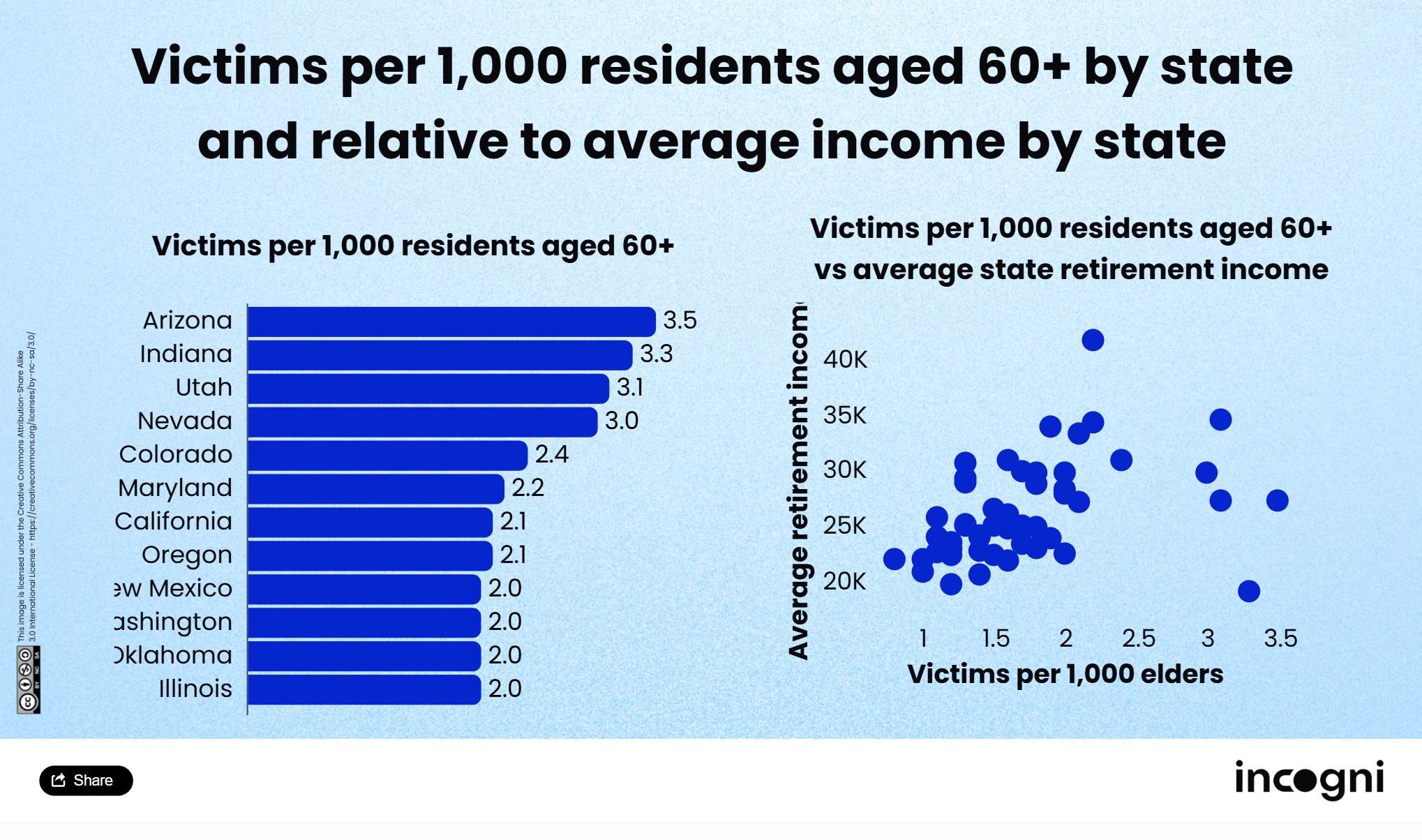
Incogni researchers also cross-checked the total number of complaints versus the population of individuals aged 60+ years for each state to understand better the ratios of elders living in each state to those affected.


Across the US, around 1.8 complaints were filed per 1,000 American residents aged 60 years or older, while some states stood out regarding the number of elders affected per senior population.

The highest number of complaints among states was seen among Arizona's older residents, who reported 3.5 complaints for every 1,000 elders. Indiana, Utah, and Nevada followed, with three or more complaints per 1,000 residents aged 60+ years.

Incogni's researchers also found a statistically significant correlation between the average retirement income in each state and the number of complaints per 1,000 elders in that state, proving that older populations living in wealthier states are more likely to be victims of cybercrime.

“It's absolutely critical that we defend our seniors from these devastating frauds and scams targeting them based on the personal information available online,–added Belejevas. "However, to create more coordinated efforts to shield elderly Americans from the wave of cybercrimes, we need policymakers, companies, and citizens to work together."

Incogni's researchers examined the 2024 Internet Crime Report, published by the Internet Crime Complaint Center (IC3), a division of the FBI.

Full analysis , including the public dataset, can be found here.

Read next: Nearly Half Of Americans, Particularly Millennials, Worry About Online Privacy But Continue Using Data-hungry Apps


by Irfan Ahmad via Digital Information World