Friday, April 17, 2026

Stanford AI Index 2026 Report Details Advances, Risks, and Global Shifts in AI

By Shana Lynch

This year's AI Index report reveals AI's capabilities are advancing quickly; less so, our ability to measure and manage them.

Led by a steering committee of academic and industry experts and produced by the Stanford Institute for Human-Centered AI, the Artificial Intelligence Index has tracked the field's evolution since 2017, measuring everything from technical capabilities and research output to societal impact and public perception. What began as an effort to bring rigor and transparency to AI's rapid development has become the field's most comprehensive annual snapshot—a data-driven portrait of where artificial intelligence stands, where it's headed, and what it means for society.

The new report shows that AI models are achieving breakthrough results in science and complex reasoning, but at a concerning environmental toll. America is outspending any other country on AI, but is finding it harder to attract top talent. Meanwhile, AI’s workforce disruption has moved from prediction to reality, hitting young workers first.

What follows are the year’s most significant developments in AI, or read the full report.

Power-Hungry Models


As AI's capabilities improve, its environmental impact increases. Grok 4's estimated training emissions reached 72,816 tons of CO2 equivalent, or roughly the same amount of greenhouse gas emissions created from driving 17,000 cars for one year. AI data center power capacity rose to 29.6 GW, or about what it takes to power the entire state of New York at peak demand, and annual GPT-4o inference water use (the water used to cool data servers or run them off hydroelectricity) alone may exceed the drinking water needs of 12 million people.

For perspective, the cumulative power demand of all-in AI systems is comparable to the national electricity consumption of Switzerland or Austria.

China/US: The Lead Evaporates


For years, the U.S. outpaced all other global regions on AI - in model size, performance, artificial intelligence research, citations, and more. But China emerged as an AI counterweight to the U.S., gradually gaining ground, and this year it appears to have nearly erased any U.S. lead. U.S. and Chinese models have traded places at the top of the performance rankings multiple times since early 2025. In February 2025, DeepSeek-R1 briefly matched the top U.S. model, and as of March 2026 Anthropic's top model leads by just 2.7%. The U.S. still produces more top-tier AI models and higher-impact patents, while China leads in publication volume, citations, patent output, and industrial robot installations.

America’s Draw Fades


Asterisks indicate that a country’s y-axis label is scaled differently than the y-axis label for the other countries.

The U.S. is home to the most AI researchers and developers of any country by far, but the flow of these experts into the country is dramatically slowing. The number of AI scholars moving to the United States has dropped 89% since 2017. That decline is accelerating, down 80% in the last year alone.

AI Can Win a Mathematical Olympiad But Can’t Tell Time
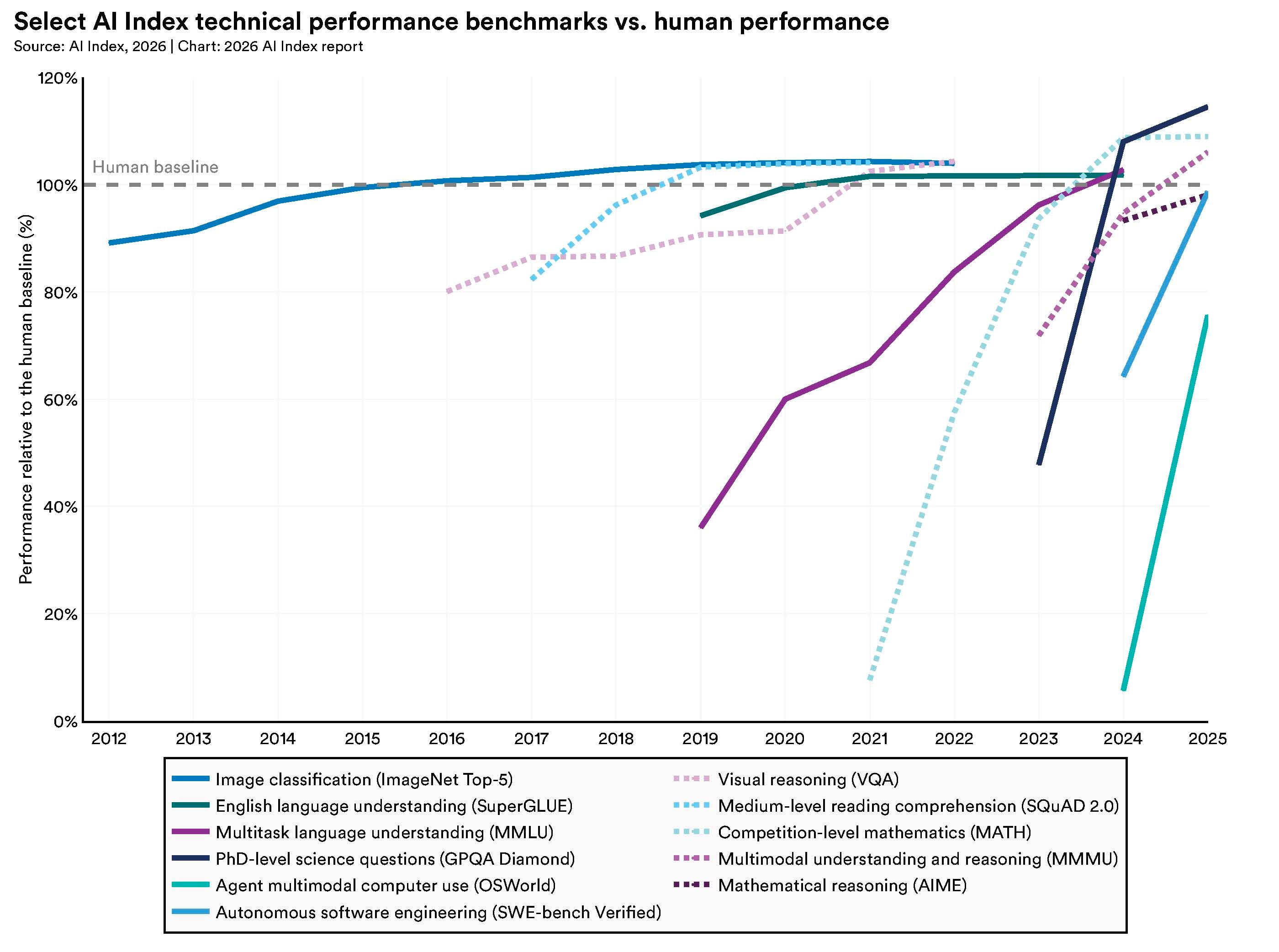
AI continues to expand its capabilities, hitting higher scores on benchmarks across types. But not all capabilities are evenly distributed. Frontier models now meet or exceed human capabilities on items like PhD-level science questions, multimodal reasoning, and competition mathematics. Other areas that had been performing poorly saw huge growth. For example, the success rate of agents handling real-world tasks improved from 20% in 2025 to 77.3% today, according to Terminal-Bench, while AI agents handling cybersecurity issues solved problems 93% of the time compared to 15% in 2024.

At other tasks, AI lags behind, including learning from video, generating video that is coherent and realistic, telling time, managing multiple-step planning, conducting financial analysis, and answering certain expert-level academic exams. Robots still have far to go on managing household chores—they succeed in only 12% of real household tasks like folding clothing or washing dishes.

The AI Investment Surge

More and more money is flowing into AI; global corporate AI investments hit $581.7 billion in 2025, up 130% from the prior year. Meanwhile, private investments reached $344.7 billion, an increase of 127.5% from 2024. The United States leads all other countries in doling out AI dollars: Its investments ($285.9 billion) were 23.1 times greater than those of the next-highest country, China ($12.4 billion). However, comparisons based solely on private investment likely understate the amount of capital China is directing toward AI. The Chinese government channels resources through government guidance funds, state-initiated investment funds that produce financial returns and further the government’s strategic priorities. Between 2000 and 2023, it was estimated that $912 billion of these funds were deployed across industries, including AI.

An Entry-Level Squeeze

Productivity gains from AI are appearing in many of the same fields where entry-level employment is starting to decline. Employment among software developers aged 22–25 has plummeted nearly 20% since 2024, even as their older colleagues' headcount grows. The pattern repeats in other jobs with higher levels of AI exposure, like customer service. Meanwhile, firm surveys indicate executives expect this trend to accelerate, with planned headcount reductions outpacing recent cuts. Translation: The disruption is targeted and just beginning.

AI as Scientist and Lab Assistant

AI is driving more scientific research, moving beyond a research tool that helps write papers or check numbers and toward actual discovery in science. AI-related publications in the natural, physical, and life sciences all increased 26% to 28% year over year. Some exciting projects for the year: For the first time, AI ran a full weather forecasting pipeline end-to-end—it took raw, real-time meteorological observations and directly output final weather predictions like temperature, wind, and humidity. Astronomy also built its first foundation model, automating astronomical observations across 10 telescopes.

Power and Opacity


Today’s most capable modern models are now among the least transparent. Giant, powerful models are concentrated within the largest AI companies, which are increasingly keeping training code, dataset sizes, and parameter counts to themselves. The Foundation Model Transparency Index, which measures how openly major AI companies disclose details about their models' training data, compute, capabilities, risks, and usage policies, saw average scores drop to 40 points from last year’s 58. The index noted that the most capable models often disclose the least amount of information.

Feelings on AI: Frenemies?


Public sentiment toward AI is growing more complex. In a global survey of public attitudes and perceptions on AI, 59% of people reported feeling optimistic about the benefits, up from 52%. The survey also noted a small uptick in nervousness around the technology - a 2% increase to 52%. The U.S. is more wary than other countries. Only 33% of Americans expect AI to make their jobs better, compared to a global average of 40%, and people in the U.S. are among the highest in expecting AI to eliminate jobs rather than create new ones. The U.S. public also reported the lowest trust in its government to regulate AI among the countries surveyed, at 31%.

Generative AI: More Popular Than the Internet?


AI adoption is spreading at historic speed, and consumers are deriving substantial value from tools they often access for free. Generative AI reached 53% population adoption within three years, faster than the personal computer or the internet, though the pace varies by country and correlates strongly with GDP per capita. Some show higher-than-expected adoption, such as Singapore (61%) and the United Arab Emirates (54%), while the U.S. ranks 24th at 28.3%. The estimated value of generative AI tools to U.S. consumers reached $172 billion annually by early 2026, with the median value per user tripling between 2025 and 2026.

The Self-Education Wave

Formal education is lagging behind AI use, but people are learning it at every stage of life. Four out of five U.S. high school and college students now use AI for school-related tasks, but only half of middle and high schools have AI policies and just 6% of teachers say those policies are clear. Outside the classroom, professionals are picking up both soft AI skills (like prompts) as well as more technical skills; the United Arab Emirates, Chile, and South Africa are learning AI engineering skills fastest.

AI Is Your Doctor’s Assistant

AI has entered the clinic. Tools that automatically generate clinical notes from patient visits saw widespread adoption in 2025. Across multiple hospital systems, physicians reported up to 83% less time spent writing notes and significant reductions in burnout. But beyond certain tools, the value of clinical AI remains speculative. A review of more than 500 clinical AI studies found that nearly half relied on exam-style questions rather than real patient data, with only 5% using real clinical data.

Another area of growth in medical AI is in data twins, or dynamic, data-linked computational representations of individual patients that update over time and support forecasting, simulation and treatment optimization. Publication counts rose from near 0 in 2015 to 372 in 2025, and where rigorous trials exist, early results are promising.

Originally published on the Stanford Institute for Human-Centered Artificial Intelligence (Stanford HAI) and republished here on Digital Information World with permission.

Reviewed by Ayaz Khan.

Read next: 

• Industries most exposed to AI are not only seeing productivity gains but jobs and wage growth too

Online Viewers Prefer Livestreams to Recordings


by External Contributor via Digital Information World

Thursday, April 16, 2026

Online Viewers Prefer Livestreams to Recordings

By Sally Parker

Image: Justin Min / Unsplash

In an era when most TikTok videos are prerecorded, can a band with a new single create a tighter bond with fans by debuting via livestream instead? Can a business do the same when promoting a new product?

New research from the McCombs School of Business at The University of Texas at Austin suggests they could.

Since the pandemic, the livestreaming industry has been booming. The global market is expected to reach $345 billion by 2030, up from $100 billion in 2024. Nearly 30% of internet users watch livestreams at least once a week on social media.

Adrian Ward, associate professor of marketing, is one of them. A few years ago, he was viewing a livestream of a town hall meeting and found himself gripped by a speaker’s comments, feeling as if he were actually in the room. On reflection, he suspected it was the liveness of the event, as much as the speaker, that kept him glued to the screen.

“As we spend more of our time online and on social media, it’s worth asking how we can feel as complete and connected as possible in these spaces,” Ward says.

Live and Let Stream

With Alixandra Barasch of the University of Colorado Boulder and Nofar Duani of the University of Southern California, Ward began to investigate what he calls the “mere liveness effect”: the idea that simply knowing an event is streaming in real time makes a viewer feel more connected to the performer.

The researchers ran five experiments with 3,500 total participants. By manipulating various factors, they compared how, when, and why viewers reacted to watching livestreams versus prerecorded videos online.

In one experiment, participants watched live or recorded videos of their choosing on the platform Twitch. In another, they viewed a performance by the R&B cover band Sunny and the Black Pack, either live on YouTube Live or its recording the next day on YouTube.

In a third, the researchers created their own streaming platform to show participants identical videos, manipulating whether the content appeared to be live or prerecorded.

The experiments provide evidence that watching an online performance in real time boosts several aspects of the viewing experience:

  • Connection. Viewers in one experiment felt 7 percentage points more connected to the performers in the live video. Another experiment showed the effect was even stronger when viewers believed no one else was watching.
  • Enjoyment. In another experiment, viewers enjoyed the live video 5 percentage points more than the prerecorded one.
  • Engagement. Real-time streams carried a “liveness lift.” Viewers chose to continue watching longer, and they were more willing to follow and subscribe to the live streamer’s channels.

A common factor underlying those effects was a heightened sense of presence, Ward says. “When we watch something live, we are psychologically transported there.

“It’s not that there’s actually something different about the video itself. It’s that we know that it’s live right now, and that breaks down barriers between our world and the world on the other side of the screen.”

Lessons for Liveness

One quality weakened the liveness effect: not being able to see a performer’s face. When viewers saw only a musician’s hands, they felt less connected, even though they were watching the same performance.

The findings have implications for marketers, platform developers, and content creators, Ward says. In an age when people increasingly meet their social needs online, going live can benefit streamers by motivating audience engagement.

As a follow-up, he’s working with a graduate student to study whether the liveness effect translates into greater brand trust or sales.

“From influencers to businesses, it’s about the experience of real people seeing other real people live and in the moment,” Ward says. “It makes you feel like you’re sharing something.”

The Liveness Lift: Viewing Live Streams Creates Connection and Enhances Engagement in Amateur Music Performances” is published in The Journal of Marketing.

Originally published by the McCombs School of Business, The University of Texas at Austin. Republished here with permission.

Reviewed by Irfan Ahmad.

Read next:

• Industries most exposed to AI are not only seeing productivity gains but jobs and wage growth too

• Global deepfake fraud reaches $2.19B — US leads in losses


by External Contributor via Digital Information World

The End of the Honour System: Rethinking Age Verification Without Sacrificing Privacy

By Alex Laurie, GTM CTO, Ping Identity

The internet has long operated on an honour system when it comes to verifying age: click a box, enter a birthdate, and move on. That model is now collapsing under the weight of today’s digital reality. Across the globe, the pressure to implement more effective age verification measures has reached a tipping point. Regulators are advancing legislation, platforms are rolling out stricter policies, and parents are demanding stronger protections against harmful content.

Discord’s recent move to a global “teen-by-default” experience is a clear sign that the industry is shifting away from optional safeguards toward enforced accountability. As a parent of a son finding his feet online, I welcome that shift. Assuming users are minors until proven otherwise introduces necessary friction in an environment where explicit content, exploitation, and even AI-generated deepfake abuse are just one click away.

However, the intent of these policies is only half the battle; the technology behind these systems matters just as much.

The Age Verification Privacy Dilemma

Right now, many age verification approaches rely on invasive methods like facial analysis or the upload of government-issued IDs. While some platforms attempt to process data locally, there is often a fallback to centralized identity checks. And that’s where the risk compounds.

Every time a user uploads a passport or driver’s licence to verify their age, they are contributing to a growing pool of highly sensitive personal data. These ‘honeypots’ are prime targets for malicious actors. Scaling this model doesn’t just increase risk; it ignores a fundamental crisis of trust. In fact, 75% of consumers are more worried about personal data security than five years ago, and only 17% fully trust the organizations managing their identity data.

This is the core tension: How do we protect minors online without creating a surveillance infrastructure for everyone else?

Image: Tima Miroshnichenko - Pexels

A New Architecture for Digital Identity

The answer is not more data collection; it’s a better identity architecture built on decentralized identity. In the context of age verification, we must move away from “show me your ID” to “prove you meet the requirement”.

Technically, this is achieved through verifiable credentials stored in a secure digital wallet. Using zero-knowledge proofs, a user could verify if they are over 18 through a simple cryptographic ‘Yes/No’ signal.

This approach fundamentally changes the privacy equation. Instead of creating troves of sensitive data in one central location, we distribute trust to the edge and place control back in the hands of the user while still meeting regulatory and platform requirements. Unlike a physical ID, digital credentials can also be immediately revoked and reissued if a device is compromised.

Identity as a Continuous Signal

This shift aligns with a broader evolution happening across digital identity. In enterprise environments too, identity is no longer a one-time checkpoint; it is becoming a continuous, contextual signal evaluated in real time based on risk, behavior, and intent. This is critical in the age of AI, where autonomous agents increasingly act on behalf of users, systems, and organizations.

In these environments, identity must operate at runtime, continuously verifying not just who or what is requesting access, but whether that action is authorized, trustworthy, and aligned with expected behavior. Establishing identity as a dynamic control layer for both humans and AI is essential to ensuring trust, accountability, and security at scale.

The same principle applies here. Age verification shouldn’t be a static upload that lives indefinitely on a server. It should be a dynamic assertion, validated when needed and discarded immediately after. Identity is the only remaining "off-switch" in a decentralized AI ecosystem, and it must operate at runtime to ensure trust and accountability.

The Future of Trust Online

We are at an inflection point. The rise of deepfakes has effectively ended the age of visual trust online. In this context, doubling down on document-based verification feels like solving tomorrow’s problem with yesterday’s tools.

The future of identity for humans and machines alike will be defined by minimization: share less, prove more. Protecting minors is non-negotiable, but we must not let children pay the price of our technical delay. By embracing privacy-preserving verification, we can build a next generation of digital trust based not on data collection, but on data protection.

The honour system is over. What we build next will define the future of the internet.

Edited by Asim BN.

Read next: Google promotes ‘teacher approved’ apps for kids. Here’s what parents should know
by Guest Contributor via Digital Information World

Wednesday, April 15, 2026

Google promotes ‘teacher approved’ apps for kids. Here’s what parents should know

Chris Zomer, Deakin University and Niels Kerssens, Utrecht University

Researchers urges parents to verify children’s apps independently amid concerns over Google’s approval system transparency.
Image: Ron Lach/ Pexels

As school holidays continue around Australia, many parents are looking for educational ways to keep their children entertained.

If you own an Android device and have young children, you may find yourself browsing Google Play for educational and age-appropriate apps. If you go to the children’s section, you will be led to a page with “Teacher Approved apps & games” featuring apps for children under 13 according to different age ranges and themes.

Popular “Teacher Approved” apps such as learning app Lingokids and the game Bluey: Let’s Play have been downloaded more than 50 million times. YouTube Kids, another “Teacher Approved” app, has been downloaded more than 500 million times.

Google says “teachers and specialists” rate the “Teacher Approved” apps. But in our research we argue it’s unclear who exactly those teachers and experts are. The educational value of Google Teacher Approved apps can also be unclear at times.

What is ‘Teacher Approved’?

Google launched the “Teacher Approved” program in 2020 to set a quality standard for apps for children aged under 13.

To be included in the “Teacher Approved” section, an app needs to adhere to Google’s family policies, which includes having an easy-to-understand interface and content that is appropriate for children. Any ads, in-app purchases or cross-promotion “must be appropriate” too.

Google has an online course for developers who want to be included in the Teacher Approved section. We took this as part of our our research.

In the course, Google states “an app doesn’t have to be educational” as long as it is “enriching” and “support(s) a child’s healthy development”. At the same time, Google says teachers are assessing apps for “learning impact”. However, it is not clear how learning is assessed, especially for apps that are not educational.

Our research

In our study, we analysed how apps were presented in the children’s section on Google Play to make them seem educational.

We also interviewed five industry stakeholders (three founders/chief executives and two design specialists) from different companies developing apps for children.

We chose to involve industry rather than parents, as anecdotal evidence suggests parents have little understanding of the “Teacher Approved” program.

Confusing labels and categories

We found “Teacher Approved” apps are often categorised with vague or interchangeable labels such as “enriching apps”, “enriching games” and “games for kids”. This can make it difficult to understand the purpose of the apps, or to know whether they are educational or not.

We also found some apps with a “Teacher Approved” badge were labelled by the app developer as entertainment rather than “educational”. For example, Paw Patrol Rescue World was “Teacher Approved”, despite being labelled as “action-adventure” by the developer.

With the Teacher Approved badge Google creates the impression of educational value and trustworthiness for all sorts of apps. As one of the developers we interviewed explained:

how many people would look at a little graphical badge and go ‘oh, I trust this now, because they’ve got this badge’.

Who approves the apps?

The Teachers Approved badge implies teachers are used to evaluate the apps that appear in the children’s section on Google Play.

However, on the developer’s section of its website, Google notes it is not exclusively teachers who assess the apps. It says “teachers and children’s education and media specialists recommend high-quality [Teacher Approved] apps for kids on Google Play.”

In 2020, Google shared the names of two experts who were “lead advisers” at the time – a developmental psychologist and an education and media expert. But it is not clear who the “teachers” and “specialists” who currently rate the apps are and how many of them are actually teachers.

The Conversation asked Google where the teachers or specialists are located, whether they are paid, and what criteria non-teachers need to meet to be included in the program. The company did not respond before deadline.

What can parents do?

Our research suggests the current situation is confusing for parents. In the meantime, there are some things parents can do if they are not sure about apps their kids are using:

  • use independent sites such as Children and Media Australia that evaluate the educational content of apps

  • don’t rely on the content description on Google Play, but test the apps yourself

  • don’t use apps with advertising, as this will interrupt the learning experience.The Conversation

Chris Zomer, Research Fellow at the ARC Centre of Excellence for the Digital Child, Deakin University and Niels Kerssens, Assistant Professor in Digital Media and Society, Utrecht University

This article is republished from The Conversation under a Creative Commons license. Read the original article.

Reviewed by Irfan Ahmad.

Read next: AI is changing more than your writing — it may be shaping your worldview


by External Contributor via Digital Information World

AI is changing more than your writing — it may be shaping your worldview

By USC Dornsife News

Image: Valentin Ivantsov - pexels

Use of ChatGPT, Claude and other large language models, or LLMs — what most people call “AI” — has surged since ChatGPT debuted publicly in 2022. Hundreds of millions of people now use these tools weekly, according to recent estimates.

Users might assume these tools are just helping them organize their thoughts, but recent research suggests they may be doing something more subtle and more powerful — influencing how we all think, speak and even understand the world.

In a recent opinion piece, researchers at the USC Dornsife College of Letters, Arts and Sciences, investigated how artificial intelligence systems like ChatGPT could be nudging people toward similar ways of communicating and reasoning — a process researchers call “cultural homogenization.”

“AI isn’t just reflecting culture anymore,” said lead author Yalda Daryani, a PhD student in social psychology at USC Dornsife. “It’s actively shaping it. It’s deciding what sounds polite, what sounds clear, even what counts as a good answer.”

So the researchers set out to understand how large language models like ChatGPT, Anthropic’s Claude and Google’s Gemini might influence human culture on a global scale, and how policies could address the broader effects these LLMs might have.

A pattern emerges with AI use

The researchers — under the guidance of Morteza Dehghani, professor of psychology and computer science at USC Dornsife and head of the Morality and Language Lab — reviewed a wide range of recent studies across psychology, computer science and linguistics to understand how LLMs perform across different cultures and how people respond when using AI in real-world tasks such as writing or decision-making.

They found a consistent pattern: AI systems tend to reflect and reinforce a narrow slice of human experience.

A central finding of the research is that these systems often align with what the researchers describe as “WHELM” perspectives — Western, high-income, educated, liberal and male. In other words, they reflect the values and communication styles most common in English-language online data.

“When you ask AI for advice, you’re not getting a neutral answer,” Daryani said. “You’re getting the perspective of a very specific group of people, even if it doesn’t say that explicitly.”

This pattern appears in how AI handles moral questions. The research showed that AI systems tend to favor values such as individual freedom and fairness, while placing less emphasis on ideas like tradition, authority and community, which are more central in many non-Western cultures.

AI’s impact extends to subtle social interactions

The influence goes beyond values. It also affects how people communicate.

“When millions of people use AI to draft messages, those differences start to disappear,” Daryani said. “Over time, we may all start sounding very alike.”

Even when users ask questions in other languages, the models often return examples tied to American or European culture — such as U.S. holidays or English-language films — while offering less detailed or more stereotypical descriptions of non-Western traditions.

Dehghani says this pattern creates a kind of feedback loop. “The more we rely on these systems, the more their outputs become part of our shared knowledge, and then that same material gets used to train the next generation of AI. So the cycle reinforces itself.”

That loop, the researchers warn, could gradually narrow the range of ideas, traditions and communication styles that people are exposed to and pass on over time.

Why does that matter? Because cultural diversity isn’t just about language or customs, the researchers say. It shapes how people think, solve problems and make decisions. A wide range of perspectives can lead to better solutions and more creative ideas. If that diversity shrinks, the researchers argue, society could lose important ways of understanding the world.

How to build a better AI

Of note, the team does not suggest that AI is inherently harmful. LLMs can make writing easier, improve access to information and help people communicate more clearly. The concern, the researchers say, is what happens when a small number of systems begin to influence billions of interactions every day.

“Once the system is trained on a narrow set of data, it’s very hard to undo that,” Daryani said.

To address the issue, the team outlines a three-part approach based on their study findings, beginning with the data used to train models. Most AI systems learn from English-language content drawn heavily from Western sources. The researchers say developers should include more material from different languages, regions and cultural traditions to capture cultural knowledge that might otherwise be systematically underrepresented.

During later training stages aimed at refining and evaluating LLMs, the researchers suggest incorporating culturally diverse examples as well as consulting experts such as psychologists, anthropologists, linguists, and policymakers working in collaboration with diverse cultural communities to ensure responses reflect different social norms and values.

They then recommend changing how the training results are judged. Tech companies do employ workers from a variety of countries during this step, but those workers are trained to apply standardized Western evaluation criteria. Instead, reviewers should evaluate answers based on multiple standards.

Taken together, these changes could help AI systems recognize that there is no one “correct” way to communicate or reason, preserving a broader range of human perspectives as the technology continues to evolve.

For Daryani, the stakes are clear: “Languages, traditions, ways of thinking — once they disappear, we can’t get them back. The question isn’t whether this is difficult to fix. It’s whether we can afford not to.”

About the study

Zhivar Sourati, a PhD student at the USC Viterbi School of Engineering, was a co-author of the report, published in Policy Insights from the Behavioral and Brain Sciences.

Originally published by USC Dornsife College of Letters, Arts and Sciences News. Republished here with permission.

Reviewed by Irfan Ahmad.

Read next: In the face of rampant AI, is ‘data poisoning’ a new form of civil disobedience?
by External Contributor via Digital Information World

In the face of rampant AI, is ‘data poisoning’ a new form of civil disobedience?

Claire Tanner, Monash University; Mor Vered, Monash University, and Sam Cadman, Monash University

Image: Declan Sun/Unsplash

The explosion of generative artificial intelligence (AI) tools has provoked both hopes and anxieties about the potential benefits and harms of this technology. In advanced economies, people are almost equally worried and optimistic about it.

This is perhaps unsurprising. AI consumes vast amounts of natural resources yet promises to save the planet. It may improve human efficiency and productivity, while putting millions out of work.

For many white-collar workers, AI use now seems non-optional. The messaging is clear – get on board or be left behind.

Amid this uncertainty and rapid technological uptake, concerned citizens have made efforts to resist AI. One form of AI resistance, aimed at sabotaging the functionality of AI large language models, is data poisoning. But how accessible is it to the everyday person? And what is at stake in its use?

What is AI resistance?

Acts of AI resistance range from social sanctions and boycotts, to strikes, protests, public outcry and lawsuits. Driving these acts are perceived threats to jobs, ethics, safety, democracy and sovereignty, and the environment.

AI is also described as an existential risk to creative industries, including music, fiction and film. In the United Kingdom, generative AI has been characterised as an “industrial scale theft” that threatens a £124.6 billion (A$237bn) creative sector and more than 2.4 million jobs.

People have long used civil disobedience to address social injustices. Famously, Rosa Parks’ refusal to sit at the back of a bus in Alabama led to a 13-month bus boycott by tens of thousands of Black residents. It only ended when racial segregation on public transport was deemed unconstitutional in the United States.

Acts of sabotage have also long been central to collective action against injustice. In fights for labour rights, workers have employed diverse tactics to reduce efficiency and productivity. This has ranged from hotel workers putting salt in sugar bowls to farm workers breaking machinery.

Data poisoning can be viewed as a modern version of these historic actions.

How does data poisoning work?

Data poisoning means deliberately inserting misleading, biased, or nonsensical content into the data AI models learn from, to make their outputs worse. Only 250 poisoned documents in a dataset could compromise outputs across AI models of any size.

There are various ways to poison data. Some require highly technical skills, others are accessible to anyone with an internet connection – if their text or images are used as training data.

Researchers have developed several data poisoning tools that exploit the vulnerabilities of AI models. Glaze and Nightshade enable artists to make poisoned visual images that can’t be used as training data. The tool CoProtector defends against the exploitation of open source code repositories like Github. Monash University and the Australian Federal Police have created Silverer, enabling social media users to doctor personal images to prevent them from being used in deepfakes.

Example images of AI model output generated with data poisoned with the Nightshade tool. Shan et al., arXiv (2023), CC BY

But you don’t need a tool or advanced skills to affect AI. Simply creating websites with factitious information, making jokes in Reddit, feeding models their own outputs, or editing Wikipedia can poison data.

Data poisoning is commonly presented as a dangerous act perpetrated by “cyber criminals” or “malicious actors”. But what if it’s used to protect human rights?

Is data poisoning legal? Is it ethical?

Legal obligations related to data poisoning are often directed to AI developers and organisations. The EU Artificial Intelligence Act requires that appropriate measures are adopted to prevent and detect data poisoning.

The legal status of AI data poisoning by individual users is less clear. Criminal penalties may apply under US or UK computer fraud and misuse laws. Interference with an AI model would also likely breach the terms of service of AI companies.

If AI data poisoning is unlawful, questions could still be asked about its ethical status. Philosophers have long recognised that civil disobedience can be justifiable in circumstances where legally sanctioned practices produce serious injustice.

If AI companies are operating with state approval in ways that impact citizens’ rights to privacy, copyright, safe and secure work, quality education, social and sexual safety, data poisoning may constitute ethical civil disobedience.

For philosopher John Rawls, “[civil disobedience] is one of the stabilising devices of a constitutional system, although by definition an illegal one”.

If the intention is to prevent mass unemployment, preserve the integrity of elections, and protect against social harms (suicide, child abuse, increased human isolation, loss of human creativity and environmental degradation), data poisoning could align with the principles of justice that underpin democratic social institutions.

A significant problem with data poisoning is that even if models become compromised – and outputs grow inconsistent, misleading, or nonsensical – users overly trust AI systems. Data poisoning then could contribute to harms it seeks to resist, amplifying the inaccuracy of systems humans are increasingly relying on, irrespective of their quality and effects.

Data poisoning is not simply an immoral cyber crime. It can be an ethically complex strategy to address social injustices. AI development needs to be of collective benefit and aligned with public values and interests. If AI company employees are askingAre we the baddies?”, history may prove that in some cases data poisoners are on the side of good.The Conversation

Claire Tanner, Senior Lecturer in Sociology and Gender Studies, Monash University; Mor Vered, Senior Lecturer, Data Science & AI, Monash University, and Sam Cadman, Research Fellow, Criminology, Monash University

This article is republished from The Conversation under a Creative Commons license. Read the original article.

Edited by Asim BN.

Read next: From bias to balance: how AI can reshape hiring decisions
by External Contributor via Digital Information World

Tuesday, April 14, 2026

How the structure of online reviews shapes their helpfulness

The article at a glance

The usefulness of online product reviews depends not only on what is said, but on how the information is structured. Research co-authored at Cambridge Judge Business School shows that the sequencing of positive and negative points plays a central role in how readers interpret reviews. This suggests that better-designed review forms – ones that guide how feedback is organised – could significantly improve their value for decision-making.

Study finds structuring feedback differently improves usefulness depending on product rating and reader expectations significantly.
Image: Omar:. Lopez-Rincon / unsplash

We all have experience evaluating things: online products, services and even other people. Yet such evaluations are rarely straightforward, as most targets combine positive, negative and neutral aspects. For example, a reviewer assessing a laptop might praise its performance and design while criticising its battery life.

This raises a practical question: in what order should such information be presented to be most useful? A similar challenge arises when assessing others’ performance, where strengths and weaknesses must be weighed carefully. More broadly, this creates a dilemma: should an evaluation begin with criticism and end on a positive note, or start positively before turning to drawbacks?

Despite this common dilemma, existing research has largely focused on the overall sentiment of evaluative messages – whether feedback is positive or negative – rather than how different elements are organised within a message.

Dr Yeun Joon Kim, Associate Professor in Organisational Behaviour at Cambridge Judge Business School, explains:

“Any target of evaluation typically has both positive and negative aspects, which makes crafting evaluative messages challenging. The key question is how to structure these elements within a single message. For example, one might present criticism upfront and then move to praise, or instead integrate negative points within an otherwise positive evaluation. Yet research has paid little attention to this structural dimension. We wanted to understand whether certain structures are consistently more effective, or whether their effectiveness depends on the performance of the target being evaluated.”

The role of feedback structure in making reviews helpful

Research on this topic was conducted by Dr Luna Luan, Lecturer at the University of Queensland, and by Dr Kim based on nearly 200,000 Amazon reviews of various products ranging from clothing to food to electronics.

The research finds that a review’s usefulness to readers depends not just on whether it is overall positive or negative, but also on the sequencing of positive and negative content throughout the review: “We term this arrangement ‘feedback structure’, defined as the organisation of multiple pieces of evaluative information within a single message about a target,” says the research, which finds further that different types of sequencing are more or less helpful depending on how highly rated the product is in that particular review.

In short, say the authors: “How evaluative information is organised matters as much as what is said.”

Why the best review structure depends on how well a product is rated

For high-rated products, reviews that grow increasingly positive are most helpful to readers, while those that turn negative are least helpful. For average-rated products, progressively negative trajectories enhance helpfulness, whereas reviews that start negative and grow positive are least effective. For low-rated products, reviews are judged most helpful when they open constructively before introducing criticism.

“The results are nuanced but very clear,” says Dr Luan, who worked on the research while earning her PhD at Cambridge Judge. “Looking at the overall sentiment of reviews does not fully translate into message effectiveness. It is the broader structure of sentiment – how positivity and negativity evolve throughout the review – that shapes how readers interpret online reviews.”

Adds co-author Dr Kim: “Our findings have very real practical implications for how platforms and companies can design review pages in order to elicit the sort of reviews that will be most helpful to readers based on how highly products are rated. For example, instead of simply asking ‘Write your review here’, the online review form could instead include micro-prompts that guide how reviewers structure feedback in a way recipients find most helpful.

“More broadly, this research suggests that performance evaluations within organisations should also consider how feedback is structured, tailoring it to the level of employee performance.”

Moving beyond the feedback sandwich and other online feedback models

Previous research on the helpfulness of online product reviews identified a couple of commonly used approaches by writers of online reviews:

  • the “‘feedback sandwich’, where criticism is sandwiched between praises” to make the negative part seem not so severe, say the authors
  • the Pendleton model, dating from a well-known 1980s book on education, which begins with a factual narrative followed by praise and concluding with criticism

Both these approaches use a 3-part format (beginning, middle and ending) that seeks a more balanced message to readers. The research at Cambridge Judge also adopts this 3-part approach, but also adds a couple of other 3-part structures: opening tone (positive, neutral or negative) and valence trajectory (increasing, decreasing or steady) – therefore yielding 9 possible structures ranging from Type A reviews that start positive and become more positive as they go along, to Type I reviews that start negatively and become even more negative – with lots of variance in between.

The final sample for the research examined 5,487 distinct products, analysing 195,675 reviews of those products based on product performance and related factors as reflected in the reviews, and a helpfulness score as measured by reader votes.

When common review styles are not the most helpful

A central finding of the research is that the most commonly used review styles are not necessarily the most helpful to readers. In particular, for average- and low-rated products, the structures that reviewers tend to adopt often differ from those that readers find most useful.

This mismatch likely reflects different underlying motivations. Reviewers are not always writing to maximise usefulness for others, but may instead be expressing their own experiences, frustrations or emotions – especially when evaluating products of moderate or poor quality. As a result, review writing often serves both as information sharing and as a form of self-expression. This helps explain why widely used review styles do not always align with what readers perceive as most informative or helpful.

Which reviews are most helpful for highly rated, average and low-rated products

For highly rated products, the most helpful reviews start critical and grow more positive

The most helpful reviews of highly rated products are those that begin negatively but then increase in positivity consistently. “Such reviews capture attention by initially presenting criticisms, which enhances credibility, before shifting to positive evaluations that frame the product as fundamentally solid,” say the authors. “This approach creates the impression of balance and trustworthiness.” Reviews that transitioned to positivity from a neutral or positive start were not statistically behind, however.

The least helpful reviews of highly rated products were those that start negatively and get more negative. “This downward trajectory may foster confusion and discouragement, particularly when the product is generally high quality but the review remains predominantly critical,” say the authors.

Escalating negativity in reviews is most helpful for average-rated products

For average-rated products, the most helpful reviews were those that have escalating negativity, “which readers appear to find more informative and diagnostic when evaluating products of middling quality”.

“The least helpful structure (for average-rated products) was Type G, in which reviews began negatively but ended with a more positive tone. Readers may interpret this as non-constructive or even misleading, as it initially raises concerns but then shifts toward positivity in a way that undermines the credibility of the critique.”

Positive openings make reviews of low-rated products more helpful

As for low-rated products, the most prevalent structure (starting negatively, then increasing in positivity) were not perceived as very helpful. The way reviews opened was what mattered most to recipients of low-rated product reviews in terms of helpfulness, particularly reviews that begin positively and remain steady in tone.

“Beginning on a positive note appears to establish goodwill and foster an open mindset among readers, making them more receptive to the review that follows for low-rated products,” says the research. “By contrast, the review structures found to be least effective for reviews of low-rated products were those characterised by negative starting points. Starting with blunt criticism sets an overly harsh tone from the outset, which can make readers defensive or discouraged, diminishing receptivity to later, more constructive content. It can also render the review redundant, since the product’s low rating already signals dissatisfaction.”

Suggestions on how to structure review platforms to boost helpfulness

The study details how micro-prompts on review platforms could be structured. When products are highly rated, reviewers could be encouraged to start with any minor issues before explaining what went well overall, leading readers to perceive a review as credible and balanced. For average-rated products, reviewers could be asked to start with what could be improved before being guided progressively toward a negative trajectory that readers find as diagnostic. For low-rated products, reviewers could be invited to open constructively by noting positive aspects before sharing their main concerns, helping to establish goodwill and preventing a review being seen as overly harsh.

“Such small changes in prompt wording or field order can significantly alter how reviewers structure their narratives, aligning their natural writing flow with the structures that audiences actually value. Importantly, these nudges do not censor or distort authentic consumer voices but instead help reviewers present their thoughts in ways that maximise clarity, credibility and usefulness,” say the authors.

Featured research: Luan, Y.L. and Kim, Y.J. (2026) “The role of review structure in perceived helpfulness.” Scientific Reports (DOI: 10.1038/s41598-026-41169-z) (published online Mar 2026).

This article was originally published by the University of Cambridge Judge Business School and republished on DIW with permission.

Reviewed by Irfan Ahmad.

Read next: AIs have ‘personalities’ – here’s how they affect you more deeply than you may realize


by External Contributor via Digital Information World