Monday, May 26, 2025

How to Use Google Lens for Reverse Image Search on Any Device

Reverse image search has many benefits for users. They can use this feature to get details about images and to access different variants of an image. Photographers and creators can use it to trace people who are using their images without their approval and to reach the source of an image on the internet.

General public can use reverse image search in their daily lives for websites selling specific products or the same products being sold by other companies online. On the other hand, reverse image search can also help news readers and researchers figure out if an image is real, fake or AI generated. With just one image, users are able to open a wide range of images leading to different sources. In this way, they have everything related to the image in one place. Users will not have to waste time by roaming the internet to find specific information regarding a product or an object.

A Step-by-Step Guide: How to Do a Reverse Image Search

In this article you'll learn how you can use reverse image search on different devices and can use it effectively:

On Android

  1. Download Google Lens from the Play Store and open it.

  2. Select an image from your gallery.

  • The app will start searching for details related to the image and other similar images.

Another way to do reverse image search using Google Lens is by selecting a photo directly from your phone gallery.

  1. Open your phone gallery and select an image.

  2. After selecting the image, tap on Share and select Google Lens.

  • The image will be opened in Google Lens with related photos and details given at the bottom.

iOS Users

iOS users have to download the Google Search app first (instead of Google Lens app like Android). In the Google Search app, they can select Google Lens option. And rest of the procedure is almost same, users can also choose the gallery option and select photos directly from their phones.

On Web (Mobile and Desktop)

There are many ways for users to do reverse image search using Google Lens on web through mobile or desktop. The first one is by using Google images om mobile:

  • Search an image of your choice on Google and then click on images.


  • Select an image of which you want the related images and details.

  • Click on Google Lens option given on the left corner of the image. Google Lens will scan the image and display the results.

Or you can use images given on any website on the internet for authenticity and fact checking. Google Lens will provide you related data in a similar way.

  • Click on any image given on any website on the internet through website and select Google Lens given in the options.

  • Select Search image with Google Lens. Google Lens will start searching for related data and will display in the form of AI generated text and similar images at the bottom.

Now, if you are on desktop you can simply, Copy the image address/URL and paste it into Google Lens or Drag and drop any image from device storage/folders into Google Search , or by just right click on any image on web and by press the Search with Google Lens.

In my opinion using Google Lens direct image upload or  dedicated URL searching feels less distracted as compared to just right clicking on any images and Search with Lens option.

So here is how to use the most effective method on PC:

  • Right click on the image and select copy image address.

  1. Go to Google search and click on the Google Lens given at the end of the search bar.

  2. Paste the image address/URL in the search bar of Google Lens. It will lead you to similar images and data related to that image.

Or You can drag photos from your computer storage to Google Lens to get the same result. Just above image address bar, drag an image is mentioned. Upload a photo, and you can have the same result.

What Are the Benefits of Using Reverse Image Search?

Reverse image search can help users in locating high resolution pictures. If you have a photo, which you love, but the only thing that is making the photo appear unattractive is its low resolution, reverse image search can lead you to similar photos with better resolutions.

Photographers can even trace the original source of their photos being used by someone without their permission. Because reverse image search also reveals the website on which a specific photo is present, it is easier for them to either request website owners to give them backlinks or face legal actions.

If you do not know where to buy a specific product, just upload its photo to Google Lens, and it will show all sellers selling that product or related product online.

How To Use Reverse Image Search Effectively?

Though doing reverse image search is easy, there are still some guidelines that can make reverse image search more accurate.

  • Always use high resolution photos in Google Lens. Low resolution photos might not get scanned by the app accurately, leading to results you did not expect.
  • Use the Google Lens scanner properly. Sometimes, we only want a specific item to be searched by Google Lens, but we still upload a photo that has more stuff in it than that specific object. So Google Lens will scan the complete photo, giving us general results.

So make sure that you scan only that portion of a photo whose related data is required.

  • Along with the image that you have uploaded to Google Lens, do provide extra information as well. You can write extra information, a keyword, in Addition to your search bar given at the top of results.

  • For more diverse results, you can also use more than one search engine. For example, the same photo might produce different results on Google, Bing, or even ChatGPT. You can then compare the varied results and choose the one preferable to you.

The above mentioned detailed guide regarding reverse image search on different devices covers reverse image searching. Whether you are an android, an Apple or a desktop user, the guide will help you to use Google Lens for reverse image search more effectively.

Read next: Deepfake Technology Explained: Risks, Uses, and How to Detect Fake Videos


by Ehtasham Ahmad via Digital Information World

Sunday, May 25, 2025

China’s Henan Province Silently Enforces Heavier Internet Restrictions Than the Rest of the Country

Over the past year and a half, internet users in China’s Henan province have faced a significantly heavier digital blockade than citizens in other regions, according to new findings from a group of international researchers. The study, which drew from daily measurements across millions of online domains, reveals that Henan’s firewall exceeds national censorship thresholds by a wide margin—raising fresh concerns about the emergence of region-specific controls within China's already stringent internet ecosystem.

Between late 2023 and early 2025, analysts monitoring traffic from cloud servers located inside Henan noticed that internet access in the province was unusually constrained. Their data, covering a substantial sample of the world’s most-visited websites, shows that residents in Henan encountered access restrictions on a scale five times greater than the average Chinese internet user.

Unlike China’s uniform firewall system—which blocks content at a nationwide level—the digital gatekeeping mechanisms in Henan appeared to operate on an additional layer. That local filter intermittently blocked roughly 4.2 million domains, a number far beyond the nearly 741,000 websites commonly censored across the country. Much of the filtered content was business-related, including sites tied to finance, markets, and economic discussions.


The enforcement timeline observed by the researchers coincides with Henan’s recent history of unrest tied to financial scandals. In 2022, when thousands of locals protested after being unable to withdraw funds from their accounts, security authorities reportedly manipulated the province’s pandemic-related health code system to block protesters from gathering. While officials were later disciplined for misusing public health tools, the internet crackdown appears to have deepened afterward—possibly as a preventive measure against further dissent.

By using direct testing from within Henan, the researchers captured the daily behavior of local traffic and compared it to nationwide norms. Their experiment included a gap in testing during 2024, but data before and after showed persistent censorship levels significantly higher than in Beijing, Shanghai, or Guangdong.

What makes the case more notable is that Henan isn’t historically seen as a volatile region like Xinjiang or Tibet, where enhanced digital surveillance is expected. Instead, the provincial clampdown suggests a shift in strategy—where censorship tools may now be calibrated based on regional sensitivities or past disruptions, rather than purely political unrest.

While the source of the heightened controls remains unclear, the implementation points to either increased autonomy for provincial authorities or a centralized directive targeting Henan’s recent disruptions. No confirmation has emerged from official channels, and repeated attempts to obtain comment from Henan’s cyberspace regulator were unsuccessful.

Beyond regional censorship, China’s central government continues to invest in next-generation surveillance capabilities. Recent presentations from the Ministry of Public Security showcased tools designed to monitor users of encrypted services like VPNs and Telegram. Authorities claimed their systems had collected tens of billions of messages—hinting at a surveillance architecture that’s not only broadening but becoming increasingly precise through artificial intelligence.

These new tools, while helping authorities tighten control, may also equip digital rights researchers with the ability to test censorship more effectively. The same AI models that enhance state surveillance could, in theory, support counter-censorship strategies by identifying patterns and weaknesses in firewall configurations.

The broader implication is that internet regulation in China may no longer be uniform. Instead, provinces like Henan could serve as test beds for targeted enforcement—marking a shift from centralized censorship to a more layered, localized approach.

Read next: 

• Exposed Personal Data Enabled 72% Of Elder Fraud Cases

• The Software Skills Shaping Tech Careers in 2025
by Irfan Ahmad via Digital Information World
Saturday, May 24, 2025

Exposed Personal Data Enabled 72% Of Elder Fraud Cases

It's no novelty that fraudsters pose a threat to senior citizens living in the US, as reports show they are increasingly vulnerable to new cybercrimes, especially those involving AI-powered phishing scams and spoofing attacks. Despite improvements in digital safety education among the elderly, their limited data security knowledge (and hard-earned financial savings) make them easy targets for criminals exploiting personal information.

As a result, in 2024, the number of complaints and total losses reported to the FBI's Internet Crime Complaint Center (IC3) were the highest they've ever been. The number of victims increased by 45% to a staggering 147 thousand people. Also, the total financial losses grew by 43% compared to last year to almost $4.9 billion in 2024. Only between 2019 and 2024, nearly $15B has been reported lost, with over 600,000 victims reporting a cybercrime to the FBI.

Fraudsters tend to target older adults because they believe they have more to lose. They are also assumed to take longer to notice a scam attempt until it’s too late. Senior age groups have also demonstrated that they are often too embarrassed to report a scam after it has occurred. Criminals, therefore, consider this demographic "low-risk." Meanwhile, a successful scam can be devastating for older adults, whose ability to recover their losses is limited.

To understand the direct connection between widespread data exposure and rising cybercrime rates among seniors, Incogni's research team conducted an in-depth analysis of elder fraud incidents using FBI Internet Crime Complaint Center (IC3) statistics, showing patterns that demonstrate how exposed personal data fuels targeted scams.

Out of the 113,906 crimes involving elders reported in 2024, they identified that 72% of cases were enabled by the availability of victims' personal information online. Crimes facilitated by access to data were associated with $4.2B in losses, accounting for 86% of total losses.

When we think of personal information that fraudsters might easily find, the first thing that comes to our minds might be our email address or a phone number that criminals might just use as bait (to send a malicious link to extort more data) or in a phishing attempt to try to convince a victim into revealing login details or passwords for different services, including banking accounts.

But there are even easier ways to uncover this personal data. A Google Search, a ChatGPT search, or a people-site search exposes all this data and much more. In just two clicks (one for entering personal details, and one to hit search), they can uncover details on our living situation, the value of our house, our family members, and the value of our assets. By paying deeper into data brokers' pockets, they might also find out what our health condition is and learn our daily habits and locations we often visit. Combined with any public social media information, this tactic becomes the perfect source of information for malicious actors while searching for potential victims.

“When looking at Incogni’s research stats, at least some of these cybercrimes are very preventable. In some cases, the losses can at least be mitigated quite a bit. It all comes down to personal data online that is easily accessible by different parties, including fraudsters, underlines Darius Belejevas, Head of Incogni, a data protection company.”

“According to the results of our analysis, 72% of reported internet-based crimes and 86% of reported losses affecting older Americans could be solved through more sufficient personal data protection, or at least a better understanding of how to protect personal data so it doesn't end up in the hands of unauthorized parties,” adds Belejevas.

Incogni's researchers identified 11 crime categories from the FBI report that may be made possible or made worse if the criminals have access to the information held and sold by data brokers.


Similarly to last year, in 2024, investment scams were the most costly for victims, with total losses amounting to $1.83B, or $194,100 per complaint. These were followed by business email compromises (BECs), associated with an average loss of $116,700 per complaint, and data breaches responsible for average losses of around $95,200 per report. Phishing and spoofing dominated the cybercrime landscape, with 23.3K cases reported, which is seven times more than last year.

These two last crimes constituted 20% of all crimes reported, while in the previous year, the most reported crimes were tech-support scams, at 17.7K times, comprising 18.5% of all reported crimes. Compared to 2022, the most popular crime, tech-support scams, again constituted 18% of all crimes reported. This suggests a slow shift towards a select few techniques used by criminals and others who victimize elders.

Overall, in 2024, victims of elder fraud in Texas suffered the greatest average losses per complaint—$51.7K—followed by those in Georgia and California, where reported losses per complaint averaged over $48.2K and $46K, respectively.

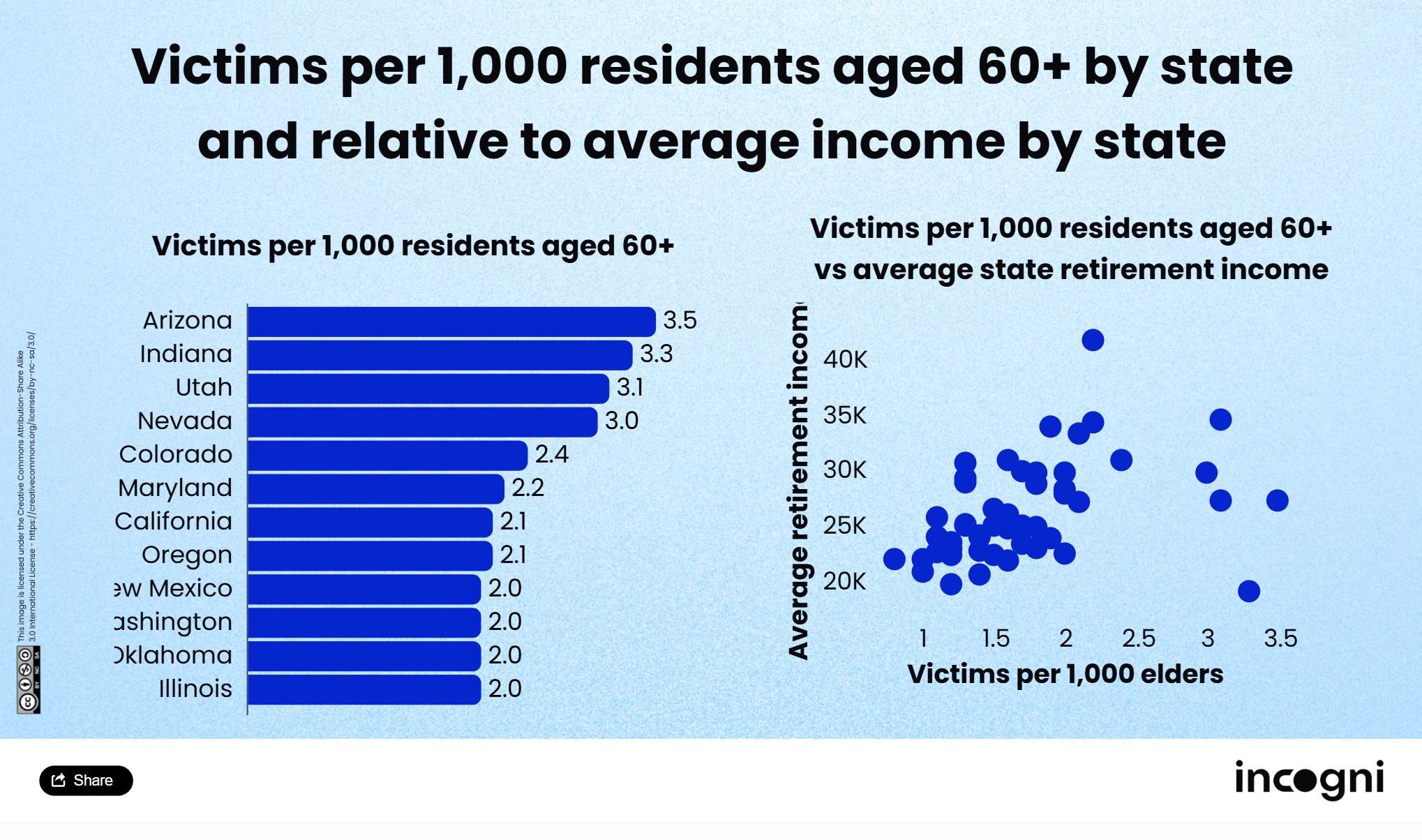
Incogni researchers also cross-checked the total number of complaints versus the population of individuals aged 60+ years for each state to understand better the ratios of elders living in each state to those affected.


Across the US, around 1.8 complaints were filed per 1,000 American residents aged 60 years or older, while some states stood out regarding the number of elders affected per senior population.

The highest number of complaints among states was seen among Arizona's older residents, who reported 3.5 complaints for every 1,000 elders. Indiana, Utah, and Nevada followed, with three or more complaints per 1,000 residents aged 60+ years.

Incogni's researchers also found a statistically significant correlation between the average retirement income in each state and the number of complaints per 1,000 elders in that state, proving that older populations living in wealthier states are more likely to be victims of cybercrime.

“It's absolutely critical that we defend our seniors from these devastating frauds and scams targeting them based on the personal information available online,–added Belejevas. "However, to create more coordinated efforts to shield elderly Americans from the wave of cybercrimes, we need policymakers, companies, and citizens to work together."

Incogni's researchers examined the 2024 Internet Crime Report, published by the Internet Crime Complaint Center (IC3), a division of the FBI.

Full analysis , including the public dataset, can be found here.

Read next: Nearly Half Of Americans, Particularly Millennials, Worry About Online Privacy But Continue Using Data-hungry Apps


by Irfan Ahmad via Digital Information World

The Software Skills Shaping Tech Careers in 2025

Tech moves fast, and software pros can’t afford to fall behind. Employers want people with sharp, specialized skills—and they’re paying top dollar for them. A new Software Finder report looked at over 16,000 U.S. tech job postings to find out which skills are actually boosting paychecks this year.

The study breaks down average salaries and shows which cities are offering the best returns. For tech workers, it’s a clear guide to staying competitive. For companies, it’s a snapshot of what they need to offer to attract top talent.

What’s Paying Now: The Top Software Skills

The data shows a few standout trends, especially around AI and data work:

  • Natural language processing (NLP) leads the pack. Jobs that require NLP pay an average of $160,284, the highest among all software skills in the study. Think virtual assistants, real-time translation, and chatbots. Demand is high, and salaries reflect it.
  • Machine learning and data science are close behind. Machine learning averages $152,677, with data science just under that at $152,406. These skills power everything from fraud detection to content recommendations, making them essential across industries.
  • Cloud-native expertise continues to pay well: Skills like Kubernetes ($143,492) and AWS ($143,012) signal strong demand for engineers who can build and manage scalable, containerized applications in the cloud.
  • Remote roles offer higher pay than on-site or hybrid jobs: Remote positions averaged $135,930—nearly 4% more than fully in-office roles, and 5% more than hybrid jobs. This further legitimizes remote work as a high-value, long-term fixture of the software world.
  • Location remains a salary driver, but not the only one: While major hubs like New York ($154,291) and San Francisco ($151,459) still lead in pay, secondary markets such as Denver ($133,953) and Austin ($132,220) are competitive and growing.

Why NLP Leads the Pack

NLP’s rise to the top of the salary charts isn’t surprising. From automated customer service bots to large language models powering next-generation search and writing tools, companies across industries are incorporating NLP into core products.

NLP pros stand out for blending computer science with human language. Their work pulls from data science, linguistics, and software engineering—a rare mix that’s tough to replace or automate.

As more companies build in voice recognition and chat-based tools, NLP’s high salary shows how central it’s become to modern tech stacks.

Cloud Skills Still Matter

Cloud platforms and container tools aren’t new, but they’re more essential than ever. Knowing Kubernetes or AWS signals more than just tech familiarity—it shows you can build systems that scale and run efficiently.

For many roles, cloud skills aren’t optional anymore. They’re expected.

Companies deploying microservices or managing global data pipelines expect engineers to optimize performance using tools like Docker, Terraform, and Helm in conjunction with Kubernetes clusters.

Remote Work Isn’t Going Away

While debates continue around returning to the office, compensation trends are clear: remote software jobs now command the highest average pay. The numbers reinforce what many developers already know—remote roles often require self-sufficiency, communication skills, and time zone flexibility that add measurable value to a team.

It’s also a signal that many of the best-paying employers, including startups and global tech firms, are prioritizing talent over geography.

  • Remote roles top salary averages: At $135,930 per year, remote positions offer stronger compensation than both hybrid and in-office equivalents.
  • Flexibility attracts top talent: High-paying remote jobs appeal to developers who are not only skilled but also selective, forcing companies to compete for attention.
  • Broader talent pools expand value: Employers aren’t limiting themselves to local applicants, driving up salaries in a national—and often international—market.

City-by-City: The Highest Paying Tech Hubs

Location still plays a part in salary outcomes, especially in traditional tech capitals. That said, strong compensation is no longer confined to coastal cities.

  • New York continues to lead: With an average salary of $154,291, New York is the highest-paying city for software professionals.
  • California remains strong: San Francisco ($151,459), Oakland ($151,201), and San Jose ($143,859) dominate thanks to proximity to top employers and venture capital.
  • Secondary cities are catching up: Denver ($133,953) and Austin ($132,220) signal that skilled professionals can find high-paying opportunities outside legacy tech centers.

This shift has implications for both recruiters and professionals. Tech workers might find cost-of-living advantages in smaller markets without compromising on pay. And employers may need to offer competitive packages across a wider geographic spectrum.

Practical Advice for Today’s Software Professionals

Adapting to these trends doesn’t require a full career pivot. Targeted upskilling can keep developers competitive and open doors to higher-paying roles.

Here are smart moves professionals can make based on the data:

  • Learn the most versatile languages: Python, Java, and C++ remain core to many high-paying roles. Their broad applicability across web, enterprise, AI, and embedded systems makes them solid foundations. Mastering these also helps when learning newer frameworks and tools built around them.
  • Get certified in cloud platforms: Proving expertise with AWS, Microsoft Azure, or Google Cloud through certifications can set candidates apart. Certifications validate hands-on skills and show employers you're ready to handle scalable, production-grade systems.
  • Build AI/ML fluency: Whether through formal coursework or hands-on projects, understanding how to train models, process data, and apply algorithms boosts value. These skills feed directly into NLP, personalization engines, and analytics.
  • Hone cybersecurity skills: With rising threats, knowledge in ethical hacking, network protection, and compliance is more critical than ever. Security expertise also crosses into DevOps and cloud roles, adding extra value.
  • Adopt DevOps methodologies: Familiarity with CI/CD pipelines and tools like Jenkins, Ansible, and GitHub Actions makes developers more desirable in high-performing teams. It also shows you can ship faster, safer code.
  • Work on real projects: Open-source contributions and portfolio projects demonstrate initiative and apply theoretical knowledge in practical ways. Hiring managers love seeing real-world problem-solving and collaboration outside of formal roles.

The Long Game: Positioning for 2025 and Beyond

Succeeding in 2025’s tech industry takes more than just technical skills. It means staying flexible, tracking where the market’s headed, and constantly learning. The best professionals will mix hands-on expertise with strategic thinking, evolving alongside trends like AI, edge computing, and decentralized systems to stay valuable.

Likewise, companies need to play the long game. Focusing only on immediate hires isn’t enough. Retaining top talent means investing in growth, offering flexibility, and building a culture that encourages development.

Smart long-term moves include:

  • Tracking tech shifts: Stay aware of emerging frameworks, tools, and platforms gaining traction in real-world use.
  • Committing to lifelong learning: Prioritize small, consistent skill-building over crash courses or reactive pivots.
  • Building cross-functional skills: Blend tech with communication, business acumen, and project management.
  • Supporting internal growth: Companies that offer training and mobility keep top talent longer—and spend less hiring.
  • Encouraging flexible work: Remote options and results-focused environments boost satisfaction and reduce churn.

Final Thoughts

This year’s data shows us a few clear truths: NLP, machine learning, and cloud skills remain top earners; remote work is now synonymous with premium compensation; and while geography still matters, it’s no longer destiny.

For tech professionals, the takeaway is simple: stay curious, stay current, and invest in the skills that keep evolving. For employers, the message is clear: the competition for talent is intensifying, and those willing to adapt their expectations—and compensation—will stay ahead.


Read next: Nearly Half Of Americans, Particularly Millennials, Worry About Online Privacy But Continue Using Data-hungry Apps
by Irfan Ahmad via Digital Information World

Friday, May 23, 2025

Xiaomi Edges Out Rivals in Global Wearable Race as Basic Bands Spark Fresh Market Momentum

In the first three months of 2025, Xiaomi climbed back to the top of the global wearable market, moving ahead of Apple by focusing on affordable bands that deliver useful features, that is according to Canalys data. The overall market also showed signs of strength, with total shipments rising to 46.6 million units—a 13 percent increase compared to the same period last year.

That growth didn’t come from flashy smartwatches, but mostly from basic bands. These simpler devices are getting popular again, especially in parts of Asia, the Middle East, and Latin America, where price plays a bigger role in buying decisions. Xiaomi took advantage of that shift.

The company shipped 8.7 million wearables in the quarter, marking a 44 percent jump from last year. Its success wasn’t tied to one model alone, but the new Redmi Band stood out. More importantly, Xiaomi’s software now links its phones, watches, and home devices into a single system, giving users a better experience without raising prices.


Apple, by contrast, had a quieter quarter. It shipped 7.6 million Apple Watches, growing just 5 percent. The product still sells well in higher-income markets, but recent models haven’t changed much, and some buyers may be holding off for something more exciting. A bigger update is expected later this year, possibly to mark the tenth anniversary of the device.

Huawei stayed close behind with 7.1 million units, thanks to steady demand for its GT and Fit watches and broader use of its health app outside China. Samsung made the biggest leap among top brands, growing 74 percent year-over-year to 4.9 million shipments. It found success by splitting its strategy—offering basic models in price-sensitive markets while also selling more advanced watches elsewhere.

Garmin, though smaller in volume, held onto its niche. It shipped 1.8 million devices, up 10 percent from last year, continuing to attract fitness-focused users who prefer specialized tools.

For now, Xiaomi’s push into affordable, connected wearables has paid off. It understood where the market was headed and moved early, building a product line that meets real needs without inflating the price tag.

Read next:

• Nearly Half Of Americans, Particularly Millennials, Worry About Online Privacy But Continue Using Data-hungry Apps

AI Shows Surprising Skill in Handling Emotionally Charged Situations, Study Finds
by Irfan Ahmad via Digital Information World

Nearly Half Of Americans, Particularly Millennials, Worry About Online Privacy But Continue Using Data-hungry Apps

Over the past two decades, the US has had over 4 billion breached accounts, ranking as the 1st country worldwide. The problem has become so widespread that people have lost millions to various cybercrimes. It would seem this evoked people’s actions to stay safe online. However, the reality is the opposite: even those who claim to be online privacy conscious still have some non-essential and data-hungry apps on their phones.

In fact, a recent survey and analysis by the cybersecurity company Surfshark reveals that those 41% who are highly concerned about their online privacy still use some data-hungry apps on their phones, especially Millennials.

Out of all people, Millennials are the most privacy-educated and privacy-conscious group. They are more aware of how companies collect and use their personal data, understand the risks of sharing information online, and are mindful about links shared on social media or messaging apps.

Overall, people in the 25-34 age group are the most privacy-policy-conscious: they significantly more often self-report that they review and adjust privacy settings on their devices and accounts (21% do it almost always), check app permissions before installing them on their phone (27% almost always), and read what data an app will collect before installing it (25% almost always).

Despite all of that, Millennials have significantly more apps that are data-hungry. People were asked which apps they have on their phones from a list of 48 popular apps, selected for their popularity and how data hungry they are. On average, these apps collect 21 unique data points, but some as many as 32 — nearly the maximum amount of 35. And some even share gathered information with third parties.

Millennials are significantly more likely than the overall sample to have at least one app of each category on their phones. For example:

  • Over half (55%) of Millennials had at least one game app, compared to 42% of participants from the overall sample. This is concerning, as gaming apps are not necessary to use, just nice to have, and they collect a vast amount of data.

  • Out of all generations, more Millennials had the Pokémon GO app, a game that collects precise and coarse location, than any other generation. This is significantly higher (19%) than the proportion of people who have this app in the overall sample (11%), as well as the highest proportion among all generation groups.

  • A similar trend was noted regarding the app Candy Crush Saga, a mobile game which collects 16 unique data points, with significantly more Millennials having it on their phones, as well as the dating app Bumble, which collects 22 unique data points.

  • Almost all Millennials use social media apps (98%). The least popular apps are AI & chatbots — only 39% have at least one of them.

What to do to change the privacy paradox?

According to a cybersecurity expert at Surfshark, Luís Costa, protecting yourself from data-hungry phone apps involves a variety of actions, for example:

  • Reviewing app permissions before installing and granting only those permissions that are absolutely necessary for the app’s core functionality.

  • Downloading apps only from trusted sources such as Google Play Store or Apple’s App Store. Also, before installing anything, it is important to check app reviews and ratings.

  • Updating apps and operating systems regularly helps to stay up to date with the newest security enhancements.

  • Checking privacy settings on the phone and changing them to limit data collection. For example, you can disable location services or set them to be used only when the app is in use. Or turn off background data usage for apps that don't need continuous access.

  • Enabling two-factor authentication for apps that offer this. It helps to enhance an extra layer of security for your personal logins.

Finally, only carefully choosing and managing your apps, you can better protect your privacy and keep your data safe.

Read next: AI Shows Surprising Skill in Handling Emotionally Charged Situations, Study Finds


by Irfan Ahmad via Digital Information World

Is It Time to Boycott Microsoft? Employee Emails Blocked Over Palestine Terms as Protests Shake Internal Culture

Internal reports from Microsoft employees allege the company has blocked emails that contain specific terms including "Palestine," "Gaza," and "genocide." The filtering, according to a group of activist employees, did not affect messages referencing "Israel" or those using modified spellings such as "P4lestine."

The activist coalition, No Azure for Apartheid, made up of Microsoft workers critical of the company’s relationship with Israel, says the block affected both internal and outgoing messages. The group reported that many employees, across departments, found their emails undelivered if the flagged terms appeared in either the subject line or the body.

These allegations surfaced shortly after a series of high-profile protests staged by the group during Microsoft’s annual Build developer conference. Demonstrations disrupted keynotes and panel discussions throughout the week. On May 19, an employee identified as Joe Lopez interrupted CEO Satya Nadella’s address and was subsequently fired. Additional protests followed on subsequent days, including actions involving both current and former staff members.

The group views the email restrictions as a form of workplace censorship. “This is an attempt to silence workers and punish those who speak out in support of Palestinian rights,” the group stated, arguing the policy disproportionately affects Palestinian employees and their allies.

Microsoft, when questioned, confirmed that it had implemented steps to limit mass emails it described as “politically motivated.” The company cited the need to keep internal communication channels focused on work-related matters. It emphasized that employees interested in political issues could use a separate opt-in forum provided by the company.

Meanwhile, Microsoft continues to face scrutiny over its ties to the Israeli government. Activists allege that Azure cloud services support Israeli military operations. The company has denied this, saying a third-party investigation found no proof that its technology had been used to harm civilians in Gaza.

In a statement, Microsoft acknowledged it had provided limited support to Israel during a hostage crisis in October 2023 but emphasized that assistance was closely monitored and aligned with the company’s values. “We evaluated requests case-by-case, granting some and rejecting others,” the statement read, adding that the company aimed to help save lives while protecting civilian rights.

The controversy places Microsoft at the intersection of worker activism, global politics, and corporate responsibility, raising broader questions about how tech companies manage internal dissent and international partnerships in a polarized geopolitical climate.

Its is important to note that Microsoft is not alone in facing scrutiny. Other tech giants, such as Google, Amazon, and Meta, have also been criticized for their involvement in or silence around the crisis in Gaza. Google and Amazon, in particular, have faced internal backlash over Project Nimbus, a $1.2 billion cloud contract with the Israeli government, which employees allege could enable surveillance and military operations against Palestinians. Meta has been repeatedly accused of suppressing Palestinian content on its platforms while allowing inflammatory material from other sources to circulate. Critics argue that these companies, in prioritizing lucrative government contracts and geopolitical neutrality, have undergone a form of moral death — abandoning ethical leadership in favor of silence, profit, or complicity. As calls for accountability grow louder, these firms must now confront the ethical weight of their technologies and the human consequences of their business decisions.

In response to the growing criticism of tech companies seen as complicit in the oppression of Palestinians, public backlash has manifested through widespread boycotts and divestment campaigns. Consumers around the world have increasingly turned away from businesses that openly support or maintain ties with companies like Microsoft, Google, and Amazon—especially those involved in contracts with the Israeli government. Activists have urged users to cancel subscriptions, delete accounts, and switch to alternative platforms, framing consumer choice as a form of resistance. These grassroots efforts reflect a rising global demand for ethical accountability in the tech industry and signal that public trust can no longer be taken for granted when human rights are at stake.


Image: DIW-Aigen

Read next: 

• Rising Digital Discontent: UK Gen Z Shows Deep Regret Over Online Life

• Why So Many People Stay Up Late on Their Phones (Even When They’re Tired)
by Irfan Ahmad via Digital Information World