Tuesday, November 15, 2022

78% of Chinese Consumers Own Wearables, But Gen X Has Privacy Concerns

Wearable tech has been seeing a huge surge in popularity all around the world, with products like the Apple Watch seeing tremendous growth in numerous countries with all things having been considered and taken into account. China is perhaps the epicenter of this new wearables craze, with 78% of Chinese consumers saying that they own some kind of wearable tech such as a smartwatch.

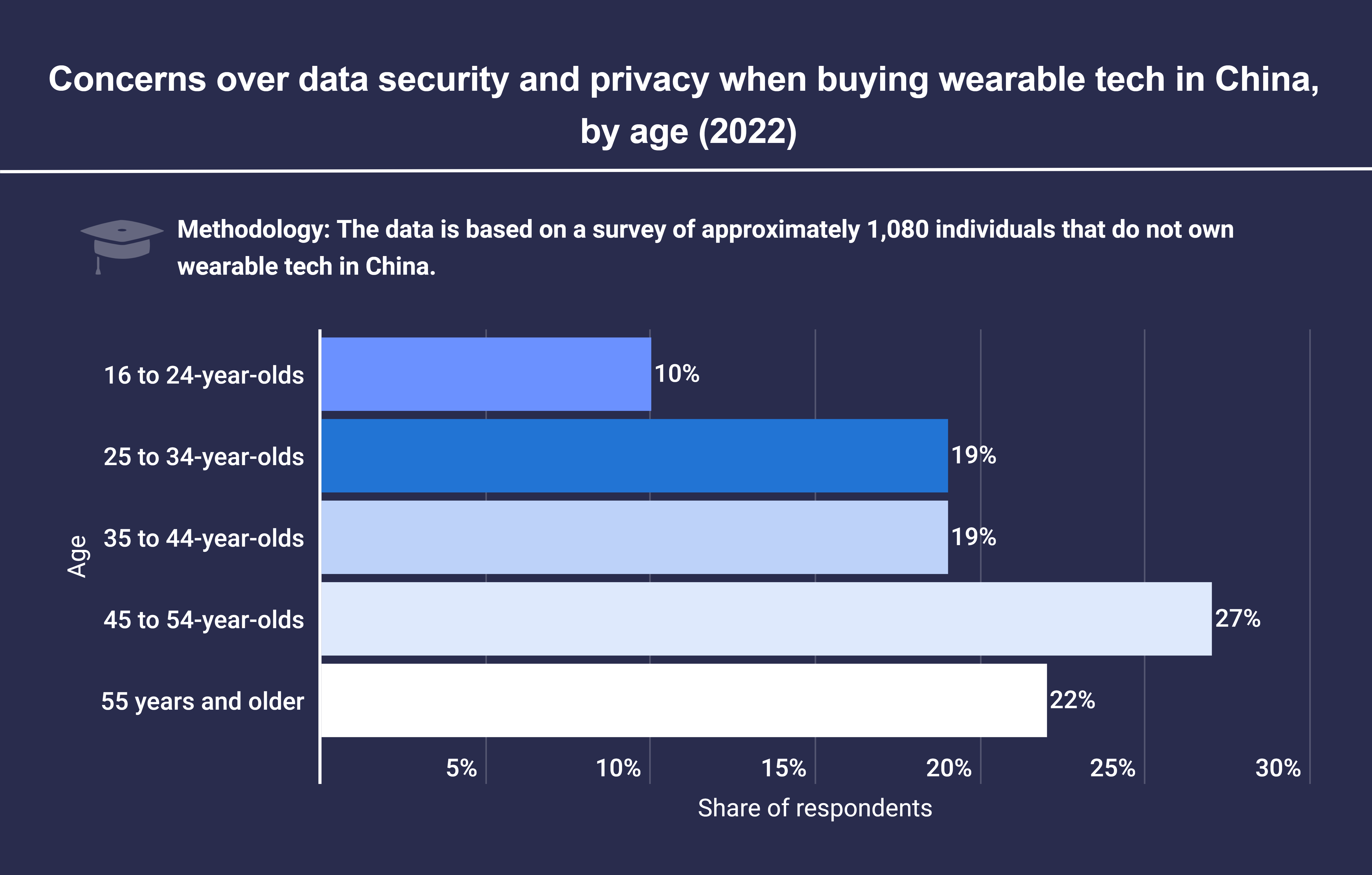
In spite of the fact that this is the case, there are many Chinese Gen X-ers who are hesitant about using wearable tech because of the fact that this is the sort of thing that could potentially end up infringing on their privacy. The Gen X cohort turned out to be the wariest of all when it comes to privacy concerns, with 27% of them explicitly saying that they don’t use wearable tech for that precise reason.

With all of that having been said and now out of the way, it is important to note that this hesitance decreases among the younger generations. For example, about 19% of Millennials cited privacy concerns as a reason for not buying a wearable tech device. The number is even lower for Gen Z, with just 10% reporting this line of reasoning.

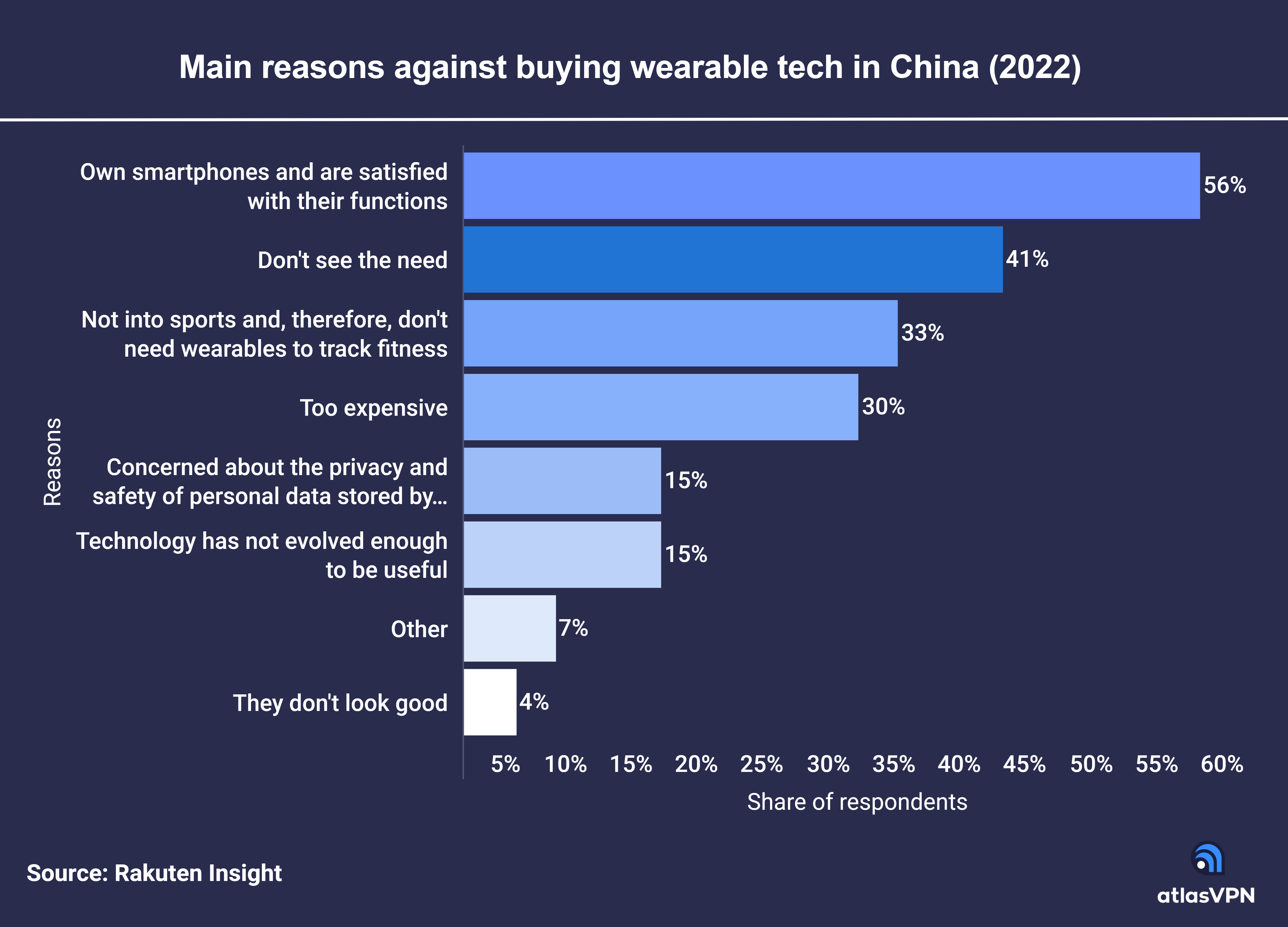
However, it must be mentioned that privacy concerns were only cited by 15% of the overall consumer base in China as a reason for not wanting wearable tech. The biggest reason by far was that they own smartphones and feel like they don’t work all that well, with 56% of consumers citing this reason.

41% of Chinese consumers who don’t buy these products also said that they feel like they don’t need wearables. Interestingly, 33% also said that they don’t play sports and therefore don’t think that smartwatches will be useful. This indicates that Chinese consumers often conflate wearable tech with a sporty kind of lifestyle. There is also a price issue here, with 30% of people in China who avoided buying wearable tech saying that it was too expensive. That is twice the number of people who are concerned about potential violations of their online privacy.

H/T: Atlasvpn

Read next: The psychology of color in planning marketing strategies
by Zia Muhammad via Digital Information World

Monday, November 14, 2022

Internet Usage is Up Among 44% of Consumers, Average Online Time Reaches 8 Hours

Internet usage has seen its ups and downs these past few years, with the pandemic resulting in massive spikes in usage which dipped not long after things started to return to normal. In spite of the fact that this is the case, 44.7% of consumers are increasing the amount of time that they spend using the internet, and this has brought the average online time up to eight hours per day with all things having been considered and taken into account.

This comes from a report that was just published by HighSpeedInternet, and it revealed a lot of insights about the state of internet usage these days. About 75% of consumers research their purchases before making them, and while in person buying is still the preference consumers still rely on the internet to make educated purchasing decisions.

Email marketing teams must be cognizant of the preferences that consumers have here because of the fact that this is the sort of thing that could potentially end up helping them to promote products in the right way to induce sales. With all of that having been said and now out of the way, it is important to note that groceries, home goods and clothing are all largely in person purchases for the average consumer.

67% of consumers prefer buying groceries in person whereas only 13% said that they would rather buy these items online. 50% of consumers also stated that they like to buy home goods in person with 20% saying the opposite, and finally 48% of clothing buyers prefer in person shopping with 22% choosing to shop online instead.

The online space is also less preferable for certain tasks, with a simple pen and paper method being more popular. These include note taking with 30% preferring pen and paper and 27% doing it online, reading books with 36% versus 26%, drafting grocery shopping lists with 44% compared to 28%, and surveying restaurant menus with 42% doing it old school and just 26% stating a preference for checking them out online due to the simplicity of the former method. Take a look at below infographics for more insights:
Read next: What’s the Most Secure and Trustworthy Cryptocurrency Exchange?
by Zia Muhammad via Digital Information World

Slit Perspective of Twitter’s Worldwide Promotion Revenue In 2022

Twitter’s ad business around 2024 seems to be mangled by 39.1%. Its numbers were like-wise brought down for Google, Amazon, Snapchat, Meta, and TikTok.

Amazon, Google, Snapchat, Meta, Twitter, and TikTok are anticipated to enjoy the most ad expenditure in 2022 out of the six platforms that Insider Intelligence published its global advertising projection.

Insight Intelligence presented its updated conjecture for worldwide promotion spending in 2022, changing its numbers descending for every one of the six organizations it examined Twitter, Amazon, Meta, Google, TikTok, and Snapchat. However, Twitter will anticipate an especially unpleasant journey.

The research company estimated that international digital ad expenditure will reach $567.49 billion in 2022, an 8.6% increase over 2021, as opposed to its earlier prediction of a 15.6% increase to $602.25 billion. Additionally, Insider Intelligence reduced its prediction for global digital ad expenditure in 2024 from $756.47 billion to $695.96 billion.


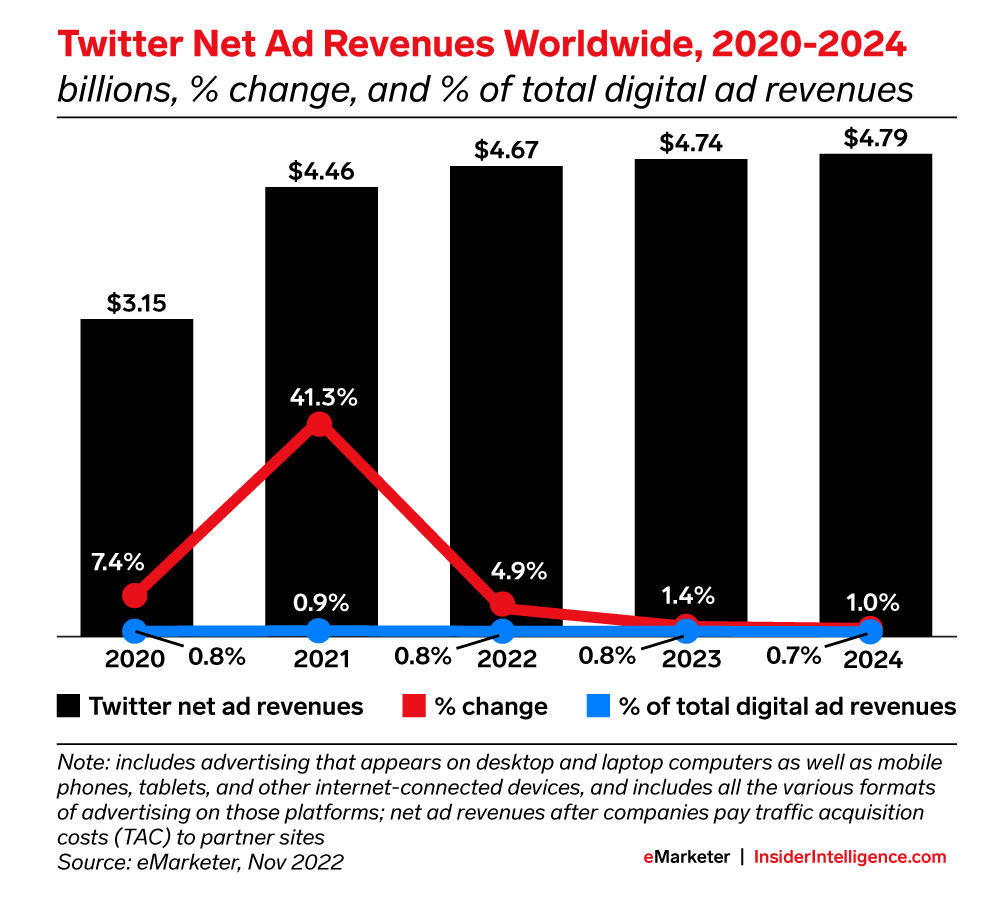
Insider Intelligence reduced its forecast for Twitter's advertising business to 2024 by 39.1%, anticipating a worldwide ad revenue increase of just 4.9% this year to $4.67 billion, down from the first-quarter prediction of 25.1% growth to $5.58 billion. The researcher now expects growth in the following two years to be practically fixed, down from initial projections of 21.6% in 2023 and 16% in 2024.

Meta is expected to experience the first-ever downfall in its business. Insider Intelligence estimates its worldwide digital ad income for 2022 at $112.68 billion, down 2% from last year and considerably below its initial expectation of $129.16 billion. The 20% decrease in its projection for Meta's ad spending until 2024, predicts that Facebook would generate $69.41 billion in digital ad income globally, far less than its $75 billion first-quarter prediction and down 4.6% from 2021. Insider Intelligence forecasts $75.11 billion in worldwide ad income for Facebook in 2024, a decrease of more than $10 billion from its initial forecast.

For Snapchat, Insider Intelligence's new forecast showed total global advertising sales of $3.97 billion, up 17.1% from the prior year but still well short of the researcher's prior $4.86 billion figure. Insider Intelligence projects that Snapchat's worldwide ad revenue would be $5.81 billion by 2024, a 33.6% decrease from the $8.75 billion it predicted at first. The company reduced its initial prediction from $11.64 billion to $9.89 billion, which represents a 155% increase year over year in TikTok's worldwide ad income. Likewise, the researcher's forecast for 2024 showed a global ad revenue of $18.49 billion, down 21.6% from the $23.58 billion it had anticipated in the beginning.

Google suffered significantly less when compared to the other social platforms examined by Insider Intelligence. It reduced its net ad income for 2022 from $174.81 billion to $168.44 billion, a decrease of just 2.8%. Meanwhile, for Amazon, Insider Intelligence forecasted international digital ad sales of $55.99 billion in 2024, below its initial forecast of $63.48 billion, and $37.99 billion in 2022, a little decrease compared to its first-quarter estimate of $41.75 billion.

Read next: Instagram and TikTok seem to have locked horns for the attention of GenZ, Report reveals
by Arooj Ahmed via Digital Information World

The US and China Now Have More Household Wealth Than the Rest of the World

The US is the foremost global superpower in the world, but in spite of the fact that this is the case China has been making a lot of headway and that has allowed the nation’s citizens to catch up in terms of wealth. China’s GDP has been seeing a massive increase for quite a few years now, and it won’t be long before it eclipses the US which is a success that the Chinese government has been coveting and working tirelessly towards.

With all of that having been said and now out of the way, it is important to note that GDP is not the only way to measure how much wealth a nation has. The total household wealth is also a useful metric because of the fact that this is the sort of thing that could potentially end up indicating how rich the average person in that country is.

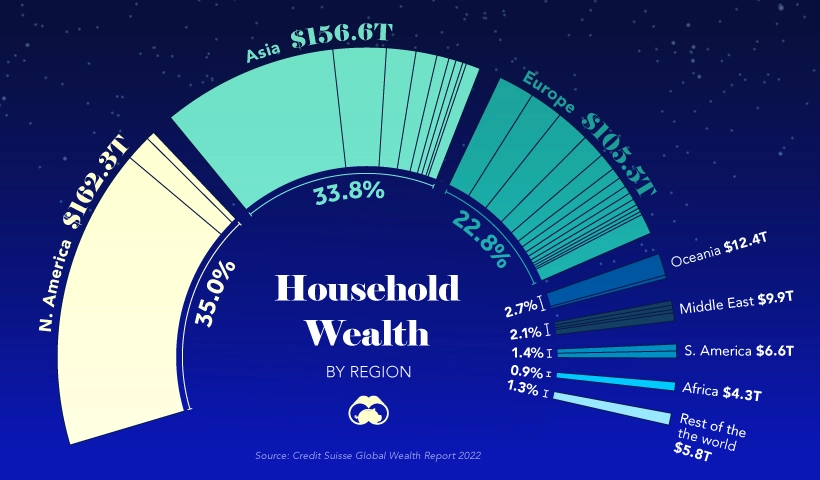
It should come as no surprise that the US tops this list, with a combined household wealth of about $145 trillion. That means that the US holds about 31.5% of the household wealth of the entire world. China comes in second with a little over $85 trillion, which indicates that 18.5% of the world’s wealth is now in the ownership of Chinese people with all things having been considered and taken into account.

Interestingly, the share of global household wealth in the US is higher than its share of global GDP, while China’s is quite similar. The US has a 24% share of global GDP whereas China has 19%, and this might indicate that the US is underperforming or that its citizens are not investing back into the country as much as Chinese people.

Another thing to note here is that Asia has now surpassed Europe in terms of overall household wealth share. China has driven much of this change, as has India which now has over $14 trillion in total household wealth. Japan is also contributing with its over $25 trillion in household wealth, and South Korea is also pulling its own weight with a little over $10 trillion.

The U.S. and China Account for Half the World’s Household Wealth


H/T: VisualCapitalist

Read next: Data Shows Talking Tom & Friends Is The Best Mobile Games IP And Outfit7 Is The Best Franchise Of This Decade
by Zia Muhammad via Digital Information World
54% of Freelancers Feel Pressured to Save for Retirement

Freelance based work, also known as gig work, has introduced a new way for people to earn money that allows them to avoid corporate jobs and all of their bureaucracy. In spite of the fact that this is the case, there are some downsides to working in the freelance space such as the lack of perks which include retirement savings accounts and pensions that they can get if they had gone for standard jobs with all things having been considered and taken into account.

With all of that having been said and now out of the way, it is important to note that the majority of freelancers, or 75% to be precise, feel like they can save an adequate sum to fund their retirements if they persist with their current gig work. 54% of them are definitely feeling a lot of pressure though, and that might be due to the uncertain nature of freelance work which can come with its fair share of dry spells as well as periods where work might feel overwhelming.


There has also been a marked shift with respect to what freelancers are saving up for after the pandemic. 74% have changed their saving behavior, with 42% saving up enough that they can take mental health days without having to take a financial hit.

37% are also trying to save up for life insurance because of the fact that this is the sort of thing that could potentially end up keeping their loved ones financially secure in the event of their untimely demise. Also, car purchasing and travel is less of a priority now than might have been the case otherwise, with only 27% saving up for the former and just 25% saving up for the latter.

As for why people prefer the freelancer lifestyle, a myriad of reasons came to the fore. 43% like being able to choose what projects they can work on, 41% enjoy being able to set their own hours, and 40% prefer not having to answer to anyone but rather acting as their own bosses.

There are some annoyances that freelancers have to deal with as well that some say come with the territory. 42% say that they have a hard time planning for vacations, since taking any time off will result in them losing out on the money they would have earned on top of the huge spending that this would entail. 40% also took issue with their clients sometimes not paying them in a timely fashion, and 38% also cited paying for health benefits out of their own pocket as a major inconvenience.

64% of freelancers are saying that they have cut back on any and all unnecessary spending as they have grown older. 25% use the savings to pay for the aforementioned health benefits, 25% also said that they use it to build a professional looking website, and 27% pay for a gym membership which is necessary given the sedentary nature of their jobs. On average, they expect to retire by 58 and they say that around $350,000 is the sweet spot that will make them retire in comfort without having to work again or take on any further freelance gigs.


H/T: Everlylife.

Read next: 89% of Hybrid Workers Say They Want Better Tech From Their Employers
by Zia Muhammad via Digital Information World
Downloading trends on famous social media platforms over the last few years shows TikTok is on the rise

The last four years were nothing less than a roller coaster ride. From the COVID-19 pandemic to global lockdown to the work-from-home movement, and then the ongoing economic crisis It appears that all these events had a deep impact on social media platforms and usage.

Based on a research report, the changing trend of social media platforms can be identified through their downloads. The data used in the report started in 2018 and ended in October 2022.

While analyzing the collective results of social media applications including Meta's Facebook and Instagram, ByteDance’s TikTok, and Musk’s Twitter, the results were pretty satisfying, as the overall figure was up by fifty percent, which means downloads went up from 14 million to 20 million.

This gives the idea that the request for such platforms is still intact. However, based on individual performance, the trend was not good for everyone and revealed some surprising turnover.

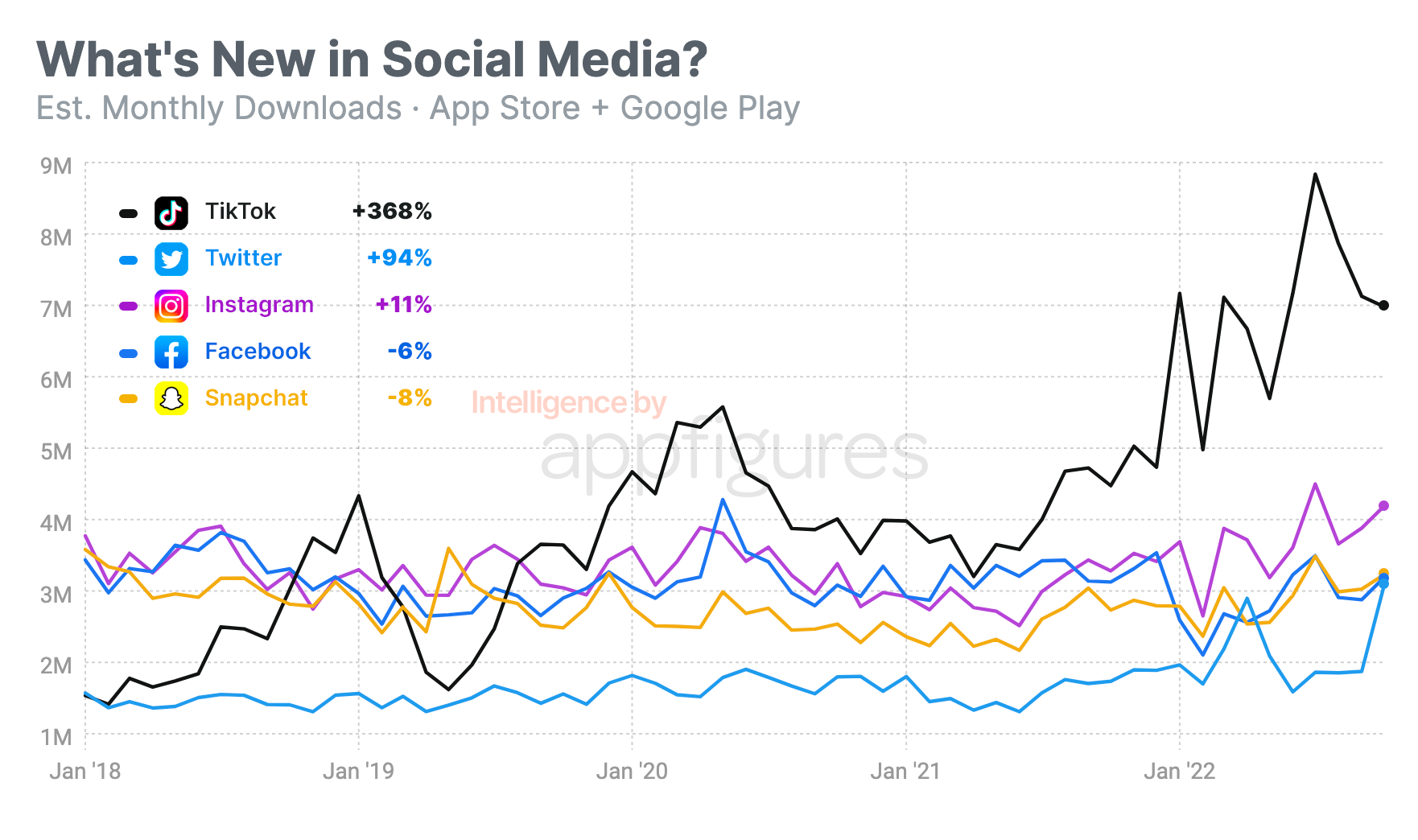
The famous short video application TikTok being at the top of the charts didn’t come as a surprise. The platform was successfully able to expand its downloads by a massive 368 percent over the last 4 years. For the second position, Twitter took away the spot, leaving other platforms surprised. One major reason for this turnover is Twitter being a hot topic with Elon Musk taking over the micro-blogging platform and introducing some controversial features. The platform was able to show a 90 percent increase in downloads after carrying an almost straight linear trend since 2018.

It is believed that the current Twitter growth is only due to its being in the spotlight recently, and after some time, the trend will be back to normal. On the other hand, Meta's Instagram was able to do well, but in comparison to TikTok, Instagram was able to increase its downloads by just 11 percent.

While these platforms were either able to maintain their downloads or managed to increase them over time, the social media giant Facebook, followed by Snapchat, were two of the most popular applications whose downloads fell. It can be expected that the trend is likely to carry itself for another year, until 2023, and after that, a new shift might take place.


H/T: AppFigures

Read next: Ideal Image Sizes for All Social Media Platforms Are Now Available
by Arooj Ahmed via Digital Information World

Elon Musk Carries On With Thousands Of Job Cuts While Hinting At New Changes On The App

Each day, Elon Musk is putting out more ideas on what to expect next on the Twitter app. And there were no surprises related to thousands of job cuts.

The firing spree is now headed to attack contract-based employees and it’s just baffling how the layoffs continue at such alarming rates. It wouldn’t be wrong to say that the reshuffling phase is carrying on at a high pace at the Twitter headquarters.

On the weekend, we saw Elon Musk and his team transition and cut out 4,400 more contract employees out of a staggering 5,500. For those wondering, the app likes to use contractors for a range of different tasks. So you can’t really call them employees and hence were not a part of the staff cull that arose during the initial days of the acquisition by Musk.

Some insider reports have gone as far as mentioning how contractors weren’t informed about having contracts canceled. They only realized the reality of the situation when they found that they no longer had access to the company’s systems. For now, there is no news on what exactly the repercussions of such a decision would be. However, it is believed that it would affect moderation as well as tasks involving day-to-day ordeals.

One thing we know for sure is that Elon Musk has never been shy about his desire to conduct massive layoffs and reduce spending. Today, the app is incurring losses worth $4 million each day and he feels that firing people would work to address the matter, if not whole but at least in part. But what he may not be realizing is how losing out on this many contractors isn’t the best for the firm’s service. And we feel that if things are really beginning to crumble, this might be one of the main reasons why.

Before we forget, remember how Musk is also taking part in a constant back-and-forth ordeal where he fires and then rehires. How interesting is that and how negative can that turn out to be for the firm? Also, it just shows how much mismanagement there is in the organization.

Moving on, we have to talk a little about the famous Twitter Blue subscriptions worth $8 and how it had promised verified ticks. It has reportedly been a little messy and even went as far as giving rise to impersonations, defamation, and some misrepresentations. People were just so confused in terms of understanding what these blue ticks meant.

So many big names in the world have been suffering thanks to this new verification policy as people are impersonating leading brands and public figures, fooling others on the platform. Hence, Twitter has now put it on hold as the billionaire chief feels it certainly requires some modification. He did indeed confirm how he didn’t think the ticks would be available by this week’s end with a change of course.

This might be in the form of a new ‘official’ gray tick that comes alongside the original blue tick. It sounds quite bizarre to us too and although we don’t know how things would work out in the end, there is certainly going to be more transparency in the process of verification. Hence, a blue tick represents a verified identity in collaboration with a brand or business of some sort. In the end, imposters aren’t going to be able to copy people having parody accounts as no additional seal of approval comes forward. Still, we’re waiting for the firm to provide more details if and when that occurs.


Read next: Users Leaving Twitter May Be Trending Worldwide But New Poll Proves Otherwise
by Dr. Hura Anwar via Digital Information World