Google has just made a new adjustment to its SERP, and it’s one that might make locating businesses easier than might have been the case otherwise. Several users on Twitter posted screenshots of a new update to the SERP that showed a business’s location on Google Maps within its own search snippet. This is similar to previous experiments that have been noted, but it is still distinct in that it places the location in the snippet rather than in the side panel.
Businesses often try to make themselves as visible as possible on Google because of the fact that this is the sort of thing that could potentially end up driving more customers to their door. The side panel used to be the primary source of information, with all of that having been said and now out of the way it is important to note that users had to click on a business before they could see it, and they had to click on the directions button to find any location information. This update eliminates the need to click to find any location data that can help them get to the shop.
Locations in the search snippet are immediately visible, and they can help users to see which local businesses are closest to where they live. Not all that many users have seen this update, although that might be because Google is just testing it out right now. If and when it does get released, it will likely be a positively received feature with all things having been considered and taken into account.
The map is shown in a rectangular box which, when clicked, will redirect the user to Google Maps so that they can plot their route. A business’s search snippet can be used to divulge all sorts of details pertaining to it, and the inclusion of a location will be a welcome addition. This is not the first time that Google has experimented with something of this sort, although it is definitely the most visible one which suggests that Google is conducting a wider test for it than it normally does.
Read next: Google Is Looking Forward To Stuffing Websites With More Ads Soon
by Zia Muhammad via Digital Information World
"Mr Branding" is a blog based on RSS for everything related to website branding and website design, it collects its posts from many sites in order to facilitate the updating to the latest technology.
To suggest any source, please contact me: Taha.baba@consultant.com
Sunday, December 4, 2022
Saturday, December 3, 2022
TikTok And Bumble Join Meta In The Fight Against Spread Of Non-Consensual Explicit Images
Both TikTok and Bumble are on a mission to help fight against the ongoing tech battle of anti-revenge porn.
The apps are the latest big tech names to join Meta which has been striving hard against putting an end to the spread of evils in a society like revenge porn. This is another term reserved for explicit images and videos that are shared on the web without taking into consideration a particular individual’s consent.
The platforms have reportedly partnered with the likes of StopNCIL.org which is an integral tool created in partnership with all of these tech platforms that would detect and even block any pictures of this sort.
This webpage allows for the creation of unique fingerprints through digital means, which entails images and videos. Hence, the process would take place on a device to protect a certain individual’s privacy. But the real files are not uploaded to this website, only a certain array of codes in the form of letters and numbers.
All such digital fingerprints that are being submitted to the website are done so through different partners of the website. So for instance, if an image or a video has been uploaded to apps like TikTok, Facebook, and even Bumble or Instagram and it matches the respective hash in question, this file would be handed over to the app’s moderation team.
In those cases where one moderator sees the image breaking the app’s respective policy, they would end up removing it. Moreover, you’ll find the other partner platforms blocking the picture so it’s not shared any further too.
For a while now, this tool has gone live and nearly 12,000 individuals have managed to make cases to stop such pictures from getting shared without any users’ consent. As of today, nearly 40,000 hashes were designed, up to date.
Bloomberg mentioned that Meta has partnered up with the likes of various non-profit organizations behind this particular helpline so it encourages others to come forward and sign up as well.
This particular effort is building up on the idea that was first begun by Meta as a pilot in Australia. It requested users to put up explicit images of a particular chat on Messenger that they carried out with themselves.
The company vowed to get rid of all the images, once the study or trial was complete but as anyone can imagine, people were very skeptical.
Both TikTok and Bumble are uniting on this front to rid this increasingly concerning matter and help carry out a major crackdown against all pictures that are intimate and shared without anyone giving consent.
Read next: This Study Reveals a Link Between Smartphone Addiction and Compulsive Shopping
by Dr. Hura Anwar via Digital Information World
The apps are the latest big tech names to join Meta which has been striving hard against putting an end to the spread of evils in a society like revenge porn. This is another term reserved for explicit images and videos that are shared on the web without taking into consideration a particular individual’s consent.
The platforms have reportedly partnered with the likes of StopNCIL.org which is an integral tool created in partnership with all of these tech platforms that would detect and even block any pictures of this sort.
This webpage allows for the creation of unique fingerprints through digital means, which entails images and videos. Hence, the process would take place on a device to protect a certain individual’s privacy. But the real files are not uploaded to this website, only a certain array of codes in the form of letters and numbers.
All such digital fingerprints that are being submitted to the website are done so through different partners of the website. So for instance, if an image or a video has been uploaded to apps like TikTok, Facebook, and even Bumble or Instagram and it matches the respective hash in question, this file would be handed over to the app’s moderation team.
In those cases where one moderator sees the image breaking the app’s respective policy, they would end up removing it. Moreover, you’ll find the other partner platforms blocking the picture so it’s not shared any further too.
For a while now, this tool has gone live and nearly 12,000 individuals have managed to make cases to stop such pictures from getting shared without any users’ consent. As of today, nearly 40,000 hashes were designed, up to date.
Bloomberg mentioned that Meta has partnered up with the likes of various non-profit organizations behind this particular helpline so it encourages others to come forward and sign up as well.
This particular effort is building up on the idea that was first begun by Meta as a pilot in Australia. It requested users to put up explicit images of a particular chat on Messenger that they carried out with themselves.
The company vowed to get rid of all the images, once the study or trial was complete but as anyone can imagine, people were very skeptical.
Both TikTok and Bumble are uniting on this front to rid this increasingly concerning matter and help carry out a major crackdown against all pictures that are intimate and shared without anyone giving consent.
Read next: This Study Reveals a Link Between Smartphone Addiction and Compulsive Shopping
by Dr. Hura Anwar via Digital Information World
This Study Reveals a Link Between Smartphone Addiction and Compulsive Shopping
The intersection of smartphones have ecommerce have created the perfect storm for the industry, but in spite of the fact that this is the case it might be harming the consumers themselves. Flow experiences on smartphones which describe a situation where someone loses themselves in their smartphone activities so much so that they forget the passage of time may be leading to other compulsive behaviors, particularly among members of the Gen Z cohort.
A new study has just revealed that two harmful behaviors, namely smartphone addiction and compulsive shopping, might actually go hand in hand. Gen Z consumers are referred to as Digital Natives due to them being born and raised in an era of smartphones and other technological devices. They don’t know a world without smartphones, and that makes them much more susceptible to such behavior than might have been the case otherwise.
This data comes from a survey conducted by Italian researchers. The study revealed a strong correlation between compulsive smartphone usage and buying things on a whim online without doing due diligence first. Many shopping platforms have a flow inducing experience because of the fact that this is the sort of thing that could potentially end up increasing sales. It turns out that they are quite effective, although this study suggests that they are exploiting compulsive behaviors in the process.
A major contributing factor to this trend is the desire for mood stabilization or regulation. Consumers who are browsing shopping platforms might enter a flow state and make purchases without rationalizing the. With all of that having been said and now out of the way, it is important to note that the study only analyzed behavior over a short period of time.
Longer study periods might reveal new information, although many other studies have confirmed what is being presented here in one way or another. Gen Z people are frequently turning to self destructive behaviors, many of which center around their smartphones. Gaming apps are a frequent source of criticism for being addictive, but shopping apps are also a part of the problem and need to change.
Read next: 20% of Remote Workers Still Use Their Own Equipment, Here’s Why That’s Bad
by Zia Muhammad via Digital Information World
A new study has just revealed that two harmful behaviors, namely smartphone addiction and compulsive shopping, might actually go hand in hand. Gen Z consumers are referred to as Digital Natives due to them being born and raised in an era of smartphones and other technological devices. They don’t know a world without smartphones, and that makes them much more susceptible to such behavior than might have been the case otherwise.
This data comes from a survey conducted by Italian researchers. The study revealed a strong correlation between compulsive smartphone usage and buying things on a whim online without doing due diligence first. Many shopping platforms have a flow inducing experience because of the fact that this is the sort of thing that could potentially end up increasing sales. It turns out that they are quite effective, although this study suggests that they are exploiting compulsive behaviors in the process.
A major contributing factor to this trend is the desire for mood stabilization or regulation. Consumers who are browsing shopping platforms might enter a flow state and make purchases without rationalizing the. With all of that having been said and now out of the way, it is important to note that the study only analyzed behavior over a short period of time.
Longer study periods might reveal new information, although many other studies have confirmed what is being presented here in one way or another. Gen Z people are frequently turning to self destructive behaviors, many of which center around their smartphones. Gaming apps are a frequent source of criticism for being addictive, but shopping apps are also a part of the problem and need to change.
Read next: 20% of Remote Workers Still Use Their Own Equipment, Here’s Why That’s Bad
by Zia Muhammad via Digital Information World
New Report Confirms Hate Speech Is At An All-Time High On Twitter
Despite billionaire Elon Musk’s grand claims about hate speech decline under his leadership, a new report is proving otherwise.
The Tesla CEO and Twitter chief may be getting a rude awakening about hate speech impressions. And that’s all thanks to a new study conducted by the Center for Countering Digital Hate.
Musk said that hate speech was down by one-third last week but this study says it has risen during that same period that he acquired the company.
On average, around 1,300 tweets have come forward with slurs against people of color that continually appear on a daily basis on the app, right before Elon Musk took over.
This number then went on to jump to a figure of 3880 after his acquisition of the platform. And it’s interesting to note how the figure further surged to 4650 when Musk made the shocking claims of hate being so low on the app.
So many slurs have risen against 62% of the trans population since Twitter had a new leader and that’s about 5100 tweets on a daily basis, as confirmed by the study. This data was brought forward by Brandwatch, which is deemed to be a leading tool for determining analytics on social media. It also entails tweets from different locations around the globe and arises in English too.
A tweet conducted during the middle part of November by Musk stated that all hate-themed tweets would be deboosted on the platform and curbed to the point where they would be demonetized. This way, users wouldn’t be coming across it too frequently, unless and until they actually went on to look for it.
But in cases where views were at an all-time low, the researchers of this study saw how the engagement for posts linked to hate speech is so high since Musk started taking over the firm.
People are just engaging so much more on such posts with likes, replies, and retweets linked to slurs going to be so high, especially in the weeks that lead up to the launch of Twitter 2.0. And if we had to put it into figures, hate speech is up by 50%.
The report basically contradicts what Musk has been saying and it’s quite interesting, to say the least. Hence, Musk was certainly not happy with the news and slapped the report as one that was utterly false.
In the same way, he vowed to put up daily statistics for data publishing and says he maintains all the impressions coming forward regarding hate speech.
Ever since Musk decided to take charge of Twitter, we’ve seen so much change come forward. The decisions have been erratic and moderation has gone out the window. Polls have been conducted that hint toward the Twitter Chief’s next move.
His idea of creating a Twitter moderation council is also done and dusted. And with the likes of Trump back on the app, one can only wonder what could possibly be next.
Read next: Twitter Is Adding A Verified Phone Number Check Mark In The Profile Info Section
by Dr. Hura Anwar via Digital Information World
The Tesla CEO and Twitter chief may be getting a rude awakening about hate speech impressions. And that’s all thanks to a new study conducted by the Center for Countering Digital Hate.
Musk said that hate speech was down by one-third last week but this study says it has risen during that same period that he acquired the company.
On average, around 1,300 tweets have come forward with slurs against people of color that continually appear on a daily basis on the app, right before Elon Musk took over.
This number then went on to jump to a figure of 3880 after his acquisition of the platform. And it’s interesting to note how the figure further surged to 4650 when Musk made the shocking claims of hate being so low on the app.
So many slurs have risen against 62% of the trans population since Twitter had a new leader and that’s about 5100 tweets on a daily basis, as confirmed by the study. This data was brought forward by Brandwatch, which is deemed to be a leading tool for determining analytics on social media. It also entails tweets from different locations around the globe and arises in English too.
A tweet conducted during the middle part of November by Musk stated that all hate-themed tweets would be deboosted on the platform and curbed to the point where they would be demonetized. This way, users wouldn’t be coming across it too frequently, unless and until they actually went on to look for it.
But in cases where views were at an all-time low, the researchers of this study saw how the engagement for posts linked to hate speech is so high since Musk started taking over the firm.
People are just engaging so much more on such posts with likes, replies, and retweets linked to slurs going to be so high, especially in the weeks that lead up to the launch of Twitter 2.0. And if we had to put it into figures, hate speech is up by 50%.
The report basically contradicts what Musk has been saying and it’s quite interesting, to say the least. Hence, Musk was certainly not happy with the news and slapped the report as one that was utterly false.
In the same way, he vowed to put up daily statistics for data publishing and says he maintains all the impressions coming forward regarding hate speech.
Ever since Musk decided to take charge of Twitter, we’ve seen so much change come forward. The decisions have been erratic and moderation has gone out the window. Polls have been conducted that hint toward the Twitter Chief’s next move.
His idea of creating a Twitter moderation council is also done and dusted. And with the likes of Trump back on the app, one can only wonder what could possibly be next.
Read next: Twitter Is Adding A Verified Phone Number Check Mark In The Profile Info Section
by Dr. Hura Anwar via Digital Information World
Predatory iOS and Android Loan Apps Received 15 Million Installs Before Removal
Apps found on both the App Store and the Google Play Store were found to be providing illegal loans to people according to a new report. These apps have been downloaded about 15 million times with all things having been considered and taken into account, and they are trapping unsuspecting users in a cycle of debt due to extortive practices.
A total of about 286 apps were discovered, and with all of that having been said and now out of the way it is important to note that a majority of them were found on the Play Store. 251 were Android apps, with 35 being available on iOS. After they received reports, Google and Apple were quick to remove all of the apps from their platforms. In spite of the fact that this is the case, the damage has already been done with tens of millions of users having been defrauded of their funds.
What’s worse is that these users were mostly located in developing countries. These countries include Uganda, India, Colombia, Philippines, Pakistan. Nigeria as well as Mexico, some titles of the apps include: AchaPaisa, AdaCash, AddMoney, BaseWallet, Bear Loan, Bucredit, CashNow, Dutta Rupee, Fast Coin, Flying Cash, HappyLoan, LibreCash, LoanClub, MobiLoan, PCash, Pinjam Tunai, RupeeStar, SkyLoan, Vidong, and Wecash. With all of that having been said and now out of the way, it is important to note that predatory loans apps are unfortunately common, and they pose a distinct thread to consumer safety.
The apps usually ask users to provide expansive permissions on their devices which make them even less safe than might have been the case otherwise. They then start using these permissions to begin uploading sensitive data to their servers, and they also have extremely high interest rates for the people that end up taking loans from them.
Users are often forced to grant these permissions, otherwise they may not be given the chance to get a loan. Such apps are preying on those that are outside of the traditional financial system and don’t have any alternatives to turn to. They are increasing in number, and removing them after they have done grievous harm may not cut it anymore. Apple and Google need to do better at keeping these apps outside of their platforms and stores.
Read next: Huge Security Leak Causes Leading Android Apps To Undergo Malware Transformation On Top Devices
by Zia Muhammad via Digital Information World
A total of about 286 apps were discovered, and with all of that having been said and now out of the way it is important to note that a majority of them were found on the Play Store. 251 were Android apps, with 35 being available on iOS. After they received reports, Google and Apple were quick to remove all of the apps from their platforms. In spite of the fact that this is the case, the damage has already been done with tens of millions of users having been defrauded of their funds.
What’s worse is that these users were mostly located in developing countries. These countries include Uganda, India, Colombia, Philippines, Pakistan. Nigeria as well as Mexico, some titles of the apps include: AchaPaisa, AdaCash, AddMoney, BaseWallet, Bear Loan, Bucredit, CashNow, Dutta Rupee, Fast Coin, Flying Cash, HappyLoan, LibreCash, LoanClub, MobiLoan, PCash, Pinjam Tunai, RupeeStar, SkyLoan, Vidong, and Wecash. With all of that having been said and now out of the way, it is important to note that predatory loans apps are unfortunately common, and they pose a distinct thread to consumer safety.
The apps usually ask users to provide expansive permissions on their devices which make them even less safe than might have been the case otherwise. They then start using these permissions to begin uploading sensitive data to their servers, and they also have extremely high interest rates for the people that end up taking loans from them.
Users are often forced to grant these permissions, otherwise they may not be given the chance to get a loan. Such apps are preying on those that are outside of the traditional financial system and don’t have any alternatives to turn to. They are increasing in number, and removing them after they have done grievous harm may not cut it anymore. Apple and Google need to do better at keeping these apps outside of their platforms and stores.
Read next: Huge Security Leak Causes Leading Android Apps To Undergo Malware Transformation On Top Devices
by Zia Muhammad via Digital Information World
Apple Officially Unveiled The Name of Its AR/VR Headset and the Registration of the Product Has Begun
Apple had been trying to name its AR/VR headset for so long now. For the most part, the company was confused about what to name its product. Apple was planning on naming the headset "RealityOS" or "rOS". But now it has come to a final decision. The Apple AR/VR headset is named "xrOS". The headset is soon to be launched. Apple hasn't told the exact date of its release and there are speculations that it will be released in early to mind 2023 as its name has been decided.
Most people are curious about this Apple headset. Just like the Apple Watch and Apple TV, Apple Headset will also have its operating system. Apart from a separate operating system, AR/VR headset is also going to have an App Store. The xr in the name xrOS stands for extended reality. This means virtual as well as augmented reality. Rumors are flying around that the Apple headset will have a mixed reality just like Microscope HoloLens which supports both virtual and augmented reality. Augmented reality is based on what the user is seeing in the real world and virtual reality is a digital world with digital experiences.
Apple is also creating a software kit for its AR/VR headset which will also allow the installation of third-party apps. Other than the third-party apps, these headsets will have separate and special Apple apps like Maps and Messages. These apps will be a completely new version, just for the headsets. When Apple was working on the headset, they used to call it rOS, but when they thought that the name was too boring and generic, they changed it to xrOS. This type of name will likely stand out among other names on the market.
Apart from all these things, Apple has started registering xrOS across the countries. Apple's way of registering a new product is unique as it registers the product through shell companies. This time xrOS is being registered under the shell company named Deep Dive LLC. Apple headset will be available in many countries but there is no sign about when this headset will be released. There is a high chance that Apple AR/VR will be unveiled in the first half of the year 2022.
Read next: Apple’s New Accessibility Video Highlights Innovative Features For Those With Disabilities
by Arooj Ahmed via Digital Information World
Most people are curious about this Apple headset. Just like the Apple Watch and Apple TV, Apple Headset will also have its operating system. Apart from a separate operating system, AR/VR headset is also going to have an App Store. The xr in the name xrOS stands for extended reality. This means virtual as well as augmented reality. Rumors are flying around that the Apple headset will have a mixed reality just like Microscope HoloLens which supports both virtual and augmented reality. Augmented reality is based on what the user is seeing in the real world and virtual reality is a digital world with digital experiences.
Apple is also creating a software kit for its AR/VR headset which will also allow the installation of third-party apps. Other than the third-party apps, these headsets will have separate and special Apple apps like Maps and Messages. These apps will be a completely new version, just for the headsets. When Apple was working on the headset, they used to call it rOS, but when they thought that the name was too boring and generic, they changed it to xrOS. This type of name will likely stand out among other names on the market.
Apart from all these things, Apple has started registering xrOS across the countries. Apple's way of registering a new product is unique as it registers the product through shell companies. This time xrOS is being registered under the shell company named Deep Dive LLC. Apple headset will be available in many countries but there is no sign about when this headset will be released. There is a high chance that Apple AR/VR will be unveiled in the first half of the year 2022.
Read next: Apple’s New Accessibility Video Highlights Innovative Features For Those With Disabilities
by Arooj Ahmed via Digital Information World
Friday, December 2, 2022
Twitter Is Adding A Verified Phone Number Check Mark In The Profile Info Section
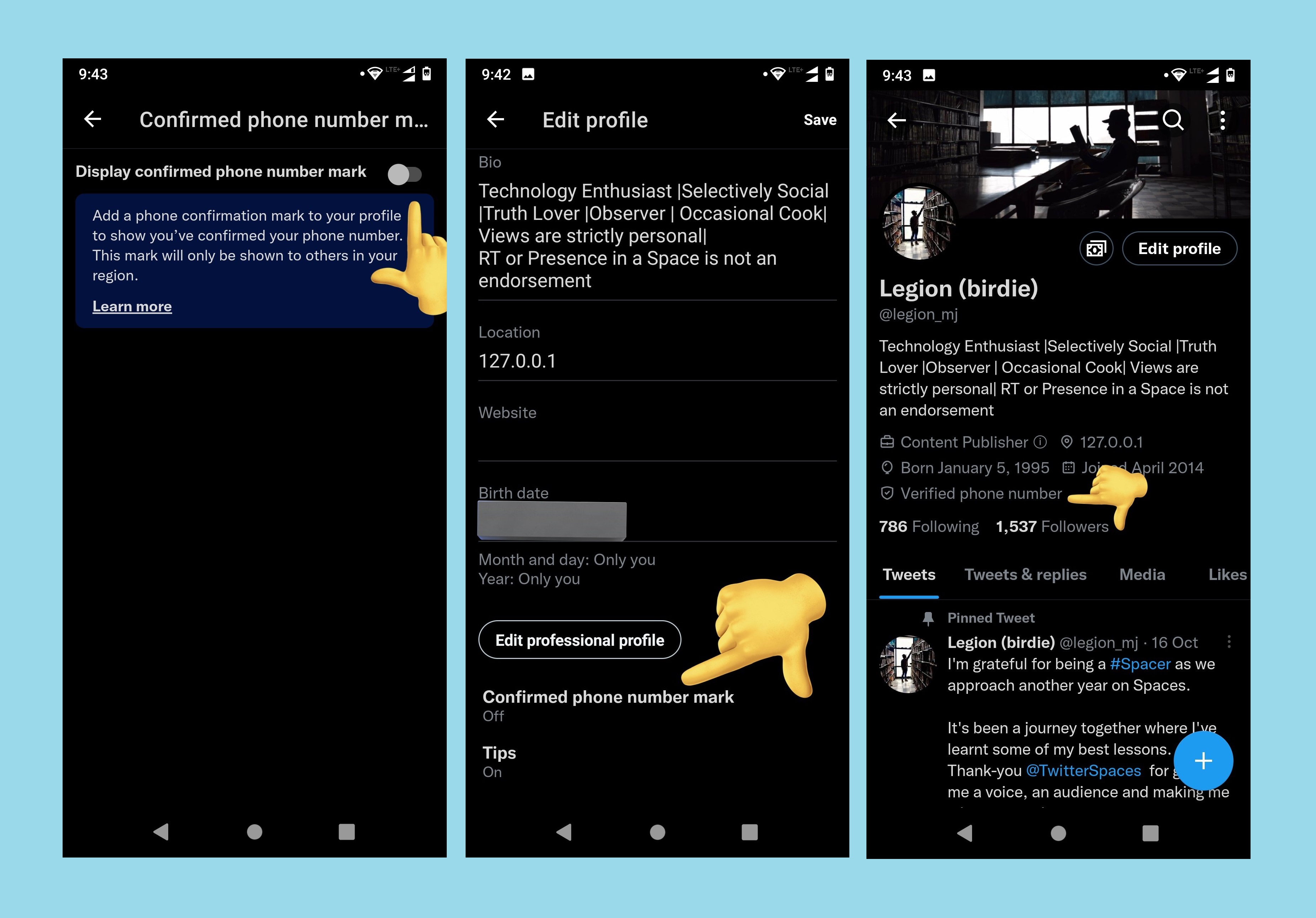
As Elon Musk has taken over Twitter, many modifications and features are being added to the app. Some of these features are appreciated but most people do not like what Musk is adding to the app. Just like many other features that Twitter has added to the platform, a new verified phone number checkmark will also being introduced in the info section of the Twitter account. Users have mixed reactions to this feature and some of them think it is unnecessary.
This feature is available in India (as per Legion's claim) and will allow users to confirm their phone numbers. Only the users who have logged in to the Twitter app will see the verified phone number section, and this way they will be able to find out that the account holder also belongs to India. Some people think that the confirmed phone number means a verified account with a blue tick. But this is not the case. You will not get a blue tick if you verify your phone number. It is a completely different process.
By activating the mobile phone confirmation, your phone number will not be displayed on your profile. To display your confirmed phone number mark, check if you have an accurate and up-to-date phone number. Just like the way you customize your profile, you will have to confirm your phone number too by going to the settings. If you do not have an up-to-date phone number, just follow the Twitter instructions to add a new one.
The reason for adding a confirmed phone number is that it will help to decrease the number of bots in the app. Many of the accounts on Twitter are operated by bots and this way unauthenticated accounts won't appear on Twitter in abundance.
Read next: Twitter Unveils Its Plans For The Future As Elon Musk Meets Apple CEO Tim Cook
by Arooj Ahmed via Digital Information World
This feature is available in India (as per Legion's claim) and will allow users to confirm their phone numbers. Only the users who have logged in to the Twitter app will see the verified phone number section, and this way they will be able to find out that the account holder also belongs to India. Some people think that the confirmed phone number means a verified account with a blue tick. But this is not the case. You will not get a blue tick if you verify your phone number. It is a completely different process.
By activating the mobile phone confirmation, your phone number will not be displayed on your profile. To display your confirmed phone number mark, check if you have an accurate and up-to-date phone number. Just like the way you customize your profile, you will have to confirm your phone number too by going to the settings. If you do not have an up-to-date phone number, just follow the Twitter instructions to add a new one.
The reason for adding a confirmed phone number is that it will help to decrease the number of bots in the app. Many of the accounts on Twitter are operated by bots and this way unauthenticated accounts won't appear on Twitter in abundance.
Read next: Twitter Unveils Its Plans For The Future As Elon Musk Meets Apple CEO Tim Cook
by Arooj Ahmed via Digital Information World
Subscribe to:
Comments (Atom)