Monday, December 12, 2022

Packaging Design Trends Packing a Punch in 2023

Packaging design plays a pivotal role in how your product and brand are perceived by customers. Not only does your label or package need to inform the buyer about what’s on the inside, communicating your brand personality through clever design choices is also key – whether that’s to stand out on a crowded shelf, or create connections with customers in their homes.

Every year we speak to the global community of professional freelance designers working on the 99designs by Vista platform to get their take on what packaging design trends we’re going to see in the year ahead. Their predictions for 2023, based on countless hours spent working directly with small businesses and brands all over the world, clearly reveal a trend towards the expressive and playful. This comes as little surprise as consumers and brands alike seek comfort, joy and escapism from some very challenging times.


If you’re looking to refresh your packaging design for the year ahead, then look no further than the biggest packaging design trends set to take 2023 by storm.

Creative displays of ingredients

Illustrated ingredients in punchy palettes are giving brands a fun, bold new way to showcase what customers can expect from their product. The simple, cartoonish illustrations give products a fresh, youthful feel and the bright, juicy colors help draw attention and differentiate between each variation.

In 2023, designers and brands are also using more abstract concepts to tap consumers’ growing appetite for transparency when it comes to the products (and brands) they invest in. Rather than just placing the product image on the package, creative use of color and geometric shapes give more subtle hints as to what’s on the inside – creating even more room for brands to be visually expressive.

Creating intrigue with pattern and texture

It’s a well known fact in the packaging design world that the more tactile a product is, the more memorable it is. With more and more designers leaning into this adage as we head into 2023, we’re seeing a rise in creative printing techniques like debossing, embossing, foil printing and die cut labels. These effects add more physical appeal and intrigue to packaging and can also help them feel more high end and luxury.

Another trend set to dominate packaging in 2023 is the use of wrap around patterns. Instead of confining the design work to the front of the product, seamless lines and shapes travel across all sides of the label and external packaging. This creates a flow and fluidity to designs that customers can help but pick up and explore.

Tapping into nostalgia

Nostalgia will forever offer us a sense of unparalleled comfort – which is why we see design styles from previous decades coming through time and time again in the trends of tomorrow. In 2023, we’re looking back to the ‘70s and ‘90s for some of that familiar relief after a tough few years.

The sticker book aesthetic that dominated the ‘90s is coming back in force, allowing many to escape back into happier and simpler times of childhood. These designs feature cute icons, stamps and doodles, placed seemingly haphazardly on a product to mimic the visual effect of a sticker book. Largely featured in bright colors, these designs are fun, youthful and charming.

Equally, the ’70s vintage aesthetic never goes completely out of style and in 2023 we’re seeing more and more packaging designs favoring the grooviest era to win the hearts of customers. Warm, earthy color schemes, particularly browns and oranges, chunky serif fonts and wavy lines make for some cool and comforting designs – which is exactly what so many of us need after another challenging year.

Bringing the fun with color and charm

Mascots have long reigned supreme in branding – and for good reason. These cheeky characters are incredibly effective at communicating a brand’s personality and creating connections with customers. Traditionally, brands tend to feature the same mascot across all their products but in 2023, we’re seeing these characters evolve and come into a life of their own. Whether it’s a change in outfit or activity, or exploring a new landscape, these subtle variations of a recognizable design element tie product lines together without sacrificing continuity – while also providing some light hearted relief.

Ecstatic colors are also providing plenty of joy in packaging design for 2023. It’s no secret that bright colors grab attention and in the year ahead you can expect to see these hues become flashier and brighter than ever. Saturated, ecstatic and largely neon colors are in vogue as designers amplify playfulness and personality to capture the attention of customers.

Keeping it personal with a hand drawn aesthetic

Typography trends in packaging almost deserve a list of their own. Playing such an integral role in the overall aesthetic of a product, each year we see new and different takes on type to draw customers in. In 2023, typographic scrawl is taking us back to basics with a casual handwritten, permanent marker style of lettering. The unevenly weighted brush strokes and imperfect handwriting style gives the impression that someone wrote it on the package almost as it left the production line.

Also adding a personal hand crafted touch to packaging design in 2023 are charming, line drawn cartoon characters that wouldn’t look out of place in a newspaper comic. The simplicity associated with this trend produces effortless illustrations that embrace imperfections rather than looking too pristine, which makes them eminently relatable. In contrast to the more polished trends for 2023, these two hand drawn styles give a more authentic, down to earth, DIY look and feel to a brand.

From quirky mascots and cartoon characters, to designs brimming with bold colors and vintage aesthetics, these trends are certainly a mixed bag of design styles and tastes. But one thing is certain: with packaging design becoming more fun, expressive and playful than ever, embracing the packaging design trends of 2023 makes creating a long-lasting, memorable impression for consumers easy.


Written by Caitlin Collins, Head of Brand Marketing & Comms at 99designs by Vista

Read next: 8 Graphic Design Trends that Will Dominate 2023
by Web Desk via Digital Information World

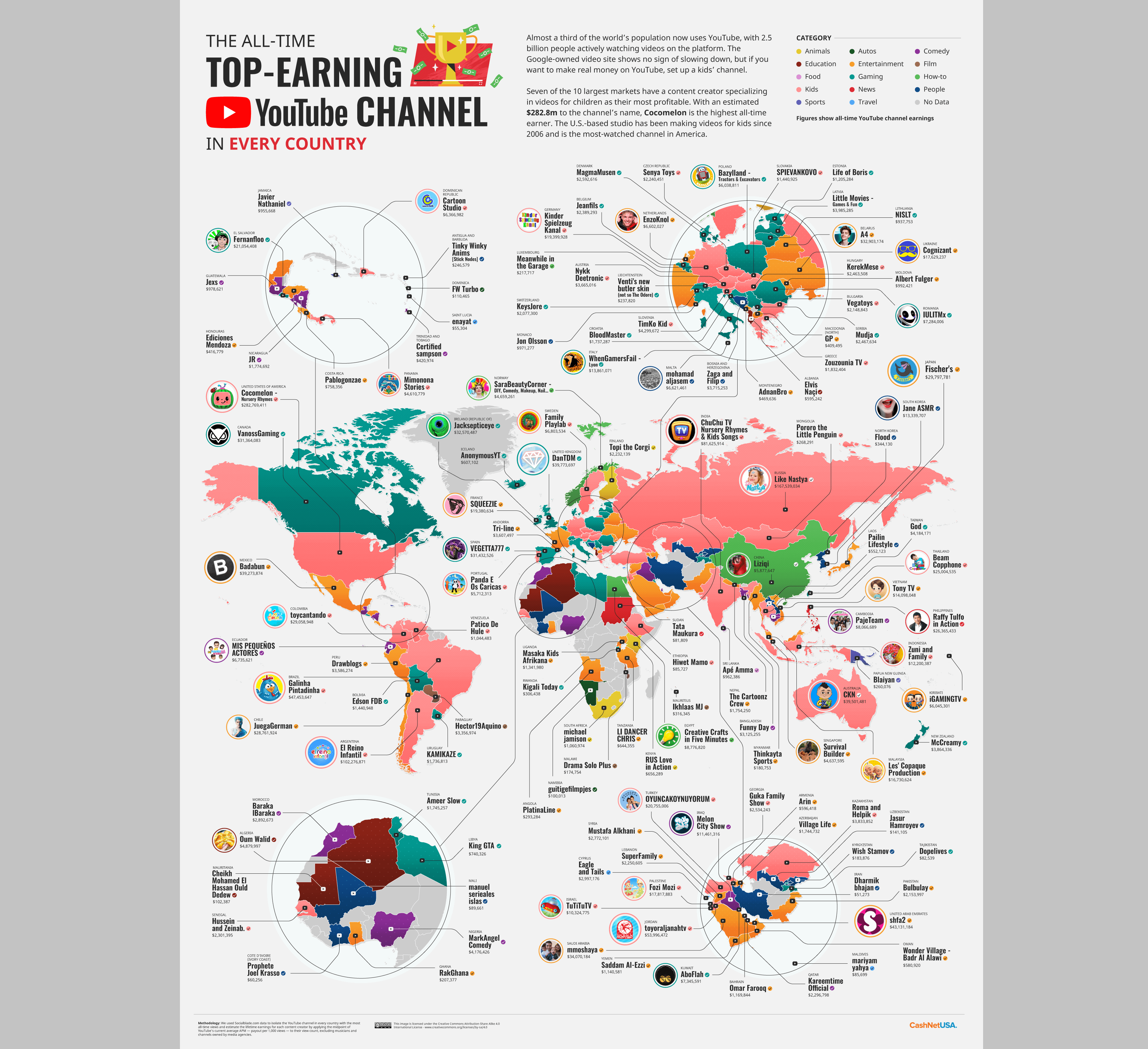
The richest YouTube content creator from every country in the world

YouTube has over 2 billion monthly active users. That means over a quarter of the global population is logging and watching content. Incredible

And when that many eyeballs are pointing in the same direction, advertisers are willing to pay serious money to make sure their messages pop up first.

Researchers from Saving Spot decided to see just how much money the most popular YouTube channels make from advertising revenues.

And they put all that data into several maps and charts that break down the global YouTube rich list.

Here's a summary of the richest YouTube content creators from every country in the world.

The highest-earning YouTube channels in the world

Cocomelon is the top-earning YouTube channel, according to research from Saving Spot.

YouTube Rich List: The highest-earning YouTuber in every country

Cocomelon creates 3D animation videos of traditional nursery rhymes and original children's songs and has amassed an incredible $282million. It's also one of a handful of YouTube channels with over a 100 million subscribers.

Highest-earning YouTube channels in North America

Cocomelon is the highest-earning YouTube channel in North America - and by quite a long way.

Its nearest rival, VanossGamining, has earned a measly $31million in comparison.


Based across the US border in Canada, it's a gaming channel owned by popular internet personality Evan Fong. The channel features montage footage of Fong playing online games with his friends and other content creators.

Evan has spoken about his school days during several interviews, recalling the numerous instances when his parents and teachers told him to stop wasting so much time playing video games. Fong's passion for gaming (and ability to monetize it) has helped him build a fortune worth a reported $25million.

The South American YouTube rich list

South America is another continent where kid's content dominates the YouTube rich list.


Argentina- based kids channel El Reino Infantil is the biggest earner of all, racking in over $100million since it launched in 2011. Its total view count is right on the verge of smashing the 50 billion barrier!

Galinha Pintadinha comes next. It's a Brazilian music channel for kids featuring a singing chicken. That content has generated almost $47million.

YouTube fortunes in Europe

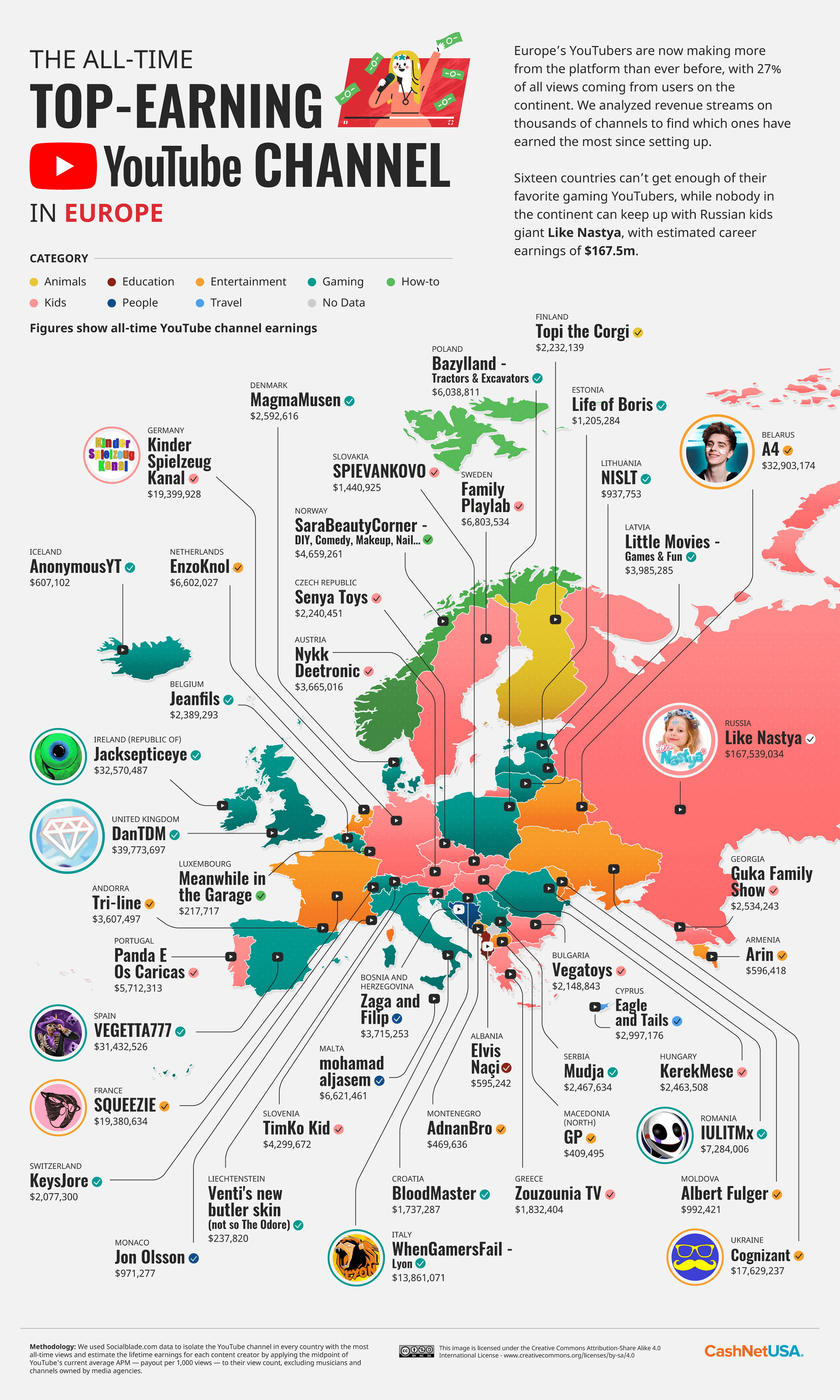
Topi the Corgi might not be the biggest or richest YouTube channel on the European continent. But it's definitely one of the best - providing, of course, that you understand what YouTube is really all about, i.e., watching dog videos.


Topi is a three-year-old male Corgi pup from Finland. He stars in hilariously adorable videos inspired by his daily life and travel adventures. Topi's cute face and impeccable comedic timing have earned his humans over $2million. And the only things Topi asks for in return are treats and a few extra belly rubs.

Europe's highest-earning YouTube channel is Like Nastya. Featuring 8-year-old Anastasia Radzinskaya and her parents, the Russian channel produces children's songs, stories, and roleplaying games.

According to Forbes, Anastasia is one of the world's fastest-growing content creators, thanks to her videos being produced in seven(!) different languages. By Saving Spot's calculations, the channel has earned an eye-watering $167million.

Top-earning YouTube channels in the Middle East and Central Asia

It's a similar situation when looking at the YouTube world in the Middle East and Central Asia.

Toyor Al Janah sits on top of the region's YouTube rich list. Toyor Al Janah was founded in 1994 by Jordanian businessman Khaled Maqdad. It started life as a kid's TV channel before making the (very wise) move to YouTube in 2008. Since then, it's made a few dollars shy of $54million


Oyuncakoynuyorum is another big earner. The Turkish YouTube channel, which is a vlog-style diary of sisters Masal and Oyku, has earned $20million since it started producing regular content in 2012.

The Middle East and Central Asia are home to some of the smallest 'biggest earning' YouTube channels in the world, including Tajikistan’s dopelives gaming channel (worth just under $100,000) and Mariyam Yahya, a cooking channel based in the Maldives that has made its creator around $85,000.

Asia and Oceania

CKN is Australia's biggest and richest YouTube channel. Starring Calvin and Kaison, who review and open the latest toys, it's made almost $40million.

ChuChi, an Indian YouTube channel, has made over $80million by producing nursery rhyme content for young kids.


Liziqi is China's richest YouTube content creator. Her lifestyle vlog has earned $6million, although it's currently on pause while Liziq settles some legal issues with a former business partner.

South Korea's highest-earning channel, Jane's ASMR, is (there's really no other word for it) just a bit weird. The content is a disembodied mouth biting into brightly colored sugary snacks. That's it, seriously. And it's made $14million. We live in strange times.

Top earning YouTube channels in Africa

YouTube has yet to really catch on in Africa, mainly due to a lack of digital infrastructure and access. It's estimated that less than 1 in 4 Africans have a permanent internet connection.

But there are still plenty of African content creators making big bucks on YouTube.


Senegalese siblings Hussein and Zainab have made over $2miilm from poking fun at their older relatives on YouTube, while Nigerian comedian Mark Angel has earned in excess of $4million by posting his sketches on the video platform.

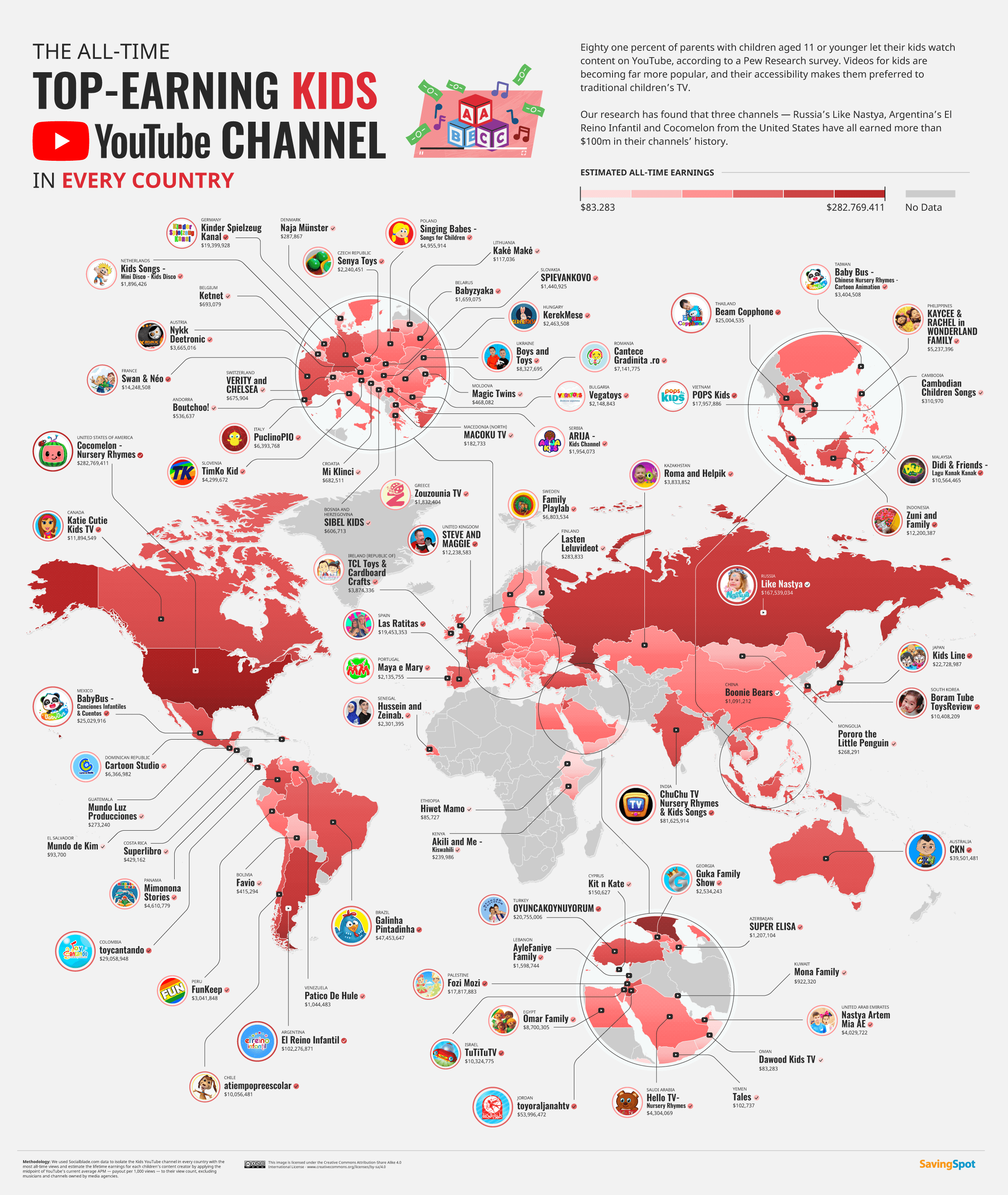
The All-Time Top-Earning Kids YouTube Channel In Every Country


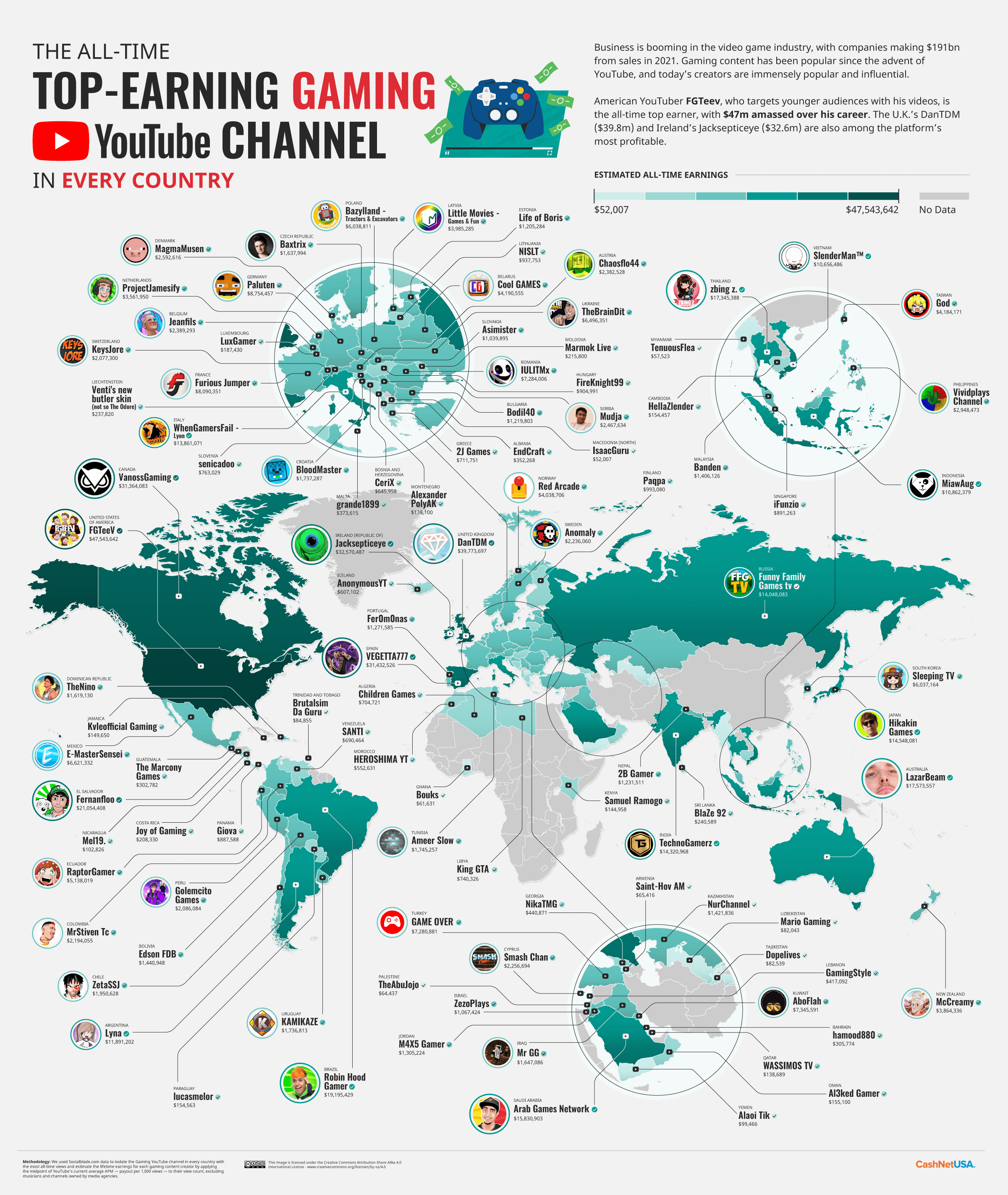
The All-Time Top-Earning Gaming YouTube Channel In Every Country


Ready to quit your day job and become a YouTube star now? Just remember that these channels are the exception. The average channel earns just $4,000 a year, and many make absolutely nothing zero. So maybe start it off as a side hustle first!
by Irfan Ahmad via Digital Information World

3 Simple Ways Specialty Sites Generate High Conversion Rates

Specialty sites generate some of the highest conversion rates, more so than other key industries, and there are three simple ways they achieve this. They focus on a very niche audience, retain loyal customers for repeat business, and thanks to their uniqueness, specialty sites can target audiences with effective marketing strategies. All of these actions contribute to more visitors, and therefore, more conversions!

But, what does a specialty site even mean? And how can you determine a good conversion rate from a bad one? We’ll answer these key questions throughout this article, but, most importantly, we’ll examine in depth the three tactics specialty sites deploy to generate impressive conversion rates.

What Is a Specialty Site?


Let’s start off with the basics. You might be wondering what a specialty site is, but it’s all in the name. Essentially, a specialty site specializes in selling niche or unique products. For example, reusable beeswax wrap, or subscription boxes for dogs. Whatever it is, customers come to these sites to find goods that can’t be bought elsewhere.

Customers tend to search for these stores themselves, instead of stumbling across them randomly, which is why specialty sites excel at converting visitors into buyers. The audience is engaged and interested already – the job of specialty sites is to simply convince them to click “buy”.

What Is a Good Conversion Rate?

Conversions are the aim of every business – at least, they should be! Your business succeeds by enticing visitors to your website, and guiding them towards the desired action, such as purchasing a product.

So, how do you know if you’re achieving a good conversion rate or not? For online stores, the average US conversion rate falls a little under 3%, so your business should aim for around or above this figure.

Of course, any conversion is a success, whether that’s one person or a hundred people, but the end goal is all about increasing your visitors and subsequent conversions to a successful rate… and maintaining it. These two measurements – the number of visitors and the number of conversions – are closely intertwined to work out a website’s conversion rate.

If you find your website falling below the average rate, consider how you’re currently connecting with your audience. Can the relationship be improved? For example, could you test new marketing methods or optimize your checkout?

On the flip side, if you have a high conversion rate already, all signs point to a successful website and online brand image – your pages, design, products, and communications, are all working effectively. Keep it up!

How Do Specialty Sites Generate High Conversion Rates?

Website Builder Expert examined five key industries, including fashion and sports, and specialty sites came out on top with the highest global conversion rate of 7.6%! Pretty impressive when you compare it with the US average of 2.86%, but what sets specialty sites apart from the rest of the web?


To put it simply, customers are at the heart of the ecommerce experience, and specialty sites work at building and maintaining a strong bond with their devoted niche audience.

Let’s take a look at the three simple ways specialty sites achieve such an incredible conversion rate:

#1. Target a Niche Audience

If you’re just getting started and want to know how to sell online, one of the first crucial steps for any business is to identify your target audience. For specialty sites, this couldn’t be more important. Who is your business trying to reach? Who will appreciate your product? What customer pain point or need does your business provide a solution for?

Specialty sites are trying to connect with a very niche crowd, so it isn’t too tricky for them to identify their customer base. This is a key way in which specialty sites see a high conversion rate – your marketing, design choices, and business aims can all focus on these unique customers.

By understanding their desired audience, specialty sites can react and respond to any potential needs and pain points effectively.

#2. Rely on Returning Customers

Another way in which specialty sites generate high conversion rates, and know which customers to target, is largely thanks to return traffic. The conversion rate on returning visitors is a staggering 8.8% – even higher than the first-time average we mentioned before.

Once customers find a specialty site, they know where to look in the future if they need to make a similar purchase. After a satisfying shopping experience, it’s easy for them to become loyal customers.

For such a niche business, building these relationships is key since holding on to repeat customers will keep those conversion rates at a high level. You don’t want to break the bond and lose customers in an already niche audience.

A reliable way to invite visitors back to your website is to use feedback forms, surveys, email marketing, and online engagement through reviews and social media. Customers return to brands that care about and interact with the consumer, which is where a custom marketing strategy helps.

#3. Create a Tailored Marketing Strategy

So, how does a specialty site target a niche audience and keep them returning? A tailored marketing strategy allows these stores to open a direct line of communication with new and existing customers.

As we’ve already mentioned, to find a specialty site, customers are generally already interested enough to start the search themselves. However, securing and maintaining a high conversion rate is all about finding new customers to convert!

Specialty sites use marketing strategies to really tap into their niche. Not only does it help them build brand authority and awareness in the market space, but it’s a great channel for businesses to really connect with customers. Speak to desires and frustrations, or share new product information – as long as you engage with your niche audience appropriately, more traffic and conversions will follow.

Summary

For any online store, securing a high visitor count and stable conversion rate is essential if you want to be successful. And specialty sites seem to knock it out of the park! To recap, there are three simple ways in which specialty sites generate consistently high conversion rates: they target a niche audience, they rely on returning customers, and they keep new and existing customers engaged with a tailored marketing strategy.

Customers of specialty sites are already committed and interested in the product – they simply need to be converted, and these three methods go a long way in helping a specialty site land the sale.
by Web Desk via Digital Information World
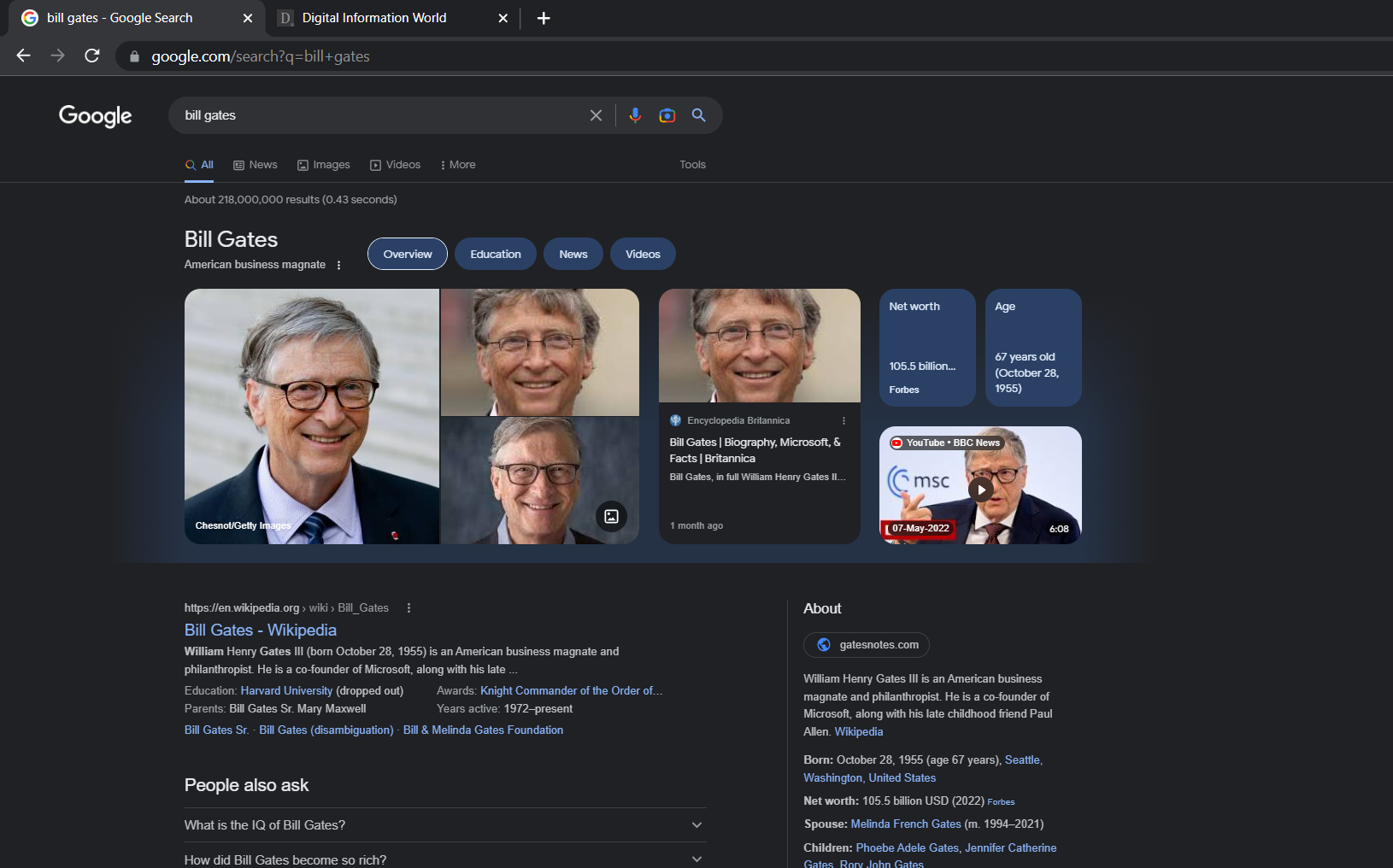
Google Rolls Out Redesigned Knowledge Panels That Make Exploring A Subject On Search Much Easier

At the Search On event this year, we saw Google go public on how it wished to make exploring easier for its users on the platform.

In September, Google mentioned how it would be highlighting some of the greatest and most useful information out there through its Knowledge Panel redesigning venture.


This project would entail the likes of cards that were arranged in the form of a grid layout. Whatever is shown totally depends on the subject of interest. But we do feel a range of pictures might be the first thing that appears on sites.

For instance, when we talk about cities, we’re talking about ‘weather averages’. These could be highs or lows for the month and how long it actually takes for a user to travel from one destination to the next via your description.

If you’re a foodie that loves to cook, well, you can search for recipes and dishes that appear in the description. This would be closely followed by so much content in the form of a carousel that states, ‘things to know’.

On a smart device, this would be in the form of a card that tries to explore content that is themed accordingly. You could have green for pesto and red for ragu. Meanwhile, other cards are blue in hue.

While scrolling away, you’ll find the usual results on the web appear. On the smartphone, we will only be seeing something like this as a ‘knowledge panel’ for redesign purposes in those aforementioned categories.

When you log in through your Desktop, you’ll just be seeing the category reserved for people. But now, you’ll also be able to find a bigger Knowledge Panel grid. It begins with pictures and even goes on to highlight stuff like age, content from social media, and also your spouse.

If you happen to be an athlete, you’ll find information like cards for height, your net worth, and even a recently published video of a recap. The sidebar located on the right side is solely for the purpose of an About description and a range of other types of information.

We won’t lie, it’s quite a prominent feature. It’s the first thing seen after the big Search Bar comes into play and starts to capture the users’ attention.

For now, Google isn’t mentioning the rollout as a feature in terms of a new redesign for cards on the Knowledge Panel or even if there is a result within a single category. But other than information, the tech giant hopes to put other content from creators in the spotlight on the web through such endeavors.

Read next: SEOs And Web Searchers Have Mixed Feelings on the State of the Internet According to This Poll
by Dr. Hura Anwar via Digital Information World
TikTok is Becoming the Most Popular News Resource for Younger Users

TikTok has been a popular source of entertainment for Gen Z and some Millennial users for quite some time now. Questions surrounding the ethics of its data collection practices may have hampered some of its growth, but in spite of the fact that this is the case it is continuing to see an increase in all of the metrics that truly matter including monthly active users and the level of engagement that videos posted to the platform tend to receive.

With all of that having been said and now out of the way, it is important to note that an increasing proportion of TikTok’s users are also turning to the platform to obtain news content. 15% of users between the ages of 15 and 24 are going to TikTok to get their daily news fix, and 10% of users between the ages of 25 and 34 also said the same. However, one thing that makes this rather concerning is that TikTok users are more likely to eschew mainstream news coverage from journalists than might have been the case otherwise.


Instead, they tend to get the news from influencers. 36% of TikTok users said that they get their news from influencers, which is far higher than the 18% of Twitter users and 14% of Facebook users that said the same. So called ordinary people came in second on TikTok with 23%, far higher than the 16% that said the same on Twitter although it is still comparable to the 25% of users on Facebook that made similar statements with all things having been considered and taken into account.

The high propensity for TikTok users to trust influencers may be dangerous because of the fact that this is the sort of thing that could potentially end up exposing them to misinformation and fake news. Influencers may provide unbalanced opinions on the news instead of just reporting the facts. That can lead to higher levels of bias among their viewers, and if TikTok doesn’t improve the quality of news coverage on its platform it might end up doing a lot of harm.

Read next: These App Niches Are the Most Resilient to Economic Headwinds
by Zia Muhammad via Digital Information World

SEOs And Web Searchers Have Mixed Feelings on the State of the Internet According to This Poll

While Google’s status as the dominant search engine of the world is hard to dispute, many have been decrying the supposed declining quality of results that they can find on the SERP. Are these complaints unfounded or are they based on an actual quality decrease? One Twitter user sought to find out with a poll, and the results of these polls are really quite interesting with all things having been considered and taken into account.

In a tweet to his followers, Greg Sterling asked if it was Google that was making the internet worse, or if the internet was quite bad in and of itself and Google was doing what it could to deal with it make it better. With all of that having been said and now out of the way, it is important to note that users that responded to this poll seemed somewhat split on the matter at hand.

40.4% of respondents said that Google was to blame, and 41.2% chose the other option by blaming the web and praising Google. It is quite interesting that neither of these responses got a majority of votes, and they instead received a similar proportion which indicates that the problem might be a lot more nuanced than might have been the case otherwise.

18.4% of poll respondents said that they weren’t sure, and that just goes to show that the matter has a lot of moving parts and is therefore hard to pin down a single culprit for. Google for its part will admit that it has a lot of improving to do, but in spite of the fact that this is the case it will still assert that it is doing quite a lot on its end.

The state of the internet is a common source of woe for SEO professionals. Changes are often hard to predict, and any predictions may be subject to sudden headwinds that no one had expected in the past. However, a large proportion of SEOs are clearly blaming Google, and it will be interesting to see where this goes in the future.


Read next: 44% of Survey Respondents Say Link Building is Less Effective Now
by Zia Muhammad via Digital Information World

Sunday, December 11, 2022

Is Snapchat+ still being subscribed by users?

Snapchat started monetizing itself in the name of Snapchat+ and earned a tremendous $6 Million as its net revenue in a single month.

But after one month, the revenue dropped immediately, putting social media observers into the thought that whether it was just a coincidence that revenues become so high or it was a trend.

As AppFigures has collected Snapchat+ revenue generation data for this year, it becomes easy to predict whether it was a trend or it just happened by chance. Now, the answer seems to be a mixture of both, as the revenue generated in June peaked at $6 Million but dropped around 21% in August to less than $5 Million, but the graph is seen going up by 3.24% in September, +4.87% in October and last month the platform once again generated near to $6 Million in November, which is an 8.15% increase in the revenue since October.

Now this is a clear steep and it’s pretty easy to predict that December may be the month, that Snapchat+ will generate near to or almost $6 Million, which would be an increase of $0.4 Million since November.

It is estimated that by January, the revenue will be more than $6 Million.


At first, it was considered that no one would pay for access features before officially launching on Snapchat. Paid beta testing for Snapchat was not considered to be a success but as time passed, it has proved that people love to pay for early access to features and consider them as a possession that is not publicly available.

So, it’s good news for the company to keep generating early access features and selling them as Snapchat+.

The current subscription charge for Snapchat+ costs $3.99 per month. What makes Snapchat+ more unique and fascinating than normal Snapchat is that you can mark friends as BFFs, exclusive badges, keep count for story rewatch, and access Snapchat web are some of the many features of Snapchat+. You can also make a story on Snapchat+ private, allowing specific people to watch which compels privacy-conscious users to buy the subscription.

One feature that is missing in Snapchat+ is that there’s no option to remove ads, which users might find irritating, as in most of the apps, by paying, you get rid of ads, like in YouTube premium. With the addition of an ad-removal service to the Snapchat+ in future, it is possible to see a greater peak in the Snapchat+ revenue chart.

Read next: The list of the most downloaded and highest earning apps and games in November is finally out
by Arooj Ahmed via Digital Information World