As many content creators are getting famous on different social media platforms day by day, many Americans also think that they can get famous by creating content. According to a survey of 2,000 Americans, 4 out of 10 think that they can get viral on social media because of their content. The possibility is high too because content creation is the highest-growing industry right now, and makes someone a superstar every passing hour of the day. 41% of people say that they want to get popular after creating something for social media while 3 out of 10 say that they have already gotten viral because of their content.
The survey also asked them why they want to get viral so 39% answered that they want it for the money as you can earn good money after being popular. But some people (37%) are also passionate about creating something for the audience while 35% say that they want to do content creation because they don't want to work for anyone. 58% say that everyone should treat content creation as any regular job because there's too much hard work, sweat and tears put into the work to make meaningful content, and that's the reason 49% say that they know that they will earn a decent amount from content creation. In this survey, it was shown that 43% of Americans want to create their content but not a lot of them can get to that level. Content creation seems like a simple and easy thing to do but a lot of people do not know how this all works. Just like 4 in 10 people in the survey think that content creators make any kind of content and they get popular while 29% think that content creators sketch an idea about the content they want to create and then do it in steps. 10% of people think that content creators just create videos for the sake of it. What people do not know is the difference between content creators and influencers. While content creators have to brainstorm different ideas for their content, influencers become popular just by advertising brand products. Two in three Americans have a faint idea about the difference between content creators and influencers and can differentiate between them easily.
People also shared their thoughts about the length of the videos. 57% of people said that short reels are best for the creators this way more followers interact with the content while 55% say that they are willing to watch long videos of the content creator if they like their shorter reels. About 81% of the people say that most of their knowledge about content on social media is from the people who make content there. Many people also shared their thoughts about what kind of content creators they like and what are their thoughts about them.
Read next: Who Were the Richest People in the Last Decade?
by Arooj Ahmed via Digital Information World
"Mr Branding" is a blog based on RSS for everything related to website branding and website design, it collects its posts from many sites in order to facilitate the updating to the latest technology.
To suggest any source, please contact me: Taha.baba@consultant.com
Saturday, December 17, 2022
Customers Urge To Feel Valued Rather Than Possessing Value
Intercom, a software company that grants access to businesses to chat with their customers, conducted a survey that shows that customers want to feel appreciated by the companies in addition to receiving value from them.
Customers are the most important asset of the business. A true relationship with consumers is the greatest approach for a business to increase customer loyalty since consumers who feel valued return for utilizing that service. Every organization should transform itself into a “customer first” organization where the business is more focused on the satisfaction of its consumers rather than making a sale.
64% of the surveyed buyers said that they would stop doing business with a company if they didn’t feel valued during a customer service transaction. However, the mentioned calculation is lower than the proportions of 66% of customers who would stop using a service if their problem went unsolved, and the percentage is 65% of those who would stop using the service after being juked out by a support agent. Furthermore, 61% of customers think that respect is valued more highly than quick customer responses. In short, buyers determine value in their unique way.
According to Des Traynor, co-founder, and chief strategy officer of Intercom, customers have increased their expectations for organizations, to be honest, active, and accessible to engage with. Their continued patronage of the company depends on how, where, and what you speak.
The study further says that the best ways to show value to your customers include recognizing their past purchases or used patterns, giving them special attention as VIPs, and providing them with constructive advice and assistance.
Moreover, the use of inappropriate slang or repulsive language, or acting overly earnestly with an inauthentic conversation, as well as excessive use of emojis in support contacts can turn away 64% of customers. Whereas, 61% of Generation Z prefer a neutral tone, and 56% of customers value professional language rather than an informal one. However, customers across all age groups appear not to like email, and 60% favor direct messaging. Regardless of the medium, 35% choose short messages over elongated paras, and 49% of youngsters stated this choice.
Remember, your customers are the heroes of the story of your business. You are their guide. You should always be there to guide them to their success. Customers must continually believe that your product or service is worth the price for your business to develop. Prioritize quality, provide affordable prices, and, of course, provide above-and-beyond customer service. Customers will recognize your worth and probably continue to use your brand for many years.
Read next: Annual Study by Opinium reveals the 2022 ranking of the Top 100 Most Connected Brands
by Arooj Ahmed via Digital Information World
Customers are the most important asset of the business. A true relationship with consumers is the greatest approach for a business to increase customer loyalty since consumers who feel valued return for utilizing that service. Every organization should transform itself into a “customer first” organization where the business is more focused on the satisfaction of its consumers rather than making a sale.
64% of the surveyed buyers said that they would stop doing business with a company if they didn’t feel valued during a customer service transaction. However, the mentioned calculation is lower than the proportions of 66% of customers who would stop using a service if their problem went unsolved, and the percentage is 65% of those who would stop using the service after being juked out by a support agent. Furthermore, 61% of customers think that respect is valued more highly than quick customer responses. In short, buyers determine value in their unique way.
According to Des Traynor, co-founder, and chief strategy officer of Intercom, customers have increased their expectations for organizations, to be honest, active, and accessible to engage with. Their continued patronage of the company depends on how, where, and what you speak.
The study further says that the best ways to show value to your customers include recognizing their past purchases or used patterns, giving them special attention as VIPs, and providing them with constructive advice and assistance.
Moreover, the use of inappropriate slang or repulsive language, or acting overly earnestly with an inauthentic conversation, as well as excessive use of emojis in support contacts can turn away 64% of customers. Whereas, 61% of Generation Z prefer a neutral tone, and 56% of customers value professional language rather than an informal one. However, customers across all age groups appear not to like email, and 60% favor direct messaging. Regardless of the medium, 35% choose short messages over elongated paras, and 49% of youngsters stated this choice.
Remember, your customers are the heroes of the story of your business. You are their guide. You should always be there to guide them to their success. Customers must continually believe that your product or service is worth the price for your business to develop. Prioritize quality, provide affordable prices, and, of course, provide above-and-beyond customer service. Customers will recognize your worth and probably continue to use your brand for many years.
Read next: Annual Study by Opinium reveals the 2022 ranking of the Top 100 Most Connected Brands
by Arooj Ahmed via Digital Information World
New Warning Issued Against Phishing Campaign That Uses Facebook Posts To Steal User Data
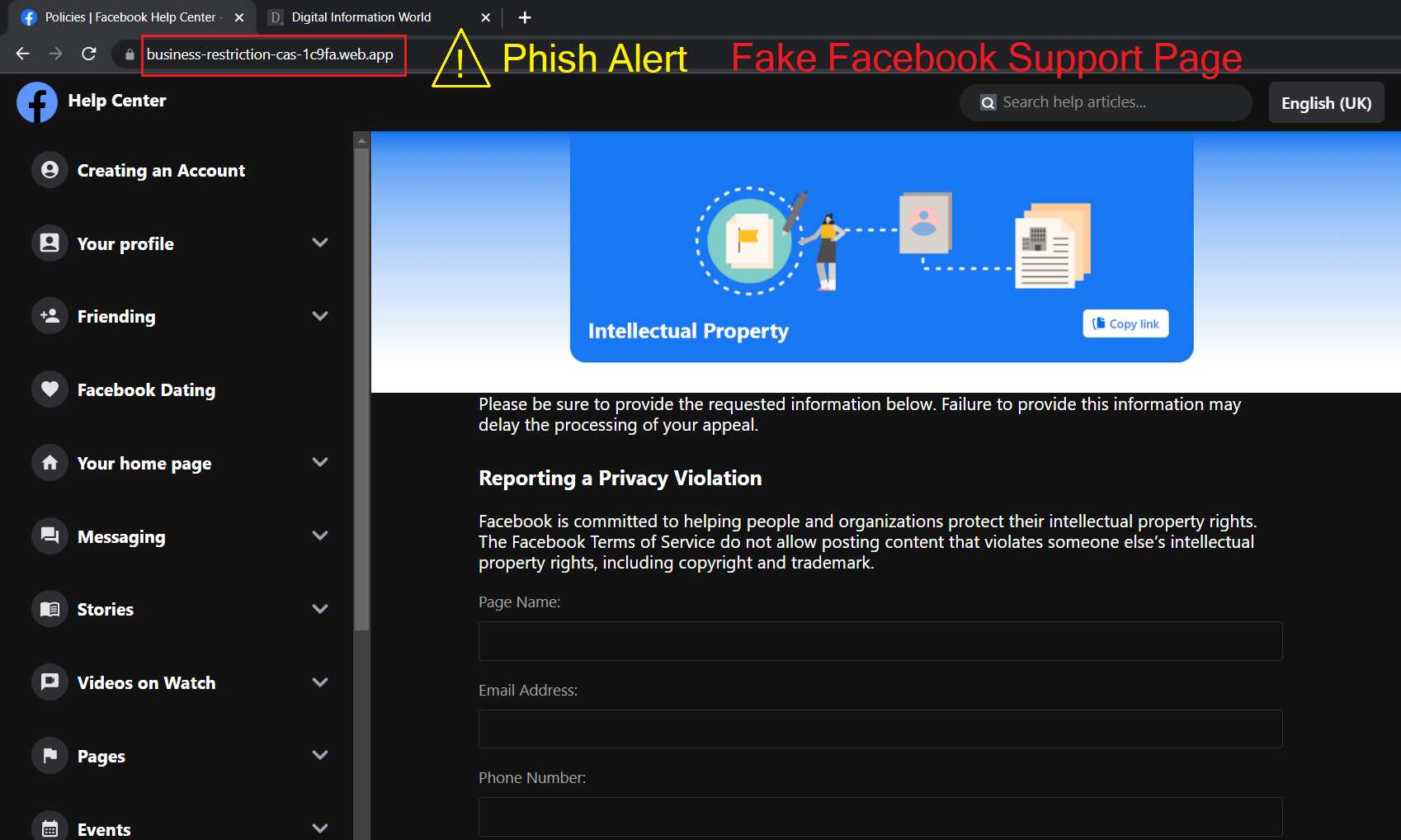
Researchers are ringing alarm bells against a phishing campaign that’s on the rise. It makes use of Facebook posts that becomes a part of the attack chain for tricking users. The campaign secretly makes users hand over sensitive details like account credentials and other personal information.
These emails are sent out to different targets and they pretend as if it’s copyright infringement matters on a particular recipient’s post on Facebook. They send out warnings about accounts getting deleted if the two-day time limit is crossed and no response is generated such as an appeal getting filed.
Many users have become victims of this scam because it does look so real. The links provided for appeals of the account deletion arise in the form of a real post from the Facebook app. This enables the malicious threat actors to bypass security enlisted for email solutions. Moreover, it ensures that phishing messages end up in the users’ target inbox.
The post on Facebook acts like it’s a Page Support and even uses logos from Facebook to make it appear as if the network manages it. But the post actually entails links for external phishing websites that are named after the likes of Meta which is Facebook’s parent firm. The whole idea is to make the scam campaign appear as real as possible so victims don’t realize the truth soon.
The news comes to us thanks to analysts at Trustwave. They were the first ones to highlight the campaign by following some URLs that are up on Facebook.
Each phishing website is carefully curated with immense care to have it appear as it is on Facebook’s real appeal page. There’s even a form where you can find victims requesting full names, email IDs, addresses, contact numbers, and usernames across Facebook.
After such data is submitted by a victim, the page manages to steal the IP address and location details. These are transferred to a new account on the Telegram app that’s under their complete control.
In some cases, you can see the threat actors collecting data like extra personal information that could bypass the likes of fingerprinting protection or any other added security measure while conducting a complete takeover.
And there are cases where a redirection would forward the victim to another similar phishing page that entails fake OTP password requests that are time-sensitive.
After adding the code, users would notice how an error sign arrives. Similarly, the experts have highlighted how the actors are resorting to Google Analytics across phishing pages to assist with tracking efficiency.
This happens to be a widespread technique that so many actors are using and TrustWave claims it has managed to locate several accounts on the Facebook app that use such phony posts. It appears in the form of support pages that push victims toward phishing sites.
During our separate research we found even more freshly created Facebook pages and posts, we reported them to Facebook, but unfortunately we don't have the bandwidth to report them all. But Facebook must have moderation tools and teams in place to curb this issue.
Sadly, Facebook and Meta, after being repeatedly informed about this matter, failed to come up with a strategy to proactively deal with bad actors on its platform. Phishing actors keep on improving their tactics to hack Facebook users but it appears the social media giant has not learned its lesson yet.
Being aware and steering clear is definitely the way to go here and save yourself from turning into a victim, experts claim.
Read next: These Countries Are the Most Dangerous for Journalists
by Dr. Hura Anwar via Digital Information World
These emails are sent out to different targets and they pretend as if it’s copyright infringement matters on a particular recipient’s post on Facebook. They send out warnings about accounts getting deleted if the two-day time limit is crossed and no response is generated such as an appeal getting filed.
Many users have become victims of this scam because it does look so real. The links provided for appeals of the account deletion arise in the form of a real post from the Facebook app. This enables the malicious threat actors to bypass security enlisted for email solutions. Moreover, it ensures that phishing messages end up in the users’ target inbox.
The post on Facebook acts like it’s a Page Support and even uses logos from Facebook to make it appear as if the network manages it. But the post actually entails links for external phishing websites that are named after the likes of Meta which is Facebook’s parent firm. The whole idea is to make the scam campaign appear as real as possible so victims don’t realize the truth soon.
The news comes to us thanks to analysts at Trustwave. They were the first ones to highlight the campaign by following some URLs that are up on Facebook.
Each phishing website is carefully curated with immense care to have it appear as it is on Facebook’s real appeal page. There’s even a form where you can find victims requesting full names, email IDs, addresses, contact numbers, and usernames across Facebook.
After such data is submitted by a victim, the page manages to steal the IP address and location details. These are transferred to a new account on the Telegram app that’s under their complete control.
In some cases, you can see the threat actors collecting data like extra personal information that could bypass the likes of fingerprinting protection or any other added security measure while conducting a complete takeover.
And there are cases where a redirection would forward the victim to another similar phishing page that entails fake OTP password requests that are time-sensitive.
After adding the code, users would notice how an error sign arrives. Similarly, the experts have highlighted how the actors are resorting to Google Analytics across phishing pages to assist with tracking efficiency.
This happens to be a widespread technique that so many actors are using and TrustWave claims it has managed to locate several accounts on the Facebook app that use such phony posts. It appears in the form of support pages that push victims toward phishing sites.
During our separate research we found even more freshly created Facebook pages and posts, we reported them to Facebook, but unfortunately we don't have the bandwidth to report them all. But Facebook must have moderation tools and teams in place to curb this issue.
Sadly, Facebook and Meta, after being repeatedly informed about this matter, failed to come up with a strategy to proactively deal with bad actors on its platform. Phishing actors keep on improving their tactics to hack Facebook users but it appears the social media giant has not learned its lesson yet.
Being aware and steering clear is definitely the way to go here and save yourself from turning into a victim, experts claim.
Read next: These Countries Are the Most Dangerous for Journalists
by Dr. Hura Anwar via Digital Information World
Friday, December 16, 2022
Have Opinions on Elon Musk’s Twitter Takeover Changed?
Although Elon Musk’s acquisition of Twitter has generated a lot of controversy, a survey by YouGov found that most people approved of his decision. Eight months after he announced his intention, and after having finally gone through with it after considerable back and forth, Americans continue to hold a favorable view with all things having been considered and taken into account. This comes from a second poll that YouGov conducted on the same topic, and it highlights what Americans think about the man himself.
Back in April when the first poll was conducted, around 30% of Americans thought that he was going to do a good job. It turns out that his approval ratings are even higher, with 34% of Americans now saying the same. In spite of the fact that this is the case, more people have an unfavorable impression of how he is handling things as well. That seems to suggest that people are coming to more concrete conclusions after seeing him in action, since that can make his competence more apparent than might have been the case otherwise.
24% of Americans disapproved of Musk’s acquisition back in April, but with all of that having been said and now out of the way it is important to note that 29% are now saying the same. As for the people who think that it is neither good nor bad, this has dropped by just one point from 18% in April to 17% as of right now.
One area where Musk has seen a bit of a decline in terms of his public perception is his level of perceived influence. 52% of people thought he was an influential figure back in April, but now this number has dropped to just 37%.
Musk may have shot himself in the foot by buying Twitter. Even though people still think he can do a decent job, more people believe otherwise and his public perception has taken a hit. Only time will tell whether or not Musk would be able to justify his decision by turning Twitter into a better social media platform than it already was.
Read next: Data Shows More Than 60 Million Americans Took Part In Skilled Freelance Work This Year
by Zia Muhammad via Digital Information World
Back in April when the first poll was conducted, around 30% of Americans thought that he was going to do a good job. It turns out that his approval ratings are even higher, with 34% of Americans now saying the same. In spite of the fact that this is the case, more people have an unfavorable impression of how he is handling things as well. That seems to suggest that people are coming to more concrete conclusions after seeing him in action, since that can make his competence more apparent than might have been the case otherwise.
24% of Americans disapproved of Musk’s acquisition back in April, but with all of that having been said and now out of the way it is important to note that 29% are now saying the same. As for the people who think that it is neither good nor bad, this has dropped by just one point from 18% in April to 17% as of right now.
One area where Musk has seen a bit of a decline in terms of his public perception is his level of perceived influence. 52% of people thought he was an influential figure back in April, but now this number has dropped to just 37%.
Musk may have shot himself in the foot by buying Twitter. Even though people still think he can do a decent job, more people believe otherwise and his public perception has taken a hit. Only time will tell whether or not Musk would be able to justify his decision by turning Twitter into a better social media platform than it already was.
Read next: Data Shows More Than 60 Million Americans Took Part In Skilled Freelance Work This Year
by Zia Muhammad via Digital Information World
These Countries Are the Most Dangerous for Journalists
Journalism is a crucial cog in a free and democratic society because of the fact that this is the sort of thing that could potentially end up keeping a check on those in power. It is perhaps for this very reason that journalists so often find themselves in the line of fire. Attempts at stifling a free press include putting restrictions on what news outlets can and can’t publish. Some governments go so far as to imprison journalists, and there have ben 57 cases of journalists being killed this year alone.
This information is coming from Reporters Without Borders, and it also revealed that there are around 532 journalists who are currently languishing in prison all around the world. Mexico turned out to be the most dangerous for journalists, with 11 of them having been killed in 2022 alone. Coming in second was Ukraine, with 8 journalists killed this year mostly as a result of Russia’s invasion. Ukraine is followed by Haiti with 6 journalists killed in the span of a year.
Yemen, Syria Brazil both tied for fourth place, although the war was to blame in Yemen and Syria whereas in Brazil there was no such conflict to cause disproportionate action against journalists. We then have the countries of Somalia, Palestine, Pakistan and Myanmar with 2 journalists killed this year in each country.
However, conflicts that have erupted in some of these countries may be resulting in disproportionate attacks against journalist and making them more frequent than might have been the case otherwise. A much more robust rubric for determining which countries are the most hostile towards their journalists is to look at how often they imprison them.
China is far and away the leader in this category, with 99 of its journalists currently in prison as of 14th December 2022. Myanmar comes in second at 62, with the military junta currently ruling the country not accepting criticism from any quarters. The state of journalism in Myanmar might be even more dire than China, since the country has 4% of China’s population yet 2/3rds as many jailed journalists.
Iran is another bad actor as far as journalists are concerned. The recent protests after the killing of Mahsa Amini have brought much of Iran’s authoritarianism to light. Currently, there are 47 Iranian journalists who have been imprisoned, and the charges against them are most often dubious at best.
Vietnam comes in with 39 jailed journalists, followed by Belarus with 31. 27 Syrian journalists are also in prison, with Saudi Arabia also clamping down on journalism in the country by putting 26 of its members of the press in jail.
Egypt and Turkey round off the list, with 24 journalists apiece in prison. This speaks to a concerning trend, one that can be found in countries that are lacking the same level of democratic advancement as others. Imprisonment is just one of the many ways in which journalists can have their freedoms curbed in such nations. Additionally, it can be hard to tell if these numbers are accurate. After all, it’s not like journalists in these countries would be able to provide accurate assessments without putting themselves at risk to some extent.
Read next: EV Batteries Can Be Recycled, but 47% of Americans Don’t Know That
by Zia Muhammad via Digital Information World
This information is coming from Reporters Without Borders, and it also revealed that there are around 532 journalists who are currently languishing in prison all around the world. Mexico turned out to be the most dangerous for journalists, with 11 of them having been killed in 2022 alone. Coming in second was Ukraine, with 8 journalists killed this year mostly as a result of Russia’s invasion. Ukraine is followed by Haiti with 6 journalists killed in the span of a year.
Yemen, Syria Brazil both tied for fourth place, although the war was to blame in Yemen and Syria whereas in Brazil there was no such conflict to cause disproportionate action against journalists. We then have the countries of Somalia, Palestine, Pakistan and Myanmar with 2 journalists killed this year in each country.
However, conflicts that have erupted in some of these countries may be resulting in disproportionate attacks against journalist and making them more frequent than might have been the case otherwise. A much more robust rubric for determining which countries are the most hostile towards their journalists is to look at how often they imprison them.
China is far and away the leader in this category, with 99 of its journalists currently in prison as of 14th December 2022. Myanmar comes in second at 62, with the military junta currently ruling the country not accepting criticism from any quarters. The state of journalism in Myanmar might be even more dire than China, since the country has 4% of China’s population yet 2/3rds as many jailed journalists.
Iran is another bad actor as far as journalists are concerned. The recent protests after the killing of Mahsa Amini have brought much of Iran’s authoritarianism to light. Currently, there are 47 Iranian journalists who have been imprisoned, and the charges against them are most often dubious at best.
Vietnam comes in with 39 jailed journalists, followed by Belarus with 31. 27 Syrian journalists are also in prison, with Saudi Arabia also clamping down on journalism in the country by putting 26 of its members of the press in jail.
Egypt and Turkey round off the list, with 24 journalists apiece in prison. This speaks to a concerning trend, one that can be found in countries that are lacking the same level of democratic advancement as others. Imprisonment is just one of the many ways in which journalists can have their freedoms curbed in such nations. Additionally, it can be hard to tell if these numbers are accurate. After all, it’s not like journalists in these countries would be able to provide accurate assessments without putting themselves at risk to some extent.
Read next: EV Batteries Can Be Recycled, but 47% of Americans Don’t Know That
by Zia Muhammad via Digital Information World
YouTube Begins Experimenting With Video Queues And New Emoji Reactions For Live Streams
YouTube is bringing forward video queues for both Android and iOS users as it begins experimenting with the feature starting today.
The offering is already up for grabs on the app’s website and that means you would soon be allowed to get content back that you didn’t wish to view at that moment in time. For now, you can only do that through your phone by pressing on the ‘Save to Watch Later’ or the ‘Save to Playlist’ feature on the app.
The problems with both of these selections are related to them being permanent. Therefore, they just save things in the library and require manual removal after a single watch. Meanwhile, queues are certainly more temporary, and seeing apps on smartphones get it is just a wonderful feeling. Just remember it’s not going to be available for Shorts just yet but who knows, we might see it coming soon.
Once it does go live, you’ll be seeing a menu for the three-dot overflow arising near videos. These would be housing new options like Play Last in Queue that’s seen at the list’s top.
After you select your desired content, the app would be creating a queue toward the screen’s bottom. This panel enables you to rearrange the order for viewing and allow for removal by swiping in a left direction. Some options are there for repeats and even shuffles so you can playback. And to clear the lineup, just swipe away.
Once you do end up playing something in this list, it gets added automatically to this queue and can be moved as well. Before, this feature used to be promoted as a Premium offering. As far as today’s test, it’s just for the app’s premium subscribers. But the platform hopes to complete the testing by the end of next month so a rollout would be after that. So stay tuned!
Moving on, YouTube is also conducting tests for some new and exciting emoji reactions to be used in Live Streams. This is another great way to generate responses to Live Chats during broadcasts.
As the company mentioned today through a post, they’ve been on the lookout for features that would help viewers react to what’s happening live. And they’ve found the perfect solution with five new emoji reactions.
Remember how the user’s reactions would be kept anonymous so nobody would be aware of what’s going on there? Other ways through which you can showcase support are donations from Super Chat and also Stickers.
But we feel it’s great for those in search of creative ways to generate a current response. If you’ve used the already available features, you’d find there is a heart, surprise, and crying emoji but now, you’ll find a few more.
You can relate this new feature to responses generated to the platform’s Timed Reactions. For now, YouTube is busy testing this feature for a limited number of channels but an expansion is soon underway.
Read next: YouTube Adds More Elements To Track Video Processing And Allows Users To Select Any Frame For Shorts Thumbnails
by Dr. Hura Anwar via Digital Information World
The offering is already up for grabs on the app’s website and that means you would soon be allowed to get content back that you didn’t wish to view at that moment in time. For now, you can only do that through your phone by pressing on the ‘Save to Watch Later’ or the ‘Save to Playlist’ feature on the app.
The problems with both of these selections are related to them being permanent. Therefore, they just save things in the library and require manual removal after a single watch. Meanwhile, queues are certainly more temporary, and seeing apps on smartphones get it is just a wonderful feeling. Just remember it’s not going to be available for Shorts just yet but who knows, we might see it coming soon.
Once it does go live, you’ll be seeing a menu for the three-dot overflow arising near videos. These would be housing new options like Play Last in Queue that’s seen at the list’s top.
After you select your desired content, the app would be creating a queue toward the screen’s bottom. This panel enables you to rearrange the order for viewing and allow for removal by swiping in a left direction. Some options are there for repeats and even shuffles so you can playback. And to clear the lineup, just swipe away.
Once you do end up playing something in this list, it gets added automatically to this queue and can be moved as well. Before, this feature used to be promoted as a Premium offering. As far as today’s test, it’s just for the app’s premium subscribers. But the platform hopes to complete the testing by the end of next month so a rollout would be after that. So stay tuned!
Moving on, YouTube is also conducting tests for some new and exciting emoji reactions to be used in Live Streams. This is another great way to generate responses to Live Chats during broadcasts.
As the company mentioned today through a post, they’ve been on the lookout for features that would help viewers react to what’s happening live. And they’ve found the perfect solution with five new emoji reactions.
Remember how the user’s reactions would be kept anonymous so nobody would be aware of what’s going on there? Other ways through which you can showcase support are donations from Super Chat and also Stickers.
But we feel it’s great for those in search of creative ways to generate a current response. If you’ve used the already available features, you’d find there is a heart, surprise, and crying emoji but now, you’ll find a few more.
You can relate this new feature to responses generated to the platform’s Timed Reactions. For now, YouTube is busy testing this feature for a limited number of channels but an expansion is soon underway.
Read next: YouTube Adds More Elements To Track Video Processing And Allows Users To Select Any Frame For Shorts Thumbnails
by Dr. Hura Anwar via Digital Information World
Twitter Suspends Accounts Of Leading Journalists Who Tweet About Elon Musk
Twitter is banning critical journalists from the platform who are busy covering the app’s Chief Elon Musk. It appears to be a no-nonsense policy as the decision to target leading reporters through account suspension has already begun at a fast pace.
Common names include the likes of New York Times’s Ryan Mac, Mashable’s Aaron Rupar, Drew Harwell from the Washington Post, and Micha Lee from The Intercept. But that’s just the start as the list continues to increase as we speak.
We saw the billionaire Twitter CEO log into his account yesterday to try and provide a justification for the actions and it’s definitely surprising. And that’s especially shocking coming from a man who wishes to promote freedom of speech through his platform.
He also ran a new poll that asked users of the app if they felt such reporters’ accounts should be unbanned and when. And to his dismay, things didn’t quite go his way as the responses weren’t in his favor.
All the journalists who received the ban from the app were those who spoke about Musk recently in regard to their attempts of deciphering where his private jet was currently located. While such accounts can’t really post their thoughts on the app, they can still go about joining a live audio chat through Twitter Spaces. And that’s where Musk came face to face with some banned journalists, justifying his actions.
During that chat, Musk accused the individuals of embarking on a task called ban evasion. He outlined how his ElonJet account was removed from the app but it was seen on Facebook and Mastodon. And when such reporters put up links to such accounts, they were going against the ban he set up. This was not the right behavior, he continued.
As one can imagine, bullets were fired at the Twitter chief by the reporters. They argued and asked what difference his ban was from publishing a story of Hunter Biden’s personal information inside a laptop. Remember, that post is currently banned.
Musk didn’t go into too many nitty-gritty details. He did try to keep it short and sweet by mentioning that the rules are very simple regarding content moderation. If you end up doxing, you get banned and it is what it is. He then opted to leave the chat at that.
More emphasis was later put forward by the company’s head of trust and safety, Ella Irwin. She reiterated how it was just a crime to share details about live locations on the app as it went against their policy. Even links related to URLs from third parties were wrong as in this case where information about travel routes had been provided.
Irwin also warned how the policies were the same for all accounts. There are no specific exemptions granted to anyone, be it a journalist, celebrity, public figure, and more.
Musk was furious when he came to know about the matter. He outlined the move as coordinates that highlighted a possible assassination attempt and it was just wrong on so many levels. He didn’t like the posting of real-time locations as it directly violated the app’s terms of service.
Read next: Twitter Predicted to Lose 32.7 Million Users in Two Years
by Dr. Hura Anwar via Digital Information World
Common names include the likes of New York Times’s Ryan Mac, Mashable’s Aaron Rupar, Drew Harwell from the Washington Post, and Micha Lee from The Intercept. But that’s just the start as the list continues to increase as we speak.
Same doxxing rules apply to “journalists” as to everyone else
— Elon Musk (@elonmusk) December 16, 2022
We saw the billionaire Twitter CEO log into his account yesterday to try and provide a justification for the actions and it’s definitely surprising. And that’s especially shocking coming from a man who wishes to promote freedom of speech through his platform.
The NYTimes' @rmac18 has been suspended from Twitter. He's been on the Elon Musk beat.
— Ben Collins (@oneunderscore__) December 16, 2022
He also ran a new poll that asked users of the app if they felt such reporters’ accounts should be unbanned and when. And to his dismay, things didn’t quite go his way as the responses weren’t in his favor.
All the journalists who received the ban from the app were those who spoke about Musk recently in regard to their attempts of deciphering where his private jet was currently located. While such accounts can’t really post their thoughts on the app, they can still go about joining a live audio chat through Twitter Spaces. And that’s where Musk came face to face with some banned journalists, justifying his actions.
During that chat, Musk accused the individuals of embarking on a task called ban evasion. He outlined how his ElonJet account was removed from the app but it was seen on Facebook and Mastodon. And when such reporters put up links to such accounts, they were going against the ban he set up. This was not the right behavior, he continued.
As one can imagine, bullets were fired at the Twitter chief by the reporters. They argued and asked what difference his ban was from publishing a story of Hunter Biden’s personal information inside a laptop. Remember, that post is currently banned.
Musk didn’t go into too many nitty-gritty details. He did try to keep it short and sweet by mentioning that the rules are very simple regarding content moderation. If you end up doxing, you get banned and it is what it is. He then opted to leave the chat at that.
More emphasis was later put forward by the company’s head of trust and safety, Ella Irwin. She reiterated how it was just a crime to share details about live locations on the app as it went against their policy. Even links related to URLs from third parties were wrong as in this case where information about travel routes had been provided.
Irwin also warned how the policies were the same for all accounts. There are no specific exemptions granted to anyone, be it a journalist, celebrity, public figure, and more.
Musk was furious when he came to know about the matter. He outlined the move as coordinates that highlighted a possible assassination attempt and it was just wrong on so many levels. He didn’t like the posting of real-time locations as it directly violated the app’s terms of service.
Read next: Twitter Predicted to Lose 32.7 Million Users in Two Years
by Dr. Hura Anwar via Digital Information World
Subscribe to:
Comments (Atom)