There's always a notion going around that the more hours you work, the more you will earn. But how much is this true? Ruben Berge Mathisen made a whole report about the average working hours of Americans and how much they get paid after working. Different people have different kinds of jobs so everyone has different working hours in which they earn different amounts of money. The Current Population Survey being held in 2022 used data from different Americans who were doing different kinds of jobs. This data wasn't about the working hours of the employees on their contract, but it included the hours they worked at their workplace. So extra shifts, side gigs, and other jobs were also added to the working hours for this survey.
This survey showed the comparisons between the working hours of top earners and the working hours of people who earn less. The survey concluded that Americans with the top 10% income worked 4.4 more hours than the people with the lowest 10% income. When this survey was conducted in other countries, the results were similar even though the number of respondents was less. This showed that the norms of working hours are almost the same in different countries but people with high income work almost the same amount of time as people with low payments.
When the average of different countries was taken, it showed that the people with high salaries in the top 10% spot from almost 27 countries worked one hour less than the lower 10%. This was among the people who worked full-time jobs and different other working sectors. The study showed that people who live in poor and underdeveloped countries are more inclined towards working more hours than people living in developed countries. Our World in Data showed the comparison between average working hours in Cambodia and Switzerland. In Cambodia, the average working hours of people are 9.4 hours a day while in Switzerland, they are 6 hours a day.
There are many factors which are involved in working hours and pay. One of the most important is technology or more equipment which increases the productivity rate. In poor countries, these kinds of facilities aren't available. That is why the workers have to do all the work by themselves and it takes more hours. But in rich countries, most of the work is done by tech equipment so the workers do not have to put much of their input. For instance, in America farm production became 16 times more productive in 2011 as compared to 1948. It was all possible because of innovations in machinery and management. That's why the work hours also decreased.
Read next: The richest YouTube content creator from every country in the world
by Arooj Ahmed via Digital Information World
"Mr Branding" is a blog based on RSS for everything related to website branding and website design, it collects its posts from many sites in order to facilitate the updating to the latest technology.
To suggest any source, please contact me: Taha.baba@consultant.com
Saturday, December 17, 2022
New Research Confirms Cyberbullying Is On The Rise Among US Teens
The Pew Research Center found that nearly 50% of the respondents taking part in a new study had experienced cyberbullying of some sort.
This just goes to show how crime is at an all-time high among teens in teenagers in the US as they went through at least one in six types of cyberbullying behavior that was delineated by this team of experts.
In case you’re wondering what those six behaviors are, we’ve listed them down below for you. For starters, it’s constantly getting asked about their whereabouts and what form of activities they might be engaged in, and who they might be accompanying.
Next up, they may admit to having explicit content shared online without any form of permission provided. They could similarly confirm that they were called some offensive names or received threats of an alarming physical nature.
Getting explicit images that may not have been requested and even spreading some of the most false rumors about themselves.
If there was one characteristic that led the pack in terms of behavior patterns, it was definitely name-calling. There 30% of people mentioned how commonly they’ve been called something derogatory online or across their smartphone devices.
This was followed up by some fake rumors, getting explicit pictures, being stalked by someone that’s not a parent, receiving physical threats, and getting images shared. And it’s amazing how a lot of teens are affected by not one by many of these behaviors online that really characterize the cyberbullying situation as intense.
Teenagers that were between the ages of 15 to 17 were the ones to go through around one form of cyberbullying incident. Meanwhile, the study by Pew outlined how older females were bound to be victimized greater than any other person out there. This was clearly seen when compared against their counterpart males of the same age group in the study.
At the same time, younger females were also the center of attention for false rumors or getting monitored by people that weren’t their actual guardians or parent. And when such people were questioned about why they turned out to be targeted, the answer was simple. They felt it was due to a certain way they appeared or carried themselves and some gave the reasoning of race or ethnicity.
It was more Black females than anyone else that had been targeted as per their race and when compared to others of Hispanic or white ethnicity.
Bullying is definitely nothing new in this world. It’s been taking place even before the term and concept of the internet or the world wide web came into existence. But this particular research by experts at Pew has clearly mentioned that such research is generating more awareness on the matter and it’s proven how bullying really increased since the arrival of the internet, smartphones, and the world of social media.
It’s just that such factors have really brought forward a new and very public ground for the matter to take a new shape and negatively impact so many online users around the globe.
Read next: The most dangerous pieces of software to search for and download
by Dr. Hura Anwar via Digital Information World
This just goes to show how crime is at an all-time high among teens in teenagers in the US as they went through at least one in six types of cyberbullying behavior that was delineated by this team of experts.
In case you’re wondering what those six behaviors are, we’ve listed them down below for you. For starters, it’s constantly getting asked about their whereabouts and what form of activities they might be engaged in, and who they might be accompanying.
Next up, they may admit to having explicit content shared online without any form of permission provided. They could similarly confirm that they were called some offensive names or received threats of an alarming physical nature.
Getting explicit images that may not have been requested and even spreading some of the most false rumors about themselves.
If there was one characteristic that led the pack in terms of behavior patterns, it was definitely name-calling. There 30% of people mentioned how commonly they’ve been called something derogatory online or across their smartphone devices.
This was followed up by some fake rumors, getting explicit pictures, being stalked by someone that’s not a parent, receiving physical threats, and getting images shared. And it’s amazing how a lot of teens are affected by not one by many of these behaviors online that really characterize the cyberbullying situation as intense.
Teenagers that were between the ages of 15 to 17 were the ones to go through around one form of cyberbullying incident. Meanwhile, the study by Pew outlined how older females were bound to be victimized greater than any other person out there. This was clearly seen when compared against their counterpart males of the same age group in the study.
At the same time, younger females were also the center of attention for false rumors or getting monitored by people that weren’t their actual guardians or parent. And when such people were questioned about why they turned out to be targeted, the answer was simple. They felt it was due to a certain way they appeared or carried themselves and some gave the reasoning of race or ethnicity.
It was more Black females than anyone else that had been targeted as per their race and when compared to others of Hispanic or white ethnicity.
Bullying is definitely nothing new in this world. It’s been taking place even before the term and concept of the internet or the world wide web came into existence. But this particular research by experts at Pew has clearly mentioned that such research is generating more awareness on the matter and it’s proven how bullying really increased since the arrival of the internet, smartphones, and the world of social media.
It’s just that such factors have really brought forward a new and very public ground for the matter to take a new shape and negatively impact so many online users around the globe.
Read next: The most dangerous pieces of software to search for and download
by Dr. Hura Anwar via Digital Information World
What Is Synthetic Identity Theft and Why Are Mostly The Children Victims of It?
According to the Federal Trade Commission, 85% of identity theft happening nowadays is synthetic where the thieves use your information to get to your credit cards and they use them to make different purchases and take loans. Most of the victims of this theft are youngsters because their credit doesn't get monitored often and when they want to pay their college loans, they find out that their credit is no longer safe for them to use.
In 2015, about $6 billion were lost because of Synthetic Identity theft but since then they increased to $20 billion in 2020. But parents do not know how to protect the credit of their children but here's a guide for them to save themselves as well as their children from this theft which is growing each passing day.
According to a study, 2 in 3 Americans (67%) do not know what synthetic identity theft is. Only 1% say that they have good knowledge about it while 32% say that they are somewhat familiar with it. To put it short, the Social Security Number of Americans that got stolen is used for Synthetic Identity Theft. The first thing thieves do after getting SSNs is steal your credit. They can get their hands on $500 to $10,000 and even more credit and can make purchases from it without the person ever finding out. The SSN can get stolen from your mobile phone or any other device that has your email, password, or other places which store your data.
Many people use credit monitoring services but they are not much effective against synthetic identity theft. You need to check your credit from time to time yourself to see if any theft is happening around. Children are the biggest victim of it because they and their parents do not check their credit much. Most of the time, the children are also a victim of it because they are not in control of their credit. More than 70% of the time, identity theft is done by someone who the child knew personally and who had control over his credit.
There are many ways that parents can prevent synthetic identity theft on their child's credit but very few take proper measures for it. In comparison to 2020, only a few parents are concerned about this theft but a large number of parents are not sharing their child's SSN unnecessarily with other people. If you want to prevent this theft from happening, keep the card of your child's social security number in a locked drawer and if you have written it somewhere on your mobile phone, keep the file locked with a strong password. If any bank or authority is asking for the child's SSN, give it to them only after confirming that they are authentic. Never give the child's data to anyone, including uncles and grandparents. There is a chance that they can unknowingly share it with someone else.
Ask the school administration of your child to keep his data safe according to cybersecurity policies and wipe away any data on your device which is of no use to you. Always educate your children that they shouldn't give their personal information to anyone including their friends and schoolfellows. If you suspect that you or your child is a victim of identity theft, change your security information like emails and passwords of sensitive documents and start a recovery plan by going to www.identitytheft.gov.
Contact the companies and tell them that it wasn't you who made all the purchases and took loans. These are the only ways you can stop synthetic identity theft from happening.
H/T: SecOrg
Read next: The most dangerous pieces of software to search for and download
by Arooj Ahmed via Digital Information World
In 2015, about $6 billion were lost because of Synthetic Identity theft but since then they increased to $20 billion in 2020. But parents do not know how to protect the credit of their children but here's a guide for them to save themselves as well as their children from this theft which is growing each passing day.
According to a study, 2 in 3 Americans (67%) do not know what synthetic identity theft is. Only 1% say that they have good knowledge about it while 32% say that they are somewhat familiar with it. To put it short, the Social Security Number of Americans that got stolen is used for Synthetic Identity Theft. The first thing thieves do after getting SSNs is steal your credit. They can get their hands on $500 to $10,000 and even more credit and can make purchases from it without the person ever finding out. The SSN can get stolen from your mobile phone or any other device that has your email, password, or other places which store your data.
Many people use credit monitoring services but they are not much effective against synthetic identity theft. You need to check your credit from time to time yourself to see if any theft is happening around. Children are the biggest victim of it because they and their parents do not check their credit much. Most of the time, the children are also a victim of it because they are not in control of their credit. More than 70% of the time, identity theft is done by someone who the child knew personally and who had control over his credit.
There are many ways that parents can prevent synthetic identity theft on their child's credit but very few take proper measures for it. In comparison to 2020, only a few parents are concerned about this theft but a large number of parents are not sharing their child's SSN unnecessarily with other people. If you want to prevent this theft from happening, keep the card of your child's social security number in a locked drawer and if you have written it somewhere on your mobile phone, keep the file locked with a strong password. If any bank or authority is asking for the child's SSN, give it to them only after confirming that they are authentic. Never give the child's data to anyone, including uncles and grandparents. There is a chance that they can unknowingly share it with someone else.
Ask the school administration of your child to keep his data safe according to cybersecurity policies and wipe away any data on your device which is of no use to you. Always educate your children that they shouldn't give their personal information to anyone including their friends and schoolfellows. If you suspect that you or your child is a victim of identity theft, change your security information like emails and passwords of sensitive documents and start a recovery plan by going to www.identitytheft.gov.
Contact the companies and tell them that it wasn't you who made all the purchases and took loans. These are the only ways you can stop synthetic identity theft from happening.
H/T: SecOrg
Read next: The most dangerous pieces of software to search for and download
by Arooj Ahmed via Digital Information World
A New Study Shows That Many Employees Are Not Happy in Their Workplaces Because Their Boss Do Not Show Them Appreciation
According to a recent study, about 64% of employees are not satisfied with their boss. This study was published after a survey of 2,000 American employees who applied to different companies over the past five years. Out of all these surveyed respondents, 65% said that they are willing to work with an underappreciated manager if their coworkers still appreciate their work. 59% of people believe that their boss has never appreciated their work and most of them say that they feel like their employer isn't recognizing their work as they should. 29% of these people are even willing to let their boss reduce their pay if this means that the employer will praise their work.
This survey was conducted by OnePoll and Bonusly to figure out what the employees need from their bosses or employers. There are many ways by which employees feel underappreciated. 41% say that when their boss favors other employees and disregards them, they feel hurt. 39% say that their boss doesn't communicate with them well enough which makes them insecure and they feel unconfident about the work they do.
This isn't all because a higher percentage of 46% of employees have left their job because they do not feel wanted by their bosses. This shows how appreciation by the boss is important in the workplace. The report also showed how employees would like to get recognition from their employers. 35% of people want bonuses or salary increases as a form of appreciation from their boss. 65% say that they will have an achievement motive while working if they know that their supervisors are going to appreciate them for their efforts.
Most of the employees say that they don't just want payment but they also want the validity of their work. About 68% of employees say that they don't want to work in companies that do not offer them any special development favors while 77% say that if they work in a company they need different opportunities by which they can climb up higher on their ranks. 25% of employees say that they want to coach at their workplaces so they can improve themselves. Only 22% will be happy with just a mere appreciation for their work while others have some demands so they work well.
38% of employees need appreciation from their supervisor but 35% want to be recognized by the people they work with. Similarly, 35% want praise from the CEO of the company. It's safe to say that employees do not need salaries only but they also want to be recognized and appreciated.
Read next: 11 examples of annoying work jargon (and what to say instead)
by Arooj Ahmed via Digital Information World
This survey was conducted by OnePoll and Bonusly to figure out what the employees need from their bosses or employers. There are many ways by which employees feel underappreciated. 41% say that when their boss favors other employees and disregards them, they feel hurt. 39% say that their boss doesn't communicate with them well enough which makes them insecure and they feel unconfident about the work they do.
This isn't all because a higher percentage of 46% of employees have left their job because they do not feel wanted by their bosses. This shows how appreciation by the boss is important in the workplace. The report also showed how employees would like to get recognition from their employers. 35% of people want bonuses or salary increases as a form of appreciation from their boss. 65% say that they will have an achievement motive while working if they know that their supervisors are going to appreciate them for their efforts.
Most of the employees say that they don't just want payment but they also want the validity of their work. About 68% of employees say that they don't want to work in companies that do not offer them any special development favors while 77% say that if they work in a company they need different opportunities by which they can climb up higher on their ranks. 25% of employees say that they want to coach at their workplaces so they can improve themselves. Only 22% will be happy with just a mere appreciation for their work while others have some demands so they work well.
38% of employees need appreciation from their supervisor but 35% want to be recognized by the people they work with. Similarly, 35% want praise from the CEO of the company. It's safe to say that employees do not need salaries only but they also want to be recognized and appreciated.
Read next: 11 examples of annoying work jargon (and what to say instead)
by Arooj Ahmed via Digital Information World
Many People In America Claim That They Can Get Famous While Making Content on Social Media
As many content creators are getting famous on different social media platforms day by day, many Americans also think that they can get famous by creating content. According to a survey of 2,000 Americans, 4 out of 10 think that they can get viral on social media because of their content. The possibility is high too because content creation is the highest-growing industry right now, and makes someone a superstar every passing hour of the day. 41% of people say that they want to get popular after creating something for social media while 3 out of 10 say that they have already gotten viral because of their content.
The survey also asked them why they want to get viral so 39% answered that they want it for the money as you can earn good money after being popular. But some people (37%) are also passionate about creating something for the audience while 35% say that they want to do content creation because they don't want to work for anyone. 58% say that everyone should treat content creation as any regular job because there's too much hard work, sweat and tears put into the work to make meaningful content, and that's the reason 49% say that they know that they will earn a decent amount from content creation. In this survey, it was shown that 43% of Americans want to create their content but not a lot of them can get to that level. Content creation seems like a simple and easy thing to do but a lot of people do not know how this all works. Just like 4 in 10 people in the survey think that content creators make any kind of content and they get popular while 29% think that content creators sketch an idea about the content they want to create and then do it in steps. 10% of people think that content creators just create videos for the sake of it. What people do not know is the difference between content creators and influencers. While content creators have to brainstorm different ideas for their content, influencers become popular just by advertising brand products. Two in three Americans have a faint idea about the difference between content creators and influencers and can differentiate between them easily.
People also shared their thoughts about the length of the videos. 57% of people said that short reels are best for the creators this way more followers interact with the content while 55% say that they are willing to watch long videos of the content creator if they like their shorter reels. About 81% of the people say that most of their knowledge about content on social media is from the people who make content there. Many people also shared their thoughts about what kind of content creators they like and what are their thoughts about them.
Read next: Who Were the Richest People in the Last Decade?
by Arooj Ahmed via Digital Information World
The survey also asked them why they want to get viral so 39% answered that they want it for the money as you can earn good money after being popular. But some people (37%) are also passionate about creating something for the audience while 35% say that they want to do content creation because they don't want to work for anyone. 58% say that everyone should treat content creation as any regular job because there's too much hard work, sweat and tears put into the work to make meaningful content, and that's the reason 49% say that they know that they will earn a decent amount from content creation. In this survey, it was shown that 43% of Americans want to create their content but not a lot of them can get to that level. Content creation seems like a simple and easy thing to do but a lot of people do not know how this all works. Just like 4 in 10 people in the survey think that content creators make any kind of content and they get popular while 29% think that content creators sketch an idea about the content they want to create and then do it in steps. 10% of people think that content creators just create videos for the sake of it. What people do not know is the difference between content creators and influencers. While content creators have to brainstorm different ideas for their content, influencers become popular just by advertising brand products. Two in three Americans have a faint idea about the difference between content creators and influencers and can differentiate between them easily.
People also shared their thoughts about the length of the videos. 57% of people said that short reels are best for the creators this way more followers interact with the content while 55% say that they are willing to watch long videos of the content creator if they like their shorter reels. About 81% of the people say that most of their knowledge about content on social media is from the people who make content there. Many people also shared their thoughts about what kind of content creators they like and what are their thoughts about them.
Read next: Who Were the Richest People in the Last Decade?
by Arooj Ahmed via Digital Information World
Customers Urge To Feel Valued Rather Than Possessing Value
Intercom, a software company that grants access to businesses to chat with their customers, conducted a survey that shows that customers want to feel appreciated by the companies in addition to receiving value from them.
Customers are the most important asset of the business. A true relationship with consumers is the greatest approach for a business to increase customer loyalty since consumers who feel valued return for utilizing that service. Every organization should transform itself into a “customer first” organization where the business is more focused on the satisfaction of its consumers rather than making a sale.
64% of the surveyed buyers said that they would stop doing business with a company if they didn’t feel valued during a customer service transaction. However, the mentioned calculation is lower than the proportions of 66% of customers who would stop using a service if their problem went unsolved, and the percentage is 65% of those who would stop using the service after being juked out by a support agent. Furthermore, 61% of customers think that respect is valued more highly than quick customer responses. In short, buyers determine value in their unique way.
According to Des Traynor, co-founder, and chief strategy officer of Intercom, customers have increased their expectations for organizations, to be honest, active, and accessible to engage with. Their continued patronage of the company depends on how, where, and what you speak.
The study further says that the best ways to show value to your customers include recognizing their past purchases or used patterns, giving them special attention as VIPs, and providing them with constructive advice and assistance.
Moreover, the use of inappropriate slang or repulsive language, or acting overly earnestly with an inauthentic conversation, as well as excessive use of emojis in support contacts can turn away 64% of customers. Whereas, 61% of Generation Z prefer a neutral tone, and 56% of customers value professional language rather than an informal one. However, customers across all age groups appear not to like email, and 60% favor direct messaging. Regardless of the medium, 35% choose short messages over elongated paras, and 49% of youngsters stated this choice.
Remember, your customers are the heroes of the story of your business. You are their guide. You should always be there to guide them to their success. Customers must continually believe that your product or service is worth the price for your business to develop. Prioritize quality, provide affordable prices, and, of course, provide above-and-beyond customer service. Customers will recognize your worth and probably continue to use your brand for many years.
Read next: Annual Study by Opinium reveals the 2022 ranking of the Top 100 Most Connected Brands
by Arooj Ahmed via Digital Information World
Customers are the most important asset of the business. A true relationship with consumers is the greatest approach for a business to increase customer loyalty since consumers who feel valued return for utilizing that service. Every organization should transform itself into a “customer first” organization where the business is more focused on the satisfaction of its consumers rather than making a sale.
64% of the surveyed buyers said that they would stop doing business with a company if they didn’t feel valued during a customer service transaction. However, the mentioned calculation is lower than the proportions of 66% of customers who would stop using a service if their problem went unsolved, and the percentage is 65% of those who would stop using the service after being juked out by a support agent. Furthermore, 61% of customers think that respect is valued more highly than quick customer responses. In short, buyers determine value in their unique way.
According to Des Traynor, co-founder, and chief strategy officer of Intercom, customers have increased their expectations for organizations, to be honest, active, and accessible to engage with. Their continued patronage of the company depends on how, where, and what you speak.
The study further says that the best ways to show value to your customers include recognizing their past purchases or used patterns, giving them special attention as VIPs, and providing them with constructive advice and assistance.
Moreover, the use of inappropriate slang or repulsive language, or acting overly earnestly with an inauthentic conversation, as well as excessive use of emojis in support contacts can turn away 64% of customers. Whereas, 61% of Generation Z prefer a neutral tone, and 56% of customers value professional language rather than an informal one. However, customers across all age groups appear not to like email, and 60% favor direct messaging. Regardless of the medium, 35% choose short messages over elongated paras, and 49% of youngsters stated this choice.
Remember, your customers are the heroes of the story of your business. You are their guide. You should always be there to guide them to their success. Customers must continually believe that your product or service is worth the price for your business to develop. Prioritize quality, provide affordable prices, and, of course, provide above-and-beyond customer service. Customers will recognize your worth and probably continue to use your brand for many years.
Read next: Annual Study by Opinium reveals the 2022 ranking of the Top 100 Most Connected Brands
by Arooj Ahmed via Digital Information World
New Warning Issued Against Phishing Campaign That Uses Facebook Posts To Steal User Data
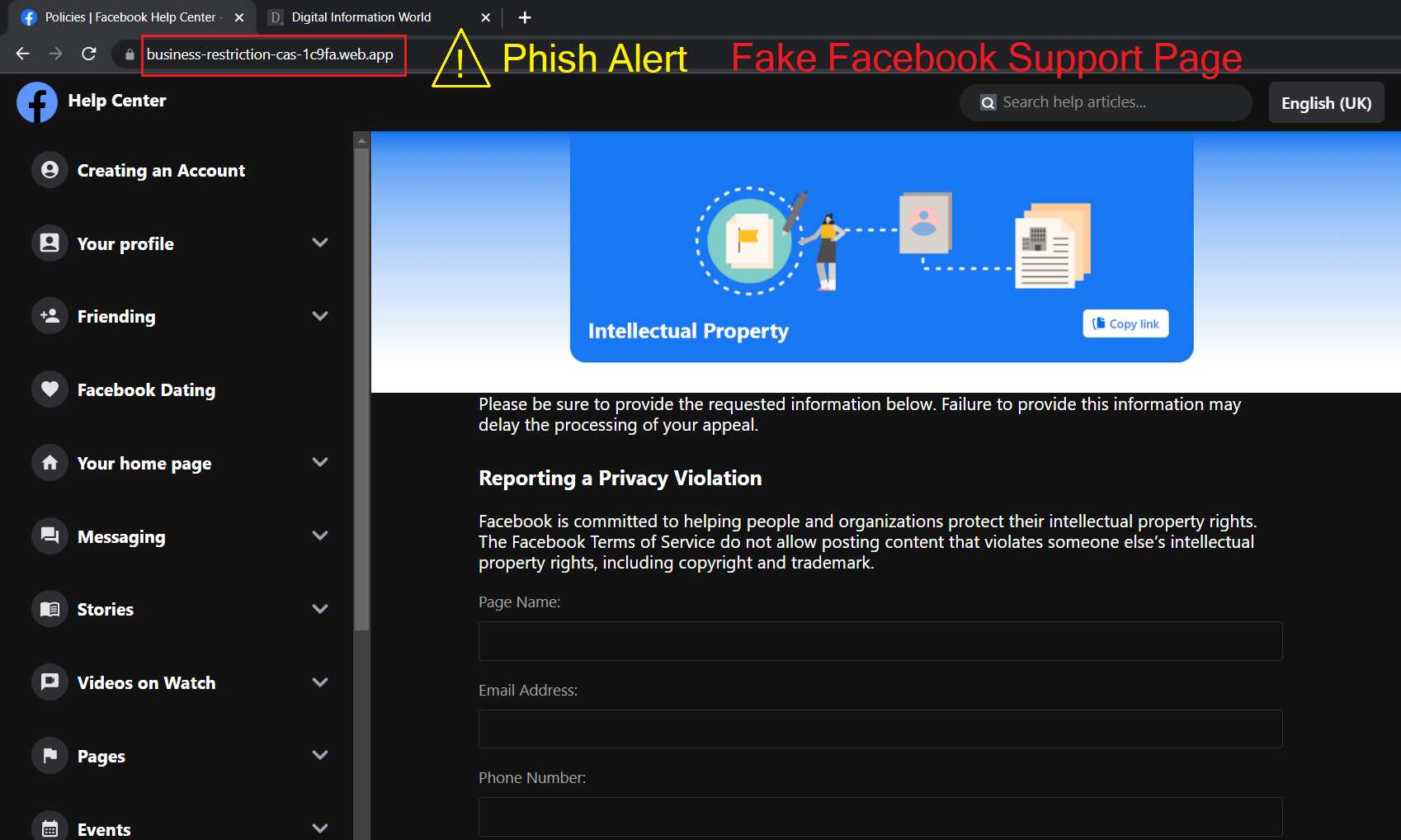
Researchers are ringing alarm bells against a phishing campaign that’s on the rise. It makes use of Facebook posts that becomes a part of the attack chain for tricking users. The campaign secretly makes users hand over sensitive details like account credentials and other personal information.
These emails are sent out to different targets and they pretend as if it’s copyright infringement matters on a particular recipient’s post on Facebook. They send out warnings about accounts getting deleted if the two-day time limit is crossed and no response is generated such as an appeal getting filed.
Many users have become victims of this scam because it does look so real. The links provided for appeals of the account deletion arise in the form of a real post from the Facebook app. This enables the malicious threat actors to bypass security enlisted for email solutions. Moreover, it ensures that phishing messages end up in the users’ target inbox.
The post on Facebook acts like it’s a Page Support and even uses logos from Facebook to make it appear as if the network manages it. But the post actually entails links for external phishing websites that are named after the likes of Meta which is Facebook’s parent firm. The whole idea is to make the scam campaign appear as real as possible so victims don’t realize the truth soon.
The news comes to us thanks to analysts at Trustwave. They were the first ones to highlight the campaign by following some URLs that are up on Facebook.
Each phishing website is carefully curated with immense care to have it appear as it is on Facebook’s real appeal page. There’s even a form where you can find victims requesting full names, email IDs, addresses, contact numbers, and usernames across Facebook.
After such data is submitted by a victim, the page manages to steal the IP address and location details. These are transferred to a new account on the Telegram app that’s under their complete control.
In some cases, you can see the threat actors collecting data like extra personal information that could bypass the likes of fingerprinting protection or any other added security measure while conducting a complete takeover.
And there are cases where a redirection would forward the victim to another similar phishing page that entails fake OTP password requests that are time-sensitive.
After adding the code, users would notice how an error sign arrives. Similarly, the experts have highlighted how the actors are resorting to Google Analytics across phishing pages to assist with tracking efficiency.
This happens to be a widespread technique that so many actors are using and TrustWave claims it has managed to locate several accounts on the Facebook app that use such phony posts. It appears in the form of support pages that push victims toward phishing sites.
During our separate research we found even more freshly created Facebook pages and posts, we reported them to Facebook, but unfortunately we don't have the bandwidth to report them all. But Facebook must have moderation tools and teams in place to curb this issue.
Sadly, Facebook and Meta, after being repeatedly informed about this matter, failed to come up with a strategy to proactively deal with bad actors on its platform. Phishing actors keep on improving their tactics to hack Facebook users but it appears the social media giant has not learned its lesson yet.
Being aware and steering clear is definitely the way to go here and save yourself from turning into a victim, experts claim.
Read next: These Countries Are the Most Dangerous for Journalists
by Dr. Hura Anwar via Digital Information World
These emails are sent out to different targets and they pretend as if it’s copyright infringement matters on a particular recipient’s post on Facebook. They send out warnings about accounts getting deleted if the two-day time limit is crossed and no response is generated such as an appeal getting filed.
Many users have become victims of this scam because it does look so real. The links provided for appeals of the account deletion arise in the form of a real post from the Facebook app. This enables the malicious threat actors to bypass security enlisted for email solutions. Moreover, it ensures that phishing messages end up in the users’ target inbox.
The post on Facebook acts like it’s a Page Support and even uses logos from Facebook to make it appear as if the network manages it. But the post actually entails links for external phishing websites that are named after the likes of Meta which is Facebook’s parent firm. The whole idea is to make the scam campaign appear as real as possible so victims don’t realize the truth soon.
The news comes to us thanks to analysts at Trustwave. They were the first ones to highlight the campaign by following some URLs that are up on Facebook.
Each phishing website is carefully curated with immense care to have it appear as it is on Facebook’s real appeal page. There’s even a form where you can find victims requesting full names, email IDs, addresses, contact numbers, and usernames across Facebook.
After such data is submitted by a victim, the page manages to steal the IP address and location details. These are transferred to a new account on the Telegram app that’s under their complete control.
In some cases, you can see the threat actors collecting data like extra personal information that could bypass the likes of fingerprinting protection or any other added security measure while conducting a complete takeover.
And there are cases where a redirection would forward the victim to another similar phishing page that entails fake OTP password requests that are time-sensitive.
After adding the code, users would notice how an error sign arrives. Similarly, the experts have highlighted how the actors are resorting to Google Analytics across phishing pages to assist with tracking efficiency.
This happens to be a widespread technique that so many actors are using and TrustWave claims it has managed to locate several accounts on the Facebook app that use such phony posts. It appears in the form of support pages that push victims toward phishing sites.
During our separate research we found even more freshly created Facebook pages and posts, we reported them to Facebook, but unfortunately we don't have the bandwidth to report them all. But Facebook must have moderation tools and teams in place to curb this issue.
Sadly, Facebook and Meta, after being repeatedly informed about this matter, failed to come up with a strategy to proactively deal with bad actors on its platform. Phishing actors keep on improving their tactics to hack Facebook users but it appears the social media giant has not learned its lesson yet.
Being aware and steering clear is definitely the way to go here and save yourself from turning into a victim, experts claim.
Read next: These Countries Are the Most Dangerous for Journalists
by Dr. Hura Anwar via Digital Information World
Subscribe to:
Comments (Atom)


