Sunday, March 26, 2023

Huge Numbers Of AI Chatbots Are Being Shipped To The Play Store And App Store At Exponential Rates

The way generative AI technology has taken over the tech world is a fact that cannot be denied.

In such a short span of time, we’ve seen AI head into the mainstream market and a lot of the credit has to be given to ChatGPT powered by OpenAI. But seeing it become so popular is now causing a political crisis.

When you look at things from the point of view of a developer or an entrepreneur, we see some very interesting points regarding ChatGPT. The tool has led so many other tech giants to come forward and present their own AI chatbot versions, making use of technology from OpenAI.

So many AI products are up for grabs in the tech world and they present little to no competitive advantage. Still, we feel the subject might be a great topic for case studies later on when the unbelievable AI chatbot hype starts to die down.

At the moment, we are seeing a large number of AI apps shipped to both the App Store as well as the Google Play Store. As per Explorer, around 398 different applications having the term chatbot included in them were observed since January of this year. And they’re making it big.

When compared to stats from 2022, we saw only 70 apps outlined as having the term chatbot as a part of them. And let’s not forget how 20 of those arose in December of last year. This happened to be due to the mega hype and popularity surrounding the ChatGPT tool so when you come to think of it, they don’t usually count for that year.

We agree that a lot of developers do end up reacting to trends at a fast pace but this is definitely way faster than what experts had imagined or seen in the past.

Developers are now sharing how interesting it is to see the impact platform can give in terms of building core functionalities but not exactly the end device. Look, OpenAI’s APIs can be credited to installing power to apps, features of products, and also platforms. It’s true that OpenAI would not be able to do all of that on its own and in such a short time with which we saw the launch take place.

This might be the great competitive advantage that OpenAI tends to have over rivals like Google which might be in panic mode at this moment in time with its own AI end product.

Analysis Shows Overwhelming Presence of AI Chatbots in App Store and Google Play Store

H/T: Appfigures

Read next: 7 Types of Artificial Intelligence (AI) You May Not Know About
by Dr. Hura Anwar via Digital Information World

Saturday, March 25, 2023

YouTube Might Be Letting Advertisers Plagiarize Creator Content

Content creators are often considered to be the backbone of YouTube, but in spite of the fact that this is the case they usually get dealt with pretty unfairly. The latest in a long line of controversies involves certain creators on YouTube claiming that their content was used by advertisers without them providing any form of consent.

Essentially, YouTube allows advertisers to repurpose creator content in their marketing campaigns. That will obviously lead to creators earning less than might have been the case otherwise. Such issues can be quite dangerous because of the fact that this is the sort of thing that could potentially end up leading to content creators getting taken advantage of, which can put further strain on the burgeoning industry.

With all of that having been said and now out of the way, it is important to note that YouTube’s ad tools may be to blame here. A creator by the name of Taki Udon, who has well over 219,000 subscribers on his channel, has pointed this out.

YouTube Might Be Letting Advertisers Promote Creator Content Without Consent

An electronics company by the name of Jsaux used his entire video in an ad, and they even gave it a brand new title with all things having been considered and taken into account. Udon’s video featured a product from the company, and Google’s Smart Shopping Campaigns tool allows advertisers to find videos that depict their products and use them at will.

Creators are understandably upset at what is going on. Every hour of content that they upload requires many weeks of effort, and companies should not be allowed to use this content without first and foremost obtaining consent. Influencers and creators also need to be paid for their work, although it does not seem like that will be an option in the near future.

According to ad agency Mekanism, this is not a new problem. Rather, it has been occurring for quite a long time. YouTube will need to fix this issue lest it results in a mass exodus of content creators which will invariably end up crippling the platform since users will no longer have anything worth staying for.

Read next: New Study Showcases How Payments For Influencers Have Altered With Time
by Zia Muhammad via Digital Information World

New Competitors Emerge in India's Short-Video Platform Scene After TikTok Ban, A Similar Trend Can Be Replicated In The US

India's restriction on TikTok in 2020 left a gap in the country's social media scene that has since been filled by domestic and international competitors. It was put in place after the government of India raised concerns over data privacy and security issues, citing the platform's Chinese rules.

While the move was observed as a significant blow to TikTok, it has opened the door for several participants in the industry to step in and fill the gap. According to recent data, the restriction has created a significant chance for remaining social media platforms to grow their consumer base and revenue.

It had over four hundred million installs in this country before the shutdown, proving it a social media force there. In contrast, TikTok only recently hit the same number of installs in the US over the same time frame.

One of the heftiest advantages of the TikTok ban has been observed by the Indian platform, Chingari. Came in 2018, it allows consumers to make, and share videos and clips from films, like the shorter content giant. Since the termination, the platform has experienced a massive increase in popularity among the local audience. The local breed was able to capitalize on the termination by offering a homegrown alternative to TikTok, which has resonated well with local consumers.
Other local platforms, such as Roposo and Mitron, have also gained popularity in the wake of TikTok's prohibition. Roposo, a comprised-video platform started eight years back, has observed a rush in installations. Similarly, Mitron, which came into existence at the time of COVID, has also gained much popularity.

What India's Ban Of TikTok Could Tell Us About The U.S. Social Media Market

What India's Ban Of TikTok Could Tell Us About The U.S. Social Media Market


New Competitors Emerge in India's Short-Video Platform Scene After TikTok Restriction

A study also demonstrates that in India, time spent on the top twenty-five live-streaming applications in 2021 significantly surpassed time spent on the whole social market. Usage of live streaming applications increased dramatically year over year by forty percent compared to just five percent for all social apps. This shows that live-streaming applications tend to be a key component of the social media landscape.

In addition to domestic players, international competitors such as Instagram, FB, and YT have also seen a climb in usage in India since TikTok's restriction. Reels updated by Instagram, which permits consumers to make precise videos, have become a popular alternative to TikTok, observing millions and millions of downloads locally.

YouTube, the world's largest video-sharing platform, has also seen an increase in usage in the country since TikTok's restriction. They have introduced a new feature called Shorts, which permits customers to make precise tapes. It has already gained significant popularity in India, with billions of daily reach in January 2021.

Another advantage of YT Shorts is its vast existing consumer base and infrastructure, which provides a solid foundation for its short-form video platform. Additionally, they permit users to easily repurpose existing YouTube videos into short-form content, giving creators more opportunities to showcase their content and reach a wider audience.

Looking at the recent TikTok turmoil in the US, Adam Blacker from Apptopia commented that, "I assume a ban (in the united states) would be a huge lift for Instagram". And if US is going follow the India's foot print, then chances are same social media trend will repeat in the country as well.

Read next: New Report Exposes Alarming Security Risks in Popular Mobile Applications


by Arooj Ahmed via Digital Information World

What Can Previous Bubbles Tell Us About the State of Today’s Tech Industry?

Tech companies are often seen by investors to be a rather safe bet, but in spite of the fact that this is the case, they are prone to some serious boom and bust cycles with all things having been considered and taken into account. While the tech industry overall has seen profits explode over the years, with share prices increasing several times over, too much focus on the positives can make people forget about the negatives.

The aftermath of the pandemic has led many to start claiming that the dam has burst and that the tech bubble has now collapsed. Amidst plummeting stock prices for most major tech corporations, wary investors have begun to scrutinize the flaws in how tech companies operate than might have been the case otherwise.

With all of that having been said and now out of the way, it is important to note that this is not the first time that the tech company has experienced such a tremendous crash. Taking a look at how previous boom and bust cycles play out can tell us a lot about how things might turn out in the present day.

The origins of the tech industry stretch all the way back to the 1960s, which was when computing started to be seen as something that regular people could take advantage of. Companies such as Hewlett-Packard, Intel as well as IBM became favorites on Wall Street, with their stock prices continuously rising to ever dizzying heights.

Things look set for greatness in the 1960s, but economic turmoil during the 1970s killed a lot of up and comers in Silicon Valley. It seemed like the tech industry was going to turn out to be a blip on the radar, but then the 1980s came and brought the PC revolution along with it.

The next couple of decades saw tech looking absolutely unstoppable with all things having been considered and taken into account. The PC revolution gave way to the rise of the internet, and countless companies started popping up that began to take advantage of the internet in numerous ways.

However, much like what had happened previously, all of this growth ended up being unsustainable. In the year 2000, the tech industry faced one of the biggest crashes in record history, with the Nasdaq falling by a whopping 39%.

Very few companies managed to survive, and tech billionaires saw their fortunes plummeting. Despite all of this, major players such as Google, Microsoft and Amazon managed to not just survive, but actually thrive in the new environment.

The Dot Com Bubble was caused by speculative investing, and when the bets didn’t pay off, people started to pull their money out. The post Dot Com Bubble recovery was marred by the 2008 recession, but the 2010s ended up being one of the best decades for tech of all time.

We are living in an era of economic turmoil, and tens of thousands of tech workers have been laid off as major corporations try to make ends meet. With ethical questions arising from every corner and business practices being questioned, this turmoil will only serve to strengthen the tech sector further although there is no telling how long a recovery might take.


Read next: LinkedIn's New Report Highlights The Current Trends In Recruiting
by Zia Muhammad via Digital Information World

What Are the Most Frequently Searched Terms on Google?

No matter what you are trying to go onto the internet for, Google will most likely be the place where you start your search. The search engine has done a great job of centering itself as the front page of the internet, and a list of most commonly searched terms can highlight what people are usually looking for when they use the search engine.

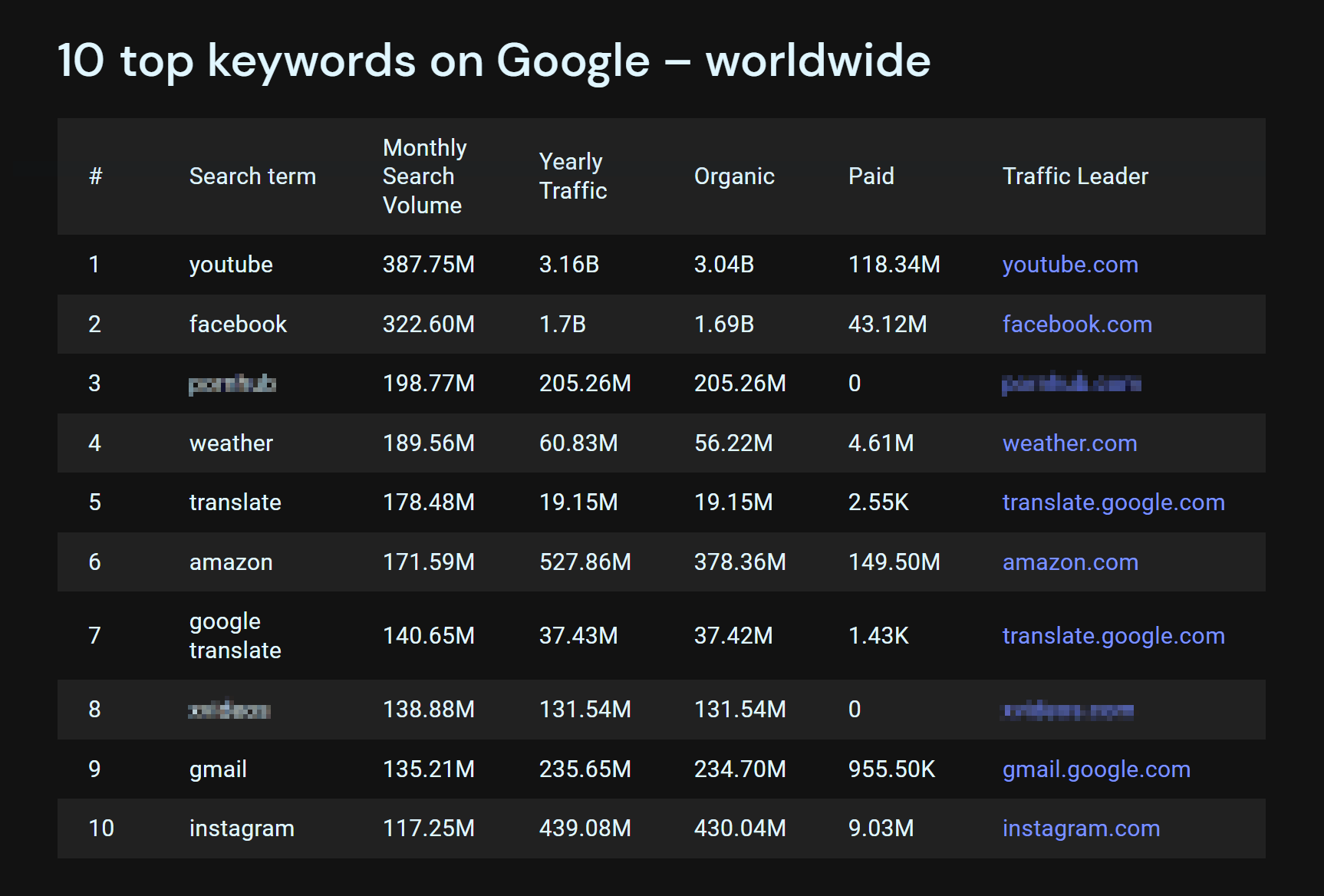
With all of that having been said and now out of the way, it is important to note that the most search term on Google current appears to be YouTube. That is quite interesting, since YouTube is one of Google’s most profitable and successful properties. With a monthly search volume of around 387 million and yearly traffic of about 3.16 billion, it’s not surprising that YouTube is the single most popular term in all of Google.

Moving on, Facebook comes in at a distant second with the search engine platform being used as a search term around 1.7 billion times over the course of the year. That is a lot lower than YouTube, but it is still miles ahead of the search term that came in third.

Perhaps unsurprisingly, the third most frequently used search term on Google with all things having been considered and taken into account turned out to be popular adult site. With a monthly search volume of 198 million and annual traffic of 205 million.

In spite of the fact that this is the case, most of the other search terms on this list were relatively mundane. Coming in fourth place was the term “weather” because of the fact that this is the sort of thing that could potentially end up allowing people to get an update regarding weather conditions in their surrounding area. This term had a monthly search volume of just under 190 million, which makes it quite close to adult site in that regard.

The term “translate” came in at fifth place. This is yet another example of a search term that keeps users within Google’s ecosystem, since Google has a translation engine that allows people to communicate more easily than might have been the case otherwise. Other translation services exist, but most users tend to just use the built in option that Google has on offer.

Indeed, Google Translate is so popular that it managed to become the seventh most popular search term in and of itself! However, it was beaten out for sixth place by none other than Amazon, with the ecommerce giant’s brand name generating an impressive 171.59 million search volume.

Another Adult site came in at 8th place, with a monthly search volume of around 140.65 million. Following that, we had another Google property in 9th place, namely Gmail.

It’s easy to see just how powerful Google has become, since three of the top ten search terms involve companies and properties that Google itself is the sole owner of. From YouTube to Google Translate, and of course Gmail, Google has clearly provided a number of useful opportunities for users to incorporate into their daily workflow and lifestyle.

Rounding off the top ten list of most searched terms on Google is Instagram, with the Meta owned social media platform generating a monthly search volume of 117.25 million or so. Meta appears to be the only company that is able to compete with Google on its home turf. Some are wondering what the implications for this are in the long term, although only time will tell what things look like in the end.


H/T: SimilarWeb

Read next: New Poll Proves People Are Very Worried That Their Smartphones Have Ears
by Zia Muhammad via Digital Information World

California’s Education Board Sues Meta For Gross Negligence And Getting Kids Addicted To Social Media

San Mateo County’s Education Board in California is holding tech giants like Meta responsible for making young kids addicted to social media.

The company was accused of gross negligence in terms of its Facebook and Instagram apps as the lawsuit alleged they did nothing to try and curb the problem that keeps on growing each day.

The board also alleged that tech firms other than Meta including Snap, Google, and TikTok were equally responsible for damaging young kids' minds with so much exposure through social media and keeping no checks and balances on the matter.

This lawsuit was filed a few months back and had a very lengthy description as the board feels Meta’s apps served as nuisances to the general public and they continue to engage in ordeals like racketeering simply because they’re dominant and can do so.

This board went on to mention how there are so many more resources that must be allocated to children by the board to try and reverse the damage that has already been done. And that’s because the effects of too much screen time are beyond negative and linked to mental issues.

So since more resources are being allocated for this purpose and to reverse the matter, sources explained how they’re now forced to make the most of smaller budgets for other crucial goals like teaching and learning.

This lawsuit points to the growing rates of youngsters embarking on self-harm as well and also emphasized how such cases were rarely seen before the advancement of social media in today’s day and age.

The end goal today seems to make younger audiences engaged on how to stay glued to platforms for a long time. And that’s because it gives businesses a greater chance to target them for advertising purposes.

So many firms have learned that things like this are better accomplished through catering toxic content that gets viral easily and they’re allowed to do that because they simply can get away without anyone holding them accountable for the deed.

As of right now, Meta has failed to comment on the matter but in a lawsuit filed in the past, they did reveal how more than 30 tools were up for grabs that enable parents to have more control over their children’s accounts.

They also advocated how necessary it was for parental supervision to take place while kids make use of social media apps in today’s time.

Photo: Bloomberg

Read next: TikTok Has Forced Its Competitors To Adopt A Less Lucrative Business Model
by Dr. Hura Anwar via Digital Information World

In 2023, it will be more difficult for marketers to balance data usage and privacy

As data gathering and privacy become more complex in 2023, brands need help finding the right balance.

According to Gartner Inc., this year will present even greater data collection and privacy challenges, two of the most crucial topics in the marketing sector today. According to a Gartner report, 60% of marketers anticipate that obtaining first-party data in 2023 will be more challenging due to balancing value and privacy.

The fact that 85% of organizations have already implemented formal procedures for managing client data raises concerns for many. Around a third have dropped an agency or channel partner over the past year to assure reliability and privacy. Despite these safeguards, only 42% of businesses can send personalized communications to their clients.

However, those who prioritize first-party data are seeing great returns. Over 50% said they exceeded their customer retention expectations. The year 2023 will mark the turning point for businesses as they focus on gathering and analyzing first-party data while protecting customer privacy. Businesses should devise plans to guarantee that they can deliver personalized experiences using correct data without jeopardizing the security and confidence of their clients.

78% of brands allow customers to manage their information to assist them in maintaining customer data management. Businesses can ensure a safe user experience while delivering tailored offers and experiences that increase loyalty by letting customers control how their data is used.

Gathering meaningful customer data while protecting consumer privacy is becoming increasingly complex, but it's essential for success in today's digital world. Companies must take steps now to balance both aspects effectively to remain competitive in 2023 and beyond.

Marketers have noticed major changes in their data sources over the past year due to the decline of third-party cookies. To make up for this loss of external data, nearly half of firms with 11 or more marketing channels actively increased their gathering and use of first-party data, a startling increase from just over one quarter among those using ten or fewer channels.

Gartner's further study finds that 36% of companies are already succeeding with new experiences and service channels, while another 24% find more potential for consumer interaction by deploying AI techniques. These findings, drawn from the research of 400 senior marketing professionals performed between November 2022 and December 2021, demonstrate that companies that can effectively navigate these seismic upheavals will have a competitive advantage in future years.

Businesses must now transition to the digital age; they no longer have a choice. Companies are leveraging technological advancements to offer more personalized customer experiences and more intuitive and efficient services. AI-driven solutions are becoming increasingly popular, as they can automate mundane tasks and provide effective customer interactions that build trust.


Read next: Top Influencer Marketing Stats For 2023 Unraveled
by Arooj Ahmed via Digital Information World