Saturday, November 25, 2023

Navigating the New Normal — 73% of Freelancers Integrating AI into Their Workflows

Freelancers are quickly adapting, not just surviving in the dynamic gig economy. Freelancer.com's recent survey sheds light on this very adaptability. It's not just about finding gigs anymore; it's about how artificial intelligence (AI) is becoming a staple in their toolkit.

Of the 8,100 freelancers surveyed globally, a striking 73% are integrating generative AI into their workflow. But it's not all-in for everyone. Around 31% are occasional explorer, tapping into AI when needed, while 21% are all in, relying on AI consistently. A small group, about 14%, haven't boarded the AI train yet.

The tools of choice? ChatGPT leads the pack. It's the go-to for 64% of freelancers worldwide. Following are Google's Bard and Microsoft's Bing Chat, Github Copilot, and visual AI tools like Midjourney, Stable Diffusion, and Dall-E. This diverse toolkit reflects a broader trend: freelancers are not just writers or illustrators anymore. They're stepping up as editors, directors – roles that demand a broader vision.

Matt Barrie, CEO of Freelancer.com, isn't surprised. He sees freelancers as trendsetters, using AI to reshape their roles and workflows. His vision? A near future where AI integration is the norm, not the exception, in every business and job.

But what about automation? How much of freelance work is AI-driven? The survey shows over a third of freelancers use AI to handle 1-25% of their tasks. The next tiers – 25-50% and 50-75% – both sit at 16%. A small but notable 9% are automating 90-100% of their work with AI.
Underneath these numbers lies a mix of excitement and apprehension. Less than half (48%) express strong concerns about AI replacing them. The rest are either somewhat concerned or not worried at all. Looking forward, freelancers are optimistic. About 28% see new opportunities emerging, 20% expect boosted productivity, and 19% foresee improved accuracy in their work.

Unmasking the Gig Economy: How Freelancers Are Revolutionizing Work with AI

Behind the Scenes: The Surprising Ways AI is Transforming Freelance Work

The recent survey by Freelancer.com reveals interesting regional variations in the adoption and perception of AI tools among freelancers. In the United States, a notable 75% of freelancers are incorporating AI into their work, a slightly higher rate compared to the 71% observed in Europe. When it comes to how frequently these tools are used, the contrast becomes more evident: In the U.S., a third of freelancers (33%) use AI tools all the time, while in Europe, the proportion is significantly lower, with only 17% using AI consistently in their work.

The preference for specific AI tools also varies by region. In the Asia-Pacific region, an overwhelming 82% of freelancers rely on ChatGPT, compared to 77% in Latin America, indicating a strong but slightly varied preference for this tool. Perhaps the most striking regional difference emerges in attitudes towards the potential of AI to replace jobs. In the United States, a high 58% of freelancers express significant concern about AI taking over their jobs. In contrast, European freelancers appear less apprehensive, with less than a third (29%) expressing a high level of concern. These statistics not only underscore the growing influence of AI in the freelance world but also highlight how its impact and reception can differ greatly depending on the region.

This survey is more than mere numbers; it's a glimpse into an evolving world where freelancers wield AI as skillfully as artists use pens or paintbrushes. They're not just surfing the crest of change; they're guiding it, sculpting their careers and the essence of freelancing itself.

Read next: Bill Gates' Forecast for a New Work Paradigm
by Irfan Ahmad via Digital Information World

Friday, November 24, 2023

Bill Gates' Forecast for a New Work Paradigm

Let's have a real talk about the future of our workweek. Imagine only clocking in for three days. Sounds like a daydream, doesn’t it? But guess what? Bill Gates, yes, the tech mogul himself, sees this as our possible future. He spilled these thoughts on Trevor Noah's podcast, "What Now?". The big question they chewed over: will artificial intelligence (AI) snatch our jobs? Gates has a different spin. He sees a time where artificial intelligence (AI) could lighten our workload. Three days of work a week? That's not so outlandish, he suggests.

Think about it. Machines doing the grunt work isn't about stealing our roles. It's more like handing us the gift of time. Time to live more, work less. Gates isn't talking about a lazy future, but a balanced one. A world where our lives don't revolve solely around work.

Here's what Gates said in his own words:
"If you zoom out, you know the purpose of life is not just to do jobs, so if you eventually get a society where you only have to work three days a week or something, that's probably okay if the machines can make all the food and the stuff, and we don't have to work as hard. There are displacements, and if they come slow enough, they're generational. You could have had a grandfather who thought the only real job was being on a farm, and then a father who did some farm work and some other work, and now this generation, only 2% of Americans are involved in farming in any way. And that's okay, even though Grandpa would think, 'Oh, that's awful, you're not getting your hands dirty.' So if it proceeds at a reasonable pace and the government helps those people who have to learn new things, then it's all good. It's, you know, the aging society, it's okay because the software makes things more productive. But eventually, you know, if you free up human labor, you can help elder people better, have small class sizes. The demand for labor to do good things is still there if you match the skills to it. And then, if you ever get beyond that, okay, you have a lot of leisure time, and we'll have to figure out what to do with it."

But hold on, it's not all rosy. Gates, wise as he is, warns about AI's pitfalls. He's not shy about it either. In a recent blog post, he mulls over AI's impact. He likens it to the dawn of personal computers. They didn't kill office jobs; they reinvented them. It's all about adapting, shifting with the times.

And guess what? Gates isn't the only big shot talking about this. Jamie Dimon from JPMorgan is on the same page. He's betting on a 3.5-day work week for future generations, all thanks to AI.

Here's a fun fact: Gates, who once saw sleep as a waste of time, is now singing a different tune. He's gone from a Microsoft-obsessed workaholic to someone who sees life as more than just a job. That's quite a turnaround, isn't it?

What's really cool is companies are already testing these waters. They're trying out four-day workweeks. And guess what they're finding? Happier, more efficient teams. It's like we're starting to live in the future Gates is talking about.

So, what's the real deal here? It's not about fearing the rise of machines. It's about embracing a new way of life. A life where we work to live, not live to work. This three-day workweek idea? It could be just the change we need. A breath of fresh air, a chance to balance our scales of life and work. Who knows, it might be closer than we think.

AI's potential to shorten work weeks and transform lifestyles, as foreseen by Gates
Photo: Bill Gates / YT

Read next: The Unstoppable Surge of Cyber Week Online Shopping
by Irfan Ahmad via Digital Information World

The Most Popular Working Destination For Ex-Apple Employees Is Google, New LinkedIn Analysis Reveals

Have you ever wondered where former employees working at Apple end up after leaving the company? Well, thanks to a new survey analysis, it’s Google that’s been named as their next top spot for employment.

And it’s not surprising to see that the opposite stands true as well. So that means Google employees are just as likely to end up at Apple! But it was interesting to see how the results displayed that most people working at the Cupertino firm arose from the likes of Microsoft, Intel, as well as Amazon.

The analysis conducted by Switch on Business mentioned how they got the findings after exploring all kinds of profiles of employees through the LinkedIn app. This was done after narrowing down selected tech firms to enroll in their research.

For starters, the workforce figures were noted at top tech giants like Nvidia, Amazon, Google, IBM, Netflix, Apple, Salesforce, Uber, Tesla, Meta, Adobe, Microsoft, and Oracle.

After that, researchers looked for workers currently employed in each of the companies listed above as well as those who worked for the organizations enlisted.

Soon, it was calculated to see the figure as well as the percentage of currently enrolled workers at every company that worked at the other big-shot firms. This provided a complete breakdown of the common links among the various companies.

As far as Apple is concerned, the study showed how most workers were previously working at Intel, Google, Nvidia, Amazon, IBM, Microsoft, Oracle, Meta, Tesla, and Adobe.

Intel is leading the pack in terms of the majority of workers hired by Apple. And it makes sense considering how the iPhone maker spent billions to purchase the firm’s smartphone business in 2019 with hopes of creating its solo radio chips.

All of those individuals who happen to be bidding farewell to tech giant Apple were nearly twice as likely to head in Google’s direction while Amazon stood second on the list in terms of popularity. This was followed up by Facebook’s parent firm Meta, software giant Microsoft, and Elon Musk’s Tesla who rounded up the top five workplace destinations.

Nvidia, Salesforce, Adobe, and Intel, followed up closely behind with Oracle closing up the top ten most popular employment places list for Apple employees.

Is there a distinct overlap that cannot be missed? Absolutely, and we’re not surprised one bit! But what was a little astonishing is that the total percentage of workers in Apple that were recruited from other leading tech giants stood at just 5.7%. And when you end up comparing those results to that seen with Meta, Google, and Salesforce, the difference is major. The corresponding percentages in order are as follows: 26%, 25%, and 20.7%. That’s nearly four to five times greater than what Apple prefers.

Hence, it’s obvious that when you’re working for a large-scale organization that’s stable, as a job seeker, you’re bound to move to another similarly scaled firm with stability to avoid the risks and associated stress that may come along the way.

Take a look at the infographics below for more insights on which technology companies (including Meta, Google, Microsoft, Apple, Amazon and more) attract the most talent from competitors.
Read next: Black Friday's Global Spread and the Evolution of Consumer Habits
by Dr. Hura Anwar via Digital Information World

Google Maps’ New Look Gets Harsh Criticism From GPS Users Including Its Former Designer

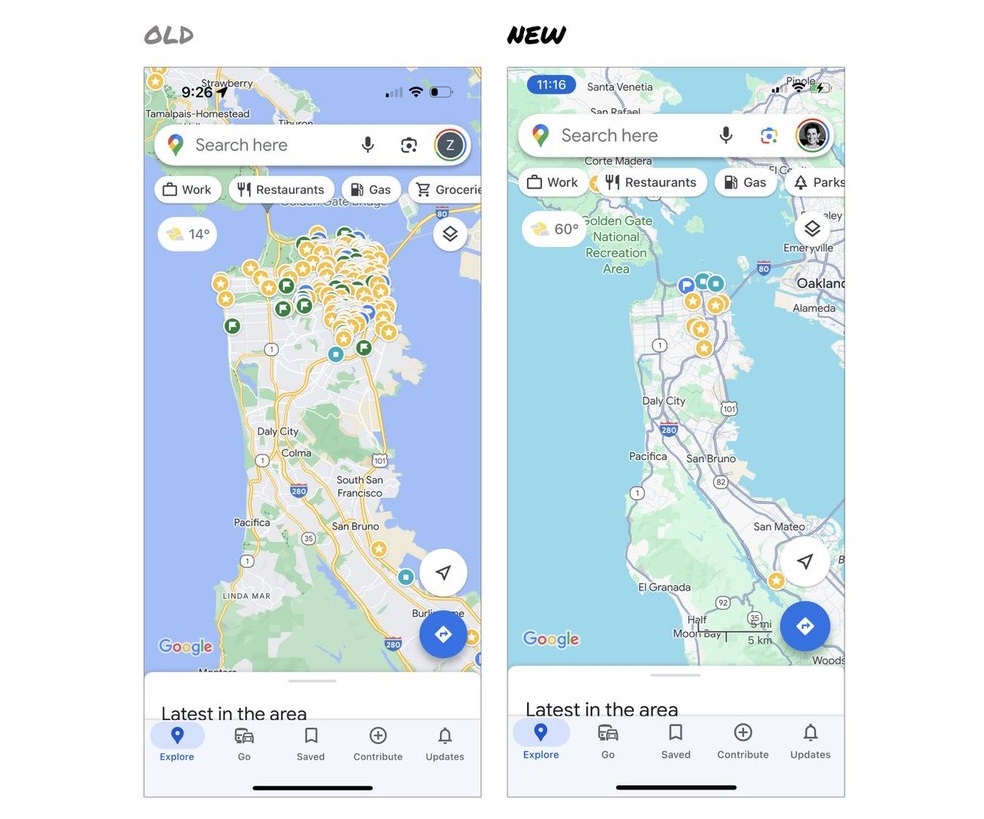
In case you didn’t know, Google Maps has been revamped but not everyone is loving the new design.

This includes GPS users and the platform’s former designer who refuses to understand why a change was made in the first place when the old one was so much better. Hence, many people did not hesitate one bit to express their criticism on the matter and how irritated they were with the latest design.

The company announced the news through its blog post last week where they happened to share details regarding the change that was coming soon. Google also spoke about a few updates that would be included for both iPhone and Android users in the next few weeks.

This included detailed directions regarding public transit as well as address details for places where users can have their electric vehicles charged. With that came the news about an innovative feature that gave your close contacts the chance to share popular destinations amongst other things.

While the rest may be loved and appreciated, not everyone sees eye to eye with the fact that there’s a color upgrade on Maps and the latest color scheme has people talking for not some great reasons.

The latest facelift has new coding for roads that are gray while the hue for water has gone from a darker shade of blue to a lighter one that represents the clearest of skies. Other features included parks and public spots being represented in the shade green.

Elizabeth Laraki says she takes great pride in the app’s design and aesthetics that arose 15 years back. And it’s safe to say that she’s disappointed with the latest outcome that the company has made in the name of a revamp. She continues to make use of it on a daily basis and calls it a feature that’s very close to her heart.

But she is not loving it right now, referring to the change as one that’s unrelatable, less human, and lacking the warmth that it was once famous for. She similarly deemed it less useful as it lost that touch of accuracy that was visible in the past.

Image: Elizabeth Laraki / X

Laraki was joined by another partner to help design Google Maps in 2007 and her reviews through her social media account on X speak volumes of her dismay. She failed to understand the logic behind some of the drastic conditions.

Seeing hues blend together and the color palette appearing like it was made by a machine instead of humans was just the start of her rant. But in case you’re wondering, she’s not the only one who was left less than impressed.

The reviews from other top users similarly echoed her thoughts and critique regarding the latest color scheme as many kept scratching their heads as to why Google would roll out an unappealing design despite the old one being loved.

Other people directly asked Google to respond to their queries after tagging it on the X thread which soon went viral. And it was disheartening to see how the change was trashed soon after the launch. Moreover, others were just shocked at how they could no longer relate or recognize it after the updates.

Another fan went on about their dismay and how they literally failed to recognize it after the latest change. Thankfully, some were optimistic and did fairly review the update. They did not slam all of the changes regarding the design.

Features they loved included seeing roads, trails, and even areas with congested traffic standing out better than before with the new colors. And then some praised the company for making the effort to try and make it simpler to use. What about you?

Read next: The Unstoppable Surge of Cyber Week Online Shopping
by Dr. Hura Anwar via Digital Information World

Thursday, November 23, 2023

Black Friday's Global Spread and the Evolution of Consumer Habits

Ah, Black Friday, you've probably heard of it, no? It's this big shopping day right after Thanksgiving in the USA. But guess what? It wasn't always as famous as it is now. Back in the 1980s, that's when people really started talking about it. And you know who came up with the name? The police! They used it to talk about all the traffic mess that happened when everyone rushed to start their Christmas shopping.

Let me tell you, since the 2000s, Black Friday has been like the king of shopping days. Stores got really clever. They started giving special discounts and opened their doors super early. It's like a big shopping party!

But here's something interesting. While Black Friday was a big thing for stores in the USA, the rise of online shopping has made it famous all over the world. People from different countries started looking for Black Friday deals online more and more every year. That is, until the pandemic showed up. In November 2020, not as many people were searching for Black Friday on Google. It dropped more than 30% from 2019. And in 2021 and 2022, it went down even more.

The Waning Popularity of Black Friday Since Its 2018 High

So, what's happening in 2023? Early data says the trend is still going down. But does this mean people are less interested in Black Friday deals? Or maybe the deals are so common now that people don't need to search for them as much? Interestingly, even though fewer people are searching, they're actually spending more online during Black Friday and Cyber Monday, especially in the USA. Adobe Analytics says 2022 was a record-breaking year for online sales, and they think 2023 will be even bigger.

So, it looks like Black Friday still has its magic. People might not be searching for it as much, but they sure are ready to shop and grab those deals!

Building on our Black Friday story, let's not forget the wise approach to this shopping extravaganza. For buyers, it's crucial to be savvy and not get swept away in the online frenzy. Start by making a list of what you truly need versus what's just a passing fancy. Compare prices across different websites to ensure you're getting the best deal. Remember, it's not just about finding discounts but about making purchases that add real value to your life. Look out for early deals too, as many retailers start their sales in advance. And importantly, set a budget to avoid overspending. This way, you're not just partaking in the thrill of Black Friday but making smart, thoughtful choices that benefit you long after the excitement of the day has faded. Remember, the true magic of Black Friday lies in being a smart shopper, not just a shopper!

Read next: Cyber Attacks Are Getting Common in USA and Consumers Are Trying to Avoid Getting Scammed
by Irfan Ahmad via Digital Information World

The Unstoppable Surge of Cyber Week Online Shopping

Cyber Week 2023 is here, and guess what? It's set to break records. You might think the spread-out Black Friday and Cyber Monday deals lessen the impact. But no, shoppers are still keen. Adobe Analytics says Cyber Monday will lead with $12 billion in sales, a 6.1% increase from last year. Black Friday is close behind, eyeing a 5.7% rise to $9.6 billion. Even Thanksgiving Day sales are climbing up, expected to be 5.5% higher at $5.6 billion.

Now, the big picture – Cyber Week. It's not just a few days; it's a phenomenon. Adobe's betting on $37.2 billion in sales during these five days. That's a hefty 16.8% of the whole holiday season's online sales, projected to be $221.8 billion from November to December.

Here's the interesting part. Despite a shaky economy and rising interest rates, e-commerce is thriving. Patrick Brown from Adobe highlights this. The reason? It's the discounts, bigger than ever, and those flexible payment options.

But there's more. Deals are everywhere, all year. Does it make Cyber Week less special? Adobe doesn't think so. These days are landmarks, they say. The challenge for retailers is real, though. They need to make their deals count, offer true savings, not just cut prices from inflated ones. That's how they'll keep us hooked and preserve the essence of Cyber Week.


Black Friday and holiday shopping are famous for big discounts. But are these deals really the best? Recent research, especially from Which? in the UK, questions this. Adobe's data in the US shows some good discounts are coming, especially close to Black Friday and Cyber Monday. Electronics, toys, and apparel are getting cheaper, with discounts expected to be 25-35% higher than last year. But the discounts' patterns vary by category.


A Wallethub study also found that many Amazon products are cheaper during Black Friday than the weeks before. But this doesn't answer if these are the best yearly deals. The UK study discovered that only a tiny portion of Black Friday deals were actually the lowest yearly prices. Retailers say they don't always offer the lowest prices on Black Friday, as better deals can happen at other times.

NPR notes that Black Friday makes finding deals easier, even if they're not the year's lowest. Shoppers can use online tools to check if they're getting a good deal. So, the big question remains: Are holiday discounts really the best of the year? The answer is mixed.

Read next: Cyber Attacks Are Getting Common in USA and Consumers Are Trying to Avoid Getting Scammed
by Irfan Ahmad via Digital Information World

Handful of Companies Hold Sway Over AI's Future Concerning Tech Experts

Top tech executives feel the time has arrived to speak in detail regarding the dominating role of a limited number of firms having too much power over AI development.

Seeing just a handful of companies having this degree of power is baffling and that’s why leading experts in the tech sector feel the time has come to speak on the concerning issue as popular technology starts to evolve with time.

There has been a massive interest in terms of AI since the end of last year and that’s all thanks to the unique manner in which the chatbot can make use of prompts from users to generate replies to any commands being thrown in their direction.

The popularity in this regard has led to the beginning of what so many individuals in the world of tech have deemed to be a massive arms race related to AI. Remember, tech giants like Microsoft as well as Google are trying to do everything to seek and launch their respective AI models. This would need a lot of computing power as they happen to be trained using large figures of data.

For the time being, tech executives feel there just are not enough companies that have the right materials required to produce these big models and allow them to function correctly. Moreover, there’s a stark need to realize that too much power is never good as the chances of it being abused are higher than ever.

There’s just so much concern about the limited number of corporations functioning at this moment in time. They are driven by the likes of profit and end up making some very bad decisions in the end.

As it is, we’ve seen many concerns arise in the past regarding Google and how it was really growing concerned about the potential of AI at the company and how it could be misused for the likes of drone warfare. The news arose when speculations about Google entering into a contract alongside the popular Defense Department arose.

Today, AI is being looked at as a leading technology that is solely restricted by those handling it and these big names have immense power in the corporate world and massive control too.

This is more or less built on resources that a few big tech giants possess which are mostly based in countries like China and the US. They’re doing well in terms of having a massive surveillance ad business model.

This is what provided them with massive computational infrastructure and the right to pull out data from big markets. They can even process the data in the best of ways to develop some great technologies in the view of concerned executives and they’re not wrong or alone in this.

One of the previous owners of the popular LA Dodgers team who happens to run the famous Project Liberty added how the goal is to develop more responsible techniques for developing such technology.

Many experts hold the popular opinion that today, there are just five companies that have all of this data with them and they’re so dominating. And while those were not named, it’s a little bit obvious as to what’s going on here.

Remember, the biggest language models of today have huge figures of data with them and if the right kind of changes are not made right now, it’s literally like you’re saying hello to the game over as there’s no chance of others entering the race.

The rest will all be designated as beneficiaries. Yes, many will come and create small things through these big tech platforms but the main issue has to do with controlling data. Moreover, there are a lot of people who hold a strong opinion about data being in the hands of the big shots who will always be called the winners at the end of the race.

Other executives feel society is being damaged by these big tech firms and AI won’t be making things any better.

Jimmy Wales who founded Wikipedia and Tim Berners who invented the web also were a part of the list of people having serious concerns about AI disrupting space with social media already being a concerning debate.

Image: DIW - AIgen

Read next: AI Still Not As Smart As Humans According to This Expert
by Dr. Hura Anwar via Digital Information World