Tuesday, August 20, 2024

Starlink vs. Fiber: Satellite Internet Emerges as Rural Favorite

According to a survey by Recon Analytics, Starlink customers are more satisfied with internet services than fiber network users. The founder of Recon Analytics, Roger Entner, says that their organization has been tracking Starlink for 2 years and now it has over 1.4 million subscribers in the USA. SpaceX's internet service, Starlink, has started making an impact now, with many users highly recommending its services.

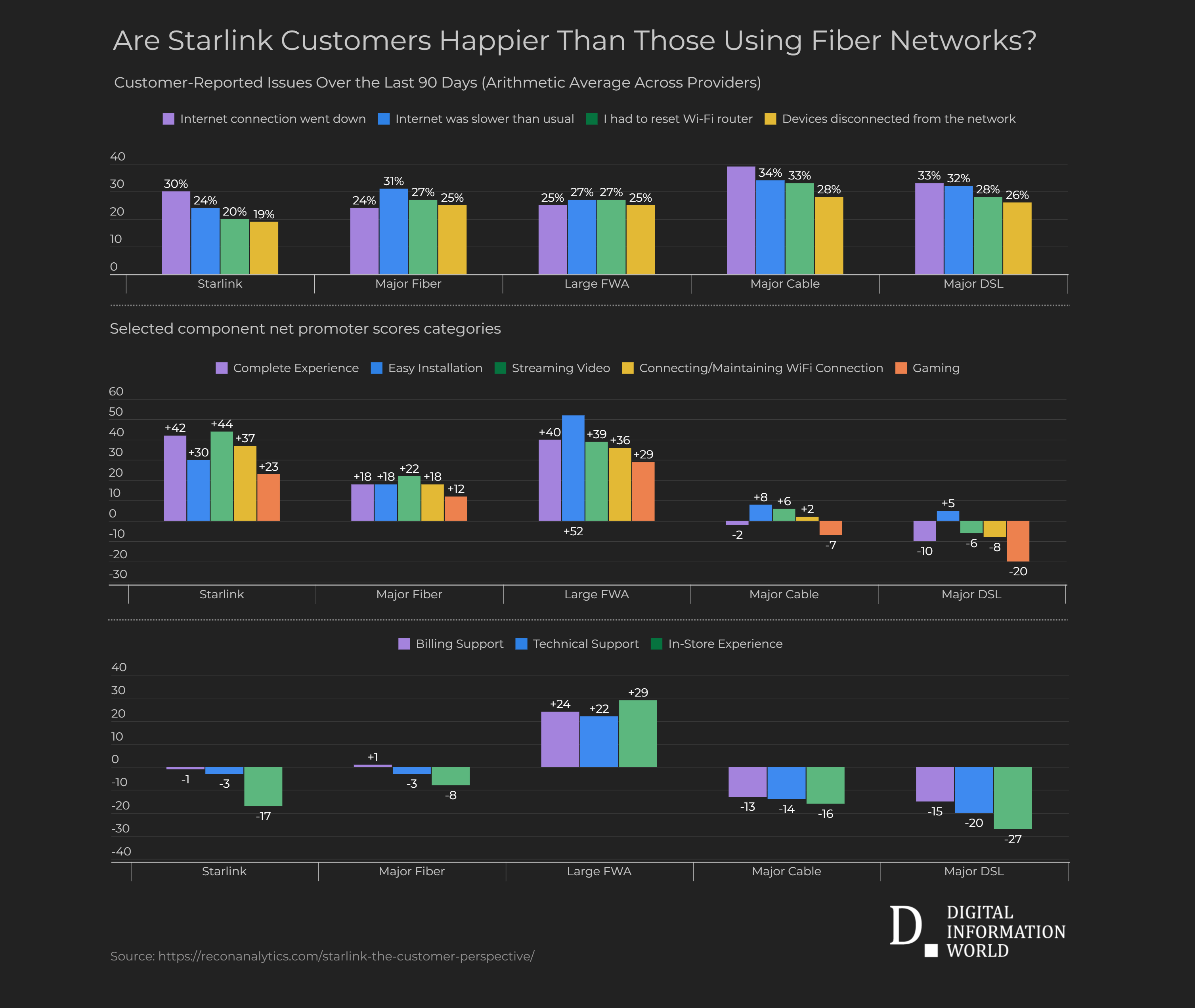
Users of Starlink have given +42 points to the complete Starlink experience, the highest score among many big wireless services like cable, 5G and DSL. It also has highest scores in video streaming (+44) and maintaining Wifi connection (+37). The survey also found out that 85% of Starlink users live in rural areas in the USA and now the residents of these places are enjoying satellite internet service. Only 15% of Starlink users are from urban or suburban areas.

Most of the Starlink users are from areas where there were limited broadband services or no access to internet services at all. 11% of the Starlink users said that they have never subscribed to any internet service before, while some users said that they only used broadband services through small ISPs. This shows that most users didn't have any alternate option before subscribing to Starlink.

Even though Starlink received a lot of positive feedback, its users weren't happy with its customer service and billing support. Starlink received -1 score on its Billing Support, -3 on Technical Support and -17 in In-Store Experience. Users said that they don't get why Starlink has to be sold at big box retailers while its hardware is available at Target, Walmart and Best Buy. Cable, DSL and Fiber also had poor In-Store Experience scores.

On the other hand, Fiber Network users rate its services positively, but they are not quite satisfied with it. High-speed fiber has a high cost which can go from $60 to $100 per month. Most users said that they think Fiber is a better option than Starlink but if we talk about its cost, this option doesn't seem too alluring.

Internet Connection Issues by Service Type When comparing different internet services, Starlink users report the following issues: 30% experienced a connection outage, 24% noted slower speeds, 20% had to reset their Wi-Fi router, and 19% faced device disconnections. In contrast, Major Fiber users experienced higher rates of slower speeds (31%) and router resets (27%), with 24% facing connection outages and 25% dealing with disconnections. Large FWA users reported similar issues to Major Fiber, with 27% encountering slower speeds and router resets, and 25% facing disconnections. Major Cable users had the highest percentage of connection outages (39%) and slower speeds (34%), while Major DSL users faced significant challenges with connection outages (33%) and slower speeds (32%). Customer Satisfaction Ratings by Service Type In terms of customer satisfaction, Starlink excels with the highest scores across various categories: +42 for the overall experience, +30 for easy installation, +44 for streaming video, +37 for Wi-Fi connection, and +23 for gaming. Major Fiber trails behind with +18 for the complete experience and streaming video, and +12 for gaming. Large FWA shows strong performance with +40 for the overall experience and +52 for easy installation, but slightly lower scores for streaming video (+39) and gaming (+29). Major Cable has negative scores in several categories, including -2 for the overall experience and -7 for gaming. Major DSL shows negative performance, particularly in gaming (-20) and overall experience (-10). Service Support Ratings Regarding support, Starlink's ratings show areas for improvement, with -1 for billing support, -3 for technical support, and a significant -17 for in-store experience. Major Fiber has slightly better ratings with +1 for billing support and -3 for technical support, but struggles with a -8 rating for in-store experience. Large FWA stands out positively with +24 for billing support, +22 for technical support, and +29 for in-store experience. Major Cable and Major DSL have notably low ratings, particularly for in-store experiences, with Major Cable scoring -13 for billing support and -14 for technical support, while Major DSL fares worse with -15 for billing support and -20 for technical support.

Read next: TikTok Keeps Growing Its Userbase At A Steady Pace In The EU


by Arooj Ahmed via Digital Information World

Water Consumption By American Data Centers Jumps To Record High As Environmentalists Warn Of Devastating Consequences

We’ve been hearing a lot about data centers consuming alarming amounts of water but the situation has reached a dangerous figure.

Experts at the Financial Times have brought to attention how the situation is getting worse and can have dangerous consequences. Each year, more and more data centers pop up and the amount of water they consume is on the rise.

When figures were compared to previous years, it was just shocking to see how big names in the tech world such as Amazon, Google, and Microsoft led the pack. Levels have gone up by nearly two-thirds that seen in 2019.

By the next decade, it will pose a serious threat to the world’s natural resources and the arrival of AI is not making things any better. Most computing infrastructure located in Virginia used 1.8 billion gallons of water last year. The trend is similar across different parts of America.

As a whole, data centers continued to consume more and more water, close to 75 billion gallons last year. This is what the capital of the UK uses over four months.

The news is devastating in terms of the effects it will have on the future as the matter keeps getting worse with time as more data centers arrive. Remember, water is used for cooling equipment and it’s not labeled as energy-efficient. Even if companies continue to reclaim it as recycled, the reality is far from it.

For example, we saw search engine giant Google speak about the advantages linked to Generative AI but it went on to admit how the latest effort does come with a cost to the environment. This is water consumption that has gone up by 14 as more water supplies are needed to cool data centers.

Meanwhile, let’s not forget another very important factor here. That is related to electricity supply. Today, data centers are using power supplies equivalent to supplying 6.5 million residences in the country. These figures were attained from Carbon Collective who raised concerns on the issue. Meanwhile, The Bank of America spoke about data centers in the US being the 10th biggest user of water in the country.

Image: DIW-Aigen

Read next:

• AI Energy Consumption Soars: ChatGPT Devours Over 500,000 kWh Daily, Dwarfing Homes' Usage
by Dr. Hura Anwar via Digital Information World

Google Tests New Security Feature That Removes All Sensitive Details During Screen Sharing On Chrome

Google Chrome is working on a new security and privacy feature that’s designed to disguise all sensitive credentials of users during screen sharing/recording.

The tech giant’s latest offering will ensure all passwords, credit card information, and other sensitive details on Chrome mobile remain hidden. This will be applicable when the user shares their screen or carries out screen recording through Android devices.

Google Chrome to protect sensitive info during screen sharing on Android, boosting privacy with new feature.

Currently, Chrome browser disables screen recording when done through its incognito mode. Now, that won’t be necessary when you’re using regular tabs. Moreover, screen recording and sharing will be equipped with an added security layer to fix previous issues.

After it’s enabled, Google says any sensitive field featuring credit cards and passwords on the same page will disappear entirely. However, the feature would only work for Android V or any other Android device, as confirmed by Google in its latest description.

At the moment, the feature is yet to go live. It’s designed to disguise all kinds of sensitive information present on a page by completely disguising all the information on the screen. For now, it’s not quite clear when this feature will launch for Chrome users on Android. However, as per browser research expert @Leopeva64's finding, we know that users on Chrome Canary can make the most of it in the next few weeks.

In other news, we did hear about Leo spotting a new option across Chrome Android. This allows users the chance to shut down any incognito tabs that they have open at the time.

The news of the latest test comes out at a time when we see Google vowing to provide more security and privacy to its Gemini chatbot users.

Read next:

• How to Customize YouTube Kids for a Safer Viewing Experience: A Step-by-Step Guide

• What Are the Most Used Mobile Phone Brands Among US Consumers?
by Dr. Hura Anwar via Digital Information World

Monday, August 19, 2024

How to Customize YouTube Kids for a Safer Viewing Experience: A Step-by-Step Guide

YouTube Kids is specifically made for children not reached their age of puberty and designed to keep parents in total control of the content that will be viewed by their children. So the children could only watch what they are supposed to watch at that age and are not exposed to adult or violent content.

But due to the search-option still available and all types of content recommendations still roaming the internet, unwanted material still pops up occasionally in YouTube kids streaming. To counter this digital problem, parents can take precautionary steps beforehand by changing the settings manually to limit and scrutinize the content for their children.

Apply the following changes in your YouTube kids version to carefully choose YouTube videos and block any inappropriate material:

Manually Choose the Built-in Settings

1) Open your YouTube kids app and click on the privacy option at the bottom-right corner of the page. It will lead you to a red screen displaying a simple mathematical equation to be solved by a parent. Do the math and click on submit.

Mastering YouTube Kids: A Parent’s Guide to Safe and Controlled Viewing

2) Select settings from the given list and then the account of your child created by you.


3) Enter your Gmail password to verify that it is really a parent, not a child or someone else.

4) You will see content settings as the first option. Click on edit settings and now choose the age range in which your child falls. If you selected one before and now think that videos recommended for children of that range do not feel suitable for your child, just relegate your choice to the lower age range.


5) Go back and just below content settings, you will see the search feature. Just swipe the toggle to the left to hinder your child or anyone else from searching videos.

6) Just below search, clear history is given. Clear all the previous search and recommended history to make sure nobody uses this loophole to escape the guarded and safe setting.

7) Scroll down a little to pause watch history. Swipe the toggle to the right to enable YouTube kids not to recommend any new videos based on your child views, especially if those videos are not in line with the age-recommended videos

8) Next you have pause search history. If you do not wish to block the search option, then swipe this toggle to the right to enable YouTube not to recommend any new content based on search history.

9) At the end, you will find clear shared content. If you happen to find shared content not abiding by the rules set by you, you just just click on clear shared content to clear your child’s profile from all shared material.

10) Go back and just below the profile, you can find downloads. Click on it and swipe the toggle to the left to block downloading, so your child has limited material available only on his/her YouTube profile. Also, delete all manually downloaded videos, if you deem the action necessary.


11) If some unwanted material is still escaping your precautionary measures, then you better choose selective channels to become the only source of content on your child’s profile.

Go to content settings and click on edit settings. Now choose the option approve content yourself. Different categoric collections of channels will be given there. Choose the ones that suit your child the best by clicking on the plus sign at the top-right corner of a collection.


Instead of choosing the whole collection of the same category, for example strong female characters, you can also choose a few from each collection. Open a collection by tapping on it and select as many or as few as you like.

But do remember that the channels keep receiving new content every now and then, so you must also keep visiting channels approved by you to keep a check on them for any material that might not be in line with your regulations.

As an additional step and for the safety of your child, go back again to click on set timer. You can set a time period before letting your child have the smartphone to limit his daily watching experience. It is a good step, for prolonged periods on YouTube not only is bad for your child’s eyes, but also creates a precarious bond between a smartphone and a child.


The aforementioned settings allow you to be in total control of what your child would be viewing on the YouTube kids app, making the app safer to use for your child and taking away the burden of worrying from parents.

Read next: Most Visited Websites in Worldwide 2024

by Ehtasham Ahmad via Digital Information World
What Are the Most Used Mobile Phone Brands Among US Consumers?

According to the data by IDC, 40% of the smartphones out of 1.4 billion that were shipped worldwide in 2023 were produced by Samsung and Apple. Apple produced 8 million more devices than Samsung and this marks the first time a US company has taken over a South Korean company in the mobile phone segment. Even though Apple’s iPhone pricing is increasing with each model, it is still the most popular mobile phone company among young people in the US.

Statista Consumer Insights did a survey to find out what are the most popular phone brands in the US. According to the survey, 67% of the people born between 1995 and 2012 prefer an iPhone over any other phone. Only 16% of these people are Samsung users in the US. Samsung is the second most popular choice for mobile phones among US millennials. Almost half of the millennial participants who were surveyed use an iPhone as compared to 30% who have phones made by South Korean company, Samsung.

If we talk about Gen-X and Baby Boomers, there is not much difference between Apple and Samsung users. 38% of Gen-X use Apple while 37% of them use Samsung. 39% of Baby Boomers are Samsung users while 36% of them use Apple’s iPhone. Motorola is also a popular choice for Baby Boomers and Gen-X. 11% of Gen-X and 9% of Baby Boomers also use Motorola. Google’s Pixel 9 family hasn't become a favorite among any of the generations yet.

iPhone Dominates as Preferred Choice for Gen Z and Millennials

Smartphone Preference by Generation Apple Samsung Google Motorola Other
Gen Z (1995-2012) 67% 16% 4% 3% 10%
Millennials (1980-1994) 49% 30% 5% 6% 10%
Gen X (1965-1979) 38% 37% 4% 11% 10%
Baby Boomer (1946-1964) 36% 39% 3% 9% 13%

Read next:

• Can Modern Smartphones Be Repaired and To What Extent? This Study Says It All

• Generation Alpha Ranks YouTube as Coolest Brand, Netflix in Second Place

• 38% of Users Wait 7-10 Seconds for Site to Load, 29% Only 3-6 Seconds
by Arooj Ahmed via Digital Information World

Employees are Getting Comfortable with Use of AI and Soon AI is Going to Become Mainstream in Organizations, Gartner

According to Gartner, Inc. Hype Cycle for Digital Workplace Applications, 2024, AI and Digital Employee Experience (DEX) are going to go mainstream in the upcoming two years. Matt Cain, the VP Analyst at Gartner, says that AI is helping a lot of employees research, write, create and collaborate on different mediums, and employees are getting comfortable with the technology. The digital friction employees were feeling with AI is wearing off and it is resulting in improved workforce digital dexterity.

2024 is giving a hard time to digital workplace application leaders as hybrid and remote work have been trending. Moreover, AI is also becoming an important part of workforces so leaders are also busy in making strategies and plans for generative AI and how it can be possibly advantageous to their organizations.

AI is infiltrating the system and now works more as a collaborator, than a mere tool in different organizations. Employees are able to do their work more quickly, comprehensively and confidently because of AI. As AI is far from traditional applications and tools, employees can feel themselves be more productive while working with this technology. With each passing day, AI is becoming more sophisticated and is a huge part of workforce productivity.
Nearly all of the employees are becoming digital employees because of how much time they spend working with technology. Organizations should make strategies to improve DEX so it can attract more employees and they can give their best. If organizations want to increase the appeal around DEX, they should collaborate with IT and non-IT partners to build an environment for employees where they can learn and grow with new ways of working with AI.

Image: DIW-Aigen

Read next: 

• A New Survey Shows that Many Companies are Adopting AI But Only Some of them Are Aware of Its Risks

• Poll Reveals Gen-Z Feels Stressed After Social Media Use; Facebook, TikTok, Instagram Blamed For Anxiety

• 38% of Users Wait 7-10 Seconds for Site to Load, 29% Only 3-6 Seconds
by Arooj Ahmed via Digital Information World

Sunday, August 18, 2024

A New Survey Shows that Many Companies are Adopting AI But Only Some of them Are Aware of Its Risks

PwC surveyed 1,001 US based business executives and techs to find how these businesses are planning to use AI in their workplaces. According to the survey, 73% of respondents are all ready to apply AI tools in their businesses but 58% aren't aware of the risks that come with AI implementation.

US AI Assurance Leader at PwC, Jenn Kosar, explains that six months ago many companies were ready to make use of AI but now is the time to make them aware of all the potential risks and responsibilities one need to see before adopting generative AI. Many gen AI Pilot Projects are informing companies about AI adoption and how they can use AI that works best for their teams and workplaces.


Recently, Elon Musk has announced a new image generation service through its Grok-2 model which appears to have no restrictions. This is going to allow users to create any controversial or problematic content including violence, deep fakes and criminal stuff. The model has no filters and can generate any type of image the user wants it to create.

The survey by PwC asks the respondents what are the top ten capabilities they want their organizations to have. Data Privacy, Model Management, Periodic Training, Upskilling, Specialized Software for AI Risk Management, Data Governance, Getting Embedded AI Risk Specialists, Monitoring and Auditing, Cyber security, Third-Party Risk Management and Model Testing were the top answers which were recorded. 80% of the companies reported that they are implementing these capabilities while 11% claimed that they have already implemented all of these capabilities in their companies. The survey found that AI implementation is being a little tricky for some organizations.

The companies who are undergoing AI implementation should make responsible AI strategies. Jenn Kosar says that companies should ensure ownership and accountability for responsible AI use by hiring a responsible AI leader or chief AI officer. AI should also be value creative for organizations as it is adding commercial value to many organizations.

Read next: 94% of Executives Embrace AI: Industrial Sector Sees Workforce Transformation
by Arooj Ahmed via Digital Information World